I had a different post planned for today, but in light of recent events, I need to focus on a topic – and books – that aren’t as heavy as the one I planned on reviewing here.
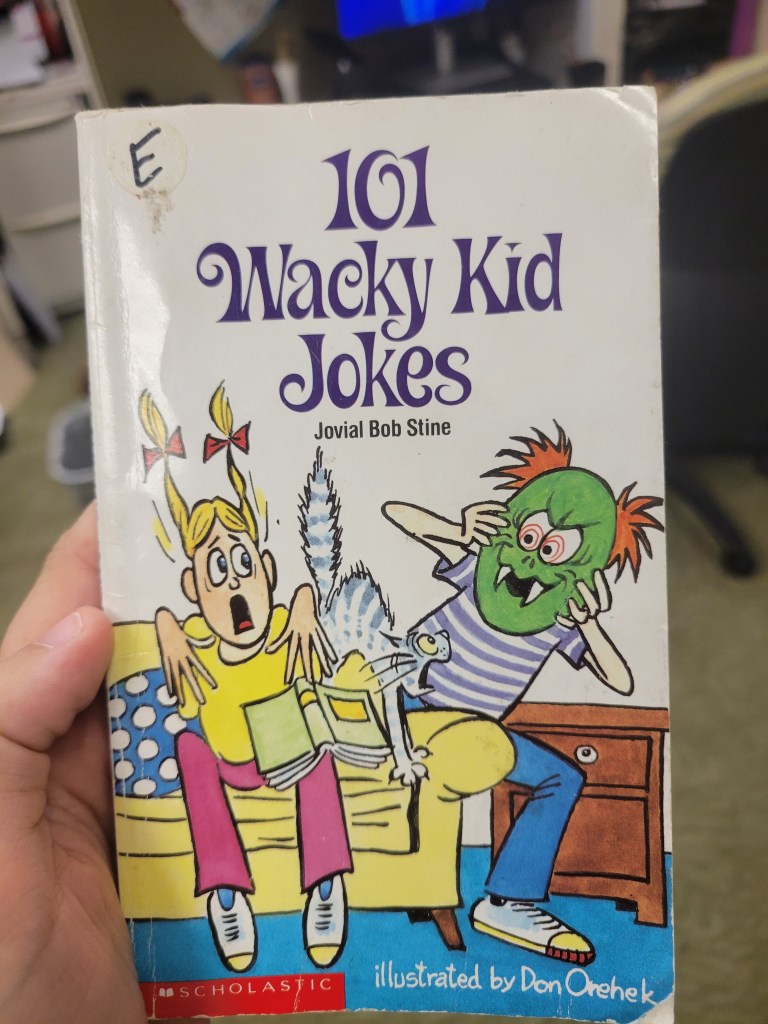
A couple weeks ago, I found a piece of literary history on a cart of donated books:
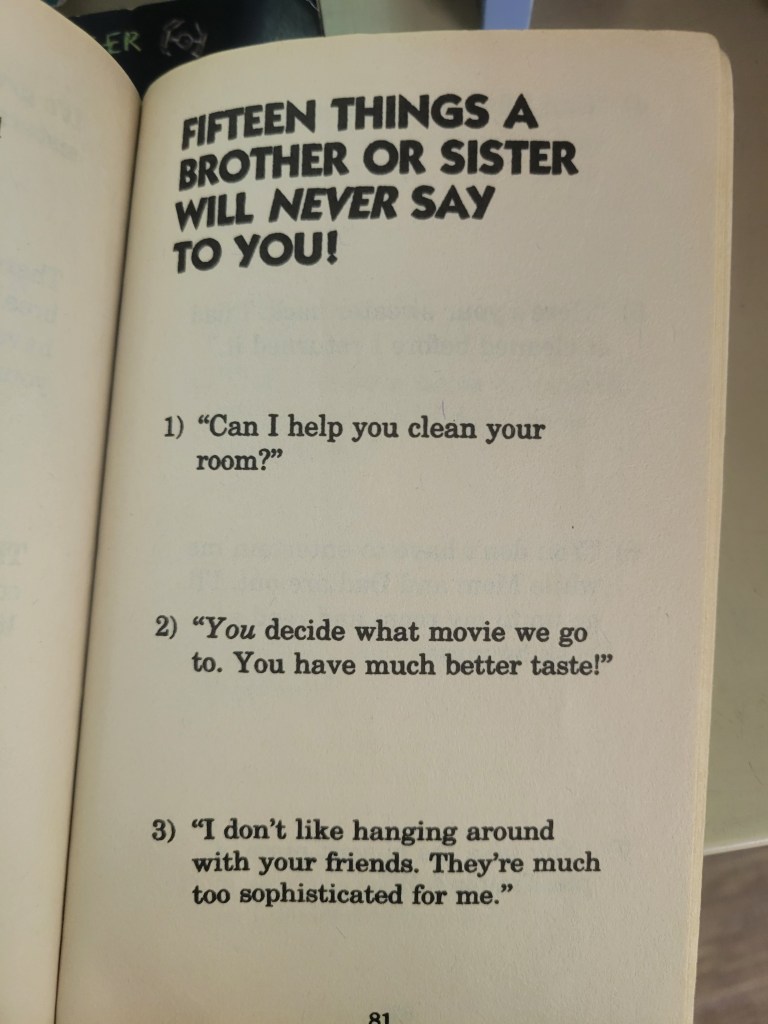
The jokes inside are as corny and as un-funny as you would think.
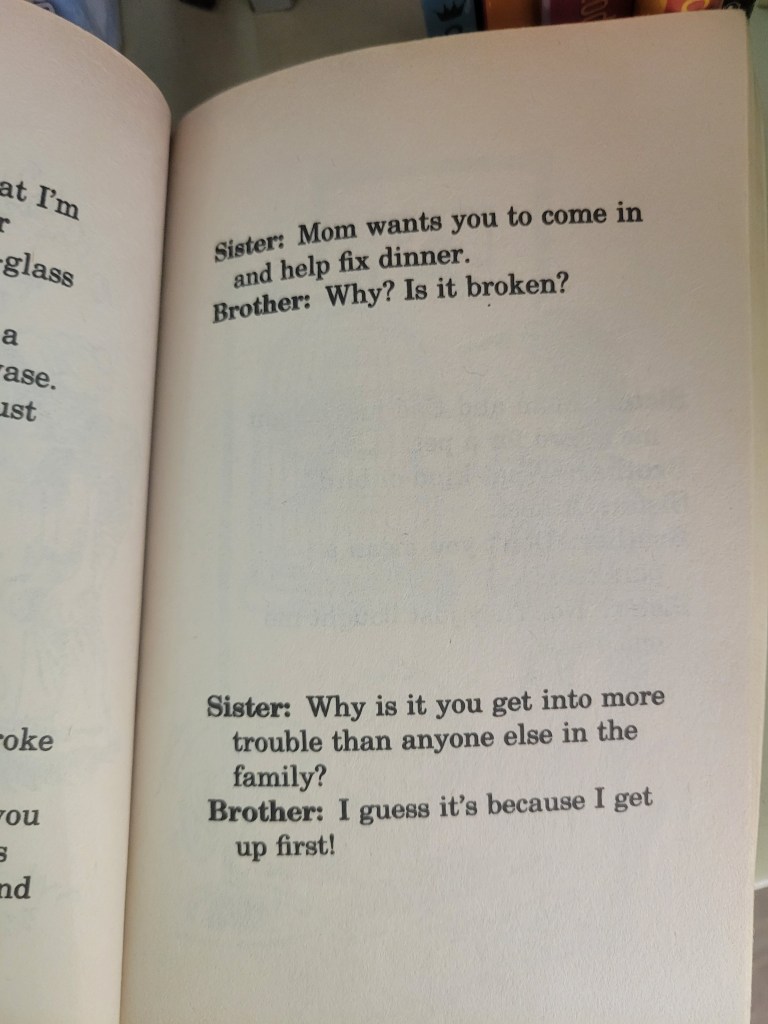
Okay, I would use the “is it broken?” line.
Why is a paperback joke book from the late 80s so important? Look again at the author: “Jovial Bob Stine.” You probably know him from some of his other “jovial works,” like….

How did Jovial Bob Stine become R.L. Stine, whose very name struck terror into the hearts of every 90s child?
Pre-Harry Potter, a lot of children’s literature was treated like a content mill. Series like The Hardy Boys and Nancy Drew were written by conglomerates of authors, which meant new books could be produced fast. There also wasn’t a lot of love and care put into the physical books themselves. A lot of these mass-produced books were paperbacks, printed on cheap paper – you can probably smell the wood pulp now. Children’s literature created in this “content mill” fashion include perennial favorites like The Baby-Sitter’s Club and Sweet Valley High, though the former was only written by one person, Anne M. Martin. I myself was a fan of Pony Pals by Jeanne Betancourt.
These weren’t the only types of children’s books being published in the 80s and 90s, but they were ubiquitous in our schools, libraries and Scholastic Books Fairs. And kids devoured them. They were fun to read, but I don’t think they really began as passion projects for a lot of authors.
So, where does Jovial Bob Stine fit into this? He never planned to be a horror writer. Stine’s writing career began with humorous comics for magazines, Bazooka Joe comics, and of course, joke books. In 1985, Stine went to lunch with a friend and editor of Scholastic Junior, Jean Fiewel. Fiewel was having issues with an author that had been hired to write a horror novel for teens, called Blind Date. She pitched the idea to Stine, who wrote it in a week.
Yeah, well, I just thought, you know, the first one did so well, and then the second one was a number-one bestseller. I thought forget the funny stuff. I’ve been scary ever since.
– R.L. Stine, 2016
Now, it’s confession time: I’d never read any Goosebumps book until last week.
We had plenty of them in the house. When she was in third grade, my sister won the first 40 Goosebumps books from a school raffle. Being brave, she read a couple of them, and then decided it was too scary to read all forty. I never even attempted, but I loved/hated to look at the cover art: green monster blood spilling down the stairs, haunted houses, a creepy green hand with plants growing out of it, coming out of the basement door. The scary covers would get the books relegated to the attic, and thus our bookshelves felt safe once again.
But, after holding Jovial Bob Stine’s work in my hands, I decided it was time to read some of the work that had terrified and entertained so many kids for decades. I picked Say Cheese and Die! because that was the cover that scared me most as a kid.

In this book, Greg and his friends break into the neighborhood haunted house. There, Greg finds a strange camera. When he takes a picture with it, the photo shows something bad happening to the subject, like his dad’s new car being totaled. What will happen when he takes pictures of his friends?
Here’s a few observations about my first Goosebumps book. First of all, the suspense is pretty good. When Greg and his family take their first drive in the new car, for example, Greg’s dad drives recklessly. I knew that Greg wouldn’t be killed, but I was bracing for impact. That scene would have been really scary if I was eight years old, along with others later in the book. The ending where Greg learns that the camera can’t be destroyed would have terrified me. Because it could still be out there.
In another interview, Stine talks about balancing humor and scares in his books.
I don’t really want to terrify kids. It’s not what I really want. If I think a scene is getting too scary, too intense, I throw in something funny.
R.L. Stine, 2022
There is some humor in Say Cheese, mostly courtesy of Greg’s friend Bird. It didn’t work for me as an adult, but I’m sure Bird’s jokes earned giggles from younger readers.
There’s also a lot of things in the book most kids deal with. Greg and his friends keep the camera a secret because they’re afraid of getting in trouble. They’re scared of goonish high school bullies. Greg’s plan to return the camera to the neighborhood haunted house is delayed because it’s almost dinnertime. Along with the familiar trappings of childhood, every chapter ends on a cliffhanger. Kids are going to want to keep reading, no matter how spooky things get.
Which brings me to my last point: it’s all surface. It’s a fast-paced scary story with no deeper meaning than what you read. If there’s a moral, it’s “don’t steal,” which is pretty basic. There was some ambiguity if the camera predicted that bad things would happen, or if it caused bad things to happen. By the end of the book, we learn that the camera is the cause. These aren’t books that have deep meaning or complex characters. They’re popcorn flicks in book form.
And you know what? That’s okay. Books like this are Doritos for the brain. Not the most nutritious or filling, but damn tasty. There’s nothing wrong with reading and enjoying books like Goosebumps, but I hope everyone gets some full, rich meals in their reading diets as well.
But for the start of spooky season, have yourself a nostalgic snack, or forty.
Not My Job: We Quiz R.L. Stine on Ralph Lauren
Goosebumps is turning 30 — the scariest part is how old that makes you
 Overlooked Books