Unknown's avatar

Posts by booksoverlookedblog

Part time writer, full time bad-ass

Blandy McBlandface: Flat Antagonists

After my most recent post, I did some more thinking on flat villains. I wondered, am I being too harsh on Eragon? One of my absolute favorite games is Dragon Age: Origins, which features a storyline that couldn’t get much more generic. Namely, a rag-tag bunch of heroes team up to defeat a giant dragon, who is evil, because the story needs an antagonist. But Origins holds up very well, even if it has a lousy Big Bad.

Several years ago I had a video game blog, wherein I cheerfully dissected some of my favorite games. I wondered: if DA:O has such a generic story, why is it so compelling?

I came to a few different conclusions, the first being the world-building. That is, there’s just so much of it. It’s impossible to go through the game without learning the history and culture of Fereldan, and if you ever want to learn more, there’s always an NPC to ask or a Codex to find. And if you still don’t learn something that you want to know, find a nerd like me to ask.

To its credit, Alagaësia, the world of Eragon, is also well-built. I don’t necessarily like how all the information is presented (read: info dumps), but by God, it’s there. The more you read, the more in-depth it gets, from the basic rules of using magic to Elven and Urgal culture. The questions that don’t get answers immediately are usually either a plot device, or put into a later books.

But the thing that kept me playing DA:O was not how interested I was in learning the Chant of Light or because I really wanted learn what it was like to live in a Circle of Magic. What kept me coming back to it, hour after hour, was the characters. There’s the main party, of course: characters like adorkabale Alistair, the witch Morrigan with her own agenda, the badass old lady mage Wynne…they all have their own personalities, and quirks, and are wonderfully vivid. The NPC cast is equally memorable, even if they’re just minor characters. Branka is terrifying, the Rhyming Oak is delightful, and the Chantry Sister who’s too hungry to get the Chant right still makes me laugh.

And I still fangirl over Alistair. Just a little bit.

So far, the list of characters I like in Eragon is…two? Saphira, and Brom. One of which is dead. I was trying to describe Eragon without mentioning his role in the story (a la RedLetterMedia), but I could come up with exactly one personality trait. He’s rash. He makes dumb decisions. That’s it. What are his likes, his dislikes, his fears? How would he react to winning a million dollars? How would he approach someone he’s attracted to? I know so little about the character that I can’t give good answers to any of these questions, except for broad generalization.

But there is one major difference between DA:O and Eragon that I can’t neglect to talk about. They’re two entirely different media. In Dragon Age (and most Bioware games), it’s easy to immerse yourself in the game and put yourself in the shoes of the protagonist. Even if the story ends the same way with a flight against the (admittedly bland) Archdemon, the decisions you’ve made to get to that point are more personal, and there’s a certain sense of ownership to them. The game is about the journey, not the destination.

Eragon is a book. It was easier for me to relate to a blank-slate fifteen-year-old character when I was fifteen, reading it for the first time. But age can’t be the only reason; certainly, I’ve enjoyed reading through the trials of the Beaudelaire orphans long after I was out of that target audience. But I can acknowledge that Eragon, too, is about the journey. There are some moments really feel magical, and things that I do like in this book. But the Dragon Rider Blandy McBlandface isn’t enough to suck me into the story.

I’m trying to think of other books with flat villains I’ve read that I really enjoy, and the first thing that came to mind was The Lord of the Rings trilogy. The books are well-crafted and beautifully written. If there’s ever been a great series about the journey, it’s that one. I’m sure a Lord of the Rings fan who knows the lore better than I do could probably write a dissertation one why Sauron is such a bad dude, but it’s not readily apparent to me.

Hell, Wormtongue gets more character development that Sauron. And it was way more fun watching Sarumon fuck everything up than seeing a fiery eyeball hanging out at the top of a tower.

And yet, it works remarkably well. Tolkien has made such a comprehensive world that a simple plot–defeat Sauron by destroying the Ring–that knowing just why Sauron is evil doesn’t feel necessary. If Sauron was more detailed as a character, yes, I might like it better. I might find Sauron scarier than I do. But it also runs the risk of bogging up the journey. Which is, after all, the real story.

But now I’m going to commit blasphemy.

I liked the Lord of the Rings movies better than the books.*

Admittedly, part of this is because the books themselves weren’t all that accessible to me. Tolkien’s known for his flowery prose, which was a bit difficult for me to grasp. There’s also so many names, places, and so much history it’s hard to keep track of it all, even with maps and appendices.

The other part is because I feel like it’s easier to get to know the characters in the films. Thinking back on some of my favorite character moments in the books, there’s only one I remember really well: Sam watching Frodo sleep, thinking about how devoted his is to Frodo and how much he loves him. But aside from that…nothing really sticks out to me.

In the movies, I could see–and have a better appreciation–of the relationships between the members of the Fellowship, their allies and their enemies. I usually don’t cry at movies, but I did when I watched Pippin and Merry separate.

I’ve been told that, to a discerning reader, none of Tolkien’s characters are flat. So maybe I’m the problem. I have the subtlety of a sledgehammer.

Maybe a well-crafted story doesn’t need a well-crafted antagonist; when I watch Mulan, I’m generally not too badly concerned that Shan-Yu is as flat as cardboard, because I’m too busy cheering on this bad-ass woman. I’m too swept away by Westley and Buttercup’s romance and adventures to really worry about why Prince Humperdink is such a dick.

But what I keep circling back to, time and time again, are the characters. Alistair’s awkwardness, Mulan’s courage, Westley’s wit, the kindness and bravery of Harry, Ron, and Hermione. Characters don’t always need to be likable, but they do need to be memorable. You can make an entire universe, but if you fill it with people that don’t stand out in any way, then I’m not going to care about their ultimate triumph or failure against their enemies, no matter how much the antagonist is supposed to scare me.

*We are, of course, going to ignore The Hobbit films. That’s another post entirely.

Eragon 42-43

It’s been awhile since I griped about a single sentence in Eragon, but there’s one that’s just truly perplexing at the beginning of chapter 42, “Fighting Shadows”. During his captivity, Eragon is drugged, which renders him unable to use his magic. He figures out the drug is in his food, and abstains from eating or drinking until it wears off. When it does the following day,

It was dark in Eragon’s cells when he sat up with a start, electrified. The wrinkle had shifted! He had felt the magic at the edge of his consciousness for hours, but every time he tried to use it, nothing happened.

“The wrinkle had shifted”?

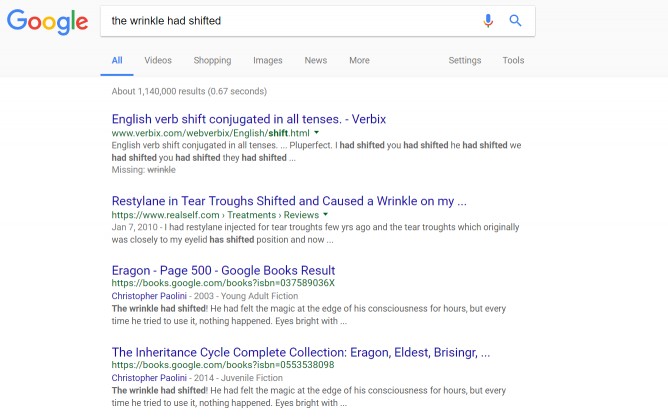
That’s such a weird line. I know it means that the drug has worn off, so Eragon isn’t foggy and able to do magic again, but…”wrinkle”? Is there a definition of “wrinkle” that I’ve never heard before? I know I’ve been pretty hard on Eragon, so I wanted to give it the benefit of the doubt. Maybe this was a phrase that people used and I’d never heard before, so I decided to Google it, just to be sure.

wrinkle-had-shifted

Congratulations, Paolini. You might be the first person to ever have the sentence “The wrinkle had shifted” in a published book.

Since a “wrinkle” was never mentioned before, I choose to believe that it refers to the folds in Eragon’s brain that allow him to use magic.

Not surprisingly, Eragon uses magic to break himself out of prison, at the same time Murtagh arrives in disguise to rescue him. But why wasn’t Murtagh also captured along with Eragon? Murtagh is wanted by the Empire, and it was his appearance in Gil’ead that led to Eragon’s capture. How did Murtagh get away? If it was due to Saphira’s intervention, why would she save Murtagh, and not her Rider?

What if Murtagh had been captured, and not Eragon? Eragon and Saphira could have some conflicts about risking themselves to save him, especially when he’s kept so much of his past a secret. There could have been a dilemma that wasn’t solved with swords or magic, something this book has been severely lacking.

But the plot marches ever-forward, and soon Eragon and Murtagh are rushing off to save Arya. When they find her, there’s another paragraph talking about how beautiful she is, and that she smells like pine needles. Wait, what? She’s been imprisoned and tortured for months. She shouldn’t smell nice. She should smell like iron and blood and…well, maybe elves’ sweat smells like pine needles. That’s the only thing that makes sense to me.

The most exciting part of this chapter is when Eragon duels the Shade, Durza, to try to cover Murtagh’s escape with Arya. We’ve seen Durza use magic in the prologue, but it didn’t have a lot of impact on the reader’s view of him, because we knew so little about what was going on. When Eragon and Durza engage in a sword fight, we know what’s at stake. We also have something to compare Durza to. We know that Eragon’s a gifted swordsman, but Durza is toying with him when they fight. There’s a huge gap between their skills, and so their fight is actually interesting to read, knowing Eragon is likely to lose.

The day is saved by Saphira, who ends up landing on the prison and destroying it. Normally I’m not a fan of the “Big Damn Heroes” trope, with the characters arriving right in the nick of time to save everyone. In this case I’ll forgive it, because Saphira is one of the few reasons I’ve managed to keep reading this book.

My first complaint about the next chapter, “A Warrior and a Healer”, was the abundant use of adverbs. The one that struck me as the laziest was Eragon “tiredly” healing one of Saphira’s wounds after their escape from Gil’ead.

Eragon also brings up that elves speak the Ancient Language, and most of them can use magic. This still brings me back to the question I had many chapters ago: how do elves have a conversation without casting spells and lighting everything on fire? This book goes into detail on so many things I don’t care about and have no impact on the story, but still has yet to answer that one question.

As Eragon, et. al. flee from Gil’ead, Murtagh tells him that the Urgals and Durza were working for Galby. No shit. Even as a kid, I knew that would be the case. The obvious bad guys are working for the bigger bad guy. This is just how the hierarchy of villainy works. I wasn’t shocked then, and I wasn’t shocked now.

I am, perhaps, a little more shocked and disappointed by Saphira’s explanation of all this.

A sick, angry feeling welled in his stomach. ‘The Urgals were under Galbatorix’s orders! Why would he commit such an atrocity on his own subjects?’

‘Because he is evil,’ stated Saphira flatly.

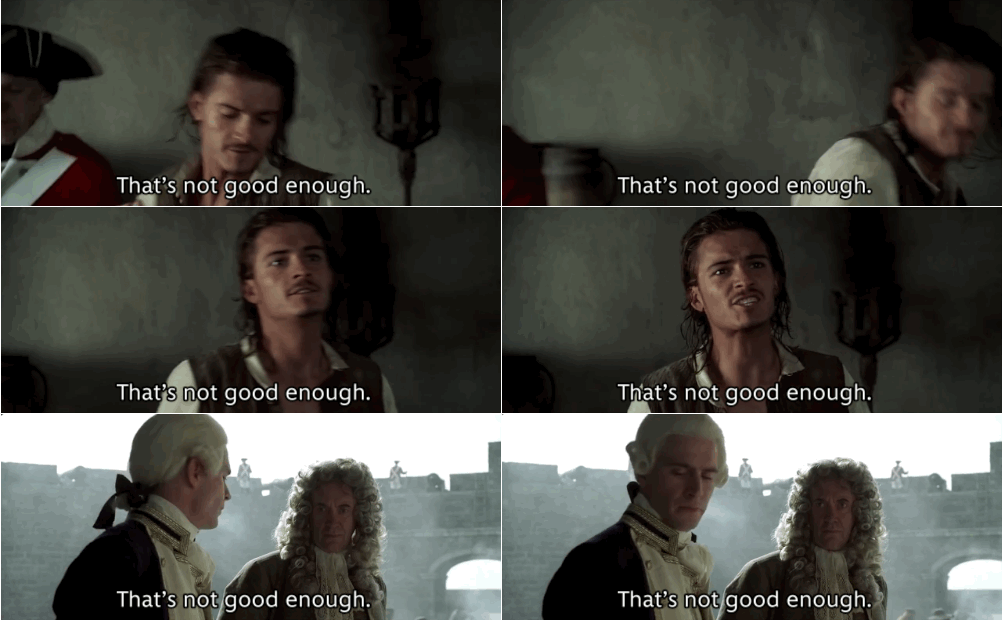
not good enough.gif

From Saphira’s perspective, this makes perfect sense. However, this is one of the big problems I have with the Inheritance series. Galby is evil because he’s crazy, and…well, that’s it. The antagonist who is evil for the sake of being evil is just a lousy villain. There’s no greater depth to them, no chance for them to be sympathetic or intriguing. If your only descriptor is “evil”, you’re not just a flat character. You’re boring and indistinguishable from the multitude of bland, oh-so-evil forgotten baddies.

After Eragon learns the not-so-shocking truth about the Urgals and Durza, he sets about to healing Arya. Paolini spends two paragraphs describing her wounds: back covered with bruises, oozing cuts, marks from whips and hot brands. Credit where it’s due: the description of Arya’s wounds is pretty horrifying, especially when you add in the fact she’s probably been tortured daily for months. So, nice one, Paolini.

But we still can’t go one chapter without mentioning how beautiful the elf is, even after she’s been brutally tortured.

[H]e could not help but notice that underneath the disfiguring marks, her body was exceptionally beautiful.

Ugh.


Eragon 40-41: Capture at Gil’ead

And so we keep moving forward with Eragon, and the next chapter, “Capture at Gil’ead”. Hm, I wonder what’s going to happen here? As chapters titles go, I guess it’s not bad. Certainly, no worse than “Doom of Innocence”. But it doesn’t leave much room for suspense. However, the title does come from the only memorable part of this chapter, so there’s that.

Most of this chapter seems like filler. Eragon and Murtagh are traveling to Gil’ead, where Brom had instructed Eragon to go before he died. I found it really boring and uneventful. This is partly because I’ve been reading Storm of Swords, where characters can’t step out their door for five minutes before something terrible happens, never mind a long journey. Where’s the bandits and gore? But more than that, this chapter covers weeks worth of travel, long enough for Eragon’s broken ribs to heal, and we see only three conversations between Eragon and Murtagh, and even less of Saphira. All the events are glossed over, and it’s really disappointing.

For instance, Eragon and Murtagh must ride near Urû’baen*, the capital where Galby reigns. Eragon and Saphira have just escaped from some of Galby’s most fearsome allies, and everyone loyal to the king will be on the look-out for them. They’ll have to use all their wits and skills to keep Saphira hidden and remain free, or else a fate most foul awaits them.

Or not. Instead, we get this.

Their travels north forced them toward the capital, Urû’baen. It was a heavily populated area, which made it difficult to escape notice. Soldiers patrolled the roads and guarded the bridges. It took them several tense, irritable days to skirt the capital.

That’s it. Seriously, that’s all we get. What might have been exciting and tense is boiled down to one insipid paragraph.

There’s another thing I’m trying to figure out as well. When I first read this book, I really liked Murtagh. He was easily my favorite character. Now, I’m honestly trying to remember why. I think it’s because he’s a badass with a dark and mysterious past, and I always did like angsty boys.** But Murtagh hasn’t exhibited much personality other than those few traits. Even when though we’ve known him for a few chapters now, we still don’t know much more about him as a person than we did when we first met him. In this chapter he demonstrates that he’s smarter than Eragon, but so are most characters in this book.

After pages of being told (not shown) that Eragon and Murtagh are friends, they arrive near Gil’ead and Murtagh arranges a meeting with one of Brom’s allies. But then–gasp!–Eragon loses consciousness. Again. And gets captured. Again.

How many times has he fainted now? I stopped counting.

Eragon wakes in a cell, drugged and dopey. He’s fairly sedated, to the point where he can’t remember enough of the Ancient Language to use magic to escape. He does see the elf from his dreams, Arya, in the prison, and her description is…well…

Her long midnight-black hair obscured her face, despite a leather strip bound around her head to hold the tresses back. [. . .] Her sculpted face was as perfect as a painting. Her round chin, high cheekbones, and long eyelashes gave her an exotic look. The only mar in her beauty was a scrape along her jaw; nevertheless, she was the fairest woman he had ever seen.

It made me roll my eyes, but then I remembered that the elves in this universe are a race of Mary Sues. Brom did imply this before, and the point really gets hammered home in the sequel, Eldest. After remembering that, I don’t mind it as much. At least it makes sense with the rest of the book.

No, it’s Eragon’s reaction that’s truly worthy of an eye roll.

Eragon’s blood burned as he looked at her. Something awoke in him–something he had never felt before. It was an obsession, except stronger, almost a fevered madness.

producers

All other obvious jokes aside, I do have another nit to pick about this chapter. In the first book in the series, Eragon’s greatest enemy is Durza, the Shade. Remember Durza, how scary he was?

Oh, no, you don’t. Or, at least, I didn’t. Until now, Durza had only been in the prologue. There was passing mention of Shades and how dangerous they are, but I don’t think we’re ever told what exactly a Shade is. Far more time is spent learning about the Ra’zac or dragons, which is fair. But when it becomes clear that Eragon wouldn’t be able to defeat the Ra’zac, his new enemy becomes Durza. But since we know next to nothing about Shades or Durza, his sudden appearance here doesn’t do much to scare the reader.

That, and because Durza’s description sounds like Ronald McDonald. White face with red lips and hair? Forget powerful magician, he’s a hamburger-slinging clown.

Durza has a conversation with Eragon, saying that he’s visiting the cell just to gloat at capturing a Dragon Rider. You know, an action that’s never led to any villain’s downfall, ever. In truth, he comes to find out exactly what Eragon’s “true name” is, which is a wasted effort as Eragon doesn’t even know what it really is.

If you ask me, the true purpose of their conversation is to remind the reader that Eragon has enemies besides the Ra’zac, but Durza doesn’t feel particularly threatening, especially since it’s been more than 40 chapters since we last heard from the Shade, or cared about what he was doing.

*Do you really need both the apostrophe and the û?! One is more than enough. Now you’re just fucking with us, Paolini.
**Adulting Protip: Leave the dark, brooding male lead in fiction where he belongs. Do not date him in real life. 

Eragon 38-39: The Un-Twist

This chapter is supposed to make me feel sad, but all it did was cement just how dumb Eragon actually is. As Brom is dying, he reveals that he, too, was a Dragon Rider. His dragon was named Saphira, and she was slain by Morzan. Because of course she was.

I wish I could remember my reaction to this news when I read this book for the first time years ago. I have a feeling that it was more, “I knew it!” than, “Whaaaat? Brom was a Rider?!” There’s so many hints that anyone who’s read a fantasy book before could have figured it out.

But here’s the big question: why did Brom hide this from Eragon? Let’s see what our wise old mentor has to say.

‘Why didn’t you tell me this before?’ asked Eragon softly.

Brom laughed. ‘Because…there was no need to.’

No. NO.

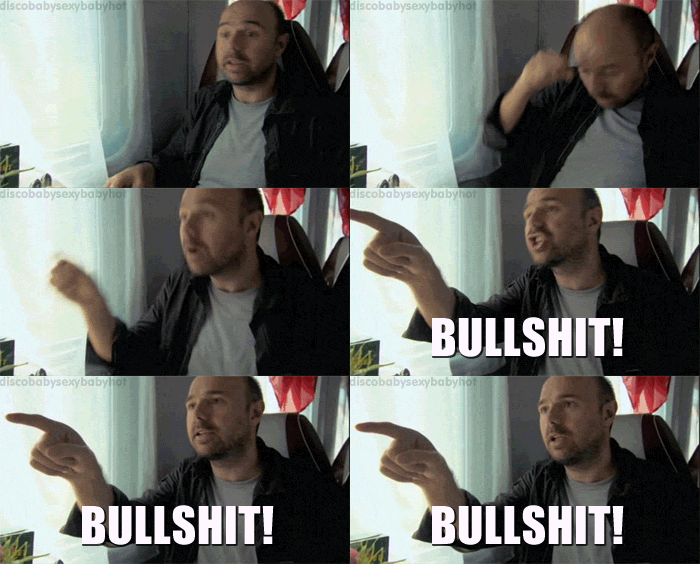
You do not get to have a dramatic reveal if the main reason for not doing it sooner was, essentially, “I didn’t feel like it.” If it was for his or Eragon’s protection, fine. That’s at least a reason. And Eragon probably would have liked knowing that he wasn’t the only non-evil Dragon Rider. But this…

bullshit

Anyway, Brom dies, Eragon is sad and buries him. I know I’m supposed to feel sad, and I think I was when I first read this book. But now I’m lamenting Brom’s death for another reason: he was a much better character than Eragon.

In the following chapter, Eragon learns more about Murtagh, and makes plans to continue his journey, even if he’s not sure where he should go next. Murtagh displays a surprising amount of information about Brom, the Riders, and Eragon’s sword, Zar’roc.

God, I hate typing all these unnecessary apostrophes.

When I began reading this book, one of my big problems was the way the dialogue jumped back and forth between flowery prose and more modern language. The prose finally seemed to even itself out, making it much less cringey. In this chapter, though, some of the dialogue seems to slip back into that awkward phrasing. The most obvious might be when Murtagh is asking Eragon about Brom.

Is your Brom the Brom? The one who hlped steal a dragon egg from the king, chased it across the Empire, and killed Morzan in a duel? I heard you say his name, and I read the inscription you put on his grave, but I must know for certain, Was that he?

It’s the “Was that he?” with the weird capital “W” that gets me.

Because Murtagh knows a suspicious amount about the Dragon Riders and Morzan, Eragon tries to probe into his mind to figure out who Murtagh actually is. Murtagh has strong mental defenses, though, and Eragon can’t get into his mind. Blocking someone from your mind is a difficult skill to learn, and Eragon hasn’t mastered it yet. Also, when Brom tried to communicate with Eragon through his mind, Eragon was able to feel the intrusion and attempt to fend it off. So, likely Murtagh knows that Eragon tried to get inside his head, and doesn’t do anything about it. Eragon also has every reason to leave Murtagh, but they just kind of…let it go.

I think it’s been well-established that Eragon can be pretty dumb, but why wouldn’t Murtagh react?

Saphira and Eragon discuss what their next plans should be. Apparently, Brom had told Saphira that he was a Rider, and gave her information to find a man that could help them get to the Varden. Saphira never told Eragon any of this, because Brom had asked her not to.

In other words, Brom trusted a dragon hatchling better than his own protégé.

According to Saphira, Brom also said that he thought Eragon was the best person to carry on the Riders’ legacy.

…really? Clearly, Brom saw something in Eragon that I don’t.

Of course, we make sure to get some good teen angst in.

‘What does your heart say?’ asked Saphira.

‘My heart died a while back,’ Eragon said with a hint of black humor.

When I read Eragon’s response, I had to put the book down for a few minutes just to laugh at it.

Eragon 36-37: The Worst Laid Plans

Every so often, someone asks me how I find the time to read so much. The answer is simple: move to two different states within the span of five months where you don’t know anyone, be severely underemployed, and you will read a lot. Now that I’m settled in to my new new adopted state, I thought it was time to start back down the treacherous path that is Eragon.

My list of complaints about the chapter “Ra’zac’s Revenge” might be longer than the chapter itself.

Eragon has awoken from his most recent fainting spell to discover that he and Brom have been kidnapped by the Ra’zac. He’s tied up and can’t seem to muster the mental capacity to use his magic. The Ra’zac make it known pretty quickly that he and Brom have been drugged. Because the Ra’zac are such deadly foes that they spill their whole plan in front of the groggy heroes.

It is kind of weird to see the Ra’zac speak. The only other time we’ve seen them talk was in Carvahall as they were looking for information on Saphira. I think the Ra’zac were scarier after they burned Eragon’s farm, killed his uncle, and disappeared. We’ve seen what they’re capable of, and can only imagine what they must be doing while Eragon and Brom are trying to track them. The Ra’zac were more frightening when they couldn’t be seen. To hear them arguing with each other like generic henchmen destroys the image of them as formidable foes.

There’s also the matter of Saphira. You know, Saphira, the reason I’ve been able to keep slogging through this book. She’s also been captured by the Ra’zac. They explain that she allowed herself to be chained down after they threatened to kill Eragon if she fought back. I’m really, really disappointed with that. Remembering her rage and fear when the Ra’zac came to Carvahall, I don’t think it’s in her character to have given into them. Especially when she declared to Eragon that she would not run from them any longer.

What might be really exciting if Saphira, knowing she couldn’t save Eragon, fled and kept in touch with them through their mental link. Eragon ends up not needing herself to escape, so it’s not like we’d be missing much without Saphira captured as well. Then we could at least have a subplot of trying to reunite with Saphira.

I also want to remind everyone that the Ra’zac are really stupid hunters. More than once they threaten to kill Eragon, even though they discuss that they’re supposed to keep him and Brom alive. They also mock him, saying that they’re much more valuable to Galby than Eragon is. Yeah, no. Other than making the rookie mistake of leaving your supplies behind, Eragon is unique. He is the only Dragon Rider on the continent within Galby’s reach, and (as we find out in Eldest), Saphira is the only female dragon remaining. At this point, I’d say that Galby would much rather have Eragon as a potential ally, rather than dead.

Of course, if Galby didn’t want to make Eragon his enemy, then maybe he shouldn’t have just up and murdered the kid’s family. Try some diplomacy first. If that doesn’t work, then murder the family.

Oh, and Brom jumps in front of a knife to save Eragon from dying, blah blah blah. And Eragon is so shocked that he fucking faints again.

At least the next chapter, “Murtagh”, is also short. It’s where–wait for it–we meet a guy named Murtagh.

Well, still a better chapter title than “Doom of Innocence”.

After passing out for the…fifth time? Eragon awakes to find that the Ra’zac have been chased away (though not killed) by a young man named Murtagh.

To his credit, Eragon does try to heal Brom as soon as he’s able, but says he can only fix what’s on the surface, not the internal damage. That works for me, especially because Eragon is still a novice when it comes to magic, and Brom’s likely too weak to heal himself.

We learn a little bit about Murtagh, who had also been tracking the Ra’zac. I’m not really sure why, and I don’t think he ever explains. He also agrees to travel with Eragon because…well, I’ll let him tell it.

I’ve no better place to be. Besides, if I stay with you, I might get another shot at the Ra’zac sooner than if I were on my own. Interesting things are bound to happen around a Rider.

“Because it might be interesting” is already a lazy excuse, Murtagh should want to stay far away from any Dragon Riders, and even further from Galby or any of his servants. In Eldest, it’s revealed that Murtagh is actually the son of Darth Vader Morzan, the Rider who fell to the Dark Side betrayed the ancient Dragon Riders to Galby. Even if Eragon could help Murtagh find the Ra’zac (spoiler: he doesn’t), he would have been much better off on his own.

They flee the Ra’zac’s encampment, with Saphira carrying Brom. Eragon decides that if Murtagh is untrustworthy, Saphira can chase him away.

You know, just like she did with the Ra’zac.

I’m not angry, Saphira. Just disappointed.


Adults Reading Children’s Books

I visited a friend a few weeks ago, and told her that the only Tamora Pierce books I’d read were in the Circle universe. I’d tried reading the Immortals series when I started high school, but older students on the bus, including my sister’s best friend, started making fun of me for it. I put the book down and never picked it up again.

My friend, Liz, was surprised that I’d never read Tamora Pierce’s The Song of the Lioness series. She told me I’d love it and practically shoved the first book, Alanna, in my hands. I had my doubts. I knew the basic story: girl wants to be  knight, so she disguises herself as a boy to become one. It didn’t seem that original to me. I wasn’t expecting to be blown away by the prose, either; this was a book for kids, after all. Even the first chapter seemed very rushed. On the second page, with the reader having no prior knowledge of these characters, Alanna and her twin brother decide to switch places. Boom! Suddenly the plot’s rolling. A little too fast for my taste.

So, no, I did not come into this book with high expectations.

I ended up loving it: the main character, her friends, and all the adventures she went on. Maybe my favorite part was when Alanna beat the crap out of the bully that’d been beating her for months. For someone who was also bullied at Alanna’s age, I think it was cathartic for me.

A few years ago, I might not have even considered reading Alanna or similar books. I was familiar with young adult fiction, and so much of it seemed the same: girl in dystopian world starts a revolution and falls in love along the way. I wasn’t very interested in children’s literature, either. I thought that it wouldn’t be able to challenge more or entertain me. Fortunately, my attitude changed with a little help of a friend, and Lemony Snicket.

I’d tried to read the Series of Unfortunate Events books when they were “age-appropriate” for me, but I really didn’t enjoy them. I managed to get through one book, and gave up. A few years ago, one of my friends bought the first two books. Remembering how much I enjoyed the Series of Unfortunate Events movie, I picked up the first book as well.

At the time I was working as an educator at a small museum, which hosted overnight programs for scouting groups. I like to read before I go to bed, but I was also tired and had to be up early the next morning to cook breakfast for the scouts. I couldn’t read anything that was too long, or anything that would make me stay up late thinking. So I started reading The Bad Beginning. I quickly found that the writing was clever and humorous in ways that I couldn’t appreciate when I was younger. Even if the characters are simple and straight-forward, the stories twist and turn and are endlessly entertaining. The Unfortunate Events series also grapples with moral ambiguity and doesn’t give clear-cut answers to all its mysteries. These are things that would have frustrated me endlessly as a child. As an adult, however, the give what seems to be a simple story a deeper meaning and complexity, full of questions whose answers could be mulled over for hours.

This blog is as much about growing up as it is about books. When I read those old books that I grew up with, time and time again, I can see the ways that I have changed. Moreover, I derive different meanings from the same stories as I grew up. This is probably the most obvious in The Magician’s Nephew reviews. Certainly, I could draw parallels between Diggory’s life and my own when I was ten, but for the most part it was a wonderful adventure I could get lost in. As an adult, I had a much better understand of the story as a whole, especially as a Christian allegory. I was also a lot more intrigued by the characters of Uncle Andrew and Jadis. As a child, I’d written them off as villains, and were therefore to be disliked, no matter what.

The experiences I had reading these books are worth revisiting, and I’m happy that I have a space to share them. But thanks to Lemony Snicket and Tamora Pierce, I’ve learned that I can still draw deep meaning and enjoyment from books that are supposedly not for adults.

I got several new books for Christmas this year that I’m still working my way through, including In the Hand of the Goddess by Tamora Pierce, and All The Wrong Questions by Lemony Snicket. Right now I’m reading through the dark and complicated world A Storm of Swords, but I can’t wait to finish this book, crack open my new Tamora Pierce, and see how Alanna is doing.


Eragon 35: Helgrinding Through

And we keep plunging into the literary abyss that is Eragon. But this chapter was much better than the past few because–wait for it–something actually happens!

The chapter, “Worshipers of Helgrind” starts with Eragon going out to explore the city of Dras-Leona. The chapter title comes from the citizens of Dras-Leona, who worship Helgrind, the mountain that looms above the city.

Does anyone else think that the name “Helgrind” is just a little too on the nose?

While he’s wandering through the city, Eragon finds a slave auction. He plans to use magic to free a slave that’s being bid on, but realizes that the slave would never be able to escape. So finally, finally, Eragon has learned something. He realizes that he can’t save everyone, but if he fights against the Empire, he can help a lot of people. I’m not sure if I would call this a proper turning point for his character, as he’s never wanted to join the Empire. But at least it’s something.

Going back to the “Galby is a terrible autocrat” theory, sending the Ra’zac to capture Eragon and kill his family might be the worst possible way to get Eragon on his side. It’s a great way to ensure that a unique and soon-to-be very powerful young man hates you. Why couldn’t Galby start with something more appealing: “Join me, I’ll make you a king. You’ll have power and gold and your family will be safe.” That would be a much more interesting–and challenging–test of Eragon’s character.

Back to the matter at hand, Eragon visits a cathedral in the city.  I am actually curious about what Eragon believes in. Religion was never mentioned prior to Eragon and Brom arriving in Dras-Leona, so I’m curious as to what sort of faith they have, if any. When Eragon pays his respects in the cathedral, it’s not to any god (or Helgrind), but to the cathedral and its impressive architechture.

But remember when I promised that something happened in this chapter?

Something finally happens! When Eragon goes to leave the cathedral, the Ra’zac are standing in the entrance.

Now, since it’s been far too long since I’ve made fun of a single sentence…

A sibilant hiss came from the smaller Ra’zac.

I would like to nominate “sibilant hiss” as the most redundant phrase of the book so far.

He had chased the Ra’zac for so many weeks that the pain of their muderous deed had dulled withinin him. But his vengeance was at hand. His wrath exploded like a volcano[.]

I shit you not, I laughed outloud. There must be a way to do purple prose so it’s not so unintetionally funny. This isn’t it.

Eragon does try to fight the Ra’zac, but they’ve got the city guards backing them, and he’s outnumbered. When he finally gets in touch with Saphira (and through her, Brom), they agree that they’re outnumbered* and need to flee the city. They ride as far from the city as they can in the night and set up camp. Not long after they set up camp, Eragon falls unconscious.

He falls unconscious a lot. Let’s see…I think that’s four times so far. And, glancing ahead, it’s going to happen a few more times before the book is finished. It’s gotten to the point where it’s no longer dramatic, and Eragon is more reminiscent of a fragile anime girl or flimsy romantic heroine than a badass Dragon Rider. I’m not really a fan of the constantly fainting character anymore. I first noticed this in the Hunger Games series. Whenever Eragon (or Katniss) faints, when (s)he comes to, there’s someone ready to explain what happened while (s)he was out, instead of the character experiencing it and narrating it for themselves. The literal definition of telling rather than showing. In the cases of Eragon fainting because he used magic that took a lot of energy, it makes sense. But it just keeps happening over and over again, and no longer cares the suspense that it should.

*Outgunned, outmanned, outnumbered, outplanned

Eragon 32-33: Sunk Cost Fallacy

The next two chapters are mercifully short, but not exactly exciting. They did not, however, end with me shouting about Eragon’s stupidity, so that’s a slight plus. Chapter 32, “The Mire of Dras-Leona” is only a few pages, most of which is exposition about the city. I don’t mind it so much here, because it’s not convoluted rules of the universe. Brom is more like a tour guide than mentor here, and it’s a nice change of pace. I can just relax and accept what he’s saying, instead of scratching my head and cringing at lengthy and convoluted explanations.

One thing I did like in this chapter is that Saphira and Eragon discuss exactly what he plans to do after killing the Ra’zac. They don’t dwell on it too long, but I think it’s still a good point to bring up. If revenge is your character’s driving motivation, what do they do once they’ve achieved their goal? Saying, perhaps, that there are no jobs as the Dread Pirate Roberts available.

Before I get into the next chapter, I also want to point out that the inn Eragon and Brom are staying is is called “The Golden Globe”. Yeah.

The following chapter, “Trail of Oil” is pretty short, and pretty lazy. Brom and Eragon split up to search the city and see if they can track down the oil the Ra’zac use. Eragon wanders around the city and learns next to nothing, but Brom comes back with good information, which he then relays to Eragon. Just like everything else in this book. I feel like Paolini really skimmed over this. Brom discovering helpful information and just explaining it to Eragon is a lot easier than having Eragon learn something for himself. Worldbuilding and tutoring Eragon is one thing, but I’m getting really sick of this.

I’m also beginning to think that Galby is really terrible at being a dictator. Brom learns that he’s coming to Dras-Leona to punish the city’s leader for not being as obedient as the king would like. Okay, I can buy that. But Brom also says this is the first time Galby has left his stronghold in at least a decade.

Here’s the thing: I don’t get it. Galby is a threat to Eragon and Saphira, largely because he wants them under his control. He’s a threat to the as-of-yet unseen rebels, the Varden, because they openly oppose him. But the majority of the people he rules are not dragons, Dragon Riders, or rebels. It seems like the only thing he really cares about is ruling the dragons, not actually ruling the land or its people. He seems rather lackadaisical when it comes to being an evil dictator. Right now, it seems like he’s only a threat to Eragon and the Varden. We’re told over and over again that Galby’s evil, he’ll destroy everything you know and love, but we never really see it, and I’m definitely not feeling it. If Galby wants to be a true evil dictator, worthy of actually being reviled, he really needs to broaden his horizons.

Chapter 33 marks the halfway point of the novel. And so far, I’ve been pretty disappointed. When I decided to re-read Eragon, I knew that it wouldn’t ever be as good as it was when I was fourteen. I did not expect it to be so…boring. Most of the novel so far has been Eragon asking questions and Brom giving him the answers. If I didn’t know all this beforehand, it would probably be more interesting to me, but it’s really hard to get into this book and actually enjoy it.

This also might explain why I didn’t re-read Eragon after I first finished it until now. It’s not just that I knew the bulk of the story. There are books that I’ve read and re-read dozens of times, even after I know the story. It’s because of beautiful writing, or because something in it touched me, or because I just didn’t want to leave the story’s world. These are the books that you keep thinking about long after you’ve turned the last page.

Then there’s Eragon. I’ve critiqued the writing, the plot, the characters, and I’m not even sure that I should continue this endeavor. Only my pride (and the sunk cost fallacy) has really kept me from tossing the book out right now.


Eragon 30-31: Stew Today, Stew Tomorrow, Stew Forever

I need to discuss one thing that has bugged me for a long time.

Why is it always stew?

As Dianne Wynne Jones wrote in The Tough Guide to Fantasy Land: 

Stew is the staple food in Fantasyland, so be warned.  You may shortly be longing passionately for omelette, steak, or baked beans, but none of these will be forthcoming, indoors or out.  Stew will be what you are served to eat every single time.  Given the disturbed nature of life in this land, where in camp you are likely to be attacked without warning, and in an inn prone to be the centre of a tavern brawl, Stew seems to be an odd choice as staple food, since, on a rough calculation, it takes forty times as long to prepare as steak.  But it is clear the inhabitants have not yet discovered fast food.  The exact recipe for Stew is of course a Management secret, but it is thought to contain meat of some kind and perhaps even vegetables.  Do not expect a salad on the side.

William Goldman also captures this wonderfully in The Princess Bride: 

This was after stew. But then, so is everything. When the first man crawled out of the slime and went to make his home on land, what he had for dinner that night was stew.

Okay, stew is great if you’ve got tough meet or vegetables, but you’ve also got to have time to cook it. In this one situation it might be acceptable, because Eragon’s been unconscious for two days, so I’m sure that Brom had plenty of time to hang out for eight hours and make a stew. And while I’ve been praising Brom for generally being smarter than his charge, he and Saphira just pulled a serious bonehead move. Namely, leaving his unconscious charge alone at camp while he and Saphira go Urgal hunting. If that wasn’t bad enough, Eragon can’t get in contact with Saphira, so he has no idea where they are or what’s going on. So he just hangs out and eats his goddamn stew.

But, seriously, Brom. You’ve made it abundantly clear that Eragon is in danger and a lot of people are after him. Why the hell would you leave the obviously prone Dragon Rider alone, never mind out of reach of his dragon?

When Brom and Saphira return, Brom explains that he was hunting down the Urgals Eragon had encountered earlier, and he’s rightfully pissed.

‘[T]hat piece of magic nearly killed you! You’ve been sleeping for two days. There were twelve Urgals. Twelve! But that didn’t stop you from trying to throw them all the way back to Teirm, now did it? What were you thinking? Sending a rock through each of their heads would have been the smart thing to do. But no, you had to knock them unconscious so they could run away later. I’ve spent the last two days trying to track them down. Even with Saphira, three escaped! [. . .] You don’t even deserve to be called a Rider after this, boy.’

Why the hell would Eragon even bother keeping the Urgals alive? He could have dispatched them from the safety of Saphira’s back, or at least had her attack them, not land in front of them and try to talk to hostile enemies. Just…ugh. I know that main characters have to make mistakes, but our designated hero is just so beast-headed I’m having a hard time feeling sympathetic for him at all.

As much as I love pissed-off Brom, it’s not enough to off-set the disappointment that comes at the end of the chapter. Brom starts drilling Eragon with different combat scenarios, but we don’t get to actually hear what Eragon’s ideas are. I’d have liked to hear at least once of the scenarios and Eragon’s answers, but readers can’t have nice things.

Moving forward, the next chapter might be the most cringe-worthy one yet, because this is where Eragon truly begins his descent into Mary Suedom.

The chapter begins with Eragon scrying on Arya–sorry, the raven-haired elf maiden–and she not only knows that she’s being scryed on, but also is able to acknowledge Eragon. Does this ever get explained why she can do this? I really don’t remember.

The explanation might just be, “because she’s an elf”. Or, as Brom explains,

[I]f you ever have the misfortune to fight and elf–trained or not, female or male–expect to lose. They, along with dragons and other creatures of magic, are many times stronger than nature intended. Even the weakest elf could easily overpower you.’

Elves are a race of goddamn Mary Sues. Whatever you do, they will always be better at it, and be prettier than you. In the sequel, Eldest, Eragon lives among the elves, and I remember hating them. With the exception of maybe Eragon’s new mentor, I found most of the elves to be haughty and completely insufferable. Remember that pretty blond girl at school who was popular and got good grades and was gifted in a million different ways? And was really mean? The elves in the Eragon universe are just mean, pretty high school girls repeated a million times. Even Arya is hard to like in Eldest.

Of course, elves aren’t the only Sues to be accounted for. I’ve tried to give Eragon something of a pass on this, because sometimes plot demands that a main character have traits associated with Mary Sues. He’s also made enough dumb choices so far to help keep him out of that category. But then he had to go and break his wrist, and Brom makes him continue learning swordplay using his left hand instead of his right. He becomes adept at using his left hand, eventually beating Brom when they spar.

Brom shook his head. ‘I can teach you nothing more of the sword. Of all the fighters I’ve met, only three of them could have defeated me like that, and I doubt any of them could have done it with their left hand.’ He smiled ruefully. ‘I may not be as young as I used to be, but I can tell that you’re a talented and rare swordsman.’

Yep. Then that happened. I don’t think he’s an irredeemable Sue yet, but he’s getting there.

Ugh.

I made a note to discuss the overly-complicated rules of a wizard duel as well, but I’d rather talk about the one saving grace in this chapter.

Saphira. It’s Saphira. If not for her, I probably would have thrown this nonsense across the room long ago. I’m beginning to suspect that Paolini made Saphira’s scenes so enjoyable so that readers would forget about the rest of the pitfalls in the story. In this chapter, Brom, Eragon, and Saphira arrive at Dras-Leona, which is on the banks of Leona Lake. Eragon and Saphira go for a swim, diving from the air into the cold water, leaping into the air from the the water…it’s kind of magical.

Eragon 29: Unique, Not Useful

After college, I got a job that required a lot of driving in vans that didn’t have CD players or aux cables. Only three radio stations came in clearly: Top 40, Christian rock, and country music. Thus, I began listening to a lot of country music, and generally hating it, but thought it was better than the alternatives. After a few months, I was happily singing along to the songs that I couldn’t stand.

I called this “musical Stockholm Syndrome”.

In the last few chapters, I was worried that I was developing “literary Stockholm Syndrome”, as I was actually enjoying Eragon a lot more than I expected. Would the rose-tinted glasses of nostalgia block me from seeing the truth of this book?

Upon reading this chapter, I was glad to find that this was not the case. Maybe those chapters I’d liked so much were genuinely good. Once Brom and Eragon get on the road again, though, I can start looking at the story with a more critical eye. Or, rather, one that pokes and prods at tiny details that just happen to annoy me.

Like, Eragon asking Brom about werecats as they leave Terim. Eragon lies to Brom, saying it was just something that he heard about, not that he met Solembum or Angela. But why lie about that? Wouldn’t it be helpful to just be honest with Brom, who could probably help him sort this out?

On the plus side, Eragon is finally wising up and questioning Brom.

‘There’s a lot going on that I don’t understand. For instance, who are your ‘friends’, and why were you hiding in Carvahall? I trust you with my life–which is why I’m still traveling with you–but I need to know more about who you are and what you are doing. What did you steal in Gil’ead, and what is the tuatha du orothrim that you’re taking me through? I think that after all that’s happened, I deserve an explanation.’

To his credit, Brom answer most of Eragon’s questions about how Saphira’s egg was stolen from Galby, and partially how it came to Eragon. Brom doesn’t tell him everything, but that’s forgivable because Brom himself doesn’t know everything that happened. But he still won’t tell Eragon he was a Dragon Rider, and Eragon still doesn’t have a clue about that. Which, c’mon, he really should at this point.

What does Brom have to gain by withholding that information from him? How is that trying to protect him in the slightest?

Brom and Eragon also discuss his options as a Dragon Rider, and it seems that Eragon will eventually have to decide if he will side with the evil Empire, or the Varden, a group of rebels fighting against Galby. Brom claims that they’re not fighting for land or people, but for control over the first Dragon Rider in a million years. You know, so they can have him on their side to control the land and people.

Are those the only options? For someone whose fate is supposedly in his own hands, they seem like pretty limiting choices. There’s no way for Eragon and Saphira to strike out on their own?

When Eragon relays the story of how Saphira’s egg came to him, we get this.

He told Saphira what he had learned. She was intrigued by Brom’s revelations, but recoiled from the thought of being one of Galbatorix’s possessions. At last she said, ‘Aren’t you glad you didn’t stay in Carvahall?’

That’s it, and it’s pretty disappointing. I want to see Saphira’s reaction to this news, I don’t want to be told about it. Considering her terror just at the presence of the Ra’zac in Carvahall, I thought there’d be a lot more from her at this news. If nothing else, at least she switches back to sarcasm pretty quickly.

A little later on, Eragon breaks his wrist at an inconvenient time, when a band of Urgals start chasing after him, Brom, and Saphira. Since Eragon can’t ride his horse, he rides on Saphira to get away from the Urgals. This leaves Brom riding on the ground, and the Urgals are threatening to overtake Brom. Instead of trying to protect Brom or fight the Urgals with magic, or even have Saphira attack them from the sky, he has her land in front of the Urgals.

Not on them. In front of them. To his credit, this does throw the Urgals from their horses, and makes the horses fall and get tangled up in each other. They’ve been significantly slowed, but he still doesn’t have Saphira attack them, or have her fly away.  Instead, he wants to talk to them.

‘We have do do something!’ exclaimed Eragon.

‘What?’

‘Land in front of the Urgals!’

‘Are you crazy?’ demanded Saphira.

Listen to your dragon, kid.

Eragon wants to talk to the Urgals, presumably to get information out of them. When the conversation seems to be going nowhere, Eragon just uses magic to injure them. Not kill them, note. You know, the same thing he could have done from the safety of the air.

Eragon, just because you are unique does not mean that you are useful.