Unknown's avatar

Posts by booksoverlookedblog

Part time writer, full time bad-ass

Dec. Book Recs: The Runners-Up

First off: sorry for only one post in November. I was sick for a couple weeks, and then had family visiting for Thanksgiving. But don’t worry, I’ve still got plenty to say about banned books! But first…

I read a lot of books this year. Not including my Did Not Finishes and picture books, I’ve read 56 books this year. That’s a lot, even for me. The vast majority were books I read for these monthly recommendation lists. I really enjoyed working on them, but each list took a lot of time and effort. That’s why I didn’t have any lists for July or August – I was simply too busy. For 2024, I’m going to do mini-recommendation lists, with only one or two books a month. 

Even though I read a lot, not every book I read made it onto the book recommendation lists. I limited myself to only 5 fiction books and 5 nonfiction books for each list. There were some great books that I really enjoyed that just didn’t make the cut. Even so, I felt like they were still worthy of sharing. So here it is: the final recommendation list of 2023: Books that Didn’t Make the Cut, but Are Still Good.

Nonfiction

Planting Stories: The Life of Librarian and Storyteller Pura Belpré / Sembrando historias: Pura Belpré: bibliotecaria y narradora de cuentos by Anika Aldamuy Denise. Illustrated by Paola Escobar

If there’s such a thing as a legendary librarian, it would be Pura Belpré. Originally from Puerto Rico, Belpré came to New York City for her sister’s wedding, and ended up staying for most of her life. She became the first Puerto Rican to be hired by the New York Public Library. There, she discovered her talent and passion for storytelling, though the library shelves lacked the stories she loved growing up in Puerto Rico. Throughout her life, Belpré wrote many children’s books based on Puerto Rican folklore, becoming one of the first Puerto Ricans to publish works in English in the U.S. Her work helped open up the library to the Latinx residents of New York City, and her stories continue to celebrate the culture she loved. Planting Stories is a picture book biography of Belpré’s life, with beautiful illustrations on each page. 

Why it didn’t make the cut: I really wanted to include something about Pura Belpré for Hispanic Heritage Month. Unfortunately, the only biography I found aimed towards adults (The Stories I Read to the Children by Laura Sánchez-González) isn’t easy to find unless you’re prepared to buy it. I found picture book biographies, but I didn’t want to showcase more than one picture book. I’d already decided on A Land of Books by Duncan Tonatiuh. His work is just so cool. I encourage everyone to learn about Pura Belpré, or at least read some Pura Belpré award winners! 

Signs of Survival: A Memoir of the Holocaust by Renee G. Hartman with Joshua M. Green

Two Jewish sisters – one hearing, one Deaf – recount their struggle to survive during World War II. During the Nazi occupation of what was Czechoslovakia, Renee was the only hearing person in her family. She had to be her family’s ears, listening for the sound of Nazi boots coming to take her family away. Renee and her younger sister, Herta, were eventually separated from their parents and shipped to Bergen-Belsen concentration camp. Using sign language to communicate, Renee and Herta had to rely on each other to survive. Presented as an oral history, both sisters recount their lives before and after the Holocaust in a tragic story of sisterhood and survival. 

Why it didn’t make the cut: I had this book as a potential pick for Disability Pride. After reading it, I realized that it didn’t fit the theme that well. It was more Renee’s story, rather than Herta’s. Regardless, their story is still powerful and important. 

And the Spirit Moved Them: The Lost Radical History of America’s First Feminists by Helen LaKelly Hunt

When did the feminist movement begin in the United States? With Susan B. Anthony and the Seneca Falls Convention in 1848? With Gloria Steinem in the 1960s? Hunt argues that the first feminist movement in the U.S. began with women like Lucretia Mott, Maria Weston Chapman, and Grace and Sarah Doughlass in the 1830s. These women railed against the patriarchal structures that treated them as unequal partners in the abolitionist movement. They bucked tradition and began their own interracial abolitionist movement, which included the Anti-Slavery Convention of American Women in 1837. Most of these women were moved to action by their Christian faith and felt “armed by God” as they denounced pro-slavery religious figures. Including photos and documents, this book is accessible to many readers who are interested in women’s history. 

Why it didn’t make the cut: It’s religious. The women being moved by their Christian faith wasn’t just a side-note, it’s a major point Hunt makes throughout the book. Towards the end, she calls for more faith-based feminism among women (of any faith, not just Christianity). There is nothing wrong with being religious, especially if your faith guides you to help others. I didn’t like how religion-focused it was, but it’s a book that many others would enjoy and even feel inspired by. 

The Immortal Life of Henrietta Lacks by Rebecca Skloot

In 1951, Henrietta Lacks’s cells were taken from her without her consent or knowledge. These cells continued to grow and divide long after Henrietta’s death. Her “immortal” cell line has contributed to scientific and medical discoveries for decades, from a polio vaccines to studying COVID-19, and even being sent to space. Yet Henrietta’s family never learned about the HeLa cell line until 1975. While her cells have helped so many people, her family lived in poverty and, ironically, could not afford health care. Rebecca Skloot was fascinated by Henrietta Lacks and her cells, and worked with Henrietta’s daughter, Deborah, to tell the story of Henrietta, HeLa cells, and the Lacks family today. This book is impossible to put down, and examines race, class, and ethics in medicine and science.

Why it didn’t make the cut: Even if you haven’t read this book, you’ve at least heard of it. And it is absolutely worth the hype. Though I did put some award-winners and best sellers on the lists, I wanted to highlight less well known books that are still praise-worthy and meaningful. But if you haven’t read this one yet, stop reading this and go read it. Go read it now. 

Fiction

The Marrow Thieves by Cherie Dimaline 

The planet has been ravaged by climate change, which has resulted in most of the world’s population losing the ability to dream. The Indigenous people of North America can still dream, and are hunted for their bone marrow.  After French loses his parents and his brother is captured and taken to the “schools” – a parallel to the Canadian residential boarding school system – he joins a group of other Indigenous people – old and young alike – who have fled the cities to stay safe. Led by Miigwans, they travel north, living off the land and learning each other’s histories while trying to avoid becoming victims of a genocide. 

Why it didn’t make the cut: It’s a dark story. Really dark. Rape and murder are commonplace in this new world. The ending is ultimately hopeful, but it’s a long, bleak trek to reach that conclusion. The horrors the characters in this book face parallel real world atrocities committed against Indigenous Americans, most saliently with references to residential schools. It’s an important story, but a hard book to read. 

The City Beautiful by Aden Polydoros

While the rest of Chicago is marveling at the 1893 World’s Fair, Altar Rosen is working hard to earn money to bring his mother and sisters to the United States from Romania. After his best friend, Yakov, is murdered at the Fair, Altar is possessed by Yakov’s dybbuk. Unless Altar can find Yakov’s killer and bring him to justice, Yakov’s dybbuk will permanently take over Altar’s body. But there’s no justice to be found for poor Jewish immigrants, even when their bodies start piling up. Altar has no choice but to work with his old “friend” Frankie. Frankie helped Altar survive when he first arrived in America, but he has dark secrets of his own. Together, they need to track down a dangerous serial killer targeting Jewish boys all the while Altar navigates his grief and comes to understand his feelings for Frankie. A queer historical thriller, steeped in Jewish mythology. Includes content warning, glossary, and author’s note.

Why it didn’t make the cut: I really liked this book, and originally planned on using it for Pride Month. But when it comes to Pride, there’s a lot to cover, and I wanted to get as much diversity as I could when it came to the LGBTQIA+ spectrum. But I loved The Darkness Outside Us even more. It destroyed me emotionally was one of my favorite books that I read all year, and I really wanted to showcase it. The City Beautiful was still a great read, and I’m excited to share it here. 

Loving vs. Virginia: A Documentary Novel of the Landmark Civil Rights Case by Patricia Hruby Powell

Based on the true story of Richard Loving and Mildred (Jeter) Loving, this is the story of two people whose love changed U.S. history for the better. Milly, who was Black, and Richard, who was White, lived in the small town of Central Point, Virginia, surrounded by family. While Black and White folks mixed freely in Central Point, the rest of the state still had strict segregation laws, including laws against interracial marriage and “miscengenation.” Milly and Richard were married in Washington D.C. in 1958. Upon returning home, they were both arrested for “cohabitating as man and wife” and faced a year of jail time unless they left Virginia. They moved to Washington D.C., but were virtually exiled from the home they loved, unable to see their families or cross state lines together. After one of their children was hit by a car (he survived, but was injured), Milly and Richard were determined to return home. Thus began the fight of their lives for their right to be married. A novel in verse, the Lovings’ story is told from both Richard and Milly’s perspective, with illustrations throughout that enhance the reading experience. The dual perspectives during their wedding is breath-taking (especially if you listen to it on audio while reading the book, like I did). Facts about Jim Crow and anti-miscegenation laws begin each chapter. 

Why it didn’t make the cut: I loved this book, and I could’ve used it for a few different themes. But every time I’d planned to use it, I discovered another book that I wanted to highlight, and Loving vs. Virginia got pushed to the backburner. This book is one of the big reasons I wanted to share “runners-up” for December! 

Dragonfly Eyes by Cao Wenxuan. Translated by Helen Wang. 

Dragonfly Eyes is a historical fiction novel that tells the story of Ah Mei and her French grandmother, Océane. Océane married into the wealthy Shanghainese Du Meixi family in the 1920s and would eventually move to Shanghai and raise her family there. Océane adores her youngest grandchild (and only granddaughter) Ah Mei. Their close bond carries both of them through the turbulent times: Japan’s invasion of China in the 1930s, famine in the 1950s, and finally the Chinese Cultural Revolution in the 1960s and 70s. An omniscient narrator describes Ah Mei and Océane’s lives with tender details amidst the historical backdrop. Ah Mei and Océane’s loving relationship is the heart of this novel, softening the harsh blows that buffet the family.

Why it didn’t make the cut: I didn’t like it. Omniscient narrators and a thin plot made it hard for me to get into this novel. The book was lovely in its own way, it but wasn’t for me.

Nov. Book Recs.: Native American Heritage Month

November is Native American Heritage Month in the United States! Native American Heritage Month was established in 1990 to recognize and celebrate the diverse cultures of Indigenous Americans. There are 574 federally recognized Indigenous nations in the United States. Native Land Digital contains a map which shows the original territories of Indigenous peoples across the globe. I encourage everyone to check it out.

I first became interested in Indigenous American literature when I learned how little there was of it. Moreover, of the literature that does exist, there are many books that rely on stereotypes and myths about Indigenous people. Dr. Debbie Reese (Nambé Pueblo) established the American Indians in Children’s Literature Institute (AICL). Her blog contains book reviews and many resources for learning more about Indigenous Americans. Dr. Reese’s tone can be acerbic and her critiques have not always been well-received but the AICL is still a valuable resource. To find work by more Indigenous Americans, some prominent authors and illustrators to check out are Shonto Begay, Louise Erdrich, Joy Harjo, Michael Lacapa, George Littlechild, Leslie Marmon Silko, Cynthia Leitich Smith, Tim Tingle, and Traci Sorell.

There are many terms used for America’s first peoples: Native American, Indigenous, First Nations, etc. Anton Truer notes that each of these terms are “often ambiguous, and equally problematic” as “Indian.” It is best to use the names that Indigenous people use to refer to themselves and their tribe or nation. As in the October book list, I’ll be using the terms that the authors and characters use to describe themselves.

Fiction

Firekeeper’s Daughter by Angeline Boulley

Daunis Fontain is still trying to adjust to the New Normal. After her grandmother’s stroke and her uncle’s death, Daunis delayed her college plans so she could stay close to home on Michigan’s Upper Peninsula. While her brother, Levi, and best friend, Lily, are ecstatic that she’ll be sticking around for another year, some of the elders in her Ojibwe community don’t agree with her decision. Everyone knows how smart Daunis is, and some say she needs to be pursuing her dream of becoming a doctor. Jamie, a striking new arrival in town, catches everyone’s eye, but he seems most interested in Daunis. After she witnesses a shocking murder, he tells her the truth: he’s an undercover agent working for the FBI, investigating a new form of crystal meth, one that’s been mixed with traditional Ojibwe medicines. He and his partner want Daunis to be their new confidential informer. Her knowledge of chemistry, traditional medicines, and the community make her the perfect candidate for this role. Curbing the use of illegal substances would help her community in a major way, but can she really trust the federal government to do the right thing for Indians? And if she does, what dangers will she face? A little slow to start, once the plot gets rolling, you won’t want to put this book down. Dark themes make this book better for older teens and adults.

Give Me Some Truth by Eric Gansworth

Carson has a plan to get off the Tuscarora Reservation: Battle of the Bands 1980. The winning prize is $1000 and a trip to New York City, and Carson’s not letting a little detail like not actually having a band get in his way. He’s pretty sure he can wrangle his Beatles obsessed sort-of-friend Lewis to join him, and soon they’ll be ready to rock. Even his brother getting shot in the ass by a racist restaurant owner isn’t enough to make him lose focus. An old/new arrival to the Rez shakes things up: fifteen-year-old Maggi, who’s moved back after being away for seven years. Her water drum and vocables make her a unique addition to the band, but she wants more than that. Maggi’s tired of making traditional beadwork to sell to tourists, and wants to create conceptual artwork like Andy Warhol and Yoko Ono. But she’s even more tired of being treated like a kid. When Maggi thinks she’s found her first love – and her path to womanhood – she doesn’t see the danger she could be in. There were times I wanted to yell at Carson and Maggi, but their excellent character growth (as well as Lewis’s) lead to a satisfying conclusion in this coming-of-age novel.

The Storyteller by Brandon Hobson

Ziggy has anxiety, possibly because his mom disappeared when he was just a baby. Ziggy holds onto the hope that someday he’ll see her again, though his dad and older sister, Moon, believe otherwise. When he learns that his mom liked to explore caves in the desert, Ziggy thinks there might be a clue in a secret cave, something that the police missed all those years ago. With a little hesitation, he asks his classmate “Weird Alice” to help him find the cave. She agrees, telling Ziggy about the Nunnehi, immortal spirits that can take many forms. If the Nunnehi hid and protected their Cherokee ancestors on the Trail of Tears, maybe they helped Ziggy’s mom, too. Their night trek into the desert begins with a talking coyote (and possible chupacabra) named Rango. Ziggy, Alice, Moon, and Ziggy’s friend Corso have a night replete with supernatural encounters, and some memorable mundane ones as well. Ziggy will see, first hand, the importance of remembering history and the power of stories to connect us to the past.

Harvest House by Cynthia Leitich Smith

After his school’s fall play is canceled, Hughie Wolfe is glad that he’ll still get a chance to participate in local theatre by volunteering at Harvest House, a new haunted house at the crossroads. But Hughie (who is Muscogee) is less thrilled when he learns that the star of the haunt will be the “Indian maiden” whose ghost is said to haunt the town’s crossroads, and that the grand finale will take place on “ancient Indian burial grounds.” And even though Hughie and his friends are tired of “Indian maiden” legends, there is something eerie going on at the crossroads. Someone – or something – is going after Indigenous girls when they’re alone at night. Most locals think it’s a man harassing young women, or the stories are fake publicity for Harvest House. But that doesn’t explain the voices the young women hear, or the strange animal behavior during each of these occurrences. Hughie’s got his work cut out for him. Can he change Harvest House’s proprietor’s mind about using his culture for cheap scares and solve the mystery of the crossroads ghost before Halloween?

Moonshot: The Indigenous Comics Collection

Moonshot: The Indigenous Comics Collection is a folklore comic anthology created entirely by Indigenous American writers and illustrators. Each story has a unique style, and there are several different genres in the book as a whole. “Strike and Bolt” is a sci-fi story of two brothers who represent lightning and thunder on a distant planet, while “Siku” and “The Quallupik” are unsettling tales of horror. My favorite was “Coyote and the Pebbles,” based on the story of how the stars came to be. An important and impressive showcase of talent, there is a second volume which centers around Indigenous spirituality and tradition.

Nonfiction

#NotYourPrincess edited by Lisa Charleyboy and Mary Beth Leatherdale

#NotYourPrincess is a “love letter” to young Indigenous women. This book is a multimedia collection of visual art, poetry, photos, songs, essays, and personal memories that reflect on the experience of being an Indigenous woman in modern America. Each seeks to defy the stereotype of a docile “Indian princess.” Themes of decolonization, overcoming abuse and abandonment, cultural appropriation, heritage, and identity run through this book. #NotYourPrincess shows the complexity of what it means to be an Indigenous woman in modern America, and includes current topics such as Standing Rock and the Rematriation movement. At its core, #NotYourPrincess looks to the future of Indigenous women, in all its complexity.

An Indigenous Peoples’ History of the United States by Roxanne Dunabar Ortiz

Indigenous peoples lived in the Americas for thousands of years before Christopher Columbus set sail, and yet the history of the United States is so rarely told from the perspective of its original inhabitants. As the title suggests, Dunbar-Ortiz gives an overview of the United States’s history from the perspective of Indigenous Americans. It starts with an overview of life in North America before European settlers, an extensive network of self-sufficient agrarian nations. From there, the book goes on to give the history of treaties made and broken, Indigenous peoples’ roles in American wars, the horrors of residential boarding schools, and the consequences of Manifest Destiny. The history continues beyond Wounded Knee or the Battle of Little Bighorn into the Indigenous Civil Rights movement and activism. The young reader’s edition, published in 2019, includes an extra chapter about Standing Rock and the DAPL pipeline protest. Throughout the book, Dunbar-Ortiz makes the case that the atrocities inflicted on Indigenous people constitutes genocide, and draws parallels between the United States’s dealings with Indigenous peoples in the past and current global conflicts today. By no means is this a “fun” read, but it is a comprehensive and informative one. For those who want to learn more about Indigenous history, this is a good place to start.

Highway of Tears : A True Story of Racism, Indifference, and the Pursuit of Justice for Missing and Murdered Indigenous Women and Girls by Jessica McDiarmid

Highway 16 stretches between Prince Rupert and Prince George in British Columbia, covering 725 km (450 mi). But it’s known by another name: the Highway of Tears. Estimates vary, but 1,200 to 4,000 Indigenous women and girls have gone missing or been murdered along this route. McDiamrid gives personal accounts of some of the missing and murdered victims, telling their stories and the stories of those that lost them. She also examines the systematic racism that has forced many Indigenous people into poverty, leading to addiction, crime, and violence. She also brings to light the apathy and uncaring attitudes of many members of law enforcement and the Canadian government toward victims who are Indigenous, and the noticeable silence of the press. This problem is not unique to Canada, and Indigenous women and girls in the United States are far more likely to be victims of violence and sexual assault than non-Native women. This exposé is a tragic reminder of the dangers of racism and indifference, and a call for justice for those who have lost their lives along the Highway of Tears.

Living Nations, Living Words: An Anthology of First Peoples Poetry, with forward by Joy Harjo

Joy Harjo is the first Indigenous American to hold the title of Poet Laureate in the United States. During her tenure as Poet Laureate, she created Living Nations, Living Words: A Map of First Peoples Poetry. This poetry collection is based on that work.

A poetry collection by the United States’s First People, wherein each poet contributed a poem “based on the theme of place and displacement, and with four touchpoints in mind: visibility, persistence, resistance, and acknowledgement.” Each poem is preceded by a photo and brief biography of its author. Several poems are bilingual, written in the author’s indigenous language and followed by an English translation. The collection also spans beyond the borders of the continental U.S., showcasing First Nation poets from Hawaii and Guam. The book is uniquely organized by geography and theme: “East” for daybreak, birth and beginnings, “Center” for “the belly and the heart of presence”, – poems crossroads, full of affirmation and anger; and “West” which looks forward to the future. Decolonization, identity, and heritage are all important themes throughout the book. The poets are not exclusively from the continental United States, but also poets from Hawai’i, Alaska, and Guåhan (Guam).

Everything You Wanted to Know About Indians but Were Afraid to Ask by Anton Truer

American Indian culture has long been mythologized, and is often misunderstood, stereotyped, or exploited by non-Indians today. Dr. Anton Truer answers questions that he has received about Indian culture, from the reasonable (“What is a powwow?”) to the ridiculous (“Where are the real Indians?”). The book is divided into several sections, each covering a different topic, like history, politics, religion, and economics. The true story of the first Thanksgiving and Columbus’s arrival in the Americas, as well as the consequences of western expansion are prominent in the history section. He explains policies, laws, and treaties that still affect Indians today, and dispels myths and misunderstandings about Indian culture. Truer answers each question in an informative and conversational way. Throughout the book, he makes it clear to the reader that American Indians are a broad and diverse group, and there is no one-size-fits all answer to these questions. Originally published in 2012, an updated edition from 2021 includes more questions and answers. The backmatter also includes resources for further reading and viewing.

Banned Books Week 2: The Reasons

If you want to know what the current moral panic facing America is, check the ALA’s top 10 banned books list. When you think of banned books, you might be thinking of the classics: Brave New World, Huckleberry Finn, To Kill an Mockingbird. And, sure, there are classic books that have been challenged and banned since they were first published. Just ask Toni Morrison. But in recent years, the most common reasons for challenging or banning books are for containing LBGTQIA+ content or critiques of systemic racism. Labeling a book as “sexually explicit” is another common reason, though that’s pretty much always been the case when it comes to book bans.

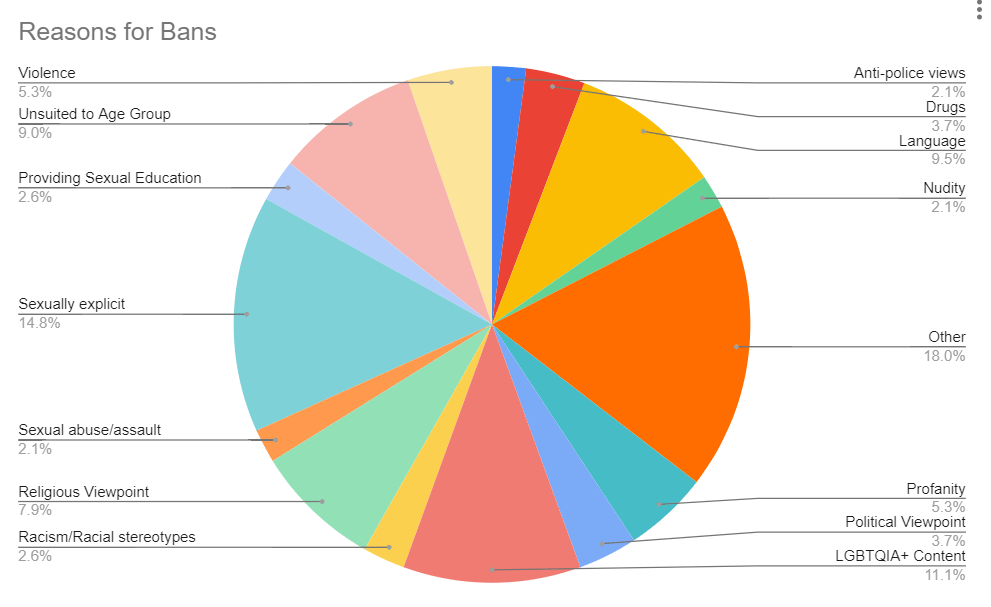
To show this, I’ve made a couple charts tracking the reasons why books were challenged or banned from 2012 – 2022. If you want a more detailed view, this is the spreadsheet I used to compile everything from the ALA’s lists. 

A little bit about the data here: most books have multiple reasons given for being challenged/banned. For example, Gender Queer by Maia Kobabe was challenged for LGBTQIA+ content and for being sexually explicit, so I marked it as both. “Language” can mean a few different things, depending on the book and who’s complaining about it. It might be curse words, but some books that deal with racial issues were challenged for having “divisive language.” Since one of those was a picture book, I don’t think that divisive language in that particular book was f-bombs. I’ve included racial slurs and derogatory terms in the category “language” as well. Similar to “language,” profanity can mean different things to different people, but it’s generally accepted to mean swearing. I’ve combined “racism” and “racial stereotypes” into one category, since you typically don’t get one without the other. I’ve also combined drugs and alcohol into the same category, though books that are challenged for drug use may not include alcohol use, and vice versa. 

All in all, the reasons given to ban or challenge books in the past 10 years looks a little something like this: 

From 2012 to 2022, the three most common were “other”, “sexually explicit”, and “LGBTQIA+ content.” I’ll talk about “other” in a later post. Right now, I want to go over “sexually explicit.” 

As I’ll talk about in another post, “sexually explicit” can mean a lot of things. It can mean graphic sex scenes, steamy scenes, sexual assault, nudity (both sexual and nonsexual), and anything in between. What I find sexually explicit may not be what you find sexually explicit. 

Books with LGBTQIA+ content also tend to be called “sexually explicit” more frequently than books without it, even if the content is pretty mild. I can’t think of a book where this is more obvious than Drama by Raina Telgemeir. In one scene, two boys kiss. It’s a first kiss, innocent and sweet. If it had been a boy and a girl kissing, no one would bat an eye. 

Are you ready for this? Ready for this borderline pornographic scene?

No one tell the concerned parents how Shakespeare plays were originally cast.

Which brings me to my next point: challenging and banning books with LGBTQIA+ content. You’ve probably heard about this, since it’s becoming scarily common. These aren’t just parents showing up at school board meetings or quietly filling out a “request for reconsideration” form at a library. It’s a school board member filing a criminal complaint against Flagler Schools for having an “obscene” book in the school library.

 Or public libraries losing funding for having LGBTQIA+ materials.

 Or multiple bomb threats made against public libraries for carrying LGBTQIA+ materials.

This scares the shit out of me. To be totally honest, I think it’s a matter of time before a library worker is seriously injured or even killed due to this anti-LGBTQIA+ moral panic. But at least there’s an injunction against the Arkansas law that would prosecute librarians and booksellers for having materials that are “harmful” to minors in their collections, right?

Challenges to books with LGBTQIA+ content are obvious homophobia and transphobia. Censoring these materials attempts to erase already marginalized people and groups who have been unseen for centuries. The same can be said for books that confront systemic racism in America. In both cases, censorship acts to hide away authentic stories and information. Taken to the extreme, it could mean that only material that’s ultimately harmful to marginalized groups could remain on the shelves, further perpetuating homophobia, transphobia, and racism. These books combat this ugliness by exposing it. And if it makes you uncomfortable, good. Homophobia should be uncomfortable. Racism should be uncomfortable. 

And if it makes you feel seen and validated, or comforted to know that there is someone out there who feels like you do, sees the world like you do, or just makes you feel like you’re not alone…even better. 

Accessibility is about power, gatekeeping is founded on the protection of power, and to all of that I say: fuck that, because information that can change lives should never be hoarded.

Prisca Dorcas Mojica Rodriguez, For Brown Girls with Sharp Edges and Tender Hearts

The rash of censorship spreading across school and public libraries, and even private businesses, is appalling on every level. 

You cannot say you are protecting children and at the same time take away the things that validate who they are.

You cannot claim to uphold family values while calling in bomb threats.

You cannot say you value freedom and free speech and actively call for censorship.

Oct. Book Recs: Disability Pride

For October, we’re celebrating Disability Pride! I know that Disability Pride Month is in July, but at the time I didn’t have enough time to do a full recommendation list. Here’s the mini-recommendation list. Even better, here’s some extra books to add to it!

 This is an important subject to me, and one that many of us have personal experience with. I have “invisible” disabilities, and the concept of “Disability Pride” is new to me. I’ve rarely felt proud of having disabilities as they have always felt more of a hindrance than a gift. However, I admire those who can embrace their disabilities – even when it’s hard – and celebrate themselves as they are. To steal a phrase from Temple Grandin, we are different, not lesser.

There are a lot of ways you can talk about disabilities and people who have disabilities. The conversation and vocabulary around disabilities and neurodivergence has changed a lot in recent years (like the word “neurodivergence” entering the common parlance) and it will continue to change. For this list, I will be using the terms that the authors/characters use to describe themselves. 

Nonfiction

Not So Different: What You Really Want to Know About Having a Disability by Shane Burcaw

When kids encounter someone with a disability, they may be frightened, and probably have questions they don’t know how to ask. In Not So Different, Shane Burcaw answers some common questions kids have about his life with Spinal Muscular Atrophy. Burcaw demystifies what life with a severe physical disability is like, answering questions about his wheelchair and daily needs that he needs help with. He explains that even though his body is different from most people’s, there’s nothing wrong with him. He may look different, but he still has a full life, doing the same things that all of us enjoy: spending time with family and friends, playing sports and video games, and of course, eating pizza.

Thinking in Pictures: My Life with Autism by Temple Grandin

Temple Grandin is so well known in psychology and animal science circles that the inclusion of Thinking in Pictures almost feels unnecessary, but her work both in the livestock industry and advocating for autism rights have been groundbreaking. Thinking in Pictures is part autobiography, and part primer on autism.  Grandin tells the story of her life as an autistic woman, and how she learned to navigate a world that wasn’t built for someone like her. Grandin’s stunning ability for visual thinking and deep connection with animals changed the livestock industry in the U.S. forever and led to the creation of more humane slaughterhouses (yes, that is a thing). She also describes the challenges and benefits of being autistic, and how it has shaped her life. Grandin writes that she is “different, not lesser” and shows how autism can be a gift. Originally published in 1995, some of the information on diagnosing autism and medications is outdated. Yet Grandin’s life story – born at a time when autistic children were often institutionalized – is compelling and fascinating. If you have any interest in neurodivergence, this is a must-read. 

Vincent and Theo: the Van Gogh Brothers by Deborah Heiligman

Two brothers walk to a windmill and make a pledge that will shape the rest of their lives.

Vincent van Gogh was one of the most remarkable and celebrated painters that ever lived. But the beauty in his paintings was often missing in his own life. The (literal) portrait of a tormented artist, Vincent most likely had bipolar disorder, among other physical and mental ailments. Throughout his troubled life, there was one person he valued above all overs: his younger brother, Theo. Theo supported his brother financially and emotionally throughout both their lives, sending him money and paint, and most importantly, believing in Vincent and his art. Their relationship was often strained, and rarely easy, but the deep bond and love between them carried both brothers through the darkest and brightest times of their lives. Meticulously drawn from the hundreds of letters that the brothers wrote to each other, Heiligman paints a stunning biography of both men. Beautifully written, Vincent and Theo’s life stories are filled with tenderness and tragedy. Much as we celebrate Vincent’s work today, it should be known: there would be no Vincent without Theo. The audiobook is excellent, and the print version has illustrations and a photo insert of some of Vincent’s work.

All Cats are on the Autism Spectrum
All Dogs Have ADHD
All Birds Have Anxiety

By Kathy Hoopmann

I couldn’t pick just one of these books – I had to include all three. Hoopmann describes common traits of autism, ADHD, and anxiety, using cute and funny animal pictures to illustrate each one. The books also list the positive traits as well: “His creativity is legendary!” “[P]eople marvel at their intelligent minds.” Each book ends on a hopeful note, that with love and support, you can achieve anything (and have anxiety-free days!) no matter what kind of brain you have. For parents, it can be hard to explain a child’s diagnosis to them, or find an opening to talk about it. Books like these are a great way to start the conversation, and the photos (apart from being adorable) can help both adults and children understand autism, ADHD, and anxiety better. They’re cute, informative, and I love how Hoopmann incorporates positive traits as well. My brain is wired differently from most people’s, and it has its drawbacks. It’s nice to be reminded that there are good things about that, too. 

Fiction

You’re Welcome, Universe by Whitney Gardner

It’s time for Julia to go public with her art. After a slur against her best friend is spray-painted on the gym at Kingston School for the Deaf, Julia covers it with a mural of her own, covering a nasty message with art. Instead of being grateful, her friend rats on her, and Julia is expelled for vandalizing the school.. Friendless and angry, Julia is forced to attend a mainstream school in the suburbs. Julia turns her focus on her art and makes a splash with her first graffiti mural…until someone tags over it. Then it happens again. And her rival is good. Really good. Julia never thought she’d be in a graffiti war, but she’s determined to win this, and hold tight to the one thing in her life that still makes sense. Illustrations of Julia’s (and her rival’s) artwork are scattered throughout the book. A fun read with insights into Deaf culture and a side of teen drama. 

Get a Grip, Vivy Cohen! By Sarah Kapit

When twelve-year-old Vivy Cohen writes a letter to her favorite baseball player, VJ Capello, for her social skills group, she doesn’t think he’ll actually write back. She doesn’t think she’ll ever be able to play on a baseball team either, even though she’s got a mean knuckleball. But when Coach K spots her pitching in the park, he doesn’t care that she’s a girl or autistic. He just wants her on his team. After some reluctance on her mom’s part, Vivy joins the team and can finally play the best sport in the world. Even better, VJ Capello starts writing her back! The two strike up a correspondence, with VJ offering advice on not just on pitching, but also friendships, bullying, and being a good team player. VJ understands her love of the game and believes in her…so why can’t Vivy’s mom? But with VJ’s support and a catcher who’s always got her back, Vivy’s determined to earn her place on the pitcher’s mound.

Pieces of Me by Kate McLaughlin

Dylan wakes up in a stranger’s apartment with no memory of how she got there. She’s blacked out before – the main reason she quit drinking – but is shaken to her core when she realizes that she’s been missing for three days. Dylan knows that she’s “crazy” – all the other mental health diagnoses she has don’t explain her losing time as frequently as she does. After a life-threatening event, Dylan is finally diagnosed with Dissociative Identity Disorder, formerly known as multiple personalities. The diagnosis is both a relief and a nightmare. Dylan must learn to live, communicate with, and eventually accept her alters as part of herself. To heal, she must also recall the trauma that forced her consciousness to fracture when she was just a child. The book can be dark, but it gives a sympathetic portrayal of DID, which is often misunderstood and stigmatized. Dylan’s story is ultimately hopeful as she learns that she can have a full, meaningful life with DID. Resources and a content warning are included. 

Unbroken: 13 Stories of Disabled Teens edited by Marieke Nijkamp

An autistic girl is cursed to grant wishes to anyone who is kind to her. A young writer comes to a new understanding of the theatre through Faust. A teenager with severe anxiety is the only one who can save her city from an impending attack. Unbroken is a multi-genre short story anthology, with stories ranging from high-stakes sci-fi to rom-com to historical fiction. The protagonists are well-crafted, never reduced to just their disabilities. The protagonists don’t set out to “cure” themselves, but their motivations are things every teen wants: love, security, acceptance. My favorite story is the first one, “The Long Road” by Heidi Heilig, where a traveler on the Silk Road (implied to have bipolar disorder) comes to see herself not as cursed, and accepts herself as she is. 

Banned Books Week 1: Intellectual Freedom

I can only remember my reading choices being called into question three times.

First, when I was in elementary school, my aunt saw me reading some sort of business-type book by Scott Adams, the creator of Dilbert. I was skipping the text and reading the comic strips that had been inserted on each page. My aunt laughed and asked if I understood what I was reading. I told her I was only reading the comics. She asked if I understood the comics, which I mostly didn’t, and I told her, “Some of them.”

The second time was probably in the summer of 1997, making me eight years old. I was eagerly reading a Newsweek article about the recently-launched Sojourner Mars rover. My mom asked me if I understood what I was reading. I was an above-average reader for my age, but Newsweek was still beyond me. I had no idea what the article was saying. I lied and told her that I understood it all.

The last time came when I was sixteen or seventeen, and reading The House of the Scorpion by Nancy Farmer. Whenever I set it down, I was very careful to always place it cover side up, lest someone be weirded out by the summary on the back. When I did leave it upside down once, though, my mom read the summary and asked, “What is this book you’re reading?” Considering that the summary talks about opium and a boy being harvested from a cow’s womb, I’m not surprised that it raised a few eyebrows. When I told her it was sci-fi about clones and I also thought it was weird, but good. She just kind of went, “all right then” and didn’t ask again.

But at no point has anyone ever told me, “I don’t like that, so you can’t read it.” No one has ever tried to take a book from me because it was too advanced, or because they were uncomfortable with the subject matter. I got to read whatever I wanted, even if my parents didn’t love all of it. Though my mom might occasionally “check in” if I was reading a book with mature themes, she trusted me to make my own decisions when it came to reading. Some kids aren’t that lucky.

Let’s talk about banned books.

This is the week to do it, after all. Banned Books Week was established in 1982 by the Office of Intellectual Freedom (OIF), a subdivision of the American Library Association (ALA), in response to a sudden uptick in book bans and challenges that year.

Notably, the subject of book bans made it all the way to the U.S. Supreme Court in 1982, in the case Island Tree Schools School District v. Pico. The school district had removed 11 books from the high school and middle school libraries, which the school board decreed were, “anti-American, anti-Christian, anti-Sem[i]tic, and just plain filthy.” A group of five students, led by high school senior Steven Pico, filed suit against the school board. They alleged that removing books from their school violated their First Amendment rights. In a 5-4 decision, the Supreme Court ruled that school boards did not have the right to remove books from the school library “simply because they dislike the ideas contained in those books and seek by their removal to ‘prescribe what shall be orthodox in politics, nationalism, religion, or other matters of opinion.'”

Five kids stood up for their intellectual freedom, and they saved their right to information. But book bans and challenges are still happening today, and at an alarming and unprecedented rate.

So I want to dedicate this and the next few posts to Banned Books Week, taking a look at intellectual freedom, and the threats it faces.

But first: What is intellectual freedom?

Librarians don’t take an oath when we graduate,* but if we did, it would probably look like the Library Bill of Rights. To shrink it down into just three main tenets, the Library Bill of Rights says (in brief)

  1. Everyone has a right to information, regardless of their age, sex, race, religion, orientation, gender identity, etc.
  2. Libraries facilitate these rights by providing information from all points of view, and need to challenge censorship or attempts to restrict anyone’s freedom to read and learn.
  3. Everyone has a right to privacy, and libraries need to safeguard the privacy of everyone who uses them.

I could talk about the right to privacy and libraries for a long time, but for this post, I’ll be sticking to those first two tenets. In a nutshell, this is intellectual freedom. Everyone has a right to information from all points of view, without restriction. And it’s not just me saying that. The U.N. agrees.

Everyone has the right to freedom of opinion and expression; this right includes freedom to hold opinions without interference and to seek, receive and impart information and ideas through any media and regardless of frontiers.

U.N.’s Universal Declaration of Human Rights

Censorship, book bans, and challenges all restrict our human right to information.

I’m going to pre-empt one of the most common (if not the most common) arguments for book challenges and bans: “Think of the children!”

As a youth librarian, I work with all ages of kids, from babies to teenagers. I obviously wouldn’t hand a three-year-old and a thirteen-year-old the same book. Likewise, two kids of the same age can have entirely different reading and maturity levels. A book that’s perfect for one kid might be totally wrong for another. That’s fine – there is no single book that is perfect for every person. Adults can and should provide guidance for kids when it comes to their media consumption, including books.

What shouldn’t be done is deprive others of the opportunity to access those materials. There are plenty of books that I don’t like, and ones that I disagree vehemently with. I choose not to read those books, or to read them with a critical eye. Just because I don’t like Red, White, and Royal Blue doesn’t mean that I can take it away from everyone else who might want to read it.

One more thing that I haven’t addressed yet: the right to receive information from all points of view.

This can be a hard thing when it comes to selecting materials for libraries. For instance, political pundits espouse plenty of opinions I disagree with. Yet they still have fans who want to hear from them, and who will eagerly dive into any book their favorite commentator puts out. Even if it’s misleading or potentially harmful.

At times, this has been really difficult for me. I mostly deal with juvenile and YA fiction, so I don’t have to decide if a book like Why Women Shouldn’t Vote** by John “Women are Intimidated by How Smart I Am” Smith belongs in a library. But I still have to make choices like:

Is this book where the characters appropriate sacred Indigenous practices something we want in our collection?
This books has strong misogynistic content, but the movie is extremely popular and it’s trending on #BookTok. Do we buy it?
The teens really enjoy rom-coms, but this one starts after a girl is kissed by a stranger in the dark. How would that be interpreted by the teens who read it?
This author is a slimeball and criminal, but his books get checked out a lot. Is it okay for me to buy this book and support him financially? Or is it better for me to order it so fewer people need to go out and buy the book?

I have to take all of these questions on a book-by-book basis. I reject many books because I feel that they would not suit our library patron’s needs, and I purchase others that I would never choose for myself because I know the patrons will like them. These are the times that I need to separate my professional ethics from my personal beliefs.

Everyone still has a right to read these books, no matter what your beliefs are. The library’s role is not to sort out what should and shouldn’t be read, but to provide information to those who seek it. Intellectual freedom is a human right, and Banned Books Week is a challenge to anyone who would take away that right.

So crack open The Bluest Eye, pull your copy of Perks of Being a Wallflower off the shelf, and dare to check out Flamer. Let freedom read.


*We do, however, get a cardigan alongside our diploma.
**Not a real book. I hope.

BIDP: Butterflies in November

In 2015, I took a trip to Iceland with my sister, boyfriend (now husband), and a friend. For ten days we traveled the Ring Road that encircles the country. It was an adventure unlike any other I’d been on, not only because of the beautiful and primal landscape we explored. It was also because I spent the second night of our trip in an Icelandic hospital, and got to learn about the Scandinavian health care system first hand. But that’s another story altogether.

I bring this all up because I wanted to explain how the book Butterflies in November landed in my lap. Technically, I did pick this book, just not for myself. I bought it for my sister, who re-gifted it back to me. I got this book specifically for her because it’s about an Icelandic woman making an unexpected trip around the Ring Road, and the people she meets along the way. It had been praised in reviews, and I thought it would be fun to relive our trip through a book where the protagonist takes the same route we did. My sister said that the book was “okay” – not exactly high praise – and passed it on to me.

One unusual thing about Butterflies in November is that very few characters have names, including the main character. For this review, I’ll be referring the her as “Kvenhetja,” the Icelandic word for “heroine.” At least, I think it is. Google Translate is far from perfect.

Here’s the basic plot: Kvenhetja is a linguist and freelance editor and translator. She’s been married for almost five years, but has been having an affair with one of her clients. Shortly after being dumped by both her husband and lover, she becomes the reluctant guardian of her best friend’s child. Tumi is four years old, deaf and largely mute, and Kvenhetja doesn’t have a mothering bone in her body. After Tumi picks the winning numbers for the largest lottery jackpot in Icelandic history, he and Kvenhetja set out on a  journey on the Icelandic Ring Road that encircles the entire country.

The plot isn’t anything we haven’t seen before. Someone unlucky in love who takes in a child (bonus points if they have special needs) and goes on a journey of self-discovery. The main difference between this book and stories like No Reservations, Raising Helen, and this way-too-accurate trailer for every Academy Award-winning movie ever is that it’s set in Iceland. But what really drew me into the book was how similar I was to the protagonist. Scarily so.

‘It’s as if you just don’t want to grow up, behaving like a child, even though you’re thirty-three years old, doing your weird and careless things [. . .] You’re always forgetting things, arriving the last at everything, you don’t wear a watch. And to top it all, you always seem to choose the longest route anywhere. [. . .] Words, words, words, exactly, your entire life revolves around the definition of words. Well here you go, impulsive: abrupt, hasty, headlong and impetuous. [. . .] Having a child might have changed you, smoothed your edges a bit. But still, what kind of mother would behave the way you do?’

It was bound to reach this point, the baby issue. But I’m a realist so I agree with him, I wasn’t made to be a mother, to bring up new humans, I haven’t the faintest clue about children, nor the skills required to rear them. The sight of a small child doesn’t trigger a wave of soft maternal feelings in me.

I have never felt so called out by a book before.

But in that outlining of Kvenhetja’s traits and quirks, there is one thing I am that she’s not. Impatient. I was promised a travelogue, but it took several chapters of set-up to get her and Tumi on the road. Granted, the chapters tend to be short, but it felt like forever to get to. When Kvenhetja and Tuni finally get to their journey on the Ring Road, I kept reading and waiting for…something to happen.

I’ve read some non-fiction travelogues, and they’re often a series of anecdotes as the narrator travels form Point A to Point B. This makes sense. Our lives don’t follow the structured five stages of plot (though sometimes it feels like they do). Telling a true story about your life isn’t going to be like telling a story in a novel.

Once Kvenhetja and Tumi are on the road, the story is mostly composed of anecdotes of people she and Tumi meet along the way. There are definite characters she meets, like a falconer and an Estonian men’s choir. There is a through-line to the plot, at least:  Kvenhetja is on the road to receive a prize she won, and Tumi is along for the ride.

The road trip was the part of the book I was most interested in, because it was a way to re-visit my trip around the Ring Road. All the people on the road that Kvenhetja meets are helpful and friendly, something I probably would have scoffed at if I hadn’t seen the kindness of native Icelanders and tourists firsthand. Iceland is a rugged country, and being stranded on the Ring Road can be dangerous. I think that’s one of the reasons why it feels like everyone has each other’s back.

I also liked to see  things on the page that had enchanted me in real life: black sand deserts, lava fields, hot springs and one-lane bridges. These are landscapes you can get lost in, perfect for resetting your life. The novel makes a lot of use of metaphors reflecting on the Icelandic landscape and travel on the Ring Road.

The reviews promised a quirky and funny story, but most of the time I read it, I was just bored. Despite the similarities between Kvenhetja and me, as the book went on, I just didn’t like her very much. She’s impulsive and makes poor decisions that are potentially dangerous for the child in her care. Granted, Iceland is generally safer than the U.S., but I don’t think that it’s a good idea to have sex with a stranger in a lava field while a four-year-old charge is sleeping in the car. Half the time Tumi may as well not even be in the story, considering how much of the prose is devoted to Kvenhetja’s introspection.

This book also hit on one of my pet peeves when it comes to writing child characters: children who don’t act like children. I don’t mind a precocious character every now and then, and Tumi is meant to be an “introspective oddball.” I liked how he has an interest in words and could read and write a little. It helped bring Kvenhetja and Tumi connect, not just for the purposes of communication. She might not have any inkling of what to do with a child, but their shared interest in words helps build their relatiomship. But for an entire trip, Kvenhetja never had to deal with Tumi wetting his pants, throwing a tantrum, or trying to eat rocks. Tumi isn’t just introspective; he’s the most un-childlike four-year-old I think I’ve seen in fiction.

Overall, I didn’t really care for Butterflies in November. I didn’t seem to get the wry humor that reviews promised. The prose is descriptive and fantastic, but it ultimately wasn’t enough to save the thin plot.

I don’t think it was a bad book. It certainly got plenty of love from critics. It just wasn’t a good book for me. If Butterflies in November sounds like something you’d enjoy, I encourage you to check it out!

Sep. Book Recs: Hispanic Heritage Month

September marks the beginning of Hispanic Heritage Month in the U.S.! Hispanic Heritage Month begins on September 15 and goes to October 15. It’s a little unusual for a monthly observation to begin in the middle of the month, but there’s a reason for it. On September 15, 1821, Costa Rica, El Salvador, Guatemala, Honduras, and Nicaragua declared independence from Spain. Mexico declared its independence on September 16, 1810, and Chile did so on September 18, 1810. Almost 200 years later, Belize would declare independence from Great Britain on September 21, 1981. 

Hispanic Heritage Month celebrates the achievement, culture, and traditions of Latinx Americans of Mexican, Central American, South American, Caribbean, and Spanish ancestry. 

As always, I can only offer a smidgen of what is out there for books by and about Latinx individuals. If you’re looking for more, Pura Belpré award winners and honorees are a great place to start! There are also many Latinx authors and illustrators doing stellar work. To name a few: Alma Flor Ada, Julia Alvarez, Jorge Argueta, Monica Brown, Isabel Campoy, Joe Cepeda, Angela Cervantes, Veronica Chambers, Sandra Cisneros, Judith Ortiz Cofer, Raul Colón, Carmen Agra Deedy, Lulu Delacre, David Díaz, Angela Dominguez, Margarita Engle, Xavier Garza, Christina Díaz González, Carmen T. Bernier-Grand, Susan Guevara, Francisco Jiménez, René Colato Laínez, Rafael López, Meg Medina, Marisa Montes, Pat Mora, Yuyi Morales, Sara Palacios, John Parra, Celia C. Pérez, Pam Muñoz Ryan, Benjamín Alire Sáenz, Garo Soto, Francisco X. Stork, Carmen Tafolla, Raúl the Third, Duncan Tonatiuh, and Erica Velazquez. 

That’s quite a list! You’ll find some of those writers on this list as well. ¡Vamos a leer!

Nonfiction

Enchanted Air: A Memoir by Margarita Engle

Margarita is a child of two countries: the United States, and Cuba. Her mother’s country, Cuba, is a place of dancing trees, singing vendors, and beautiful forests and farms. Cuba is a place where Margarita can be brave – as brave as a boy. But most of the year she lives in Los Angeles, timid and lonely. Growing up in the 1950s and 60s, she doesn’t understand how two countries she loves so much can hate each other. As relations between Cuba and the United States worsen, Margarita wonders: will her relatives in Cuba hate her? Why is her mother choosing to be “stateless”? When will she visit her beloved Cuba again? In evocative verse, Engle shares her experiences growing up Cuban-American during the Bay of Pigs invasion and Cuban Missile Crisis, her summers in Cuba before the United States embargo against the country, and her deep and abiding love for words and poetry. 

Once I was You: A Memoir / Una vez fui tuí: Memorias by Maria Hinojosa

When Mexican-born Maria Hinojosa came to the United States as a one-year-old in 1962, she was nearly separated from her family. Only her mother refusing to leave her child allowed Maria to move to the U.S. with her family. In this memoir, Hinojosa chronicles her life and they many identities she has: an immigrant, a woman, a survivor of sexual assault, a wife, mother, and award-winning journalist. She started as an intern at NPR, pitching stories by day and waiting tables by night. Throughout her career, she sought to highlight human stories that are often overlooked, and give a voice to the voiceless. Yet this book is about more than one woman’s life. Opening on an encounter with children who were separated from their families while crossing the U.S.-Mexico border, Hinojosa gives a history of changing immigration policies from the 1960s to 2020, when the book was published. She explains the politics behind the end of Immigration Naturalization Services (INS) and the formation of Immigration and Customs Enforcement (ICE), and the societal and political changes that brought us to where we are now. Most sobering, Hinojosa describes the horrifying conditions of immigrant detention centers, and the ICE raids that help fill those centers. A powerful memoir of resilience, alongside painful reminders of the U.S.’s broken immigration system today. Published subsequently in Spanish. A young reader’s edition which focuses on Hinojosa’s childhood and adolescence is also available. 

Wild Tongues Can’t Be Tamed: 15 Voices from the Latinx Diaspora, edited by Saraciea J. Fennell

There are as many ways to be Latinx as there are Latinx people in the world. This essay collection gives voice to Latinx and Afro-Latinx writers’ experiences. Each essay has its own style and theme: “Eres Un Pocho” by Mark Oshira, written as second-person letters to a younger self, and “#JulianforSpiderman” by Julian Randall is a reflection of Afro-Latinx identity told alongside the story of Miles Morales. “More than Nervios” by Lilliam Riviera describes challenges Latinx individuals face in receiving treatment for mental health issues, and Jasminne Mendez recounts coming face to face with racism in theatre. Frequently underrepresented Latinx ethnicities are represented as well, like Honduran and Panamania writers. These beautiful, sometimes heartbreaking essays each tell a unique and personal story, often of seeking and discovering identity. Colorism is another prominent theme. Each essay is deeply human, and the struggle to understand yourself and your place in the world is something everyone can relate to, no matter their background. 

Inventing Latinos: A New Story of American Racism by Laura E. Gómez

“Race isn’t real, but racism is.” This is the thesis statement of Inventing Latinos. Published just before the United States’s controversial 2020 Census, Gómez presents a macro-level overview “the how and why of Latinx identity becoming a distinctive racial identity.” She starts with the legacies of Spanish colonization and American imperialism, the effects of which still echo today. She explores the complexity of racial identity with the mestizaje population, racially mixed people with Indigenous, Spanish, and African ancestry. She also discusses discrimination faced by Latinx Americans, particularly in schools, and that Latinx populations are often treated as a “buffer” group between White and Black populations in the United States. Gómez ends an overview of Trump-era policies steeped in anti-Latinx racism, and argues to list Latino/a/x as a race rather than an ethnicity on future censuses. While not everyone agrees with Gómez on this matter, this academic overview of Latinx identity contains important (if dry at times) information. 

A Land of Books: Dreams of Young Mexihcah Word Painters by Duncan Tonatiuh

Before the arrival of Europeans, Mesoamerica was an amoxtlalpan – a “land of books.” A young Mexihcah (Aztec) girl tells her little brother about the process of making books (amoxtin) to her younger brother, starting with their tlahcuilohqueh parents – painters of words. She describes the process, from creating paper pulp from tree bark and dyes from plants and insects to paint the books. The book informs readers about Mexihcah culture, including education, literacy, and religion. Nahuatl words are used throughout the text, with a glossary and pronunciation guide in the back. This picture book has beautiful illustrations, done in the Pre-Columbian style inspired by Indigenous Mesoamerican art. A detailed author’s note talks about the history of Mexihcah codices (of which only 15 remain) and the importance of preserving Indigenous art. 

Fiction

Cuba in my Pocket by Adrianna Cuevas

After the failure of the Bay of Pigs invasion solidifies Fidel Castro’s power in Cuba, twelve-year-old Cumba lives in fear. Fear of executions, fear of whispering neighbors, and fear of the soldier who seems to track his every footstep. In danger of being recruited into Young Rebels, and eventually military service, Cumba’s family decides to send him to the United States. After reaching Miami, Cumba must contend with not knowing English, strange food, and most of all, missing his family. He gradually adjusts to life in the United States, sharing Prima Benita’s house with two other teenage refugees. He deeply misses home, and struggles to hold out hope that his family will join him in the U.S. in the future. 

Woven in Moonlight by Isabel Ibañez

In this Bolivian-inspired fantasy, Ximena was left orphaned after the Llascan revolt leveled her home and forced Illustrians like herself out of La Ciudad. After the revolt, Ximena was plucked out of the rubble due to her resemblance to the last surviving Illustrian royal, the condesa Catalina. For ten years Ximena has acted as Catalina’s decoy, and only Catalina’s inner circle knows the truth. When the Llascan king Atoc demands the condesa’s hand in marriage, it is Ximena’s duty to go to the capital in her place. Yet she has no plans to see herself or Catalina married. Thirsty for revenge, she will spy and search for the Estrella, a mysterious artifact that Atoc used to summon an army of ghosts during the revolt. Using her gift to spin thread from moonlight, Ximena sends messages hidden in tapestries back to Catalina. Yet as she comes to know the Llascans around her – and the mysterious vigilante, El Lobo – she begins to question her mission. Atoc is too dangerous to remain on the throne, but is Catalina really the queen that they need?

Our Shadows Have Claws: 15 Latin American Monster Stories, edited by Yamile Saied Méndez and Amparo Ortiz

A black wolf with red eyes stalks a high school bully. Death welcomes a girl into her home. A girl raised as a vampire hunter prepares for the fight of her life. Our Shadows Have Claws is an anthology of fifteen different monster stories set across Latin America and the Latinx Diaspora. Despite what the title suggests, these are not all horror stories. Some are romance, some are heartwarming, and some will make you shiver when you hear something go “bump” in the night. Themes of racism and colorism are woven throughout; environmentalism, heritage, and finding home are other important themes. All but one of the stories star girls, but each lead character must face their fears to protect their loved ones, themselves, or just to discover who they are. “Beware the Empty Subway Car” by Maika and Maritza Moulite was my favorite, the story of a hidden lougarou who suddenly wants to be seen. If you like supernatural stories, there’s something for everyone in this collection. 

Gods of Jade and Shadow by Silvia Moreno-Garcia

The Jazz Age is in full swing, and Casiopea Tun has dreams – dreams of driving an automobile, swimming in the Pacific, and dancing fast in nightclubs. She has no way of chasing those dreams, living as her grandfather’s servant following the death of her Mayan father. She thinks she must simply wait for the old man to die before she can leave her small town on the Yucatán Peninsula…until she opens a mysterious box and accidentally frees a Mayan god of death from imprisonment. Hun-Kamé once reigned over the underworld Xibalba, until his treacherous brother beheaded him and scattered his eye, ear, finger, and jade necklace across Mexico. Hun-Kamé’s and Casiopea’s fates are now tied together, and she must help him retrieve what has been stolen from him. Their time is short – the bond between them drains Casiopea’s life and threatens Hun-Kamé’s godhood. Together, they travel across Mexico and face challenges Casiopea has only read about in books. A gorgeous fairytale, rich with Mayan mythology. 

My Papi Has a Motorcycle / Mi papi tiene una moto by Isabel Quintero. Illustrated by Zeke Peña. 

Daisy loves riding around town with her Papi on his motorcycle. Like a streaking comet, they fly through the neighborhood. Daisy can see how her city is changing: Don Rudy’s Raspados has shut down; new homes are being built where citrus groves once stood. Yet Daisy knows that, no matter how much her city changes, it will always be a part of her, just like her father’s love. With a beautiful palette of sunset colors, this picture book tells the story of a neighborhood gentrifying, but the strong sense of community binding it together. Published concurrently in Spanish and English, Spanish words are sprinkled throughout the English version. 

And for girls with dads with motorcycles, this hits straight home. 
BIDP: Partials by Dan Wells

Today’s edition of Books I Didn’t Pick” is brought to you by Partials, courtesy of a holiday book exchange.

Some books are timeless: stories that ring true from generation to generation, no matter how circumstances change. Other books are timely: it’s no surprise that Hamnet: A Novel of the Plague was a New York Times best seller for weeks in 2020, even if it was set in the 1500s.

Then there’s books that I’ll call “personally timely.” These are the ones that might not have meant as much to you if you’d read them at another point in your life, but they’re meaningful now.

Partials by Dan Wells is one of those for me.

To begin, Partials is set eleven years after the devastating Partials War. The Partials are genetically engineered super-soldiers that turned on their human creators, and then vanished. Before disappearing entirely, the Partials left humanity with a parting gift: the RM virus. The virus all but annihilated the human race, and robbed humanity of its future. Every human baby born since the introduction of the virus has died, succumbing to RM within days, if not hours.

The Defense Grid, one of the last pockets of humanity, requires all women age 18 or older to become pregnant as often as possible, in the hope that one of the babies will be born with an immunity to RM.

Kira Walker is a medical intern whose father was killed by the RM Virus. When her best friend becomes pregnant, Kira will risk her life to find a cure for RM. With every other avenue of research failing to find a cure, she will attempt to do what no one else has done. To save the life of her best friend’s child, she must capture and study one of the brutal and deadly Partials.

That’s a lot to unpack, I know. I’m sure that everyone will have a different reaction to reading a story about a pandemic now than they would have pre-2020. Before COVID, I was even working on a post-apocalyptic short story which had been brought about by a plague. I liked the possibilities that pandemic fiction offered: a reset of the world that you live in, while keeping much of the world’s infrastructure intact. It also felt like a safe, remote end of the world scenario. Nuclear war and devastating natural disasters are threats that felt much more real at the time. But after three years of a pandemic that has killed millions of people, plague-related fiction isn’t nearly as fun as it used to be. COVID-19 wasn’t the end of the world by any means, but living through it has changed the way I engage with media that use a pandemic as a plot or setting element. As for my post-apocalyptic story? I haven’t touched it since 2020, and it’s unlikely that I ever will again.

Other than the fictitious pandemic, there’s something else that triggered a strong reaction in me, which wouldn’t have been as strong if I’d read Partials as a teenager. But for a thritysomething woman who’s been married for just shy of three years now, pregnancy is kind of a huge deal.

I have baggage around pregnancy/childbirth/motherhood. It’s not severe enough that I wouldn’t be able to read a book like Partials, but instead of feeling like a dystopia, the novel felt like a horror story to me. And that’s okay. Sometimes I seek out something that I know will scare me, if only out of some eerie fascination with it. The 1996 Mount Everest disaster, for instance. Horrifying, and yet I’ve read every Wikipedia page related to it, Into Thin Air by John Krakauer (and the made for TV movie), along with watching the movie Everest, and two separate documentaries on the subject. That’s what reading about pregnancy (forced or otherwise), childbirth, and infant mortality is like for me. It’s a nightmare, but when there’s a fourth wall between it and me, it’s easier for me to engage with it. It’s a safe way to interact with something you’re afraid of.

But that’s not what you’re here for, so let’s get back into the book itself.

The writing is fine. There’s nothing stellar about the prose, but it’s not bad, either. It gets the job done, which works for the breakneck pace of the plot. However, the moments with the biggest emotional impacts sometimes feel lackluster because of it.

The plot is pretty dense, and I think the novel suffers from excess. There’s so many characters and factions to keep track of, along with their relationships with one another. Several of Kira’s friends play a role in the story. Alongside Kira, there’s her boyfriend, Marcus; foster-sisters Madison, Ariel, Xochi, and Isolde; Jayden, Madison’s brother; and Madison’s husband, Haru. There are also a plethora of other characters that the audience needs to remember and keep track of: the senators that run the island, various military and medical superiors, and members of the rebel group, the Voice. These people play no small role in the story, but it’s nigh impossible to keep track of all of them.

Then there’s also the factions in the story. Kira and her multitude of friends live in the Defense Grid, on Long Island, possibly the last human city remaining on Earth. The Grid is occasionally attacked by The Voice, a group of rebels seeking to end forced pregnancy. Both the Grid and the Voice hate and fear the superhuman Partials, who have created their own society away from the Grid and the Voice. As the story goes on, we discover that the Partials have also all subdivided into factions of their own.

It’s a lot. Sometimes I felt like I needed a notebook to keep track of what was going on. With so many characters, they can’t possible get all the time they need to be fully developed. This made many of Kira’s friends an indistinct blur, and the villains largely forgettable. They’re evil, but they’re not interesting.

There’s also plenty that I do like about this book, too. It’s exciting with plot reveals that keep you guessing. While it could be overly complicated at times, the story never stagnates. I also liked the reasons why teenagers had to be the protagonists in this book.

In YA fiction, especially dystopian YA, teenagers often get put in dangerous situations that they have no business dealing with, especially if there are adults better able to handle the situation. Partials at least does a good job of addressing this. When sixteen-year-old Kira is placed in charge of research that goes well beyond her training and knowledge, she and her friends question why the senators are allowing her to do this. Their reasons are revealed later and actually make sense.

Even more than that, Kira makes a point about why it had to be teenagers and young people to make a change, and why her generation will the ones who cure R.M. Kira and her generation are called “plague babies,” born before R.M., but too young to remember remember what the world was like before the virus. The adults do remember the old world, as well as the horrific events of the Partials uprising and the spread of R.M. Most of them have given up hope that R.M. can be cured, and refuse to take the drastic measures required to guarantee the future of the human species. Billions of humans are dead, and they’re unwilling to risk any more lives on trying to a cure. They insist on doing the same thing over again, mandating pregnancy, hoping one day a child will be born with an immunity to R.M. This has not produced a single healthy baby, yet the Senate refuses to change tactics and try something new. When the adults have given up on the future of the human race, Kira realizes that only “plague babies” like her have enough will and passion to act and try to fix things.

I remember what it was like to be a kid. I remember feeling unheard, or that no one took me seriously because I was young. Thankfully, I had parents, teachers, and adults in my life who understood that children and teenagers have something worth saying. In the wake of the Marjory Stoneman Douglas High School shooting, students rose up and demanded change. I observed many adults criticizing the student activists. One of the common refrains of their detractors were that they were kids, with no real-world experience and no business in telling adults what to do.

It made me think of one of my favorite high school teachers, who gave quizzes on current events and made us watch political debates as homework assignments. In 2006, he took a group of students, including me, to a Save Darfur rally in Washington, D.C. It was incredible to be there with so many like-minded people supporting a cause I cared deeply about. My teacher understood that just because we were young didn’t mean that we couldn’t be passionate about saving human lives, or civil rights, or a million other things outside of typical high school worries.

I didn’t realize how remarkable that was. At this point I’ve spent most of my career working with children and families, and I have a better understanding of how young people need to be heard. And how rare that can be.

In Partials, this is all Kira’s choice. She doesn’t have a special fate or destiny. There’s no prophecy about her. She just knows what she has to do, and she’s willing to risk everything for what she believes in.

I don’t think I’ll be reading the any of the sequels, but I liked Partials as I was reading it, even when it hit a bit too close to home.

To Sleep in a Sea of Stars

First of all, thank you to everyone who read my work for Flash Fiction Month! I don’t normally post my original fiction online for various reasons, but FFM is special. I will be taking down most (if not all) of my stories after August, so please read them while you have the chance!

We now return you to your regular book rants.

This review contains spoilers for To Sleep in a Sea of Stars by Christopher Paolini. I’ve written a quick chapter summary here.

A few years ago, I re-read one of my favorite books as a teenager: Eragon, by Christopher Paolini. While my fifteen-year-old self had loved it, adult me was very aware of its flaws. I determined that Paolini was great at worldbuilding and description, but wasn’t great at writing characters. Paolini was a teenager when Eragon was published, and still wet behind the ears when it came to his craft. It’s now been twenty years since Eragon first came out (cripes, I’m old!). In my review, I wondered what a novel by a more experienced Paolini might look like today.

Well, in 2020, we got our answer. And like most things from 2020, I didn’t like it.

I think I’m in the minority in this case, though. To Sleep got good reviews overall, and there are plenty of fans online who really like this book. I generally like sci-fi, but To Sleep just wasn’t for me.

To Sleep in a Sea of Stars is Paolini’s first adult novel, and his first science-fiction book. It’s a whopping 800+ pages of space, aliens, futuristic technology…and a decent amount of fantasy elements for an otherwise “hard”* sci-fi.

Before we get into the novel, I want to talk about the physical book itself. I don’t pay a ton of attention to how books are marketed, but its pretty obvious they were trying to sell this one on Paolini’s name alone. The spine only has “PAOLINI” on it. The title isn’t on there. It’s pretty common for popular authors to have their names featured prominently on book spines, sometimes in a larger font than the title. But they all still include the title.

With that said, let’s get into what’s between the covers. I have tried to get away from nit-picking books to death, I still have included one-sentence reviews/reactions to each chapter at the bottom of this post, because they’re too much fun for me not to do.

The plot is very dense, to the point where writing a spoiler-free review is kind of impossible. I wrote a companion post for this review, with brief (and hopefully humorous) summaries of each chapter for those who haven’t read the book, or read the book but forgot some of it. Can’t blame you there – there’s a lot.

To Sleep in a Sea of Stars is a galaxy-spanning saga of alien invasion, mysterious and powerful artifacts, and high-tech space battles. Kira Navarez is a xenobiologist who travels with a crew of scientists to uncolonized planets to see if they could be made habitable. After she falls into alien ruins on a mission, a complex piece of alien technology becomes attached to her. The xeno encases her body, and is eventually responsible for the death of most of her crewmates, including her fiancé, Alan.

Then things get complicated.

The story moves quickly, and has lots of twists and turns. In an interview that’s available in some editions of the book, Paolini said that he was essentially trying to write an entire series in the span of one novel. It justifies the length, and it really does feel like he’s managed to succeed in telling an epic story from beginning to end, without needing to break it into multiple parts.

There are things that I both liked and disliked about this. First, it kept the plot moving. In my posts about Eragon, I occasionally complained about filler chapters, but I don’t think there were any here. There were times when it was hard to put the book down because I wanted to know what happened next.

On the other hand, sometimes it moved too fast. It meant that I didn’t have time to get to know or care about the characters (often before they met, or nearly met, their dooms) in the start. There was also no room to breathe, especially in the beginning. Humans, both real and fictional, need time to rest. When we only see characters in a crisis – which was the majority of the book – we see how they react to the situations they’re in, but not necessarily who they are. Too often, the characters often felt like reaction, rather than fully fleshed out people. Paolini does a better job with character development than he has in his previous novels, but sometimes it felt forced, like a chapter where Kira systematically learns the backstories of all her crewmates.

Then there was the way the plot itself was constructed. As I mentioned, there are a lot of twists and unexpected events throughout. It keeps the story unpredictable, and the reader curious about how the characters will solve the newest curveball that’s been thrown their way.

But it also meant that some story arcs felt pointless, or like padding, once they concluded. For me, the most aggravating instance was when Kira and her new crew are searching for something called the Staff of Blue. No one is really sure what the Staff is, but Kira knows that it’s an important weapon that will help humanity combat the invading alien race nicknamed the “Jellies.” For more than 100 pages, Kira et al. search for the Staff, travel to a remote location to finally retrieve it, and engage in a deadly battle with the Jellies (and an even scarier creature, the Seeker). They find the Staff, but it’s broken in the battle and rendered useless.

Some readers might think, “holy crap! How will our heroes save the galaxy now?!” and read on feverishly. As for me, I was so frustrated that I just put the book down and refused to open it for two days. A “holy crap!” moment should make you want to read on, but I was annoyed that so much time had been devoted to something that ultimately had very little bearing on the actual plot.

This is also probably a good time to point out another issue I had with the book: excess. It seems a bit obvious when talking about an 800+ page book. Of course not every scene has to contribute to the overall story or character growth, but there were some spots that were just unnecessary. My first gripe with this was the character Inarë. Inarë is a refugee of the intergalactic war Kira inadvertently caused, and she and Kira meet on a ship taking refugees away from the fighting. Inarë is in the book for one or two scenes, described in a large amount of detail, and has a cat. She’s pretty weird and gives Kira cryptic advice about the journey ahead of her. Anyone who’s read Eragon could tell you that she’s pretty transparently Angela from that series, morphed into some sort of space witch. This isn’t just my assumption, either. Paolini even says so in the acknowledgements at the end of the book.

[T]hose of you who are fans of the Inheritance Cycle may have noticed some references to the series in To Sleep. You weren’t imagining things. And yes, Inarë is who you think she is.

As I mentioned in my post about The Ballad of Songbirds and Snakes, I don’t mind callbacks to an author’s previous works if it’s something small, or if it feeds into the plot later. However, Inarë has a few pages to herself, and except for her final words to Kira popping up occasionally, she had no overall bearing on the plot. In fact, the arc words that Inarë gives Kira (“Eat the path”) could have been said by nearly anyone in her crew and still have the same effect. When I see something like this, to me it feels more like fanservice and the author patting themselves on the back.

Towards the end of the book, I also wondered if a very large part of the plot was even necessary. There’s a subspecies of Jellies that the humans have to fight against, called “nightmares,” or the Corrupted. But there was already so much going on in the book without them. Space battles, ancient alien lore, a large cast of characters and almost non-stop action, reading about the nightmares and their progenitor monster, the Maw, was just exhausting. A book only about the humans and Jellies would have been interesting enough, but for me, this was too much.

It also suffered from the same ending fatigue present in movies like Return of the King. First, Kira kills the evil overlord of the Jellies. Then, she destroys the Maw. Then, she must go and destroy seven copies of the Maw. That’s seven copies that were never mentioned prior to any of the huge space battles in the climax of the book.

Then there are the appendices, which include the science behind faster-than-light travel and ship-to-ship combat in space, a timeline that covers over 500 years, and a glossary. Of all these, it’s the glossary that sticks in my craw. I complained about excess before, but there’s also the problem of absence of information, and the glossary exemplifies both.

I might start out by saying that I didn’t know that there was a glossary in the book at first, and I only found it by accident. I don’t think that there’s anything inherently bad having a glossary included in a fiction book, especially in sci-fi and fantasy stories. At the same time I was reading To Sleep, I was also reading Mastiff, by Tamora Pierce. Like To Sleep, Mastiff also has a glossary that defines the made-up words in the book, but you can also figure out what they mean in the context of the scene.

To Sleep‘s glossary doesn’t work like that. There are times when it feels like the reader was expected to have read it before starting the book.** This is best exemplified in the case of the “ship mind.” There’s almost no context for what a ship mind actually is for the first two-thirds of the book. As I read it, I was so confused about what ship minds actually were. Were they complex AI? Human-AI hybrids? Until I accidentally found the glossary, I had no idea. It turns out that ship minds are essentially augmented human brains, removed from their bodies, that sit in sarcophagi on board their ships, overseeing all the ship’s functions. This is such a huge thing, and totally different from anything I had imagined. Props to Paolini for originality, and for my new nightmares. But I really shouldn’t have had to accidentally find a glossary or wait until the near-climax of the book to see a reference to a sarcophagus housing a human brain sitting in a nutrient bath.

To Sleep takes great care to show the reader how things like faster-than-light travel and combat in outer space are possible. At the same time, it also uses a lot of fantasy tropes. I know, I know: “any sufficiently advanced technology is indistinguishable from magic.” And I can buy that when it’s something like two humans from a highly advanced technological civilization using highly advanced technology to blow up aliens and glibly referring to it as “magic.” It becomes harder for me to take when the xeno attached to Kira becomes able to do almost everything and anything. Kira first used it as a weapon and armor, but by the end of the book, she uses it heal characters with devastating wounds and build entire living space stations.

Drawing upon the Seed’s banks of encoded knowledge, she began to build the needed machines, constructing them from the atomic level up. With energy gathered from the panels, she sparked a burning sun inside herself: a fusion reactor large enough to drive the biggest UMC battleship. With energy from the artificial star, she started to manufacture antimatter–far more than the inefficient techniques of the humans or the Wranaui allowed for. The Old Ones had mastered the means of antimatter production before either species had even come into being.

p. 791

Even though this takes place after the second (sigh) major battle of the climax, it’s still quite a lot to take in.

That paragraph also shows another fantasy trope present in the novel. You probably noticed a reference to the “Old Ones.” The Old Ones were a sentient species that predate the existence of humans and the Jellies. They made the xeno that attached itself to Kira, along with the Staff of Blue, and the Great Beacons, which gave humanity a huge leap forward, technologically speaking. In other words: all that sufficiently advanced technology came from a species that was at least over 300,000 years old.

I don’t mind the “old stuff is more powerful” trope in fantasy works. It can be a bit tiresome at times, but it usually fits with the setting and the feel of the story. Ancient artifacts and mysterious ruins are part and parcel for fantasy stories. Sci-fi (especially “hard” sci-fi) is more focused on technology and what could be if any number of events or scientific discoveries occur. Sci-fi focuses on the future: how technology and/or societal changes have changed our lives, for better or for worse. A book like To Sleep should be one that dreams of humanity reaching the stars – and much more – through its own ingenuity and innovation. Relying on ancient artifacts from a vanished civilization doesn’t feel like it’s reaching out into the future. It makes it feel like all of humanity’s achievements are small, and that there’s no way they could ever create what the Old Ones have.

Throughout my review of Eragon, I had to compliment Paolini on his descriptive abilities, as well as his world building. As before, the worldbuilding is thorough, and it really does feel like he’s created a whole galaxy full of humans and aliens. The characterization could be weak at times, but the crew of the Wallfish all had distinct personalities that made them stand out. Falconi was probably my favorite character, but I had trouble getting to know who Kira was as a person.

I know I can focus too much on the negative, but I actually really did like the aliens in this book. In fiction, it’s common to have sentient, non-human races look and act quite…human. The Jellies only resembled humans in that some of them were bipedal. They’re sea-based creatures inspired by octopi, complete with tentacles that can change color. The Jellies are genderless and have a hive mind, which has been used to control them. They communicate using smells, called nearscent. They have vastly different lifecycles than humans, from birth to death. In short, they’re an alien species that feels refreshingly alien. While the book sometimes felt like it was bloated, the story moved fast, and changed in ways I didn’t predict.

Overall, I did like some of To Sleep – but not enough to pick up the next book in the series, Fractal Noise.

*The quotation marks aren’t meant to be pejorative. I don’t like the terms “hard” and “soft” to describe sci-fi, but I’m using it in this post because it’s easily understandable. Read more on the debate between “hard” and “soft” sci-fi at Tor.com
**Not recommended. This was how I accidentally spoiled what the Staff of Blue was for myself.


If you want more nit-picking, read on for (mostly) one-sentence chapter reviews. Lots of spoilers follow.

  • Chapter 1: A chapter centered around a romantic relationship, and I’m not at all convinced Paolini can write romance.
  • Chapter 2: I’m really trying to avoid comparing this book to Mass Effect, but let me have this chapter.
  • Chapter 3: Paolini’s love affair with thesauri continues, though isn’t as prevalent here than his Eragon books.
  • Chapter 4: I didn’t know enough about any of these characters, even Alan, to be sad when they died.
  • Chapter 5: Kira’s character is still made up of her reactions to things, rather than actual personality, but I’m finally getting into this book.
  • Chapter 6: Okay, I’ll admit it, I’m enjoying this.
  • Chapter 7: So far I’m not liking Kira, but I am excited for the the pew-pew space battles I’ve been waiting for.
  • Chapter 8: I understand that Kira is scared, but give us a moment to feel SOMETHING about what it’s like to be flung out in space.
  • Chapter 9: Really didn’t need a paragraph dedicated to a woman inspecting her vagina, thanks.
  • Chapter 10: Kira is just kind of numb, which is disappointing, because I was hoping to get some fantastic descriptions of space flight, but instead I just get blah.
  • Chapter 11: So…are ship’s minds humans or AI or what?
  • Chapter 12: I think Inare is supposed to be an interesting character, but she’s just a clone of Angela from Eragon, complete with cat.
  • Chapter 13: Another instance that had the possibility of being heartbreaking, except Kira is just worried about…who will find her attractive after all the trauma she’s gone through. #MenWritingWomen
  • Chapter 14: The Soft Blade is responsible for the death of Kira’s fiancé and crewmates, but Kira never seems conflicted about her gratitude towards it for keeping her alive.
  • Chapter 15: Sparrow jumping into action to save a kid is heroic, but I don’t know enough about any of these characters to care if they live or die.
  • Chapter 16: It’s clear that Hwa-Jung takes her job seriously and knows the risks of their current situation, so she should not be arguing with the captain about repairing the ship pronto.
  • Chapter 17: Paolini forgot about his love affair with the thesaurus and has begun a love affair with parentheses.
  • Chapter 18: I think the Entropists are pretty cool so far, but their shared dialogue is really annoying.
  • Chapter 19: I don’t know what a construct is any more than I know what a ship’s mind is.
  • Chapter 20: According to the characters, Kira can do no wrong, even after she’s done a lot of wrong.
  • Chapter 21: Kira was a biologist long before she was part of this story; she should be pissed that the Wallfish crew effectively destroyed an entire planet’s ecosystem, not amused.
  • Chapter 22: It just really seems like a bad idea to me to routinely send every member on a spaceship into cyro.
  • Chapter 23: Kira’s grief over the death of her fiance was barely present to begin with, but now it’s just been hand-waved away.
  • Chapter 24: Why the hell is anyone letting a teenager go on a potentially dangerous alien planet, when there are actual space marines who are much better equipped and qualified to do this mission?
  • Chapter 25: All right, I’m here for planetary exploration!
  • Chapter 26: And now the Entropists are doing actual magic.
  • Chapter 27: One thing that bugs me: there’s never any room to breathe in this book, and the action points are all the same. Solved something? Jellies attack! Go to a new planet? Another attack!
  • Chapter 28: This is just trippy.
  • Chapter 29: If the nightmares were created from the Jellies only about six months before, why are the nightmare ships so much better than the Jelly ships?
  • Chapter 30: Falconi’s advice to a shattered Kira: stop feeling guilty about this intergalactic war that you started. And Kira just…does. No struggle to get over it, no lingering guilt. Owning it and trying to fix it is far more heroic than going, “I broke everything and I don’t feel bad about it.”
  • Chapter 31: This is frustrating and Kira is frustrating.
  • Chapter 32: Kira and co. have every reason to dislike the UMC, but the UMC also has every reason to arrest and quarantine them.
  • Chapter 33: So…the Soft Blade can just be used to make vehicles now? And grow to ridiculous sizes?
  • Chapter 34: Can’t say I didn’t see Gregorovitch going off the deep end coming, but for awhile I thought it would be a lot build of about his mental state for nothing.
  • Chapter 35: This is the first time the reader gets a clear indication of what a ship mind actually is, without looking in the glossary.
  • Chapter 36: I like the Jellies/Wranuai as a species, though I’ve never been a fan of “hive minds” when it comes to fictional species.
  • Chapter 37: And now the Soft Blade can fix neural damage, because of course it can. Sex between Kira and Falconi wasn’t unexpected, but it was unintentionally funny for me to read.
  • Chapter 38: Got one big evil alien you need to destroy? That’s not enough, let’s add ANOTHER final boss to the mix!
  • Chapter 39: Ctein is…kind of cool, actually.
  • Chapter 40: The fight between Ctein and Kira is ridiculous and cinematic, and I liked it for that. Embracing the enormity of fighting a huge monster in outer space.
  • Chapter 41: I would like Kira’s unconventional defeat of the Maw via forgiveness much better if the theme of forgiveness or compassion was anywhere else in the book.
  • Chapter 42: This chapter is so cool that I can ignore how annoyed I am that Kira is basically a god now for a little bit.
  • Chapter 43: This book could have ended twice already, but now Kira has to save the day from seven other big bads that were never mentioned before. If you really wanted a third villain to show (again) that Kira is all-powerful, why not have her face off against the deadly and nigh-indestructible Seeker, who got loose ages ago?
  • Chapter 44: All powerful Kira is uninteresting and it ruins her character development.
  • Chapter 45: Fucking WHAT?! You tack on one final problem for God Kira to solve and it doesn’t even end? No actual conclusion about the seven extras Maws? It just ENDS?!

To Sleep in a Sea of Stars: A Scripted Summary

This is a companion post to my review for To Sleep in a Sea of Stars by Christopher Paolini.

When I’m reading books that I find challenging, especially classics, I sometimes boil each chapter down to its most basic plot points, and format my notes as a very short script. It’s fun, and it helps me keep track of things. To Sleep in a Sea of Stars has a dense plot with a lot of elements to it, so much so that giving an honest, spoiler-free review is kind of impossible. So, for those of you who haven’t read it and don’t plan to, or maybe you’d like a refresher, this is for you. If you are interested in reading the book and want to avoid spoilers, skip this post.

Part 1: Exogenesis

Chapter 1: Dreams

Alan: Will you marry me?
Kira: Yes!
(An awkward sex scene happens.)

Chapter 2: Reliquary

Kira: I’m going to check out these weird ruins.
Alan: Don’t.
Kira: I’m doing it. Neat, alien ruins! Alien space dust! *falls unconscious*

Chapter 3: Extenuating Circumstances

Crew: ‘Sup, Kira. You got a weird xeno organism enveloping your body so you’ve been in cryo sleep a week. Also we’re on a military ship and they’re investigating what happened at the ruins.
Kira: Damn, we lost our bonus checks. This is my biggest concern.

Chapter 4: Anguish

Kira: Well, here I am in the med bay.
Xeno: *kills all of Kira’s friends*

Chapter 5: Madness

Major Tschetter: Well, we can’t put you in cryo sleep because of the xeno. Dr. Carr will examine you and the xeno.
Carr: *does intense and invasive tests on the xeno*
Xeno: Haha, you can’t destroy me muthafuckas!!
Kira: It’s not working, stop.
Carr: *blasts Kira with lasers* Nah.
Kira: Ow. *rips giant laser machine off wall* We’re done here.

Chapter 6: Shouts and Echoes

Carr: Nothing is working, we can’t get the xeno off of you and you’re dangerous, so we’re gonna throw you out of an airlock.
Kira: So…are you gonna vent me or what, ’cause I’ve been in here forever?
Aliens: *attack ship*

Chapter 7: Countdown

Aliens: Pew pew!
Kira: I can understand what the aliens are saying?!
(A hole gets blown in the ship’s hull, which sucks Carr, Kira, fragments of the xeno, and an alien out into space.)

Chapter 8: Out & About

Kira: Ack, I’ve been flung into space space, but the xeno is protecting me. No, you don’t get to read about the wonder or terror of going into the void, the mystery of which has inspired humankind since the dawn of time. All you need to know about this is that the xeno is cool. Anyway, I’m in a shuttle now. Hope I don’t die.

Chapter 9: Choices

Kira: Ship, send a distress signal.
Ship: Can’t.
Captain Tschetter: Go to 61-Cygni.
(Military chatter happens.)
Kira: Gonna set the ship on a course and examine my entire body. Here’s a paragraph to let the reader know that the xeno is everywhere, but it’s still important to know that I’m “smooth as a doll*” between my legs. In case anyone was wondering.

Chapter 10: Exeunt I

Kira: Xeno, thanks for saving my life even though you killed my friends and fiancé. We can communicate now. Its name is the Safe Blade it does weird stuff. Now I’m gonna float in space for awhile.

Part II: Sublimare

Chapter 11: Awakening

Vishal: Welcome to the spaceship Wallfish. I’m ship’s doctor. We found you in your shuttle and rescued you.
Trig: I’m the plucky team mascot.
Falconi: I’m the captain. And we have a ship mind. His name is Gregorovich and he’s a little crazy. We’ve also got Nielson, Hwa-Jung and Sparrow.
Kira: That’s a big deal.
Me: What’s a ship mind and why is it a big deal?

Chapter 12: Wallfish

Kira: I’m hanging out with the refugees on the Wallfish who are escaping the alien war I started.
Inare: I’m wacky, have a cat, and give cryptic advice. Does this remind you of anyone?
Kira: I’m getting flashes of information about the Jellies but I don’t understand it.
Veera: We’re entropists. We’re very smart
Jorrus: and we have more advanced technology
Veera: than the rest of human society
Jorrus: and we talk like this
Veera: all the time.
Kira: I can understand the Jellies’ language, I need to get on one of their ships and stop them.

Chapter 13: Assumptions

Gregorovich: Sup meatbag.
Kira: Falconi, we need to change our route so I can investigate the Jellies.
Falconi: Nah.
Kira: There could be a lot of money in it for you.
Falconi: ‘kay.
Kira: Also, I finally got a chance to look at myself. I’ve been through a ton physical and mental trauma I’ve been through, including being responsible for the death of my fiancé…BUT WHO WILL FIND ME ATTRACTIVE NOW?!
Falconi: Heads up, Jellies coming our way

Chapter 14: Kriegsspeil

Trig: I used to live on a space station and it sucked.
(Pew pew space battles between the Jellies and UMC aka the space army)
Falconi: Okay, the Jelly ship is damaged, let’s check it out.

Chapter 15: Extremis

Kira: Okay, we’re going on this ship. It’ll probably be dangerous. Who’s in?
Veera: Yes
Jorrus: We are in.
Wallfish Crew: Let’s do this!

Chapter 16: Near & Far

(on board the Jelly ship)
Everyone: pew pew!
(Trig gets captured immediately)
Jellies: The Soft Blade is here!
(Kira grabs Trig and gets the hell out of dodge. A Jelly gets onto the Wallfish and holds a child captive. Sparrow saves the kid and is almost killed. Using the Soft Blade, Kira kills the Jelly.)

Chapter 17: Icons & Indications

Sparrow: Ow. I’m gonna live, but this is gonna hurt.
Kira: Gonna look into the information we got from the Jelly ship. I learned a little about their past and about this crazy powerful weapon called the Staff of Blue. We’ve gotta get it before the Jellies do. I also don’t know anything else about it.
(A Jelly gets onto the ship again, and is killed.)

Chapter 18: Nowhere to Hide

Kira: I’m searching star charts until I can find the one I saw in my vision that will lead us to the Staff of Blue.
Nielson: Ah, shit, more Jellies incoming.
Kira: No, those aren’t Jelly ships. It’s some new kind of alien.
(The new alien ships start firing.)

Chapter 19: Graceling

Falconi: Okay, we’re offloading the refugees here.
Refugee: Ah feck off yah hatchet-faced bint. An you, let me go, yah walloping, misbegotten graceling.*
(Kira almost kills the the offensively Scottish refugee with the Soft Blade)
Kira: Shit.
Veera: Kira, take this token
Jorrus: It will allow you to
Veera: Go to our home base if you
Jorrus: Don’t want to help the UMC
Inare: Eat the path.*
Falconi: Well, we’re going to be questioned by the UMC after our excursion on the Jelly ship.
Kira: Let’s do this.

Chapter 20: Darmstadt

UMC Officer Akawe: Tell me everything that’s going on.
Kira: I understand the Jellies’ language and they’re after me because I have the Soft Blade.
Akawe: Well, shit. And there’s another alien species called the nightmares that are attacking humans and Jellies.
Kira: We need to find the Staff of Blue to defeat them.
Akawe: Let’s do that then.

Chapter 21: Exposure

Falconi: Space marines, all aboard to find the Staff of Blue!
Jorrus: We are
Veera: Here too for
Jorrus: The mission.
Falconi: Kira, go see Sparrow to get training so you don’t accidentally stab anyone again.
Veera: We’ve discovered
Jorrus: The Jellies and nightmares
Veera: Are not the same
Jorrus: Even if they look similar.

Chapter 22: Lessons

Kira: The Soft Blade eats through stuff while I sleep, like my bed and blanket.
Sparrow: Time for training. I used to have a military career until things went sour. But I’m gonna use that experience to train you to get the Soft Blade to do what you want.
(The crew prepares the ship for a long FTL journey)
Kira: Since we’re all working together, I have a right to know why you guys aren’t allowed on the Planet Ruslan.
Falconi: Fair enough. We introduced an invasive species to the planet and it caused severe damage to the ecosystem.
Kira: Ha! That’s hilarious!
Me: Kira, you are a BIOLOGIST.
Sparrow: Everyone’s getting ready for cyro sleep. Since you can’t go into cyro anymore, Kira, make sure you practice with the Soft Blade while we travel.

Chapter 23: Exeunt II

Gregorovich: Just you and me while I power down the ship.
Kira: Yep. Gonna mostly hibernate and get up once a week to train. I’ll have some weird dreams/visions too.
(Three moths pass.)

Part III: Apocalypsis

Chapter 24: Past Sins

Kira: We’re in the star system where the Staff should be. We just need to find the right planet now. Oh, there it is.
Nielson: Have some of my backstory.
Sparrow: Let’s do more training and see how far you’ve come. Have some of my backstory too, while we’re at it.
Trig: And some of mine, too!
Kira: Let’s find the Staff, all of us. That means me, the crew, the space marines, and Trig, who is a teenager. Yes, Trig, you’re coming with us, even though we have highly trained space marines who are trained for this kind of thing and are also grown-ass adults.

Chapter 25: A Caelo Usque ad Centrum

Kira: Let’s get down to his planet and find the Staff. And here come the Jellies to attack us. Again.

Chapter 26: Shards

Kira: We finally landed on the planet. It’s full of alien ruins, which is pretty cool.
(Jelly ships keep appearing. It’s a pew pew race to find the Staff. Kira and Falconi finally find it. It’s broken. Nightmares appear.)

Chapter 27: Terror

(Jellies attack humans. Trig is super wounded.)
Tschetter: We come in peace! Yes, I’m still alive, and I’m with the Jellies now. The nightmares are attacking Jellies and humans and we’re kinda screwed without the Staff. The xeno is an artifact from The Vanished, a powerful ancient alien race that gave them and us a huge leap forward in technology. The nightmares are after it too.
(A new alien, the Seeker, breaks loose.)
Kira: This is super bad! Run!

Chapter 28: Sic Itur ad Astra

(The Seeker is basically unkillable. It is scary and awesome and will never be mentioned again once our heroes get away.)
Tschetter: I’m sticking with the Jellies. We have a chance to make peace between us and them. Now get on their ship, the Wallfish can’t land here!
Falconi: I cannot believe we’re doing this.
Kira: And here come more nightmares to attack us.

Chapter 29: Into the Dark

Nightmares: Join the Maw!
Kira: Oh shit! This crazy vision I just had showed me that the nightmares are a freakish combo of Jellies and Dr. Carr from from way back in chapter five. They serve the Maw, which I sort of created, and live only to feed it. Gotta cut my own arm off now to escape from a nightmare.

Chapter 30: Necessity

Falconi: We have a friendly Jelly on our ship now, but right now we need to focus on getting the hell out of dodge. But the Wallfish isn’t fast enough to outrun the Jellies or nightmares.
Kira: Maybe Itari, the Jelly, can mess with our FTL drive and make it go faster.
Itari: Sure can. Since you have the xeno and the Staff of Blue is broken, you’re now our best weapon against the Jellies.

Chapter 31: Sins of the Present

Falconi: Why are the nightmares bothering you so much?
Kira: Because I accidentally made them, killed my friends, and started this war.
Falconi: Stop feeling guilty.
Kira: ‘Kay.

Chapter 32: Exeunt III

Falconi: The Jellies and nightmares are having a hard time finding us. We’re going to the Sol System.
Kira: Cool. Akawe and I are going to interview the Jelly.
Itari: Here’s some of my people’s history and facts about our biology. But the big news is we have an evil alien overlord named Ctein. The friendly Jellies want to destroy him and free our people.
(The crew goes into cyro sleep for the journey.)

Part IV: Fidelitatis

Chapter 33: Dissonance

(The crew arrives in the Sol System.)
Falconi: Holy hell, it’s a war zone.
Nielson & Vishal: Gotta see if our families are okay.
UMC: Now that you’re in the area, we need to talk to you. And by talk I mean imprison.

Chapter 34: Orsted Station

(The UMC interrogates the Wallfish crew.)
UMC Stohl: Well, fuck. Anyway, thanks for the info. We sent a bunch of space marines to kill everyone at the upcoming meeting between humans and Jellies where they might be able to make peace and take down Ctein.
Kira: Fuck that, I’m getting out of here.

Chapter 35: Escape!

(Kira breaks out of her cell and rescues the crew. The Soft Blade grows to an enormous size to protect everyone during the escape. They get back to the Wallfish.)
Jorrus: My hive mind with Veera broke. She can’t talk right now.
Me: Thank fuck.
Falconi: Cool, more nightmares are here.

Chapter 36: Necessity II

Falconi: This is a lot. Crew, you up for working with friendly Jellies and taking down Ctein?
Crew: Yep.
Gregorovich: Nope.
(Gregorovich locks down the ship. Hwa-Jung shuts him down. The Wallfish resumes normal fuctionining.)
Kira: Well, that was a thing. Let’s move on with our kill Ctein plan.

Chapter 37: Exeunt IV

Kira: I’ll try talking to Gregorovich. Yeah, he’s still pretty crazy. Time to hibernate while we make another long journey to the meeting spot.

Part V: Malignitatem

Chapter 38: Arrival

Kira: Daaaamn the Soft Blade grew crazy plants while I was asleep. It even grew a new arm for me.
Falconi: I sent out a warning that the UMC is coming, but it’s going to take awhile before we hear back.
Itari: Here’s some more facts about my species and our history.
Falconi: Kira, let’s get to know each other better.
Kira: Okay.
Falconi: Well, we’re close to the meeting spot, and we’re not alone.

Chapter 39: Necessity

(The crew wakes up from cyro. The friendly Jellies have arrived.)
Tschetter: I’m still alive. We lost track of the Seeker and it’s just flying around in space now, doing whatever it wants. If you think this will be resolved later in the book, you’re wrong. Anyway, Ctein is close by, and we’re gonna be sneaky sneaks, infiltrate his ship, and kill him.
Falconi: Okay, crew, this is a lot. We sill doing this?
Crew: Yep.
(The UMC arrives.)
UMC Klein: We’re actually here to kill all the Jellies, including the friendlies. But I guess you guys can give killing Ctein a go first.

Chapter 40: Integratum

Crew: We’ll be facing off against Ctein in 7 hours. Who knows if we’ll live or die. If only we had Gregorovich here, we need him.
Kira: I bet the Soft Blade could fix his brain. (The Soft Blade fixes brain damage, because of course it does.) I’m going to talk to him. Then I’ll get to know Hwa-Jung better. Now I’ll go have sex with Falconi. Falconi, how brave are you?
(As it turned out, he was very brave. Very brave indeed.*)
Kira: I had another vision. I learned that the Soft Blade is a Seed, meant to create life, not be used as a weapon.
Falconi: Let’s go kill Ctein.

Chapter 41: Ferro Comitante

(The Wallfish attacks Ctein’s ship. The Jellies from Ctein’s ship board the Wallfish. Action happens.)
Gregorovich: I’m back and better than ever at a crucial moment to save the day! Let’s ram our ship into Ctein’s.
Falconi: Let’s go kill Ctein.
Gregorovich: The nightmares are here. And they’ve brough the Maw with them.

Chapter 42: Astorum Irae

Kira: Oh fuck.
Falconi: Let’s focus on killing Ctein.
(They navigate Ctein’s ship with Itari’s help. There is action. Jorrus is killed. The Soft Blade becomes insanely big to protect the crew.)
Kira: Everyone on my side is incapacitated. Guess I have to face Ctein on my own.
Ctein: I see you.*

Chapter 43: Sub Specie Aeternitatis

(Ctein and Kira have an cinematic and pretty awesome space battle. Kira kills Ctein.)

Chapter 44: Exeunt V

Falconi: The Maw and the nightmares are coming, and our weapons aren’t hurting the Maw at all.
Kira: Maw, leave my friends alone and I’ll join you. The Soft Blad will feed you life forever.
Maw: Om nom nom
Kira: I forgive you.
(With the magical act of forgiveness, Kira and the Soft Blade absorb the Maw.)

Part VI: Quietus

Chapter 45: Recognition

(Kira is basically a god now and builds a space station out of nothing.)

Chapter 46: Unity

Kira: I made this space station for humans and Jellies to live peacefully together. I also healed Trig and made this thing called the Staff of Green which will basically grow infinite food. But I also learned that there are somehow 7 copies of the Maw running around in space.

Chapter 47: Decession

(Kira and the crew say their goodbyes.)
Kira: I’m off to find the other copies of the Maw. Y’all be good while I’m gone.

Chapter 48: Exeunt VI

(Kira searches for the Maws. She learns her family is alive after everything that’s happened. She goes to hibernate in her ship until she finds the other Maw copies.)

The End.

*Actual dialogue/narration