Eragon 32-33: Sunk Cost Fallacy

The next two chapters are mercifully short, but not exactly exciting. They did not, however, end with me shouting about Eragon’s stupidity, so that’s a slight plus. Chapter 32, “The Mire of Dras-Leona” is only a few pages, most of which is exposition about the city. I don’t mind it so much here, because it’s not convoluted rules of the universe. Brom is more like a tour guide than mentor here, and it’s a nice change of pace. I can just relax and accept what he’s saying, instead of scratching my head and cringing at lengthy and convoluted explanations.

One thing I did like in this chapter is that Saphira and Eragon discuss exactly what he plans to do after killing the Ra’zac. They don’t dwell on it too long, but I think it’s still a good point to bring up. If revenge is your character’s driving motivation, what do they do once they’ve achieved their goal? Saying, perhaps, that there are no jobs as the Dread Pirate Roberts available.

Before I get into the next chapter, I also want to point out that the inn Eragon and Brom are staying is is called “The Golden Globe”. Yeah.

The following chapter, “Trail of Oil” is pretty short, and pretty lazy. Brom and Eragon split up to search the city and see if they can track down the oil the Ra’zac use. Eragon wanders around the city and learns next to nothing, but Brom comes back with good information, which he then relays to Eragon. Just like everything else in this book. I feel like Paolini really skimmed over this. Brom discovering helpful information and just explaining it to Eragon is a lot easier than having Eragon learn something for himself. Worldbuilding and tutoring Eragon is one thing, but I’m getting really sick of this.

I’m also beginning to think that Galby is really terrible at being a dictator. Brom learns that he’s coming to Dras-Leona to punish the city’s leader for not being as obedient as the king would like. Okay, I can buy that. But Brom also says this is the first time Galby has left his stronghold in at least a decade.

Here’s the thing: I don’t get it. Galby is a threat to Eragon and Saphira, largely because he wants them under his control. He’s a threat to the as-of-yet unseen rebels, the Varden, because they openly oppose him. But the majority of the people he rules are not dragons, Dragon Riders, or rebels. It seems like the only thing he really cares about is ruling the dragons, not actually ruling the land or its people. He seems rather lackadaisical when it comes to being an evil dictator. Right now, it seems like he’s only a threat to Eragon and the Varden. We’re told over and over again that Galby’s evil, he’ll destroy everything you know and love, but we never really see it, and I’m definitely not feeling it. If Galby wants to be a true evil dictator, worthy of actually being reviled, he really needs to broaden his horizons.

Chapter 33 marks the halfway point of the novel. And so far, I’ve been pretty disappointed. When I decided to re-read Eragon, I knew that it wouldn’t ever be as good as it was when I was fourteen. I did not expect it to be so…boring. Most of the novel so far has been Eragon asking questions and Brom giving him the answers. If I didn’t know all this beforehand, it would probably be more interesting to me, but it’s really hard to get into this book and actually enjoy it.

This also might explain why I didn’t re-read Eragon after I first finished it until now. It’s not just that I knew the bulk of the story. There are books that I’ve read and re-read dozens of times, even after I know the story. It’s because of beautiful writing, or because something in it touched me, or because I just didn’t want to leave the story’s world. These are the books that you keep thinking about long after you’ve turned the last page.

Then there’s Eragon. I’ve critiqued the writing, the plot, the characters, and I’m not even sure that I should continue this endeavor. Only my pride (and the sunk cost fallacy) has really kept me from tossing the book out right now.
 

Eragon 30-31: Stew Today, Stew Tomorrow, Stew Forever

I need to discuss one thing that has bugged me for a long time.

Why is it always stew?

As Dianne Wynne Jones wrote in The Tough Guide to Fantasy Land: 

Stew is the staple food in Fantasyland, so be warned.  You may shortly be longing passionately for omelette, steak, or baked beans, but none of these will be forthcoming, indoors or out.  Stew will be what you are served to eat every single time.  Given the disturbed nature of life in this land, where in camp you are likely to be attacked without warning, and in an inn prone to be the centre of a tavern brawl, Stew seems to be an odd choice as staple food, since, on a rough calculation, it takes forty times as long to prepare as steak.  But it is clear the inhabitants have not yet discovered fast food.  The exact recipe for Stew is of course a Management secret, but it is thought to contain meat of some kind and perhaps even vegetables.  Do not expect a salad on the side.

William Goldman also captures this wonderfully in The Princess Bride: 

This was after stew. But then, so is everything. When the first man crawled out of the slime and went to make his home on land, what he had for dinner that night was stew.

Okay, stew is great if you’ve got tough meet or vegetables, but you’ve also got to have time to cook it. In this one situation it might be acceptable, because Eragon’s been unconscious for two days, so I’m sure that Brom had plenty of time to hang out for eight hours and make a stew. And while I’ve been praising Brom for generally being smarter than his charge, he and Saphira just pulled a serious bonehead move. Namely, leaving his unconscious charge alone at camp while he and Saphira go Urgal hunting. If that wasn’t bad enough, Eragon can’t get in contact with Saphira, so he has no idea where they are or what’s going on. So he just hangs out and eats his goddamn stew.

But, seriously, Brom. You’ve made it abundantly clear that Eragon is in danger and a lot of people are after him. Why the hell would you leave the obviously prone Dragon Rider alone, never mind out of reach of his dragon?

When Brom and Saphira return, Brom explains that he was hunting down the Urgals Eragon had encountered earlier, and he’s rightfully pissed.

‘[T]hat piece of magic nearly killed you! You’ve been sleeping for two days. There were twelve Urgals. Twelve! But that didn’t stop you from trying to throw them all the way back to Teirm, now did it? What were you thinking? Sending a rock through each of their heads would have been the smart thing to do. But no, you had to knock them unconscious so they could run away later. I’ve spent the last two days trying to track them down. Even with Saphira, three escaped! [. . .] You don’t even deserve to be called a Rider after this, boy.’

Why the hell would Eragon even bother keeping the Urgals alive? He could have dispatched them from the safety of Saphira’s back, or at least had her attack them, not land in front of them and try to talk to hostile enemies. Just…ugh. I know that main characters have to make mistakes, but our designated hero is just so beast-headed I’m having a hard time feeling sympathetic for him at all.

As much as I love pissed-off Brom, it’s not enough to off-set the disappointment that comes at the end of the chapter. Brom starts drilling Eragon with different combat scenarios, but we don’t get to actually hear what Eragon’s ideas are. I’d have liked to hear at least once of the scenarios and Eragon’s answers, but readers can’t have nice things.

Moving forward, the next chapter might be the most cringe-worthy one yet, because this is where Eragon truly begins his descent into Mary Suedom.

The chapter begins with Eragon scrying on Arya–sorry, the raven-haired elf maiden–and she not only knows that she’s being scryed on, but also is able to acknowledge Eragon. Does this ever get explained why she can do this? I really don’t remember.

The explanation might just be, “because she’s an elf”. Or, as Brom explains,

[I]f you ever have the misfortune to fight and elf–trained or not, female or male–expect to lose. They, along with dragons and other creatures of magic, are many times stronger than nature intended. Even the weakest elf could easily overpower you.’

Elves are a race of goddamn Mary Sues. Whatever you do, they will always be better at it, and be prettier than you. In the sequel, Eldest, Eragon lives among the elves, and I remember hating them. With the exception of maybe Eragon’s new mentor, I found most of the elves to be haughty and completely insufferable. Remember that pretty blond girl at school who was popular and got good grades and was gifted in a million different ways? And was really mean? The elves in the Eragon universe are just mean, pretty high school girls repeated a million times. Even Arya is hard to like in Eldest.

Of course, elves aren’t the only Sues to be accounted for. I’ve tried to give Eragon something of a pass on this, because sometimes plot demands that a main character have traits associated with Mary Sues. He’s also made enough dumb choices so far to help keep him out of that category. But then he had to go and break his wrist, and Brom makes him continue learning swordplay using his left hand instead of his right. He becomes adept at using his left hand, eventually beating Brom when they spar.

Brom shook his head. ‘I can teach you nothing more of the sword. Of all the fighters I’ve met, only three of them could have defeated me like that, and I doubt any of them could have done it with their left hand.’ He smiled ruefully. ‘I may not be as young as I used to be, but I can tell that you’re a talented and rare swordsman.’

Yep. Then that happened. I don’t think he’s an irredeemable Sue yet, but he’s getting there.

Ugh.

I made a note to discuss the overly-complicated rules of a wizard duel as well, but I’d rather talk about the one saving grace in this chapter.

Saphira. It’s Saphira. If not for her, I probably would have thrown this nonsense across the room long ago. I’m beginning to suspect that Paolini made Saphira’s scenes so enjoyable so that readers would forget about the rest of the pitfalls in the story. In this chapter, Brom, Eragon, and Saphira arrive at Dras-Leona, which is on the banks of Leona Lake. Eragon and Saphira go for a swim, diving from the air into the cold water, leaping into the air from the the water…it’s kind of magical.

Eragon 29: Unique, Not Useful

After college, I got a job that required a lot of driving in vans that didn’t have CD players or aux cables. Only three radio stations came in clearly: Top 40, Christian rock, and country music. Thus, I began listening to a lot of country music, and generally hating it, but thought it was better than the alternatives. After a few months, I was happily singing along to the songs that I couldn’t stand.

I called this “musical Stockholm Syndrome”.

In the last few chapters, I was worried that I was developing “literary Stockholm Syndrome”, as I was actually enjoying Eragon a lot more than I expected. Would the rose-tinted glasses of nostalgia block me from seeing the truth of this book?

Upon reading this chapter, I was glad to find that this was not the case. Maybe those chapters I’d liked so much were genuinely good. Once Brom and Eragon get on the road again, though, I can start looking at the story with a more critical eye. Or, rather, one that pokes and prods at tiny details that just happen to annoy me.

Like, Eragon asking Brom about werecats as they leave Terim. Eragon lies to Brom, saying it was just something that he heard about, not that he met Solembum or Angela. But why lie about that? Wouldn’t it be helpful to just be honest with Brom, who could probably help him sort this out?

On the plus side, Eragon is finally wising up and questioning Brom.

‘There’s a lot going on that I don’t understand. For instance, who are your ‘friends’, and why were you hiding in Carvahall? I trust you with my life–which is why I’m still traveling with you–but I need to know more about who you are and what you are doing. What did you steal in Gil’ead, and what is the tuatha du orothrim that you’re taking me through? I think that after all that’s happened, I deserve an explanation.’

To his credit, Brom answer most of Eragon’s questions about how Saphira’s egg was stolen from Galby, and partially how it came to Eragon. Brom doesn’t tell him everything, but that’s forgivable because Brom himself doesn’t know everything that happened. But he still won’t tell Eragon he was a Dragon Rider, and Eragon still doesn’t have a clue about that. Which, c’mon, he really should at this point.

What does Brom have to gain by withholding that information from him? How is that trying to protect him in the slightest?

Brom and Eragon also discuss his options as a Dragon Rider, and it seems that Eragon will eventually have to decide if he will side with the evil Empire, or the Varden, a group of rebels fighting against Galby. Brom claims that they’re not fighting for land or people, but for control over the first Dragon Rider in a million years. You know, so they can have him on their side to control the land and people.

Are those the only options? For someone whose fate is supposedly in his own hands, they seem like pretty limiting choices. There’s no way for Eragon and Saphira to strike out on their own?

When Eragon relays the story of how Saphira’s egg came to him, we get this.

He told Saphira what he had learned. She was intrigued by Brom’s revelations, but recoiled from the thought of being one of Galbatorix’s possessions. At last she said, ‘Aren’t you glad you didn’t stay in Carvahall?’

That’s it, and it’s pretty disappointing. I want to see Saphira’s reaction to this news, I don’t want to be told about it. Considering her terror just at the presence of the Ra’zac in Carvahall, I thought there’d be a lot more from her at this news. If nothing else, at least she switches back to sarcasm pretty quickly.

A little later on, Eragon breaks his wrist at an inconvenient time, when a band of Urgals start chasing after him, Brom, and Saphira. Since Eragon can’t ride his horse, he rides on Saphira to get away from the Urgals. This leaves Brom riding on the ground, and the Urgals are threatening to overtake Brom. Instead of trying to protect Brom or fight the Urgals with magic, or even have Saphira attack them from the sky, he has her land in front of the Urgals.

Not on them. In front of them. To his credit, this does throw the Urgals from their horses, and makes the horses fall and get tangled up in each other. They’ve been significantly slowed, but he still doesn’t have Saphira attack them, or have her fly away.  Instead, he wants to talk to them.

‘We have do do something!’ exclaimed Eragon.

‘What?’

‘Land in front of the Urgals!’

‘Are you crazy?’ demanded Saphira.

Listen to your dragon, kid.

Eragon wants to talk to the Urgals, presumably to get information out of them. When the conversation seems to be going nowhere, Eragon just uses magic to injure them. Not kill them, note. You know, the same thing he could have done from the safety of the air.

Eragon, just because you are unique does not mean that you are useful.

Eragon 27-28: Of Reading and Plots

Pardon the unexpected hiatus…I just moved to a new state! Hopefully this blog will be back on track now that I’m a bit more settled in.

Chapter 27, “Of Reading and Plots” is…wait, is that seriously the chapter title?

Well, it’s boring, but I guess it’s better than “The Doom of Innocence”.

This is another disproportionately short chapter, and it mainly outlines Eragon’s time in Terim. There’s a severe lack of Saphira in this chapter, but it’s noted that she’s lonely hiding outside the city, with Eragon only being able to visit her in the evenings.

One thing that I wondered about most during this chapter is Eragon’s reading progress. He spends his morning with Brom learning how to read. After a week, he can read, albeit slowly, a page without Brom’s help. As far as cognitive development goes, most children are ready to read by ages 5 or 6. How long would it take to teach a fifteen-year-old to read? On one hand, it might take less time than a young child, because in theory, he’s already developed the cognition to be able to read, but just hasn’t put it into practice. On the other hand, even though he’s still young, his brain is already less plastic than a young child’s, and it would take longer for him to learn something new. This is why learning a new language is easier for children than adults.

Eragon also has a dream where he sees a beautiful chained woman and wakes up sobbing uncontrollably. I know it’s supposed to make me sad as well, but really…I don’t feel anything.

He saw a young woman, bent over by sorrow, chained in a cold, hard cell. A beam of moonlight shone through a barred window set high in the wall and fell on her face. A single tear rolled down her cheek, like a liquid diamond.

…except for maybe chuckling at the phrase “liquid diamond”. Nice one, Paolini.

Moving on to the next chapter, Brom, Eragon, and Jeod prepare to make their way into the castle where records are kept, so they can try to track down the oil the Ra’zac used.

From his waist swung an elegant rapier and a leather pouch. Brom eyed the rapier and observed, ‘That toad sticker is too thin for any real fighting. What will you do if someone comes after you with a broadsword or flamberge?’

‘Be realistic,’ said Joed. ‘None of the guards has a flamberge. Besides, this toad sticker is faster than a broadsword.’

For an embarrassingly long time, that paragraph was the only thing I knew about different types of swords. When I was writing my generic fantasy novels in high school, almost all the characters used rapiers because of Eragon, or katanas because I was a weeaboo nerd.

What’s really notable about this chapter is all the missed chances for excitement. They bribe their way into the records room and read as many scrolls as they can trying to find the route the oil took. Because that’s what I love about fantasy novels, watching the protagonists read about taxes and shipments.

Actually, I do like that they’re being practical about tracing the oil, with no over-the-top theatrics or magical aid. When they’re caught in the records room, though, there’s no chase scene, no fight…just Brom and Eragon hiding while Jeod deflects the guards, and they all sneak out safely.

Once they return to Jeod’s house, they pull out a map and look at all the cities the oil’s been shipped to, hoping they can find the right one that will lead them to the Ra’zac. This is when I’m really glad the book has a map of [Algaseia] on the front and back covers, so it’s easier to follow what the characters are talking about. Without it, a lot of what they’re saying would be nonsense, like when you listen to someone talk about places you’ve never heard of.

[T]he oil wasn’t sent to all of them. The parchment only lists Kuasta, Dras-Leona, and Belatona. Kuasta wouldn’t work for the Ra’zac; it’s on the coast and surrounded by mountains. Aroughs is isolated like Ceunon, though it is a center of trade. That leaves Belatona and Dras-Leona, which are rather close together. Of the two, I think Dras-Leona is likelier. It’s larger and better situated. 

That really bugs me. Eragon’s supposed to be this simple farm boy. He’s likely to have never left Palancar Valley before this story begins, and only just learned to read. But suddenly he knows all about geography and of places he’s never seen before, just by looking at a map?

This is the same issue I had with the dialogue before. Make it flowery or plain, give me an educated young man or a simple farm boy–I just want consistency. Is that so much to ask?

Although, Joed brings up something I hadn’t thought of.

If someone were to die from Seither oil in Galbatorix’s court, it would be all to easy for an earl or some other lord to discover that the Empire has been buying large amounts of it.

I always pictured Galby in some desolate stronghold, mad and alone. The idea that he has a “court”, like lords and ladies, nobility…it doesn’t fit in my mind. I’m having a hard time getting the two ideas to mesh.

But also, why would anyone care if their autocrat has the dangerous oil? What would people do? Protest? Riot? Why would they? That’s one good thing about being an amoral, evil dictator. You don’t have to worry about public opinion, because you can just execute the public whose opinions you don’t like.


Eragon 26: Literary Stockholm Syndrome

I’m beginning to worry that I have some kind of literary Stockholm Syndrome, because I’ve actually been enjoying Eragon lately.

“The Witch and the Werecat” is another chapter I was looking forward to reading. We’re properly introduced to Angela and the werecat Solembum, both of whom I’ve always rather liked.

Angela is a fictionalized version of Paolini’s sister, and that makes me wonder a couple things. First of all, how much is the real Angela like her fantasy counterpart? There’s no real way I can answer that, so the next question would be, “is it really okay to put someone you know in real life into your novel?”

My immediate thought is to recoil from the idea, but that is largely Twilight‘s fault, considering that waste of paper was originally written as a story for Stephanie Meyers’s sister. Yes, I know Eragon and Twilight are very different books, and Eragon came first, so I’m really not being fair about this. Putting a person you know in real life into a book also brings up the thought of a self-insert main character. I’ve both read and written enough fanfiction to tell you that self-inserts more often than not lead to Mary Sues and bad writing.

So I was a little wary when I came across Angela again, and I have to say that I still legitimately like the character. She’s not some beautiful woman, she’s an old, quirky witch who’s a lot of fun to watch, and I’m glad that she comes back later in the series.

Now, what about the werecat?

Eragon first sees Solembum and assumes he’s a normal cat, and tries to reach out to him with his mind. Solembum responds using the same type of mental communication Eragon shares with Saphira, and Eragon just assumes that he’s talking to her. It was probably done for humorous effect, but he can’t tell the difference between Solembum and his dragon? Really?

The werecat blinked lazily. ‘Knowing is independent of being. I did not know you existed before you bumbled in here and ruined my nap. Yet that doesn’t mean you weren’t real before you woke me.’

…Did Solembum just drop a Schrodinger reference that I would have never understood at age fourteen?

Angela, the herbalist, offers to read Eragon’s real fortune using the knuckle bones of a dragon. This was another scene that I liked a lot as a kid. When I was reading Eldest, I would frequently go back to this scene and try to figure out how all the things Angela tells him would play out.

One of the things Angela starts with is weird to me, though. After casting the bones, she says that Eragon is one of the few that is free to choose his own fate. I honestly would expect the opposite of that Saphira’s egg would have never hatched if he hadn’t touched it–I would call that destiny. I’d think that people more like Jeod and Angela, ordinary people, would have more choice in their lives than Eragon. He has to be a Dragon Rider; there’s no way he can back out.

The bones also promise an epic romance. Yeah, right. It became obvious to me when I first read this book that he would fall in love with Arya, the elf woman in the prologue. In Eldest, he does confess that he loves her, and they are friends, but she often treats Eragon with disdain. I never finished reading the third book in the series, Brisingr, but I didn’t feel a whole lotta love between the two of them there, either.

Plus, Eragon’s confession in Eldest is just cringe-worthy.

The last part of his fortune was that Eragon would be betrayed by someone in his own family. He objects to this right away, saying that his cousin Roran wouldn’t do anything like that.

I make fun of Eragon a lot here for failing to see the obvious, but this was a twist that took me by surprise when it happened near the end of Eldest, and Eragon’s long-lost brother shows up. I really think I should’ve seen that one coming.

Before Eragon leaves the shop, he receives two more pieces of advice from Solembum.

When the time comes and you need a weapon, look under the roots of the Menoa tree. Then, when all seem lost and your power is insufficient, go to the rock of Kuthian and speak your name to open the Vault of Souls.

I haven’t read far enough into the series to know what the “Vault of Souls” is, but I’m intrigued, despite myself.

Like in the previous chapter, I think the foreshadowing is handled well here. Some of the things in Eragon’s fortune happen in this book, and there’s enough information to keep me interested in learning how these things will come to pass.


Eragon 24-25: Saphira is Still the Best

Moving right along, chapter 24 was another short chapter, but still better than the previous one. Eragon and Brom arrive in Teirm, a large city on the coast. Here, they hope to find a record of the merchant that brought the oil the Ra’zac used. This chapter is largely description of the city, with Brom playing tour guide. We learn the layout of the city, and how it keeps Teirm safe. The only things I really thought were notable about this chapter was just how generic the tavern Brom and Eragon visited, and Eragon and Saphira’s relationship.

Every writers has been told, “show, don’t tell” more than once. Reading Eragon this time around, I realized that most of Eragon’s and Saphira’s relationship in the beginning of the novel was a lot of telling. In recent chapters, we finally get more showing, especially when Saphira demanded that Eragon started flying with her. It gives us this small exchange, too.

“But Brom and I do have some advantages most people don’t. We’ll be all right.”

“If anything happens, I’m going to pin you to my back and never let you off.”

“I love you too.”

At least, I think it’s sweet.

I didn’t think that I would like this chapter. It’s longer than the previous two combined, and I thought it would be more dialogue-heavy exposition. Then something strange happened. I actually started getting into it.

In Teirm, Brom meets up with an old friend, Jeod, who’s quite surprised to see him again. For starters, Jeod thought that Brom was dead, probably for decades. And, suddenly, I wished that I could read this book for the first time again. I’m going to be intrigued by nearly anything that involves faking your death, or leading others to believe you’re dead, especially when you don’t know why the character did that. When I read Jeod’s and Brom’s reunion, I remembered how much I’d wanted to know about Brom’s past when I first read this at fourteen.

This chapter is full of mystery about Brom’s past and Jeod’s identity. When they think Eragon can’t hear them, they discuss places and people Eragon hasn’t heard of: Trojenhiem, Ajihad, Surda. Some of those names you’ll find on the map on the front and back covers, but a lot of it is still unknown. Being able to identify Surda on the map doesn’t mean you know what’s going on there, or why it’s important.

In fiction, having questions the audience wants answered helps keep them hooked. It’s the same reason I’m still reading A Song of Ice and Fire. I don’t necessarily enjoy the books, but goddammit, I need to know what happens next! But at the same time, having too many questions without enough answers can also frustrate the audience and make them give up on the story. This was a problem with shows like Lost and Heroes: questions that never get resolutions.

I think Paolini handled this well. Everything that Brom and Jeod discuss out of Eragon’s earshot (or so they think) is explained and resolved by the end of this book. The plot moves forward from there, giving us more questions, more plots–and they get resolved in the next book. There’s enough there that I want to know more and keep reading, but not too much that it makes me crazy and want to give up on the work.

I have to give props for the glossary in the back of the book, which translates words and phrases from the Ancient Language into English. It gives us enough information to get us through the novel, but it doesn’t give too much away.

I also like Saphira’s sarcasm when Eragon attempts to climb up a cliff to see her, and gets stuck.

You’re right. After all, how can a mere dragon expect to tell a man like yourself what to do? In fact, everyone should stand in awe of your brilliance of finding the only dead end. Why, if you had started a few feet in either direction, the path to the top would have been clear.

Saphira would make a good blogger.

There’s even a dose of realism added. At this point I’m trying not to get too hung up on the details of smaller things, like, “Shouldn’t Eragon have scurvy by now because he’s only been eating meat for weeks?” But I really appreciate that Eragon doesn’t know how to read, like the good medieval peasant he is. It irks me a bit that Garrow could somehow read, but I won’t let it detract too much from this.

If there’s one thing that I don’t like in this chapter, it’d be how Brom spells out the reasons why Eragon can’t contact Roran, or try to draw the Ra’zac off his tail. As much as it I appreciate Brom’s practicality, I think the “stay in hiding so you can protect the ones you love” conversation went on just a bit too long, and it’s nothing new or exciting. Peter Parker could have told you the same thing in fewer words.

Well, at least Roran’s not dead. Someday I’ll elaborate on why I hate the “everyone I love is dead” trope, but for now, that’s another post altogether.


Eragon 22-23: Not Half Bad

Something unusual happened. I actually liked this chapter. While I was looking forward to reading flying scenes, especially because I’m a student pilot. However, I was sure that they would only disappoint. They did not. I even loved Eragon’s anticipation as he prepares to fly with Saphira.

Saphira waited impatiently while Eragon tightened the bands around his legs. Are you ready? she asked.

He sucked in the fresh morning air. No, but let’s do it!

That is exactly how I feel when I’m getting ready to take off. I’m always nervous and excited, but pretty soon, the sheer joy of being able to fly takes over. Then the book describes Saphira’s grace, riding on updrafts, performing aerial maneuvers…and I almost exploded in nerdy joy when Eragon sees that Saphira uses her tail as a rudder. And then, then it gets even better when Saphira lets Eragon enter her mind see the world through her eyes, feel the sheer joy of flying. GOD I WANT TO DO THIS SO BAD WHY ARE DRAGONS FICTIONAL.

It’s a good thing there’s only one of me right now, because I can’t even.

Okay, time to take a deep breath, and stop fangirling.

After weeks spent tracking the Ra’zac, it seems that Eragon and Brom have finally lost the trail. That they managed to have it for that long is kind of dubious to me, but whatever, at this point I’m along for the ride. The Ra’zac appear to have taken flight, which kind of begs the question why they took so long to fly away in the first place. Also, having not found Saphira or Eragon in Carvahall, I feel like they were doing a really shitty job of finding Saphira. Wrecking Eragon’s farm was the equivalent of leaving the hero for dead in a cunning trap, and anyone who’s ever watched a Bond movie knows how that ends.

My brain just stopped for a second. I just realized the Ra’zac are Ringwraiths. I guess I can’t like this chapter anymore.

Along with the flying, though, I’m glad that the plot’s finally moving along. Eragon finds a flask of oil that’s used to burn flesh and muscle, and nothing else. That’s pretty fucked up. Brom elucidates some of them ways it could be used against your enemies and generally be cruel. The teenage version of myself (and the part of me that likes to torture characters) thinks that’s awesome. More than I want to admit.

I also like that Brom and Eragon decide to use a decidedly mundane method of tracking the Ra’zac after they find the oil. No spells, no mind-reading, just tracking where the oil was shipped from and to. It’s as simple as finding the right document. And after so much swords and sorcery, I appreciate this practical approach.

I’m glad I liked this chapter, because the next one was just padding. I really can’t see how this made it into the final cut of the novel. Eragon is curious about what the ocean is like, and Brom tells him “the sea is emotion incarnate”. What?

Most of this chapter is, essentially, a montage. Eragon and Brom traveling, practicing swordplay and learning how to use magic. So little happens in this chapter that the most memorable line might be when Eragon thinks, “Everything about me is turning hard.” He’s thinking about his muscles and how fit he’s becoming, but I’m still immature enough to snort at that. Then I remember that this book was written by a fifteen-year-old. I’m only picturing a young Christopher Paolini also laughing at that line, or trying to convince someone that it’s so deep. The latter is what I would have done at fifteen, and the former is what I’m doing now. Because I am still a child and low-hanging fruit will always make me chuckle.


Eragon 21: Do NPCs Really Need Names?

Apologies for the unexpected pause in posting; a death in my boyfriend’s family have slowed down blogging for the time being.

I wonder if I’m being too hard on Eragon. As much as I make fun of it, I love high fantasy. My favorite games are the Dragon Age series, I’ve already made references to Lord of the Rings on this blog, and obviously I fell in love with The Chronicles of Narnia before my age had even reached double digits. I’m working through A Song of Ice and Fire, and I have d20 in my purse right now, just in case a Dungeons & Dragons game pops up.

In short, I am a nerdy, and sometimes my thoughts betray how nerdy I actually am. Because, as I was reading this chapter, one of my first thoughts was, “Brom would make a great rogue…maybe who took a few levels in wizard…no, he multi-classed to Spellsword.”

Then I decided maybe I should go outside for a little bit.

When Eragon and Brom  enter another town to re-supply. Paolini runs into the same problem I have at times when I write background characters: naming them. If they’re only appearing in one scene and never again, their names are that important. But it’s really annoying to write or read “the man with the mole” or something of that ilk every time the character gets mentioned. A lot of the time, it’s just easier to give the NPC a name than refer to them by their description, however inconsequential they are. In Eragon, these bit characters often volunteer their names upon meeting Eragon and Brom. When I write brief meetings, I often don’t have the background characters give their names. Usually, I’ll have another character call them by their proper name, at which point “the man with the mole” can be called by his name in the narration. It honestly rarely occurs to me to just have minor characters introduce themselves.

I’m not sure if you’d have guessed, but the girl who blogs about fantasy books and has a home-made Jedi robe in her closet is something of an introvert. For most of my life I have been afraid of people and social situations, and especially the telephone. Even though I’m much more sociable and outgoing now than I was as a kid, I’m still not a person to generally start conversations, and it almost never occurs to me to tell someone my name. Last month I spent an hour talking to someone I met in an airport, and we had a great conversation, and I never told him my name, nor did I learn his. So my question is this: do “normal” people ever just directly introduce themselves?

Trevor, the minor character that Brom and Eragon meet, tells them that traveling has become dangerous with Urgals attacking their villages, and says that the king should be doing something about this. Brom, for whatever reason, agrees.

Wait. Didn’t we establish several chapters ago that the king is crazy and evil? Yet Brom thinks that Galby should know that Urgals are getting organized and attacking people? And no one ever thought that maybe, just maybe the Big Bad had something to do with this?

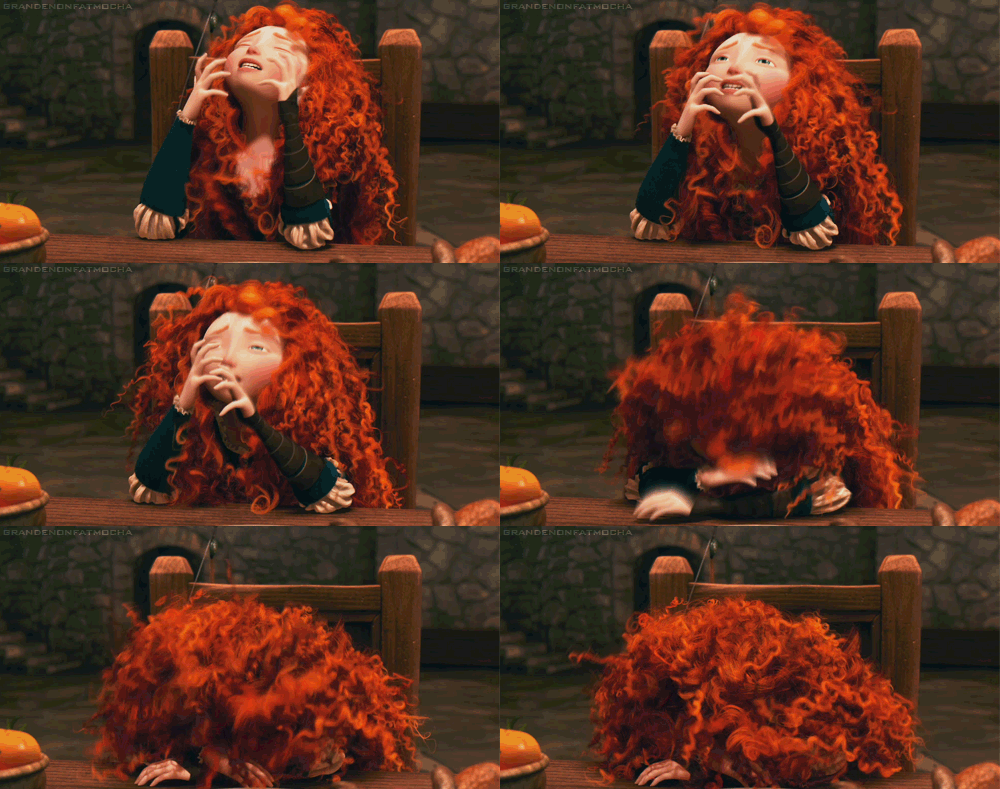
merida-headdesk

Also, we get this gem from Eragon.

“And you can do this even though you aren’t a rider?” asked Eragon.

Eragon, HOW ARE YOU THIS DUMB?!

There were a couple things I did like about this chapter, though. First, Brom teaches Eragon about communicating mentally with other sentient creatures, the same way that Eragon is able to talk to Saphira. Though years of playing DnD has made me disagree with Brom’s definition of sentience, it is a cool idea to be able to communicate with any living creature. The exposition didn’t have the clunky handling, either, as it did in some previous chapters. And there’s also this small piece of brilliance from Brom.

Think about it: you can communicate with any sentient being, though the contact may not be very clear. You could spend the entire day listening to a bird’s thoughts or understanding how an earthworm feels during a rainstorm But I’ve never found birds very interesting. I suggest starting with a cat; they have unusual personalities.

Yes. As the proud owner of one the derpiest cats on the planet, I agree so hard. Think of all the other famous fictional cats: the Cheshire Cat, the pirate cat in The Last Unicorn, and…okay, that’s all the cats I can think of, save perhaps Thackery Binx, who isn’t even really a cat.

But wouldn’t you love to know what Princess Monster Truck is thinking? I sure would.

princess-monster-truck

She is everything that is right with the internet.

Even better, my cries for more Saphira have been heard. She tackles Eragon and demands that he start flying with her so she can keep him safe. Some of her dialogue makes her sound like a concerned mom, but I’m happy she’ll be in the story more after this. Now that I’m a pilot, I’m also looking forward to reading more flying scenes, which I suspect will be much different from Eragon’s first flight.


Eragon 20: Sad Resignation to Keep Reading

The first thing I wrote upon starting chapter 20 was, “This was a lot more fun when I was drunk”. Yes, I was unnecessarily angry at a fictional character during the last chapter, but at least I felt something other than sad resignation to keep reading. For awhile, I thought that might be the only note I’d write down, as this chapter is a lot of exposition, and not much else.

I’ve talked a bit about world-building in novels, and I’ve said that in general, I like it better when the characters learn the rules of the universe as the readers do. It feels much more natural, and you’re not overwhelmed with a ton of information at once. Eragon is starting to show me the drawbacks of that method. It makes sense for the story, as Eragon starts out as a know-nothing dragon rider. However, the chapters that are nothing but exposition and conversation are starting to wear on me. Eragon accidentally using magic for the first time, and Brom’s angry admonitions of him were part of the story, though. Despite my earlier criticisms, they were exciting. This chapter is just a casual conversation, written to explain to Eragon and the readers how magic works.

I guess one of the things I don’t like about this chapter is that there’s nothing that breaks up the dialogue until the end. I know that it’s important to get information to the reader, but there’s got to be a better way of doing it than this.

Aside from that, I have several questions, not the least of which is, “why doesn’t Saphira have more screen time?”

Seriously.

Other than that, the Dragon Riders apparently kept their magic a secret, even at the height of their power, so their enemies wouldn’t be able to use it against them. I guess that explains why Eragon was so surprised that he could use magic, but it seems like something like that would be hard to keep a secret. It also really bothers me that Eragon has yet to make the connection that Brom was a Rider.

Brom also mentions that Shades and sorcerers get their magic from spirits, which makes it different from the Riders’ magic. “Spirits” largely gets glossed over in this book, and the next, with the only information we get about them being that they’re bad news. I don’t know if they’re elaborated on any further in the last two books in the series. I’d like to know more, but this chapter certainly wasn’t a good place to add even more details.

It’s also revealed that every person has two names, one that they’re given when they’re born, and a “true” name, which reflects who they really are. Sharing your true name is dangerous, as anyone who knows it has complete control over you. Since I will not likely be reading the final two books anytime soon, I let my curiosity get the better of me and Googled what Eragon’s true name is. This is what Christopher Paolini had to say:

I felt that giving them to readers would spoil some of the mystery and power they hold. You could say the whole Inheritance Cycle encompasses Eragon’s true name. But its short form is a secret between Eragon, Saphira, Glaedr, and Arya.

Aw, come on! I wanna know!


Eragon 19: Goddammit, Brom.

Full disclosure: I was not entirely sober when I read this chapter. My notes reflect this.

img_0930

In my defense, I’m of legal age, was safely at home, and the worst thing that happened was I got irrationally angry at a fictional character. That last part is not so different from when I’m sober, but this time I was just louder about it.

After so recently declaring that Brom was probably the best character in the book, where did this hatred come from? Let’s find out.

Eragon finds Brom wounded and unconscious, which prompted my note, “Seriously Brom, get your shit together”. I remember Brom being mad at Eragon for using magic, but I didn’t remember that he was wounded in this chapter. It’s a bit disappointing, because Brom’s been a much better character than Eragon. As the mentor figure, I really expected him to do a lot better against two Urgals, which I’m sure he’s slayed hundreds of before. And his excuse is, “I’m old, I can’t fight as well as I used to” is kind of crap, too. Because, you know, he’s an immortal Dragon Rider.

Saphira’s ignorance on the whole matter is also annoying. She doesn’t know what happened to Eragon or why he can suddenly use magic. However, it’s been established that Saphira has some kind of ancestral memory. She fled the Ra’zac because she knew they were bad news, even mentioning a specific battle that Eragon had never heard of. But dragons have been bonded to Riders for centuries, to the point where they’re dependent on to touch of a Rider to even hatch. If Saphira does have this racial memory, why wouldn’t she know that Riders can use magic?

After that question, most of my notes devolve into complaints about Brom, and how he never intended to teach Eragon magic. That seems pretty ridiculous to me. Maybe Brom didn’t want Eragon using magic so early in their journey, but keeping it from him entirely is pretty dumb.They’re eventually going to be facing off against the only remaining Dragon Rider, who we already know is insanely powerful. They’ll need to utilize every weapon they have to defeat Galby, but without using magic, Eragon would be at a huge disadvantage.

Brom explains that using magic is a huge risk, and casting a spell takes your own strength, which is why Eragon passed out after killing the Urgals. If you’re not strong enough to cast the spell, you’ll die. It’s understandable that Brom wanted to protect Eragon, but wouldn’t he be safer if he knew the risks of using magic before he actually tried it? Keeping him ignorant about it could have been much worse.

I do have one more question about magic, and it’s one that I’ve wondered about since I first read this book. To cast a spell, you have to say something in the Ancient Language, the language of the elves. “Brisingr”, for example, is the word for “fire”. To be able to use magic effectively, you need a strong command of the Ancient Language. I do like this idea, because it means there’s really no limit to what magic can do. Much more interesting than picking out set spells from a book. Even better, Eragon’s poor grammar using the Ancient Language becomes a plot point in the sequel.

But Eragon also becomes fluent in the Ancient Language in Eldest, and regularly holds conversations with the elves using it. What’s the difference between talking and using magic? Could he be casting spells while he tries to ask someone about their day? How is everything not on fire?