Eragon Chap. 17-18: An Orc By Another Name Still Stinks

Chapter 17 is full of great storytelling and characterization, and was such a gripping read that I had a hard time putting the book down. Or, you know, the opposite of that.

A lot of this book consists of the main characters traveling from place to place to place and having adventures on the way. Essentially, it’s a fantasy novel’s version of a road trip movie. Real-life road trips are usually pretty fun. Going to new places, meeting new people, singing along to the radio with your friends. The things that make road trips appealing and fun that we forget about all the massive inconveniences they entail. Things like getting lost, or sitting cramped in the backseat piled high with luggage, or constantly getting stuck in the middle seat with your seat on the hump, and your friends uncomfortable squished in on either side of you.

This chapter is dedicated to the parts of the road trip we’d rather forget. Like when I got really sick and wound up puking in a gas station parking lot. Most of this chapter consists of Eragon and Brom being miserable as they travel the plains, dealing with strong winds, thirst, and spending hours in the saddle. Even though this chapter doesn’t really reveal anything new about the characters or the plot, I at least appreciate that it’s not a comfortable trip. It does add a sense of realism, and it would be a pretty boring chapter if everything was nice and easy.

As a student glider pilot, I also enjoyed Saphira’s demonstration of how high winds and flying don’t mix. In the gales of a storm, Saphira has difficulty landing and her open wings caused her to keep getting blown away, including somersaulting in the as she tries to land. I’m not sure if it was meant to be comical, but I was amused by it nonetheless.

As much as I enjoyed watching Saphira try to land, and fail, a lot of chapter 17 felt like padding. The following chapter is much more interesting, when Brom and Eragon arrive in the town of Yazuac. I do feel a bit bad for Saphira, though. Because they have to keep her a secret, Saphira constantly gets left behind when Eragon and Brom go into a populated area. It makes sense, but I wish she had more screen time.

Their arrival in Yazuac is eerie, and the whole town is still and quiet. This is because, and Eragon soon finds out, the entire town is dead and has been put into one big pile of corpses. I didn’t really feel the horror that I should have when I read this, though maybe it’s because I knew it was coming. Eragon, at least, was horrified, and threw up. Which is a perfectly acceptable reaction to seeing a pile of dead bodies, if you ask me. I wonder if my indifference to this slaughter is also because “one is a tragedy, a million is a statistic”. Maybe it’s the writing, or maybe it’s because I’m a bad person. Hm.

This is also the chapter where Eragon has his first run-in with Urgals. In other words, orcs with a different name. I know that every high fantasy book has to have some bland, low-level mooks for the hero to plow through, but is it too much to ask for something other than “huge men with horns”? In the sequel, Eldest, the Urgals are more fleshed out as a race with their own social order and customs. Watching humans and Urgals try to work as allies is way more interesting than having them as generic enemies. But we’re still stuck in Eragon right now, and don’t get to see that.

Eragon kills two Urgals, shooting his bow and calling out “Brisingr!” as he does. “Brisingr”, as we later learn, is the elvish word for “fire”, and Eragon has used magic for the first time.

It’s a little too convenient for me. Not that Eragon used magic without any guidance–I’ll accept that, it is a fantasy story, after all–but that he knew the word “brisingr”. He’s heard Brom say it once, and thought it was a swear. I kind of think he wouldn’t remember one word in a pretty tight spot. In high stress situations, expanding my vocabulary is not on the forefront of my mind. I mean, I had to stop writing for about a minute today because I couldn’t remember the word “inevitable” as I was about to type it. If I were fighting monsters, the only thing I might be saying is, “fuck, fuck, fuck!”
Eragon 15-16: Br’om is the Ma’in Char’acter We Dese’rve

Here we are once again, with the short chapter-long chapter couplet. The first paragraph or so is actually pretty relatable, with Eragon remembering Garrow’s death and not wanting to get up and face the world. I think we’ve all done that at some point. After a loved one has died, sometimes the hardest thing to do is get out of bed.

I also want to share one line with you.

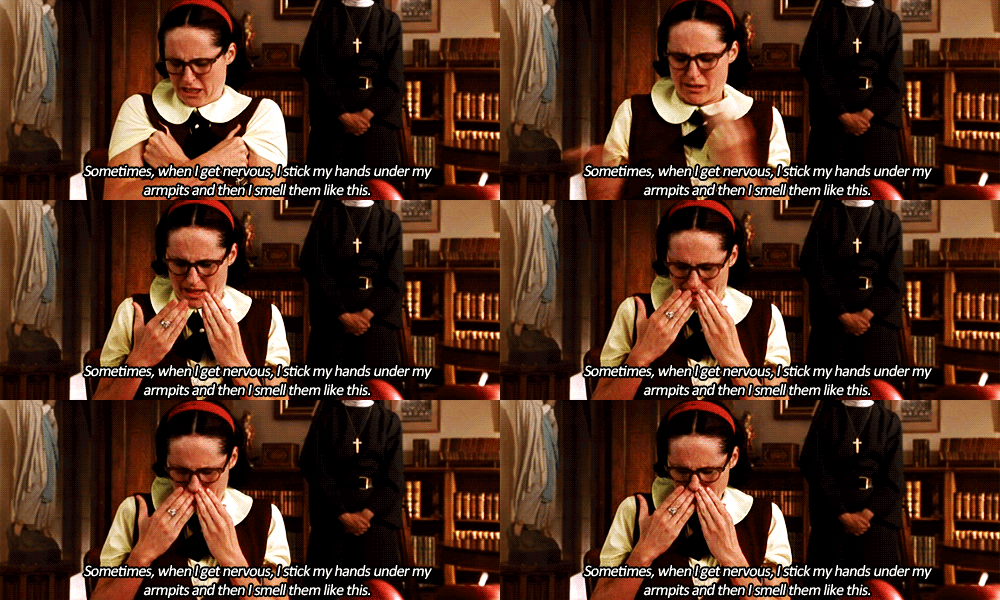
“He jammed his cold fingers in his armpits and crouched by the fire until the food was ready.”

Does that remind you of anything?

mary catherine gallagher

Ah, the 90s. A time when the women were strong, the men were good-looking, and the children are all wondering what the hell I’m referencing.

This chapter is (appropriately) called “Saddle Making”, in which Brom makes a saddle for Saphira out of a leather apron. Except I highly doubt that Brom is able to make a saddle for a dragon – albeit a young one – out of a single apron. Never mind the extra straps he cuts for when Saphira grows larger. Also, how the hell hasn’t Eragon figured out Brom’s a Dragon Rider?

Obi-Brom Kenobi is the source for all information on dragons up to this point. He has a “mysterious” past, and knows way more than any simple storyteller should. He can communicate with Saphira with his mind, build a dragon saddle, and freaking gives Eragon an actual Dragon Rider’s sword. Why the pretense, Brom? And why are you so dumb, Eragon? How have you not put the pieces together yet?!

Sighing and shaking my head, it’s time to move on to chapter 16. The first part of this chapter is largely exposition, and I’m pretty okay with how it’s been done, mostly because it makes sense with the story. Eragon has questions about dragons, and Brom answers them. What I like about this is that it’s not all done in Brom’s dialogue, nor is it done completely as narration. It actually strikes a good balance between the two. A surprise bonus of this is that I don’t have to read too much overly-flowery dialogue. Yay!

There is something I’ve always wondered about, though. Brom says that dragons don’t hatch until conditions are right for them to be born, which usually meant there was enough food for them. Dragons that the Riders used, though, would only hatch when the right Rider touched their egg. In other words, Saphira might have never hatched if Eragon hadn’t found her egg.

What happened to the “wild” dragons that were mentioned? I also find it hard to believe that dragons – notable for being a proud race – would leave the future of their species to humans and elves. Sure, Galby (I refuse to write his full name one more time) killing dragons and Riders didn’t help matters, but eggs only hatching when the right person touches them? Yeah, you’re going to wind up with an endangered species right there.

If the Eragon-verse had tumblr, I can only imagine what it would be like. “Dragons only hatch when humans or elves touch their eggs? SO RACIST. Check your privilege!”

Along with learning about dragons, Eragon asks Brom about how he got the sword of another Dragon Rider. Brom tells him that he doesn’t want to reveal it yet, and, “I don’t want to keep you ignorant, far from it.”

EXCEPT YOU TOTALLY ARE.

The sword’s history is revealed in the second book, if I recall correctly, and it would be pretty upsetting for Eragon to learn. I won’t hold it against Brom for not telling him, but…God, Brom just tell him you’re a Dragon Rider. It’s obvious to anyone who’s not Eragon.

One good thing about the book is that Eragon isn’t a total Mary Sue right away. During this chapter, he and Brom start practicing swordplay, and Eragon gets his ass kicked time and time again. He develops his sword skills throughout the book, and I like that he isn’t a “natural”. He has to learn, struggle, and get his ass handed to him. And since he’s been driving me crazy, reading about him covered in bruises fills me with a kind of smug satisfaction. Especially since Brom is a much more interesting character, and I’d be pretty happy if he lit out on his own with Saphira.

There’s also one more thing that’s really bugging me. Let’s see if you can spot it in this chapter summary.

Eragon takes his sword, Za’roc, so he can fight the Ra’zac while he’s traveling outside Utgard.

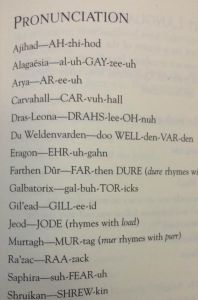
I’m not even halfway through the book, and I am so sick of these unpronounceable names with apostrophes.

Wait. I stand corrected. They’re not unprouncable.

pronunciation

But I feel like if you have to put a pronunciation guide in your novel, you’ve done something wrong.

Eragon Chap. 14: Dragon Advice

I’m not sure I get Saphira. She was my favorite character when I first read this book, mostly by logic of “ohmygodohmygodDRAGON”. She tries to give Eragon sage advice while he grieves, but I’m not sure of its validity:

Anguish enveloped Eragon as he awoke. [. . .] “I can’t live with this,” he moaned.

“Then don’t.” Saphira’s words reverberated in his head.

…did Saphira just suggest that Eragon kill himself?

Even now, I still like her character, and some of her dialogue.

The worth is in the act. Your worth halts when you surrender the will to change and experience life. But options are before you; choose one and dedicate yourself to it. The deeds will give you new hope and purpose.

But Saphira’s only a few months old at this point, though. She’s still a baby; the only human she’s seen up close until this point is Eragon. She understands how his mind works, but there’s no real reason for her to know anything about the world outside Eragon’s farm. Do dragons have some kind of ancestral memory that allows them to dole out advice like an older, wiser dragon? It’s the only explanation that would make sense to me, because Saphira knows things that there’s no way Eragon could have taught her.

On the other hand, some of her advice might be terrible.

Saphira was right. Nothing mattered anymore except the act itself.

We’ve also encountered the dead parent trope again. I’ll probably talk about this in more depth in a separate post, but I’m really sick of this. The laconic version is this: characters are more interesting when they have more to lose. Even if it leads to cheesy lines like this:

“Nothing is more dangerous than an enemy with nothing to lose,” he thought, “Which is what I have become.”

I used to love that quote when I was fourteen–a year younger than Eragon, actually. Growing up, I was bullied, ignored, never felt welcome in my school. I was an angry kid, an angrier teenager, and a line like that really spoke to me. For a long time I felt like it was me against the world, that everyone was my enemy. Since I felt so unwanted, I didn’t really see the point in playing nice with others. You might be able to imagine the unfortunate cycle that led to. The idea of a hero, fighting with no one on his side–and presumably winning–was very appealing to me.

At Saphira’s encouragement, Eragon decides to leave Carvahall and hunt down the Ra’zac, who destroyed his home and killed Garrow. Now, I know that we need the real adventure to start somehow, but I don’t like Saphira’s sudden change of heart. When the Ra’zac first came to Carvahall, she was so scared that she took off in a frenzied flight, taking Eragon with her. She was so terrorized that she wouldn’t even tell Eragon what was going on, and he was rebuffed when he tried to reach her with their mind-link.

Have you ever been so afraid of something that you couldn’t speak, or literally ran away from? I can almost guarantee that you would not be charging directly towards whatever it is you fear just because a teenager gave you a short lecture about running away.

Saphira’s fear was real and palpable, but nope, let’s forget that it ever happened. She’s over it now!

As they’re leaving town, Brom also comes to join Eragon and Saphira’s quest. He tries to sound mysterious about how he knows so much about dragons and the Ra’zac, but he’s not fooling anyone. Anyone who’s picked up a book or watched a movie like this already knows that he’s going to end up being a former dragon rider, and no doubt “Saphira” was also the name of his dragon. It doesn’t take a genius to figure that out. So why so the smokescreen? I honestly don’t remember if Brom ever gives a real reason for not telling Eragon about his past right away. I hope he does, and that it’s not something stupid.

This post is a bit lengthy, so I won’t go on to the next chapter right now. I will, however, leave you with this quote:

Brom’s eyebrows beetled with anger.

Beetled“?

Eragon 12-13: Adventure? Just Add Dead Parents

After reading a chapter that I actually liked, I was a bit more hopeful as I delved into chapter 12. This one doesn’t even start out with a silly “the X of the Y” title! Instead, it’s called “Deathwatch”. So if you’re wondering if Garrow’s going to die, the chapter title gives it away right there. Of course, if you’ve read enough books like these, you can probably assume that he was a goner anyway. As we all know, the catalyst for the adventure of a lifetime is the death of your caregivers.

http://static.tvtropes.org/pmwiki/pub/images/s_PArents_Are_Dead.jpg

It’s another trope that kinda bugs me, but more on that later.

I’m supposed to feel sad, or at least concerned for Garrow. But since he’s had barely any screen time (page time?), it’s hard to really care. Garrow seems like a good person, but that’s all we know about him. Throughout this chapter I was actually thinking more about Roran, who doesn’t yet know how his home’s been attacked and that his father is on his death bed. Maybe it’s a sign of me getting older, but I would be really interested in seeing how he takes the news. We don’t see much of Roran after he leaves, though. In the sequel, Eldest, he gets a much bigger role. And it’s way more interesting than Eragon’s.

But that’s the next book, not this one.

And while this book might be cliche in almost every way, I’ll give Paolini credit for actually having Garrow be covered in burns instead of stab wounds. It’s one of those things that I didn’t really care about when I first read this book, but I wasn’t trained in emergency response then. And during those grisly, grisly classes I had to take, I learned just how awful and potentially lethal burns really are.

I also know how to perform emergency child birth and what to do if you get an eye poked out. Those classes are not for the squeamish.

That’s about it, though. I really hoped that the surprising amount that I liked chapter 11 meant that this book was finally getting its shit together. Instead, the dialogue bounces back and forth between trying to sound medieval, but then switching back to modern language. At this point, I don’t care which style sounds better. I just want it to be consistent.

Compare for yourself: when the characters are discussing the Ra’zac, someone says,  “‘I don’t like this. Too much of this rings of wizardry.'”

When two pages earlier, Eragon was saying, “‘It’s okay, I can do it myself.'”

There is something else I’m confused about. When Saphira hatched, she gave Eragon a silver mark on his hand. Its ridiculous elven name translates to “shining palm”, so I have to assume that it does, in fact, shine. Gertrude, who is taking care of Eragon after the attack, asks him how he got such an unusual “scar”. But I’ve never seen a glowing scar before, and with the talk of magic and mysterious strangers in town, wouldn’t she have assumed it was also magical?

This post is getting a bit lengthy,  but the following chapter isn’t even two pages long. I think we can fit it here.

It’s also called “The Madness of Life”. Of all the cheesy titles so far, I think this has to be the worst one.

Here’s what happens: Garrow dies, but considering that the previous chapter was called “Deathwatch”, that’s hardly surprising. Eragon is completely inconsolable. Even if I’m not usually a fan of the “everyone you love is dead” idea that always seems to pop up in stories like this, I actually didn’t mind this chapter. Eragon’s utter grief and sorrow at the death of his uncle, to me, is the most relatable thing he’s done so far in this book. Honestly, the only thing I really hate about this chapter is the title.

Maybe Eragon is gradually getting better? Or am I just getting used to it?

Eragon Chap. 10-11: Noun of the Noun

If you’re me, you’d call chapter 10 of Eragon, “Wish Fulfillment”. If you’re Christopher Paolini, though, you give this chapter an over-the-top fantasy name, like “Flight of Destiny”. Which is one of those names that sounds cool when you’re fifteen, but as I haven’t been fifteen for a long time, it just makes me roll my eyes. That’s the thing with the writing in this novel. This is an exciting chapter, with the story finally kicking off and Eragon’s first flight on Saphira’s back. The problem is that all too often, the prose falls short, and things just aren’t as exciting or tense as they should be. I should feel Saphira’s terror and anger, as well as Eragon’s own dread. Maybe the problem is that I’m re-reading this and know everything that’s going to happen.

Some twentysomething out there, read this book for the first time and tell me if it’s the prose, or if it’s me.

One other thing that I’m noticing more and more is Paolini’s use of flowery words. I can understand it; he’s writing a story set in a fantasy medieval world, and therefore people are supposed to sound like they stepped out of a Shakespeare play. It doesn’t really work, though, because a lot of the dialogue sounds like it would be heard today. There’s just fewer apostrophes.

When Paolini does try to use a more obscure word in the narration, it just sounds goofy. Saphira is described as appearing before Eragon in “a gout of smoke.” We can assume that the “gout” is like a puff of smoke, but my first thought was of gout the disease. Which, fun fact, was sometimes called the “disease of kings” because it wasn’t terribly uncommon amongst royalty. But that’s neither here nor there.

In all fairness for this chapter, I like that Eragon’s first flight isn’t some beautiful and romantic experience. It’s full of panic, and Saphira’s scales end up injuring his legs quiet badly. If you haven’t noticed by now, I really appreciate it when reality comes into the fantasy elements. Eragon puking as he rides Saphira definitely qualifies as adding that realism. It’s almost enough to make me forgive how Eragon cries a single cliche tear at the end of the chapter.

Moving on, I was a bit confused when I finished reading chapter 11, “The Doom of Innocence”. Despite yet another cringe-worthy title, I was utterly befuddled when I found that I actually liked this chapter. What’s that about? It’s not perfect, and I still have my normal gripes about the writing. There’s still a couple lazy adverbs lying about, and it completely solidified the “Eragon is Star Wars with dragons” idea. Monomyth structure be damned, it’s the exact same story.

In the previous chapter, the arrival of the “strangers” scared Saphira so much that she flew to the neSpine, with Eragon on her back. The next day, he convinces her to go back to his home, only to find the farm destroyed and Garrow badly wounded. You know, just like how Luke returns home after meeting Old Ben and finds his igloo house destroyed and aunt and uncle dead.

But there were a few things that I actually did like about this chapter. First of all, the language of the dialogue and the narration finally match. Look at this conversation Eragon has with Saphira, when he’s trying to convince her to take him home.

“Both of us carry an obligation to Garrow. He has cared for me and, through me, you. Would you ignore that debt? What will be said of us in years to come if we don’t return–that we hid like cowards while my uncle was in danger? I can hear it now, the story of the Rider and his craven dragon! If there will be a flight, let’s face it and not shy away. You are a dragon! Even a Shade would run from you! Yet you crouch in the mountains like a frightened rabbit.”

Maybe it’s still a little over-the-top for me, but I like it much better than Eragon sounding like a teenager who grew up in the modern world.

We finally get to see Saphira’s personality, too. We saw only vague glimpses of Saphira before, and she only had a few lines of dialogue. Even in during her first flight with Eragon, she was so panicked that her actions don’t reflect what she’s normally like. Since Saphira’s the reason I haven’t given this book up yet, I’m glad that we finally get to see more of her.

The last thing in this chapter I liked was the endurance and the pain these characters go through. From what I remember of the first two books in this series, Eragon becomes ridiculously powerful as the series goes on. Here, Eragon’s legs have been rubbed raw from riding Saphira bareback, and Saphira exhausts herself to get Eragon and Garrow to Carvahall, finally landing when she can’t go any further. Eragon drags his uncle into town, legs bleeding all the while, until he passes out. I think Eragon’s determination to save Garrow is admirable. The fact that every step Eragon takes is a struggle makes it even moreso.

It’s the first time I think I’ve really supported Eragon while re-reading this. Because, like I’ve said before, most of the time he’s just a big idiot ball.

Eragon 8-9: Teenager, or Idiot Ball?

When I read books, I really like it when teenagers and child characters actually act their age. This was one of the problems I had with Angelic Layer, which was that the young child acted nothing like a little kid. But in Chapter 8 of Eragon, I can’t decide if Eragon is acting his age, or just being a big idiot ball. But since he’s only fifteen, I think it’s fair to say that he’s an idiot by default.

When Roran tells his father, Garrow, that he plans to leave, Garrow is totally okay with it. In fact, he’s happy for Roran. Eragon is pretty surprised at Garrow’s reaction, and disappointed with it. On one hand,  I understand that he’s going to miss Roran. But on the other, what the hell was he expecting? Roran’s got an opportunity to make a better living than he does on the farm, and make enough money to get married.

I think I’m supposed to be sad, or at least feel something. But Roran doesn’t have any real character yet, and the only thing we know about him so far is that he’s in love with Sloan’s daughter. I’m almost reminiscent about when my sister left for college. I was sad when she left, but I also knew that her leaving home was inevitable, and it ended up being one of the best things to happen to her. So sure, Eragon, be sad, but don’t resent Roran for moving forward with his life.

Before we move on to the next chapter, I’d like to end it with a quote near the end of the chapter, when Roran is packing to leave.

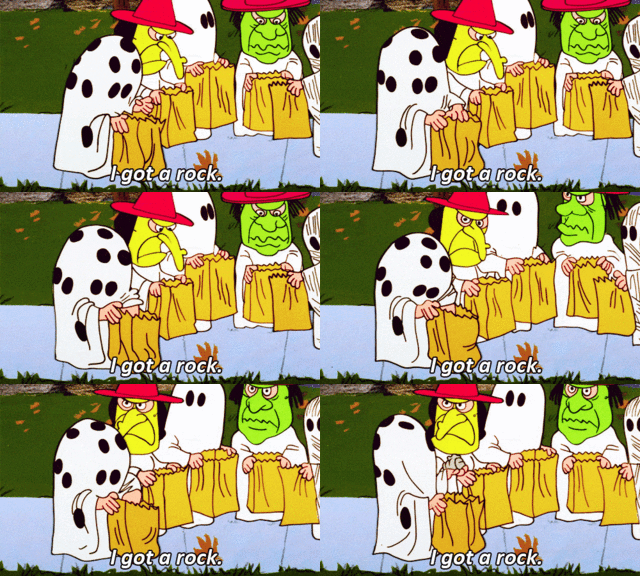
“[Roran] paused, then picked up something from the pillow and bounced it in his hand. It was a polished rock Eragon had given him years ago. Roran started to tuck it into the bundle, then stopped and set it on a shelf. A hard lump formed in Eragon’s throat, and he left.”

I know that this is supposed to make me feel sad, but it only reminds me of “It’s the Great Pumpkin, Charlie Brown!”

i got a rock.gif

Moving on to chapter nine, where we finally got…plot! Yay, plot! The chapter begins with Roran leaving the farm and Garrow giving advice to him and Eragon. It’s as awkward as it is sweet. But in the back of my mind I had to remember that the author was only fifteen when he wrote this. A lot of that shows in his prose, but it kind of dampened the impact of Garrow’s farewell speech to me. Garrow talks about life and love, giving him advice for the future. Things that the author’s never experienced. It actually reminds me of a time, during my senior year of college, when a freshman tried to complain to a group of seniors about his workload. In an out-of-character moment for me, I ripped this guy a new asshole, (loudly) explaining how he can complain about his work to other freshmen, but he had no right to whine to us.

He never complained in front of me again.

Of course, when we’re teenagers, we think we know everything. So maybe Paolini trying to show off his “wisdom”, such as it is, is entirely in-line with the rest of his writing.

Eragon goes into town to see Roran off, and is warned by another villager that there are strangers who have been asking about the “stone” he found in the Spine. Eragon puts the pieces together that someone is after Saphira. Well, what were you expecting, Eragon? You know the Empire and Galby killed the other Dragon Riders, and you even acknowledged that they would probably hunt down Saphira, too. God, you’re dumb.

And watch out, because I’m going to tear apart a single sentence. Again.

“The voice was deep and moist.”

Ugh.

No one likes the word moist. And I’m not even sure how a voice can sound “moist”, unless they’ve got a lot of spit in it. The idea was that the stranger’s voice gave Eragon a sense of rot and decay. But there just had to be some better way to evoke this. Because right now, I’m only giggling. Because the voice is deep, like a cave. And moist, like a…cave.

An Ember in the Ashes

I’m back, baby! I’ll be getting back to Eragon shortly, but I’d like to take a a moment to review a more recent book, An Ember in the Ashes by Sabaa Tahir. I’ll also be posting parts of this review on GoodReads, so don’t worry–I’m only plagiarizing myself.

An Ember in the Ashes follows the stories of two main characters: Laia and Elias, with each chapter switching between their perspectives. They lead very different lives in the Empire; Laia is a poor Scholar, while Elias is one of the top students at the elite military academy, Blackcliff. When Laia’s brother is jailed for treason and her family is killed, she seeks the help of the Resistance to save him. In exchange for freeing him, she agrees to spy on the Commandant, the leader of Blackcliff. Elias dreams of freedom outside of Blackcliff and plans to desert after his graduation, even though doing so is punishable by death. When fate intervenes, Elias stays at Blackcliff, where he finally meets Laia, and their lives are forever changed.

As long as you don’t mind first-person present tense or changing character perspectives every chapter, the prose is quite good. I never came across a line that made me want to pull my hair out because it was so poorly phrased, which is more than I can say for some of the books I’ve reviewed on this blog. Even so, some of Laia’s chapters just felt like they were padding, and only part of the book to keep with the pattern of switching between the two characters. This is especially true during Part 2, when most of Laia’s chapters are just details of the Commandant’s abuse. They don’t reveal any new information about Laia or the Commandant, nor do they move the plot forward. I’m all for treating your characters horribly, but at least make sure that their suffering is for something. Laia herself is a rather insipid character. She doesn’t grow much throughout the novel, her most daring moment being when she agrees to spy for the Resistance. Even that seems out-of-character for her, as she’s quite meek and doesn’t take risks. Elias’s side of the story is more interesting, and he’s one of the few characters in the book I ended up liking. At times, I really felt that the novel could benefit by removing Laia’s chapters entirely.

Laia’s character isn’t the only one that needs to be fleshed out. The Commandant – who is also Elias’s mother – is the lead villain in the story. She is evil because…well, because she’s evil. She enjoys abusing her slaves, killing members of the Resistance, and actively tries to get others to murder Elias. Her reason behind all this? She’s evil. She’s never made even slightly sympathetic, and the readers are never really shown her motives.

The world building is also problematic. The first two chapters are in media res. It might be exciting, but because the book’s just starting out, the reader has nothing invested in the two main characters. We don’t have any reason to like them, and can’t really appreciate the impact of their actions until later in the book. Exposition in the beginning of the book feels heavy-handed and shoved in for the benefit of the audience. In later chapters it comes more naturally. Or maybe I’d just gotten used to it at that point.

An Ember in the Ashes wasn’t really a book for me. Sometimes I thought the book would redeem itself, but for everything in it that I liked, it did two things that I didn’t. At the end of the day, its flaws outweighed its strengths.

Still, if it sounds like a book you might enjoy, check it out. I just wouldn’t recommend paying full price.

I only came to read An Ember in the Ashes in the first place was because my sister and I are in a small book club. Obviously, this wasn’t my selection for the group. My sister and I were not overly thrilled with the prospect of reading yet another young adult book staring a girl in an oppressed society starting a revolution and finding true love along the way. To help keep us both sane–and give us something to smile about while we dragged ourselves through this–I texted her a one-sentence review of each chapter. Please, enjoy my descent into madness.

  • Chapter 1: I read this chapter three hours ago and I already forgot the brother’s name because that’s how little I care.
  • Chapter 2: There’s so little world building or characterization that I neither understand the importance of or care about anything that’s happening.
  • Chapter 3: All the things I dislike in this chapter won’t fit in a single sentence.
  • Chapter 4: If Elias wanted to desert, why didn’t he run when the school literally kicked him out to survive on his own for four years?
  • Chapter 5: Have I ever mentioned how much I hate first-person present tense?
  • Chapter 6: Not really loving the way the exposition was handled here, but it’s more than the rest of the book has given us so far.
  • Chapter 7: At this point, “character development” would mean that the main character develops a personality.
  • Chapter 8: Just once, I would like to read a young adult fantasy novel that never uses the word “destiny”.
  • Chapter 9: I’m a little amazed that I have the willpower to not throw this book across the room.
  • Chapter 10: You know, it is possible to write a young adult fiction without having a “chosen one”.
  • Chapter 11: Wait, when did Laia grow a spine?
  • Chapter 12: The more I think about the details of Blackcliff Academy, the less sense it makes.
  • Chapter 13: I really hope the Commandant becomes an actual character, and not just a villain who’s evil for the sake of being evil.
  • Chapter 14: OF COURSE LAIA IS SO BEAUTIFUL WITH HER GOLDEN EYES AND LONG EYELASHES AND “FULL LIPS”
  • Chapter 15: When will this end?
  • Chapter 16:  Every time this book comes close to being cool, it ruins it.
  • Chapter 17: Laia’s chapters are nothing but light torture porn.
  • Chapter 18: I seriously suspect Sabaa Tahir has mommy issues.
  • Chapter 19: This is not how you build a strong female lead.
  • Chapter 20: Changing perspectives every chapter makes the slow story progression less noticeable, and I’m not sure if Tahir is a genius, or can’t get a handle on pacing.
  • Chapter 21: All of Laia’s chapters in a nutshell: Laia is sad because someone either tells her she makes a lousy spy or hurts her.
  • Chapter 22: There’s one female character with depth, and her entire arc is about men lusting after her.
  • Chapter 23: I make a motion to replace all Laia chapters with Spiro Teluman chapters.
  • Chapter 24: Can we talk for a second about how Elias and Helene didn’t actually use their cunning to pass the Trial of Cunning?
  • Chapter 25: This chapter made me so happy because it means I’m halfway through this waste of paper.
  • Chapter 26: I strongly suspect Helene’s sudden burst of racism is because Tahir noticed she was a much better female lead than Laia.
  • Chapter 27: Generally, it takes normal human beings more than thirty-second conversations to fall in love with each other, no matter how beautiful they are.
  • Chapter 28: This is just four pages of Elias thinking Laia is hot.
  • Chapter 29: If the flirting in this chapter was any more awkward or forced, it would be the second Avengers movie. #2Burns1Stone
  • Chapter 30: This book talks about sexual violence a lot.
  • Chapter 31:  Achievement unlocked: cameo character is more intriguing than main character.
  • Chapter 32: I also vote to remove insipid and predictable love triangles.
  • Chapter 33: NOPE.
  • Chapter 34: Can we go one chapter without mentioning rape?  
  • Chapter 35: I’m not sure what I hate more: that Helene goes completely against her established character, or that Laia’s only role in this book is to be a punching bag.
  •  Chapter 36: The Helene-Elias romance subplot is so, so dumb.
  • Chapter 37:  Five bucks says the Resistance is going to betray Laia.
  • Chapter 38: And now we’ll take a break from an Ember in the Ashes to bring you a less interesting version of The Hunger Games.
  • Chapter 39: You know, this backstory would have been really useful AT THE BEGINNING OF THE FUCKING BOOK.
  • Chapter 40: There are so many logical holes in the Trial of Strength I wouldn’t be able to list them all here.
  • Chapter 41: Laia, how are you this stupid and still alive?
  • Chapter 42: So many eyerolls.
  • Chapter 43:If the Commandant knew that Laia was a slave since the Moon Festival, why didn’t she kill her much sooner?
  • Chapter 44: The “Trial of Loyalty” is really just a test of who could get to Laia the fastest.
  • Chapter 45: I call bullshit on Laia suddenly be able to take the Resistance leader hostage, in his own hideout, surrounded by his supporters.
  • Chapter 46: This is the closest thing we get to an explanation of the Commandant’s anti-social behavior, and it still fails to explain anything or make her an iota more sympathetic.
  • Chapter 47: Laia is way overdue to become a strong heroine, but when it actually happens, it just is out of character for her.
  • Chapter 48: I’m supposed to feel something at Elias’s rapidly impending death, but mostly I’m annoyed that all he’s doing is whining and quoting Serenity.
  • Chapter 49: We really shouldn’t have to wait until the second-to-last chapter of the book for the main character to do something useful.
  • Chapter 50: OH THANK GOD I’M DONE

Final Thoughts:

T81Ltam

I hated this book. The love triangles were unnecessary and sloppily written, the magical aspects go unexplained, the villains are never given any depth, Laia is almost on par with Bella Swan as a female lead, and the book doesn’t even freaking end. I’ve read 50 chapters of this crap, and nothing gets resolved: not the romantic subplots, Laia’s quest to save her brother, or even a basic explanation of Helene’s sudden magical powers. Nope, there’s a sequel coming out, and someone’s already got the movie rights.

And, to get on my soapbox for a minute, this is also on par with Twilight for bad female role models. Helene is the token strong girl, but her entire character arc is about men lusting after her, and her doing anything she can to keep Elias alive. Including swearing fealty to the man who has directly said that he’s going to rape her. Laia’s not much better, as her arc is almost entirely her getting tortured or beaten up (and then rescued by Elias)–for another male character, albeit her brother–and she doesn’t do anything proactive until the very end of the book. The one female character whose arc doesn’t revolve around a man is the Commandant, who is a heartless monster (for no fucking reason).

This book is 446 pages of drivel. Sabaa Tahir’s prose is well-written, but the characters are flat and boring, and the story has no satisfying resolution.

Screw this. It’s my turn to choose the next book for book club, and after reading Me Before YouThe Nightingale, and now, An Ember in the Ashes, I need to get away from all this stupid chick lit. If you need me, I’ll be nose deep in Do Androids Dream of Electric Sheep?

Eragon 6-7: Exposition for Two

When you’re writing something that doesn’t take place in the real world, you have to find some way to tell the audience the “rules” of the universe. There are two main ways authors do this: by directly stating what those rules are (The Hunger Games loves this) or Character A telling Character B explaining the rules. In most cases, Character B is some kind of newcomer–like Obi-Wan teaching Luke about the Force, for instance.

Most authors use a mix of both methods, which works well, but I prefer the latter. I think it helps the story flow more naturally, and helps keep the reader in the world a bit more easily. And then there are chapters like this.

Eragon goes into town, and meets with Brom the storyteller in a chapter that is nothing but exposition. Eragon, naturally, wants to learn more about dragons and the Dragon Riders, and has plenty of questions about both. The whole chapter is Eragon asking questions, and Brom giving him the answers. We learn about the history of the Riders, and more about dragons themselves. Even though I generally prefer this method of getting information to the readers, for some reason I don’t like it here. I can’t exactly pinpoint why. Part of it might just be that it feels lazy–Paolini couldn’t figure out how to wedge all this in, so he put it here. Or maybe it’s the length of the chapter that bothers me. It’s pretty long–longer than the last two combined. There’s not a lot of action, just a back-and-forth. I just don’t like large information dumps, and I wonder if cutting out some of the details of this chapter would have helped me like it better. Of course, this is also my second time reading the book, so I already know what Brom’s going to say. Obviously, this stuff isn’t going to be as interesting to me the second time around.

Well, whatever. I didn’t like the way the information was shoved down my throat. I also had one head-scratching moment, wherein Brom describes a war between the dragons and the elves. It was a huge war that left the land devastated, but it only lasted…five years? Okay, that’s a long time for a human war, but we’re talking about creatures that live for centuries. Five years seems a little short.

Moving on to the next chapter.

Chapter 7 is another unevenly short chapter, not quite four pages long. On their way back to the farm, Eragon’s cousin Roran announces that he’s accepted an offer of work in another town. Eragon doesn’t really want Roran to leave, and suggests he wait until spring. Roran disagrees, and says he will be leaving shortly while they’re waiting for winter. Even though this isn’t a book about the division of farm labor, I still need to ask: where the hell are all the farmhands? It’s only Roran, Eragon, and Eragon’s Uncle Garrow working on the farm. How do just the three of them manage to keep it running and productive? How did Garrow and his now deceased wife manage to do it before Eragon and Roran were old enough to help? And for that matter, why doesn’t Garrow have, like, ten other kids to do farm work?

It’s been said that when you’re writing science-fiction, you get one lie, and you have to then work within the confines of that lie. Everything else has to follow the rules. Fantasy, I think, is a little broader, but still follows that principle. f you’re writing about dragons, that’s fine, because dragons are mythological creatures and you can do what you want with them, as long as you follow the basic rules. Things like dragons fly, breathe something dangerous, and could kill you several times over.

Suspension of disbelief is a funny thing. I’m all for dragons and magic–that’s why I picked up this book in the first place. It’s the small, nagging details that bother me. You want to write about a dragon that flies and breathes fire? Cool. Go ahead. But if you’re writing about something that exists in real life, that readers know about, then you have to make it realistic. Realistic details in a fantasy setting make the world plausible. It’s not the fantasy elements that will drive readers away. What will turn them if is when they don’t see the familiar reflected in the extraordinary.

That was kind of an unexpected rant. Anyway, the dragon was finally named “Saphira”, surprising absolutely no one. First of all, she’s a bright blue dragon. Second of all, you know another Saphira was important to Brom, just from the way he said it.

Anyway, moral of the story? It’s cool if your main character can shoot fireballs from his hand or whatever, but if he, say…lived in the 21st Century and didn’t have an email account, I would seriously have to question both the author’s writing choices and their* perception of what is normal in the world.


*Strunk and White be damned, I’m totally okay with “they” as a singular gender neutral pronoun.

Eragon 4-5: How to Write Your Dragon

Remember when I said that the chapters in this book were really uneven, length-wise? Chapter 3 was 16 pages of exposition, backstory, and stupid names. Chapter 4 isn’t quite 3 pages long, and so short it would hardly be worth mentioning, if not for one event in it.

Saphira!

That’s right, the dragon finally hatches, and I remember the reason I started reading this book in the first place. So far I’ve found it cliche and unintentionally humorous, but maybe things will change from here on out. Maybe, with the dragon in the picture, things will get better from here.

Let’s read to find out. Moving on to the next chapter!

What I like about this is that it actually goes into depth about Eragon’s thought-process when it comes to keeping Saphira. He has to take into consideration how he’s going to take care of a dragon, how he could hide it, and even if he should keep it. It takes him a couple pages figuring out his rationalization to keep the dragon, despite all the reasons he shouldn’t. You know, like Galbatorix (I hate typing that name) swooping down to kill him and everyone he loves. So that’s decidedly a “con”. Pros of raising a dragon: IT’S A DRAGON!

If I were Eragon, I would totally risk keeping a dragon. Saphira’s the best part of this book! You have no idea how much I love dragons, guys. If someone offered me a billion dollars or a dragon, I would take the dragon. Especially if it was an intelligent one that you shared a mind-link with! And if a dragon egg hatched under my watch, you can imagine I wouldn’t be calm about it. Which is why I’m a little disappointed that Eragon is so cavalier about this.

Let me put it like this:

Remember when you were a kid, and you loved dinosaurs? You read books about dinosaurs, you drew dinosaur pictures, you collected dinosaur stickers, you loved to hear stories about dinosaurs. You were probably sad that there aren’t any dinosaurs anymore, and wouldn’t it be great if they came back?

Well, suddenly, a baby dinosaur hatched in your bedroom, and it’s the first dinosaur to be born in millennia. What do you do?

You’d probably freak out, for a start. Maybe wonder if it’s a prank, or if the dinosaur is real. After all, there haven’t been any for millions of years. My point being, you would not be calm and rational, and you wouldn’t accept it right away that suddenly you have a long-extinct creature in your bedroom.

Eragon doesn’t for a second doubt that it’s a dragon, that it’s real, and that he was meant to have it. Remember, dragons were supposed to be wiped out by Galby (I refuse to write “Galbatorix” one more time) hundreds of years ago, but Eragon doesn’t have any trouble accepting that this mythical, should-be-extinct creature, is in his bedroom. His calm reaction is just so unnatural.

The rest of this chapter is Eragon learning more about Saphira, and it’s pretty disappointing. In fantasy and science-fiction, characters experience things that we, in the real world, will never get to do. That’s a big part of their appeal. We’ll never be able to fly on the back of a dragon or shoot fire from our hands, but through books like this one, we can imagine what it’s like. Which is why Paolini’s vague descriptions of Eragon’s interactions with Saphira are so annoying to me. For example, he tells us that Eragon played with the dragon, but doesn’t say what that means. Were they playing fetch? Hide and seek? Chasing mice? How would an intelligent creature with abilities different than ours (and a newborn) react to her rapidly expanding world? How does Eragon respond to her actions? There’s a lot of possibility to show us some exciting (and adorable) stuff, but it just gets glossed over.

I want to play fetch with a baby dragon so badly.

Eragon 3: This is a Joke, Right?

It is truly shocking how little I care about the goings-on in Carvahall, Eragon’s village. Since I’ve read Eragon already and know what’s going to happen, there’s no tension in this chapter anymore. I wonder if this is one of the reasons I never read this book twice, despite how much I enjoyed it the first time around. So far it’s the longest chapter in the book, and it’s nothing but exposition.

Before I get into that, though, I want to pick apart the text.

“He helped himself to a piece of chicken, which he devoured hungrily.”

Does anyone else see what’s wrong with that sentence?

I’ve taken enough creative writing classes to know that you should (a) avoid adverbs and (b) use verbs for description.

I love how Stephen King put it in his memoir, On Writing:

“I believe the road to hell is paved with adverbs, and I will shout it from the rooftops. To put it another way, they’re like dandelions. If you have one on your lawn, it looks pretty and unique. If you fail to root it out, however, you find five the next day…fifty the day after that…and then, my brothers and sisters, your lawn is totally, completely, and profligately covered with dandelions. By then you see them for the weeds they really are, but by then it’s–GASP!!–too late.”

One or two adverbs here or there are okay. Too many, though, and they become annoying and repetitive, and make your writing look lazy and weak.

And this ties into into (b) use verbs for description.

Don’t get me wrong, adjectives are great. But verbs are better.

Compare:

“I don’t like it,” she said in a soft voice.

To:

“I don’t like it,” she whispered.

They both mean the same thing, but the second sentence should feel stronger and put a more immediate picture in your mind than the first. If it didn’t, I’ve clearly done something wrong here. Like adverbs, adjectives can get ungainly when they’re overused. Don’t use two words when one will suffice.

If you haven’t figured it out yet, my problem with the above sentence is two-fold. Obviously, I don’t like “hungrily”. But it’s also redundant. If Eragon is “devouring”, he’s clearly hungry; there’s no need to say he devoured something “hungrily”.

“Eragon devoured the chicken.”
“Eragon hungrily ate the chicken.”

Either of these would have been better than what we got.

I just spent way too much time picking apart one sentence that’s probably gone unnoticed by most readers.

As for the rest of this chapter, it’s mostly just exposition. A good portion of it is just the villagers talking about how much they hate the Empire. I think it would be better if it was done using more dialogue and didn’t rely on the narration so much, but it also seems to repeat itself a lot.

The most important part of this chapter comes at the end, when Brom tells the story of the Dragon Riders. They were a group of Mary Sues humans and elves who rode dragons and kept peace throughout the land. So, you know, Jedi, but with dragons. As you might imagine, some tragedy befell them, and now the Dragon Riders are no more. Or, as Brom tells it:

“‘Some saw his abrupt rise as dangerous and warned the others, but the Riders had grown arrogant in their power and ignored caution. Alas, sorrow as conceived that day.'”

Hahaha! This is another case of flowery words backfiring. “Conceived”? Really?

“Brom, how did the Riders fall?”

“Well, Eragon, when a Dragon Rider loves arrogance very much, they conceive sorrow!”

The story is about a Rider named Galbatorix…

…yes, that’s his real name. Not a name that he took after going crazy and becoming evil. Sigh.

Galbatorix’s dragon was killed, he went crazy, and the Riders refused to give him a new one. Now, Brom talks a lot about how cunning Galbatorix is, and how skilled he was with magic and a sword. Basically, a real bad-ass. When he goes to overthrow the Riders, though, he can only do it with the help of an accomplice, Morzan.

“‘Galbatorix convinced Morzan to leave a gate unbolted in the citadel Ilirea, which is now called Urû’baen.'”

Two things here: First, all of those names are so cringe-worthy. The dragon Galbatorix steals is even named “Shruikan”. You know, “shuriken” spelled wrong.

Second, Brom spent so much time telling us how dangerous Galbatorix was on his own, I’m kind of finding it hard to believe that all he needed was a gate left open instead of melting the lock with magic, or blasting it open, or disguising himself as another Rider. Once Shruikan is all grown-up, Galbatorix and thirteen other defectors kill the other Dragon Riders. Vrael, leader of the Dragon Riders, fights Galbatorix, but…well, this is the part where I nearly threw the book down with rage.

“‘As they fought, Galbatorix kicked Vrael in the fork of his legs. With that underhanded blow he gained dominance over Vrael and removed his head with a blazing sword. [. . .] And from that day, he has ruled us.”

A crotch shot?

A CROTCH SHOT?!

THE WORLD WAS CHANGED BECAUSE OF A CROTCH SHOT?!

THE ENTIRE WORLD COULD HAVE BEEN SAVED IF VRAEL WORE A CODPIECE.

WHAT IS THIS SHIT.