June Book Recs: Read with Pride

A little blog update: I am still dealing with personal issues which has impacted my writing. I’ll be posting (hopefully) posting Flash Fiction Month stories here daily throughout July, and then will be taking a break from the blog until September. My brain needs it.


June is Pride Month! Pride celebrates LGBTQIA+ history, culture, and. well…pride! Pride began with the Stonewall riots in June and July of 1969, and June was officially recognized as “Gay and Lesbian Pride Month” in 1999. LGBTQIA+ rights have come a long way, but there’s still a lot of progress to be made, especially as the trans community is increasingly under attack.

LGBTQIA+ covers a huge range of identities, and two books certainly can’t cover all of them. The two books I have here were stand-out options for Pride.

Nonfiction

Real Queer America: LGBT Stories from Red States by Samantha Allen

Samantha Allen, a trans woman, loves the places that queer people are supposed to fear. She and her friend Billy, a trans man, embark on a road trip across red states in the United States, to tell the stories of queer people who live, or have chosen to stay, in places that are often thought to be unwelcoming or even unsafe for queer individuals. They start in Provo, Utah, where Samantha had attended Brigham Young University pre-transition, and finds a sanctuary that she would have thought would never exist. Texas is outrageously fun despite the state’s anti-trans laws, then it’s on to Indiana, where Samantha met her wife. They stop in Tennessee, Mississippi, and finally, return to Samantha’s home with her wife in Florida. Samantha and Billy’s journey is one of surprising compassion as they find queer spaces and people who welcome them unquestionably, and bright spots of love and acceptance in whatever state they’re in. The author also includes her personal history, and reflects on anti-trans policies in the era of the Trump administration. Most of all, this is a story about connecting that reminds the readers the queer Americans are everywhere, carving out loving spaces for themselves, and road-trippers who happen to come their way.

On a Sunbeam by Tillie Walden

On a Sunbeam is a space opera graphic novel that follows a young woman in two different times of her life. Mia isn’t the best student at her high-end boarding school, Cleary’s School for Girls. Her only real interest is the school sport Lux, her passion for which gets her in trouble. While waiting outside the principal’s office, Mia meets Grace. Grace seems to have a secret – and magic powers? – but the two girls soon fall for one another. Five years later, newly graduated, Mia gets a job on aboard the spaceship Aktis. The crew consists of Char, her wife Alma, Alma’s niece Jules, and Elliot, who is non-binary and non-verbal. Mia joins the crew in restoring old buildings in space, and chronicles the things they discover. Char, Alma, and Elliot all have histories they’d rather Mia not know, and Mia has some unfinished business of her own. I don’t want to say too much about the plot without giving it away, but this is an epic and imaginative story of queer love, found family, forgiveness, and of course, space.

Summer Updates

It doesn’t matter that the calendar says the solstice isn’t until June 21 – summer is here. I just wanted to do a quick update about what that means for the blog.

Summer is by far my busiest season. I’m also dealing with some personal matters right now, and some days I just don’t have the extra spoons to read or write (“The Spoon Theory” by Christine Miserandino [pdf]). I’ll do a book recommendations for the summer months, but not much else in June and August. July is also Flash Fiction Month, so I’ll be endeavoring to post a short-short story every day. I know that sounds contradictory, but they’re two different processes.

I’ll be back on Friday with a couple book recommendations for Pride, and then I hope to see everyone back here in July!

May Book Recs: Asian-American and Pacific Islander Heritage Month

Without in any way limiting the author’s exclusive rights under copyright, any use of this publication to “train” generative artificial intelligence (AI) technologies to generate text is expressly prohibited. The author reserves all rights to license uses of this work for generative AI training and development of machine learning language models.


May is Asian American and Pacific Island Heritage Month in the U.S.! AAPI Month began as Asian/Pacific Heritage Week in 1978, and was extended to the entire month of May in 1990. In 2009, the obserservance’s name was changed to Asian American and Pacific Islander Heritage Month. Asia and the Pacific island are both huge places with numerous cultures, and a short list like this can’t possibly cover every country. I’ve decided to showcase four books for this month, with one book focusing on Asia, and one on the Pacific Islands for each category. 

As a reminder: I don’t distinguish YA from adult books on these lists. This is a deliberate choice, for several different reasons I might get into on another post. However, if you are dead-set on not reading any books outside your demographic age, here’s a simple guide: if the main character is a teenager, it’s probably a YA book; if the main character is an adult, it’s probably an adult book. This isn’t always the case, and I do try to note when books featuring teen characters would be better suited for older audiences.

Without further ado, here’s some books to celebrate AAPI month!

Nonfiction

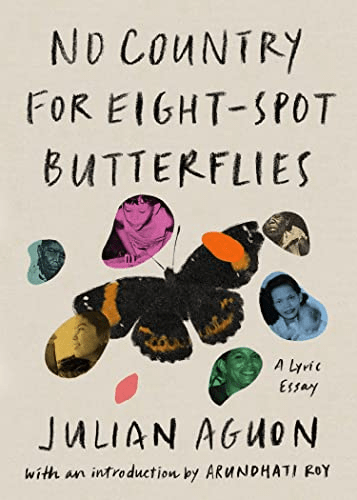
No Country for Eight-Spot Butterflies: A Lyric Essay by Julian Aguon

Julian Aguon is a Chamorro human rights lawyer and the founder of Blue Ocean Law, which specializes in Indigenous rights and environmental justice. He’s also a passionate and talented writer, as exemplified in No Country for Eight-Spot Butterflies. This book is a collection of his essays, speeches, and poems, but it’s also a love letter to the young people of Guam. “The Ocean Within” encourages high school graduates to imagine, dream big, and “get quiet” when they search for their destiny. Other essays discuss threats to the natural world, through climate change and increased militarization of Guam, despite its residents’ protests. Loss and grief are also central themes, shown in deeply personal writing. Though some entries are painful (“Fighting Words” is particularly difficult to read), overall, the book encourages its readers to make changes in the world, even if it’s only in a small way. My favorite essay was “Nikki and Me,” which resonated so strongly with me I had to read it twice. 

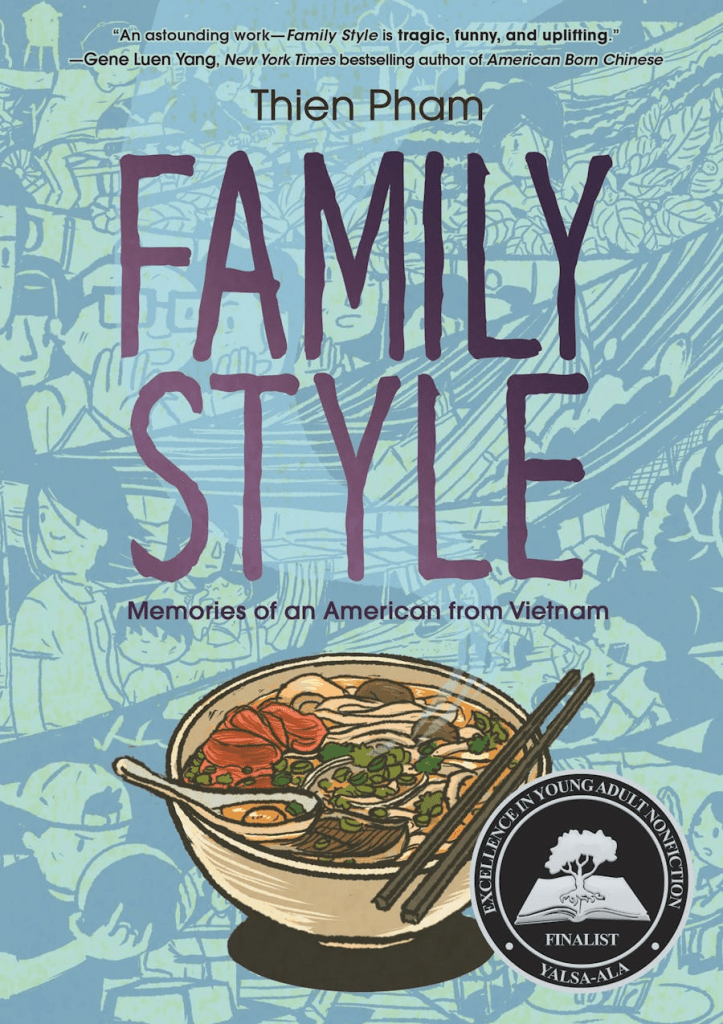
Family Style by Thien Pham

Thien’s first memory is “the saltiness of fish…and the sweetness of rice” when he was a young child on a refugee boat traveling from Vietnam to Thailand. Food is the prominent framing device in this graphic novel memoir, which shows Thien’s life first as a refugee, then as a Vietnamese immigrant, and finally as a U.S. citizen. Each period of his life is marked by an important food, from the bánh cuốn his mother cooked in a refugee camp in Thailand to the ham and cheese croissants that signify the Pham family gaining financial independence in the United States. Thien chronicles his family’s story of starting a new life in America with help from other Vietnamese refugees. Challenges included learning English, financial hardships, and strange cafeteria food. At times Thien questions his cultural identity, trying to understand what it means to be Vietnamese and American. While parts of Thien’s story are harrowing, particularly his journey to Thailand, the graphic novel is well-balanced with humorous and touching memories as well. 

Fiction

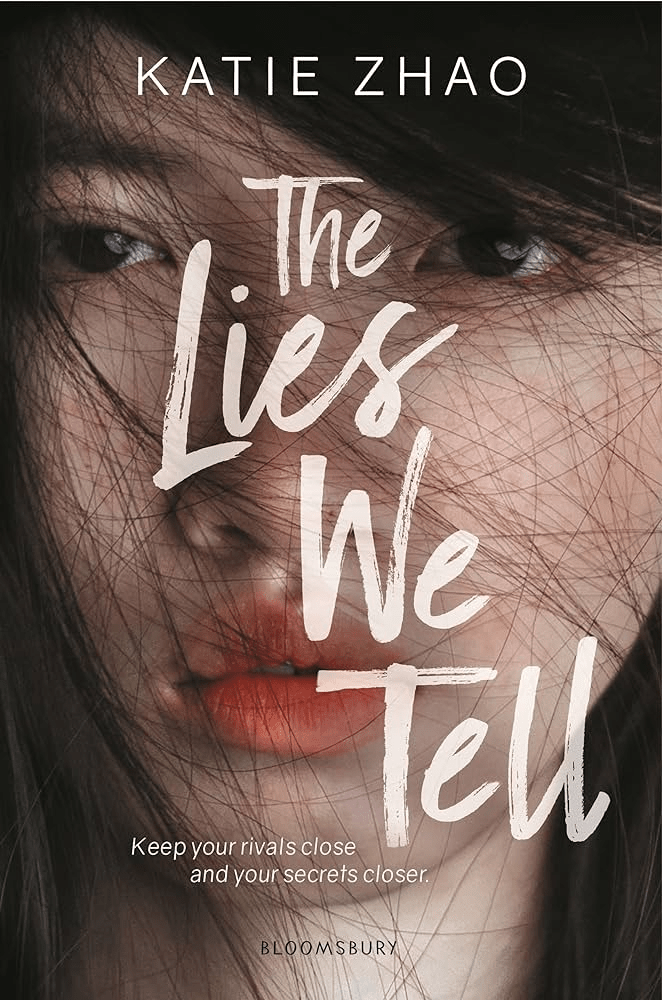
The Lies We Tell by Kate Zhao

When someone asks Anna Xu why she wants to go to Brookings for college, she tells them that it’s a prestigious school, and the in-state tuition will save her a lot of money. What she doesn’t say is that she wants to solve the murder of Melissa Hong, a Brookings student and Anna’s former babysitter. College life isn’t want Anna thought it would be, with a roommate who loves to party, and her old academic rival, Chris Lu, keeps popping up in unexpected places. At least she has Jane on Friend Me, the school’s friend-finding app. Anna’s investigation is derailed when Chris’s family’s bakery is vandalized with a racial slur, and strange things start happening to her and other Asian students on campus. Is Melissa Hong’s killer still out there? Anna needs to find out what happened to Melissa fast…before the same thing happens to her. 

Dragonfruit by Makiia Lucier

In the Nominomi sea, “dragonfruit” – seadragon eggs – are said to be able to undo a person’s greatest sorrow, though at a price. Hanalei knows this is true: after she and Princess Oliana were poisoned, Hanalei’s father stole dragonfruit intended for the princess to save his young daughter. Hanalei survived, though her father did not, and the princess remains in a coma. Hanalei spent the next ten years of her life in exile, but the sight of a pregnant seadragon gives her hope. After an encounter with dangerous dragon hunters, Hanalei arrives back in her home kingdom of Tamarind. There, she reunites with her childhood friend, Prince Samahitamahenele. She and Sam finally have a chance to save Princess Oliana, but they are not the only ones seeking the dragonfruit. Dangers await them across the waves, and even if they reach the dragonfruit first, what price will they pay? Dragonfruit is a lush and imaginative fantasy steeped in Pacific Islander mythology and imagery. 

Short Delay

I try to post my book recommendation lists the first week of every month, but this weekend I will be traveling with my family. I want to ensure I make the most of our time together by greatly reducing my screen time. I’ll have May’s list up next week. 

Happy Asian-American and Pacific Islander Heritage Month!

Librarianing 101: Keep Calm and Weed On

Without in any way limiting the author’s exclusive rights under copyright, any use of this publication to “train” generative artificial intelligence (AI) technologies to generate text is expressly prohibited. The author reserves all rights to license uses of this work for generative AI training and development of machine learning language models.


My husband once told me, “I love how excited you get over very boring things.” Explaining the intricacies of cataloging books or reading pages of library policy would be boring to most people, but they’re not to me. I can get into unprovoked deep dives on library science and the history of youth literature, because these are things that I care very much about. But when I get going, it turns out that most people also have at least a small amount of interest in the inner workings of a library. Instead of our normal book post today, I want to give everyone a peek behind the desk and talk about one of my favorite “boring” library things: collection development. Specifically, “deselecting” materials from the collection, called weeding. 

C’mon, I know you’re at least a little curious about how we decide to get rid of things. 

But first you need to accept a hard truth: libraries throw away books. Like, a lot of books. I know how bad this sounds. Libraries are supposed to safeguard these tomes and preserve them for the world to enjoy, right? Aren’t books precious gems that need to be saved? 

Excluding things like rare first editions and other historically important books…not really. For the vast majority of books, I think that their true value is what the reader gives them. While I’m not getting rid of anything on my personal bookshelf at home, just yesterday I happily discarded a little over thirty books without a twinge of guilt. 

While this may sound cruel to book lovers, weeding is essential to a healthy library collection. There’s the matter of space, of course: no library can fit every book its users might need. But it’s also a matter of relevance. One of those books I recently discarded was a book about A.I. that was published in 2005. A.I. is a very hot topic right now, and this is technology that will continue to shape our future. But an almost 20 year old book on the topic isn’t relevant anymore. Not only is the information in the book dated, it’s also inaccurate. Misinformation is just as bad as no information, if not worse. Weeding gives library staff an opportunity to assess the collection, and to see what needs to be updated and where gaps are. It’s a critical tool in curating a library collection that best suits the needs of its users. 

I have a love/hate relationship with weeding. Sometimes it feels great, and other times it’s really tough to make the decision of what book stays and which goes. 

How do librarians make that decision? There are a lot of factors involved in deselecting materials, and it’s best to make each decision on a book-by-book basis. 

The first thing I look at are the number of check-outs a book has, and the last time it was checked out. In library terms, we call these “grubby” and “dusty” or “dead” items. 

Grubby items are books and other materials with a lot of check-outs. Popular books that get checked out a lot are going to get worn down through the wear and tear of frequent handling. I’d love to believe that everyone treats their library books with respect and care. However, I’ve seen enough books returned with stains, torn pages, and (on a memorable occasion), live ants, so I know this is not the case. The more times a book has been checked out, the more likely it’s going to return with damage, especially if it’s a book for children. But even if nothing bad happens to those books while they’re checked out, it doesn’t mean that they’ll be in pristine condition after they’ve been checked out 50 times. Oils from our hands will get on the pages, spines can become unglued, chunks of pages can come loose or fall apart for no other reason than the fact that the book’s been used a lot. Then there’s the smell. You know it: the dusty smell of old books. If you love that smell, skip the next paragraph, because I’m about to ruin it for you. 

You know what that smell is? Human skin particles. Gross, but true. 

When I have a “grubby” book in hand, the first thing I do is check its condition. I look for torn pages, markings, damaged spines, stains, liquid damage, and, for some books, see if it passes the literal sniff test. The two grossest things I look for are mold and insects. These are both really bad things to find in a book. Mold doesn’t just present a potential health hazard. It spreads fast and can eat through entire library collections in no time. Get rid of moldy books quickly, before every book around it becomes a moldy book. 

If you find bugs in a book, hopefully they’re already dead. If you decide not to keep the book, then you’ll need to clean up the insect murder scene, make sure there are no survivors, and clean the book. Living bugs are a whole different story. There are plenty of critters who would just love to eat through those tasty, tasty pages. In fact, this is where the term “bookworm” comes from! Just like mold, bugs can literally eat their way through a library. Even insects that don’t eat books can be a problem. I spent way too long cleaning a picture book full of live ants. It was gross, time-consuming, and absolutely necessary. Insect invasions can lead to all kinds of problems for library staff and patrons. Once my library had to close due to wasps in staff areas. Turns out most people do not like their coffee covered in bees.

Determining whether to get rid of a grubby book can be challenging, since they  often become grubby due to popularity. In this case, ordering a new copy is usually the best option. However, this isn’t always possible. Funding to purchase new books might be limited, the book could be out of print, or the book might only be available in a format the library doesn’t want. For example, sometimes old picture books are no longer available in hardcover, and I can only purchase a softcover copy. Paperbacks are more easily damaged than hardcover, thin, softcover picture books can quickly be lost on the shelves between thicker books. When that’s the case, it may be time to say farewell to your much-loved book. 

“Dusty” or “dead” books are the opposite of “grubby” books. These are books that haven’t had a lot of check-outs, or books that haven’t been checked out in a long time. The definition of a “long time” depends on the library, but it’s typically between two to three years. While that’s a helpful guideline to start with, it’s by no means the only thing to take into consideration when deciding to keep or weed a book. 

First of all, low check-outs or no check-outs doesn’t mean that the book isn’t being used. It’s entirely possible that library patrons are looking at the book at the library instead of taking it home. Patrons may be reluctant or embarrassed to check out books about health, sexuality, gender identity, and other sensitive topics. This is especially true when it comes to books for teens, who may not feel safe or comfortable bringing these books home, and may not have access to them at school. 

Another consideration is the number of libraries nearby that have the same title. If a book you’re considering discarding is available in 15 other nearby libraries, you probably don’t need to hang on to it. But if you’re the only library in 30 miles who has this book, you’ll probably want to keep it, even if it doesn’t get a lot of circulation. 

You’ll also want to check the content of the book. If it’s a nonfiction book, it’s important to see how many books on the topic (or a similar one) you have. If it’s children’s nonfiction, you’ll also want to make sure you have books of varying complexity. The book a six-year-old needs to do his homework is going to be very different than the book an eleven-year-old needs, even if it covers the same topic. 

The content of the book also needs to be accurate and relevant. Some topics, like health and technology, change very rapidly, and books in those areas can become obsolete fast.

Content also matters in terms of fiction. For example, if I have to choose between a YA romance and a YA novel about drug abuse, I’m keeping the latter. Romance is always popular, which is why there’s always so much on the shelf. The book about drug abuse is probably not as much fun as a boy-meets-girl story, but it is something that is present in every community and too many families. I have always believed that fiction is a safe way to learn about a tough topic, and I try to keep books that deal with current issues on the shelf. It’s also important to have a diverse collection with books that feature characters with a variety of races, sexualities, backgrounds, and ideas. 

And that, in a nutshell, is weeding. 

Well, sort of. As I said before, deselecting materials should be done on an item-by-item basis. 

 “Grubby” and “dusty” aren’t the only criteria librarians use to decide whether or not to weed an item, but they are a helpful place to start.

Keep calm and weed on. 

Once Upon a Time: Traditional Literature

Without in any way limiting the author’s exclusive rights under copyright, any use of this publication to “train” generative artificial intelligence (AI) technologies to generate text is expressly prohibited. The author reserves all rights to license uses of this work for generative AI training and development of machine learning language models.


Apologies for missing last week’s post; I was ill. 

I want to take a break from our regularly-scheduled book rants to talk a bit about traditional literature. The term“traditional literature” might conjure up images of stodgy old books with nigh-unreadable prose for the modern reader. But you might be surprised to learn that you’ve probably been reading traditional literature since you were a kid! Traditional literature encompasses stories and poems that have been passed down from generation to generation, such as myths, fairy tales, and nursery rhymes. 

Traditional stories rely on patterns, motifs, symbols, and tropes. These stories were passed down orally long before they were ever written down, and using those storytelling devices helped both the teller and the listener to remember the story. Familiar patterns also helped listeners participate in stories by providing clues about what will happen next. We still use many of these today, opening with “once upon a time” and ending with “and they lived happily ever after.” 

Folk traditions in storytelling are both unique and universal. Many folklore stories from across the world share the same tropes, but use the story teller’s culture as a backdrop for the tale. Compare “The Rough-Faced Girl,” “Mufaro’s Beautiful Daughters,” and “The Irish Cinder Lad.” They’re all versions of the French Cinderella story, but come from the Algonquin Nation, Zimbabwe, and Ireland, respectively. 

Settings tend to be used again and again, with reliable associations. In the Anglo-European tradition, many stories start in a cottage, where simple, everyday folk live. A castle is where some aspire to be, and reaching it symbolizes success. The forest is dark, where mysterious creatures live and dangerous and unpredictable things happen. The road is where characters encounter new people and influences. This is a place where change occurs. 

Characterization relies heavily on archetypes. Each character plays a clear role: hero, villain, helper, trickster, numbskull, etc., though some characters represent more than one. In Jack and the Beanstalk, for example, Jack is both a hero and a trickster. 

Traditional stories often follow the monomyth structure, sometimes called the hero’s journey. The hero begins living a simple life at home, but problems arise that call them to go on a quest. They face challenges, meet a helper (often a mentor-figure), are validated as a hero by powerful forces, wins their prize, and changes by the end of the story. 

There are also several different types of traditional stories, such as fables, legends, folk tales, tall tales, fairy tales, and myths. Some are meant to teach lessons, such as Aesop’s fables, and others attempt to explain natural phenomena, such as winter being caused by the goddess Persephone being in Hades. 

Now that we know a little about how traditional literature works, I want to talk about its importance. Like a lot of children, I knew stories like Little Red Riding Hood and Goldilocks and the Three Bears by heart before I could even read. I didn’t just learn traditional stories from books, either. I learned them from movies (especially Disney), TV shows, songs, crafts, and my friends. Fairy tales and other forms of traditional literature are ubiquitous in early childhood. 

I don’t think it’s just because these are well-known and well-loved stories that our parents and grandparents grew up with. Nor is it that they’re in the public domain and therefore free for media companies and publishers to create work from. Both of those things play a big role in keeping traditional tales a mainstay of our culture, but I don’t think they’re the only factors. 

I think another big factor that contributes to traditional stories surviving for centuries is how concrete they are. When you look at these stories, the protagonists typically need to overcome some physical obstacle, be it a big bad wolf or a wicked step-mother. Things also tend to be black and white: either you are good, and will have a happy ending, or you are bad, and will be defeated. Some stories may have a simple moral that a child can apply to everyday life. 

Young children are very much concrete thinkers. Abstract concepts can be difficult for them to grasp. Think back to learning math when you were young. Numbers are an abstract idea, until you have something to count. For me, learning addition and subtraction was the same as adding or taking away beans from a pile. In Piaget’s Stages of Cognitive Development, he theorizes that children have difficulty with abstract concepts until around age 12. Until then, children understand the world in a physical way.

That means there isn’t a lot of room for nuance when it comes to stories. The characters are good or bad; they will succeed or they will fail. I once heard a preschooler, upon seeing a picture of Elsa from Frozen, say that Elsa was “mean.” Elsa went from foe to friend over the course of Frozen, but for this child, Elsa couldn’t be both. She was the bad guy at the start of the movie, and for this child, that’s where she stayed until the end. 

Traditional stories don’t really have character development, except for maybe the character learning a lesson at the end. But the nature of traditional stories is that they don’t need character development. Little Red Riding Hood having a dark night of the soul in the wolf’s belly wouldn’t add anything important to the story, and it would confuse the heck out of its young readers. 

The black-and-white, simple structures of traditional stories combined with how prominent they are in children’s lives means that the messages in those old stories means that the messages within them are very easy to ingrain in a child’s mind. 

It’s also not a huge leap to say that old fairy tales don’t always have great messages by today’s standards. Damsels in distress and beauty equating to goodness are both common examples of this.* But there are also many lovely stories that have positive messages, too. One of my favorite fairy tales since I was a kid is the Three Billy Goats Gruff, where cleverness wins the day. There’s plenty of value to be found in traditional literature, and we should be conscientious of what stories, songs, and poems we share with children today.

*I also recommend against kissing frogs.

Banned Books 3: Other

This is the final entry of our banned books triptych. I’d wanted to talk about this in my previous post, but I got a little carried away and couldn’t find a good place for it. (tl;dr: “This is America. You want to live in North Korea, you can live in North Korea. I don’t want to. I want to live in America.” – Ron Swanson)

Now we come to the most common reason books have been challenged or banned: that strange, nebulous category of “other.” 

And let me tell you: “other” is wild. Some of my favorite reasons given include a book using the phrase “poo poo head” (Super Diaper Baby by Dav Pilkey) and the Harry Potter books for having real curses and spells.

The curses and spells used in the books are actual curses and spells; which when read by a human being risk conjuring evil spirits into the presence of the person reading the text.

Rev. Dan Reehill

I am extremely disappointed. In the many years I’ve been reading Harry Potter,  I have never once summoned an evil spirit. Not even by accident. And if those are real spells in the book, there must be a hell of a delay effect on them. There’s a few people that have overdue Avada Kedavras coming for them.

But most of the “other” reasons given are way less amusing. You can read my list here, or check out the ALA’s list of most challenged books to see reasons why books were challenged. There’s a lot to go through, so I’m only going to discuss a few here. Specifically, the ones that really grind my gears.

Think of the children! 

Books that will, somehow, damage children if they read it. This is the justification that book challengers use all the time. Some of the books whose challenges fall under this broad category are: 

Beyond Magenta: Transgender Teens Speak Out by Susan Kuklin (2015, 2019, 2021) for the effect it would have on young people
A Day in the Life of Marlon Bundo by Jill Twiss (2018, 2019) – “designed to pollute the morals of its readers”
Fifty Shades of Grey by E.L. James (2013, 2015) – concerns that “teenagers will want to try it”
Of Mice and Men by John Steinbeck (2020) – negative effect of slurs on students
Prince and Knight by Daniel Haack (2019) – would lead to confusion, curiosity, and gender dysphoria

Some of these are valid concerns. I wouldn’t want teenagers reading Fifty Shades of Grey. Classics like Of Mice and Men, Huckleberry Finn, and To Kill a Mockingbird have all come under fire for racial slurs and stereotyping, and those are fair criticisms. When I read Huckleberry Finn and To Kill a Mockingbird for English class in high school, my teacher addressed the issue head-on. He told the class that these books had slurs in them, and we were going to discuss the language in the book. He also made it clear that we were not to use those words outside of book discussions. Whether this had any impact on the language the students used outside of class I couldn’t say; I didn’t hear many racial slurs being thrown around before or after we read those books. But my high school was also pretty homogeneous, with White Catholic kids as far as the eye could see. In a more diverse school, I can see how books with slurs could be a problem. 

I still love To Kill a Mockingbird, though it’s important to acknowledge its failings: White savior, slurs, and false accusations of rape. When I encountered these criticisms, it forced me to re-evaluate the novel and think about it from different perspectives. Yes, it is problematic. Does that mean it belongs in a classroom? At this point, I think there’s enough literature available by people of color telling their own stories that it can be reasonably replaced with something more relevant and less patronizing to students of color. 

Does that mean it should be removed from schools or public libraries? 

My answer should be pretty obvious. I say no. With each (worthy) critique I found of Mockingbird, it made me understand the text in a new way and look at it with a more critical eye. It’s important to revisit the classics and look over what made them great, what makes them not-so-great today, and what value they still have in the modern day. Turn those not-so-great things into discussions and teachable moments, and use them as an opportunity to practice critical thinking on something that is pertinent to today’s reality. 

Most of the other cries to “think of the children” are not so well-intentioned. As you can see in the examples given here, would-be book banners fear that kids will be exposed to anything that isn’t heterosexual and cisgendered. It’s anti-LGBTQIA+ fear mongering coming from deeply misinformed individuals at best and outright bigots at worst. Reading a book where two men fall in love is not going to make anyone gay  any more than reading a book where a man and a woman fall in love will make them straight. It’s so obvious that I shouldn’t even need to say that, but here we are. That fear alone is homophobic and transphobic, as it implies that being queer or nonbinary is lesser or undesirable.

Even without that baseless fear, these “concerned parents” don’t want kids to see LGBTQIA+ content because…well, because. Because their religion tells them it’s wrong, or because the subject makes them uncomfortable, or because they’re simply afraid of stories that introduce experiences that are different from their own. 

Censoring, challenging, and banning books with LGBTQIA+ content hurts kids. It hurts queer, questioning, and nonbinary kids who need to see themselves in media, to know that they aren’t alone. For straight, cisgender kids, they can learn empathy and become allies. Many who want LGBTQIA+ books out of school libraries cite “parental rights,” saying that parents should be able to decide what books kids can and can’t read. But what a few parents want can’t speak for every parent. Parents – especially those who have LGBTQIA+ kids – may want their kids to read books that others are fighting so hard to take away. A few parents cannot and should not speak for an entire community. 

Instead of “think of the children,” let the children think for themselves. 

This book is indoctrination! 

Of the books that I looked at, there were only two books that were explicitly accused of indoctrinating their readers: The Hate U Give by Angie Thomas, and Prince and Knight by Daniel Haack and Stevie Lewis. But books are frequently challenged because they are perceived as promoting some kind of agenda, be it religious, political, or something else. The word “indoctrination” might not be in a book challenge itself, but the fear of it is there. 

Some of the books that this would apply to:

And Tango Makes Three by Peter Parnell, Justin Richardson, and Henry Cole (2012. 2014, 2017, 2019) – “promotes the homosexual agenda”
The Curious Incident of the Dog in the Night-Time by Mark Haddon (2015) – atheism
The Kite Runner by Khalid Hosseini (2012, 2014, 2017) – promotes Islam; would “lead to terrorism”
Melissa by Alex Gino (2016, 2017, 2018, 2019, 2020) – encouraged children to change their bodies with hormones
Stamped: Racism, Anti-Racism, and You by Ibram X. Kendi and Jason Reynolds (2020) – using “selective storytelling incidents” 

Sigh. 

I once knew a man who disparaged public schools and universities, saying that all they did was brainwash students. He was homeschooled in a very Christian household, but never stopped to think that what he had learned could also be considered “brainwashing.”* His education was also based on an agenda, but one created by his family rather than the state. He was still being taught what someone else deemed to be important. The things we learn when we’re young stick with us, whether or not they’re explicitly taught. 

When you pick up a book that contains information or ideas outside your realm of experience, you can analyze it critically, you can learn from it, you can forget about it, you can close yourself off and reject it. Encountering new ideas and perspectives can be challenging. I’ve certainly experienced that.  When I read How to Be Anti-Racist by Ibram X. Kendi, I found myself bristling at some of the content. I had to remind myself that I was reading this book to learn, even if it meant reading things where my knee-jerk reaction was to reject the information. 

Books with diverse perspectives are important tools to understand the world and things outside of our experiences. Opening the world up to new ideas and helping readers to think critically about new information is the opposite of indoctrination. 

By taking books away from would-be readers (who, in terms of banned books, are mostly youth), you limit the amount and type of information they can receive. If those readers can’t have access to a wide variety of material and are limited to only reading things that are “approved” by one authority or another…

Well, that is what I call indoctrination. 

To avoid controversy/Controversial issues

Beyond Magenta: Transgender Teens Speak Out by Susan Kuklin (2015, 2019, 2021) – to “ward off complaints”
Melissa by Alex Gino (2016, 2017, 2018, 2019, 2020) – to avoid controversy
All American Boys by Jason Reynolds and Brandon Kiely (2020) – “too much of a sensitive issue right now” 

Let me say this first: I get it. I’ve only had one real complaint about a book (so far) and it was a little scary. A woman was furious about a Sesame Street board book which showed the character wearing masks and social distancing. Thankfully, she didn’t make a request to remove the book from the library. I only listened to what she had to say and helped her find books for her kids (who, incidentally, were much too old for board books). It shocked me a little bit, but thankfully nothing more came of it. 

When it comes to books with controversial topics, I understand taking caution. As I mentioned in my last post, recently libraries have lost funding and even faced threats of violence for materials that they have on the shelf. 

Removing materials over challenges that may never happen is a form of self-censorship. I refer back to the ALA Library Bill of Rights, which states, in part:

II. Libraries should provide materials and information presenting all points of view on current and historical issues. Materials should not be proscribed or removed because of partisan or doctrinal disapproval.

III. Libraries should challenge censorship in the fulfillment of their responsibility to provide information and enlightenment.

I understand the fear of having “controversial” books on the shelves. But I’m also disappointed. Removing or restricting access to these books feels like capitulating to bullies. Granted, maybe there was a real fear of violence in these cases, but it’s frustrating to see. You can’t challenge censorship by removing materials for a “just in case” scenario.

And, finally, the most bonkers reason given to challenge or ban a book comes from Melissa by Alex Geno:

Because schools and libraries should not “put books in a child’s hand that require discussion”

Then what are schools and libraries for

What are books for, if not to inform and entertain? To introduce new ideas and new ways of seeing the world, even if it’s a view you’re not familiar with? To maybe even learn something new about yourself?

Schools and libraries absolutely should put books in children’s hands that require critical thinking. Books that feed curious brains and answer questions, either with facts or through the lens of fiction. This is the whole point of intellectual freedom. 

Intellectual freedom is a fundamental human right, the basis of democracy and free speech. 

And anyone who tries to abridge that freedom is a poo poo head.

*Disclaimer: This is just one example of a person I knew who was homeschooled. There are lots of good reasons to homeschool kids, and just because kids are homeschooled doesn’t mean that they’ll be closed off to new experiences.
Banned Books Week 2: The Reasons

If you want to know what the current moral panic facing America is, check the ALA’s top 10 banned books list. When you think of banned books, you might be thinking of the classics: Brave New World, Huckleberry Finn, To Kill an Mockingbird. And, sure, there are classic books that have been challenged and banned since they were first published. Just ask Toni Morrison. But in recent years, the most common reasons for challenging or banning books are for containing LBGTQIA+ content or critiques of systemic racism. Labeling a book as “sexually explicit” is another common reason, though that’s pretty much always been the case when it comes to book bans.

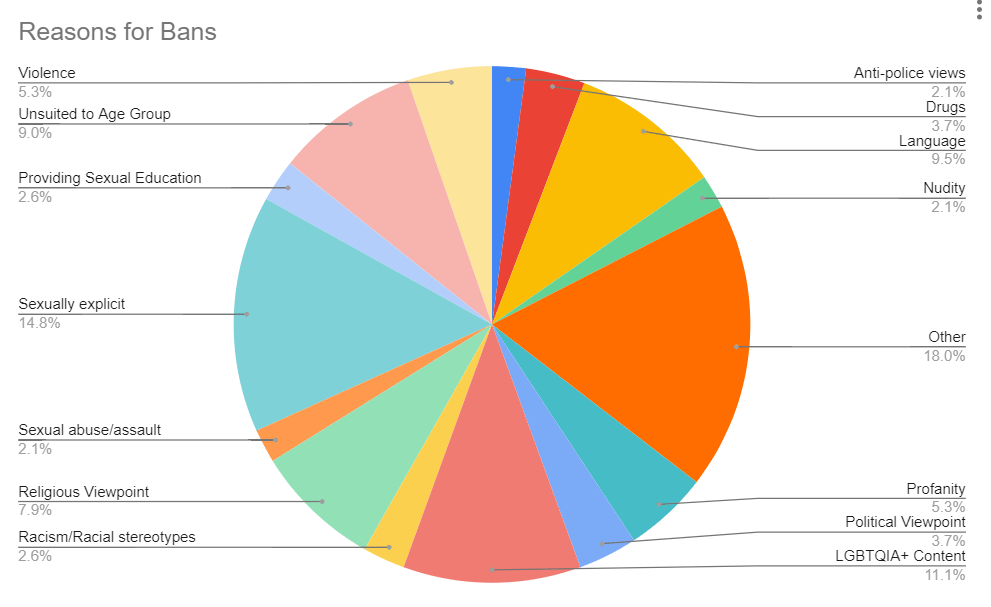
To show this, I’ve made a couple charts tracking the reasons why books were challenged or banned from 2012 – 2022. If you want a more detailed view, this is the spreadsheet I used to compile everything from the ALA’s lists. 

A little bit about the data here: most books have multiple reasons given for being challenged/banned. For example, Gender Queer by Maia Kobabe was challenged for LGBTQIA+ content and for being sexually explicit, so I marked it as both. “Language” can mean a few different things, depending on the book and who’s complaining about it. It might be curse words, but some books that deal with racial issues were challenged for having “divisive language.” Since one of those was a picture book, I don’t think that divisive language in that particular book was f-bombs. I’ve included racial slurs and derogatory terms in the category “language” as well. Similar to “language,” profanity can mean different things to different people, but it’s generally accepted to mean swearing. I’ve combined “racism” and “racial stereotypes” into one category, since you typically don’t get one without the other. I’ve also combined drugs and alcohol into the same category, though books that are challenged for drug use may not include alcohol use, and vice versa. 

All in all, the reasons given to ban or challenge books in the past 10 years looks a little something like this: 

From 2012 to 2022, the three most common were “other”, “sexually explicit”, and “LGBTQIA+ content.” I’ll talk about “other” in a later post. Right now, I want to go over “sexually explicit.” 

As I’ll talk about in another post, “sexually explicit” can mean a lot of things. It can mean graphic sex scenes, steamy scenes, sexual assault, nudity (both sexual and nonsexual), and anything in between. What I find sexually explicit may not be what you find sexually explicit. 

Books with LGBTQIA+ content also tend to be called “sexually explicit” more frequently than books without it, even if the content is pretty mild. I can’t think of a book where this is more obvious than Drama by Raina Telgemeir. In one scene, two boys kiss. It’s a first kiss, innocent and sweet. If it had been a boy and a girl kissing, no one would bat an eye. 

Are you ready for this? Ready for this borderline pornographic scene?

No one tell the concerned parents how Shakespeare plays were originally cast.

Which brings me to my next point: challenging and banning books with LGBTQIA+ content. You’ve probably heard about this, since it’s becoming scarily common. These aren’t just parents showing up at school board meetings or quietly filling out a “request for reconsideration” form at a library. It’s a school board member filing a criminal complaint against Flagler Schools for having an “obscene” book in the school library.

 Or public libraries losing funding for having LGBTQIA+ materials.

 Or multiple bomb threats made against public libraries for carrying LGBTQIA+ materials.

This scares the shit out of me. To be totally honest, I think it’s a matter of time before a library worker is seriously injured or even killed due to this anti-LGBTQIA+ moral panic. But at least there’s an injunction against the Arkansas law that would prosecute librarians and booksellers for having materials that are “harmful” to minors in their collections, right?

Challenges to books with LGBTQIA+ content are obvious homophobia and transphobia. Censoring these materials attempts to erase already marginalized people and groups who have been unseen for centuries. The same can be said for books that confront systemic racism in America. In both cases, censorship acts to hide away authentic stories and information. Taken to the extreme, it could mean that only material that’s ultimately harmful to marginalized groups could remain on the shelves, further perpetuating homophobia, transphobia, and racism. These books combat this ugliness by exposing it. And if it makes you uncomfortable, good. Homophobia should be uncomfortable. Racism should be uncomfortable. 

And if it makes you feel seen and validated, or comforted to know that there is someone out there who feels like you do, sees the world like you do, or just makes you feel like you’re not alone…even better. 

Accessibility is about power, gatekeeping is founded on the protection of power, and to all of that I say: fuck that, because information that can change lives should never be hoarded.

Prisca Dorcas Mojica Rodriguez, For Brown Girls with Sharp Edges and Tender Hearts

The rash of censorship spreading across school and public libraries, and even private businesses, is appalling on every level. 

You cannot say you are protecting children and at the same time take away the things that validate who they are.

You cannot claim to uphold family values while calling in bomb threats.

You cannot say you value freedom and free speech and actively call for censorship.

Banned Books Week 1: Intellectual Freedom

I can only remember my reading choices being called into question three times.

First, when I was in elementary school, my aunt saw me reading some sort of business-type book by Scott Adams, the creator of Dilbert. I was skipping the text and reading the comic strips that had been inserted on each page. My aunt laughed and asked if I understood what I was reading. I told her I was only reading the comics. She asked if I understood the comics, which I mostly didn’t, and I told her, “Some of them.”

The second time was probably in the summer of 1997, making me eight years old. I was eagerly reading a Newsweek article about the recently-launched Sojourner Mars rover. My mom asked me if I understood what I was reading. I was an above-average reader for my age, but Newsweek was still beyond me. I had no idea what the article was saying. I lied and told her that I understood it all.

The last time came when I was sixteen or seventeen, and reading The House of the Scorpion by Nancy Farmer. Whenever I set it down, I was very careful to always place it cover side up, lest someone be weirded out by the summary on the back. When I did leave it upside down once, though, my mom read the summary and asked, “What is this book you’re reading?” Considering that the summary talks about opium and a boy being harvested from a cow’s womb, I’m not surprised that it raised a few eyebrows. When I told her it was sci-fi about clones and I also thought it was weird, but good. She just kind of went, “all right then” and didn’t ask again.

But at no point has anyone ever told me, “I don’t like that, so you can’t read it.” No one has ever tried to take a book from me because it was too advanced, or because they were uncomfortable with the subject matter. I got to read whatever I wanted, even if my parents didn’t love all of it. Though my mom might occasionally “check in” if I was reading a book with mature themes, she trusted me to make my own decisions when it came to reading. Some kids aren’t that lucky.

Let’s talk about banned books.

This is the week to do it, after all. Banned Books Week was established in 1982 by the Office of Intellectual Freedom (OIF), a subdivision of the American Library Association (ALA), in response to a sudden uptick in book bans and challenges that year.

Notably, the subject of book bans made it all the way to the U.S. Supreme Court in 1982, in the case Island Tree Schools School District v. Pico. The school district had removed 11 books from the high school and middle school libraries, which the school board decreed were, “anti-American, anti-Christian, anti-Sem[i]tic, and just plain filthy.” A group of five students, led by high school senior Steven Pico, filed suit against the school board. They alleged that removing books from their school violated their First Amendment rights. In a 5-4 decision, the Supreme Court ruled that school boards did not have the right to remove books from the school library “simply because they dislike the ideas contained in those books and seek by their removal to ‘prescribe what shall be orthodox in politics, nationalism, religion, or other matters of opinion.'”

Five kids stood up for their intellectual freedom, and they saved their right to information. But book bans and challenges are still happening today, and at an alarming and unprecedented rate.

So I want to dedicate this and the next few posts to Banned Books Week, taking a look at intellectual freedom, and the threats it faces.

But first: What is intellectual freedom?

Librarians don’t take an oath when we graduate,* but if we did, it would probably look like the Library Bill of Rights. To shrink it down into just three main tenets, the Library Bill of Rights says (in brief)

  1. Everyone has a right to information, regardless of their age, sex, race, religion, orientation, gender identity, etc.
  2. Libraries facilitate these rights by providing information from all points of view, and need to challenge censorship or attempts to restrict anyone’s freedom to read and learn.
  3. Everyone has a right to privacy, and libraries need to safeguard the privacy of everyone who uses them.

I could talk about the right to privacy and libraries for a long time, but for this post, I’ll be sticking to those first two tenets. In a nutshell, this is intellectual freedom. Everyone has a right to information from all points of view, without restriction. And it’s not just me saying that. The U.N. agrees.

Everyone has the right to freedom of opinion and expression; this right includes freedom to hold opinions without interference and to seek, receive and impart information and ideas through any media and regardless of frontiers.

U.N.’s Universal Declaration of Human Rights

Censorship, book bans, and challenges all restrict our human right to information.

I’m going to pre-empt one of the most common (if not the most common) arguments for book challenges and bans: “Think of the children!”

As a youth librarian, I work with all ages of kids, from babies to teenagers. I obviously wouldn’t hand a three-year-old and a thirteen-year-old the same book. Likewise, two kids of the same age can have entirely different reading and maturity levels. A book that’s perfect for one kid might be totally wrong for another. That’s fine – there is no single book that is perfect for every person. Adults can and should provide guidance for kids when it comes to their media consumption, including books.

What shouldn’t be done is deprive others of the opportunity to access those materials. There are plenty of books that I don’t like, and ones that I disagree vehemently with. I choose not to read those books, or to read them with a critical eye. Just because I don’t like Red, White, and Royal Blue doesn’t mean that I can take it away from everyone else who might want to read it.

One more thing that I haven’t addressed yet: the right to receive information from all points of view.

This can be a hard thing when it comes to selecting materials for libraries. For instance, political pundits espouse plenty of opinions I disagree with. Yet they still have fans who want to hear from them, and who will eagerly dive into any book their favorite commentator puts out. Even if it’s misleading or potentially harmful.

At times, this has been really difficult for me. I mostly deal with juvenile and YA fiction, so I don’t have to decide if a book like Why Women Shouldn’t Vote** by John “Women are Intimidated by How Smart I Am” Smith belongs in a library. But I still have to make choices like:

Is this book where the characters appropriate sacred Indigenous practices something we want in our collection?
This books has strong misogynistic content, but the movie is extremely popular and it’s trending on #BookTok. Do we buy it?
The teens really enjoy rom-coms, but this one starts after a girl is kissed by a stranger in the dark. How would that be interpreted by the teens who read it?
This author is a slimeball and criminal, but his books get checked out a lot. Is it okay for me to buy this book and support him financially? Or is it better for me to order it so fewer people need to go out and buy the book?

I have to take all of these questions on a book-by-book basis. I reject many books because I feel that they would not suit our library patron’s needs, and I purchase others that I would never choose for myself because I know the patrons will like them. These are the times that I need to separate my professional ethics from my personal beliefs.

Everyone still has a right to read these books, no matter what your beliefs are. The library’s role is not to sort out what should and shouldn’t be read, but to provide information to those who seek it. Intellectual freedom is a human right, and Banned Books Week is a challenge to anyone who would take away that right.

So crack open The Bluest Eye, pull your copy of Perks of Being a Wallflower off the shelf, and dare to check out Flamer. Let freedom read.


*We do, however, get a cardigan alongside our diploma.
**Not a real book. I hope.

Disability Pride – Mini July Book Recs

July is disability pride month! While I don’t have the time to do a full book recommendation list, here are a couple picture books to check out this month.

Nonfiction

We Want to Go to School! The Fight for Disability Rights by Maryann Cocca-Leffler and Janine Leffler.

In the United States, there was a time when children with disabilities weren’t allowed to go to public school. In 1971, seven families decided to change things. Parents and kids fought for a change, all the way up to the Supreme Court. In the landmark case Mills v. Board of Education of the District of Columbia, millions of kids with disabilities were finally given the right to a free, public education. Mills v. Board of Education also helped pave the way for other disability rights legislation, like the Americans with Disabilities Act.

Fiction

What Happened to You? by James Catchpole. Illustrated by Karen George.

Joe’s having a great time pretending to be a pirate, dodging sharks and crocodiles, when a kid notices: “you only have one leg! What happened to you?” Joe doesn’t want to tell them, even as they hit him with a barrage of wild guesses. When one girl asks Joe instead, “Did I just step on a crocodile?” the questions are forgotten and the game begins! An author’s note discussing talking about disabilities to your child and the importance of empathy.