May 2025 Book Recommendations: AAPI Heritage Month

May is Asian-American and Pacific Islander (AAPI) Heritage Month! Asian American Heritage Month began in 1979 as Asian/Pacific American Week. In 1992, May was permanently recognized as Asian/Pacific American Month. May is a significant month in Asian-American history, as the first Japanese immigrants arrived in the U.S. on May 7, 1843. On May 10, 1869, the first transcontinental railroad was finally completed, which was constructed in part by over 10,000 Chinese workers who faced dangerous conditions, low pay, and discrimination. AAPI month recognizes the contributions of Asian-Americans and Pacific Islanders while celebrating a myriad of rich cultures. 

This month, you get extra books! Asia and the Pacific Islands are huge areas with many diverse cultures, and there’s no way I can cover everything with just a few books. This year, there are two nonfiction books focusing on Asia, as well as one for the Pacific Islands. Normally I would only have one book for Asia in either category, but Banned Book Club feels so pertinent to the time we’re living in now that I had to include it. As it’s part of Korean history and takes place entirely in Korea, I wanted to highlight a book about the Asian-American experience as well. 

A quick note on the authors’ names: in many Asian countries, the family name comes before the personal name. Additionally, Asian immigrants may choose Western names for themselves after moving to a Western country. For this list, I’m using the names the authors were published under. 

Nonfiction

Almost American Girl by Robin Ha

This graphic novel memoir explores identity, adolescence, and the ups and downs of being an immigrant in America. Robin and her mom don’t always see eye-to-eye. Even so, they’re a team with an unbreakable bond. Robin doesn’t know why her mom wants to take them on a vacation to Alabama in the United States, but their trips together are so much fun, Robin trusts her. There, Robin meets Mr. Kim and his family, all Korean-American immigrants. Then Robin’s mom startles her when she announces they’re not going back to Korea. She and Mr. Kim are getting married and staying in America. Robin is suddenly separated from her home, her friends, and her beloved comic books without warning. Her mother insists that they will have a better life in America, away from the stigma of being a single parent, but Robin – doesn’t believe her. Robin enrolls in an American high school where he struggles with fitting in, learning English, and bullying from racist classmates and a manipulative cousin. Difficulties in her mother’s marriage, especially conflicts with her in-laws, add an extra layer of stress in Robin’s new home. As Robin finds her place in America, her strong bond with her mother carries both of them through their new lives as Korean-Americans. 

Banned Book Club by Kim Hyun Sook and Ko Hyung-Ju. Illustrated by Ryan Estrada. 

Hyun Sook’s first day of college in 1983 didn’t go like she expected. Her college campus is disrupted by student protests against South Korea’s Fifth Republic, a military regime with a history of censorship, torture, and murder. Hyun tries to keep her focus on her studies and the masked dance club, but things take an unexpected turn when she gets invited to a book club. Hyun thinks that she and other students will be discussing Western classics like Shakespeare or The Scarlet Letter, but is shocked to learn that it’s actually a club dedicated to reading books banned by the regime. The banned book club does much more than that to stand up to the government, like organizing protests and publishing illegal newspapers. As Hyun learns the truth about the world around her, she becomes more and more involved with the Banned Book Club and their activities. However, fighting back puts her and her family in danger. Banned Book Club is a graphic novel memoir with a unique illustration style. I wanted to highlight this one because it explicitly talks about how disinformation and censorship are tools used to create and aid unchecked power and violence. 

Poūkahangatus by Tayi Tibble

In Poūkahangatus (incisively pronounced “Pocohontas”), New Zealand poet Tayi Tibble explores what it means to be Māori, a woman, and a Millennial/Gen Z. Written in free verse and prose poetry, the collection tackles bigotry, sexism, and Indigenous representation in media. There’s also warmth and nostalgia as Tibble writes about her mother and childhood. My favorite poems were “Cowboys and Indians” a sly condemnation of the White Savior Complex, and “Vampires versus Werewolves.” At first glance it’s a poem about being a teenager at the height of Twilight’s popularity, but unfurls into something much deeper and more complex (“It’s the boy who cried wolf,/but in reverse you cry sheep and/nobody believes your bleating”). Poūkahangatus is a fantastic North American debut, and Tibble as a poet to watch.

Bonus Book: 

Paper Son: The Inspiring Story of Tyrus Wong, Immigrant and Artist by Julie Leung. Illustrated by Chris Sasaki.

Tyrus Wong (born Wong Gen Yao) immigrated to the United States from China in 1919 as a paper son, pretending to be the child of another Chinese person who had received U.S. residency. At age 9, he was temporarily separated from his father and detained at Angel Island Immigration Station before being allowed to enter the country. Tyrus and his father faced discrimination, but nothing dampened his love of art. Tyrus would become an artist for Disney, and eventually the lead artist for Bambi. He combined Eastern and Western art styles to create the film’s gorgeous backgrounds, but was fired soon after, and never got full credit for his work until recent years. This picture book biography is told with beautiful, impressionist illustrations.

Fiction

Ninetails: Nine Tales by Sally Wen Mao

Foxes populate folklore throughout the world. In Chinese mythology, hulijing, or fox spirits, can take on different forms, both benevolent and antagonistic. Ninetails is a collection of nine stories inspired by fox spirit lore. A cursed boy attempts to befriend his ostracized hulijing classmate; a vixen takes revenge on an abuser; a woman shrinks to be the size of wasps while an imposter takes over her life. My favorite was “Lotus Stench” in which a fox and a ghost become roommates. Another story runs through the book at interludes: “The Haunting of Angel Island.” Each part tells the story of a paper daughter detained at Angel Island while waiting for her interrogation to be let into the United States. These interludes are utterly absorbing and were some of my favorite parts of the book. A collection of surreal and engaging stories and historical fantasy.

Sharks in the Time of Saviors by Kawai Strong Washburn
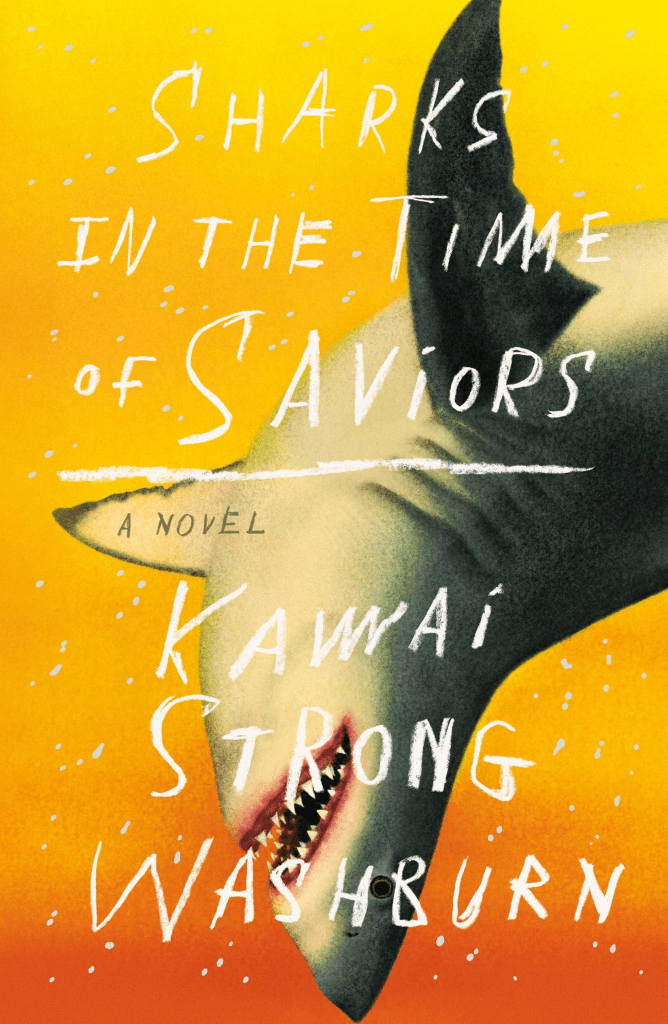
When he was seven years old, Nainoa fell overboard a glass-bottomed boat and into the ocean. He was returned to the boat gently, in the jaws of a shark, holding him as gently as a baby. Since then, Noa has been regarded as a miracle, and everyone in Kalihi knows it. Behind closed doors, Noa struggles with the expectations thrust upon him, while his siblings ache to be seen as something more than Noa’s brother and sister. As time passes, all three are drawn away from the Hawaiian Islands. Eldest brother Dean attends college in Spokane on a basketball scholarship with dreams of fame; Noa’s younger sister hurls herself into rigorous academics and increasingly bigger risks in San Diego. Nainoa works as an EMT in Portland as he tries to understand his abilities, and what he should be doing with his gift. Through all of this, their mother, Malia, believes that Noa has been chosen by the gods to do something great. Tragedy draws the family back together, where they must reconcile their complicated bonds and failures. Sharks in the Time of Saviors is a lyrical family saga with Indigenous Hawaiian religion and mysticism woven throughout. 

Bonus Book

Aloha Everything by Kaylin Melia George. Illustrated by Mae Waite.
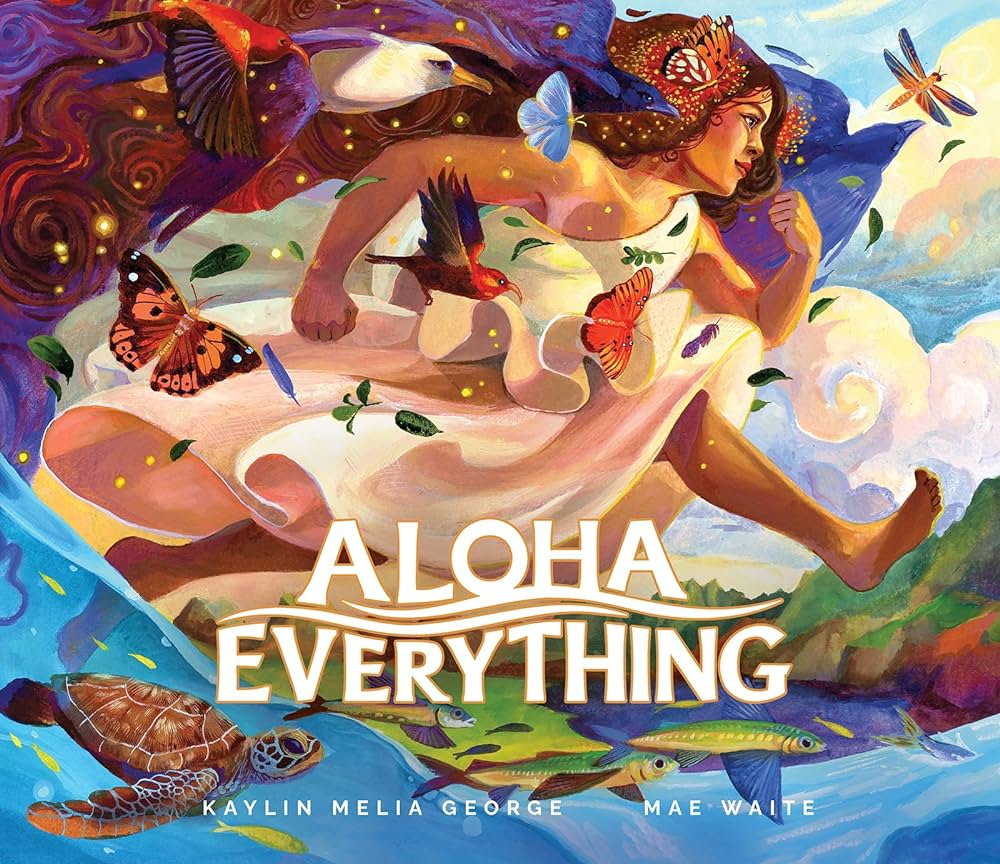
A baby nestled under the branches of a koa tree grows to become a proud and strong Hawaiian woman in this vibrant picture book. Through breathtaking illustrations and verse with Hawaiian words sprinkled throughout, the reader watches the girl grow and learn. The book is a celebration of hula, nature, and Hawaiian history and culture. A glossary and pronunciation guide of Hawaiian words is included. What did hula teach her?  What did hula teach you? 

Asian-American and Pacific Islander Heritage Month – May Book Recs

May is Asian-American and Pacific Islander Heritage Month! Asia and the Pacific Island are both huge areas, encompassing thousands of languages and cultures. Asia is the most populated continent, with around 50 countries (the number changes, depending on who you ask). I’ve also included a couple books from Hawaiian and Maori culture, as well as a memoir of a Syrian refugee family. This is where the “depends on who you ask” kicks in, since I consider the Middle East to be geographically in Asia, though not everyone does. I can’t cover all the aspects of Asian and Pacific Islander literature, but some key writers and illustrators to check out are Linda Sue Park, Grace Lin, Lauren Yep, Naomi Shihab Nye, Minh Le, Dan Santat, Uma Krishnaswami, Bao Phi, Erin Entrada Kelly, Justina Chen, Witi Ihimera, Kiana Davenport, and Kelly Yang.

Non-fiction 

Welcome to the New World by Jake Halpern and Michael Sloan

This graphic novel tells the true story of a Syrian refugee family coming to the United States. Ibrahim Aldabaan, his wife, Adeebah, and their three children fled from war-torn Syria to Jordan. There, they make the hard decision to start a new life in the United States, even if it means leaving siblings and Ibrahim’s mother behind. The family arrives in the U.S. on November 8, 2016 – the day of Donald Trump’s election. His Muslim ban means that the family may never reunite again. Ibrahim and Adeebah have only four months to become self-sufficient, an already difficult task made even harder by a lack of English and Islamophobia. Meanwhile, their children must contend with learning new social customs, bullies, and not fitting in at their school. 

The Fishermen and the Dragon: Fear, Greed, and a Fight for Justice on the Gulf Coast by Kirk Wallace Johnson

Fishermen in 1970s in Galveston Bay were struggling. Droughts, oil spills, and petrochemical plants legally dumping chemical waste into the water were damaging the fishing industry, but White fishermen pinned the blame on Vietnamese refugees who’d broken into the shrimping industry. Racial tensions in the small town of Seadrift reached a breaking point when a Vietnamese fisherman killed a White man in self-defense. In retaliation, the White fishermen burned Vietnamese boats and homes, eventually calling on the Ku Klux Klan to drive the Vietnamese out of the bay. Colonel Nam, the de facto leader of the Vietnamese community in the bay, urged the Vietnamese community to stand their ground and place their faith in the Constitution, ensuring their freedoms. Amongst all the tension, one woman could see the harm that petrochemical plants were doing to the waters and people she loved, and became an renowned environmental activist, going to great lengths to ensure her demands were heard. This is a non-fiction book that reads like a novel, thoroughly researched and suspenseful that it’s hard to put down.

Samurai Rising: The Epic Life of Minamoto Yoshitsune by Pamela S. Turner

In twelfth-century Japan, Yoshitsune’s father went to war with the Taira, a rival samurai family. His father was defeated and killed, his mother was captured, and his only surviving brother was exiled from Kyoto. Only a baby at the time, Yoshitsune was fortunate to survive, spending his early years in a Buddhist temple. He ran away from the temple to train as a samurai, determined to reclaim his family’s honor and glory. Yoshitsune’s story may have ended centuries ago, but his feats of heroism have rendered him immortal. This is a bloody and action packed biography, as deliciously readable as any novel. Who says history has to be boring?

Kapaemahu by Hinaleimoana Wong-Kalu, Dean Hamer, and Joe Wilson. Illustrated by Daniel Sousa.

Kapaemahu is a picture book that depicts the Hawaiian mo’olelo – or traditional story – of the ancient healers who came to Waikiki. The four healers were mahu, people who were neither male nor female, but a mixture of both in mind, spirit, and heart. The mahu taught the Hawaiian people healing arts, and the Hawaiians created a monument of four massive stones to honor them. Over time, changes to Hawaii’s cultural and physical landscape, the sacred stones were lost. Though they have been recovered now, their true story still needs to be told. This is a bilingual book, written in both the Hawaiian dialect ‘Olelo Ni’ihau, and English. The illustrations are done in a gorgeous palette that evokes sunset, and hope for the future.

From a Whisper to a Rallying Cry: The Killing of Vincent Chin and the Trial that Galvanized the Asian American Movement by Paula Yoo

In 1982, the American auto industry was in decline, and anti-Asian sentiment was on the rise. Many American auto workers blamed falling car sales and mass layoffs on imported Japanese cars. In Detroit, the heart of the American auto industry, Chinese-American Vincent Chin was brutally murdered almost a week before his wedding. There was no doubt about who his killers were: Chrysler plant supervisor Ronald Ebens, and his adult stepson Michael Nitz. They plea bargained their charge from second degree murder to manslaughter, and were given a $3,000 fine and three years probation. Incensed at the lenient sentencing, the Asian-American community rallied to seek justice for Vincent Chin and his family. The U.S. had never seen Asian-American activism on this scale before. Hate crimes had not yet been codified into U.S. law, and eventually Ebens and Nitz would be tried again for violating Vincent Chin’s civil rights. United States vs. Ebens would be the first federal civil rights case regarding a crime committed against an Asian American. Exhaustively researched, From a Whisper to a Rallying Cry gives an objective view of the events and people involved in this tragedy. It’s both hard to read and impossible to put down. An afterword (written in 2021) discusses the link between COVID-19 and anti-Asian sentiment, a sobering reminder of why Vincent Chin must never be forgotten. 

Fiction

The Weight of Our Sky by Hanna Alkaf

Malaysian Melati has a djinn who shows her visions of her mother’s gruesome death on repeat. She has developed complex counting and tapping rituals to appease the djinn and keep her mother safe. She doesn’t know that her djinn is actually obsessive compulsive disorder, which was poorly understood in 1969, when the story takes place. Her life is plagued by anxiety, which has only grown worse following the death of her father the previous year. After a general election, violence breaks out between the Malays and Chinese of Kuala Lumpur. Melati is narrowly saved from certain death by a Chinese woman, Auntie Bee. While violence rages outside, Melati takes shelter with Auntie Bee, Uncle Chong, and their sons, Frankie and Vincent. Melati cannot bear to be separated from her mother, and she enlists Vincent’s help to find her. It will take all of her courage to go out into a city under fire and reunite with the person she’s always tried to protect.

The Whale Rider by Witi Ihimaera

Apirana is chief of his Maori tribe, one of a  long, unbroken chain of male leaders. When his first great-grandchild is a girl, he wants nothing to do with her. Young Kahu wants nothing more than his love and tries to learn all she can about Maori culture, despite his firm rejection of her. The book is narrated by her uncle Rawiri, who deepens his understanding of his Maori identity as he travels in Oceania. When dangerous omens wash ashore, Apirana asks: will the Maori culture live, or die? The answer lies in the girl he’s rejected. Beautifully written, this short novel deftly interweaves traditional Maori religion and the Maori language.

The Henna Wars by Adiba Jaigirdar

When Bengali-Irish teen Nishat tries to come out to her parents as a lesbian, their silence speaks volumes. Her parents think that being a lesbian is a choice, and they ask her to make a different one. But Nishat knows who she is, and her growing crush on her Brazilian-Irish classmate Flavia can’t be ignored. When the school announces a business competition, Nishat starts a henna business, excited to connect with her Bangladeshi culture. In a move that smacks of cultural appropriation, Flavia and her cousin Chyna (who happens to be Nishat’s biggest enemy) start a rival henna business. Angry as she is, Nishat can’t ignore her feelings for Flavia. But with her ultra-supportive sister Priti at her side, Nishat is determined to win this battle. 

Temple Alley Summer by Sachiko Kashiwaba. Illustrated by Miho Satake. Translated by Avery Fischer Udagawa 

Fifth-grader Kazu is almost certain he saw a ghost walk out of his house, a girl wearing a white kimono with red baubles in her hair. The next day, he’s shocked to see the ghost in his class, looking alive and well. According to his classmates, Kazu and Akari have been neighbors for years, though Kazu has no memory of her. Stranger still, he learns that his home may have once been the site of the ancient Kimyō Temple. Legends have it that the Kimyō Temple could bring the dead back to life. As he uncovers more about his neighborhood’s history and the temple, he discovers that Akari’s new life is in danger. Featuring a story-within-a-story, Temple Alley Summer is a charming novel about friendship and not-so-scary ghosts.

Front Desk by Kelly Yang

Mia’s family left China and came to the United States looking for a better life. What they found was xenophobia and a daily struggle to get by. They think they’ve hit the jackpot when Mia’s parents are hired to work at the Calivista Motel, but the motel’s unscrupulous owner exploits the family. Mia faces troubles at school with bullying and being one of two Asian kids in her class – the other being the Calivista’s owner’s son. She loves to write, but her mom encourages her to focus on math, believing that Mia will never be able to write in English as well as the American kids. While her parents clean the rooms, Mia makes herself the manager of the Calivista Motel, working at the front desk. She befriends the “weeklies” who live at the motel like herself, and helps hide and support other Chinese immigrants alongside her family. Mia dreams of owning a motel, and helping her family claim a piece of the American pie. Mia is a wonderful character, and the novel has an immensely satisfying ending.