Dec. 2025 Book Recs: Just Books I Liked


Without in any way limiting the author’s exclusive rights under copyright, any use of this publication to “train” generative artificial intelligence (AI) technologies to generate text is expressly prohibited.


Quick announcement before we begin: I’ve decided that I will not be doing book recommendation lists in 2026. Making these lists has been a great experience, and I’ve read a lot of excellent books that I might not have picked up otherwise. They’ve really helped me diversify my book shelves and read outside my comfort zone, and I hope they’ve done the same for you too. 

It’s also a lot of work. I don’t just read two books a month – I “sample” several, which usually means reading at least 100 pages. Most of the reading I’ve done for the past two years has been just for these recommendation lists, and it’s time to take a break and read…well, whatever I want. Maybe I’ll finally get around to Sunrise on the Reaping. This doesn’t mean that the blog is finished, though. I’ll still be doing “books I didn’t pick” and “dusty” titles, and hopefully more. I’d really love to do something about literature and theatre, and Shakespeare adaptations. (But have you ever read Shakespeare? It’s hard.) 

Let’s get into the final book recommendation list: Just Stuff I Liked. These are books that are worthy of sharing, but never made it onto a list before. Here are some of my favorite books in the last few years that never made it to the blog.

Nonfiction

Nickel and Dimed: On (Not) Getting by in America by Barbara Ehrenreich
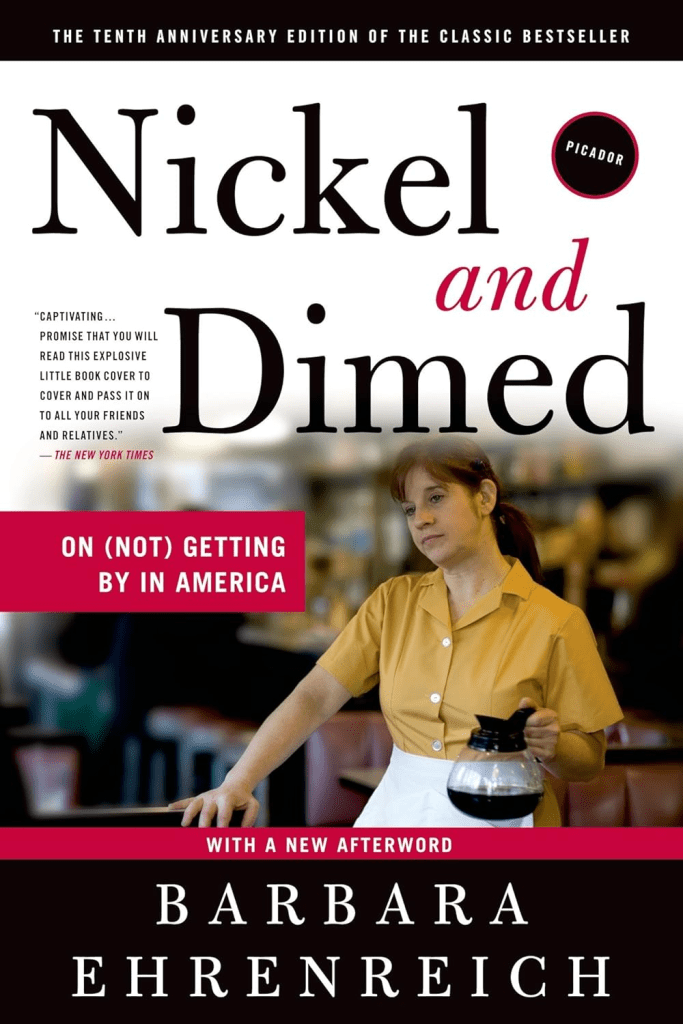
First published in 2001, Nickel and Dimed has remained scarily relevant for over twenty years. Between 1998 and 2000, writer Barbara Ehrenreich voluntarily joined the ranks of the working poor. She worked as a maid, nursing home aid, waitress, and Wal-Mart associate to understand the lived realities of millions of Americans below the poverty line. This book documents her experiences and struggles, such as working through pain and finding housing within her budget. The experiment ended when Ehrenreich faced homelessness, or, as she put it, she could no longer afford to work at Wal-Mart. Along with issues with housing, she also looks at food insecurity, the impact of manual labor on employees’ health, and hiring practices that veer into discriminatory. While the numbers have changed since this book was published, the facts have not. Nickel and Dimed remains a revelatory must-read for Americans today. 

Her Space, Her Time: How Trailblazing Women Scientists Decoded the Hidden Universe by Shohini Ghose
Women have long been involved in scientific fields, but have rarely gotten acknowledged for their work until recent history. Her Space, Her Time finally gives some of these brilliant women their much overdue credit. In the late 19th Century, astronomer Annie Jump Cannon helped create Harvard’s Classification Scheme, which is still used today, while being paid less than her male counterparts. Lise Meitner and her nephew Otto Frisch published the first paper on nuclear fission. Meitner’s longtime collaborator Otto Hahn was awarded the Nobel Prize for this discovery, and Meitner was left in obscurity. We all know Marie Curie, but what about Harriet Brooks or Bibha Chowdhuri? Each chapter focuses on a different scientific top, such as astronomy, physics, or chemistry, and the women who helped revolutionize their fields of study. Ghose explains complex scientific concepts in an understandable way, perfect for science lovers who chickened out of taking physics in high school (read: me). I learned so much from this book, not only about science, but also about the phenomenal women who helped shape our understanding of the universe, from the smallest sub-atomic particles to the Big Bang.

The Soul of an Octopus: A Surprising Explorating Into the Wonder of Consciousness  by Sy Montgomery
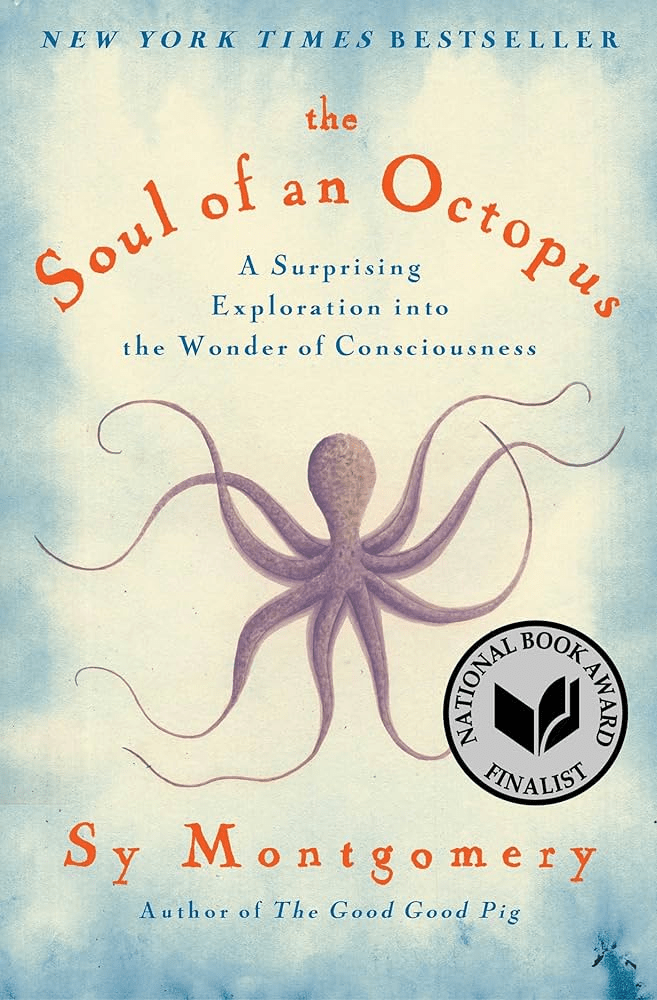

The intelligence and physiology of octopuses1 make them among the most fascinating animals on the planet. Naturalist Sy Montgomery was intrigued by octopus consciousness before she had the chance to meet one in person. At her casual visits to the aquarium, she felt that they were watching her as much as she was watching them. Montgomery first met the Pacific Octopus Athena, who eagerly latched on to Montgomery’s arm. Athena was strong enough to pull Montgomery into her icy tank, but instead was playful and curious. Thus began a series of octopus friends that Montgomery got to observe from their youth to death: Octavia, Kali, and Karma. Octopuses are highly intelligent animals that require toys and stimulation to keep them occupied; a bored octopus can be dangerous to itself and its handlers. They also have distinct personalities (Montgomery notes that Kali was aptly named) and strong emotions. Soul of an Octopus offers a compelling look at octopus consciousness both like and unlike our own. 

Patriot: A Memoir by Alexei Navalny

This story of Alexei Navalny’s life begins when he nearly died. While flying from Tomsk, Siberia to Moscow, he was poisoned with the nerve agent Novichok. He spent 18 days in a coma, and spent several months recovering in Berlin. Navalny knew who his would-be assassin was: Vladimir Putin. Navalny has been an outspoken critic of Putin’s regime and leader of the opposition party, the Anti-Corruption Foundation. He began writing his memoir while recovering from the poisoning, and ended it in prison. First is Navalny’s biography, where he recounts growing up before and after the fall of the Soviet Union and his education and early years as a lawyer. He writes about how he became the Russian opposition leader, and the dangerous and life-altering consequences for him and his family. One chilling chapter details Navalny returning to Russia after his poisoning, despite knowing that he will likely be arrested once he returns. The second half of the book is Navalny’s prison diaries and social media posts. He shares his experience in prison, including a hunger strike when he was denied medical care. The entries become sparser as his punishments in prison worsen, and Navalny would be killed in a prison above the Arctic Circle. Despite bleak circumstances, his writing never veers into self-pity or nihilism. Instead, he writes passionately about his work and condemns the invasion. Navalny also never loses his sharp sense of humor, adding some surprising moments of levity. While not an easy read, it is a powerful memorial and a stark reminder of how important it is to stand against authoritarianism. 

Musicophilia: Tales of Music and the Brain by Oliver Sacks
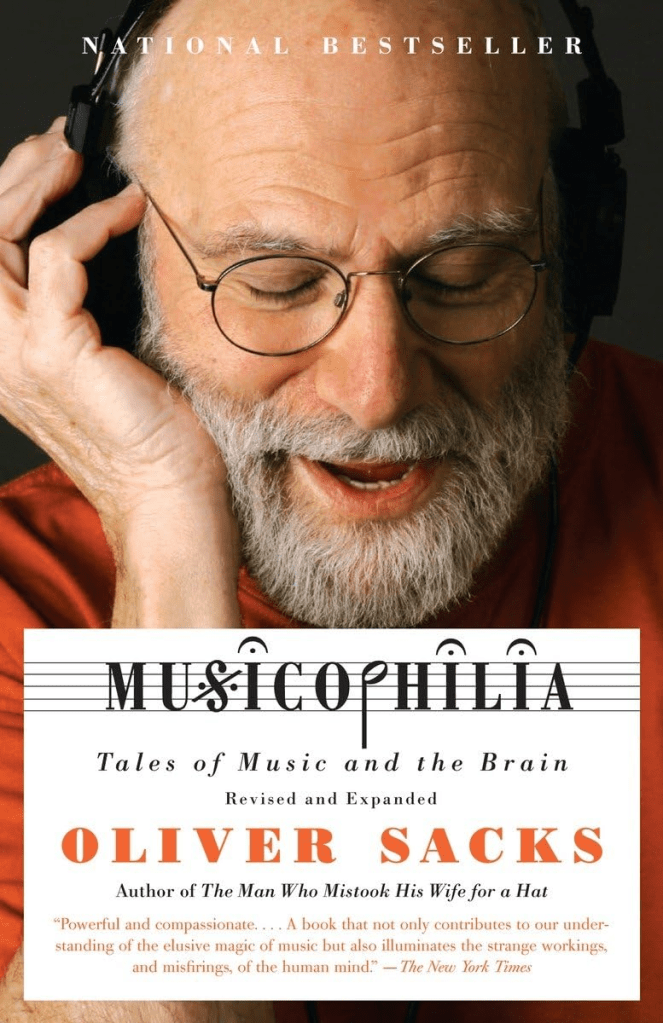
Ah, music! Who doesn’t love a great song that you can sing along to? Well, if you have amusia, a symphony may sound like pots and pans banging together. Musical hallucinations are real, too, and can cause a great deal of distress. But many of us love music, and our brains do, too. Oliver Sacks, best known for his work The Man Who Mistook His Wife For a Hat, takes a look into the good, the bad, and the utterly strange ways that music affects our brains. The book opens with the case of Tony Cicoria, a man who never had more than a casual interest in music. Then he was struck by lightning. Cicoria survived, but was struck by another passion: classical music. Within three months of his recovery, he was spending almost all of his time playing piano and composing music. His new obsession lasted decades. This is only one of the stories about the mysterious relationship between music and the human brain. Others include a man with amnesia whose memory lasts only seconds, but can still read and play music, a musician with severe Tourette’s whose tics diminish greatly only when he performs, among others. The therapeutic effects of music on people with Parkinson’s and Alzheimer’s is shown as well. Sacks never turns these narratives into freak shows, but writes compassionately about the power of music and the mysteries of the human brain. 

Fiction

Gravity by Sarah Deming
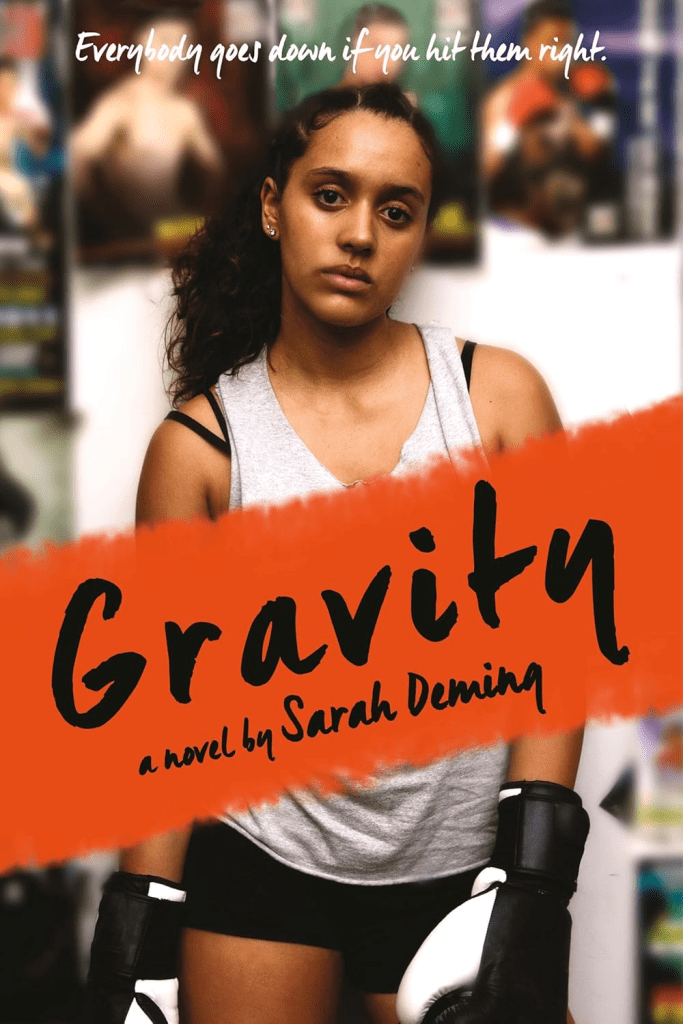
Gravity Delgado is a force to be reckoned with. This young woman is a fierce, undefeated boxer, preparing for the 2016 Olympics in Rio. She’s been training since she was twelve, but her biggest challengers are the ones that she faces outside the ring. Her alcoholic mother, responsibilities for her younger brother, and a heady romance all threaten Gravity’s rising star. She still has her supportive aunt and cousin, as well as her found family at the gym in her corner. Still, Gravity’s biggest obstacle might be herself. The boxing matches are exciting to read, and include both the physical and mental aspects of a bout. Gravity makes mistakes and occasionally stumbles, but you’ll be cheering for her in and out of the ring. A novel that pulls no punches in the best way. 

The Truth About Everything by Bridget Farr

Fifteen-year-old Lark knows how to drive, fix an engine, and catch her own food, but she can barely read. She and her parents know the end is coming, and they’ll be the only ones left standing after the inevitable downfall of America. Raised by two doomsday preppers, Lark has never questioned the conspiracy theories that she was raised on. Then Lark gets her period for the first time. She thinks that she’s miscarrying, something that has happened to her mother many times before, but doesn’t know how she could have gotten pregnant in the first place. After her mother explains what her period is, Lark starts to wonder what else her parents haven’t told her? Lark secretly enrolls herself in high school, where new knowledge conflicts with everything she’s been taught at home. She’s hungry to learn, even when it means uncovering painful truths. But soon, Lark finds herself at a crossroads. What is the real truth? And what will Lark have to sacrifice for it? Pairs well with Educated by Tara Westover. 

Uprooted by Naomi Novik
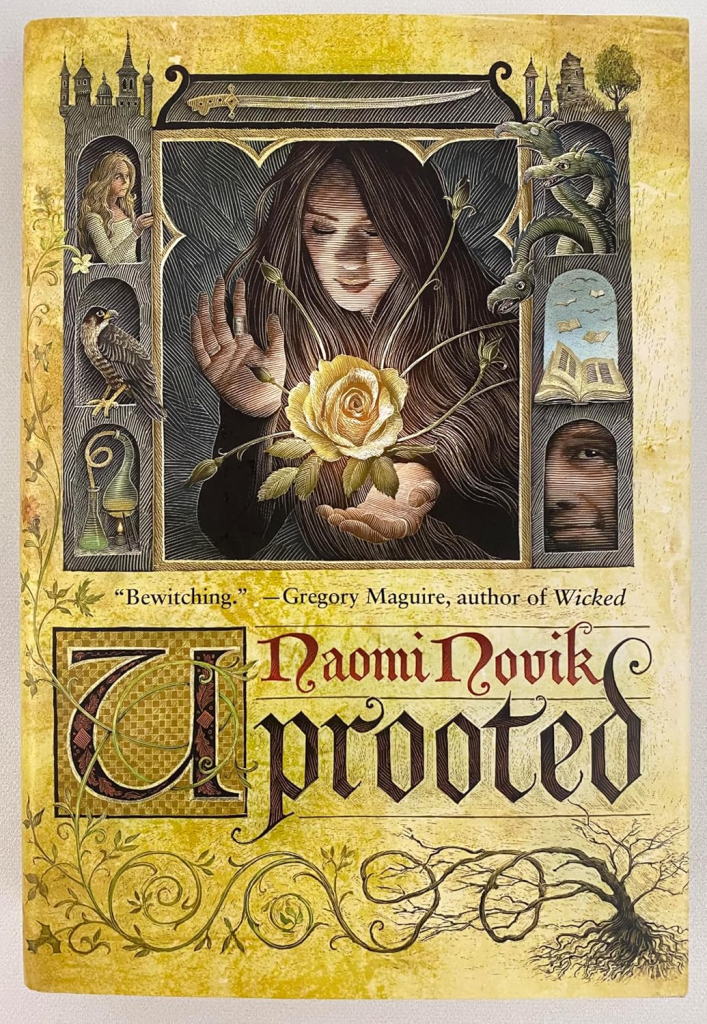
Once every ten years, the Dragon takes a village girl into his tower in the corrupt Wood. When she leaves a decade later, with jewels and finery, she is irrevocably changed and leaves the village forever. But the Dragon isn’t a scaly creature that breathes fire. He is a seemingly ageless, enigmatic wizard. Agnieszka has no fear of being taken. The Dragon only takes the most remarkable young ladies, and she’s nothing special. Though no one says it, everyone believes that Kasia, Agnieszka’s best friend, will be the one he picks. Yet it is Agnieszka the Dragon, reluctantly on his part. She is a witch, and her newly-found powers could be devastating if the corruption of the Wood reaches her. Agnieszka and the Dragon have a rocky start, but their mutual dislike of each other must be put aside when the Wood threatens her home. The well-developed characters, rich, Eastern European-inspired setting, and fantastic storytelling will leave you spellbound. 

The Tea Dragon Society by K. O’Neil
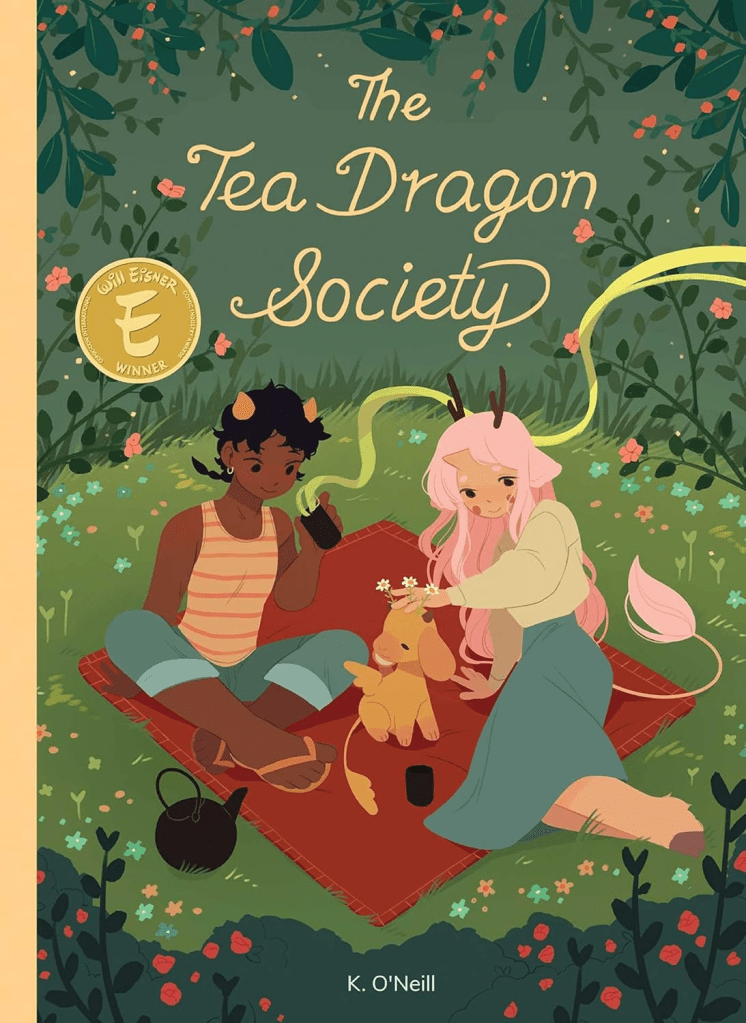
Half-human, half-goblin Greta is an apprentice blacksmith in a world where the old crafts are fading. Greta helps a lost tea dragon – a small dragon that grows tea leaves – find its caretakers, and she is introduced to the Tea Dragon Society. Like blacksmithing, the care and cultivation of tea dragons is a dying art. The Tea Dragon Society is made up now only of Hesekiel, his partner Erik, and a shy girl named Minette. As a year passes, Greta learns to care for the dragons alongside Minette, assuring Hesekiel that the Tea Dragon Society will go on. I’ve enjoyed O’Neil’s other graphic novels, and The Tea Dragon Society embodies so much of what I love about their work. The artwork is soft, with no heavy outlines, adding to the whimsical feel of the world. It features a diverse cast in a simple but visually beautiful story. The Tea Dragon Society is the graphic novel equivalent of sliding into a warm bubble bath…maybe with a nice cup of tea. 

Long Way Down by Jason Reynolds

Will’s older brother, Shawn, has just been murdered. Will knows the rules of his neighborhood: don’t cry, don’t snitch, always get revenge. Will takes Shawn’s gun, and take the elevator from his eighth-floor apartment down to the first floor. The doors open on the seventh floor, and Shawn’s friend Buck gets on. Except Buck shouldn’t be here – he was already shot to death. On each floor, another ghost gets on. All of them played a role in Will’s life, and all of them were victims of gun violence. Each tells Will their stories, challenging his resolve. Can he kill his brother’s killer? Should he? This is a short, intense novel in verse that will stay with you long after you turn the final page.  

  1. Yes, that is the correct pluralization. Octopodes is acceptable, octopi is right out.  ↩︎
June 2025 Book Recs: Read with Pride

Without in any way limiting the author’s exclusive rights under copyright, any use of this publication to “train” generative artificial intelligence (AI) technologies to generate text is expressly prohibited. The author reserves all rights to license uses of this work for generative AI training and development of machine learning language models.


Before we begin, just a couple updates for summer. I’m trying to get back to two posts a month, but I’ve been really busy this spring. July is Flash Fiction Month, so I’ll be posting some short fiction here every day (hopefully). Summer is the busiest time of the year for me, so August is going to be a rest month. 

June is Pride Month! Pride celebrates LGBTQIA+ history, culture, and. well…pride! Pride began with the Stonewall riots in June and July of 1969, and June was officially recognized as “Gay and Lesbian Pride Month” in 1999. LGBTQIA+ rights have come a long way, but there’s still a lot of progress to be made, especially as the trans community is increasingly under attack. PFLAG has a really useful Executive Order Explainer that tracks anti-LGBTQIA+, anti-DEI, anti-immigration, anti-reproductive health, and anti-voting rights executive orders. It also includes links to resources like the Trans Legal Survival Guide from Advocates for Trans Equality, along with resources for mental health, advocacy, and legal help. 

LGBTQIA+ covers a huge range of identities, and two books can’t cover all of them. May was also an incredibly busy month for me, so I wasn’t able to do as much reading as I would like. I still hope this small selection of books enhances your Pride month!

Non-fiction

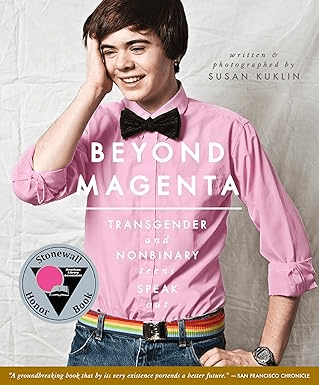
Beyond Magenta: Transgender Teens Speak Out by Susan Kuklin

Six teens and young adults – two trans girls, two trans boys, two nonbinary individuals (one of whom is intersex) – share their stories. With honesty and courage, these young people tell their stories about their early lives, their families, discovering their gender identities, and eventual transitions. They come from a range of backgrounds and experiences, like Luke who has a supportive family and realized he was trans with the help of his queer theatre group, or Mariah, who lived in poverty and has experienced violence due to her gender identity. (Note: Mariah’s chapter includes disturbing content, including sexual abuse.) She began to transition openly during her senior year at an all-boy Catholic school, in the face of bullying, an unsupportive mother, and punishments from the school. Many teens talk about the spectrum of gender and gender as a social construct. Most importantly, each chapter shows the subjects as whole, complex individuals, who are more than just their gender identity. 

Trans issues are a hot topic right now, and there is a lot of discourse and misinformation about gender identity, sexuality, and youth. It’s important for young trans and nonbinary people to have a seat at the table and tell their own stories. 

Fiction

The Gentleman’s Guide to Vice and Virtue by Mackenzie Lee

There is only one thing that Henry “Monty” Montague is looking forward to, probably for the rest of his life: his Tour of the European Continent. The Tour is something of a rite of passage for wealthy noblemen in the eighteenth century: a year of gambling, drinking, and debauchery before he returns to England to work alongside his father.  What he’s most interested in, however, is spending a year with his best friend, Percy. Monty has been secretly in love with Percy for years, and the Tour might be the last chance Monty has for something to happen with him. At the end of the Tour, Percy will be attending law school in Amsterdam, leaving Monty alone. Traveling with them is Monty’s intelligent but taciturn younger sister, Felicity, who struggles to understand Monty’s bisexuality. After a visit to Versailles ends in disaster worthy of being disinherited over, Monty, Percy, and Felicity find themselves being hunted down by bandits, catching rides on pirate ships, and – most terrifying of all – growing as people. This novel is a fun romp around Europe, full of adventure, romance, a bit of magic, and a few steamy scenes. The Montague siblings’ adventures continue in two sequels. 

May 2025 Book Recommendations: AAPI Heritage Month

May is Asian-American and Pacific Islander (AAPI) Heritage Month! Asian American Heritage Month began in 1979 as Asian/Pacific American Week. In 1992, May was permanently recognized as Asian/Pacific American Month. May is a significant month in Asian-American history, as the first Japanese immigrants arrived in the U.S. on May 7, 1843. On May 10, 1869, the first transcontinental railroad was finally completed, which was constructed in part by over 10,000 Chinese workers who faced dangerous conditions, low pay, and discrimination. AAPI month recognizes the contributions of Asian-Americans and Pacific Islanders while celebrating a myriad of rich cultures. 

This month, you get extra books! Asia and the Pacific Islands are huge areas with many diverse cultures, and there’s no way I can cover everything with just a few books. This year, there are two nonfiction books focusing on Asia, as well as one for the Pacific Islands. Normally I would only have one book for Asia in either category, but Banned Book Club feels so pertinent to the time we’re living in now that I had to include it. As it’s part of Korean history and takes place entirely in Korea, I wanted to highlight a book about the Asian-American experience as well. 

A quick note on the authors’ names: in many Asian countries, the family name comes before the personal name. Additionally, Asian immigrants may choose Western names for themselves after moving to a Western country. For this list, I’m using the names the authors were published under. 

Nonfiction

Almost American Girl by Robin Ha

This graphic novel memoir explores identity, adolescence, and the ups and downs of being an immigrant in America. Robin and her mom don’t always see eye-to-eye. Even so, they’re a team with an unbreakable bond. Robin doesn’t know why her mom wants to take them on a vacation to Alabama in the United States, but their trips together are so much fun, Robin trusts her. There, Robin meets Mr. Kim and his family, all Korean-American immigrants. Then Robin’s mom startles her when she announces they’re not going back to Korea. She and Mr. Kim are getting married and staying in America. Robin is suddenly separated from her home, her friends, and her beloved comic books without warning. Her mother insists that they will have a better life in America, away from the stigma of being a single parent, but Robin – doesn’t believe her. Robin enrolls in an American high school where he struggles with fitting in, learning English, and bullying from racist classmates and a manipulative cousin. Difficulties in her mother’s marriage, especially conflicts with her in-laws, add an extra layer of stress in Robin’s new home. As Robin finds her place in America, her strong bond with her mother carries both of them through their new lives as Korean-Americans. 

Banned Book Club by Kim Hyun Sook and Ko Hyung-Ju. Illustrated by Ryan Estrada. 

Hyun Sook’s first day of college in 1983 didn’t go like she expected. Her college campus is disrupted by student protests against South Korea’s Fifth Republic, a military regime with a history of censorship, torture, and murder. Hyun tries to keep her focus on her studies and the masked dance club, but things take an unexpected turn when she gets invited to a book club. Hyun thinks that she and other students will be discussing Western classics like Shakespeare or The Scarlet Letter, but is shocked to learn that it’s actually a club dedicated to reading books banned by the regime. The banned book club does much more than that to stand up to the government, like organizing protests and publishing illegal newspapers. As Hyun learns the truth about the world around her, she becomes more and more involved with the Banned Book Club and their activities. However, fighting back puts her and her family in danger. Banned Book Club is a graphic novel memoir with a unique illustration style. I wanted to highlight this one because it explicitly talks about how disinformation and censorship are tools used to create and aid unchecked power and violence. 

Poūkahangatus by Tayi Tibble

In Poūkahangatus (incisively pronounced “Pocohontas”), New Zealand poet Tayi Tibble explores what it means to be Māori, a woman, and a Millennial/Gen Z. Written in free verse and prose poetry, the collection tackles bigotry, sexism, and Indigenous representation in media. There’s also warmth and nostalgia as Tibble writes about her mother and childhood. My favorite poems were “Cowboys and Indians” a sly condemnation of the White Savior Complex, and “Vampires versus Werewolves.” At first glance it’s a poem about being a teenager at the height of Twilight’s popularity, but unfurls into something much deeper and more complex (“It’s the boy who cried wolf,/but in reverse you cry sheep and/nobody believes your bleating”). Poūkahangatus is a fantastic North American debut, and Tibble as a poet to watch.

Bonus Book: 

Paper Son: The Inspiring Story of Tyrus Wong, Immigrant and Artist by Julie Leung. Illustrated by Chris Sasaki.

Tyrus Wong (born Wong Gen Yao) immigrated to the United States from China in 1919 as a paper son, pretending to be the child of another Chinese person who had received U.S. residency. At age 9, he was temporarily separated from his father and detained at Angel Island Immigration Station before being allowed to enter the country. Tyrus and his father faced discrimination, but nothing dampened his love of art. Tyrus would become an artist for Disney, and eventually the lead artist for Bambi. He combined Eastern and Western art styles to create the film’s gorgeous backgrounds, but was fired soon after, and never got full credit for his work until recent years. This picture book biography is told with beautiful, impressionist illustrations.

Fiction

Ninetails: Nine Tales by Sally Wen Mao

Foxes populate folklore throughout the world. In Chinese mythology, hulijing, or fox spirits, can take on different forms, both benevolent and antagonistic. Ninetails is a collection of nine stories inspired by fox spirit lore. A cursed boy attempts to befriend his ostracized hulijing classmate; a vixen takes revenge on an abuser; a woman shrinks to be the size of wasps while an imposter takes over her life. My favorite was “Lotus Stench” in which a fox and a ghost become roommates. Another story runs through the book at interludes: “The Haunting of Angel Island.” Each part tells the story of a paper daughter detained at Angel Island while waiting for her interrogation to be let into the United States. These interludes are utterly absorbing and were some of my favorite parts of the book. A collection of surreal and engaging stories and historical fantasy.

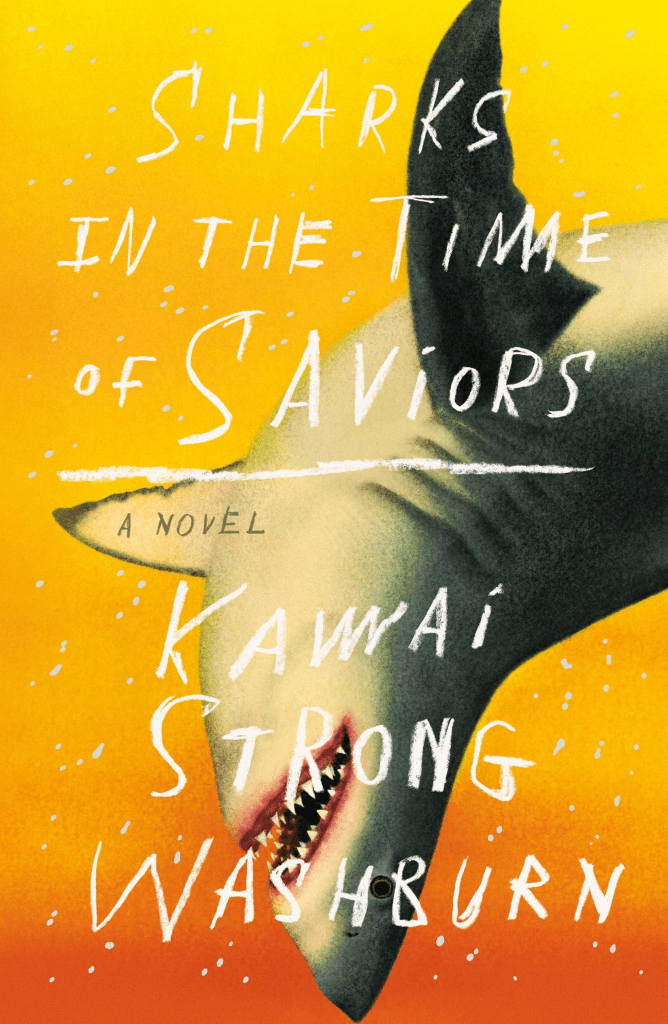
Sharks in the Time of Saviors by Kawai Strong Washburn

When he was seven years old, Nainoa fell overboard a glass-bottomed boat and into the ocean. He was returned to the boat gently, in the jaws of a shark, holding him as gently as a baby. Since then, Noa has been regarded as a miracle, and everyone in Kalihi knows it. Behind closed doors, Noa struggles with the expectations thrust upon him, while his siblings ache to be seen as something more than Noa’s brother and sister. As time passes, all three are drawn away from the Hawaiian Islands. Eldest brother Dean attends college in Spokane on a basketball scholarship with dreams of fame; Noa’s younger sister hurls herself into rigorous academics and increasingly bigger risks in San Diego. Nainoa works as an EMT in Portland as he tries to understand his abilities, and what he should be doing with his gift. Through all of this, their mother, Malia, believes that Noa has been chosen by the gods to do something great. Tragedy draws the family back together, where they must reconcile their complicated bonds and failures. Sharks in the Time of Saviors is a lyrical family saga with Indigenous Hawaiian religion and mysticism woven throughout. 

Bonus Book

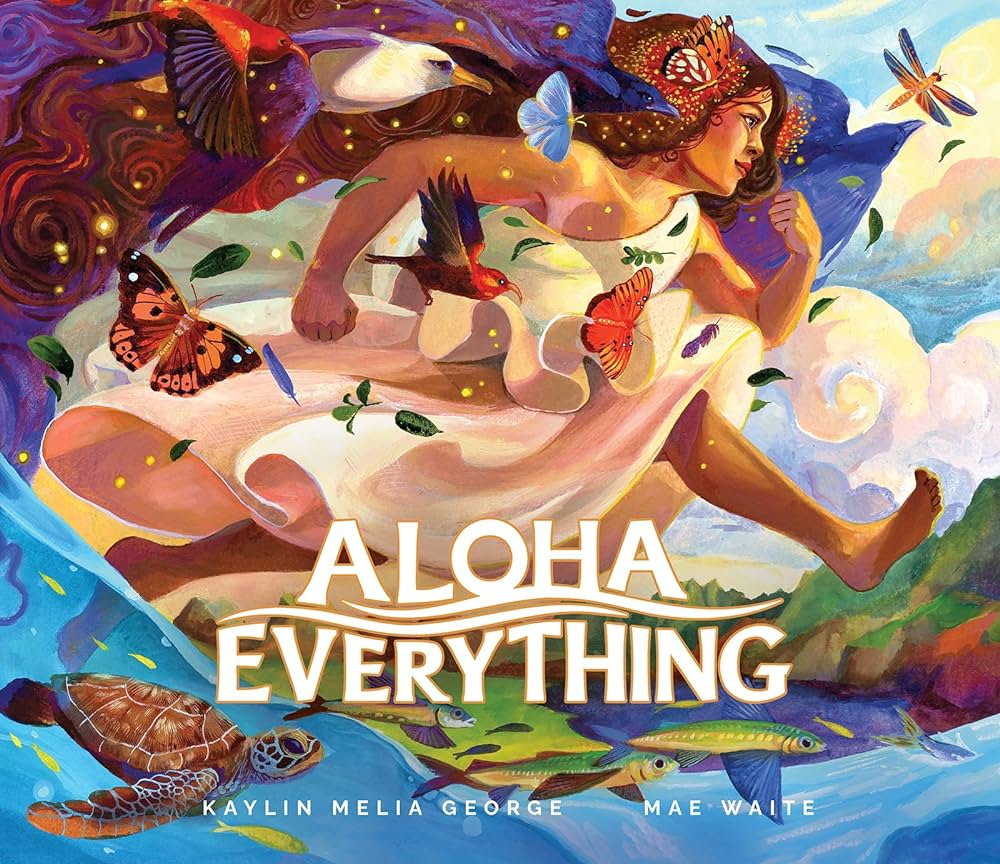
Aloha Everything by Kaylin Melia George. Illustrated by Mae Waite.

A baby nestled under the branches of a koa tree grows to become a proud and strong Hawaiian woman in this vibrant picture book. Through breathtaking illustrations and verse with Hawaiian words sprinkled throughout, the reader watches the girl grow and learn. The book is a celebration of hula, nature, and Hawaiian history and culture. A glossary and pronunciation guide of Hawaiian words is included. What did hula teach her?  What did hula teach you? 

October 2024 Recs: Spooky Season

It’s spooky season! While I am not a huge fan of horror, I can appreciate how the genre can work on multiple levels. Scary stories are excellent ways to examine human nature and society…and perfect for keeping you up on dark and stormy nights. 

Nonfiction

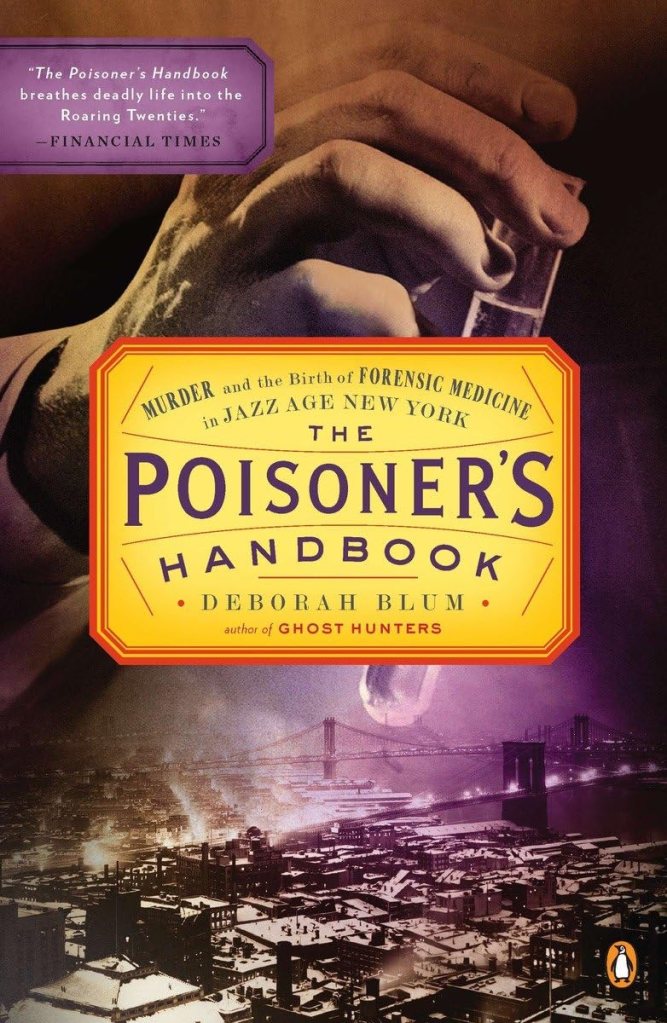
The Poisoner’s Handbook:  Murder and the Birth of Forensic Medicine in Jazz Age New York by Deborah Blum

Prohibition-era New York City was a hotbed of political corruption, organized crime, and poison. Poison was a deadly fact of life, found in the bootlegged liquor of speakeasies, beauty tonics, and in the hands of impatient heirs and jealous spouses. New York City’s chief medical examiner, Charles Norris, set out to change things. With his assistant Alexander Gettler, the NYC medical examiner’s office became the birthplace of forensic medicine. Working long hours, they examined corpses, exhumed bodies, and invented groundbreaking new tests to identify poisons, and put poisoners behind bars. Each chapter is centered on a different poison: chloroform and cyanide to kill, methyl alcohol served in speakeasies, industrial poisons such as tetraethyl lead and radium, and more. The Poisoner’s Handbook is a perfect for lovers of true crime and science history, though there are moments where a strong stomach is helpful.

Lakewood by Megan Giddings

After the death of her grandmother, college student Lena Johnson takes over the role of head of household. Her mother, Deziree, suffers from a mysterious serious illness (or possibly illnesses)  which has racked up more medical debt than the Johnson family can afford. Sometimes, it’s a choice between paying for water or paying for medicine. When Lena gets invited to take part in a research study that pays beyond well and offers amazing health insurance for Deziree, she thinks she’s found her way out. Lena moves to the sleepy town of Lakewood to become a test subject in a secretive government research project. She knows that what she’s doing is risky, but she is willing to endure everything for her mother’s sake. When will the risks become too big, and what will the consequences be when they do? Drawing from the historical medical exploitation of BIPOC individuals (Lena is Black; the experimenters are all White), Lakewood is a slow burn horror that will get under your skin…in more ways than one.

April Book Recs: Let There (Not) Be Light

At a restaurant, a sommelier might recommend the perfect red wine to go with your steak. I aspire to be a book sommelier who finds nonfiction and fiction that complement each other, bringing out the best flavors in each text to enhance your reading experience. For April, I would like to offer two books that pair well together for a little bit of “light” reading.

Nonfiction

The End of Night: Searching for Natural Darkness in the Age of Artificial Light by Paul Bogard

Have you ever seen the Milky Way with your naked eye? When was the last time you saw a truly starry sky? Earth is brighter than ever, but does that mean that it’s better for its residents? Starting with the brightest light on the planet – The Luxor Sky Beam in Las Vegas –  and ending with the darkest skies in the United States, Bogard examines the multitude of ways that widespread artificial lighting has changed our world. He interviews engineers, astronomers, ecologists, third-shift workers, and even clergy members about what the loss of darkness means for humans and the natural world. Starlight is not the only thing we risk losing when dark skies disappear: Bogard also investigates the health and safety risks associated with artificial lighting, and the disconnect between ourselves and nature. This is a thought-provoking book that will make you see your world – both in day and night – a little differently. 

Fiction

The City of Ember by Jeanne DuPrau

Twelve-year-olds Lina and Doon have lived in the city of Ember their entire lives, where nothing is more important than light. Without the electric lights, the city would be in complete darkness all the time. With no known way to make portable light, blackouts are frightening for all the city’s residents. When Assignment Day arrives, Lina is disappointed that she’s been assigned to be a laborer at the Pipeworks. Much to her surprise, Doon trades assignments with her. Now Lina can spend her days running through Ember as a messenger, while Doon descends into the bowels of the city. With blackouts increasing at an alarming rate, Doon knows that something is wrong in Ember. If he can get close to the generator that powers the city, maybe he can learn why the blackouts are happening. Meanwhile, Lina discovers a two-hundred-year-old message from the founders of the city. Parts of it have been destroyed, but whatever it contains could be the key to saving Ember. She and Doon must work together to discover the forgotten secrets of Ember, and maybe even bring its citizens into the light. 

Nov. Book Recs.: Native American Heritage Month

November is Native American Heritage Month in the United States! Native American Heritage Month was established in 1990 to recognize and celebrate the diverse cultures of Indigenous Americans. There are 574 federally recognized Indigenous nations in the United States. Native Land Digital contains a map which shows the original territories of Indigenous peoples across the globe. I encourage everyone to check it out.

I first became interested in Indigenous American literature when I learned how little there was of it. Moreover, of the literature that does exist, there are many books that rely on stereotypes and myths about Indigenous people. Dr. Debbie Reese (Nambé Pueblo) established the American Indians in Children’s Literature Institute (AICL). Her blog contains book reviews and many resources for learning more about Indigenous Americans. Dr. Reese’s tone can be acerbic and her critiques have not always been well-received but the AICL is still a valuable resource. To find work by more Indigenous Americans, some prominent authors and illustrators to check out are Shonto Begay, Louise Erdrich, Joy Harjo, Michael Lacapa, George Littlechild, Leslie Marmon Silko, Cynthia Leitich Smith, Tim Tingle, and Traci Sorell.

There are many terms used for America’s first peoples: Native American, Indigenous, First Nations, etc. Anton Truer notes that each of these terms are “often ambiguous, and equally problematic” as “Indian.” It is best to use the names that Indigenous people use to refer to themselves and their tribe or nation. As in the October book list, I’ll be using the terms that the authors and characters use to describe themselves.

Fiction

Firekeeper’s Daughter by Angeline Boulley

Daunis Fontain is still trying to adjust to the New Normal. After her grandmother’s stroke and her uncle’s death, Daunis delayed her college plans so she could stay close to home on Michigan’s Upper Peninsula. While her brother, Levi, and best friend, Lily, are ecstatic that she’ll be sticking around for another year, some of the elders in her Ojibwe community don’t agree with her decision. Everyone knows how smart Daunis is, and some say she needs to be pursuing her dream of becoming a doctor. Jamie, a striking new arrival in town, catches everyone’s eye, but he seems most interested in Daunis. After she witnesses a shocking murder, he tells her the truth: he’s an undercover agent working for the FBI, investigating a new form of crystal meth, one that’s been mixed with traditional Ojibwe medicines. He and his partner want Daunis to be their new confidential informer. Her knowledge of chemistry, traditional medicines, and the community make her the perfect candidate for this role. Curbing the use of illegal substances would help her community in a major way, but can she really trust the federal government to do the right thing for Indians? And if she does, what dangers will she face? A little slow to start, once the plot gets rolling, you won’t want to put this book down. Dark themes make this book better for older teens and adults.

Give Me Some Truth by Eric Gansworth

Carson has a plan to get off the Tuscarora Reservation: Battle of the Bands 1980. The winning prize is $1000 and a trip to New York City, and Carson’s not letting a little detail like not actually having a band get in his way. He’s pretty sure he can wrangle his Beatles obsessed sort-of-friend Lewis to join him, and soon they’ll be ready to rock. Even his brother getting shot in the ass by a racist restaurant owner isn’t enough to make him lose focus. An old/new arrival to the Rez shakes things up: fifteen-year-old Maggi, who’s moved back after being away for seven years. Her water drum and vocables make her a unique addition to the band, but she wants more than that. Maggi’s tired of making traditional beadwork to sell to tourists, and wants to create conceptual artwork like Andy Warhol and Yoko Ono. But she’s even more tired of being treated like a kid. When Maggi thinks she’s found her first love – and her path to womanhood – she doesn’t see the danger she could be in. There were times I wanted to yell at Carson and Maggi, but their excellent character growth (as well as Lewis’s) lead to a satisfying conclusion in this coming-of-age novel.

The Storyteller by Brandon Hobson

Ziggy has anxiety, possibly because his mom disappeared when he was just a baby. Ziggy holds onto the hope that someday he’ll see her again, though his dad and older sister, Moon, believe otherwise. When he learns that his mom liked to explore caves in the desert, Ziggy thinks there might be a clue in a secret cave, something that the police missed all those years ago. With a little hesitation, he asks his classmate “Weird Alice” to help him find the cave. She agrees, telling Ziggy about the Nunnehi, immortal spirits that can take many forms. If the Nunnehi hid and protected their Cherokee ancestors on the Trail of Tears, maybe they helped Ziggy’s mom, too. Their night trek into the desert begins with a talking coyote (and possible chupacabra) named Rango. Ziggy, Alice, Moon, and Ziggy’s friend Corso have a night replete with supernatural encounters, and some memorable mundane ones as well. Ziggy will see, first hand, the importance of remembering history and the power of stories to connect us to the past.

Harvest House by Cynthia Leitich Smith

After his school’s fall play is canceled, Hughie Wolfe is glad that he’ll still get a chance to participate in local theatre by volunteering at Harvest House, a new haunted house at the crossroads. But Hughie (who is Muscogee) is less thrilled when he learns that the star of the haunt will be the “Indian maiden” whose ghost is said to haunt the town’s crossroads, and that the grand finale will take place on “ancient Indian burial grounds.” And even though Hughie and his friends are tired of “Indian maiden” legends, there is something eerie going on at the crossroads. Someone – or something – is going after Indigenous girls when they’re alone at night. Most locals think it’s a man harassing young women, or the stories are fake publicity for Harvest House. But that doesn’t explain the voices the young women hear, or the strange animal behavior during each of these occurrences. Hughie’s got his work cut out for him. Can he change Harvest House’s proprietor’s mind about using his culture for cheap scares and solve the mystery of the crossroads ghost before Halloween?

Moonshot: The Indigenous Comics Collection

Moonshot: The Indigenous Comics Collection is a folklore comic anthology created entirely by Indigenous American writers and illustrators. Each story has a unique style, and there are several different genres in the book as a whole. “Strike and Bolt” is a sci-fi story of two brothers who represent lightning and thunder on a distant planet, while “Siku” and “The Quallupik” are unsettling tales of horror. My favorite was “Coyote and the Pebbles,” based on the story of how the stars came to be. An important and impressive showcase of talent, there is a second volume which centers around Indigenous spirituality and tradition.

Nonfiction

#NotYourPrincess edited by Lisa Charleyboy and Mary Beth Leatherdale

#NotYourPrincess is a “love letter” to young Indigenous women. This book is a multimedia collection of visual art, poetry, photos, songs, essays, and personal memories that reflect on the experience of being an Indigenous woman in modern America. Each seeks to defy the stereotype of a docile “Indian princess.” Themes of decolonization, overcoming abuse and abandonment, cultural appropriation, heritage, and identity run through this book. #NotYourPrincess shows the complexity of what it means to be an Indigenous woman in modern America, and includes current topics such as Standing Rock and the Rematriation movement. At its core, #NotYourPrincess looks to the future of Indigenous women, in all its complexity.

An Indigenous Peoples’ History of the United States by Roxanne Dunabar Ortiz

Indigenous peoples lived in the Americas for thousands of years before Christopher Columbus set sail, and yet the history of the United States is so rarely told from the perspective of its original inhabitants. As the title suggests, Dunbar-Ortiz gives an overview of the United States’s history from the perspective of Indigenous Americans. It starts with an overview of life in North America before European settlers, an extensive network of self-sufficient agrarian nations. From there, the book goes on to give the history of treaties made and broken, Indigenous peoples’ roles in American wars, the horrors of residential boarding schools, and the consequences of Manifest Destiny. The history continues beyond Wounded Knee or the Battle of Little Bighorn into the Indigenous Civil Rights movement and activism. The young reader’s edition, published in 2019, includes an extra chapter about Standing Rock and the DAPL pipeline protest. Throughout the book, Dunbar-Ortiz makes the case that the atrocities inflicted on Indigenous people constitutes genocide, and draws parallels between the United States’s dealings with Indigenous peoples in the past and current global conflicts today. By no means is this a “fun” read, but it is a comprehensive and informative one. For those who want to learn more about Indigenous history, this is a good place to start.

Highway of Tears : A True Story of Racism, Indifference, and the Pursuit of Justice for Missing and Murdered Indigenous Women and Girls by Jessica McDiarmid

Highway 16 stretches between Prince Rupert and Prince George in British Columbia, covering 725 km (450 mi). But it’s known by another name: the Highway of Tears. Estimates vary, but 1,200 to 4,000 Indigenous women and girls have gone missing or been murdered along this route. McDiamrid gives personal accounts of some of the missing and murdered victims, telling their stories and the stories of those that lost them. She also examines the systematic racism that has forced many Indigenous people into poverty, leading to addiction, crime, and violence. She also brings to light the apathy and uncaring attitudes of many members of law enforcement and the Canadian government toward victims who are Indigenous, and the noticeable silence of the press. This problem is not unique to Canada, and Indigenous women and girls in the United States are far more likely to be victims of violence and sexual assault than non-Native women. This exposé is a tragic reminder of the dangers of racism and indifference, and a call for justice for those who have lost their lives along the Highway of Tears.

Living Nations, Living Words: An Anthology of First Peoples Poetry, with forward by Joy Harjo

Joy Harjo is the first Indigenous American to hold the title of Poet Laureate in the United States. During her tenure as Poet Laureate, she created Living Nations, Living Words: A Map of First Peoples Poetry. This poetry collection is based on that work.

A poetry collection by the United States’s First People, wherein each poet contributed a poem “based on the theme of place and displacement, and with four touchpoints in mind: visibility, persistence, resistance, and acknowledgement.” Each poem is preceded by a photo and brief biography of its author. Several poems are bilingual, written in the author’s indigenous language and followed by an English translation. The collection also spans beyond the borders of the continental U.S., showcasing First Nation poets from Hawaii and Guam. The book is uniquely organized by geography and theme: “East” for daybreak, birth and beginnings, “Center” for “the belly and the heart of presence”, – poems crossroads, full of affirmation and anger; and “West” which looks forward to the future. Decolonization, identity, and heritage are all important themes throughout the book. The poets are not exclusively from the continental United States, but also poets from Hawai’i, Alaska, and Guåhan (Guam).

Everything You Wanted to Know About Indians but Were Afraid to Ask by Anton Truer

American Indian culture has long been mythologized, and is often misunderstood, stereotyped, or exploited by non-Indians today. Dr. Anton Truer answers questions that he has received about Indian culture, from the reasonable (“What is a powwow?”) to the ridiculous (“Where are the real Indians?”). The book is divided into several sections, each covering a different topic, like history, politics, religion, and economics. The true story of the first Thanksgiving and Columbus’s arrival in the Americas, as well as the consequences of western expansion are prominent in the history section. He explains policies, laws, and treaties that still affect Indians today, and dispels myths and misunderstandings about Indian culture. Truer answers each question in an informative and conversational way. Throughout the book, he makes it clear to the reader that American Indians are a broad and diverse group, and there is no one-size-fits all answer to these questions. Originally published in 2012, an updated edition from 2021 includes more questions and answers. The backmatter also includes resources for further reading and viewing.

Asian-American and Pacific Islander Heritage Month – May Book Recs

May is Asian-American and Pacific Islander Heritage Month! Asia and the Pacific Island are both huge areas, encompassing thousands of languages and cultures. Asia is the most populated continent, with around 50 countries (the number changes, depending on who you ask). I’ve also included a couple books from Hawaiian and Maori culture, as well as a memoir of a Syrian refugee family. This is where the “depends on who you ask” kicks in, since I consider the Middle East to be geographically in Asia, though not everyone does. I can’t cover all the aspects of Asian and Pacific Islander literature, but some key writers and illustrators to check out are Linda Sue Park, Grace Lin, Lauren Yep, Naomi Shihab Nye, Minh Le, Dan Santat, Uma Krishnaswami, Bao Phi, Erin Entrada Kelly, Justina Chen, Witi Ihimera, Kiana Davenport, and Kelly Yang.

Non-fiction 

Welcome to the New World by Jake Halpern and Michael Sloan

This graphic novel tells the true story of a Syrian refugee family coming to the United States. Ibrahim Aldabaan, his wife, Adeebah, and their three children fled from war-torn Syria to Jordan. There, they make the hard decision to start a new life in the United States, even if it means leaving siblings and Ibrahim’s mother behind. The family arrives in the U.S. on November 8, 2016 – the day of Donald Trump’s election. His Muslim ban means that the family may never reunite again. Ibrahim and Adeebah have only four months to become self-sufficient, an already difficult task made even harder by a lack of English and Islamophobia. Meanwhile, their children must contend with learning new social customs, bullies, and not fitting in at their school. 

The Fishermen and the Dragon: Fear, Greed, and a Fight for Justice on the Gulf Coast by Kirk Wallace Johnson

Fishermen in 1970s in Galveston Bay were struggling. Droughts, oil spills, and petrochemical plants legally dumping chemical waste into the water were damaging the fishing industry, but White fishermen pinned the blame on Vietnamese refugees who’d broken into the shrimping industry. Racial tensions in the small town of Seadrift reached a breaking point when a Vietnamese fisherman killed a White man in self-defense. In retaliation, the White fishermen burned Vietnamese boats and homes, eventually calling on the Ku Klux Klan to drive the Vietnamese out of the bay. Colonel Nam, the de facto leader of the Vietnamese community in the bay, urged the Vietnamese community to stand their ground and place their faith in the Constitution, ensuring their freedoms. Amongst all the tension, one woman could see the harm that petrochemical plants were doing to the waters and people she loved, and became an renowned environmental activist, going to great lengths to ensure her demands were heard. This is a non-fiction book that reads like a novel, thoroughly researched and suspenseful that it’s hard to put down.

Samurai Rising: The Epic Life of Minamoto Yoshitsune by Pamela S. Turner

In twelfth-century Japan, Yoshitsune’s father went to war with the Taira, a rival samurai family. His father was defeated and killed, his mother was captured, and his only surviving brother was exiled from Kyoto. Only a baby at the time, Yoshitsune was fortunate to survive, spending his early years in a Buddhist temple. He ran away from the temple to train as a samurai, determined to reclaim his family’s honor and glory. Yoshitsune’s story may have ended centuries ago, but his feats of heroism have rendered him immortal. This is a bloody and action packed biography, as deliciously readable as any novel. Who says history has to be boring?

Kapaemahu by Hinaleimoana Wong-Kalu, Dean Hamer, and Joe Wilson. Illustrated by Daniel Sousa.

Kapaemahu is a picture book that depicts the Hawaiian mo’olelo – or traditional story – of the ancient healers who came to Waikiki. The four healers were mahu, people who were neither male nor female, but a mixture of both in mind, spirit, and heart. The mahu taught the Hawaiian people healing arts, and the Hawaiians created a monument of four massive stones to honor them. Over time, changes to Hawaii’s cultural and physical landscape, the sacred stones were lost. Though they have been recovered now, their true story still needs to be told. This is a bilingual book, written in both the Hawaiian dialect ‘Olelo Ni’ihau, and English. The illustrations are done in a gorgeous palette that evokes sunset, and hope for the future.

From a Whisper to a Rallying Cry: The Killing of Vincent Chin and the Trial that Galvanized the Asian American Movement by Paula Yoo

In 1982, the American auto industry was in decline, and anti-Asian sentiment was on the rise. Many American auto workers blamed falling car sales and mass layoffs on imported Japanese cars. In Detroit, the heart of the American auto industry, Chinese-American Vincent Chin was brutally murdered almost a week before his wedding. There was no doubt about who his killers were: Chrysler plant supervisor Ronald Ebens, and his adult stepson Michael Nitz. They plea bargained their charge from second degree murder to manslaughter, and were given a $3,000 fine and three years probation. Incensed at the lenient sentencing, the Asian-American community rallied to seek justice for Vincent Chin and his family. The U.S. had never seen Asian-American activism on this scale before. Hate crimes had not yet been codified into U.S. law, and eventually Ebens and Nitz would be tried again for violating Vincent Chin’s civil rights. United States vs. Ebens would be the first federal civil rights case regarding a crime committed against an Asian American. Exhaustively researched, From a Whisper to a Rallying Cry gives an objective view of the events and people involved in this tragedy. It’s both hard to read and impossible to put down. An afterword (written in 2021) discusses the link between COVID-19 and anti-Asian sentiment, a sobering reminder of why Vincent Chin must never be forgotten. 

Fiction

The Weight of Our Sky by Hanna Alkaf

Malaysian Melati has a djinn who shows her visions of her mother’s gruesome death on repeat. She has developed complex counting and tapping rituals to appease the djinn and keep her mother safe. She doesn’t know that her djinn is actually obsessive compulsive disorder, which was poorly understood in 1969, when the story takes place. Her life is plagued by anxiety, which has only grown worse following the death of her father the previous year. After a general election, violence breaks out between the Malays and Chinese of Kuala Lumpur. Melati is narrowly saved from certain death by a Chinese woman, Auntie Bee. While violence rages outside, Melati takes shelter with Auntie Bee, Uncle Chong, and their sons, Frankie and Vincent. Melati cannot bear to be separated from her mother, and she enlists Vincent’s help to find her. It will take all of her courage to go out into a city under fire and reunite with the person she’s always tried to protect.

The Whale Rider by Witi Ihimaera

Apirana is chief of his Maori tribe, one of a  long, unbroken chain of male leaders. When his first great-grandchild is a girl, he wants nothing to do with her. Young Kahu wants nothing more than his love and tries to learn all she can about Maori culture, despite his firm rejection of her. The book is narrated by her uncle Rawiri, who deepens his understanding of his Maori identity as he travels in Oceania. When dangerous omens wash ashore, Apirana asks: will the Maori culture live, or die? The answer lies in the girl he’s rejected. Beautifully written, this short novel deftly interweaves traditional Maori religion and the Maori language.

The Henna Wars by Adiba Jaigirdar

When Bengali-Irish teen Nishat tries to come out to her parents as a lesbian, their silence speaks volumes. Her parents think that being a lesbian is a choice, and they ask her to make a different one. But Nishat knows who she is, and her growing crush on her Brazilian-Irish classmate Flavia can’t be ignored. When the school announces a business competition, Nishat starts a henna business, excited to connect with her Bangladeshi culture. In a move that smacks of cultural appropriation, Flavia and her cousin Chyna (who happens to be Nishat’s biggest enemy) start a rival henna business. Angry as she is, Nishat can’t ignore her feelings for Flavia. But with her ultra-supportive sister Priti at her side, Nishat is determined to win this battle. 

Temple Alley Summer by Sachiko Kashiwaba. Illustrated by Miho Satake. Translated by Avery Fischer Udagawa 

Fifth-grader Kazu is almost certain he saw a ghost walk out of his house, a girl wearing a white kimono with red baubles in her hair. The next day, he’s shocked to see the ghost in his class, looking alive and well. According to his classmates, Kazu and Akari have been neighbors for years, though Kazu has no memory of her. Stranger still, he learns that his home may have once been the site of the ancient Kimyō Temple. Legends have it that the Kimyō Temple could bring the dead back to life. As he uncovers more about his neighborhood’s history and the temple, he discovers that Akari’s new life is in danger. Featuring a story-within-a-story, Temple Alley Summer is a charming novel about friendship and not-so-scary ghosts.

Front Desk by Kelly Yang

Mia’s family left China and came to the United States looking for a better life. What they found was xenophobia and a daily struggle to get by. They think they’ve hit the jackpot when Mia’s parents are hired to work at the Calivista Motel, but the motel’s unscrupulous owner exploits the family. Mia faces troubles at school with bullying and being one of two Asian kids in her class – the other being the Calivista’s owner’s son. She loves to write, but her mom encourages her to focus on math, believing that Mia will never be able to write in English as well as the American kids. While her parents clean the rooms, Mia makes herself the manager of the Calivista Motel, working at the front desk. She befriends the “weeklies” who live at the motel like herself, and helps hide and support other Chinese immigrants alongside her family. Mia dreams of owning a motel, and helping her family claim a piece of the American pie. Mia is a wonderful character, and the novel has an immensely satisfying ending. 

National Poetry Month: April Book Recs.

Poetry is an art form close to my heart. I discovered poets like Shel Silverstein, Jack Prelutsky, and Bruce Lansky in early elementary school, and devoured children’s poetry collections. By the time I was ten, I was writing poetry of my own, my first real foray into creative writing. Poetry allowed me to express so many things that I was too shy to say, and in any way that I wanted to say it. While I don’t write poetry as much as I used to, I still love this artistic form. 

April is National Poetry Month, so the non-fiction books are all about writing. The fiction section – in honor of National Poetry Month – are novels in verse (or mostly in verse). 

Now, the usual disclaimer. I am a youth librarian, which means I’m most familiar with books written for young people. This means you’ll see a lot of YA and juvenile books on these lists. If you’re an adult looking for something good to read, don’t feel bad or embarrassed about reading youth books. Juvenile and YA books deal with themes and ideas that are applicable to all ages, even if the text isn’t as challenging as books written for adults. And there’s no age limit on good stories. 

I also want to remind everyone that not every book will appeal to everyone. You may hate a book that I love, and that’s okay. Not liking a book doesn’t mean that the book is bad, it just means that you don’t like it. I’ll try to appeal to a wide range of interests, but I don’t expect for you to love or even be interested in everything on this list. There’s a reader for every book, and every book has a reader. I’d love to help readers and books find each other! 

Nonfiction

Writing Fiction by Janet Burroway

There are a plethora of books that offer writing advice, but the simply titled Writing Fiction by Janet Burroway is my favorite. Each chapter takes you through a different aspect of fiction writing, be it description, plotting, dialogue, characterization, or setting. Every chapter ends with a few short stories that exemplify that chapter’s subject, along with writing exercises to challenge and inspire you. Burroway’s writing style is engaging and she understands well the angst of writing and the fear of the blank page. This is far and away the most useful book on creative writing I’ve ever used. If you’ve ever wanted to take a creative writing class, but can’t seem to fit it into your schedule or your budget, this book is the next best thing.

Putting the Fact in Fantasy edited by Dan Koboldt
Putting the Science in Fiction edited by Dan Koboldt

Most fantasy and sci-fi writers haven’t actually led a cavalry charge against the wicked king or traveled through a wormhole to a new dimension. We might not even know how to ride a horse, or have an understanding of physics beyond Newton’s laws of motion. This is where the research begins. Putting the Fact in Fantasy and Putting the Science in Fiction are collections of essays written by experts to help you bring more accuracy and realism to fantastical worlds. Fact in Fantasy includes essays about history, language, culture, and other survival and adventuring tips (My favorite is “Historically accurate ways to die”). Among other topics, Science in Fiction discusses technology, medicine, robots, space, and the far future. While you’re not going to be an expert, each essay provides a starting point for research, usually with a list of resources that you can use for further research. All writers make mistakes. The goal isn’t to be perfect. It’s to be a little less wrong.

Bird by Bird: Some Instructions on Writing and Life by Anne Lamott

In Bird by Bird, Anne Lamott shares the painful secret to writing that every writer should know: that there is no secret to writing. There’s no magic spell or secret formula for churning out best seller after best seller. The only thing you can do is to sit down, day after day, and write authentically. With humor and personal anecdotes, Lamott tackles characterization, plot, dialogue, and “shitty first drafts.” She also explains how she deals with her own self-doubt, writer’s block, professional jealousy, and learning discipline – things most writers deal with. While this book is intended for novices, there are many gems even seasoned writers can take away from each fantastic and funny chapter. I often turn to my favorite chapter, “Shitty First Drafts” when I’m frustrated with my work. It always gives me a boost and gets my butt back in the chair, working on that writing habit. 

The Making of a Poem: A Norton Anthology of Poetic Forms by Mark Strand

The Making of a Poem is more than an anthology. Each chapter is dedicated to a different poetic form, from ballads and sonnets to haiku and free verse. The chapters begin with an overview of the form, followed by a brief history, such as the sonnet’s Italian roots and its evolution to Shakespeare’s work.  Poems in each chapter feature both “classic” poems, as well as works from contemporary, 20th century poets. Finally, chapters close on an analysis of one of the poems in the chapter, alongside a brief biography of its author. The information and analyses are interesting without being overwhelming, making this great introduction to poetic techniques. 

How to Tell a Story: The Essential Guide to Storytelling from The Moth by Meg Bowles, Catherine Burns, Jenifer Hixson, Sarah Autin Jenness, and Kate Tellers

From astronauts to grandmothers, comedians and that guy sitting next you, everyone has a story. Perhaps no one understands this better than the directors of The Moth, a non-profit ground dedicated to the art of storytelling. You may be familiar with The Moth Radio Hour, in which participants tell true, personal stories of their lives. Some famous Moth storytellers include Neil Gaiman and Elizabeth Gilbert, but people from all walks of life are invited to share their stories on the Moth stage. How to Tell a Story is a guide to help you find stories from your own life, and learn to tell them with aplomb. Those of us who aren’t as keen on public storytelling will still find How to Tell a Story loaded with helpful advice for speaking with confidence, alongside strategies for toasts, eulogies, business presentations and even job interviews. The book is also interspersed with stories from The Moth storytelling programs, including stories from comedian Mike Birbiglia and actor and writer Hasan Minhaj. 

Fiction: 

Shark Girl by Kelly Bingham

Jane Arroway’s life was normal: homework, chores, friends, the occasional trip to the beach. But during an otherwise normal day at the beach, Jane is attacked by a shark. Jane survives the attack, but her right arm is amputated just above the elbow. Her story is broadcast on nation-wide news, and Jane knows that she’s going to be “shark girl” forever. Jane doesn’t want to be famous, and she certainly doesn’t want to be told that she’s “so strong” or “inspirational.” What she wants are all the things she’s lost: her artistic talent, cooking for her family, and not being stared at when she goes to the grocery store. Jane grieves for the things she’s lost and all the ways her life has changed. Gradually, Jane adapts to her new life, and starts planning a future that she thought she’d lost. Come for the shark attack, stay for the character growth. 

The Things She’s Seen by Ambelin and Ezekiel Kwaymullina

Alternative Title: Catching, Teller, Crow

Beth Teller is dead, but she’s not going anywhere. Instead, she’s sticking close to her dad, an Australian detective. He’s the only one who can see or hear Beth, or so she thinks. His grief has made him withdraw from the rest of his family, and Beth’s determined to stay at his side. When he’s sent to a remote town to investigate a mysterious fire, Beth tags along, wanting to help her dad solve the case. Their only witness is a girl who goes by Catching…who can see and talk to Beth. Enigmatic Catching speaks in cryptic verse, talking about “Snatchers” and stolen colors. Beth and her father must decode Catching’s story as they investigate, and reveal hidden truths about this quaint Australian town. The novel, starring Aboriginal girls and written by two Aboriginal authors, reflects on grief, friendship, and the effects of colonialism in Australia.

Red, White, and Whole by Rajani LaRocca

It’s 1983, and Reha wants the same things that all middle-schoolers want: to wear fashionable clothes to birthday parties instead of the dresses her mother makes her, to go to the school dance, to watch MTV and wear lip gloss. What she wants, most of all, is to fit in. But as the only Indian-American in her school, fitting in seems about as out of her grasp as the stars she’s named for. She often feels like she has two lives, and is frustrated by her immigrant parents trying to replace her American values and habits with their Indian ones. When Reha’s mother becomes seriously ill, both of her lives come together to support Reha and her family. The poetry shines with metaphors, and the layered, evolving relationship Reha has with her parents feels authentic and relatable. 

D-39: A Robodog’s Journey by Irene Latham

This isn’t your typical “a girl and her dog” story. The girl lives in a war-torn dystopia, and the dog is a robot. Twelve-year-old Klynt lives with her father on their farm in the midst of a civil war. With schools closed due to the war, Klynt has only her father and six-year-old neighbor Jopa for company. Then D-39 arrives on the farm. D-39 is a robot dog, or “robo” for short, and the only kind of dog left in the Worselands. It’s thought that all real dogs were eradicated after the onset of BrkX plague, carried by dogs, but Klynt knows better. Her mother left years ago to start the K-9 Corridor that helps bring real dogs to safety. Though no one has heard from her mother in years, Klynt believes that she’s still running the K-9 Corridor in the Wilds. Klynt has D-39 for company, bringing her companionship and joy during a time of fear. After the war reaches her home and bombardment destroys the farm, Klynt and Jopa are separated from their families. Klynt, Jopa, and D-39 set out on a treacherous journey to the Wilds to find their families, and a new home. I debated about including this book for this month’s list, as it’s written in prose poetry rather than traditional verse. But it’s a compelling and atmospheric adventure story, with a bit of whimsy, that will keep you turning pages. 

The Snow Fell Three Graves Deep by Allan Wolf

The Donner Party was perhaps the most infamous group of pioneers to travel to California. Snowbound and trapped in the Sierra Nevada mountains, the surviving members of the group resorted to cannibalism to keep themselves alive. While it’s certainly a fascinating – and horrifying – part of their story, it was not the only trouble they faced. The Snow Fell Three Graves Deep gives voice to these misguided pioneers, whose decisions led to disaster. The book is narrated by Hunger, which stalked the Donner’s wagons long before they reached the Sierras. Members of the Donner Party also tell their own stories in evocative verse: Young Patty Reed; George Donner’s wife, Tamzene; the Miwok Guides who tried to lead the Donners through the mountains; even the oxen, pulling their heavy loads. The book is historical fiction, with an incredible amount of research behind each word. The real-life people the book is based on are portrayed with respect and sympathy, and invite us to re-think our judgements of the Donner Party. Author’s notes in the back give select biographies of some of the real-life characters, notes about the decisions and creative liberties he took in writing the book, much more information on the real Donner Party, and resources for those hungry to learn more. Pun intended.

New Year, New Me! January Book Recommendations

Welcome to my first monthly book list! Each month, I’ll be bringing you a fresh list of books all based on a different theme. If you have an idea for a themed list, please let me know!

Before we get in, there’s a few things you should know. First, I am a youth librarian, which means I’m most familiar with books written for young people. This means you’ll see a lot of YA and juvenile books on these lists. If you’re an adult looking for something good to read, don’t feel bad or embarrassed about reading youth books. Juvenile and YA books deal with themes and ideas that are applicable to all ages, even if the text isn’t as challenging as books written for adults. And there’s no age limit on good stories.

I’ll also be listing non-fiction and fiction, because there’s a lot of great non-fiction out there that needs some love, too.

I also want to remind everyone that not every book will appeal to every reader. You may hate a book that I love, and that’s okay. Not liking a book doesn’t mean that the book is bad, it just means that you don’t like it. I’ll try to appeal to a wide range of interests, but I don’t expect for you to love or even be interested in everything on this list. There’s a reader for every book, and every book has a reader. I’d love to help readers and books find each other!

New Year, New Me

Nonfiction

ADD-Friendly Ways to Organize Your Life by Judith Kolberg and Dr. Kathleen Nadeau

Thanks to the way my brain is wired, I live in a kind of an entropic mess mixed in the occasional bursts of cleaning and organizing, then promising myself “I’ll never let it get that bad again.” It always turns out to be a lie, but I try.

So when I recommend a book on organizing that actually works for me, I mean it actually works. ADD Friendly Ways… teaches you how to work with your ADD, rather than against it, to get organized. This book is written in short, helpful chapters and formatted specifically to help people with ADHD be able to sit and read it. It gives practical tips on organizing your life which are easy to follow, and offers suggestions for how to find more support if needed and to take control of your life. It’s the best organization self-help book I’ve ever used, and the only one I’ve seen that specifically addresses the role that ADHD plays in the struggle of keeping your life together.

The War of Art by Stephen Pressfield

Making stuff is hard. Whether it’s writing, drawing, dancing, or sculpting, no creative endeavor comes easily. Pressfield calls the universal force that acts against our creativity “resistance,” and it can come in many forms. It could be fear, pressure to perform, irritations in your daily life, or the fact that the new Pokemon game just dropped and how can you be expected to write when you can’t get Sprigatito out of your head? Pressfield brilliantly describes resistance, how to overcome it, and the sacred act of creating. Each short chapter is a micro pep talk for anyone experiencing resistance. It’s a small, thin book and shouldn’t take you long to read. I read it cover to cover years about five years ago and still take it off my shelf when I’m feeling stuck.

The Confidence Code/The Confidence Code for Girls and Living the Confidence Code by Clair Shipman and Katty Kay

Self-doubt. Imposter syndrome. Lack of confidence. We’ve all experienced it, especially girls and women who have internalized messages that they will never be enough. The Confidence Code is a best-selling guide to empower women to become self-assured and confident in their lives, using scientific research and proven methods of behavioral research. Following the success of The Confidence Code, the young reader’s edition, The Confidence Code for Girls aims to reach teen and tween girls struggling with inner doubt.

Living the Confidence Code is true stories of girls, ranging from grade school to teenagers, who are changing the world. These inspiring stories show how everyday girls can have a major impact on their homes, the lives of others, and the world. The word “inspiring” gets tossed around a lot, but I really mean it. After reading this book I was ready to start writing letters to the editor and began researching ways to help with period poverty in my area. If these kids can change their hometowns, I can too!

Draw Stronger: Self Care for Cartoonists and Other Visual Artists by Kriota Willberg

Whether you draw, paint, or write, creating art takes a physical toll on your body. Draw Stronger is a comic book that shows how chronic pain and injuries can occur, and provides tips to prevent and treat injuries. Fun and informative, this is a must-read for anyone who spends good chunks of time sitting at a desk drawing, writing, or typing. While this is geared mainly at visual artists, I’ve found it helpful for dealing with a repetitive strain injury caused by a lockdown’s worth of handwriting.

Fiction:

When Women Were Dragons by Kelly Barnhill

Alex is one of the many who was left behind after the Mass Dragoning of 1955, when hundreds of thousands of women transformed into dragons, wrecked a path of fiery destruction, and took to the skies. She is left with questions: did they choose to become dragons? Why did her beloved Aunt Marla change, but not her mother? Propriety forbids Alex from ever asking. Instead, she must deal with her overprotective mother, her distant father, and a younger sister obsessed with dragons. Most troubling of all, there’s the insistence that her aunt never actually existed. In a world where women are forced into small, confined roles, what happens when they (literally) rise up? Kelly Barnhill is already known for some excellent fantasy for youth, but this novel for adults does not disappoint.

A Psalm for the Wild-Built by Becky Chambers

Two hundred years ago on the moon of Panga, all robots gained consciousness. They left human society peacefully, and were given half the moon to do with as they pleased — which was to leave it untouched and observe the natural world around them. Two centuries later, Sibling Dex is a tea monk who travels the roads of Panga, offering tea, a listening ear, and small comforts to anyone who needs it. Feeling restless in their life, Dex seeks a new journey in a remote corner of the human world. Incredibly, they meet Mosscap on their way. Mosscap and Dex share the first human-robot contact in two hundred years. Mosscap comes in peace, but also bearing a question for Dex: what do humans need? Elegantly written, imaginative, and relaxing, this is one of my favorite books I’ve read recently. I want to live in this world. Thankfully, there’s a sequel as well, so you can return to Panga again.

Whistle: A New Gotham City Hero by E. Forester and Manuel Preitano

Willow Zimmerman is busy. She’s a teen activist who spends her weekends protesting at city hall to help her rundown Gotham neighborhood. Her nights are spent working at the local animal shelter to help pay her mother’s medical bills. When E. Nigma, an old friend of her mother’s, shows up in Willow’s life, he makes her a job offer she can’t refuse. Soon Willow is organizing his high-rolling (and not entirely legal) poker games for E. Nigma and his ludicrously wealthy friends. After an encounter with one of Gotham’s many notorious villains, Willow discovers she has superpowers, including telepathy with dogs. She also learns who her employer really is. The high life isn’t all it’s cracked up to be, and Willow must decide where her values truly lie, and the cost of following her convictions. The story is more about Willow growing as a person, rather than her as a superhero, but she’s such a great character you’ll be wanting to read more of her adventures.

Juliet Takes a Breath by Gabby Rivera

Juliet Palante is a self-described “closeted Puerto-Rican baby-dyke from the Bronx.” Even though her coming out didn’t go as planned, she’s still got a lot to look forward to. Juliet

has just landed her dream internship working for Harlowe Brisbane in Portland, Oregon. Harlowe is a feminist lesbian author, and the strong, empowered woman that Juliet wants to be. But life on the West Coast isn’t what Juliet had expected. She’s not sure about the New Age culture that surrounds her, or even if Harlowe’s (who is White) brand of feminism is right for her. This is a coming-of-age story that examines gaps in the mainstream feminist movement and intersectionality, all while Juliet realistically explores her own identity, and maybe even falls in love. In short: a novel to provoke thought and discussions that will ultimately leave you breathless.

Sherwood by Megan Spooner

Robin of Loxley is dead, killed in the Crusades far from the shores of England and his beloved Lady Marian. Robin was not only Marian’s betrothed, but also her best friend and closest confidant. With Robin gone and Guy of Gisbourn aiming to take his place, the poor of Nottingham have no one to speak for them. Despite the deep grief Marian carries with her, she cannot ignore the suffering of the people of Nottingham. When her friends are threatened by the dogged Gisbourn and the Sheriff of Nottingham, she will take up Robin’s mantle and become her own hero. Well-written, this is an action-packed and enjoyable re-imagining of the Robin Hood legend.