Without in any way limiting the author’s exclusive rights under copyright, any use of this publication to “train” generative artificial intelligence (AI) technologies to generate text is expressly prohibited.
Quick announcement before we begin: I’ve decided that I will not be doing book recommendation lists in 2026. Making these lists has been a great experience, and I’ve read a lot of excellent books that I might not have picked up otherwise. They’ve really helped me diversify my book shelves and read outside my comfort zone, and I hope they’ve done the same for you too.
It’s also a lot of work. I don’t just read two books a month – I “sample” several, which usually means reading at least 100 pages. Most of the reading I’ve done for the past two years has been just for these recommendation lists, and it’s time to take a break and read…well, whatever I want. Maybe I’ll finally get around to Sunrise on the Reaping. This doesn’t mean that the blog is finished, though. I’ll still be doing “books I didn’t pick” and “dusty” titles, and hopefully more. I’d really love to do something about literature and theatre, and Shakespeare adaptations. (But have you ever read Shakespeare? It’s hard.)
Let’s get into the final book recommendation list: Just Stuff I Liked. These are books that are worthy of sharing, but never made it onto a list before. Here are some of my favorite books in the last few years that never made it to the blog.
Nonfiction
Nickel and Dimed: On (Not) Getting by in America by Barbara Ehrenreich
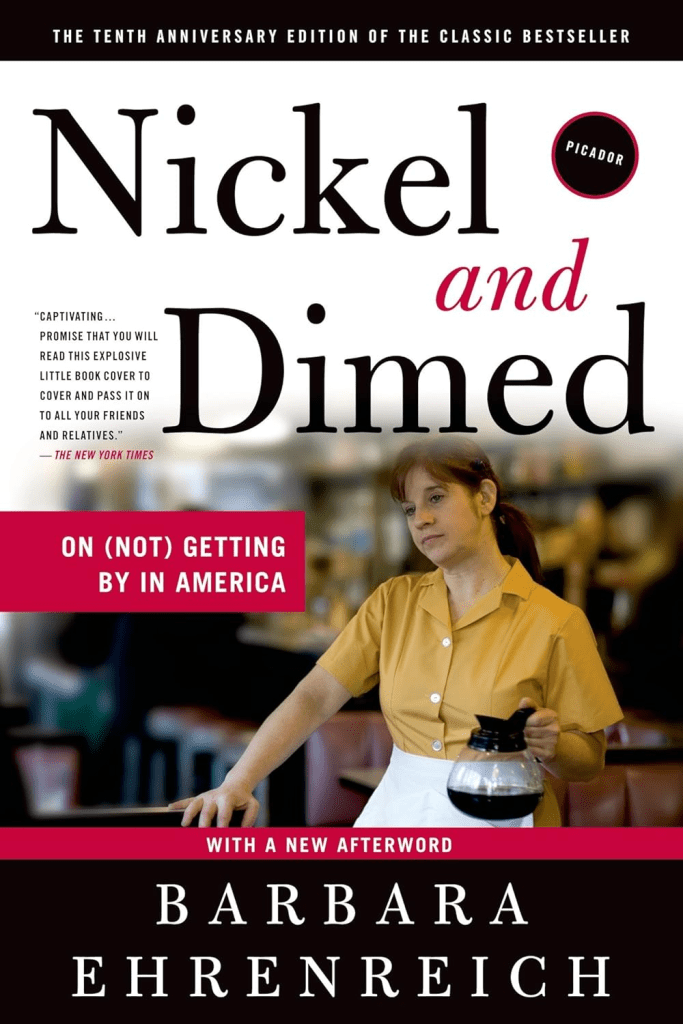
First published in 2001, Nickel and Dimed has remained scarily relevant for over twenty years. Between 1998 and 2000, writer Barbara Ehrenreich voluntarily joined the ranks of the working poor. She worked as a maid, nursing home aid, waitress, and Wal-Mart associate to understand the lived realities of millions of Americans below the poverty line. This book documents her experiences and struggles, such as working through pain and finding housing within her budget. The experiment ended when Ehrenreich faced homelessness, or, as she put it, she could no longer afford to work at Wal-Mart. Along with issues with housing, she also looks at food insecurity, the impact of manual labor on employees’ health, and hiring practices that veer into discriminatory. While the numbers have changed since this book was published, the facts have not. Nickel and Dimed remains a revelatory must-read for Americans today.
Her Space, Her Time: How Trailblazing Women Scientists Decoded the Hidden Universe by Shohini Ghose
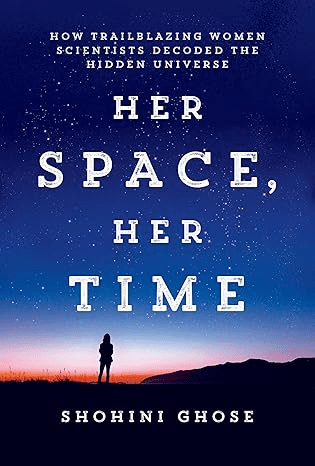
Women have long been involved in scientific fields, but have rarely gotten acknowledged for their work until recent history. Her Space, Her Time finally gives some of these brilliant women their much overdue credit. In the late 19th Century, astronomer Annie Jump Cannon helped create Harvard’s Classification Scheme, which is still used today, while being paid less than her male counterparts. Lise Meitner and her nephew Otto Frisch published the first paper on nuclear fission. Meitner’s longtime collaborator Otto Hahn was awarded the Nobel Prize for this discovery, and Meitner was left in obscurity. We all know Marie Curie, but what about Harriet Brooks or Bibha Chowdhuri? Each chapter focuses on a different scientific top, such as astronomy, physics, or chemistry, and the women who helped revolutionize their fields of study. Ghose explains complex scientific concepts in an understandable way, perfect for science lovers who chickened out of taking physics in high school (read: me). I learned so much from this book, not only about science, but also about the phenomenal women who helped shape our understanding of the universe, from the smallest sub-atomic particles to the Big Bang.
The Soul of an Octopus: A Surprising Explorating Into the Wonder of Consciousness by Sy Montgomery
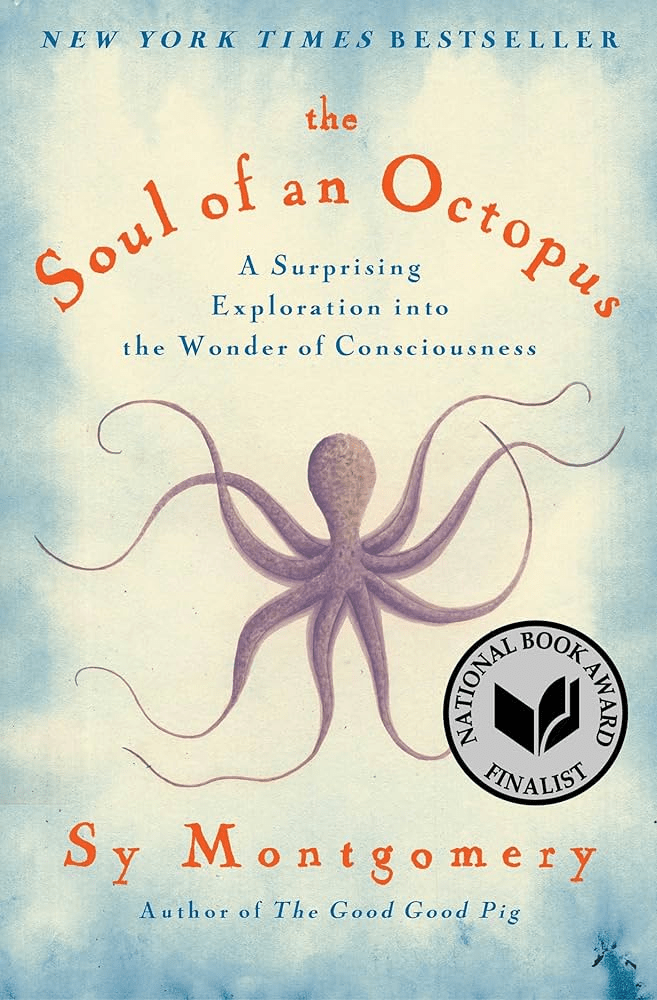
The intelligence and physiology of octopuses1 make them among the most fascinating animals on the planet. Naturalist Sy Montgomery was intrigued by octopus consciousness before she had the chance to meet one in person. At her casual visits to the aquarium, she felt that they were watching her as much as she was watching them. Montgomery first met the Pacific Octopus Athena, who eagerly latched on to Montgomery’s arm. Athena was strong enough to pull Montgomery into her icy tank, but instead was playful and curious. Thus began a series of octopus friends that Montgomery got to observe from their youth to death: Octavia, Kali, and Karma. Octopuses are highly intelligent animals that require toys and stimulation to keep them occupied; a bored octopus can be dangerous to itself and its handlers. They also have distinct personalities (Montgomery notes that Kali was aptly named) and strong emotions. Soul of an Octopus offers a compelling look at octopus consciousness both like and unlike our own.
Patriot: A Memoir by Alexei Navalny

This story of Alexei Navalny’s life begins when he nearly died. While flying from Tomsk, Siberia to Moscow, he was poisoned with the nerve agent Novichok. He spent 18 days in a coma, and spent several months recovering in Berlin. Navalny knew who his would-be assassin was: Vladimir Putin. Navalny has been an outspoken critic of Putin’s regime and leader of the opposition party, the Anti-Corruption Foundation. He began writing his memoir while recovering from the poisoning, and ended it in prison. First is Navalny’s biography, where he recounts growing up before and after the fall of the Soviet Union and his education and early years as a lawyer. He writes about how he became the Russian opposition leader, and the dangerous and life-altering consequences for him and his family. One chilling chapter details Navalny returning to Russia after his poisoning, despite knowing that he will likely be arrested once he returns. The second half of the book is Navalny’s prison diaries and social media posts. He shares his experience in prison, including a hunger strike when he was denied medical care. The entries become sparser as his punishments in prison worsen, and Navalny would be killed in a prison above the Arctic Circle. Despite bleak circumstances, his writing never veers into self-pity or nihilism. Instead, he writes passionately about his work and condemns the invasion. Navalny also never loses his sharp sense of humor, adding some surprising moments of levity. While not an easy read, it is a powerful memorial and a stark reminder of how important it is to stand against authoritarianism.
Musicophilia: Tales of Music and the Brain by Oliver Sacks
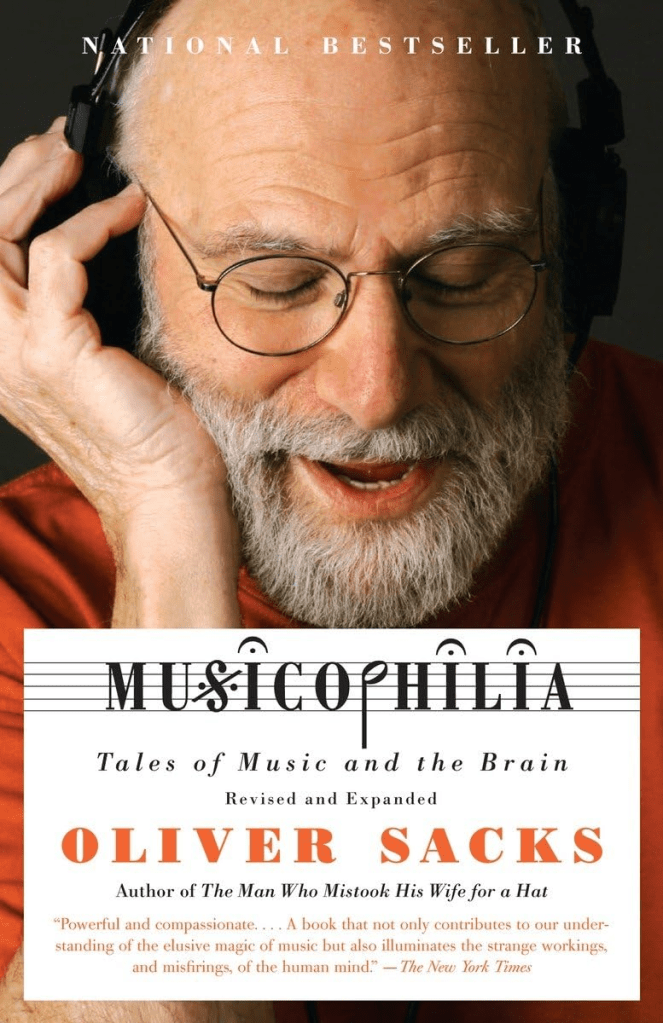
Ah, music! Who doesn’t love a great song that you can sing along to? Well, if you have amusia, a symphony may sound like pots and pans banging together. Musical hallucinations are real, too, and can cause a great deal of distress. But many of us love music, and our brains do, too. Oliver Sacks, best known for his work The Man Who Mistook His Wife For a Hat, takes a look into the good, the bad, and the utterly strange ways that music affects our brains. The book opens with the case of Tony Cicoria, a man who never had more than a casual interest in music. Then he was struck by lightning. Cicoria survived, but was struck by another passion: classical music. Within three months of his recovery, he was spending almost all of his time playing piano and composing music. His new obsession lasted decades. This is only one of the stories about the mysterious relationship between music and the human brain. Others include a man with amnesia whose memory lasts only seconds, but can still read and play music, a musician with severe Tourette’s whose tics diminish greatly only when he performs, among others. The therapeutic effects of music on people with Parkinson’s and Alzheimer’s is shown as well. Sacks never turns these narratives into freak shows, but writes compassionately about the power of music and the mysteries of the human brain.
Fiction
Gravity by Sarah Deming
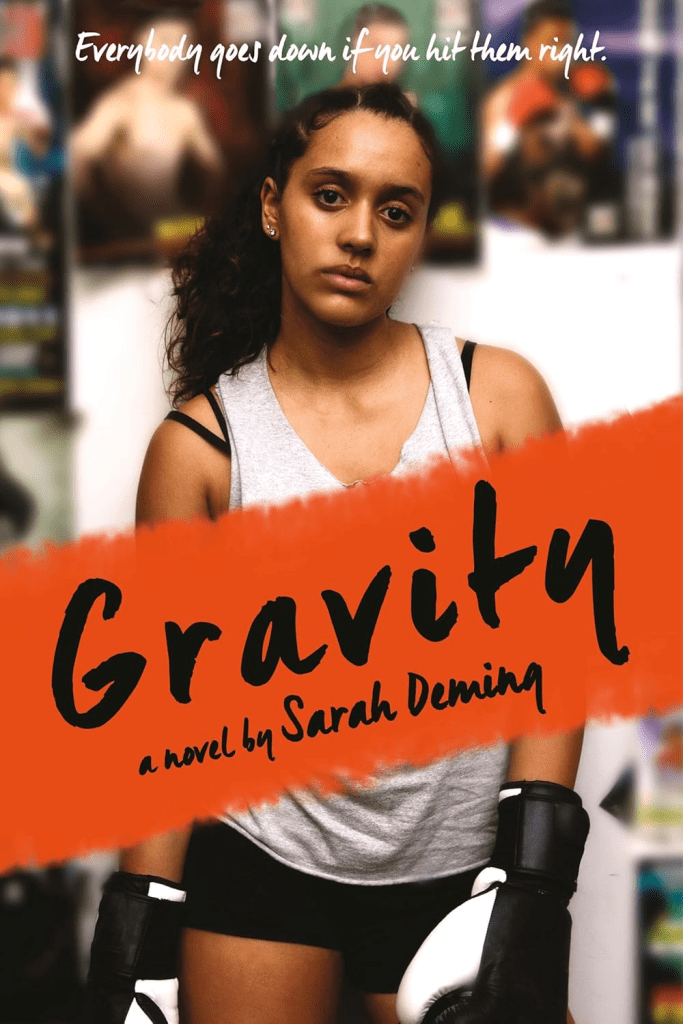
Gravity Delgado is a force to be reckoned with. This young woman is a fierce, undefeated boxer, preparing for the 2016 Olympics in Rio. She’s been training since she was twelve, but her biggest challengers are the ones that she faces outside the ring. Her alcoholic mother, responsibilities for her younger brother, and a heady romance all threaten Gravity’s rising star. She still has her supportive aunt and cousin, as well as her found family at the gym in her corner. Still, Gravity’s biggest obstacle might be herself. The boxing matches are exciting to read, and include both the physical and mental aspects of a bout. Gravity makes mistakes and occasionally stumbles, but you’ll be cheering for her in and out of the ring. A novel that pulls no punches in the best way.
The Truth About Everything by Bridget Farr

Fifteen-year-old Lark knows how to drive, fix an engine, and catch her own food, but she can barely read. She and her parents know the end is coming, and they’ll be the only ones left standing after the inevitable downfall of America. Raised by two doomsday preppers, Lark has never questioned the conspiracy theories that she was raised on. Then Lark gets her period for the first time. She thinks that she’s miscarrying, something that has happened to her mother many times before, but doesn’t know how she could have gotten pregnant in the first place. After her mother explains what her period is, Lark starts to wonder what else her parents haven’t told her? Lark secretly enrolls herself in high school, where new knowledge conflicts with everything she’s been taught at home. She’s hungry to learn, even when it means uncovering painful truths. But soon, Lark finds herself at a crossroads. What is the real truth? And what will Lark have to sacrifice for it? Pairs well with Educated by Tara Westover.
Uprooted by Naomi Novik
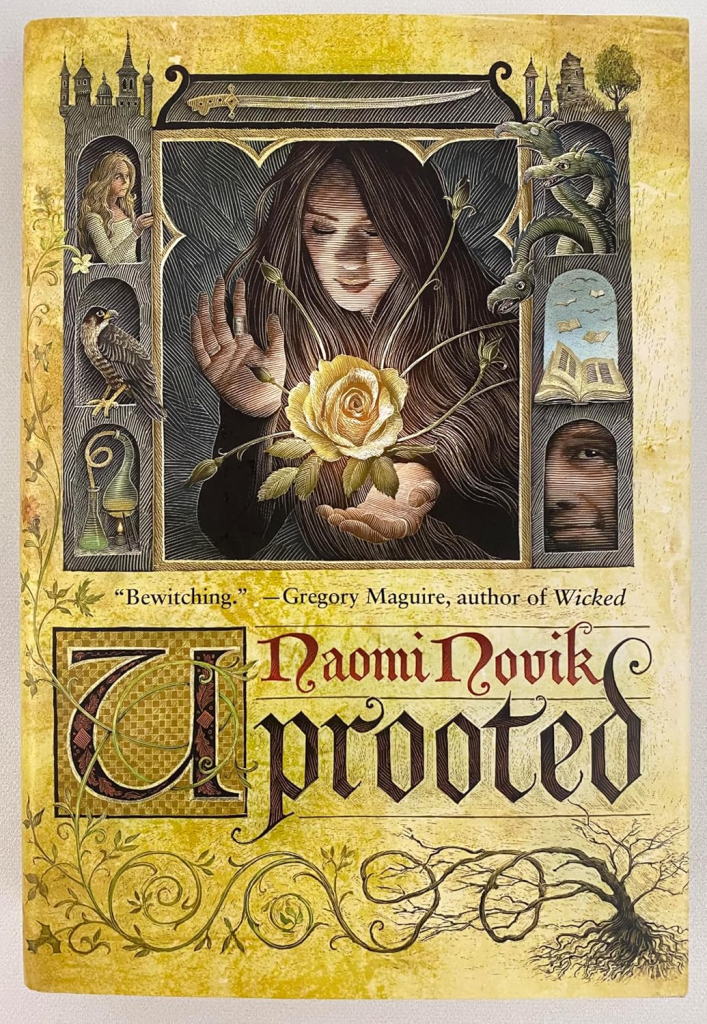
Once every ten years, the Dragon takes a village girl into his tower in the corrupt Wood. When she leaves a decade later, with jewels and finery, she is irrevocably changed and leaves the village forever. But the Dragon isn’t a scaly creature that breathes fire. He is a seemingly ageless, enigmatic wizard. Agnieszka has no fear of being taken. The Dragon only takes the most remarkable young ladies, and she’s nothing special. Though no one says it, everyone believes that Kasia, Agnieszka’s best friend, will be the one he picks. Yet it is Agnieszka the Dragon, reluctantly on his part. She is a witch, and her newly-found powers could be devastating if the corruption of the Wood reaches her. Agnieszka and the Dragon have a rocky start, but their mutual dislike of each other must be put aside when the Wood threatens her home. The well-developed characters, rich, Eastern European-inspired setting, and fantastic storytelling will leave you spellbound.
The Tea Dragon Society by K. O’Neil
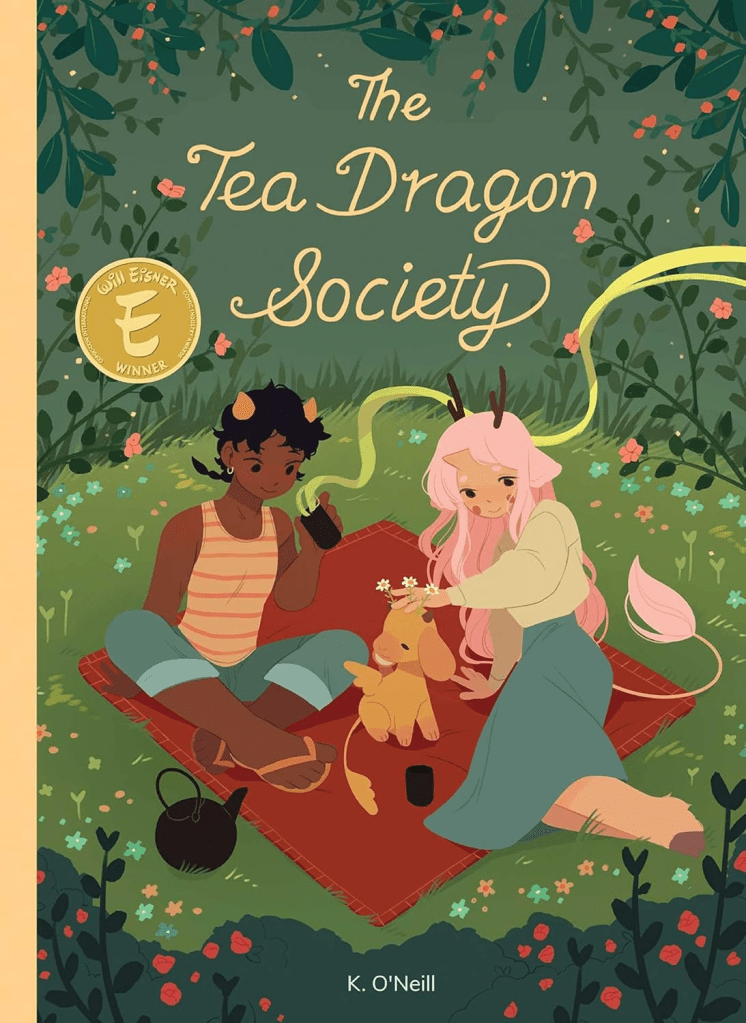
Half-human, half-goblin Greta is an apprentice blacksmith in a world where the old crafts are fading. Greta helps a lost tea dragon – a small dragon that grows tea leaves – find its caretakers, and she is introduced to the Tea Dragon Society. Like blacksmithing, the care and cultivation of tea dragons is a dying art. The Tea Dragon Society is made up now only of Hesekiel, his partner Erik, and a shy girl named Minette. As a year passes, Greta learns to care for the dragons alongside Minette, assuring Hesekiel that the Tea Dragon Society will go on. I’ve enjoyed O’Neil’s other graphic novels, and The Tea Dragon Society embodies so much of what I love about their work. The artwork is soft, with no heavy outlines, adding to the whimsical feel of the world. It features a diverse cast in a simple but visually beautiful story. The Tea Dragon Society is the graphic novel equivalent of sliding into a warm bubble bath…maybe with a nice cup of tea.
Long Way Down by Jason Reynolds

Will’s older brother, Shawn, has just been murdered. Will knows the rules of his neighborhood: don’t cry, don’t snitch, always get revenge. Will takes Shawn’s gun, and take the elevator from his eighth-floor apartment down to the first floor. The doors open on the seventh floor, and Shawn’s friend Buck gets on. Except Buck shouldn’t be here – he was already shot to death. On each floor, another ghost gets on. All of them played a role in Will’s life, and all of them were victims of gun violence. Each tells Will their stories, challenging his resolve. Can he kill his brother’s killer? Should he? This is a short, intense novel in verse that will stay with you long after you turn the final page.
- Yes, that is the correct pluralization. Octopodes is acceptable, octopi is right out. ↩︎
 Overlooked Books