Eragon 30-31: Stew Today, Stew Tomorrow, Stew Forever

I need to discuss one thing that has bugged me for a long time.

Why is it always stew?

As Dianne Wynne Jones wrote in The Tough Guide to Fantasy Land: 

Stew is the staple food in Fantasyland, so be warned.  You may shortly be longing passionately for omelette, steak, or baked beans, but none of these will be forthcoming, indoors or out.  Stew will be what you are served to eat every single time.  Given the disturbed nature of life in this land, where in camp you are likely to be attacked without warning, and in an inn prone to be the centre of a tavern brawl, Stew seems to be an odd choice as staple food, since, on a rough calculation, it takes forty times as long to prepare as steak.  But it is clear the inhabitants have not yet discovered fast food.  The exact recipe for Stew is of course a Management secret, but it is thought to contain meat of some kind and perhaps even vegetables.  Do not expect a salad on the side.

William Goldman also captures this wonderfully in The Princess Bride: 

This was after stew. But then, so is everything. When the first man crawled out of the slime and went to make his home on land, what he had for dinner that night was stew.

Okay, stew is great if you’ve got tough meet or vegetables, but you’ve also got to have time to cook it. In this one situation it might be acceptable, because Eragon’s been unconscious for two days, so I’m sure that Brom had plenty of time to hang out for eight hours and make a stew. And while I’ve been praising Brom for generally being smarter than his charge, he and Saphira just pulled a serious bonehead move. Namely, leaving his unconscious charge alone at camp while he and Saphira go Urgal hunting. If that wasn’t bad enough, Eragon can’t get in contact with Saphira, so he has no idea where they are or what’s going on. So he just hangs out and eats his goddamn stew.

But, seriously, Brom. You’ve made it abundantly clear that Eragon is in danger and a lot of people are after him. Why the hell would you leave the obviously prone Dragon Rider alone, never mind out of reach of his dragon?

When Brom and Saphira return, Brom explains that he was hunting down the Urgals Eragon had encountered earlier, and he’s rightfully pissed.

‘[T]hat piece of magic nearly killed you! You’ve been sleeping for two days. There were twelve Urgals. Twelve! But that didn’t stop you from trying to throw them all the way back to Teirm, now did it? What were you thinking? Sending a rock through each of their heads would have been the smart thing to do. But no, you had to knock them unconscious so they could run away later. I’ve spent the last two days trying to track them down. Even with Saphira, three escaped! [. . .] You don’t even deserve to be called a Rider after this, boy.’

Why the hell would Eragon even bother keeping the Urgals alive? He could have dispatched them from the safety of Saphira’s back, or at least had her attack them, not land in front of them and try to talk to hostile enemies. Just…ugh. I know that main characters have to make mistakes, but our designated hero is just so beast-headed I’m having a hard time feeling sympathetic for him at all.

As much as I love pissed-off Brom, it’s not enough to off-set the disappointment that comes at the end of the chapter. Brom starts drilling Eragon with different combat scenarios, but we don’t get to actually hear what Eragon’s ideas are. I’d have liked to hear at least once of the scenarios and Eragon’s answers, but readers can’t have nice things.

Moving forward, the next chapter might be the most cringe-worthy one yet, because this is where Eragon truly begins his descent into Mary Suedom.

The chapter begins with Eragon scrying on Arya–sorry, the raven-haired elf maiden–and she not only knows that she’s being scryed on, but also is able to acknowledge Eragon. Does this ever get explained why she can do this? I really don’t remember.

The explanation might just be, “because she’s an elf”. Or, as Brom explains,

[I]f you ever have the misfortune to fight and elf–trained or not, female or male–expect to lose. They, along with dragons and other creatures of magic, are many times stronger than nature intended. Even the weakest elf could easily overpower you.’

Elves are a race of goddamn Mary Sues. Whatever you do, they will always be better at it, and be prettier than you. In the sequel, Eldest, Eragon lives among the elves, and I remember hating them. With the exception of maybe Eragon’s new mentor, I found most of the elves to be haughty and completely insufferable. Remember that pretty blond girl at school who was popular and got good grades and was gifted in a million different ways? And was really mean? The elves in the Eragon universe are just mean, pretty high school girls repeated a million times. Even Arya is hard to like in Eldest.

Of course, elves aren’t the only Sues to be accounted for. I’ve tried to give Eragon something of a pass on this, because sometimes plot demands that a main character have traits associated with Mary Sues. He’s also made enough dumb choices so far to help keep him out of that category. But then he had to go and break his wrist, and Brom makes him continue learning swordplay using his left hand instead of his right. He becomes adept at using his left hand, eventually beating Brom when they spar.

Brom shook his head. ‘I can teach you nothing more of the sword. Of all the fighters I’ve met, only three of them could have defeated me like that, and I doubt any of them could have done it with their left hand.’ He smiled ruefully. ‘I may not be as young as I used to be, but I can tell that you’re a talented and rare swordsman.’

Yep. Then that happened. I don’t think he’s an irredeemable Sue yet, but he’s getting there.

Ugh.

I made a note to discuss the overly-complicated rules of a wizard duel as well, but I’d rather talk about the one saving grace in this chapter.

Saphira. It’s Saphira. If not for her, I probably would have thrown this nonsense across the room long ago. I’m beginning to suspect that Paolini made Saphira’s scenes so enjoyable so that readers would forget about the rest of the pitfalls in the story. In this chapter, Brom, Eragon, and Saphira arrive at Dras-Leona, which is on the banks of Leona Lake. Eragon and Saphira go for a swim, diving from the air into the cold water, leaping into the air from the the water…it’s kind of magical.
Eragon 15-16: Br’om is the Ma’in Char’acter We Dese’rve

Here we are once again, with the short chapter-long chapter couplet. The first paragraph or so is actually pretty relatable, with Eragon remembering Garrow’s death and not wanting to get up and face the world. I think we’ve all done that at some point. After a loved one has died, sometimes the hardest thing to do is get out of bed.

I also want to share one line with you.

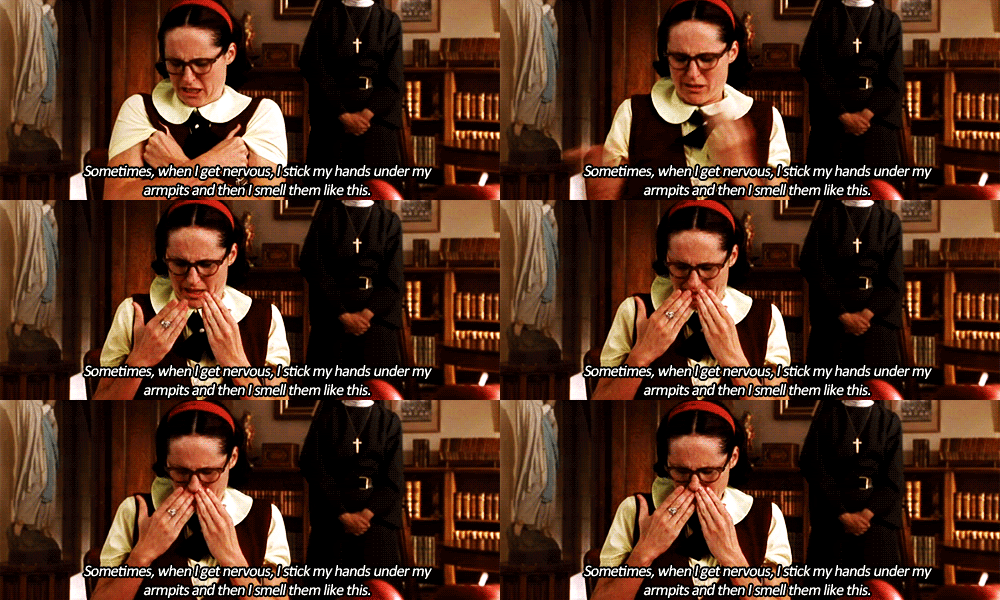
“He jammed his cold fingers in his armpits and crouched by the fire until the food was ready.”

Does that remind you of anything?

mary catherine gallagher

Ah, the 90s. A time when the women were strong, the men were good-looking, and the children are all wondering what the hell I’m referencing.

This chapter is (appropriately) called “Saddle Making”, in which Brom makes a saddle for Saphira out of a leather apron. Except I highly doubt that Brom is able to make a saddle for a dragon – albeit a young one – out of a single apron. Never mind the extra straps he cuts for when Saphira grows larger. Also, how the hell hasn’t Eragon figured out Brom’s a Dragon Rider?

Obi-Brom Kenobi is the source for all information on dragons up to this point. He has a “mysterious” past, and knows way more than any simple storyteller should. He can communicate with Saphira with his mind, build a dragon saddle, and freaking gives Eragon an actual Dragon Rider’s sword. Why the pretense, Brom? And why are you so dumb, Eragon? How have you not put the pieces together yet?!

Sighing and shaking my head, it’s time to move on to chapter 16. The first part of this chapter is largely exposition, and I’m pretty okay with how it’s been done, mostly because it makes sense with the story. Eragon has questions about dragons, and Brom answers them. What I like about this is that it’s not all done in Brom’s dialogue, nor is it done completely as narration. It actually strikes a good balance between the two. A surprise bonus of this is that I don’t have to read too much overly-flowery dialogue. Yay!

There is something I’ve always wondered about, though. Brom says that dragons don’t hatch until conditions are right for them to be born, which usually meant there was enough food for them. Dragons that the Riders used, though, would only hatch when the right Rider touched their egg. In other words, Saphira might have never hatched if Eragon hadn’t found her egg.

What happened to the “wild” dragons that were mentioned? I also find it hard to believe that dragons – notable for being a proud race – would leave the future of their species to humans and elves. Sure, Galby (I refuse to write his full name one more time) killing dragons and Riders didn’t help matters, but eggs only hatching when the right person touches them? Yeah, you’re going to wind up with an endangered species right there.

If the Eragon-verse had tumblr, I can only imagine what it would be like. “Dragons only hatch when humans or elves touch their eggs? SO RACIST. Check your privilege!”

Along with learning about dragons, Eragon asks Brom about how he got the sword of another Dragon Rider. Brom tells him that he doesn’t want to reveal it yet, and, “I don’t want to keep you ignorant, far from it.”

EXCEPT YOU TOTALLY ARE.

The sword’s history is revealed in the second book, if I recall correctly, and it would be pretty upsetting for Eragon to learn. I won’t hold it against Brom for not telling him, but…God, Brom just tell him you’re a Dragon Rider. It’s obvious to anyone who’s not Eragon.

One good thing about the book is that Eragon isn’t a total Mary Sue right away. During this chapter, he and Brom start practicing swordplay, and Eragon gets his ass kicked time and time again. He develops his sword skills throughout the book, and I like that he isn’t a “natural”. He has to learn, struggle, and get his ass handed to him. And since he’s been driving me crazy, reading about him covered in bruises fills me with a kind of smug satisfaction. Especially since Brom is a much more interesting character, and I’d be pretty happy if he lit out on his own with Saphira.

There’s also one more thing that’s really bugging me. Let’s see if you can spot it in this chapter summary.

Eragon takes his sword, Za’roc, so he can fight the Ra’zac while he’s traveling outside Utgard.

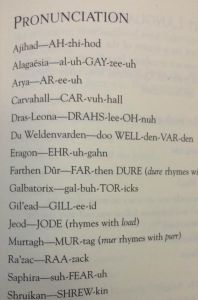
I’m not even halfway through the book, and I am so sick of these unpronounceable names with apostrophes.

Wait. I stand corrected. They’re not unprouncable.

pronunciation

But I feel like if you have to put a pronunciation guide in your novel, you’ve done something wrong.

Eragon Chap. 14: Dragon Advice

I’m not sure I get Saphira. She was my favorite character when I first read this book, mostly by logic of “ohmygodohmygodDRAGON”. She tries to give Eragon sage advice while he grieves, but I’m not sure of its validity:

Anguish enveloped Eragon as he awoke. [. . .] “I can’t live with this,” he moaned.

“Then don’t.” Saphira’s words reverberated in his head.

…did Saphira just suggest that Eragon kill himself?

Even now, I still like her character, and some of her dialogue.

The worth is in the act. Your worth halts when you surrender the will to change and experience life. But options are before you; choose one and dedicate yourself to it. The deeds will give you new hope and purpose.

But Saphira’s only a few months old at this point, though. She’s still a baby; the only human she’s seen up close until this point is Eragon. She understands how his mind works, but there’s no real reason for her to know anything about the world outside Eragon’s farm. Do dragons have some kind of ancestral memory that allows them to dole out advice like an older, wiser dragon? It’s the only explanation that would make sense to me, because Saphira knows things that there’s no way Eragon could have taught her.

On the other hand, some of her advice might be terrible.

Saphira was right. Nothing mattered anymore except the act itself.

We’ve also encountered the dead parent trope again. I’ll probably talk about this in more depth in a separate post, but I’m really sick of this. The laconic version is this: characters are more interesting when they have more to lose. Even if it leads to cheesy lines like this:

“Nothing is more dangerous than an enemy with nothing to lose,” he thought, “Which is what I have become.”

I used to love that quote when I was fourteen–a year younger than Eragon, actually. Growing up, I was bullied, ignored, never felt welcome in my school. I was an angry kid, an angrier teenager, and a line like that really spoke to me. For a long time I felt like it was me against the world, that everyone was my enemy. Since I felt so unwanted, I didn’t really see the point in playing nice with others. You might be able to imagine the unfortunate cycle that led to. The idea of a hero, fighting with no one on his side–and presumably winning–was very appealing to me.

At Saphira’s encouragement, Eragon decides to leave Carvahall and hunt down the Ra’zac, who destroyed his home and killed Garrow. Now, I know that we need the real adventure to start somehow, but I don’t like Saphira’s sudden change of heart. When the Ra’zac first came to Carvahall, she was so scared that she took off in a frenzied flight, taking Eragon with her. She was so terrorized that she wouldn’t even tell Eragon what was going on, and he was rebuffed when he tried to reach her with their mind-link.

Have you ever been so afraid of something that you couldn’t speak, or literally ran away from? I can almost guarantee that you would not be charging directly towards whatever it is you fear just because a teenager gave you a short lecture about running away.

Saphira’s fear was real and palpable, but nope, let’s forget that it ever happened. She’s over it now!

As they’re leaving town, Brom also comes to join Eragon and Saphira’s quest. He tries to sound mysterious about how he knows so much about dragons and the Ra’zac, but he’s not fooling anyone. Anyone who’s picked up a book or watched a movie like this already knows that he’s going to end up being a former dragon rider, and no doubt “Saphira” was also the name of his dragon. It doesn’t take a genius to figure that out. So why so the smokescreen? I honestly don’t remember if Brom ever gives a real reason for not telling Eragon about his past right away. I hope he does, and that it’s not something stupid.

This post is a bit lengthy, so I won’t go on to the next chapter right now. I will, however, leave you with this quote:

Brom’s eyebrows beetled with anger.

Beetled“?

Eragon 8-9: Teenager, or Idiot Ball?

When I read books, I really like it when teenagers and child characters actually act their age. This was one of the problems I had with Angelic Layer, which was that the young child acted nothing like a little kid. But in Chapter 8 of Eragon, I can’t decide if Eragon is acting his age, or just being a big idiot ball. But since he’s only fifteen, I think it’s fair to say that he’s an idiot by default.

When Roran tells his father, Garrow, that he plans to leave, Garrow is totally okay with it. In fact, he’s happy for Roran. Eragon is pretty surprised at Garrow’s reaction, and disappointed with it. On one hand,  I understand that he’s going to miss Roran. But on the other, what the hell was he expecting? Roran’s got an opportunity to make a better living than he does on the farm, and make enough money to get married.

I think I’m supposed to be sad, or at least feel something. But Roran doesn’t have any real character yet, and the only thing we know about him so far is that he’s in love with Sloan’s daughter. I’m almost reminiscent about when my sister left for college. I was sad when she left, but I also knew that her leaving home was inevitable, and it ended up being one of the best things to happen to her. So sure, Eragon, be sad, but don’t resent Roran for moving forward with his life.

Before we move on to the next chapter, I’d like to end it with a quote near the end of the chapter, when Roran is packing to leave.

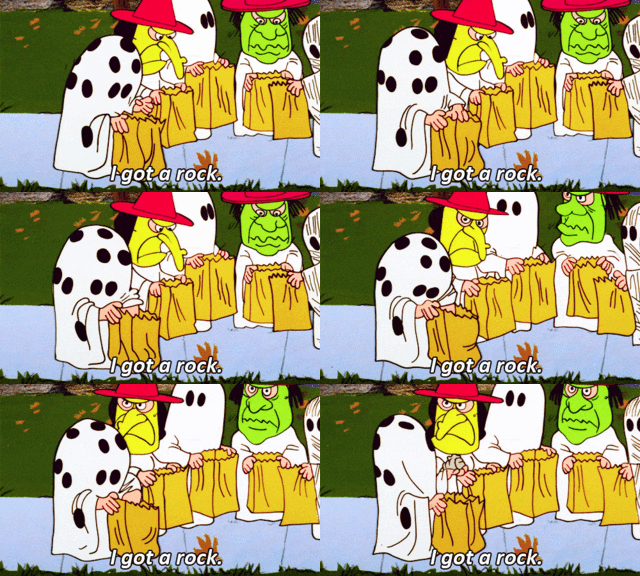
“[Roran] paused, then picked up something from the pillow and bounced it in his hand. It was a polished rock Eragon had given him years ago. Roran started to tuck it into the bundle, then stopped and set it on a shelf. A hard lump formed in Eragon’s throat, and he left.”

I know that this is supposed to make me feel sad, but it only reminds me of “It’s the Great Pumpkin, Charlie Brown!”

i got a rock.gif

Moving on to chapter nine, where we finally got…plot! Yay, plot! The chapter begins with Roran leaving the farm and Garrow giving advice to him and Eragon. It’s as awkward as it is sweet. But in the back of my mind I had to remember that the author was only fifteen when he wrote this. A lot of that shows in his prose, but it kind of dampened the impact of Garrow’s farewell speech to me. Garrow talks about life and love, giving him advice for the future. Things that the author’s never experienced. It actually reminds me of a time, during my senior year of college, when a freshman tried to complain to a group of seniors about his workload. In an out-of-character moment for me, I ripped this guy a new asshole, (loudly) explaining how he can complain about his work to other freshmen, but he had no right to whine to us.

He never complained in front of me again.

Of course, when we’re teenagers, we think we know everything. So maybe Paolini trying to show off his “wisdom”, such as it is, is entirely in-line with the rest of his writing.

Eragon goes into town to see Roran off, and is warned by another villager that there are strangers who have been asking about the “stone” he found in the Spine. Eragon puts the pieces together that someone is after Saphira. Well, what were you expecting, Eragon? You know the Empire and Galby killed the other Dragon Riders, and you even acknowledged that they would probably hunt down Saphira, too. God, you’re dumb.

And watch out, because I’m going to tear apart a single sentence. Again.

“The voice was deep and moist.”

Ugh.

No one likes the word moist. And I’m not even sure how a voice can sound “moist”, unless they’ve got a lot of spit in it. The idea was that the stranger’s voice gave Eragon a sense of rot and decay. But there just had to be some better way to evoke this. Because right now, I’m only giggling. Because the voice is deep, like a cave. And moist, like a…cave.

Eragon 6-7: Exposition for Two

When you’re writing something that doesn’t take place in the real world, you have to find some way to tell the audience the “rules” of the universe. There are two main ways authors do this: by directly stating what those rules are (The Hunger Games loves this) or Character A telling Character B explaining the rules. In most cases, Character B is some kind of newcomer–like Obi-Wan teaching Luke about the Force, for instance.

Most authors use a mix of both methods, which works well, but I prefer the latter. I think it helps the story flow more naturally, and helps keep the reader in the world a bit more easily. And then there are chapters like this.

Eragon goes into town, and meets with Brom the storyteller in a chapter that is nothing but exposition. Eragon, naturally, wants to learn more about dragons and the Dragon Riders, and has plenty of questions about both. The whole chapter is Eragon asking questions, and Brom giving him the answers. We learn about the history of the Riders, and more about dragons themselves. Even though I generally prefer this method of getting information to the readers, for some reason I don’t like it here. I can’t exactly pinpoint why. Part of it might just be that it feels lazy–Paolini couldn’t figure out how to wedge all this in, so he put it here. Or maybe it’s the length of the chapter that bothers me. It’s pretty long–longer than the last two combined. There’s not a lot of action, just a back-and-forth. I just don’t like large information dumps, and I wonder if cutting out some of the details of this chapter would have helped me like it better. Of course, this is also my second time reading the book, so I already know what Brom’s going to say. Obviously, this stuff isn’t going to be as interesting to me the second time around.

Well, whatever. I didn’t like the way the information was shoved down my throat. I also had one head-scratching moment, wherein Brom describes a war between the dragons and the elves. It was a huge war that left the land devastated, but it only lasted…five years? Okay, that’s a long time for a human war, but we’re talking about creatures that live for centuries. Five years seems a little short.

Moving on to the next chapter.

Chapter 7 is another unevenly short chapter, not quite four pages long. On their way back to the farm, Eragon’s cousin Roran announces that he’s accepted an offer of work in another town. Eragon doesn’t really want Roran to leave, and suggests he wait until spring. Roran disagrees, and says he will be leaving shortly while they’re waiting for winter. Even though this isn’t a book about the division of farm labor, I still need to ask: where the hell are all the farmhands? It’s only Roran, Eragon, and Eragon’s Uncle Garrow working on the farm. How do just the three of them manage to keep it running and productive? How did Garrow and his now deceased wife manage to do it before Eragon and Roran were old enough to help? And for that matter, why doesn’t Garrow have, like, ten other kids to do farm work?

It’s been said that when you’re writing science-fiction, you get one lie, and you have to then work within the confines of that lie. Everything else has to follow the rules. Fantasy, I think, is a little broader, but still follows that principle. f you’re writing about dragons, that’s fine, because dragons are mythological creatures and you can do what you want with them, as long as you follow the basic rules. Things like dragons fly, breathe something dangerous, and could kill you several times over.

Suspension of disbelief is a funny thing. I’m all for dragons and magic–that’s why I picked up this book in the first place. It’s the small, nagging details that bother me. You want to write about a dragon that flies and breathes fire? Cool. Go ahead. But if you’re writing about something that exists in real life, that readers know about, then you have to make it realistic. Realistic details in a fantasy setting make the world plausible. It’s not the fantasy elements that will drive readers away. What will turn them if is when they don’t see the familiar reflected in the extraordinary.

That was kind of an unexpected rant. Anyway, the dragon was finally named “Saphira”, surprising absolutely no one. First of all, she’s a bright blue dragon. Second of all, you know another Saphira was important to Brom, just from the way he said it.

Anyway, moral of the story? It’s cool if your main character can shoot fireballs from his hand or whatever, but if he, say…lived in the 21st Century and didn’t have an email account, I would seriously have to question both the author’s writing choices and their* perception of what is normal in the world.


*Strunk and White be damned, I’m totally okay with “they” as a singular gender neutral pronoun.

Eragon 3: This is a Joke, Right?

It is truly shocking how little I care about the goings-on in Carvahall, Eragon’s village. Since I’ve read Eragon already and know what’s going to happen, there’s no tension in this chapter anymore. I wonder if this is one of the reasons I never read this book twice, despite how much I enjoyed it the first time around. So far it’s the longest chapter in the book, and it’s nothing but exposition.

Before I get into that, though, I want to pick apart the text.

“He helped himself to a piece of chicken, which he devoured hungrily.”

Does anyone else see what’s wrong with that sentence?

I’ve taken enough creative writing classes to know that you should (a) avoid adverbs and (b) use verbs for description.

I love how Stephen King put it in his memoir, On Writing:

“I believe the road to hell is paved with adverbs, and I will shout it from the rooftops. To put it another way, they’re like dandelions. If you have one on your lawn, it looks pretty and unique. If you fail to root it out, however, you find five the next day…fifty the day after that…and then, my brothers and sisters, your lawn is totally, completely, and profligately covered with dandelions. By then you see them for the weeds they really are, but by then it’s–GASP!!–too late.”

One or two adverbs here or there are okay. Too many, though, and they become annoying and repetitive, and make your writing look lazy and weak.

And this ties into into (b) use verbs for description.

Don’t get me wrong, adjectives are great. But verbs are better.

Compare:

“I don’t like it,” she said in a soft voice.

To:

“I don’t like it,” she whispered.

They both mean the same thing, but the second sentence should feel stronger and put a more immediate picture in your mind than the first. If it didn’t, I’ve clearly done something wrong here. Like adverbs, adjectives can get ungainly when they’re overused. Don’t use two words when one will suffice.

If you haven’t figured it out yet, my problem with the above sentence is two-fold. Obviously, I don’t like “hungrily”. But it’s also redundant. If Eragon is “devouring”, he’s clearly hungry; there’s no need to say he devoured something “hungrily”.

“Eragon devoured the chicken.”
“Eragon hungrily ate the chicken.”

Either of these would have been better than what we got.

I just spent way too much time picking apart one sentence that’s probably gone unnoticed by most readers.

As for the rest of this chapter, it’s mostly just exposition. A good portion of it is just the villagers talking about how much they hate the Empire. I think it would be better if it was done using more dialogue and didn’t rely on the narration so much, but it also seems to repeat itself a lot.

The most important part of this chapter comes at the end, when Brom tells the story of the Dragon Riders. They were a group of Mary Sues humans and elves who rode dragons and kept peace throughout the land. So, you know, Jedi, but with dragons. As you might imagine, some tragedy befell them, and now the Dragon Riders are no more. Or, as Brom tells it:

“‘Some saw his abrupt rise as dangerous and warned the others, but the Riders had grown arrogant in their power and ignored caution. Alas, sorrow as conceived that day.'”

Hahaha! This is another case of flowery words backfiring. “Conceived”? Really?

“Brom, how did the Riders fall?”

“Well, Eragon, when a Dragon Rider loves arrogance very much, they conceive sorrow!”

The story is about a Rider named Galbatorix…

…yes, that’s his real name. Not a name that he took after going crazy and becoming evil. Sigh.

Galbatorix’s dragon was killed, he went crazy, and the Riders refused to give him a new one. Now, Brom talks a lot about how cunning Galbatorix is, and how skilled he was with magic and a sword. Basically, a real bad-ass. When he goes to overthrow the Riders, though, he can only do it with the help of an accomplice, Morzan.

“‘Galbatorix convinced Morzan to leave a gate unbolted in the citadel Ilirea, which is now called Urû’baen.'”

Two things here: First, all of those names are so cringe-worthy. The dragon Galbatorix steals is even named “Shruikan”. You know, “shuriken” spelled wrong.

Second, Brom spent so much time telling us how dangerous Galbatorix was on his own, I’m kind of finding it hard to believe that all he needed was a gate left open instead of melting the lock with magic, or blasting it open, or disguising himself as another Rider. Once Shruikan is all grown-up, Galbatorix and thirteen other defectors kill the other Dragon Riders. Vrael, leader of the Dragon Riders, fights Galbatorix, but…well, this is the part where I nearly threw the book down with rage.

“‘As they fought, Galbatorix kicked Vrael in the fork of his legs. With that underhanded blow he gained dominance over Vrael and removed his head with a blazing sword. [. . .] And from that day, he has ruled us.”

A crotch shot?

A CROTCH SHOT?!

THE WORLD WAS CHANGED BECAUSE OF A CROTCH SHOT?!

THE ENTIRE WORLD COULD HAVE BEEN SAVED IF VRAEL WORE A CODPIECE.

WHAT IS THIS SHIT.

Eragon 1-2: SO INTENSE.

When I began this blog, I knew right away that I wanted to re-read Eragon for it, mostly to see if the book I loved as a teenager was as bad as everyone said it was. I did have one pretty big hang-up about getting it started: the length. Almost 500 pages long, reading a book this size was no mean feat for a fourteen-year-old, and might prove to be even more of a challenge for an adult with a full-time job who spends most of her weekends either traveling or working. Sometimes both. And this book gets pretty heavy as a carry-on. Plus, the table of contents alone is 3 pages long. That’s a lot of chapters to review.

Flipping through the book, I realized that the chapters don’t have even lengths. The first chapter is about 2.5 pages long, as is the second. They’re fairly quick reads, and though I expect some big, fat chapters later on in the book, right now it doesn’t seem like such an intimidating project. But I do have a good backlog of posts, so…let’s give it a shot.

Chapter one introduces us to the titular protagonist, Eragon. We learn that he’s just a teenager (because of course he is), who’s a skilled hunter and tracker. The prose isn’t bad, but there’s just something about it that feels lacking. It seems like Paolini was reaching for flowery language, but prose that is still easy to understand.

What doesn’t feel lacking is just over-the-top. Three paragraphs in, and I’m already scoffing over Eragon’s description:

“Eragon was fifteen, less than a year from manhood. Dark eyebrows rested above his intense brown eyes.”

It’s the “intense brown eyes” that gets me. That’s the kind of phrase I would have used in fanfiction when describing a character. It’s a description that just doesn’t make sense to me. When someone has “intense” eyes, I can only picture a person whose eyes are unearthly–in that they’re glowing, or can hypnotize you with a stare. For me, it’s just too vague to actually mean anything.

However, his ridiculous eyes do lead him to a blue stone, the same one that the elf was carrying in the prologue. I think that there’s supposed to be suspense here, but anyone who read the inside flap of the book can tell you right away it’s got something to do with the blue dragon on the cover. However, it does lead us to the first sentence that made me laugh out loud in this book.

“The stone was cool and frictionless under his fingers, like hardened silk.”

It’s another case of trying to using flowery language, except it backfired hilariously. I know that he’s trying to say that the stone is really smooth, but “frictionless”?

If it were truly frictionless, Eragon wouldn’t be able to hold it. It would be sliding out of his hands, slipping through the forest, and no one would ever be able to catch it. The mental image of that–a huge blue stone, forever moving across the world–is funnier than it should be to me. Maybe because right now I’m wishing that’s what would really happen.

…maybe that’d be a better way of keeping the stone safe, rather than teleporting it somewhere where it might never get found, or worse, fall into the wrong hands?

And that about does it for the first chapter. Like I said, it was pretty short. Moving on to the next…

The first two pages of this chapter are nothing but description. It’s not bad, and it wasn’t even that boring. We’re also introduced to Sloan, the butcher. I never liked Sloan; as a kid it was because he’s a dick. Now, it’s because he’s a dick to just the main character. He hates Eragon, and the reason that’s given is because Eragon isn’t afraid to venture into the mountain range where Sloan’s wife was killed.

I read the first two books completely, and almost finished the third one in this series. Some major shit happens to Sloan, and I think it’s meant to be his comeuppance for being an asshole to Eragon. It’s a pretty disproportionate punishment for just being a jerk. Even Eragon, who’s supposed to be our hero, punishes Sloan right after saving him.

I guess I should just be focusing on this book, and this chapter, but Sloan’s treatment gets taken too far.

We also see the farm that Eragon lives on, with his uncle and cousin.

Okay, I’ll accept dragons and magic and elves. I cannot accept that a farm has only three people living and working on it. If they can’t afford farmhands, shouldn’t Uncle Garrow have, like, eight kids? A farm is freaking hard to run, especially when you only have three people working on it, and one of them seems to be hunting in the woods more often than not, if Sloan’s dialogue is any indication.

Also, this is our first description of Garrow:

“His worn clothes hung on him like rags on a stick frame. A lean, hungry face with intense eyes gazed out from under graying hair.”

SO INTENSE. What does that even mean?

Eragon Prologue: A Scent that Would Change The World

Hoo, boy.

When I started this blog, I knew right away that one of the books I wanted to read for it was Eragon. I loved this book when I was fourteen, but I’m aware of all the terrible reviews it’s gotten. The main character has been called a sociopath, the overall story is said to be Star Wars with dragons, the writing’s been called proof that Paolini has access to a thesaurus. Now, it’s time for me to go back and see if any of that is true.

But before we go any further, let’s get the Star Wars thing out of the way right now. The first Star Wars movie (A New Hope)  follows a classic monomyth structure. This is where a lot of familiar storytelling devices come from: the call to adventure, the wise old man, the first failure. The protagonist succeeds and fails, and finally wins the day and learns a lesson.

Eragon, inasmuch as I remember, follows the same monomyth structure. It’s not necessarily that it’s a rip-off of Star Wars, but that it follows the same story structure that has existed…probably for as long as stories have. Can you really blame a fifteen-year-old novelist, in his first book, for using a tried and true formula?

Well, yes, I suppose you could.

Enough of that, let’s jump right in!

“Wind howled through the night, carrying a scent that would change the world.”

Oh my God.

That’s the first line of this series.

That’s the first line.

If I spotted this in a bookstore today, picked it up, and read the first sentence, I would have slammed it shut so fast. I have a terrible feeling that the awful, corny sentence I just read is going to set the tone for the rest of this book.

But I loved this book as a kid. And it was really popular! There’s gotta be a reason why so many people enjoyed it! It can’t be all bad, right?

…Right?

The prologue follows a “raven-haired” (groan) woman who is clearly on a mission, but we don’t know what that mission is. The first time I read this book, I was totally confused, and had no idea what was happening. Because I was an idiot, I took that as a good thing.

My reasoning was this:

1. The Similarillion is a great book.
2. I had no goddamn clue was was going on in The Silmarillion.
3. Therefore, if I didn’t understand what was happening in the long fantasy novel, and it had a lot of made-up words, it was good.

Now I know the opposite to be true. Confusing your audience is a good way to lose them pretty quickly. Case in point: I never actually read past the first chapter of The Silmaraillion.

Paolini tells us about a “Shade” and “Urgals” chasing our dark-haired beauty, without really explaining what they are. We can figure out that Urgals are just another flavor of orc, and a Shade is some kind of magician, presumably an evil one. I guess I can see why you’d want to use different terms than the norm when writing a book like this, but a rose by any other name still smells.

Anyway, the beautiful woman gets captured, but teleports a blue stone far away from her location. Anyway, the hero will eventually save her and–

They were right. They were right all along. This is just Star Wars.

No…I have to hold out hope. I have to believe that this isn’t just a a rip-off of a better, more beloved franchise. It’s just the monomyth structure! It’s just the monomyth structure!

Maybe if I say it enough, I’ll convince myself that it’s true.

It’s just the monomyth structure, it’s just the monomyth structure, it’s just the monomyth structure…