Eragon 24-25: Saphira is Still the Best

Moving right along, chapter 24 was another short chapter, but still better than the previous one. Eragon and Brom arrive in Teirm, a large city on the coast. Here, they hope to find a record of the merchant that brought the oil the Ra’zac used. This chapter is largely description of the city, with Brom playing tour guide. We learn the layout of the city, and how it keeps Teirm safe. The only things I really thought were notable about this chapter was just how generic the tavern Brom and Eragon visited, and Eragon and Saphira’s relationship.

Every writers has been told, “show, don’t tell” more than once. Reading Eragon this time around, I realized that most of Eragon’s and Saphira’s relationship in the beginning of the novel was a lot of telling. In recent chapters, we finally get more showing, especially when Saphira demanded that Eragon started flying with her. It gives us this small exchange, too.

“But Brom and I do have some advantages most people don’t. We’ll be all right.”

“If anything happens, I’m going to pin you to my back and never let you off.”

“I love you too.”

At least, I think it’s sweet.

I didn’t think that I would like this chapter. It’s longer than the previous two combined, and I thought it would be more dialogue-heavy exposition. Then something strange happened. I actually started getting into it.

In Teirm, Brom meets up with an old friend, Jeod, who’s quite surprised to see him again. For starters, Jeod thought that Brom was dead, probably for decades. And, suddenly, I wished that I could read this book for the first time again. I’m going to be intrigued by nearly anything that involves faking your death, or leading others to believe you’re dead, especially when you don’t know why the character did that. When I read Jeod’s and Brom’s reunion, I remembered how much I’d wanted to know about Brom’s past when I first read this at fourteen.

This chapter is full of mystery about Brom’s past and Jeod’s identity. When they think Eragon can’t hear them, they discuss places and people Eragon hasn’t heard of: Trojenhiem, Ajihad, Surda. Some of those names you’ll find on the map on the front and back covers, but a lot of it is still unknown. Being able to identify Surda on the map doesn’t mean you know what’s going on there, or why it’s important.

In fiction, having questions the audience wants answered helps keep them hooked. It’s the same reason I’m still reading A Song of Ice and Fire. I don’t necessarily enjoy the books, but goddammit, I need to know what happens next! But at the same time, having too many questions without enough answers can also frustrate the audience and make them give up on the story. This was a problem with shows like Lost and Heroes: questions that never get resolutions.

I think Paolini handled this well. Everything that Brom and Jeod discuss out of Eragon’s earshot (or so they think) is explained and resolved by the end of this book. The plot moves forward from there, giving us more questions, more plots–and they get resolved in the next book. There’s enough there that I want to know more and keep reading, but not too much that it makes me crazy and want to give up on the work.

I have to give props for the glossary in the back of the book, which translates words and phrases from the Ancient Language into English. It gives us enough information to get us through the novel, but it doesn’t give too much away.

I also like Saphira’s sarcasm when Eragon attempts to climb up a cliff to see her, and gets stuck.

You’re right. After all, how can a mere dragon expect to tell a man like yourself what to do? In fact, everyone should stand in awe of your brilliance of finding the only dead end. Why, if you had started a few feet in either direction, the path to the top would have been clear.

Saphira would make a good blogger.

There’s even a dose of realism added. At this point I’m trying not to get too hung up on the details of smaller things, like, “Shouldn’t Eragon have scurvy by now because he’s only been eating meat for weeks?” But I really appreciate that Eragon doesn’t know how to read, like the good medieval peasant he is. It irks me a bit that Garrow could somehow read, but I won’t let it detract too much from this.

If there’s one thing that I don’t like in this chapter, it’d be how Brom spells out the reasons why Eragon can’t contact Roran, or try to draw the Ra’zac off his tail. As much as it I appreciate Brom’s practicality, I think the “stay in hiding so you can protect the ones you love” conversation went on just a bit too long, and it’s nothing new or exciting. Peter Parker could have told you the same thing in fewer words.

Well, at least Roran’s not dead. Someday I’ll elaborate on why I hate the “everyone I love is dead” trope, but for now, that’s another post altogether.


Eragon 22-23: Not Half Bad

Something unusual happened. I actually liked this chapter. While I was looking forward to reading flying scenes, especially because I’m a student pilot. However, I was sure that they would only disappoint. They did not. I even loved Eragon’s anticipation as he prepares to fly with Saphira.

Saphira waited impatiently while Eragon tightened the bands around his legs. Are you ready? she asked.

He sucked in the fresh morning air. No, but let’s do it!

That is exactly how I feel when I’m getting ready to take off. I’m always nervous and excited, but pretty soon, the sheer joy of being able to fly takes over. Then the book describes Saphira’s grace, riding on updrafts, performing aerial maneuvers…and I almost exploded in nerdy joy when Eragon sees that Saphira uses her tail as a rudder. And then, then it gets even better when Saphira lets Eragon enter her mind see the world through her eyes, feel the sheer joy of flying. GOD I WANT TO DO THIS SO BAD WHY ARE DRAGONS FICTIONAL.

It’s a good thing there’s only one of me right now, because I can’t even.

Okay, time to take a deep breath, and stop fangirling.

After weeks spent tracking the Ra’zac, it seems that Eragon and Brom have finally lost the trail. That they managed to have it for that long is kind of dubious to me, but whatever, at this point I’m along for the ride. The Ra’zac appear to have taken flight, which kind of begs the question why they took so long to fly away in the first place. Also, having not found Saphira or Eragon in Carvahall, I feel like they were doing a really shitty job of finding Saphira. Wrecking Eragon’s farm was the equivalent of leaving the hero for dead in a cunning trap, and anyone who’s ever watched a Bond movie knows how that ends.

My brain just stopped for a second. I just realized the Ra’zac are Ringwraiths. I guess I can’t like this chapter anymore.

Along with the flying, though, I’m glad that the plot’s finally moving along. Eragon finds a flask of oil that’s used to burn flesh and muscle, and nothing else. That’s pretty fucked up. Brom elucidates some of them ways it could be used against your enemies and generally be cruel. The teenage version of myself (and the part of me that likes to torture characters) thinks that’s awesome. More than I want to admit.

I also like that Brom and Eragon decide to use a decidedly mundane method of tracking the Ra’zac after they find the oil. No spells, no mind-reading, just tracking where the oil was shipped from and to. It’s as simple as finding the right document. And after so much swords and sorcery, I appreciate this practical approach.

I’m glad I liked this chapter, because the next one was just padding. I really can’t see how this made it into the final cut of the novel. Eragon is curious about what the ocean is like, and Brom tells him “the sea is emotion incarnate”. What?

Most of this chapter is, essentially, a montage. Eragon and Brom traveling, practicing swordplay and learning how to use magic. So little happens in this chapter that the most memorable line might be when Eragon thinks, “Everything about me is turning hard.” He’s thinking about his muscles and how fit he’s becoming, but I’m still immature enough to snort at that. Then I remember that this book was written by a fifteen-year-old. I’m only picturing a young Christopher Paolini also laughing at that line, or trying to convince someone that it’s so deep. The latter is what I would have done at fifteen, and the former is what I’m doing now. Because I am still a child and low-hanging fruit will always make me chuckle.


Eragon 20: Sad Resignation to Keep Reading

The first thing I wrote upon starting chapter 20 was, “This was a lot more fun when I was drunk”. Yes, I was unnecessarily angry at a fictional character during the last chapter, but at least I felt something other than sad resignation to keep reading. For awhile, I thought that might be the only note I’d write down, as this chapter is a lot of exposition, and not much else.

I’ve talked a bit about world-building in novels, and I’ve said that in general, I like it better when the characters learn the rules of the universe as the readers do. It feels much more natural, and you’re not overwhelmed with a ton of information at once. Eragon is starting to show me the drawbacks of that method. It makes sense for the story, as Eragon starts out as a know-nothing dragon rider. However, the chapters that are nothing but exposition and conversation are starting to wear on me. Eragon accidentally using magic for the first time, and Brom’s angry admonitions of him were part of the story, though. Despite my earlier criticisms, they were exciting. This chapter is just a casual conversation, written to explain to Eragon and the readers how magic works.

I guess one of the things I don’t like about this chapter is that there’s nothing that breaks up the dialogue until the end. I know that it’s important to get information to the reader, but there’s got to be a better way of doing it than this.

Aside from that, I have several questions, not the least of which is, “why doesn’t Saphira have more screen time?”

Seriously.

Other than that, the Dragon Riders apparently kept their magic a secret, even at the height of their power, so their enemies wouldn’t be able to use it against them. I guess that explains why Eragon was so surprised that he could use magic, but it seems like something like that would be hard to keep a secret. It also really bothers me that Eragon has yet to make the connection that Brom was a Rider.

Brom also mentions that Shades and sorcerers get their magic from spirits, which makes it different from the Riders’ magic. “Spirits” largely gets glossed over in this book, and the next, with the only information we get about them being that they’re bad news. I don’t know if they’re elaborated on any further in the last two books in the series. I’d like to know more, but this chapter certainly wasn’t a good place to add even more details.

It’s also revealed that every person has two names, one that they’re given when they’re born, and a “true” name, which reflects who they really are. Sharing your true name is dangerous, as anyone who knows it has complete control over you. Since I will not likely be reading the final two books anytime soon, I let my curiosity get the better of me and Googled what Eragon’s true name is. This is what Christopher Paolini had to say:

I felt that giving them to readers would spoil some of the mystery and power they hold. You could say the whole Inheritance Cycle encompasses Eragon’s true name. But its short form is a secret between Eragon, Saphira, Glaedr, and Arya.

Aw, come on! I wanna know!


Eragon 19: Goddammit, Brom.

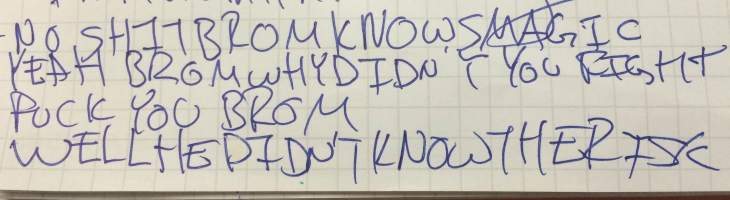
Full disclosure: I was not entirely sober when I read this chapter. My notes reflect this.

img_0930

In my defense, I’m of legal age, was safely at home, and the worst thing that happened was I got irrationally angry at a fictional character. That last part is not so different from when I’m sober, but this time I was just louder about it.

After so recently declaring that Brom was probably the best character in the book, where did this hatred come from? Let’s find out.

Eragon finds Brom wounded and unconscious, which prompted my note, “Seriously Brom, get your shit together”. I remember Brom being mad at Eragon for using magic, but I didn’t remember that he was wounded in this chapter. It’s a bit disappointing, because Brom’s been a much better character than Eragon. As the mentor figure, I really expected him to do a lot better against two Urgals, which I’m sure he’s slayed hundreds of before. And his excuse is, “I’m old, I can’t fight as well as I used to” is kind of crap, too. Because, you know, he’s an immortal Dragon Rider.

Saphira’s ignorance on the whole matter is also annoying. She doesn’t know what happened to Eragon or why he can suddenly use magic. However, it’s been established that Saphira has some kind of ancestral memory. She fled the Ra’zac because she knew they were bad news, even mentioning a specific battle that Eragon had never heard of. But dragons have been bonded to Riders for centuries, to the point where they’re dependent on to touch of a Rider to even hatch. If Saphira does have this racial memory, why wouldn’t she know that Riders can use magic?

After that question, most of my notes devolve into complaints about Brom, and how he never intended to teach Eragon magic. That seems pretty ridiculous to me. Maybe Brom didn’t want Eragon using magic so early in their journey, but keeping it from him entirely is pretty dumb.They’re eventually going to be facing off against the only remaining Dragon Rider, who we already know is insanely powerful. They’ll need to utilize every weapon they have to defeat Galby, but without using magic, Eragon would be at a huge disadvantage.

Brom explains that using magic is a huge risk, and casting a spell takes your own strength, which is why Eragon passed out after killing the Urgals. If you’re not strong enough to cast the spell, you’ll die. It’s understandable that Brom wanted to protect Eragon, but wouldn’t he be safer if he knew the risks of using magic before he actually tried it? Keeping him ignorant about it could have been much worse.

I do have one more question about magic, and it’s one that I’ve wondered about since I first read this book. To cast a spell, you have to say something in the Ancient Language, the language of the elves. “Brisingr”, for example, is the word for “fire”. To be able to use magic effectively, you need a strong command of the Ancient Language. I do like this idea, because it means there’s really no limit to what magic can do. Much more interesting than picking out set spells from a book. Even better, Eragon’s poor grammar using the Ancient Language becomes a plot point in the sequel.

But Eragon also becomes fluent in the Ancient Language in Eldest, and regularly holds conversations with the elves using it. What’s the difference between talking and using magic? Could he be casting spells while he tries to ask someone about their day? How is everything not on fire?


Eragon Chap. 17-18: An Orc By Another Name Still Stinks

Chapter 17 is full of great storytelling and characterization, and was such a gripping read that I had a hard time putting the book down. Or, you know, the opposite of that.

A lot of this book consists of the main characters traveling from place to place to place and having adventures on the way. Essentially, it’s a fantasy novel’s version of a road trip movie. Real-life road trips are usually pretty fun. Going to new places, meeting new people, singing along to the radio with your friends. The things that make road trips appealing and fun that we forget about all the massive inconveniences they entail. Things like getting lost, or sitting cramped in the backseat piled high with luggage, or constantly getting stuck in the middle seat with your seat on the hump, and your friends uncomfortable squished in on either side of you.

This chapter is dedicated to the parts of the road trip we’d rather forget. Like when I got really sick and wound up puking in a gas station parking lot. Most of this chapter consists of Eragon and Brom being miserable as they travel the plains, dealing with strong winds, thirst, and spending hours in the saddle. Even though this chapter doesn’t really reveal anything new about the characters or the plot, I at least appreciate that it’s not a comfortable trip. It does add a sense of realism, and it would be a pretty boring chapter if everything was nice and easy.

As a student glider pilot, I also enjoyed Saphira’s demonstration of how high winds and flying don’t mix. In the gales of a storm, Saphira has difficulty landing and her open wings caused her to keep getting blown away, including somersaulting in the as she tries to land. I’m not sure if it was meant to be comical, but I was amused by it nonetheless.

As much as I enjoyed watching Saphira try to land, and fail, a lot of chapter 17 felt like padding. The following chapter is much more interesting, when Brom and Eragon arrive in the town of Yazuac. I do feel a bit bad for Saphira, though. Because they have to keep her a secret, Saphira constantly gets left behind when Eragon and Brom go into a populated area. It makes sense, but I wish she had more screen time.

Their arrival in Yazuac is eerie, and the whole town is still and quiet. This is because, and Eragon soon finds out, the entire town is dead and has been put into one big pile of corpses. I didn’t really feel the horror that I should have when I read this, though maybe it’s because I knew it was coming. Eragon, at least, was horrified, and threw up. Which is a perfectly acceptable reaction to seeing a pile of dead bodies, if you ask me. I wonder if my indifference to this slaughter is also because “one is a tragedy, a million is a statistic”. Maybe it’s the writing, or maybe it’s because I’m a bad person. Hm.

This is also the chapter where Eragon has his first run-in with Urgals. In other words, orcs with a different name. I know that every high fantasy book has to have some bland, low-level mooks for the hero to plow through, but is it too much to ask for something other than “huge men with horns”? In the sequel, Eldest, the Urgals are more fleshed out as a race with their own social order and customs. Watching humans and Urgals try to work as allies is way more interesting than having them as generic enemies. But we’re still stuck in Eragon right now, and don’t get to see that.

Eragon kills two Urgals, shooting his bow and calling out “Brisingr!” as he does. “Brisingr”, as we later learn, is the elvish word for “fire”, and Eragon has used magic for the first time.

It’s a little too convenient for me. Not that Eragon used magic without any guidance–I’ll accept that, it is a fantasy story, after all–but that he knew the word “brisingr”. He’s heard Brom say it once, and thought it was a swear. I kind of think he wouldn’t remember one word in a pretty tight spot. In high stress situations, expanding my vocabulary is not on the forefront of my mind. I mean, I had to stop writing for about a minute today because I couldn’t remember the word “inevitable” as I was about to type it. If I were fighting monsters, the only thing I might be saying is, “fuck, fuck, fuck!”

Eragon 15-16: Br’om is the Ma’in Char’acter We Dese’rve

Here we are once again, with the short chapter-long chapter couplet. The first paragraph or so is actually pretty relatable, with Eragon remembering Garrow’s death and not wanting to get up and face the world. I think we’ve all done that at some point. After a loved one has died, sometimes the hardest thing to do is get out of bed.

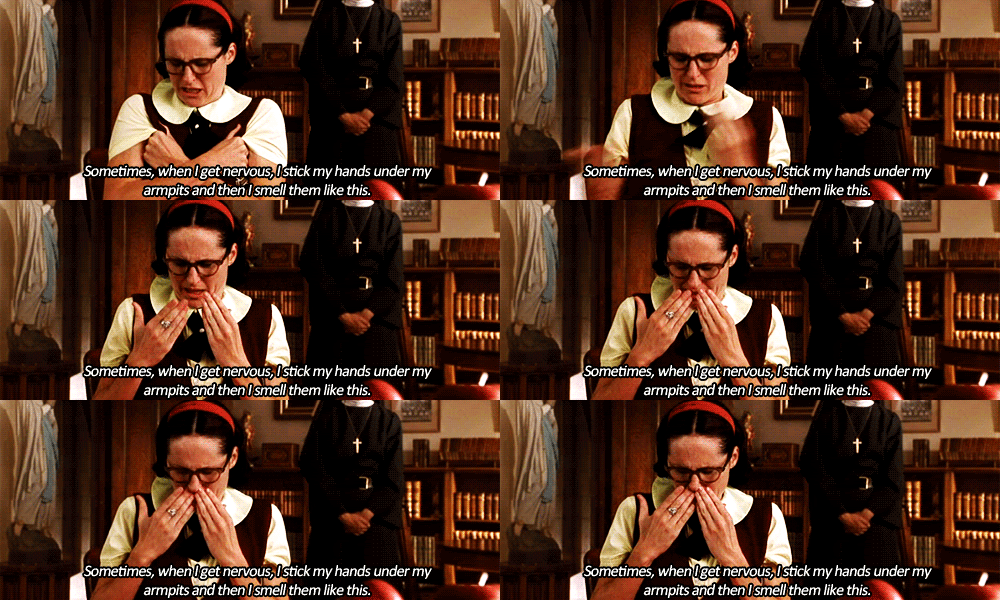
I also want to share one line with you.

“He jammed his cold fingers in his armpits and crouched by the fire until the food was ready.”

Does that remind you of anything?

mary catherine gallagher

Ah, the 90s. A time when the women were strong, the men were good-looking, and the children are all wondering what the hell I’m referencing.

This chapter is (appropriately) called “Saddle Making”, in which Brom makes a saddle for Saphira out of a leather apron. Except I highly doubt that Brom is able to make a saddle for a dragon – albeit a young one – out of a single apron. Never mind the extra straps he cuts for when Saphira grows larger. Also, how the hell hasn’t Eragon figured out Brom’s a Dragon Rider?

Obi-Brom Kenobi is the source for all information on dragons up to this point. He has a “mysterious” past, and knows way more than any simple storyteller should. He can communicate with Saphira with his mind, build a dragon saddle, and freaking gives Eragon an actual Dragon Rider’s sword. Why the pretense, Brom? And why are you so dumb, Eragon? How have you not put the pieces together yet?!

Sighing and shaking my head, it’s time to move on to chapter 16. The first part of this chapter is largely exposition, and I’m pretty okay with how it’s been done, mostly because it makes sense with the story. Eragon has questions about dragons, and Brom answers them. What I like about this is that it’s not all done in Brom’s dialogue, nor is it done completely as narration. It actually strikes a good balance between the two. A surprise bonus of this is that I don’t have to read too much overly-flowery dialogue. Yay!

There is something I’ve always wondered about, though. Brom says that dragons don’t hatch until conditions are right for them to be born, which usually meant there was enough food for them. Dragons that the Riders used, though, would only hatch when the right Rider touched their egg. In other words, Saphira might have never hatched if Eragon hadn’t found her egg.

What happened to the “wild” dragons that were mentioned? I also find it hard to believe that dragons – notable for being a proud race – would leave the future of their species to humans and elves. Sure, Galby (I refuse to write his full name one more time) killing dragons and Riders didn’t help matters, but eggs only hatching when the right person touches them? Yeah, you’re going to wind up with an endangered species right there.

If the Eragon-verse had tumblr, I can only imagine what it would be like. “Dragons only hatch when humans or elves touch their eggs? SO RACIST. Check your privilege!”

Along with learning about dragons, Eragon asks Brom about how he got the sword of another Dragon Rider. Brom tells him that he doesn’t want to reveal it yet, and, “I don’t want to keep you ignorant, far from it.”

EXCEPT YOU TOTALLY ARE.

The sword’s history is revealed in the second book, if I recall correctly, and it would be pretty upsetting for Eragon to learn. I won’t hold it against Brom for not telling him, but…God, Brom just tell him you’re a Dragon Rider. It’s obvious to anyone who’s not Eragon.

One good thing about the book is that Eragon isn’t a total Mary Sue right away. During this chapter, he and Brom start practicing swordplay, and Eragon gets his ass kicked time and time again. He develops his sword skills throughout the book, and I like that he isn’t a “natural”. He has to learn, struggle, and get his ass handed to him. And since he’s been driving me crazy, reading about him covered in bruises fills me with a kind of smug satisfaction. Especially since Brom is a much more interesting character, and I’d be pretty happy if he lit out on his own with Saphira.

There’s also one more thing that’s really bugging me. Let’s see if you can spot it in this chapter summary.

Eragon takes his sword, Za’roc, so he can fight the Ra’zac while he’s traveling outside Utgard.

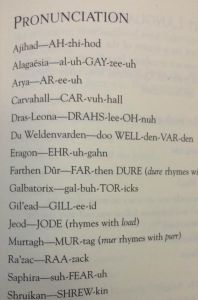
I’m not even halfway through the book, and I am so sick of these unpronounceable names with apostrophes.

Wait. I stand corrected. They’re not unprouncable.

pronunciation

But I feel like if you have to put a pronunciation guide in your novel, you’ve done something wrong.

Eragon Chap. 14: Dragon Advice

I’m not sure I get Saphira. She was my favorite character when I first read this book, mostly by logic of “ohmygodohmygodDRAGON”. She tries to give Eragon sage advice while he grieves, but I’m not sure of its validity:

Anguish enveloped Eragon as he awoke. [. . .] “I can’t live with this,” he moaned.

“Then don’t.” Saphira’s words reverberated in his head.

…did Saphira just suggest that Eragon kill himself?

Even now, I still like her character, and some of her dialogue.

The worth is in the act. Your worth halts when you surrender the will to change and experience life. But options are before you; choose one and dedicate yourself to it. The deeds will give you new hope and purpose.

But Saphira’s only a few months old at this point, though. She’s still a baby; the only human she’s seen up close until this point is Eragon. She understands how his mind works, but there’s no real reason for her to know anything about the world outside Eragon’s farm. Do dragons have some kind of ancestral memory that allows them to dole out advice like an older, wiser dragon? It’s the only explanation that would make sense to me, because Saphira knows things that there’s no way Eragon could have taught her.

On the other hand, some of her advice might be terrible.

Saphira was right. Nothing mattered anymore except the act itself.

We’ve also encountered the dead parent trope again. I’ll probably talk about this in more depth in a separate post, but I’m really sick of this. The laconic version is this: characters are more interesting when they have more to lose. Even if it leads to cheesy lines like this:

“Nothing is more dangerous than an enemy with nothing to lose,” he thought, “Which is what I have become.”

I used to love that quote when I was fourteen–a year younger than Eragon, actually. Growing up, I was bullied, ignored, never felt welcome in my school. I was an angry kid, an angrier teenager, and a line like that really spoke to me. For a long time I felt like it was me against the world, that everyone was my enemy. Since I felt so unwanted, I didn’t really see the point in playing nice with others. You might be able to imagine the unfortunate cycle that led to. The idea of a hero, fighting with no one on his side–and presumably winning–was very appealing to me.

At Saphira’s encouragement, Eragon decides to leave Carvahall and hunt down the Ra’zac, who destroyed his home and killed Garrow. Now, I know that we need the real adventure to start somehow, but I don’t like Saphira’s sudden change of heart. When the Ra’zac first came to Carvahall, she was so scared that she took off in a frenzied flight, taking Eragon with her. She was so terrorized that she wouldn’t even tell Eragon what was going on, and he was rebuffed when he tried to reach her with their mind-link.

Have you ever been so afraid of something that you couldn’t speak, or literally ran away from? I can almost guarantee that you would not be charging directly towards whatever it is you fear just because a teenager gave you a short lecture about running away.

Saphira’s fear was real and palpable, but nope, let’s forget that it ever happened. She’s over it now!

As they’re leaving town, Brom also comes to join Eragon and Saphira’s quest. He tries to sound mysterious about how he knows so much about dragons and the Ra’zac, but he’s not fooling anyone. Anyone who’s picked up a book or watched a movie like this already knows that he’s going to end up being a former dragon rider, and no doubt “Saphira” was also the name of his dragon. It doesn’t take a genius to figure that out. So why so the smokescreen? I honestly don’t remember if Brom ever gives a real reason for not telling Eragon about his past right away. I hope he does, and that it’s not something stupid.

This post is a bit lengthy, so I won’t go on to the next chapter right now. I will, however, leave you with this quote:

Brom’s eyebrows beetled with anger.

Beetled“?

Eragon 12-13: Adventure? Just Add Dead Parents

After reading a chapter that I actually liked, I was a bit more hopeful as I delved into chapter 12. This one doesn’t even start out with a silly “the X of the Y” title! Instead, it’s called “Deathwatch”. So if you’re wondering if Garrow’s going to die, the chapter title gives it away right there. Of course, if you’ve read enough books like these, you can probably assume that he was a goner anyway. As we all know, the catalyst for the adventure of a lifetime is the death of your caregivers.

http://static.tvtropes.org/pmwiki/pub/images/s_PArents_Are_Dead.jpg

It’s another trope that kinda bugs me, but more on that later.

I’m supposed to feel sad, or at least concerned for Garrow. But since he’s had barely any screen time (page time?), it’s hard to really care. Garrow seems like a good person, but that’s all we know about him. Throughout this chapter I was actually thinking more about Roran, who doesn’t yet know how his home’s been attacked and that his father is on his death bed. Maybe it’s a sign of me getting older, but I would be really interested in seeing how he takes the news. We don’t see much of Roran after he leaves, though. In the sequel, Eldest, he gets a much bigger role. And it’s way more interesting than Eragon’s.

But that’s the next book, not this one.

And while this book might be cliche in almost every way, I’ll give Paolini credit for actually having Garrow be covered in burns instead of stab wounds. It’s one of those things that I didn’t really care about when I first read this book, but I wasn’t trained in emergency response then. And during those grisly, grisly classes I had to take, I learned just how awful and potentially lethal burns really are.

I also know how to perform emergency child birth and what to do if you get an eye poked out. Those classes are not for the squeamish.

That’s about it, though. I really hoped that the surprising amount that I liked chapter 11 meant that this book was finally getting its shit together. Instead, the dialogue bounces back and forth between trying to sound medieval, but then switching back to modern language. At this point, I don’t care which style sounds better. I just want it to be consistent.

Compare for yourself: when the characters are discussing the Ra’zac, someone says,  “‘I don’t like this. Too much of this rings of wizardry.'”

When two pages earlier, Eragon was saying, “‘It’s okay, I can do it myself.'”

There is something else I’m confused about. When Saphira hatched, she gave Eragon a silver mark on his hand. Its ridiculous elven name translates to “shining palm”, so I have to assume that it does, in fact, shine. Gertrude, who is taking care of Eragon after the attack, asks him how he got such an unusual “scar”. But I’ve never seen a glowing scar before, and with the talk of magic and mysterious strangers in town, wouldn’t she have assumed it was also magical?

This post is getting a bit lengthy,  but the following chapter isn’t even two pages long. I think we can fit it here.

It’s also called “The Madness of Life”. Of all the cheesy titles so far, I think this has to be the worst one.

Here’s what happens: Garrow dies, but considering that the previous chapter was called “Deathwatch”, that’s hardly surprising. Eragon is completely inconsolable. Even if I’m not usually a fan of the “everyone you love is dead” idea that always seems to pop up in stories like this, I actually didn’t mind this chapter. Eragon’s utter grief and sorrow at the death of his uncle, to me, is the most relatable thing he’s done so far in this book. Honestly, the only thing I really hate about this chapter is the title.

Maybe Eragon is gradually getting better? Or am I just getting used to it?

Eragon Chap. 10-11: Noun of the Noun

If you’re me, you’d call chapter 10 of Eragon, “Wish Fulfillment”. If you’re Christopher Paolini, though, you give this chapter an over-the-top fantasy name, like “Flight of Destiny”. Which is one of those names that sounds cool when you’re fifteen, but as I haven’t been fifteen for a long time, it just makes me roll my eyes. That’s the thing with the writing in this novel. This is an exciting chapter, with the story finally kicking off and Eragon’s first flight on Saphira’s back. The problem is that all too often, the prose falls short, and things just aren’t as exciting or tense as they should be. I should feel Saphira’s terror and anger, as well as Eragon’s own dread. Maybe the problem is that I’m re-reading this and know everything that’s going to happen.

Some twentysomething out there, read this book for the first time and tell me if it’s the prose, or if it’s me.

One other thing that I’m noticing more and more is Paolini’s use of flowery words. I can understand it; he’s writing a story set in a fantasy medieval world, and therefore people are supposed to sound like they stepped out of a Shakespeare play. It doesn’t really work, though, because a lot of the dialogue sounds like it would be heard today. There’s just fewer apostrophes.

When Paolini does try to use a more obscure word in the narration, it just sounds goofy. Saphira is described as appearing before Eragon in “a gout of smoke.” We can assume that the “gout” is like a puff of smoke, but my first thought was of gout the disease. Which, fun fact, was sometimes called the “disease of kings” because it wasn’t terribly uncommon amongst royalty. But that’s neither here nor there.

In all fairness for this chapter, I like that Eragon’s first flight isn’t some beautiful and romantic experience. It’s full of panic, and Saphira’s scales end up injuring his legs quiet badly. If you haven’t noticed by now, I really appreciate it when reality comes into the fantasy elements. Eragon puking as he rides Saphira definitely qualifies as adding that realism. It’s almost enough to make me forgive how Eragon cries a single cliche tear at the end of the chapter.

Moving on, I was a bit confused when I finished reading chapter 11, “The Doom of Innocence”. Despite yet another cringe-worthy title, I was utterly befuddled when I found that I actually liked this chapter. What’s that about? It’s not perfect, and I still have my normal gripes about the writing. There’s still a couple lazy adverbs lying about, and it completely solidified the “Eragon is Star Wars with dragons” idea. Monomyth structure be damned, it’s the exact same story.

In the previous chapter, the arrival of the “strangers” scared Saphira so much that she flew to the neSpine, with Eragon on her back. The next day, he convinces her to go back to his home, only to find the farm destroyed and Garrow badly wounded. You know, just like how Luke returns home after meeting Old Ben and finds his igloo house destroyed and aunt and uncle dead.

But there were a few things that I actually did like about this chapter. First of all, the language of the dialogue and the narration finally match. Look at this conversation Eragon has with Saphira, when he’s trying to convince her to take him home.

“Both of us carry an obligation to Garrow. He has cared for me and, through me, you. Would you ignore that debt? What will be said of us in years to come if we don’t return–that we hid like cowards while my uncle was in danger? I can hear it now, the story of the Rider and his craven dragon! If there will be a flight, let’s face it and not shy away. You are a dragon! Even a Shade would run from you! Yet you crouch in the mountains like a frightened rabbit.”

Maybe it’s still a little over-the-top for me, but I like it much better than Eragon sounding like a teenager who grew up in the modern world.

We finally get to see Saphira’s personality, too. We saw only vague glimpses of Saphira before, and she only had a few lines of dialogue. Even in during her first flight with Eragon, she was so panicked that her actions don’t reflect what she’s normally like. Since Saphira’s the reason I haven’t given this book up yet, I’m glad that we finally get to see more of her.

The last thing in this chapter I liked was the endurance and the pain these characters go through. From what I remember of the first two books in this series, Eragon becomes ridiculously powerful as the series goes on. Here, Eragon’s legs have been rubbed raw from riding Saphira bareback, and Saphira exhausts herself to get Eragon and Garrow to Carvahall, finally landing when she can’t go any further. Eragon drags his uncle into town, legs bleeding all the while, until he passes out. I think Eragon’s determination to save Garrow is admirable. The fact that every step Eragon takes is a struggle makes it even moreso.

It’s the first time I think I’ve really supported Eragon while re-reading this. Because, like I’ve said before, most of the time he’s just a big idiot ball.

Eragon 8-9: Teenager, or Idiot Ball?

When I read books, I really like it when teenagers and child characters actually act their age. This was one of the problems I had with Angelic Layer, which was that the young child acted nothing like a little kid. But in Chapter 8 of Eragon, I can’t decide if Eragon is acting his age, or just being a big idiot ball. But since he’s only fifteen, I think it’s fair to say that he’s an idiot by default.

When Roran tells his father, Garrow, that he plans to leave, Garrow is totally okay with it. In fact, he’s happy for Roran. Eragon is pretty surprised at Garrow’s reaction, and disappointed with it. On one hand,  I understand that he’s going to miss Roran. But on the other, what the hell was he expecting? Roran’s got an opportunity to make a better living than he does on the farm, and make enough money to get married.

I think I’m supposed to be sad, or at least feel something. But Roran doesn’t have any real character yet, and the only thing we know about him so far is that he’s in love with Sloan’s daughter. I’m almost reminiscent about when my sister left for college. I was sad when she left, but I also knew that her leaving home was inevitable, and it ended up being one of the best things to happen to her. So sure, Eragon, be sad, but don’t resent Roran for moving forward with his life.

Before we move on to the next chapter, I’d like to end it with a quote near the end of the chapter, when Roran is packing to leave.

“[Roran] paused, then picked up something from the pillow and bounced it in his hand. It was a polished rock Eragon had given him years ago. Roran started to tuck it into the bundle, then stopped and set it on a shelf. A hard lump formed in Eragon’s throat, and he left.”

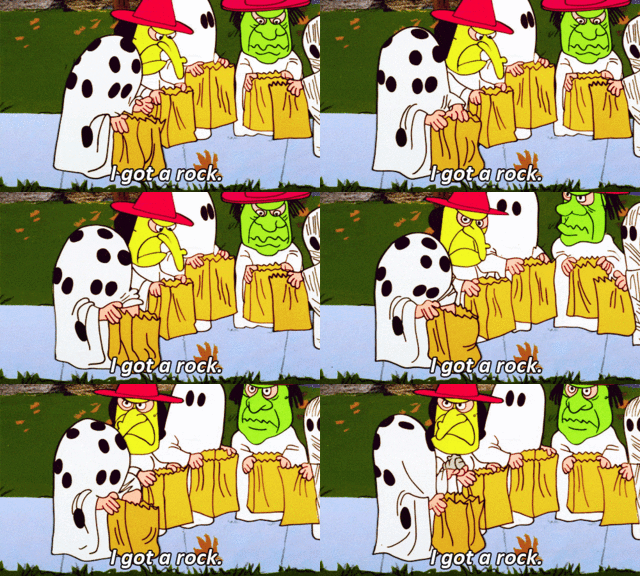
I know that this is supposed to make me feel sad, but it only reminds me of “It’s the Great Pumpkin, Charlie Brown!”

i got a rock.gif

Moving on to chapter nine, where we finally got…plot! Yay, plot! The chapter begins with Roran leaving the farm and Garrow giving advice to him and Eragon. It’s as awkward as it is sweet. But in the back of my mind I had to remember that the author was only fifteen when he wrote this. A lot of that shows in his prose, but it kind of dampened the impact of Garrow’s farewell speech to me. Garrow talks about life and love, giving him advice for the future. Things that the author’s never experienced. It actually reminds me of a time, during my senior year of college, when a freshman tried to complain to a group of seniors about his workload. In an out-of-character moment for me, I ripped this guy a new asshole, (loudly) explaining how he can complain about his work to other freshmen, but he had no right to whine to us.

He never complained in front of me again.

Of course, when we’re teenagers, we think we know everything. So maybe Paolini trying to show off his “wisdom”, such as it is, is entirely in-line with the rest of his writing.

Eragon goes into town to see Roran off, and is warned by another villager that there are strangers who have been asking about the “stone” he found in the Spine. Eragon puts the pieces together that someone is after Saphira. Well, what were you expecting, Eragon? You know the Empire and Galby killed the other Dragon Riders, and you even acknowledged that they would probably hunt down Saphira, too. God, you’re dumb.

And watch out, because I’m going to tear apart a single sentence. Again.

“The voice was deep and moist.”

Ugh.

No one likes the word moist. And I’m not even sure how a voice can sound “moist”, unless they’ve got a lot of spit in it. The idea was that the stranger’s voice gave Eragon a sense of rot and decay. But there just had to be some better way to evoke this. Because right now, I’m only giggling. Because the voice is deep, like a cave. And moist, like a…cave.