Your library will always be there for you. Please be there for your library.

Without in any way limiting the author’s exclusive rights under copyright, any use of this publication to “train” generative artificial intelligence (AI) technologies to generate text is expressly prohibited. The author reserves all rights to license uses of this work for generative AI training and development of machine learning language models.


I’m writing this introduction on Saturday, January 18, on my lunch break. I don’t usually work Saturdays, but today I have a Teen Advisory Board meeting. In a few hours, a group of teenagers will come into the library and tell me what kinds of things they would like to see the library provide for them. I’ll distribute scholarship information for three local colleges, tell them about a student employee position that’s just opened up, and give them advice on how to apply and what the library looks for in a job interview. After, we’ll make cards for troops stationed abroad. Elsewhere in the library, adults and kids will be using computers to access the internet, do homework, apply for jobs, or catch up on YouTube. People who don’t have internet access at home can check out hotspots. Maybe they’ll use it to access live virtual tutoring, or Ancestry.com, or Consumer Reports – all free with their library card. And, of course, there will be books. All kinds of books: novels, picture books, biographies, travel guides, comic books, board books, cookbooks, books for beginning readers and books that read to you. 

Later this month, kids will practice reading to a licensed therapy dog. People struggling with food insecurity will receive assistance in applying for SNAP benefits. Toddlers and pre-schoolers will learn pre-literacy skills at storytime (including a bilingual storytime). Free tax assistance will be available. Senior citizens will take a class to learn basic computer skills English language learners will meet to practice casual conversations. I’ll also be running my favorite activity, a tabletop roleplaying game for teens, which has become a haven for a small group of queer teens. All of this for the low, low price of free. 

Libraries are one of the few places left where you don’t have to pay anything to be there, you don’t even necessarily need to be a member. Just come in, and we’ll try to help you. 

Libraries are magical. They are also in danger. 

For many of us in the United States, the next four years are going to be a scary and difficult time. There is so much I could talk about when we discuss the second Trump administration, but I want to focus on something that this blog has always focused on: books. Well, books, literacy, and access to information. As I have said in a previous post, access to information is recognized as a basic human right by the United Nations. In an age of rampant misinformation and censorship, this is a right that needs to be safeguarded more than ever. Public libraries are on the forefront of the battle for intellectual freedom, a battle which is only going to intensify in the coming years. 

As I’ve written about before, public and school libraries are facing intense scrutiny over the materials they have on their shelves. Book bans are on the rise, and libraries and library staff are facing threats of violence, lawsuits, and even jail time. And things are going to get much, much worse. 

The Trump administration’s plans are detailed in Project 2025. This is not a document of hypotheticals; this is a road map. And this road map leads to, among other things, a direct attack on every Americans’ intellectual freedom. 

Project 2025 aims to dismantle the Department of Education, cancel funding for public services,  support censorship, and, potentially, jail teachers, librarians, and booksellers. 

That’s not hyperbole. Project 2025 classifies any LGBTQIA+ material as pornography, including picture books like the innocent And Tango Makes Three or non-fiction books intended for education, like This Book is Gay. If that wasn’t bad enough, librarians and others who distribute “pornography” to children may be required to register as sex offenders. 

Yes, you read that right. No, this is not me being melodramatic. Conflating LGBTQIA+ media with pornography is a tried and true tactic when it comes to censoring, challenging, and banning books. 

Nor am I exaggerating the potential legal consequences for librarians. So far, Indiana, Oklahoma, Tennessee, and Montana have passed laws that say school staff, public librarians, and museum employees could be jailed and/or fined thousands of dollars for distributing “obscene” material to children. 

Book challenges and bans are only going to become more frequent. Moms For Liberty, right-wing group dedicated to banning books, is strongly supported by the Heritage Foundation [PDF] (the organization behind Project 2025), by providing them with financial and even legal support.

The final thing I want to talk about regarding Project 2025 and libraries is not nearly as dramatic as everything else, but it is no less crucial. Federal funding for public services is going to be greatly reduced, up to and including eliminating the Institute of Museum and Library Services (IMLS). Most libraries already operate on string shoe budgets, and librarians and library staff are notoriously underpaid. Cutting federal funding is going to hurt the services that libraries offer, especially in rural and low-income areas. 

There is a big disconnect between politicians and their constituents in the perception of public libraries. They are valued community spaces with something for everyone – be it Talking Books for the blind, someone to walk you through an online job application, even just a safe place to exist. There’s a lot of love for libraries. In fact, there’s more public libraries than there are McDonald’s in the U.S.

To borrow some words from The Memeing Librarian: The library will always be here for you. So please be there for your library. 

I know that libraries are not going to be on the forefront of your mind as we go into this next big challenge together. However, there are simple, everyday things that you can do to support your library, free speech, and freedom of information. 

First, VOTE! Not just in big national elections, but state and local elections as well. Local elections determine so many things in your community, like commissioners, judgeships, school boards, and funding for public services like the library. 

Get a library card if you don’t already have one, and check out books. I know this seems obvious, but it’s really important. One of the things that determines funding for libraries is the number of members a library has, as well as circulation for books, DVDs, and other library materials. Some libraries even have “library of things” where you can borrow items like tools or cake pans, or seed libraries if you want to start your own garden. My library system also lends hotspots and backpacks with educational materials based on certain topics.

Attend library programs. Like I mentioned above, statistics are everything when it comes to securing funding. Library programs aren’t just for kids, either. There’s lots of stuff for adults and teenagers. Some popular recurring programs we have for adults are film discussions, “craft and chat” events, and English language learning events. Attendance is also a good way to show the library what you’re interested in seeing for future events. Many libraries also have teen advisory boards, where teens can give their input into library programs and earn community service hours. 

Volunteer. There is always something that needs to be done, whether it’s organizing books, preparing crafts for storytime, tutoring, or corralling kids during a craft-a-palooza. You could also join a Friends organization. Many libraries also have a Friends organization, which raises money for the library. Our Friends organization has helped pay for activities and guest presenters, like theatre performances and historical impersonators. 

Donate if you are able. Financial donations are obviously the most direct way you can give, but there are other things you can donate as well. Lightly used books that someone else might want to read (please don’t give us your old copy of Windows 95 for Dummies) may be added to the library’s collection or sold in a book sale to raise money. It doesn’t have to be just books, either. Last year, someone donated a huge box of Pokemon cards, which meant that every kid who attended a Pokemon program I ran got 2 cards to take home, and a holographic card if they registered for the Summer Reading Program. 

Give the library your feedback (but be nice about it). If you liked a program, if you hate the new signage, if we absolutely need to get this book or that movie. Most libraries also have online surveys and book order requests on their websites.

Tell your librarian what you love about the library. I love my job, but it’s not as easy as it looks, and there are times when I’ve fantasized about just walking out and never coming back. It’s the little wins, like helping a patron find the perfect book or a parent giving a compliment that helps us get through the day and reminding us why we do this. 

When you take a book off the shelf and decide you don’t want it, don’t put it back on the shelf. Don’t put it at the end of the shelf. Don’t leave it next to the self check-out. Please stop reshelving the books. Please. I’m begging you.

These next four years are going to be tough. Take care of yourself, take care of your loved ones, and take care of your library. 

Some sources and further reading: 

Project 2025 and Its Threat to Free Expression, Part 1 (PEN America)
Project 2025 and Its Threat to Free Expression, Part 2 (PEN America)
Project 2025 and Its Consequences for Libraries (EveryLibrary Institute, PDF)
Red states threaten libraries with prison — as blue states work to protect them (Washington Post)
Unite Against Book Bans (American Library Association)
Banned & Challenged Books (ALA)
Trans Rights Readathon
We Need Diverse Books


Banned Book: Prince and Knight

Without in any way limiting the author’s exclusive rights under copyright, any use of this publication to “train” generative artificial intelligence (AI) technologies to generate text is expressly prohibited. The author reserves all rights to license uses of this work for generative AI training and development of machine learning language models.


Think of your favorite fairy tale. Were there talking animals? A handsome prince falling in love with a beautiful princess? Did it teach a lesson? 

When we’re very young, fairy tales and fables are usually our first introduction to stories. We learn a lot about narrative structure from these old tales. We learn that stories have a beginning, a middle, and an end. Stories have characters and conflicts. We even learn some basic symbolism: a cottage represents safety and home, the woods represent danger, and a castle represents success. A beautiful person is good, and an ugly person is evil. These simple, familiar stories set the foundation for our understanding of narratives long before we have the ability to read one on our own. 

There are many things in traditional stories that aren’t viewed as fondly today as they once were, like beauty equating to goodness and women as prizes. There are lots of retellings of classic stories now, which often change turn the formerly helpless maiden into a certified bad-ass. Heck, the best-selling Twisted Tale series are just Disney AUs based on their popular movies.

I didn’t write my earlier post about traditional literature just because it’s one of my favorite genres (though that is true), but because I want to discuss the oft-challenged picture book, Prince and Knight, but Daniel Haack and Stevie Lewis.

Well, let’s look at this dangerous book together. I love the illustrations – bright and colorful, and perfect for a picture book. The story is also told in rhyme, which I enjoyed. Sometimes rhyming picture books can be clunky or choose awkward words to make the rhyme work, but I didn’t see any of that here. Overall, it’s nice to look at and fun to read out loud.

Prince and Knight repeats familiar fairy tale beats: a prince goes on a journey, overcomes a challenge, and is rewarded with true love. The main difference between this and stories like Sleeping Beauty is that the prince’s true love is another man. 

The story goes like this: a prince is getting ready to inherit the kingdom, but the king and queen know that it’s too much work to rule alone. They want their son to find a nice girl and get married. He meets many lovely ladies, but he doesn’t want to marry any of them. When a dragon attacks, the prince races to save the kingdom. He’s not fighting alone, either. A bold knight rushes into the battle to assist the king. They save each other’s lives, and together, capture the beast. Soon, the prince realizes that his one true love, the one he’s been searching for, is this brave knight in shining armor. The prince and the knight are married, the kingdom rejoices, and everyone lives happily ever after.

I loved Prince & Knight. There’s action, but not violence (the prince and knight tie up the dragon rather than slay it), and it has an adorable happily ever after. My favorite thing about the book might be the king and queen’s reaction to the prince falling in love with another man. They’re ecstatic that he’s found someone and don’t care that it’s not a princess, and the whole kingdom celebrates their wedding. 

Cute, right?

Unfortunately, not everyone thought so. According to the ALA Prince and Knight was one of the most frequently banned or challenged books in 2019 for “featuring a gay marriage and LGBTQIA+ content; for being ‘a deliberate attempt to indoctrinate young children’ with the potential to cause confusion, curiosity, and gender dysphoria; and for conflicting with a religious viewpoint”

Siiiigh. Let’s break this down.

Prince and Knight was published in 2018, three years after same-sex marriage became legal throughout the United States. According to Pew Research Center, a majority Americans support same-sex marriage and it’s part of the cultural landscape, whether you think it should be or not.

“Confusion” and “curiosity” are natural parts of childhood. Young kids are learning about the world and, no matter what book you read to a young child, they’re going to have questions. For an example from my own life, I was in fourth grade when I two older students – who were also my neighbors – told me that our principal was a lesbian. I’d never even heard the word “lesbian” before, and it had to be explained to me: girls who love girls. I became worried, and asked, “am I a lesbian because I love my mom?” The older girls told me that girl family members didn’t count. Later, my neighbor’s mother called my house to warn my mom that I might be asking some questions about what I’d learned that day. But I can’t remember asking any other questions about it, or even it being that big of a deal in the long run. If a child has a question about the gay marriage in the book, “Some boys fall in love with other boys” isn’t indoctrination, it’s just a true statement. And it’s not going to be as earth-shattering as you think. And while we’re not totally certain what causes gender dysphoria, you don’t get it from reading a picture book.

As far as a religious viewpoint goes…I’m pretty sure we can guess which religion the complainants are talking about. Some religious communities, like the Buddhist Churches of America and some Jewish movements have celebrated or supported same-sex marriage for decades, and many sects of Christianity do so as well now. Even the Catholic church is slooooowly becoming more accepting of same-sex couples. So this book isn’t against all religious viewpoints, just a certain one. 

At the start of this post, I talked about the role fairy tales play in our formative years. So I have a question: why is Prince and Knight indoctrination, but a story like “Sleeping Beauty” isn’t? Classic Western fairy tales are often about finding true love through magical means. The prince magically awakens a sleeping princess with a kiss; a princess kisses a frog and finds her true love; a glass slipper fits only one woman perfectly. So many stories treat the princess as a prize to be won. I would say reading only fairy tales like that introduce kids to harmful stereotypes of gender. So why aren’t tales of heterosexual love accused of indoctrinating kids? 

I love fairy tales, old and new. I am aware of the pitfalls in classic traditional stories, and I enjoy adaptations that change things up. I still think fairy tales and other traditional stories and rhymes are an important part of early literacy. But there’s a phrase I heard once that’s always stuck with me: “It’s not what you have, it’s what you don’t have.” This sums up how I feel about a lot of media diets. If you get nothing but stories with a narrow view of what the world is like, it’s going to affect how you see the world. I don’t see anything inherently wrong with traditional stories, but I think it’s important for children to see stories where the princess saves the prince, where the ugly person is kind, and where the prince and the knight find true love. 

Because in real life, girls can save boys, not-beautiful people can be kind, and two men can fall in love and marry each other. To pretend otherwise is insulting to all of those who don’t live in a fairytale.

Banned Books 3: Other

This is the final entry of our banned books triptych. I’d wanted to talk about this in my previous post, but I got a little carried away and couldn’t find a good place for it. (tl;dr: “This is America. You want to live in North Korea, you can live in North Korea. I don’t want to. I want to live in America.” – Ron Swanson)

Now we come to the most common reason books have been challenged or banned: that strange, nebulous category of “other.” 

And let me tell you: “other” is wild. Some of my favorite reasons given include a book using the phrase “poo poo head” (Super Diaper Baby by Dav Pilkey) and the Harry Potter books for having real curses and spells.

The curses and spells used in the books are actual curses and spells; which when read by a human being risk conjuring evil spirits into the presence of the person reading the text.

Rev. Dan Reehill

I am extremely disappointed. In the many years I’ve been reading Harry Potter,  I have never once summoned an evil spirit. Not even by accident. And if those are real spells in the book, there must be a hell of a delay effect on them. There’s a few people that have overdue Avada Kedavras coming for them.

But most of the “other” reasons given are way less amusing. You can read my list here, or check out the ALA’s list of most challenged books to see reasons why books were challenged. There’s a lot to go through, so I’m only going to discuss a few here. Specifically, the ones that really grind my gears.

Think of the children! 

Books that will, somehow, damage children if they read it. This is the justification that book challengers use all the time. Some of the books whose challenges fall under this broad category are: 

Beyond Magenta: Transgender Teens Speak Out by Susan Kuklin (2015, 2019, 2021) for the effect it would have on young people
A Day in the Life of Marlon Bundo by Jill Twiss (2018, 2019) – “designed to pollute the morals of its readers”
Fifty Shades of Grey by E.L. James (2013, 2015) – concerns that “teenagers will want to try it”
Of Mice and Men by John Steinbeck (2020) – negative effect of slurs on students
Prince and Knight by Daniel Haack (2019) – would lead to confusion, curiosity, and gender dysphoria

Some of these are valid concerns. I wouldn’t want teenagers reading Fifty Shades of Grey. Classics like Of Mice and Men, Huckleberry Finn, and To Kill a Mockingbird have all come under fire for racial slurs and stereotyping, and those are fair criticisms. When I read Huckleberry Finn and To Kill a Mockingbird for English class in high school, my teacher addressed the issue head-on. He told the class that these books had slurs in them, and we were going to discuss the language in the book. He also made it clear that we were not to use those words outside of book discussions. Whether this had any impact on the language the students used outside of class I couldn’t say; I didn’t hear many racial slurs being thrown around before or after we read those books. But my high school was also pretty homogeneous, with White Catholic kids as far as the eye could see. In a more diverse school, I can see how books with slurs could be a problem. 

I still love To Kill a Mockingbird, though it’s important to acknowledge its failings: White savior, slurs, and false accusations of rape. When I encountered these criticisms, it forced me to re-evaluate the novel and think about it from different perspectives. Yes, it is problematic. Does that mean it belongs in a classroom? At this point, I think there’s enough literature available by people of color telling their own stories that it can be reasonably replaced with something more relevant and less patronizing to students of color. 

Does that mean it should be removed from schools or public libraries? 

My answer should be pretty obvious. I say no. With each (worthy) critique I found of Mockingbird, it made me understand the text in a new way and look at it with a more critical eye. It’s important to revisit the classics and look over what made them great, what makes them not-so-great today, and what value they still have in the modern day. Turn those not-so-great things into discussions and teachable moments, and use them as an opportunity to practice critical thinking on something that is pertinent to today’s reality. 

Most of the other cries to “think of the children” are not so well-intentioned. As you can see in the examples given here, would-be book banners fear that kids will be exposed to anything that isn’t heterosexual and cisgendered. It’s anti-LGBTQIA+ fear mongering coming from deeply misinformed individuals at best and outright bigots at worst. Reading a book where two men fall in love is not going to make anyone gay  any more than reading a book where a man and a woman fall in love will make them straight. It’s so obvious that I shouldn’t even need to say that, but here we are. That fear alone is homophobic and transphobic, as it implies that being queer or nonbinary is lesser or undesirable.

Even without that baseless fear, these “concerned parents” don’t want kids to see LGBTQIA+ content because…well, because. Because their religion tells them it’s wrong, or because the subject makes them uncomfortable, or because they’re simply afraid of stories that introduce experiences that are different from their own. 

Censoring, challenging, and banning books with LGBTQIA+ content hurts kids. It hurts queer, questioning, and nonbinary kids who need to see themselves in media, to know that they aren’t alone. For straight, cisgender kids, they can learn empathy and become allies. Many who want LGBTQIA+ books out of school libraries cite “parental rights,” saying that parents should be able to decide what books kids can and can’t read. But what a few parents want can’t speak for every parent. Parents – especially those who have LGBTQIA+ kids – may want their kids to read books that others are fighting so hard to take away. A few parents cannot and should not speak for an entire community. 

Instead of “think of the children,” let the children think for themselves. 

This book is indoctrination! 

Of the books that I looked at, there were only two books that were explicitly accused of indoctrinating their readers: The Hate U Give by Angie Thomas, and Prince and Knight by Daniel Haack and Stevie Lewis. But books are frequently challenged because they are perceived as promoting some kind of agenda, be it religious, political, or something else. The word “indoctrination” might not be in a book challenge itself, but the fear of it is there. 

Some of the books that this would apply to:

And Tango Makes Three by Peter Parnell, Justin Richardson, and Henry Cole (2012. 2014, 2017, 2019) – “promotes the homosexual agenda”
The Curious Incident of the Dog in the Night-Time by Mark Haddon (2015) – atheism
The Kite Runner by Khalid Hosseini (2012, 2014, 2017) – promotes Islam; would “lead to terrorism”
Melissa by Alex Gino (2016, 2017, 2018, 2019, 2020) – encouraged children to change their bodies with hormones
Stamped: Racism, Anti-Racism, and You by Ibram X. Kendi and Jason Reynolds (2020) – using “selective storytelling incidents” 

Sigh. 

I once knew a man who disparaged public schools and universities, saying that all they did was brainwash students. He was homeschooled in a very Christian household, but never stopped to think that what he had learned could also be considered “brainwashing.”* His education was also based on an agenda, but one created by his family rather than the state. He was still being taught what someone else deemed to be important. The things we learn when we’re young stick with us, whether or not they’re explicitly taught. 

When you pick up a book that contains information or ideas outside your realm of experience, you can analyze it critically, you can learn from it, you can forget about it, you can close yourself off and reject it. Encountering new ideas and perspectives can be challenging. I’ve certainly experienced that.  When I read How to Be Anti-Racist by Ibram X. Kendi, I found myself bristling at some of the content. I had to remind myself that I was reading this book to learn, even if it meant reading things where my knee-jerk reaction was to reject the information. 

Books with diverse perspectives are important tools to understand the world and things outside of our experiences. Opening the world up to new ideas and helping readers to think critically about new information is the opposite of indoctrination. 

By taking books away from would-be readers (who, in terms of banned books, are mostly youth), you limit the amount and type of information they can receive. If those readers can’t have access to a wide variety of material and are limited to only reading things that are “approved” by one authority or another…

Well, that is what I call indoctrination. 

To avoid controversy/Controversial issues

Beyond Magenta: Transgender Teens Speak Out by Susan Kuklin (2015, 2019, 2021) – to “ward off complaints”
Melissa by Alex Gino (2016, 2017, 2018, 2019, 2020) – to avoid controversy
All American Boys by Jason Reynolds and Brandon Kiely (2020) – “too much of a sensitive issue right now” 

Let me say this first: I get it. I’ve only had one real complaint about a book (so far) and it was a little scary. A woman was furious about a Sesame Street board book which showed the character wearing masks and social distancing. Thankfully, she didn’t make a request to remove the book from the library. I only listened to what she had to say and helped her find books for her kids (who, incidentally, were much too old for board books). It shocked me a little bit, but thankfully nothing more came of it. 

When it comes to books with controversial topics, I understand taking caution. As I mentioned in my last post, recently libraries have lost funding and even faced threats of violence for materials that they have on the shelf. 

Removing materials over challenges that may never happen is a form of self-censorship. I refer back to the ALA Library Bill of Rights, which states, in part:

II. Libraries should provide materials and information presenting all points of view on current and historical issues. Materials should not be proscribed or removed because of partisan or doctrinal disapproval.

III. Libraries should challenge censorship in the fulfillment of their responsibility to provide information and enlightenment.

I understand the fear of having “controversial” books on the shelves. But I’m also disappointed. Removing or restricting access to these books feels like capitulating to bullies. Granted, maybe there was a real fear of violence in these cases, but it’s frustrating to see. You can’t challenge censorship by removing materials for a “just in case” scenario.

And, finally, the most bonkers reason given to challenge or ban a book comes from Melissa by Alex Geno:

Because schools and libraries should not “put books in a child’s hand that require discussion”

Then what are schools and libraries for

What are books for, if not to inform and entertain? To introduce new ideas and new ways of seeing the world, even if it’s a view you’re not familiar with? To maybe even learn something new about yourself?

Schools and libraries absolutely should put books in children’s hands that require critical thinking. Books that feed curious brains and answer questions, either with facts or through the lens of fiction. This is the whole point of intellectual freedom. 

Intellectual freedom is a fundamental human right, the basis of democracy and free speech. 

And anyone who tries to abridge that freedom is a poo poo head.

*Disclaimer: This is just one example of a person I knew who was homeschooled. There are lots of good reasons to homeschool kids, and just because kids are homeschooled doesn’t mean that they’ll be closed off to new experiences.

Banned Books Week 2: The Reasons

If you want to know what the current moral panic facing America is, check the ALA’s top 10 banned books list. When you think of banned books, you might be thinking of the classics: Brave New World, Huckleberry Finn, To Kill an Mockingbird. And, sure, there are classic books that have been challenged and banned since they were first published. Just ask Toni Morrison. But in recent years, the most common reasons for challenging or banning books are for containing LBGTQIA+ content or critiques of systemic racism. Labeling a book as “sexually explicit” is another common reason, though that’s pretty much always been the case when it comes to book bans.

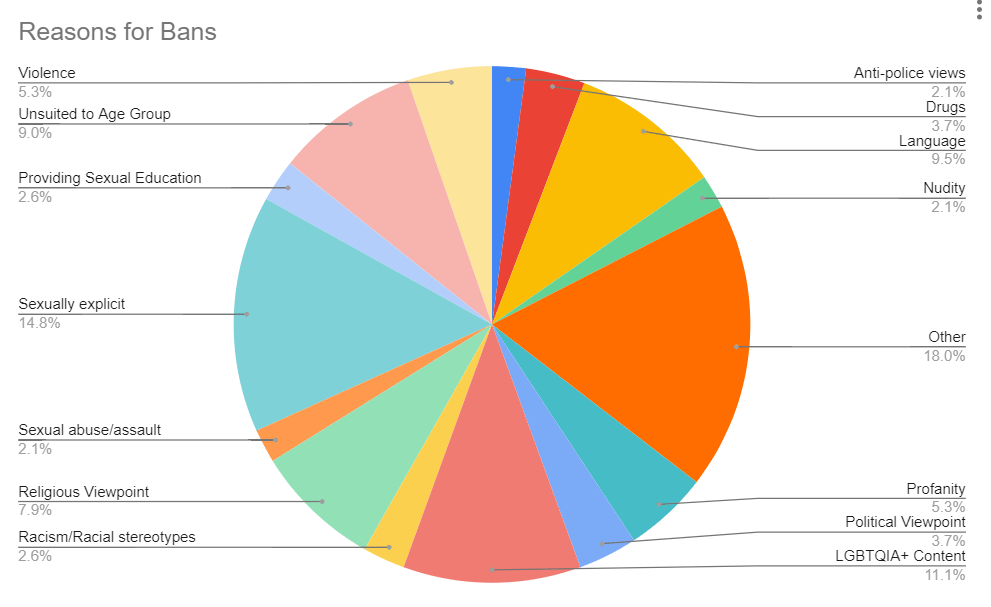
To show this, I’ve made a couple charts tracking the reasons why books were challenged or banned from 2012 – 2022. If you want a more detailed view, this is the spreadsheet I used to compile everything from the ALA’s lists. 

A little bit about the data here: most books have multiple reasons given for being challenged/banned. For example, Gender Queer by Maia Kobabe was challenged for LGBTQIA+ content and for being sexually explicit, so I marked it as both. “Language” can mean a few different things, depending on the book and who’s complaining about it. It might be curse words, but some books that deal with racial issues were challenged for having “divisive language.” Since one of those was a picture book, I don’t think that divisive language in that particular book was f-bombs. I’ve included racial slurs and derogatory terms in the category “language” as well. Similar to “language,” profanity can mean different things to different people, but it’s generally accepted to mean swearing. I’ve combined “racism” and “racial stereotypes” into one category, since you typically don’t get one without the other. I’ve also combined drugs and alcohol into the same category, though books that are challenged for drug use may not include alcohol use, and vice versa. 

All in all, the reasons given to ban or challenge books in the past 10 years looks a little something like this: 

From 2012 to 2022, the three most common were “other”, “sexually explicit”, and “LGBTQIA+ content.” I’ll talk about “other” in a later post. Right now, I want to go over “sexually explicit.” 

As I’ll talk about in another post, “sexually explicit” can mean a lot of things. It can mean graphic sex scenes, steamy scenes, sexual assault, nudity (both sexual and nonsexual), and anything in between. What I find sexually explicit may not be what you find sexually explicit. 

Books with LGBTQIA+ content also tend to be called “sexually explicit” more frequently than books without it, even if the content is pretty mild. I can’t think of a book where this is more obvious than Drama by Raina Telgemeir. In one scene, two boys kiss. It’s a first kiss, innocent and sweet. If it had been a boy and a girl kissing, no one would bat an eye. 

Are you ready for this? Ready for this borderline pornographic scene?

No one tell the concerned parents how Shakespeare plays were originally cast.

Which brings me to my next point: challenging and banning books with LGBTQIA+ content. You’ve probably heard about this, since it’s becoming scarily common. These aren’t just parents showing up at school board meetings or quietly filling out a “request for reconsideration” form at a library. It’s a school board member filing a criminal complaint against Flagler Schools for having an “obscene” book in the school library.

 Or public libraries losing funding for having LGBTQIA+ materials.

 Or multiple bomb threats made against public libraries for carrying LGBTQIA+ materials.

This scares the shit out of me. To be totally honest, I think it’s a matter of time before a library worker is seriously injured or even killed due to this anti-LGBTQIA+ moral panic. But at least there’s an injunction against the Arkansas law that would prosecute librarians and booksellers for having materials that are “harmful” to minors in their collections, right?

Challenges to books with LGBTQIA+ content are obvious homophobia and transphobia. Censoring these materials attempts to erase already marginalized people and groups who have been unseen for centuries. The same can be said for books that confront systemic racism in America. In both cases, censorship acts to hide away authentic stories and information. Taken to the extreme, it could mean that only material that’s ultimately harmful to marginalized groups could remain on the shelves, further perpetuating homophobia, transphobia, and racism. These books combat this ugliness by exposing it. And if it makes you uncomfortable, good. Homophobia should be uncomfortable. Racism should be uncomfortable. 

And if it makes you feel seen and validated, or comforted to know that there is someone out there who feels like you do, sees the world like you do, or just makes you feel like you’re not alone…even better. 

Accessibility is about power, gatekeeping is founded on the protection of power, and to all of that I say: fuck that, because information that can change lives should never be hoarded.

Prisca Dorcas Mojica Rodriguez, For Brown Girls with Sharp Edges and Tender Hearts

The rash of censorship spreading across school and public libraries, and even private businesses, is appalling on every level. 

You cannot say you are protecting children and at the same time take away the things that validate who they are.

You cannot claim to uphold family values while calling in bomb threats.

You cannot say you value freedom and free speech and actively call for censorship.

Banned Books Week 1: Intellectual Freedom

I can only remember my reading choices being called into question three times.

First, when I was in elementary school, my aunt saw me reading some sort of business-type book by Scott Adams, the creator of Dilbert. I was skipping the text and reading the comic strips that had been inserted on each page. My aunt laughed and asked if I understood what I was reading. I told her I was only reading the comics. She asked if I understood the comics, which I mostly didn’t, and I told her, “Some of them.”

The second time was probably in the summer of 1997, making me eight years old. I was eagerly reading a Newsweek article about the recently-launched Sojourner Mars rover. My mom asked me if I understood what I was reading. I was an above-average reader for my age, but Newsweek was still beyond me. I had no idea what the article was saying. I lied and told her that I understood it all.

The last time came when I was sixteen or seventeen, and reading The House of the Scorpion by Nancy Farmer. Whenever I set it down, I was very careful to always place it cover side up, lest someone be weirded out by the summary on the back. When I did leave it upside down once, though, my mom read the summary and asked, “What is this book you’re reading?” Considering that the summary talks about opium and a boy being harvested from a cow’s womb, I’m not surprised that it raised a few eyebrows. When I told her it was sci-fi about clones and I also thought it was weird, but good. She just kind of went, “all right then” and didn’t ask again.

But at no point has anyone ever told me, “I don’t like that, so you can’t read it.” No one has ever tried to take a book from me because it was too advanced, or because they were uncomfortable with the subject matter. I got to read whatever I wanted, even if my parents didn’t love all of it. Though my mom might occasionally “check in” if I was reading a book with mature themes, she trusted me to make my own decisions when it came to reading. Some kids aren’t that lucky.

Let’s talk about banned books.

This is the week to do it, after all. Banned Books Week was established in 1982 by the Office of Intellectual Freedom (OIF), a subdivision of the American Library Association (ALA), in response to a sudden uptick in book bans and challenges that year.

Notably, the subject of book bans made it all the way to the U.S. Supreme Court in 1982, in the case Island Tree Schools School District v. Pico. The school district had removed 11 books from the high school and middle school libraries, which the school board decreed were, “anti-American, anti-Christian, anti-Sem[i]tic, and just plain filthy.” A group of five students, led by high school senior Steven Pico, filed suit against the school board. They alleged that removing books from their school violated their First Amendment rights. In a 5-4 decision, the Supreme Court ruled that school boards did not have the right to remove books from the school library “simply because they dislike the ideas contained in those books and seek by their removal to ‘prescribe what shall be orthodox in politics, nationalism, religion, or other matters of opinion.'”

Five kids stood up for their intellectual freedom, and they saved their right to information. But book bans and challenges are still happening today, and at an alarming and unprecedented rate.

So I want to dedicate this and the next few posts to Banned Books Week, taking a look at intellectual freedom, and the threats it faces.

But first: What is intellectual freedom?

Librarians don’t take an oath when we graduate,* but if we did, it would probably look like the Library Bill of Rights. To shrink it down into just three main tenets, the Library Bill of Rights says (in brief)

  1. Everyone has a right to information, regardless of their age, sex, race, religion, orientation, gender identity, etc.
  2. Libraries facilitate these rights by providing information from all points of view, and need to challenge censorship or attempts to restrict anyone’s freedom to read and learn.
  3. Everyone has a right to privacy, and libraries need to safeguard the privacy of everyone who uses them.

I could talk about the right to privacy and libraries for a long time, but for this post, I’ll be sticking to those first two tenets. In a nutshell, this is intellectual freedom. Everyone has a right to information from all points of view, without restriction. And it’s not just me saying that. The U.N. agrees.

Everyone has the right to freedom of opinion and expression; this right includes freedom to hold opinions without interference and to seek, receive and impart information and ideas through any media and regardless of frontiers.

U.N.’s Universal Declaration of Human Rights

Censorship, book bans, and challenges all restrict our human right to information.

I’m going to pre-empt one of the most common (if not the most common) arguments for book challenges and bans: “Think of the children!”

As a youth librarian, I work with all ages of kids, from babies to teenagers. I obviously wouldn’t hand a three-year-old and a thirteen-year-old the same book. Likewise, two kids of the same age can have entirely different reading and maturity levels. A book that’s perfect for one kid might be totally wrong for another. That’s fine – there is no single book that is perfect for every person. Adults can and should provide guidance for kids when it comes to their media consumption, including books.

What shouldn’t be done is deprive others of the opportunity to access those materials. There are plenty of books that I don’t like, and ones that I disagree vehemently with. I choose not to read those books, or to read them with a critical eye. Just because I don’t like Red, White, and Royal Blue doesn’t mean that I can take it away from everyone else who might want to read it.

One more thing that I haven’t addressed yet: the right to receive information from all points of view.

This can be a hard thing when it comes to selecting materials for libraries. For instance, political pundits espouse plenty of opinions I disagree with. Yet they still have fans who want to hear from them, and who will eagerly dive into any book their favorite commentator puts out. Even if it’s misleading or potentially harmful.

At times, this has been really difficult for me. I mostly deal with juvenile and YA fiction, so I don’t have to decide if a book like Why Women Shouldn’t Vote** by John “Women are Intimidated by How Smart I Am” Smith belongs in a library. But I still have to make choices like:

Is this book where the characters appropriate sacred Indigenous practices something we want in our collection?
This books has strong misogynistic content, but the movie is extremely popular and it’s trending on #BookTok. Do we buy it?
The teens really enjoy rom-coms, but this one starts after a girl is kissed by a stranger in the dark. How would that be interpreted by the teens who read it?
This author is a slimeball and criminal, but his books get checked out a lot. Is it okay for me to buy this book and support him financially? Or is it better for me to order it so fewer people need to go out and buy the book?

I have to take all of these questions on a book-by-book basis. I reject many books because I feel that they would not suit our library patron’s needs, and I purchase others that I would never choose for myself because I know the patrons will like them. These are the times that I need to separate my professional ethics from my personal beliefs.

Everyone still has a right to read these books, no matter what your beliefs are. The library’s role is not to sort out what should and shouldn’t be read, but to provide information to those who seek it. Intellectual freedom is a human right, and Banned Books Week is a challenge to anyone who would take away that right.

So crack open The Bluest Eye, pull your copy of Perks of Being a Wallflower off the shelf, and dare to check out Flamer. Let freedom read.


*We do, however, get a cardigan alongside our diploma.
**Not a real book. I hope.