Sep. 2025 Book Recs.: Hispanic Heritage Month

Without in any way limiting the author’s exclusive rights under copyright, any use of this publication to “train” generative artificial intelligence (AI) technologies to generate text is expressly prohibited. The author reserves all rights to license uses of this work for generative AI training and development of machine learning language models.


And we’re back! Thank you to everyone who read my work for Flash Fiction Month.

September marks the beginning of Hispanic Heritage Month! Hispanic Heritage Month celebrates the achievement, culture, and traditions of Latinx Americans of Mexican, Central American, South American, Caribbean, and Spanish ancestry.

Hispanic Heritage Month officially begins on September 15, and goes until October 15. The mid-month start date is because many Hispanic countries declared their independence from Spain in September. Costa Rica, El Salvador, Guatemala, Honduras, and Nicaragua all declared independence on September 15, 1821. Mexico declared its independence on September 16, 1810, and Chile did so on September 18, 1810. Over 150 years later, years later, Belize would declare independence from Great Britain on September 21, 1981.


Nonfiction: Finding Latinx: In Search of the Voices Redefining Latin Identity by Paola Ramos
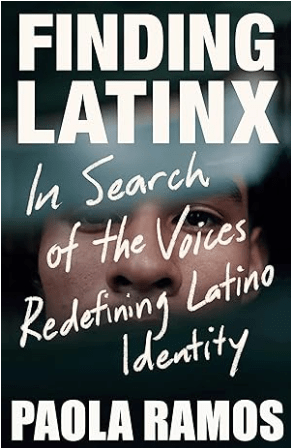
What does it mean to be Latinx? For journalist Paola Ramos, “Latinx” covers who she is: Latina, Cuban, Mexican, and American. But who are the millions of Americans who identify as Latinx? Ramos traveled across the United States to find out. She met with farmworkers in California, old friends in Miami, and Indigenous Maya communities in the Southern United States. She shares an iftar meal with Latinx Muslims in Washington, D.C. and cheers on an undocumented drag queen competing in the Miss Gay America pageant in Missouri. Ramos even sits down with Enrique Tarrio to try to understand what drove this Afro-Latinx man to the White supremacist group, The Proud Boys. (Note: Tarrio’s role in the Jan. 6 attacks is not mentioned. This book was published in 2020, and this chapter was likely written prior to the event.) Ramos gives readers a snapshot of the rich diversity of Latinx people in the United States, from the every day to the extraordinary. 

Fiction: The Inheritance of Orquídea Divina by Zoraida Córdova
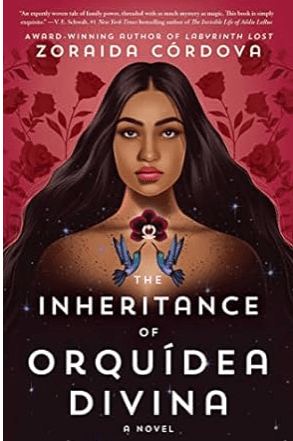
Orquídea Montoya’s living descendants receive a mysterious message from the matriarch of the family: I am dying. Come and collect your inheritance. When the family gathers at the homestead in Four Rivers, but instead of dying, Orquídea transforms into a ceiba tree. Two of Orquídea’s grandchildren, Rey and Marimar, are left with flowers growing out of their bodies, as is Orquídea’s great-granddaughter, Rhiannon. The family is left with more questions than answers, with Marimar pondering Orquídea’s parting words: protect your magic. When a mysterious force begins tearing through the Montoyas, the family travels to Ecuador, Orquídea’s birthplace, searching for answers. Orquídea’s history unfolds in alternating chapters, with her story dovetailing beautifully with her descendents’ during the climax. This is an intergenerational story of magic, monsters, and family secrets coming to light. And if you’re a regular reader of this blog, you’ll see it has something rare: an omniscient narrator that I actually liked. 

Sep. 2024 Recs: Hispanic Heritage Month

Without in any way limiting the author’s exclusive rights under copyright, any use of this publication to “train” generative artificial intelligence (AI) technologies to generate text is expressly prohibited. The author reserves all rights to license uses of this work for generative AI training and development of machine learning language models.

Just a couple blog updates before we get started with this month’s book list. First: most of my stuff for Flash Fiction Month has been taken down, but there’s still a few stories I decided to leave on here. Second: until the end of the year, I’ll only be posting book recommendation lists here with any consistency. I may have a couple extra posts every so often (I’m working on one now!) but don’t expect them regularly.


September marks the beginning of Hispanic Heritage Month! Hispanic Heritage Month celebrates the achievement, culture, and traditions of Latinx Americans of Mexican, Central American, South American, Caribbean, and Spanish ancestry.

Hispanic Heritage Month officially begins on September 15, and goes until October 15. The mid-month start date is because many Hispanic countries declared their independence from Spain in September. Costa Rica, El Salvador, Guatemala, Honduras, and Nicaragua all declared independence on September 15, 1821. Mexico declared its independence on September 16, 1810, and Chile did so on September 18, 1810. Over 150 years later, years later, Belize would declare independence from Great Britain on September 21, 1981.

For this month’s list, I’ve chosen to only feature graphic novels. I love graphic novels for many reasons, one of which is accessibility. They’re great for reluctant readers, or people who find reading difficult. Graphic novels are also not just for kids! They’re a unique medium that combines art and text to tell stories that can be as emotional, complex, and well-told as any novel. If you’ve never read a comic book as an adult, give ‘em a shot. There’s a ton of great stuff out there! 

¡Vamos a leer!

Nonfiction

Mexikid: A Graphic Memoir by Pedro Martín

Pedro calls himself a Mexikid. His parents and older siblings came to the U.S. as immigrants, while he and his younger siblings were born in the United States. With nine kids, life in the Martín house is cramped and chaotic, and Pedro can’t believe that Apá wants to bring their Revolution-era Abuelito from Mexico to live with them. Even more unbelievable, the whole family – all 11 of them – are driving down to Mexico to pick him up. This rollicking road trip is full of pranks, half-bananas, and family legends about Abuelito. Once they arrive, though, Pedro starts to doubt the legends – and himself. Can this old man really be “The Mexican Jedi” he’s heard so much about, and how can artsy Pedro connect with him? Is Pedro “Mexican enough” to really be a part of his extended family? And can he really step up to help his parents, like his older sister believes he can? This is a humorous and often moving memoir, told from the backseat of a Winnebago.

Fiction 

Invisible by Christina Diaz Gonzalez and Gabriela Epstein 

People think that George, Sara, Dayara, Nico, and Miguel must be the same because they all speak Spanish. The five middle schoolers know differently: the only thing they have in common is that they speak Spanish, and they’re all assigned to clean the cafeteria before school starts. At first, the kids only see the categories their classmates fit into: the brain, the weirdo, tough kid, the entitled rich kid, and the athlete. When George meets a young girl and her mom that really need help, the kids band together. As they do, they learn that there’s more to all of them than just their labels. Each kid has their own problems, and their own strengths and weaknesses. Yet they’re united in their compassion, and determined to help someone truly in need. Can this middle school breakfast club really make a difference in someone’s life? Or will they remain invisible?