Banned Books Week 2: The Reasons

If you want to know what the current moral panic facing America is, check the ALA’s top 10 banned books list. When you think of banned books, you might be thinking of the classics: Brave New World, Huckleberry Finn, To Kill an Mockingbird. And, sure, there are classic books that have been challenged and banned since they were first published. Just ask Toni Morrison. But in recent years, the most common reasons for challenging or banning books are for containing LBGTQIA+ content or critiques of systemic racism. Labeling a book as “sexually explicit” is another common reason, though that’s pretty much always been the case when it comes to book bans.

To show this, I’ve made a couple charts tracking the reasons why books were challenged or banned from 2012 – 2022. If you want a more detailed view, this is the spreadsheet I used to compile everything from the ALA’s lists. 

A little bit about the data here: most books have multiple reasons given for being challenged/banned. For example, Gender Queer by Maia Kobabe was challenged for LGBTQIA+ content and for being sexually explicit, so I marked it as both. “Language” can mean a few different things, depending on the book and who’s complaining about it. It might be curse words, but some books that deal with racial issues were challenged for having “divisive language.” Since one of those was a picture book, I don’t think that divisive language in that particular book was f-bombs. I’ve included racial slurs and derogatory terms in the category “language” as well. Similar to “language,” profanity can mean different things to different people, but it’s generally accepted to mean swearing. I’ve combined “racism” and “racial stereotypes” into one category, since you typically don’t get one without the other. I’ve also combined drugs and alcohol into the same category, though books that are challenged for drug use may not include alcohol use, and vice versa. 

All in all, the reasons given to ban or challenge books in the past 10 years looks a little something like this: 
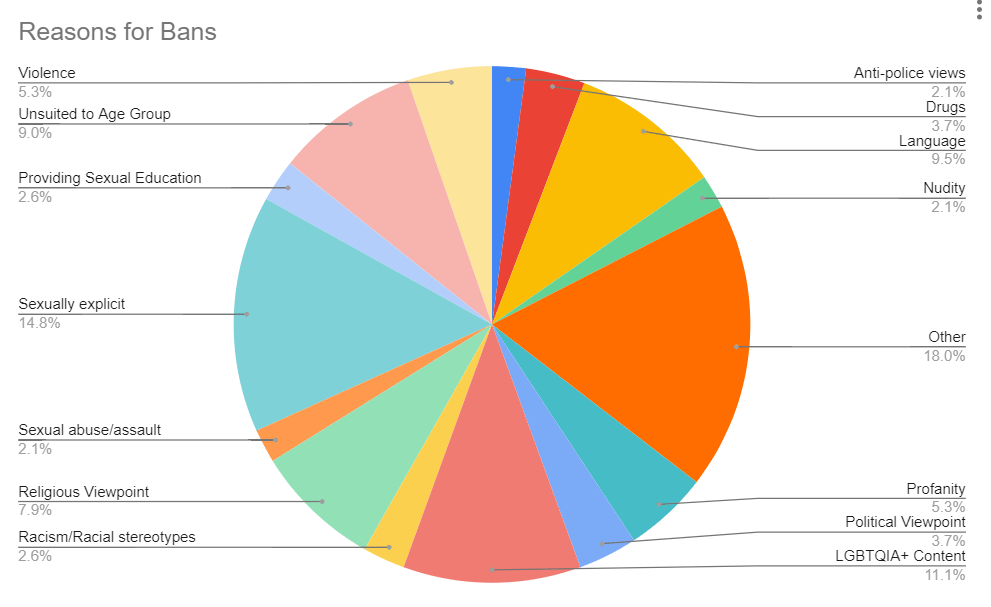
From 2012 to 2022, the three most common were “other”, “sexually explicit”, and “LGBTQIA+ content.” I’ll talk about “other” in a later post. Right now, I want to go over “sexually explicit.” 

As I’ll talk about in another post, “sexually explicit” can mean a lot of things. It can mean graphic sex scenes, steamy scenes, sexual assault, nudity (both sexual and nonsexual), and anything in between. What I find sexually explicit may not be what you find sexually explicit. 

Books with LGBTQIA+ content also tend to be called “sexually explicit” more frequently than books without it, even if the content is pretty mild. I can’t think of a book where this is more obvious than Drama by Raina Telgemeir. In one scene, two boys kiss. It’s a first kiss, innocent and sweet. If it had been a boy and a girl kissing, no one would bat an eye. 

Are you ready for this? Ready for this borderline pornographic scene?

No one tell the concerned parents how Shakespeare plays were originally cast.

Which brings me to my next point: challenging and banning books with LGBTQIA+ content. You’ve probably heard about this, since it’s becoming scarily common. These aren’t just parents showing up at school board meetings or quietly filling out a “request for reconsideration” form at a library. It’s a school board member filing a criminal complaint against Flagler Schools for having an “obscene” book in the school library.

 Or public libraries losing funding for having LGBTQIA+ materials.

 Or multiple bomb threats made against public libraries for carrying LGBTQIA+ materials.

This scares the shit out of me. To be totally honest, I think it’s a matter of time before a library worker is seriously injured or even killed due to this anti-LGBTQIA+ moral panic. But at least there’s an injunction against the Arkansas law that would prosecute librarians and booksellers for having materials that are “harmful” to minors in their collections, right?

Challenges to books with LGBTQIA+ content are obvious homophobia and transphobia. Censoring these materials attempts to erase already marginalized people and groups who have been unseen for centuries. The same can be said for books that confront systemic racism in America. In both cases, censorship acts to hide away authentic stories and information. Taken to the extreme, it could mean that only material that’s ultimately harmful to marginalized groups could remain on the shelves, further perpetuating homophobia, transphobia, and racism. These books combat this ugliness by exposing it. And if it makes you uncomfortable, good. Homophobia should be uncomfortable. Racism should be uncomfortable. 

And if it makes you feel seen and validated, or comforted to know that there is someone out there who feels like you do, sees the world like you do, or just makes you feel like you’re not alone…even better. 

Accessibility is about power, gatekeeping is founded on the protection of power, and to all of that I say: fuck that, because information that can change lives should never be hoarded.

Prisca Dorcas Mojica Rodriguez, For Brown Girls with Sharp Edges and Tender Hearts

The rash of censorship spreading across school and public libraries, and even private businesses, is appalling on every level. 

You cannot say you are protecting children and at the same time take away the things that validate who they are.

You cannot claim to uphold family values while calling in bomb threats.

You cannot say you value freedom and free speech and actively call for censorship.

Banned Books Week 1: Intellectual Freedom

I can only remember my reading choices being called into question three times.

First, when I was in elementary school, my aunt saw me reading some sort of business-type book by Scott Adams, the creator of Dilbert. I was skipping the text and reading the comic strips that had been inserted on each page. My aunt laughed and asked if I understood what I was reading. I told her I was only reading the comics. She asked if I understood the comics, which I mostly didn’t, and I told her, “Some of them.”

The second time was probably in the summer of 1997, making me eight years old. I was eagerly reading a Newsweek article about the recently-launched Sojourner Mars rover. My mom asked me if I understood what I was reading. I was an above-average reader for my age, but Newsweek was still beyond me. I had no idea what the article was saying. I lied and told her that I understood it all.

The last time came when I was sixteen or seventeen, and reading The House of the Scorpion by Nancy Farmer. Whenever I set it down, I was very careful to always place it cover side up, lest someone be weirded out by the summary on the back. When I did leave it upside down once, though, my mom read the summary and asked, “What is this book you’re reading?” Considering that the summary talks about opium and a boy being harvested from a cow’s womb, I’m not surprised that it raised a few eyebrows. When I told her it was sci-fi about clones and I also thought it was weird, but good. She just kind of went, “all right then” and didn’t ask again.

But at no point has anyone ever told me, “I don’t like that, so you can’t read it.” No one has ever tried to take a book from me because it was too advanced, or because they were uncomfortable with the subject matter. I got to read whatever I wanted, even if my parents didn’t love all of it. Though my mom might occasionally “check in” if I was reading a book with mature themes, she trusted me to make my own decisions when it came to reading. Some kids aren’t that lucky.

Let’s talk about banned books.

This is the week to do it, after all. Banned Books Week was established in 1982 by the Office of Intellectual Freedom (OIF), a subdivision of the American Library Association (ALA), in response to a sudden uptick in book bans and challenges that year.

Notably, the subject of book bans made it all the way to the U.S. Supreme Court in 1982, in the case Island Tree Schools School District v. Pico. The school district had removed 11 books from the high school and middle school libraries, which the school board decreed were, “anti-American, anti-Christian, anti-Sem[i]tic, and just plain filthy.” A group of five students, led by high school senior Steven Pico, filed suit against the school board. They alleged that removing books from their school violated their First Amendment rights. In a 5-4 decision, the Supreme Court ruled that school boards did not have the right to remove books from the school library “simply because they dislike the ideas contained in those books and seek by their removal to ‘prescribe what shall be orthodox in politics, nationalism, religion, or other matters of opinion.'”

Five kids stood up for their intellectual freedom, and they saved their right to information. But book bans and challenges are still happening today, and at an alarming and unprecedented rate.

So I want to dedicate this and the next few posts to Banned Books Week, taking a look at intellectual freedom, and the threats it faces.

But first: What is intellectual freedom?

Librarians don’t take an oath when we graduate,* but if we did, it would probably look like the Library Bill of Rights. To shrink it down into just three main tenets, the Library Bill of Rights says (in brief)

  1. Everyone has a right to information, regardless of their age, sex, race, religion, orientation, gender identity, etc.
  2. Libraries facilitate these rights by providing information from all points of view, and need to challenge censorship or attempts to restrict anyone’s freedom to read and learn.
  3. Everyone has a right to privacy, and libraries need to safeguard the privacy of everyone who uses them.

I could talk about the right to privacy and libraries for a long time, but for this post, I’ll be sticking to those first two tenets. In a nutshell, this is intellectual freedom. Everyone has a right to information from all points of view, without restriction. And it’s not just me saying that. The U.N. agrees.

Everyone has the right to freedom of opinion and expression; this right includes freedom to hold opinions without interference and to seek, receive and impart information and ideas through any media and regardless of frontiers.

U.N.’s Universal Declaration of Human Rights

Censorship, book bans, and challenges all restrict our human right to information.

I’m going to pre-empt one of the most common (if not the most common) arguments for book challenges and bans: “Think of the children!”

As a youth librarian, I work with all ages of kids, from babies to teenagers. I obviously wouldn’t hand a three-year-old and a thirteen-year-old the same book. Likewise, two kids of the same age can have entirely different reading and maturity levels. A book that’s perfect for one kid might be totally wrong for another. That’s fine – there is no single book that is perfect for every person. Adults can and should provide guidance for kids when it comes to their media consumption, including books.

What shouldn’t be done is deprive others of the opportunity to access those materials. There are plenty of books that I don’t like, and ones that I disagree vehemently with. I choose not to read those books, or to read them with a critical eye. Just because I don’t like Red, White, and Royal Blue doesn’t mean that I can take it away from everyone else who might want to read it.

One more thing that I haven’t addressed yet: the right to receive information from all points of view.

This can be a hard thing when it comes to selecting materials for libraries. For instance, political pundits espouse plenty of opinions I disagree with. Yet they still have fans who want to hear from them, and who will eagerly dive into any book their favorite commentator puts out. Even if it’s misleading or potentially harmful.

At times, this has been really difficult for me. I mostly deal with juvenile and YA fiction, so I don’t have to decide if a book like Why Women Shouldn’t Vote** by John “Women are Intimidated by How Smart I Am” Smith belongs in a library. But I still have to make choices like:

Is this book where the characters appropriate sacred Indigenous practices something we want in our collection?
This books has strong misogynistic content, but the movie is extremely popular and it’s trending on #BookTok. Do we buy it?
The teens really enjoy rom-coms, but this one starts after a girl is kissed by a stranger in the dark. How would that be interpreted by the teens who read it?
This author is a slimeball and criminal, but his books get checked out a lot. Is it okay for me to buy this book and support him financially? Or is it better for me to order it so fewer people need to go out and buy the book?

I have to take all of these questions on a book-by-book basis. I reject many books because I feel that they would not suit our library patron’s needs, and I purchase others that I would never choose for myself because I know the patrons will like them. These are the times that I need to separate my professional ethics from my personal beliefs.

Everyone still has a right to read these books, no matter what your beliefs are. The library’s role is not to sort out what should and shouldn’t be read, but to provide information to those who seek it. Intellectual freedom is a human right, and Banned Books Week is a challenge to anyone who would take away that right.

So crack open The Bluest Eye, pull your copy of Perks of Being a Wallflower off the shelf, and dare to check out Flamer. Let freedom read.


*We do, however, get a cardigan alongside our diploma.
**Not a real book. I hope.