June 2025 Book Recs: Read with Pride

Without in any way limiting the author’s exclusive rights under copyright, any use of this publication to “train” generative artificial intelligence (AI) technologies to generate text is expressly prohibited. The author reserves all rights to license uses of this work for generative AI training and development of machine learning language models.


Before we begin, just a couple updates for summer. I’m trying to get back to two posts a month, but I’ve been really busy this spring. July is Flash Fiction Month, so I’ll be posting some short fiction here every day (hopefully). Summer is the busiest time of the year for me, so August is going to be a rest month. 

June is Pride Month! Pride celebrates LGBTQIA+ history, culture, and. well…pride! Pride began with the Stonewall riots in June and July of 1969, and June was officially recognized as “Gay and Lesbian Pride Month” in 1999. LGBTQIA+ rights have come a long way, but there’s still a lot of progress to be made, especially as the trans community is increasingly under attack. PFLAG has a really useful Executive Order Explainer that tracks anti-LGBTQIA+, anti-DEI, anti-immigration, anti-reproductive health, and anti-voting rights executive orders. It also includes links to resources like the Trans Legal Survival Guide from Advocates for Trans Equality, along with resources for mental health, advocacy, and legal help. 

LGBTQIA+ covers a huge range of identities, and two books can’t cover all of them. May was also an incredibly busy month for me, so I wasn’t able to do as much reading as I would like. I still hope this small selection of books enhances your Pride month!

Non-fiction

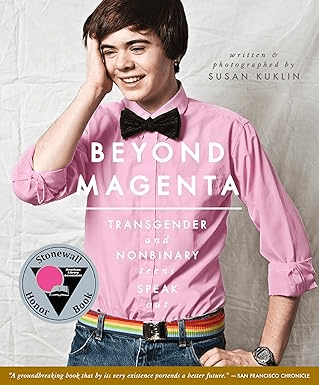
Beyond Magenta: Transgender Teens Speak Out by Susan Kuklin

Six teens and young adults – two trans girls, two trans boys, two nonbinary individuals (one of whom is intersex) – share their stories. With honesty and courage, these young people tell their stories about their early lives, their families, discovering their gender identities, and eventual transitions. They come from a range of backgrounds and experiences, like Luke who has a supportive family and realized he was trans with the help of his queer theatre group, or Mariah, who lived in poverty and has experienced violence due to her gender identity. (Note: Mariah’s chapter includes disturbing content, including sexual abuse.) She began to transition openly during her senior year at an all-boy Catholic school, in the face of bullying, an unsupportive mother, and punishments from the school. Many teens talk about the spectrum of gender and gender as a social construct. Most importantly, each chapter shows the subjects as whole, complex individuals, who are more than just their gender identity. 

Trans issues are a hot topic right now, and there is a lot of discourse and misinformation about gender identity, sexuality, and youth. It’s important for young trans and nonbinary people to have a seat at the table and tell their own stories. 

Fiction

The Gentleman’s Guide to Vice and Virtue by Mackenzie Lee

There is only one thing that Henry “Monty” Montague is looking forward to, probably for the rest of his life: his Tour of the European Continent. The Tour is something of a rite of passage for wealthy noblemen in the eighteenth century: a year of gambling, drinking, and debauchery before he returns to England to work alongside his father.  What he’s most interested in, however, is spending a year with his best friend, Percy. Monty has been secretly in love with Percy for years, and the Tour might be the last chance Monty has for something to happen with him. At the end of the Tour, Percy will be attending law school in Amsterdam, leaving Monty alone. Traveling with them is Monty’s intelligent but taciturn younger sister, Felicity, who struggles to understand Monty’s bisexuality. After a visit to Versailles ends in disaster worthy of being disinherited over, Monty, Percy, and Felicity find themselves being hunted down by bandits, catching rides on pirate ships, and – most terrifying of all – growing as people. This novel is a fun romp around Europe, full of adventure, romance, a bit of magic, and a few steamy scenes. The Montague siblings’ adventures continue in two sequels. 

June Book Recs: Read with Pride

A little blog update: I am still dealing with personal issues which has impacted my writing. I’ll be posting (hopefully) posting Flash Fiction Month stories here daily throughout July, and then will be taking a break from the blog until September. My brain needs it.


June is Pride Month! Pride celebrates LGBTQIA+ history, culture, and. well…pride! Pride began with the Stonewall riots in June and July of 1969, and June was officially recognized as “Gay and Lesbian Pride Month” in 1999. LGBTQIA+ rights have come a long way, but there’s still a lot of progress to be made, especially as the trans community is increasingly under attack.

LGBTQIA+ covers a huge range of identities, and two books certainly can’t cover all of them. The two books I have here were stand-out options for Pride.

Nonfiction

Real Queer America: LGBT Stories from Red States by Samantha Allen

Samantha Allen, a trans woman, loves the places that queer people are supposed to fear. She and her friend Billy, a trans man, embark on a road trip across red states in the United States, to tell the stories of queer people who live, or have chosen to stay, in places that are often thought to be unwelcoming or even unsafe for queer individuals. They start in Provo, Utah, where Samantha had attended Brigham Young University pre-transition, and finds a sanctuary that she would have thought would never exist. Texas is outrageously fun despite the state’s anti-trans laws, then it’s on to Indiana, where Samantha met her wife. They stop in Tennessee, Mississippi, and finally, return to Samantha’s home with her wife in Florida. Samantha and Billy’s journey is one of surprising compassion as they find queer spaces and people who welcome them unquestionably, and bright spots of love and acceptance in whatever state they’re in. The author also includes her personal history, and reflects on anti-trans policies in the era of the Trump administration. Most of all, this is a story about connecting that reminds the readers the queer Americans are everywhere, carving out loving spaces for themselves, and road-trippers who happen to come their way.

On a Sunbeam by Tillie Walden

On a Sunbeam is a space opera graphic novel that follows a young woman in two different times of her life. Mia isn’t the best student at her high-end boarding school, Cleary’s School for Girls. Her only real interest is the school sport Lux, her passion for which gets her in trouble. While waiting outside the principal’s office, Mia meets Grace. Grace seems to have a secret – and magic powers? – but the two girls soon fall for one another. Five years later, newly graduated, Mia gets a job on aboard the spaceship Aktis. The crew consists of Char, her wife Alma, Alma’s niece Jules, and Elliot, who is non-binary and non-verbal. Mia joins the crew in restoring old buildings in space, and chronicles the things they discover. Char, Alma, and Elliot all have histories they’d rather Mia not know, and Mia has some unfinished business of her own. I don’t want to say too much about the plot without giving it away, but this is an epic and imaginative story of queer love, found family, forgiveness, and of course, space.

Banned Book: Prince and Knight

Without in any way limiting the author’s exclusive rights under copyright, any use of this publication to “train” generative artificial intelligence (AI) technologies to generate text is expressly prohibited. The author reserves all rights to license uses of this work for generative AI training and development of machine learning language models.


Think of your favorite fairy tale. Were there talking animals? A handsome prince falling in love with a beautiful princess? Did it teach a lesson? 

When we’re very young, fairy tales and fables are usually our first introduction to stories. We learn a lot about narrative structure from these old tales. We learn that stories have a beginning, a middle, and an end. Stories have characters and conflicts. We even learn some basic symbolism: a cottage represents safety and home, the woods represent danger, and a castle represents success. A beautiful person is good, and an ugly person is evil. These simple, familiar stories set the foundation for our understanding of narratives long before we have the ability to read one on our own. 

There are many things in traditional stories that aren’t viewed as fondly today as they once were, like beauty equating to goodness and women as prizes. There are lots of retellings of classic stories now, which often change turn the formerly helpless maiden into a certified bad-ass. Heck, the best-selling Twisted Tale series are just Disney AUs based on their popular movies.

I didn’t write my earlier post about traditional literature just because it’s one of my favorite genres (though that is true), but because I want to discuss the oft-challenged picture book, Prince and Knight, but Daniel Haack and Stevie Lewis.

Well, let’s look at this dangerous book together. I love the illustrations – bright and colorful, and perfect for a picture book. The story is also told in rhyme, which I enjoyed. Sometimes rhyming picture books can be clunky or choose awkward words to make the rhyme work, but I didn’t see any of that here. Overall, it’s nice to look at and fun to read out loud.

Prince and Knight repeats familiar fairy tale beats: a prince goes on a journey, overcomes a challenge, and is rewarded with true love. The main difference between this and stories like Sleeping Beauty is that the prince’s true love is another man. 

The story goes like this: a prince is getting ready to inherit the kingdom, but the king and queen know that it’s too much work to rule alone. They want their son to find a nice girl and get married. He meets many lovely ladies, but he doesn’t want to marry any of them. When a dragon attacks, the prince races to save the kingdom. He’s not fighting alone, either. A bold knight rushes into the battle to assist the king. They save each other’s lives, and together, capture the beast. Soon, the prince realizes that his one true love, the one he’s been searching for, is this brave knight in shining armor. The prince and the knight are married, the kingdom rejoices, and everyone lives happily ever after.

I loved Prince & Knight. There’s action, but not violence (the prince and knight tie up the dragon rather than slay it), and it has an adorable happily ever after. My favorite thing about the book might be the king and queen’s reaction to the prince falling in love with another man. They’re ecstatic that he’s found someone and don’t care that it’s not a princess, and the whole kingdom celebrates their wedding. 

Cute, right?

Unfortunately, not everyone thought so. According to the ALA Prince and Knight was one of the most frequently banned or challenged books in 2019 for “featuring a gay marriage and LGBTQIA+ content; for being ‘a deliberate attempt to indoctrinate young children’ with the potential to cause confusion, curiosity, and gender dysphoria; and for conflicting with a religious viewpoint”

Siiiigh. Let’s break this down.

Prince and Knight was published in 2018, three years after same-sex marriage became legal throughout the United States. According to Pew Research Center, a majority Americans support same-sex marriage and it’s part of the cultural landscape, whether you think it should be or not.

“Confusion” and “curiosity” are natural parts of childhood. Young kids are learning about the world and, no matter what book you read to a young child, they’re going to have questions. For an example from my own life, I was in fourth grade when I two older students – who were also my neighbors – told me that our principal was a lesbian. I’d never even heard the word “lesbian” before, and it had to be explained to me: girls who love girls. I became worried, and asked, “am I a lesbian because I love my mom?” The older girls told me that girl family members didn’t count. Later, my neighbor’s mother called my house to warn my mom that I might be asking some questions about what I’d learned that day. But I can’t remember asking any other questions about it, or even it being that big of a deal in the long run. If a child has a question about the gay marriage in the book, “Some boys fall in love with other boys” isn’t indoctrination, it’s just a true statement. And it’s not going to be as earth-shattering as you think. And while we’re not totally certain what causes gender dysphoria, you don’t get it from reading a picture book.

As far as a religious viewpoint goes…I’m pretty sure we can guess which religion the complainants are talking about. Some religious communities, like the Buddhist Churches of America and some Jewish movements have celebrated or supported same-sex marriage for decades, and many sects of Christianity do so as well now. Even the Catholic church is slooooowly becoming more accepting of same-sex couples. So this book isn’t against all religious viewpoints, just a certain one. 

At the start of this post, I talked about the role fairy tales play in our formative years. So I have a question: why is Prince and Knight indoctrination, but a story like “Sleeping Beauty” isn’t? Classic Western fairy tales are often about finding true love through magical means. The prince magically awakens a sleeping princess with a kiss; a princess kisses a frog and finds her true love; a glass slipper fits only one woman perfectly. So many stories treat the princess as a prize to be won. I would say reading only fairy tales like that introduce kids to harmful stereotypes of gender. So why aren’t tales of heterosexual love accused of indoctrinating kids? 

I love fairy tales, old and new. I am aware of the pitfalls in classic traditional stories, and I enjoy adaptations that change things up. I still think fairy tales and other traditional stories and rhymes are an important part of early literacy. But there’s a phrase I heard once that’s always stuck with me: “It’s not what you have, it’s what you don’t have.” This sums up how I feel about a lot of media diets. If you get nothing but stories with a narrow view of what the world is like, it’s going to affect how you see the world. I don’t see anything inherently wrong with traditional stories, but I think it’s important for children to see stories where the princess saves the prince, where the ugly person is kind, and where the prince and the knight find true love. 

Because in real life, girls can save boys, not-beautiful people can be kind, and two men can fall in love and marry each other. To pretend otherwise is insulting to all of those who don’t live in a fairytale.

Banned Book: Flamer by Mike Curato

This is the last post of the year! I will be taking a break in January and be back in February.


New on the ALA’s Banned Book list this year is the graphic novel Flamer by Mike Curato. If you’re a picture book aficionado, you might already be familiar with his work, such as the Little Elliot series.

In 2022, Flamer became challenged and banned books in the U.S. due to LGBTQIA+ content, and being considered as “sexually explicit.” Despite this, the book has received high praise from critics, but I think the blurb on the cover says it all.

This book will save lives.

Jarret J. Krosoczka

Fourteen-year-old Aiden Navarro isn’t excited to go to high school. He was frequently bullied at his Catholic middle school, and fears that public high school will be much worse. His parents’ frequent fights don’t make his home life easy, either. Thankfully, he has an escape during the summer at sleep away Boy Scout camp. Aiden loves scouting, but the Summer of ’95 isn’t going to be like any camp experience he’s had before. As the summer goes on, Aiden finds himself drawn to his confidant bunk mate, Elias. At first Aiden thinks that he admires Elias’s confidence and friendly nature. It can’t be a crush, right? That would make Aiden gay. And if being gay is a sin that can condemn you to hell (and get you kicked out of Boy Scouts), then it must be pretty bad. And Aiden isn’t a bad kid.

So he can’t be gay…right?

The last two weeks of summer camp are filled with some great memories – and also some terrible ones. Though Aiden makes great friends and loves camp, he’s also subjected to homophobic and racist bullying. When things look at their bleakest, Aiden wonders: does his life really have value?

The comic is in black and white, except when fire and a few other important objects are depicted. Flames are yellow, red, and orange, the only colors in the book. It’s used to great effect, especially in the climax and resolution.

Non-spoiler review: Flamer hits on heavy real-life topics that many tweens and teens can relate to. The main themes of identity and growing up are relevant to everyone, not just LGBTQIA+ youth. There is some mild sexual content, so I’d recommend this book to kids 13-14 and older.

I want to talk about the reasons that Flamer was challenged, banned, removed, or relocated.

One of the reasons was that Flamer is “sexually explicit.” Is it? Well, I think that depends on who you ask. Explicit-ness can be subjective and your feelings about what is and is not “sexually explicit” can change with time and experience. Some of the things that made me blush when I was fourteen I’m totally comfortable with now and I wouldn’t consider “explicit” today. Whether you find the sexual content in the book offensive or too much is really up to your own comfort levels. For me, the sexual content in Flamer was a little uncomfortable to read, but it wasn’t graphic. It seemed realistic and fit with the overall theme and story of the book. I can’t really object to it.

The other major complaint against Flamer is that it contains LGBTQIA+ content. And, well, duh. It’s a story about a young teenager accepting himself as gay.

As we saw earlier, LGBTQIA+ content was a really common reason given to challenge/ban books for the last 10 years. I won’t beat around the bush: this is homophobia and transphobia. There’s no other way to explain it. Otherwise, why would perfectly innocent (and adorable) books like And Tango Makes Three or This Day in June be challenged so frequently? I wouldn’t hand an elementary-age child Flamer; it’s not appropriate for the age group. But a cute picture book about a same-sex couple like Prince and Knight? Well, I wouldn’t have a problem suggesting that to a young child.

Because queer people (and penguins) exist. Everyone – from all walks of life – need to see themselves represented in media, but I think this is especially true for kids. Our early experiences shape our lives, and it’s important to see ourselves reflected in what we watch and read. Simply put, if you can’t see it, you can’t be it.

Beyond this point, there are going to be spoilers. If you’re interested in reading Flamer, check it out before you scroll down. I’d hate to ruin the (awesome) ending for you.

Content warning: there will be mentions of suicide from here on out. If that’s not something you want to read about, it’s okay to sit this one out. Mental health resources can be found at the bottom of this post.

Towards the end of Flamer, Aiden feels that everyone has turned against him. His best friend hasn’t written him back after he hinted at being gay in his most recent letter to her; a camp counselor he looked up to was removed from camp after he was discovered to be gay; Elias has been avoiding Aiden after Aiden surprised him with a kiss on his cheek. After yet another day of harsh bullying, Aiden can’t see how his life will ever get better. It feels like it would be better to end it now, and save himself years of misery. He runs to the camp’s outdoor chapel with a pocket knife and plans to take his own life.

Before Aiden can harm himself, he is taken to a strange place filled with darkness and fire. In a beautiful sequence, he speaks to “the fire of life” within himself. It challenges him: why is Aiden trying to destroy them both? They are not weak. They deserve to live. In this encounter, Aiden realizes that his life may not be as easy as his friends’, but it still has value. He still deserves to live. No matter what happens, he is enough. Just as he is.

It’s a powerful moment.

Even more powerful when you consider that suicide is the second leading cause of death among teens in the United Sates. LGBTQIA+ youth are at a higher risk for suicide, especially when they live in environments that are not supportive of their identities.

LGBTQ youth are not inherently prone to suicide risk because of their sexual orientation or gender identity but rather placed at higher risk because of how they are mistreated and stigmatized in society.

The Trevor Project, Facts about LGBTQ Youth Suicide, 2021

Aiden is fictional. But his feelings are real to those who’ve lived through them. The impact that Flamer can have on its readers is also very real. No matter how bad things have been for Aiden, or how bad they might get, he knows that he as value as a human being. And that’s a really great message, especially for teenagers. Even more so for LGBTQIA+ youth who need to see someone with the same struggles they’re going through, and come through it feeling strong.

One last thing to really drive the message home: Flamer is true. Well, parts of it. Flamer is a semi-autobiographical graphic novel, inspired by author and illustrator Mike Curato’s experiences as a gay Boy Scout in the 90s. In an author’s note at the end of the book, Curato shares some of his internal conflicts when he was Aiden’s age, and some memories from camp.

Including his suicide attempt in the camp’s chapel.

Curato survived, and went on to become a much-loved, award-winning illustrator. And now his story – and Aiden’s – is there to tell kids like him you are worthwhile. You are valued. You are enough.

And I cannot imagine why anyone who would be so cruel as to take that message away from kids who so badly need to hear it.

National Suicide Prevention Hotline (US): 1-800-273-8255
List of Suicide Crisis Lines (Worldwide)
The Trevor Project Lifeline: 1-866-488-7386 | Text: START to 678-678 | Online chat available
Q Chat Space

More resources can be found here: https://booksoverlookedblog.com/resources/

Banned Books Week 2: The Reasons

If you want to know what the current moral panic facing America is, check the ALA’s top 10 banned books list. When you think of banned books, you might be thinking of the classics: Brave New World, Huckleberry Finn, To Kill an Mockingbird. And, sure, there are classic books that have been challenged and banned since they were first published. Just ask Toni Morrison. But in recent years, the most common reasons for challenging or banning books are for containing LBGTQIA+ content or critiques of systemic racism. Labeling a book as “sexually explicit” is another common reason, though that’s pretty much always been the case when it comes to book bans.

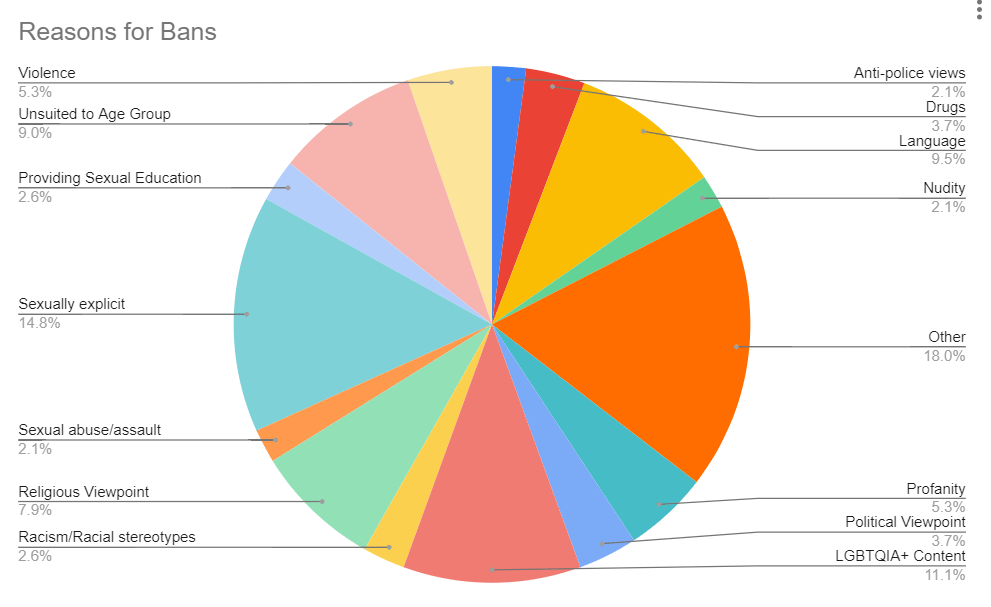
To show this, I’ve made a couple charts tracking the reasons why books were challenged or banned from 2012 – 2022. If you want a more detailed view, this is the spreadsheet I used to compile everything from the ALA’s lists. 

A little bit about the data here: most books have multiple reasons given for being challenged/banned. For example, Gender Queer by Maia Kobabe was challenged for LGBTQIA+ content and for being sexually explicit, so I marked it as both. “Language” can mean a few different things, depending on the book and who’s complaining about it. It might be curse words, but some books that deal with racial issues were challenged for having “divisive language.” Since one of those was a picture book, I don’t think that divisive language in that particular book was f-bombs. I’ve included racial slurs and derogatory terms in the category “language” as well. Similar to “language,” profanity can mean different things to different people, but it’s generally accepted to mean swearing. I’ve combined “racism” and “racial stereotypes” into one category, since you typically don’t get one without the other. I’ve also combined drugs and alcohol into the same category, though books that are challenged for drug use may not include alcohol use, and vice versa. 

All in all, the reasons given to ban or challenge books in the past 10 years looks a little something like this: 

From 2012 to 2022, the three most common were “other”, “sexually explicit”, and “LGBTQIA+ content.” I’ll talk about “other” in a later post. Right now, I want to go over “sexually explicit.” 

As I’ll talk about in another post, “sexually explicit” can mean a lot of things. It can mean graphic sex scenes, steamy scenes, sexual assault, nudity (both sexual and nonsexual), and anything in between. What I find sexually explicit may not be what you find sexually explicit. 

Books with LGBTQIA+ content also tend to be called “sexually explicit” more frequently than books without it, even if the content is pretty mild. I can’t think of a book where this is more obvious than Drama by Raina Telgemeir. In one scene, two boys kiss. It’s a first kiss, innocent and sweet. If it had been a boy and a girl kissing, no one would bat an eye. 

Are you ready for this? Ready for this borderline pornographic scene?

No one tell the concerned parents how Shakespeare plays were originally cast.

Which brings me to my next point: challenging and banning books with LGBTQIA+ content. You’ve probably heard about this, since it’s becoming scarily common. These aren’t just parents showing up at school board meetings or quietly filling out a “request for reconsideration” form at a library. It’s a school board member filing a criminal complaint against Flagler Schools for having an “obscene” book in the school library.

 Or public libraries losing funding for having LGBTQIA+ materials.

 Or multiple bomb threats made against public libraries for carrying LGBTQIA+ materials.

This scares the shit out of me. To be totally honest, I think it’s a matter of time before a library worker is seriously injured or even killed due to this anti-LGBTQIA+ moral panic. But at least there’s an injunction against the Arkansas law that would prosecute librarians and booksellers for having materials that are “harmful” to minors in their collections, right?

Challenges to books with LGBTQIA+ content are obvious homophobia and transphobia. Censoring these materials attempts to erase already marginalized people and groups who have been unseen for centuries. The same can be said for books that confront systemic racism in America. In both cases, censorship acts to hide away authentic stories and information. Taken to the extreme, it could mean that only material that’s ultimately harmful to marginalized groups could remain on the shelves, further perpetuating homophobia, transphobia, and racism. These books combat this ugliness by exposing it. And if it makes you uncomfortable, good. Homophobia should be uncomfortable. Racism should be uncomfortable. 

And if it makes you feel seen and validated, or comforted to know that there is someone out there who feels like you do, sees the world like you do, or just makes you feel like you’re not alone…even better. 

Accessibility is about power, gatekeeping is founded on the protection of power, and to all of that I say: fuck that, because information that can change lives should never be hoarded.

Prisca Dorcas Mojica Rodriguez, For Brown Girls with Sharp Edges and Tender Hearts

The rash of censorship spreading across school and public libraries, and even private businesses, is appalling on every level. 

You cannot say you are protecting children and at the same time take away the things that validate who they are.

You cannot claim to uphold family values while calling in bomb threats.

You cannot say you value freedom and free speech and actively call for censorship.

Read with Pride: June Book Recommendations

Before we get into June’s book recommendations, I just want to let everyone know that there won’t be a book list for July, and possibly not one for August. As a children’s librarian, summer is my busiest time of the year. Much as I wanted to create a book recommendation list for every month this year, I’m a little overwhelmed right now and it’s just not in the cards. 

June is my favorite month for many reasons: my birthday, the start of summer, and many good memories I have of school ending. June is also  Pride Month! First established in 1999, Pride Month commemorates the 1969 Stonewall Riots that are often used to mark the beginning of the gay rights movement in the United States. LGBTQIA+ rights have come a long way since then, but it is still an uphill battle, particularly for the trans and nonbinary community. 

I live in Florida, which has passed extreme anti-LGBTQIA+ laws, including the infamous “Don’t Say Gay” law (which recently was extended to eighth grade); HB 1521, which regulates bathroom use; and SB 245, which bans gender-affirming care for trans minors and allows the state to remove children from their families if they receive gender-affirming care.  The Human Rights Campaign, the largest LGBTQIA+ group in the U.S., has even issued a travel advisory for  individuals traveling to Florida.

I am obviously disgusted and enraged by the bigotry and cruelty present in these new laws, and my heart breaks for the trans and nonbinary community. I often feel frustrated and small, and that there should have been something more I could have done to stop this from happening. 

One way I can fight back is through my job. I’m a public librarian, which means that (for now) I don’t have the same restrictions on talking about gender and orientation as school staff do. At the time of this writing, public libraries also don’t have the same restrictions on what books people can have access to. I take my job very seriously. I feel that I have a responsibility to help fill the gaps that kids and teens no longer have easy access to. 

I do a lot of the ordering for YA books at my library, and I’m really pleased to see that there is a lot more LGBTQIA+ representation than there has been in the past. Certainly much more than when I was a teen, and more positive representation as well! Queer and non-binary characters are no longer relegated to being one-off jokes, side-kicks, or dying gruesomely, but are fully realized characters whose orientation or gender identity does not define them. 

There are still many areas where LGBTQIA+ fiction is lacking. For example, I’ve come across way more books about trans boys than trans girls, and very few books have asexual characters as the lead. Also, the majority of LGBTQIA+ fiction I come across is contemporary romance. I think all of these things will improve with time, but it’s the last one I want to talk about right now. There’s nothing wrong with contemporary romance, of course, though it’s not my favorite thing to read. There still isn’t a large amount LGBTQIA+ representation in genre fiction (though it’s improving!), which is disappointing. Queer and nonbinary individuals should still be able to see themselves in their favorite genres – historical, fantasy, sci-fi…and yes, even contemporary romance, if you insist. 

For the fiction half of this list, I’m focusing on genre fiction. Because you know what’s better than two boys finding true love? Two boys finding true love IN SPACE!

Nonfiction

This Book is Gay by Juno Dawson

This Book is Gay has the honor of being one of the most challenged books in the U.S. for two years running, for “LGBTQIA+ content” and “providing sex education.” Dawson’s book seeks to educate both queer and straight teens on same-sex relationships, including the physical aspects of those relationships. But sex is far from the only thing this book covers. It’s got everything from coming out, dating apps, discussions of queer culture, and the downsides of being LGBTQIA+. The breezy, upbeat writing is frequently witty and always informative, and black and white cartoons add humor into even the hardest topics the book covers, like harassment and discrimination. But I honestly can’t describe this book any better than the summary itself: “There’s a long-running joke that, after coming out as a lesbian, gay, bisexual, transgender, or intersex person, you should receive a membership card and instruction manual. This is that instruction manual. You’re welcome.” 

The Invisible Orientation: An Introduction to Asexuality by Julie Sondra Decker

While there is much better queer representation in the media today, asexuality is an orientation that often gets left out. It’s also frequently misunderstood, or treated as a joke. Because of this, it can be difficult for someone on the asexual spectrum to understand their orientation or have it be taken seriously.  It can be a huge relief to find the right word to describe yourself, and know that you’re not the only one who feels this way. The Invisible Orientation discusses asexuality and other ace-spectrum orientations, while emphasizing fluidity and that asexuality can change over time. It also addresses myths about asexuality, that being asexual is healthy and not the result of a physical or mental illness, and includes a chapter for friends and family of asexual people. I’ve known for awhile now that I’m on the ace spectrum, and while the label doesn’t matter to me much anymore, seeing myself in this book made me feel validated in a way I’d never been. 

Say it with me: we’re here, we’re queer, we don’t wanna touch your rear!

Gender Queer: A Memoir by Maia Kobabe

You’ve probably heard of Gender Queer before: maybe because it’s a Stonewall Honor Book, or maybe because it’s been the most frequently challenged book in the U.S. for the past two years. Gender Queer is a graphic novel that chronicles Maia Kobabe’s (e/eir/em) journey from childhood to adulthood, as e discovers eirself as nonbinary and asexual. The book starts in Maia’s childhood, and covers eir confusion about eir orientation, gender identity, and dating. Even after Maia discovers that e is gender queer, eir journey continues with coming out to friends and family, changing pronouns, and coming into eir own as a nonbinary person. This is a great choice for older teens and adults who are nonbinary, or seek to understand what it means to be nonbinary. 

The 57 Bus by Dashka Slater

Richard and Sasha’s paths probably would have never crossed if not for the 57 bus, which runs between Sasha’s middle class home Oakland’s foothills, and Richard’s crime-riddled community in the flatlands. Agender teen Sasha fell asleep on the bus, and woke to find their skirt in flames. The fire was set by Richard, and left Sasha with severe burns. Sasha’s recovery would require a lengthy hospital stay, multiple surgeries, and months of follow-up treatments. Richard was arrested and charged with two felonies and two hate crimes, potentially facing life in prison. The 57 Bus tells both Sasha’s and Richard’s stories: Sasha’s love of language and all things Russian, discovering their gender identity, and life after a devastating attack; Richard as a troubled kid trying to turn his life around, despite many obstacles. The book examines prejudice, discrimination, and even danger faced by  individuals, as well as the injustices of the juvenile justice system. 

Queerstory: An Infographic History of the Fight for LGBTQ+ Rights, published by Tiller Press, with forward by Linda Riley.

Queer history in the United States didn’t begin with Stonewall, and it didn’t end with the legalization of same-sex marriage. You can find a number of books about LGBTQIA+ history – especially if you’re looking for information about Stonewall or the AIDS Crisis – but sometimes it’s hard to know where to start. If you’re just looking for a quick overview of the LGBTQIA+ rights movement, a jumping-off point for more in-depth learning, or a very colorful way to learn queer history, then Queerstory will not disappoint. Loaded with illustrations, timelines, brief biographies, and facts, Queerstory presents LGBTQIA+ history in a visually appealing and digestible way. While not as in-depth as other books on queer history, the colorful presentation and infographic format add a splash of fun into what is often a weighty topic.

Fiction

Summer Bird Blue by Akemi Dawn Bowman

Lea wasn’t just Rumi’s sister. Lea was Rumi’s best friend, the other half of her soul. Writing songs with her was one of the greatest joys of Rumi’s life. Lea understood Rumi in a way that no one else did, like how Rumi felt left behind when her friends started dating and she just doesn’t understand why romance has to be such a big deal for everyone but her. When Lea is killed in an accident, Rumi is lost, unsure of what to do with her life without her sister in it. Her distant mother, consumed by grief, sends Rumi from their home in Washington to live with her aunt in Hawaii. Rumi navigates her grief, survivor’s guilt, and deep rage over her sister’s death and mother’s abandonment, while trying to understand her asexuality and complete the last song she and Lea would ever write together. At first, she wants nothing to do with Hawaii or her new neighbors – Kai, the cheerful boy next door, and the curmudgeonly Mr. Watanabe. But maybe, with their help, she can find her way back to the music that she once loved so much. 

Dreadnought by April Daniels

Danny Tozer has known for a long time that she’s a girl, even if she has a boy’s body. She’s afraid to come out as trans, but her secret’s out when the world’s greatest superhero, Dreadnought, falls out of the sky. Dying, Dreadnought transfers his superpowers to Danny, giving her super strength, flight, and the body she always wanted. Transitioning suddenly and gaining superpowers makes life a little complicated: Danny’s vitriolic and verbally abusive father is looking for a way to “cure” her; the Legion Pacifica of superheroes are in disagreement if Danny should be the new Dreadnought; even Danny’s best friend has abandoned her. “Caping” with fellow superhero Calamity helps Danny escape from her civilian troubles. The girls start small, but Danny is determined to track down Utopia, the super villain who killed Dreadnought. Danny doesn’t feel that she deserves the gift that he gave her, and this is how she can repay him. Yet as her journey as a trans girl and a superhero go on, she comes to understand that she deserves Dreadnought’s mantle – and more – as much as he did. 

Last Night at the Telegraph Club by Melinda Lo

It’s 1954, and seventeen-year-old Lily struggles to find a place where she belongs. While other girls her age are worrying about boys, Lily instead dreams of working at the Jet Propulsion Lab, like her aunt. She and her classmate Kath connect over an ad for a male impersonator at the lesbian bar, The Telegraph Club, and both girls’ lives are forever changed.  Lily gradually realizes she is a lesbian and falls in love with Kath, but following her heart is a huge risk. McCarthyism is in full-swing, and Chinese-Americans like Lily and her family could face deportation if they are accused of being Communist sympathizers. Being a lesbian only adds to the danger.  Lily learns how to switch between ostensibly straight, Chinatown Lily and Telegraph Club Lily. But when the two halves of her life collide, she will have a difficult choice to make that will change everything. 

The Darkness Outside Us by Eliot Schrefer

Ambrose Cusk wakes to find himself in space, but he has no memory of a launch. Apparently, he was injured in an accident at launch and has been in a coma for weeks. Even so, Ambrose remembers his mission clearly: he is being sent to Saturn’s moon, Titan, to rescue his sister. He’s also surprised to find that he is not alone on the ship. Spacefarer Kodiak Celius is from Demokratia, the country locked in a cold war with Ambrose’s home country, Federacion. At first Kodiak keeps his distance, but Ambrose gradually draws him out of his chosen seclusion. As their journey progresses, both boys discover that there’s something sinister happening on board. Why can’t they get in touch with mission control? Is the ship’s AI telling them the truth about Ambrose’s sister? These two sworn enemies must work together to discover the deadly secrets being kept hidden from them, at the same time coming to understand each other in the stark isolation of outer space. 

On a personal note, I recommend that you don’t read this on your lunch break at work. Once your break is over you’ll have to go back to work and try to be normal and not act like you’ve just been emotionally destroyed at the hands of a paperback. 

The Sunbearer Trials by Aiden Thomas

In the beginning, Sol and Tierra made the gods: the “powerful but vain” Golds, the “kind but focused” Jades, and the “passionate but selfish” Obsidians. But Sol and Tierra loved humans the most, and the jealous Obsidians turned them into mindless slaves. Sol sacrificed their body to protect humans, leaving the Sun Stones behind. Every ten years, the Sunbearer Trials are held, in which the children of the gods, or semidioses, compete to be chosen as the Sunbearer who will rekindle the Sun Stones. The loser of the trials has the dubious honor of being sacrificed to fuel them for another decade. Teo, the trans son of the goddess of birds, has no interest in the Trials. As a Jade surrounded by more talented Gold peers, he’s certain he’ll never be picked. But he and his best friend, Niya, must both compete against each other in the Trials, alongside Aurelio, Teo’s old friend turned enemy. Then there’s Xio, the thirteen-year-old trans son of the god of bad luck. No matter the outcome, Teo and Niya are determined to protect Xio from being sacrificed. The Hunger Games meets Mexican mythology in a lush, queer positive fantasy.