FFM 27: Sleepless in Tír na nÓg

Without in any way limiting the author’s exclusive rights under copyright, any use of this publication to “train” generative artificial intelligence (AI) technologies to generate text is expressly prohibited. The author reserves all rights to license uses of this work for generative AI training and development of machine learning language models.

July is Flash Fiction Month! I’ll be sharing short short stories here through the month of July. More notes at the end of the story.


The queens hadn’t had a good night’s sleep in over a month. No queen ever slept easy when their country was at war, but Fiadh and Mairead had another problem keeping them awake. A small, squirmy blond problem named Alexander. 

He’d always been a happy child, with a ready smile and a musical laugh. But then he’d fallen, and that cheerful, confident boy disappeared. It wasn’t surprising. He’d witnessed something that no child should see, trapped and alone. 

After that, Alex refused to be left alone for even a few minutes. When his mothers couldn’t spend time with him, he trailed behind his sister, Grainne. And if she couldn’t be with him, he’d go to the kitchens or follow the pages as they did their duties. 

Every night, Alex drank soporific tea to help him sleep. He would fall asleep peacefully in his own bed, then wake up screaming. The only way he could fall asleep again was snuggled between his parents, safe. 

It was getting to be a problem. 

Alex kicked in his sleep. He rolled. He slept sideways. 

And he still had nightmares. 

There was a tea for dreamless sleep, but it was a powerful blend, too stong for a child. If Alex drank too much, there was a chance that he’d be asleep for days. Fiadh had remarked that she and Mairead should down a few cups and actually get some rest. 

Then there was the matter of Grainne. She’s always been a serious girl, but she’d become sullen. She trained from dawn til dusk with any weapon she could get her hands on. She threw herself into magic practice, especially geomancy, which she’d always struggled with. 

As much as Fiadh and Mairead had tried to shield Alex and Gráinne from the war, it had found its way to them. And its touch had changed their children irrevocably. 

Things came to a head at breakfast one morning. “Mam and I need to leave for a few days,” Mairead announced. Alex and Gráinne looked up sharply. 

“We’re meeting with some potential allies,” Fiadh told them. 

“You can’t do that here?” Gráinne frowned. 

“This group hasn’t exactly been friendly with us in the past. It’s better to meet them on neutral ground,” Fiadh replied, then stabbed her sausage with such force that her fork scraped the bottom of her plate. 

“Better to have strange bedfellows than no bedfellows,” Mairead said. “Especially now. Uncle Lex is going to come stay with you for a few days.” 

Normally, they would have loved this. Uncle Lex spoiled the kids rotten and was something of a mischief-enabler for Alex. But at this announcement, Gráinne shoved her chair away from the table. “I’m going to the practice yard.” 

“Sit for a minute. Let’s talk about this,” Mairead started, but the princess was already gone. 

“I’ll grab her,” Fiadh offered, then started after Gráinne. 

Mairead looked across the table at Alex. He’d been voracious before, but now he stared at the food on his plate as if it were made of stone. “You know you’re safe here, right? Nothing will ever hurt you here. And Uncle Lex will keep you both safe.” She reached across the table and squeezed his hand. 

“Do you really hafta go?” Alex asked, still staring at his meal. 

“I can’t let Mam go alone. But I will miss you and your sister terribly, even if it’s only for a few days.” 

“Then don’t go.” 

Mairead let out a small, sad sigh. “I’m not worried, mo stór. And do you know why?”

Alex finally looked up. “Why?”

“Because I know you and your sister will look after each other.” She smiled. “Whatever happens.” 

“But I can’t fight like she does.” 

“Taking care of someone isn’t just about fighting. It’s about being there.” She scruffed Alex’s yellow hair. “Do you think you can do that for her?”

Alex nodded. “I think so.” 

“Good.” Mairead stood up and kissed Alex’s brow. “You didn’t finish your breakfast…but I think there’s a bit of apple tart left over from last night. Should we share it with Mam and Gráinne?”

Alex shook his head. There was a mischievous glint in his eye that had been absent for too long. “They can have cold breakfast.”


Yep, another one. But, hey, I’m caught up now! Poor young Puck (Alex) had a bit of a traumatizing incident with far-reaching consequences when he was young. There were a couple images in my head of him trying to sleep after, and the first one is in here. The second one will be in the next part. I don’t love dividing my stories for FFM into multiple parts, but at 600+ words I didn’t think I’d be able to give the final scene the room it deserved.

Also, it’s around this time in his life that Alex started to be called Puck. He’s not quite there yet, though.

Other FFM stories from this universe:

FFM 3: Love is a Battlefield
FFM 8: Queen of Nothing
FFM 15: It’s Not Rocket Science
FFM 18: The Goddess in the River
FFM 24: Summer Blues
FFM 18: The Goddess in the River

Without in any way limiting the author’s exclusive rights under copyright, any use of this publication to “train” generative artificial intelligence (AI) technologies to generate text is expressly prohibited. The author reserves all rights to license uses of this work for generative AI training and development of machine learning language models.

July is Flash Fiction Month! I’ll be sharing short short stories here through the month of July. More notes at the end of the story.


The air wasn’t as frigid as Rosalie thought it would be, but there was a sharpness to it. A wildness that was rarely found in the human world. The two women stood in a Carpathian mountain valley, the only mostly-human souls around. Green was starting to emerge from underneath the snow that had yet to melt away, but it would still be weeks before the wildflowers would bloom. “She’s here. If she’s anywhere, she’s here.” 

“That way.” Gráinne pointed to a spot where the snow had melted into a silver river. The rapid water splashed up on the banks, as though calling Gráinne and Rosalie to its edges. 

Rosalie looked over at Gráinne with wide eyes. “Can you…”

“I can try to call her. But she may not respond.” 

Rosalie nodded. “I know.” 

The young women knelt beside the water, never minding the mud and cold that seeped through their jeans. Gráinne dipped her hand into the icy water. She released her magic into the river, a soft moss green momentarily coloring the waters

The water flowed around Gráinne’s wrist, unchanged. They waited. Nothing. 

“Rose, I’m sorry. But she won’t come for me.” 

“It’s okay,” Rosalie said softly. 

But it wasn’t okay. Gráinne was next in line to the throne of Tír na nÓg. If even she couldn’t reach the goddess, there was no way Rosalie would be able to, either. 

Gráinne sighed and stood up. “Maybe we could make an offering?”

Rosalie didn’t move. “I don’t think a willing sacrifice is just gonna appear.” She trailed her fingertips along the edge of the water. 

“Please.” Rosalie trailed her fingers over the clear water. Tears pooled in her eyes. “I’m not asking for much. Just a conversation.” 

A tear slipped down Rosalie’s cheek and fell into the water. 

The water stilled. Ripples spread outward, reaching across to the opposite bank. 

Rosalie held her breath. Light glittered off the surface of the water. It wasn’t sunlight – too cloudy for that – but came from underneath. 

The sparkles coalesced around Rosalie’s fingertips. They expanded, forming a face. It was neither old nor young, but her features were soft and kind. 

Rosalie exhaled. “Great-grandmother.” 

The face disappeared in a whirlpool. Rosalie let out a small cry. 

Moya pravnuchka,” a voice like springwater rolling over pebbles said. Rosalie looked up. 

Berehynia stood in front of her, smiling down at the young woman. Rosalie didn’t speak Ukranianian, but she understood. My great-granddaughter. 

Rosalie got to her feet. She had waited for this moment for years, but now she didn’t know what to say. She didn’t know what she wanted from this nature goddess, except to have Berehynia acknowledge her. 

Berehynia spoke first. “You are lovely.” 

Rosalie swallowed. “So are you.” 

“Your grandmother left this land long ago. Why are you here now?” 

Rosalie looked back at Gráinne for reassurance. Gráinne nodded and walked away to give them some privacy. 

“I wanted to meet you. And I hope that you want to meet me.” 

“I wouldn’t have come if I didn’t want to meet you.” She brushed her delicate fingers over Rosalie’s cheek. “I have had many daughters, but your father was my first grandson. You are my first, and only, great-granddaughter.” 

Rosalie blinked, surprised. “‘Only?’”

Berehynia nodded. “Very few of my daughters have ever had children. But your grandmother was strong. She knew what she wanted, and she crossed the sea to have the life she dreamed of.” The goddess smiled. She wasn’t upset with her rebellious daughter. “Yet you’ve crossed it again, in the other direction.” 

“I…” Rosalie rubbed her hands on her thighs, her nervous quirk. “I thought if I met you, I might…understand myself better.”

“And do you?” Berehynia asked. 

“I don’t know,” Rosalie admitted. 

“You’re scared about your future, and the future of this world.” 

Something came loose in Rosalie. She started to burble everything out: wars, nuclear fallout, Agent Orange, the conflict in the Otherworld, how she had magic but not really, not in a powerful way that mattered. She talked about the boys in her classes and even some of her professors looked at her, like she wasn’t supposed to be there. Like she wasn’t just as smart and talented as they were. She talked about her dad and all the ways they didn’t understand each other anymore. When Rosalie finished, Berehynia was wiping away her great-granddaughter’s tears. 

“You are like me, malenʹka troyanda. You care until it hurts.” Berehynia took Rosalie’s hands in hers. “It is your weakness, and your strength.” 

Berehynia tucked a strand of Rosalie’s dark hair behind her ear. “You have so much compassion, little rose. Spare some for yourself.” 

Rosalie’s eyes watered again, for entirely different reasons. “Thank you, Great-Grandmother.” 

“I cannot be the mother you’re looking for,” Berehynia said. She looked toward Gráinne, standing at a distance. “But blood is not the only thing that makes a family. That girl is your friend, but she’s also your family, isn’t she?” 

Rosalie nodded. “Our parents are best friends. We call ourselves cousins.” 

“Good. Hold on to that. As for the rest…” Berehynia sighed, and it was the sigh of wind through the trees. “I feel your fears for this planet, too.” Berehynia spun, and her pale hair whirled around her. Colors appeared, green and purple tinged with brown, the dead rainbows of gasoline puddles. 

“No single person can heal the world. It takes many, many healers. You are one. You do not work alone, and you never will.” Berehynia held Rosalie’s face in her hands one last time. “I will not always be able to talk with you like this, but I carry you in my heart, little rose.” 

Berehynia kissed Rosalie’s forehead. When Rosalie opened her eyes, the goddess was gone. An otter stared at her from the riverbank, then dove under the water, and disappeared. 

After a silent moment, Rosalie went back to Gráinne. 

“Well?” Gráinne asked. 

Rosalie swiped at her eyes. “Thanks for bringing me, cos. I got what I needed.”


Oof, this was another one that initially clocked in at over 1000 words. Got it down to 999, though!

Rosalie and Gráinne are, once again, characters from my WIP novel. Rosalie is the “helper” character to Puck, Gráinne’s younger brother.

Berehynia (aka Bereginya) is a supernatural Slavic being. She’s often referred to as a goddess of nature and protection, but other sources describe her as a nature spirit.

More stories set in this universe:

FFM 3: Love is a Battlefield
FFM 8: Queen of Nothing
FFM 15: It’s Not Rocket Science

FFM 8: Queen of Nothing

Without in any way limiting the author’s exclusive rights under copyright, any use of this publication to “train” generative artificial intelligence (AI) technologies to generate text is expressly prohibited. The author reserves all rights to license uses of this work for generative AI training and development of machine learning language models.

July is Flash Fiction Month! I’ll be sharing short short stories here through the month of July. More notes at the end of the story.


You don’t usually get a choice of where to go when you’re exiled. You just leave in a hurry. Maybe I’m lucky in that regard. I could choose Dublin, or Niagara Falls. Two very different places, but both easily within the queens’ reaches, and filled with their allies.

I chose Niagara Falls. It remains a place of power, despite humans’ many attempts to tame it. It wasn’t the magic alone that made me choose it. I wanted to see the place my antín and her human fell in love, touch the wild waters that had saved her life.

Mamó should have let Antín Fiadh and her human stay here. If she had, my mother would be on the throne now, instead of in a grave. 

My first friends were the crows. I would sit by the water and toss them bread, hoping that one of them might be the Morrigan. I had a quixotic dream that the war goddess would find me and bring me home, raining fire and destruction down on the usurpers. She never came, of course. The gods rarely took sides in Otherworld conflicts anymore; one of them coming to the mortal realm was unthinkable. 

Crows possess many admirable traits. They’re intelligent, grateful, and vindictive. That makes for an excellent friendship. They brought me gifts – shiny tin foil, lost toys, even money on occasion. But their greatest gift to me was a path forward. 

It came to me in the shape of a young man, not human, but not Fae, either. The birds didn’t scatter when he approached, but flew to my shoulders and the bench. Staying close to me.

“Hi. I’ve seen you here a lot. I thought I’d introduce myself.” He waved. “I’m Paul.”

I wasn’t afraid, but I was cautious. “You’ve noticed me?” 

“I thought you might be…” he lowered his voice. “One of us?”

His glamour was weak. He looked human enough, but I could see the shimmer of a tufted tail he wasn’t entirely able to hide. I silently debated what I would tell him. If he was one of Antín Fiadh’s spies, he was doing a poor job of it. 

“Who’s ‘us’?” I asked. 

“You know…Gestalts. Us.” 

Gestalts – people with a mix of human and Fae blood. There were few in Tír na nÓg. The only two I knew of were Antín Fiadh’s children. That alone might have made me distrustful of Paul, but my loneliness was stronger than my caution. I hadn’t just lost my family. I’d lost my entire world. 

“You’re right,” I told him. “I am like you.” I didn’t give him my true name. Even in the mortal realm, names have power. Instead, I took inspiration from my avian friends. “Call me Korbyn.” 

We started meeting regularly, and soon Paul introduced me to his other Gestalt friends. “There’s a lot of people like us around. You just have to know where to look,” he told me. 

Things started to get easier. I still wept for my mother, meeting others with Fae blood eased my inner turmoil somewhat. I wasn’t happy, exactly, but I was finding my place, and there was comfort with my new friends. I started thinking that I might be able to make a life for myself in this world. I wouldn’t forget who I was or where I came from, but maybe I could make a future here. 

Until the day I saw them. Princess Gráinne and her younger brother, Alexander, walking through the park with their cousin-by-friendship. They were all laughing. They didn’t even notice me when they walked by. 

I felt the injustice of it all hit like a physical blow. The princess and prince still had their family. They could go between worlds anytime they chose. I had lost all of that because of who my mother was. 

I watched the prince as he passed by, and a realization struck me. I’d always thought that I had not been executed alongside my mother out of mercy. I was still young, and had no hand in her rebellion. But now, I understood the truth. 

The queens had no spare. 

Gráinne would be in line for the throne after her parents, but inheritance was strictly matrilineal. Alexander would never be king in his own right. If something happened to Gráinne…

The crown would fall to me. 

But how? How could I make it happen? 

The answer came to me the next night, when I was at a party with my friends. I was hardly in a festive mood, but I went anyway. As the night went on, Paul and I ended up next to each other on the couch. He’d drank too much, a plastic cup still in his hand. “Korbyn,” He mumbled, and rested his head on my shoulder. “Why do you feel like home?” 

I threaded my fingers through his wheat-colored hair. “Have you ever been to the Otherworld?” 

“You can’t get there from here,” he slurred. “I want to go. Everyone wants to go.” He looked up at me with glassy eyes. “How can you be homesick for a place you’ve never been?”

“I might know a way,” I said. “But it would take work. A lot of work.”

Paul tried to straighten up to show he was serious. “I can do the work.”

A slow smile uncurled across my face. Paul would be my first. There would be many, many others. 


Today’s challenge: bring forth the dice!

Element 1: Write a story centered around royalty.

Element 2: Roll a six-sided die. Can’t roll a physical one due to your location and/or lack of immediate access to one? No need to worry; we have digital dice too. The number you roll determines your protagonist’s station in the royal family as per the following list:

  • 1-2: The ruling monarch (e.g. king or queen)
  • 3-4: The heir to the throne (e.g. crown prince or crown princess)
  • 5-6: The heir next in line for the throne after the above heir (e.g. the lastborn child of the ruling monarch)

I rolled a 6, so the heir next in line after the previous heir. The royalty aspect of the story was easy to figure out, since the novel I’m working on is about a royal family. Yup, Gráinne’s and Alexander’s parents are Fiadh and Mairead! Korbyn (real name withheld for Fae reasons) is Fiadh’s niece and would be next in line for the throne of something terrible happens to Gráinne.

Korbyn would like to be that terrible thing.

Tithe 6: Put A Spell On You

I’ve always liked etymology, but I’ve never studied it in any kind of capacity. I wish I knew a bit more about it now, because of the various spellings of the word “faerie”. Tithe was the first time I encountered the word spelled as such, and I assumed that it was the British spelling, never mind that the author is American. Thanks to this book it became my preferred spelling, because “fairy” felt a bit childish to me. But I always referred to the race of supernatural beings as “fae”, while Holly Black uses “fey”. I had to get to the bottom of this spelling mystery.

A quick Google search led me to this Wikipedia page which states that “fairy/faerie” comes from the Old French word “faierie”, a modification of the word “faie”. I was a little surprised; I had thought the word would be Gaelic in origin, considering how much I associate fae with Ireland. It seems that either spelling of “faerie” would work, though I have a harder time seeing how you would get “fey” out of “faie”.

If the previous paragraphs were being read out loud to you, I apologize for any confusion.

This is my long-winded way of saying I’ll be using the spelling “faerie” and “fae”, no matter how they’re spelled in the book. But it doesn’t really answer my question as to why Corny would spell “faerie” with the e, rather than the more commonly known “fairy” spelling when they try to Google it. I know some people hate search engine montages in their fiction, and it’s totally understandable. It’s lazy writing, and half the time the author doesn’t know how the internet actually works.

But if I suddenly found out I was a non-human, the first thing I would do would be to Google exactly what it meant to be a faerie. Kaye and Corny don’t find out a lot of useful information. Rather, trivia, which Corny finds amusing, but it’s not helpful. But there’s one other thing about this scene that hits me right in the nostalgia.

‘Can I use your phone?’

He nodded. ‘Do it now. You can’t use it while I’m signed on. We only have the one line.’

Land lines. Getting your slow internet through your phone line. When Tithe came out, my family had recently switched from AOL to EarthLink. Remember EarthLink? For the first time in our house, we could use the internet and be on the phone at the same time. It was life changing.

Eventually, Kaye remembers the kelpie that she summoned to help Roiben, and wonders if it can help her as well. Here the internet does come in handy and gives them (and the reader) some information about how dangerous it is. In short, the horse-shaped kelpie will try to lure riders on to its back, then drown and eat them. The kelpie is also one of the fae I knew about prior to reading this book, because it was a rather memorable entry in J.K. Rowling’s Fantastic Beasts and Where to Find Them book.

When Kaye and Corny do meet the kelpie, it wants something in trade before teaching Kaye magic. Kaye isn’t sure what it would want, but Corny is more open to the idea of actually drowning people.

‘Well,’ he said after a moment’s hesitation, ‘actually, there are a whole lot of people I wouldn’t mind feeding to that thing.’

She laughed.

‘No, really,’ he said.

‘What do you mean?’

‘I mean that there are a whole lot of people I wouldn’t mind seeing drowned. Really. I think that we should go for it.’

Kaye looked up at him. He didn’t look particularly fazed by what he’d just proposed.

This is more in line with Corny’s introduction, where he imagines himself as a murderous psychopath. Corny has a lot of anger, he wants to be bad. But he’s never gone for it. Early on, he even acknowledges that this game of him pretending to be a dangerous man is getting boring, and worse, pathetic. With the kelpie, he finally sees an opportunity – and a reason – to be that person. Fortunately, Kaye won’t let him.

After reading that conversation, I began to wonder if there was anyone I’d lead to a kelpie. I know a lot of people that I’d rather not see again, but very few I would think deserve to get eaten by a demonic water horse. What disturbed me most, though, was when I realized there were maybe two people on that list that I’d be okay with getting eaten. And from there, I had to ask myself: of those two people, would I be able to lead them to the water’s edge?

If I could, it wouldn’t be as easily as Corny could.

Kaye at least finds something the kelpie will like: the broken carousel horse she found early in the book. I’m a fan of Chekov’s guns, and I was glad to see that the horse was used for more than just hinting at Kaye’s true nature. The car ride to pick it up is harrowing for her, however. With her glamour off, all of Kaye’s senses are enhanced, as is her sensitivity to iron. While she’s in the car, the metal she’s surrounded by burns her lungs and makes her sick.

One thing that can be difficult for a writer to get across to a reader is an experience that the reader will never be able to have. Sorry, guys, we’ll never be able to smell the chemicals in our soda or have the crazy vision of a hawk. But we do all know what it’s like to be queasy and puke your guts out.

Holly Black also makes sure that we know what holding magic in your hand feels like, by using another sensation that we’ve all felt before.

Kaye cupped her hand and imagined the air in her hand thickening and shimmering with energy. After a moment, she looked up in surprise. ‘It feels like when your hand falls asleep and then you move it. Prickly, like you said, like little shocks of energy shooting through it. It hurts a little.’

Admit it: you just tried to gather energy in your hand.

No? Just me? Okay.

Tithe 5: Roll Credits!

In this chapter of Tithe, we get some of the answers that both Kaye and the reader have been wondering about. For example, where have Kaye’s faerie friends been, and why did Roiben kill one of them? These are far from the only things Kaye has on her mind when she is awakened at night by Lutie-Loo and Spike, her childhood friends. They take her to see the Thistlewitch, thus far the closest thing Kaye has to a fae mentor.

I really like the variety of Fae in this book, of all different…races? Species? What exactly do you call the different categories of fae? Either way, Lutie is what most people would think when they hear the word “faerie”. She’s small and silly, and flies on iridescent wings. Spike is more feral and rugged, and the less kind of the two. The Thistlewitch has only a minor appearance in the book, but she also has a wild appearance, with reeds and briars covering her.

The Thistlewitch tells Kaye that she is a changeling, or a fae that was glamoured to look like a human, and left in place of a human child. Kaye takes the news surprisingly well at first, saying that it all makes sense, considering her unintentional magic. She gets over the shock pretty quickly, not even bothering to question her friends about her origins. For me, she just accepts it way too easily.

There’s a couple reasons that I’ll give this one a pass though, and the first is that faeries cannot tell lies.Having fae friends during her childhood, Kaye would have likely known about this rule, so she wouldn’t have any reason to disbelieve what they’re saying. The second is that curiosity gets the better of her later in the chapter, and she acts more like a teenager who’s just been told their entire life is a lie.

Later in the night, Kaye does remove her glamour, against the advisement of the Thistlewitch, and discovers what her “true self”, such as it is, looks like. Grass-green, with liquid black eyes and an extra knuckle on each of her fingers. Kaye doesn’t know how to put her glamour back on, and can’t find anyone to help. She winds up finding Corny to help her out. Their friendship might have seemed unlikely, but thinking about it, Corny is the perfect person to go to. He’s a well-established nerd, and if there was anyone I’d want on my side in a situation, it’d be a fantasy geek.

In other words, I may never be a fantasy heroine, but at the very least, I’d be a great genre-savvy sidekick.

The Thistlewitch explains exactly why they had to bring Kaye back to New Jersey and reveal her true nature: She is going to be selected for an Unseelie ritual known as the tithe, in which a mortal is sacrificed by the Unseelie Court of fae. When the ritual is complete, it will bind the fae without a court to the Unseelie Court for…reasons?

There’s a lot of lore in this chapter, and my background as a fantasy geek means that I can keep up with a lot of it. But I was never totally clear on why, exactly, the solitary fae are bound to the Unseelie Court. Even if the Thistlewitch tries to explain:

‘Why do the solitary fey trade their freedom for a human sacrifice?’

‘Some do it for the blood, others for protection. The human sacrifice is a show of power. Power that could force our obedience.’

‘But won’t they just take you back by force then?’

‘No. They must obey the agreement as we do. They are bounded by constraints. If the sacrifice is voided, then we are free for seven years.’

That’s one of the things about fae lore: a lot of it is just ‘because I said so’. It’s one of the things that make them so interesting to write and read about: there are a lot of rules they have to obey, and fae are clever tricksters who find ways to bend those rules without breaking them. This is exactly what’s happening here: the tithe will be performed, but voided once they discover that the sacrifice is a faery, not a mortal.

But I still wish there was a better explanation than that.

Tithe 2: Tall, Dark, and Brooding

I really expected that the magic of re-reading Tithe for the first time in years would be gone as soon as Kaye stumbled across her love interest, Roiben. I opened the book, armed with my incredible ability to nit-pick everything, and came away more or less satisfied with the second chapter.

No, let’s be honest, I got totally sucked in again.

It didn’t really start that way, though. Kaye flees the carousel and her own embarrassment, and starts on her way home. She’s more upset about how she made the broken carousel horse stand up on its own than about Kenny groping her, which makes sense, I guess, but in her situation, that’s not the thing I’d be hyper-focusing on. When she does think about Kenny, she’s more worried about what Janet will think, and what Kenny will tell people.

But the opening of the chapter is rendered less frustrating to me thanks to the lovely descriptions of Kaye’s walk home. I can vividly picture the wet woods at night, walking through the rain in the dark, cold and scared. I’m really envious of Holly Black’s descriptive abilities. She can make the scene come to life and paint a picture with her words, without making it drag on.

As Kaye makes her way home, she comes across a beautiful wounded man. She realizes that he is a faerie, but not like the faeries that were her childhood friends. The ones she had seen as a child were small and mischievous and playful, what most people would think of when they hear the word “faery”. Roiben, who Kaye finds here, is tall and handsome, more a warrior elf than a fun-loving sprite. The modern idea of fae is more like what we see in Disney movies: beautiful winged women granting wishes and turning you into a princess or a real boy. Tinkerbell may actually be closer to a traditional fae, with her jealousy nearly leading to the death of Wendy.

But for the most part, that Disney idea was what I grew up with. Charming creatures that would help you with your housework and friendly elves that made toys and shoes. A character like Roiben, in my book, was an entirely different species, like an elf from Lord of the RingsTithe was my first real introduction to the more traditional look at faeries, seeing their dark and dangerous side that went hand-in-hand with their beauty.

Roiben, by the way, was exactly what my fourteen-year-old self was looking for. Tall, handsome, dark and mysterious. He was in pain, he was broken, and I found that irresistible. Five years later, I found my own beautiful angsty man and knew that I could fix him, that I could be the light to his darkness.

If there are any teenage girls out there reading this now: I do not recommend attempting this. You cannot fix him, you will only get hurt in the process. Love your tall, dark, and brooding man in fiction, and leave him there.

Before I finish up this post, there is just one thing I need to point out.

She let out a breath she hadn’t known she was holding.

It’s not a bad line, and I can’t think of a better way to describe that sudden un-tightening of your chest after your see relief from a tense situation. But this line is used so much in fiction that it’s almost become another character. I know I’m guilty of using it way too much.

To be totally honest, this is probably something I would have never noticed, if not for one of my favorite tweets ever.

Someday I want to write a YA novel where the main character lets out a breath she knew damn well that she was holding.

P.S.: I’m on Twitter, like all the cool kids: https://twitter.com/nortonwriter14

Tithe 4: Enchantment? Enchantment!

The fourth chapter of Tithe remains mostly in the mundane world, but here we get a second look at Janet’s older brother, Corny. The reader was introduced to him at the end of the first chapter, where he’s downright threatening.

Then he would drive around, cruise past all the local rutting joints, imagining he had a semi-automatic rifle in the car and counting how many he could have gotten. ‘Pow,’ he’d say, softly, to rolled-up windows as a brown-haired boy with broad shoulders and a backwards baseball cap ran up to the giggling girls behind the window of a red truck. ‘Pow. Pow.’

This reads very differently for me in 2018 than it did in 2004, years after Columbine but before Virginia Tech. Because in my life then, shootings happened, but they happened somewhere else. They weren’t at my school, and they weren’t at my doorstep.

But now it seems like we can’t turn on the news without hearing another story about gun violence, to the point where it’s almost become white noise. I was more innocent the first time I opened Tithe, and Corny’s introduction just seemed creepy to me. But now he’d be the “lone wolf”, the potential threat. I don’t find that to be true to his character at all, which makes his opening sequence all the more off-putting. Though it makes me wonder: if not for Kaye’s arrival, would he have eventually gone through with it? That idea alone is far scarier to me than any of the magical dangers Kaye faces.

Kaye doesn’t know about Corny’s inner life, though, and stops by his trailer to see him while Janet’s at school. Fourteen-year-old me immediately warmed up to him after he and Kaye discuss comics, especially because Corny references shonen-ai, gay romance manga. This is also how Kaye discovers that Corny is gay.

This is a trope I’ve seen a couple times, where a character is outed as gay because they have gay porn. And, because I saw this in fiction, I used to think that this was the main way people came out. I’d seen it done in Tithe, obviously, and the film Saved!, so I was curious if this trope had been used elsewhere. However, a poorly worded Google search left me with some…interesting results, and I decided not to delve in further.

Corny does have a spectacularly nerdy coming out story, though.

It’s no big deal. One night at dinner I said, ‘Mom, you know the forbidden love that Spock has for Kirk? Well, me too.’ It was easier for her to understand that way.

I want to point out here that until 2009, this was the only thing I knew about Star Trek.

Once Janet arrives home, she and Kaye go to a diner to meet some friends. There Kaye is peppered with questions about her mom being in a band, and one character asks if her mother sleeps with her boyfriends. I’m curious is if this was meant to be foreshadowing for Valiant, the second novel in the Tithe universe, in which the protagonist runs away after discovering her mom is doing just that.

Janet’s boyfriend, Kenny, leaves to use the bathroom and Kaye follows. Here it’s revealed that Kaye has done something to him, and that he can’t stop thinking about her. Kaye doesn’t know what she’s done, if anything, and soon Kenny starts kissing her. It gets sexual very quickly, and Kaye can’t decide if she wants to push him away or keep going. I’d forgotten all about this scene, and most of the Kenny subplot. Which is to say it took me by surprise, and was really uncomfortable to read through.

I’m not sure if it gets better or worse when Roiben comes into the diner, shortly after Janet catches Kenny and Kaye together. Kaye’s conversation with Roiben is one of the most important scenes in the book, as it sets up a major plot point not just for the end of Tithe, but its sequel, Ironside.

Kaye learns that Roiben did kill her faerie friend Gristle, because he was ordered to do so by his mistress. She doesn’t find out exactly why his mistress would order him to do that, but does wind up with a far more important piece of information: Roiben’s full name. She doesn’t know why faeries don’t like to give out their true names, only that it would piss him off. That is, until she tells him, “Kiss my ass, Rath Roiben Rye.”

After which he proceeds to throw her on the floor of the diner and literally kiss her ass.

It’s a little funny, and a little scary, and Kaye’s friends don’t know what’s going on. All they saw was Kaye kissing Kenny, then her getting thrown around by a stranger. Janet and her friend Fatima take the rather startled Kaye outside. Janet is furious at Kaye, and has every right to be. It’s such a change from her trying to protect Kaye at the beginning of the book. Granted, she just saw her best friend making out with her boyfriend. Most people wouldn’t react calmly and rationally to that. If I had been in Janet’s shoes, at age 16, I know I’d be calling her a slut and probably a lot more.

The thing that bothers me is that I’d probably react the same, even now. I’d like to think that once the initial shock is over, I’d be able to handle it with some nuance.

But I also know I wouldn’t take, “sorry, I accidentally enchanted your boyfriend” as an excuse.

Eragon 56-57: Fantasy Pet Peeves

The next chapter’s title, “Hall of the Mountain King”, made me hesitate. I was certain that this was just going to be another long chapter full of description and little else. I was wrong on one count: it isn’t full of description. But the “little else” part rings true. Here, Eragon meets the dwarf king Hrothgar, and…that’s it. Hrothgar, who plays so small a role in the overarching story that it’s hard to care about anything he says. Not that he gives Eragon (or the reader) a lot of new information.

It does, however, hit on one of my more recent pet peeves about high fantasy stories.

Why is everything so ancient? There’s a sword that was forged hundreds of years ago, an unbroken history with few (if any) holes in it dating back a thousand years? Why did all the technology advancement stop at medieval siege weaponry? You had a millennium for your race to develop actual advanced technology, and the best you can come up with is a sword?

It shouldn’t take that long for someone to figure out gunpowder, or indoor plumbing.

For some perspective, humans flew in manmade aircraft for the first time in 1903.  Not even a century later, we landed on the moon.

I understand that technology advances exponentially, and that we–the human race–were stuck with primitive technology and weaponry like swords and shields for so long because people centuries ago didn’t live that long. Medical science has helped us stay alive longer, along with basic education and knowledge in regards to our own health and well-being. So I acknowledge that it is realistic for a society in a medieval setting to have not made much progress. For the humans, at least. But for the long-lived and disease resistant dwarves and elves? What’s their excuse?

I bring this up because the dwarf king Hrothgar is super old, which he says himself.

For eight millennia–since the dawn of our race–dwarves have ruled under Farthen Dûr. We are the bones of the land, older than both the fair elves and the savage dragons. [. . .]

I am old, human–even by our reckoning–old enough to have seen the Riders in all their fleeing glory, old enough to have spoken with their last leader, Vrael, who paid tribute to me within these very walls.

According to the Inheritance Wiki (There really is a Wiki for everything), roughly 100 years have gone by between Vrael’s death via crotch shot and Saphira’s hatching.

Hrothgar takes a lot of pride in his heritage, as well as his age. But then, after Eragon says he wouldn’t be interested in the throne once Galby is slain, Hrothgar says this:

Certainly you would be a kinder king than Galbatorix, but no race should have a leader who does not age or leave the throne.

Oh, you mean a king like you, Hrothgar? Or what about the immortal elves, and their queen, who also doesn’t age or die easily?

This would sound more like a piece of wisdom if it wasn’t mired in hypocrisy.

Eragon’s refusal of the throne, at least, sounds like he’s good for the sake of being good. There’s nothing wrong with that; not every character needs to be gritty and angsty with a dark side. It could be an admirable trait, if there was anything else distinguishing about Eragon’s personality. He’s just there, reacting to the situations around him, and doesn’t stand out as an individual in any way.

In the next chapter, Eragon is tested by the Varden to show both his magical abilities and swordsmanship. The Twins are up first, and ask Eragon to do a variety of magical tasks. He faces a few new challenges dealing with them, but after the initial task, we don’t get to see any of it. Everything else is glossed over, so we don’t get to see his creative solutions to the problems. In other chapters we’ll get paragraphs upon paragraphs of description, but when there’s something I actually want to read, it’s shoved out of the way.

In the final task, the Twins challenge Eragon to “summon the essence of silver” from a ring. Eragon doesn’t know how to do this, and they are interrupted by Arya. When he asks her about what the Twins were asking, Arya explains that they were asking him to do…

Something not even they can accomplish. It is possible to speak the true name of an object in the ancient language and summon its true form. It takes years of work and great discipline, but the reward is complete control over the object.

Let’s back up here.

In that (a), the Twins are magically stronger than Eragon and incapable of doing this task.

And (b), magic that is too strong for the caster to wield will lead to that caster’s death

I conclude that (c) the Twins just straight up tried to kill Eragon, while Arya and several others watched.

And no one, not Arya, not Orik, no one thinks that this is weird, or the Twins are evil. In fact, it never gets brought up again!

And I know that victim-blaming is bad, but if the Varden is this obtuse, they deserved to get betrayed.

After that attempt on Eragon’s life is ignored, Arya challenges him to a duel. Eragon is a bit hesitant to fight her at first. Even though she’s out and walking around, she’s still healing after months of torture and poisoning. She’s still in a weakened state…and beats Eragon easily.

This scene illustrates everything I hate about the elves in this series. Arya’s so beautiful, everyone stares at her as she crosses the training ground. Her voice gives Eragon chills. By all rights, she should have lost the duel, but comes out on top. All of this for one reason: she’s an elf.

The elves are immortal, infallible…and insufferable. They are a race of Mary Sues, and we are supposed to be in awe of their abilities. I’m not, though. Sometimes I wish I could just reach through the pages and wring Arya’s perfect neck.

Sadly, there is one more gripe I have to get out before we’re done with this chapter. Eragon goes to visit Murtagh in his cell. Murtagh is pretty comfortable, and says that even if he were free, he probably would spend most of his time in there anyway.  When asked why, he replies:

You know well enough. No one would be at ease around me, knowing my true identity, and there would always be people who wouldn’t limit themselves to harsh looks or words.

Seriously, Murtagh, you’re still on this? Like, four people know that you’re Morzan’s son, and two of them are Eragon and Saphira. It’s not like you’re going to wander around yelling, “I’m Morzan’s son! I’m Morzan’s son!”

I guess being a drama queen is better than being devoid of personality, but not by much.

Eragon 42-43

It’s been awhile since I griped about a single sentence in Eragon, but there’s one that’s just truly perplexing at the beginning of chapter 42, “Fighting Shadows”. During his captivity, Eragon is drugged, which renders him unable to use his magic. He figures out the drug is in his food, and abstains from eating or drinking until it wears off. When it does the following day,

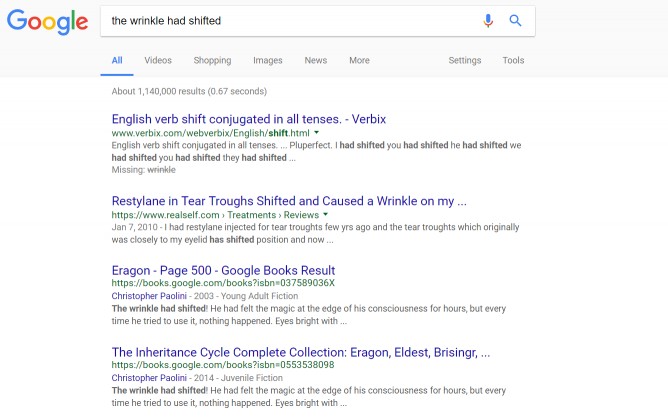
It was dark in Eragon’s cells when he sat up with a start, electrified. The wrinkle had shifted! He had felt the magic at the edge of his consciousness for hours, but every time he tried to use it, nothing happened.

“The wrinkle had shifted”?

That’s such a weird line. I know it means that the drug has worn off, so Eragon isn’t foggy and able to do magic again, but…”wrinkle”? Is there a definition of “wrinkle” that I’ve never heard before? I know I’ve been pretty hard on Eragon, so I wanted to give it the benefit of the doubt. Maybe this was a phrase that people used and I’d never heard before, so I decided to Google it, just to be sure.

wrinkle-had-shifted

Congratulations, Paolini. You might be the first person to ever have the sentence “The wrinkle had shifted” in a published book.

Since a “wrinkle” was never mentioned before, I choose to believe that it refers to the folds in Eragon’s brain that allow him to use magic.

Not surprisingly, Eragon uses magic to break himself out of prison, at the same time Murtagh arrives in disguise to rescue him. But why wasn’t Murtagh also captured along with Eragon? Murtagh is wanted by the Empire, and it was his appearance in Gil’ead that led to Eragon’s capture. How did Murtagh get away? If it was due to Saphira’s intervention, why would she save Murtagh, and not her Rider?

What if Murtagh had been captured, and not Eragon? Eragon and Saphira could have some conflicts about risking themselves to save him, especially when he’s kept so much of his past a secret. There could have been a dilemma that wasn’t solved with swords or magic, something this book has been severely lacking.

But the plot marches ever-forward, and soon Eragon and Murtagh are rushing off to save Arya. When they find her, there’s another paragraph talking about how beautiful she is, and that she smells like pine needles. Wait, what? She’s been imprisoned and tortured for months. She shouldn’t smell nice. She should smell like iron and blood and…well, maybe elves’ sweat smells like pine needles. That’s the only thing that makes sense to me.

The most exciting part of this chapter is when Eragon duels the Shade, Durza, to try to cover Murtagh’s escape with Arya. We’ve seen Durza use magic in the prologue, but it didn’t have a lot of impact on the reader’s view of him, because we knew so little about what was going on. When Eragon and Durza engage in a sword fight, we know what’s at stake. We also have something to compare Durza to. We know that Eragon’s a gifted swordsman, but Durza is toying with him when they fight. There’s a huge gap between their skills, and so their fight is actually interesting to read, knowing Eragon is likely to lose.

The day is saved by Saphira, who ends up landing on the prison and destroying it. Normally I’m not a fan of the “Big Damn Heroes” trope, with the characters arriving right in the nick of time to save everyone. In this case I’ll forgive it, because Saphira is one of the few reasons I’ve managed to keep reading this book.

My first complaint about the next chapter, “A Warrior and a Healer”, was the abundant use of adverbs. The one that struck me as the laziest was Eragon “tiredly” healing one of Saphira’s wounds after their escape from Gil’ead.

Eragon also brings up that elves speak the Ancient Language, and most of them can use magic. This still brings me back to the question I had many chapters ago: how do elves have a conversation without casting spells and lighting everything on fire? This book goes into detail on so many things I don’t care about and have no impact on the story, but still has yet to answer that one question.

As Eragon, et. al. flee from Gil’ead, Murtagh tells him that the Urgals and Durza were working for Galby. No shit. Even as a kid, I knew that would be the case. The obvious bad guys are working for the bigger bad guy. This is just how the hierarchy of villainy works. I wasn’t shocked then, and I wasn’t shocked now.

I am, perhaps, a little more shocked and disappointed by Saphira’s explanation of all this.

A sick, angry feeling welled in his stomach. ‘The Urgals were under Galbatorix’s orders! Why would he commit such an atrocity on his own subjects?’

‘Because he is evil,’ stated Saphira flatly.

not good enough.gif

From Saphira’s perspective, this makes perfect sense. However, this is one of the big problems I have with the Inheritance series. Galby is evil because he’s crazy, and…well, that’s it. The antagonist who is evil for the sake of being evil is just a lousy villain. There’s no greater depth to them, no chance for them to be sympathetic or intriguing. If your only descriptor is “evil”, you’re not just a flat character. You’re boring and indistinguishable from the multitude of bland, oh-so-evil forgotten baddies.

After Eragon learns the not-so-shocking truth about the Urgals and Durza, he sets about to healing Arya. Paolini spends two paragraphs describing her wounds: back covered with bruises, oozing cuts, marks from whips and hot brands. Credit where it’s due: the description of Arya’s wounds is pretty horrifying, especially when you add in the fact she’s probably been tortured daily for months. So, nice one, Paolini.

But we still can’t go one chapter without mentioning how beautiful the elf is, even after she’s been brutally tortured.

[H]e could not help but notice that underneath the disfiguring marks, her body was exceptionally beautiful.

Ugh.


Eragon 35: Helgrinding Through

And we keep plunging into the literary abyss that is Eragon. But this chapter was much better than the past few because–wait for it–something actually happens!

The chapter, “Worshipers of Helgrind” starts with Eragon going out to explore the city of Dras-Leona. The chapter title comes from the citizens of Dras-Leona, who worship Helgrind, the mountain that looms above the city.

Does anyone else think that the name “Helgrind” is just a little too on the nose?

While he’s wandering through the city, Eragon finds a slave auction. He plans to use magic to free a slave that’s being bid on, but realizes that the slave would never be able to escape. So finally, finally, Eragon has learned something. He realizes that he can’t save everyone, but if he fights against the Empire, he can help a lot of people. I’m not sure if I would call this a proper turning point for his character, as he’s never wanted to join the Empire. But at least it’s something.

Going back to the “Galby is a terrible autocrat” theory, sending the Ra’zac to capture Eragon and kill his family might be the worst possible way to get Eragon on his side. It’s a great way to ensure that a unique and soon-to-be very powerful young man hates you. Why couldn’t Galby start with something more appealing: “Join me, I’ll make you a king. You’ll have power and gold and your family will be safe.” That would be a much more interesting–and challenging–test of Eragon’s character.

Back to the matter at hand, Eragon visits a cathedral in the city.  I am actually curious about what Eragon believes in. Religion was never mentioned prior to Eragon and Brom arriving in Dras-Leona, so I’m curious as to what sort of faith they have, if any. When Eragon pays his respects in the cathedral, it’s not to any god (or Helgrind), but to the cathedral and its impressive architechture.

But remember when I promised that something happened in this chapter?

Something finally happens! When Eragon goes to leave the cathedral, the Ra’zac are standing in the entrance.

Now, since it’s been far too long since I’ve made fun of a single sentence…

A sibilant hiss came from the smaller Ra’zac.

I would like to nominate “sibilant hiss” as the most redundant phrase of the book so far.

He had chased the Ra’zac for so many weeks that the pain of their muderous deed had dulled withinin him. But his vengeance was at hand. His wrath exploded like a volcano[.]

I shit you not, I laughed outloud. There must be a way to do purple prose so it’s not so unintetionally funny. This isn’t it.

Eragon does try to fight the Ra’zac, but they’ve got the city guards backing them, and he’s outnumbered. When he finally gets in touch with Saphira (and through her, Brom), they agree that they’re outnumbered* and need to flee the city. They ride as far from the city as they can in the night and set up camp. Not long after they set up camp, Eragon falls unconscious.

He falls unconscious a lot. Let’s see…I think that’s four times so far. And, glancing ahead, it’s going to happen a few more times before the book is finished. It’s gotten to the point where it’s no longer dramatic, and Eragon is more reminiscent of a fragile anime girl or flimsy romantic heroine than a badass Dragon Rider. I’m not really a fan of the constantly fainting character anymore. I first noticed this in the Hunger Games series. Whenever Eragon (or Katniss) faints, when (s)he comes to, there’s someone ready to explain what happened while (s)he was out, instead of the character experiencing it and narrating it for themselves. The literal definition of telling rather than showing. In the cases of Eragon fainting because he used magic that took a lot of energy, it makes sense. But it just keeps happening over and over again, and no longer cares the suspense that it should.

*Outgunned, outmanned, outnumbered, outplanned