March 2025 Book Recs: Women’s History Month

Without in any way limiting the author’s exclusive rights under copyright, any use of this publication to “train” generative artificial intelligence (AI) technologies to generate text is expressly prohibited. The author reserves all rights to license uses of this work for generative AI training and development of machine learning language models


March is Women’s History Month in the U.S.! Women’s History Month began in California in 1978 as “Women’s History Week.” It was kicked off the week of March 8, International Women’s Day. In 1987, Congress designated March as Women’s History Month. It’s kind of crazy to me that Women’s History Month isn’t even 40 years old yet! 

Women’s History Month is a time to celebrate the achievements and contributions of women that have often been left out of history books. It’s also a time to celebrate the women and girls leading us into the future. 

Quick note: There won’t be a book list for April, but you’ll be getting extra for May.

Nonfiction
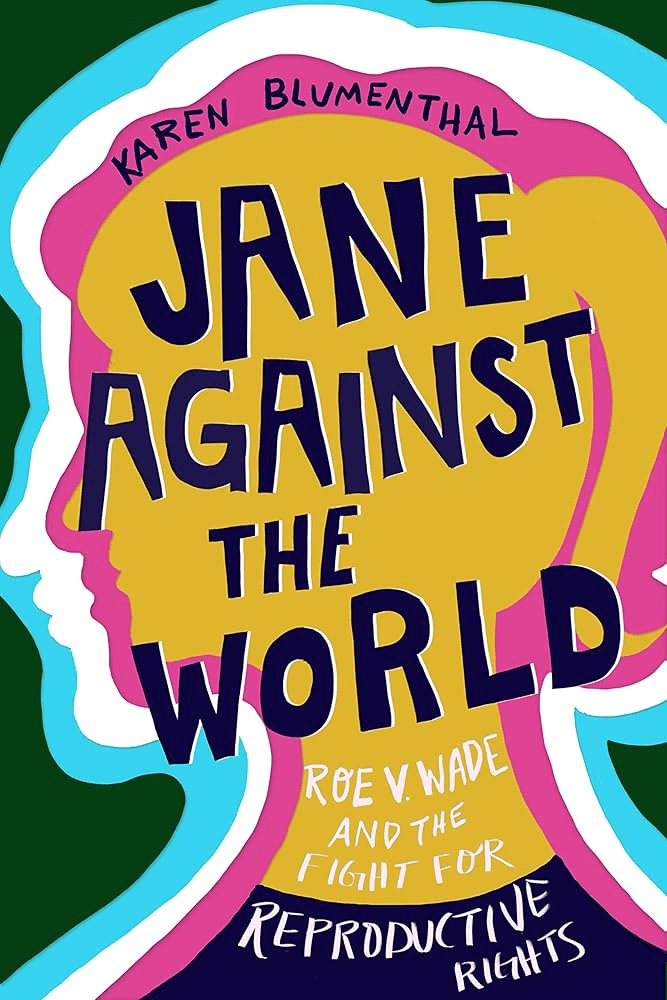
Jane Against the World: Roe v. Wade and the Fight for Reproductive Rights by Karen Blumenthal 

I can think of no topic that’s as controversial or ignites as many passionate debates than abortion. But how did we get here? How did women get abortions and reproductive care before Roe vs. Wade? And what comes after it? Jane Against the World looks at the history of abortion and birth control in the United States, reform and repeals, and Roe vs. Wade. The book is broken into four parts. Restrictions is dedicated to the history of abortion and abortion providers in the United States from the 1800s to the 1960s, and highlights the Comstock Act of 1873, about which much debate has arisen following the Dobbs vs. Jackson Women’s Health Organization in 2022. Reform covers reform of abortion laws, legal gray areas of performing abortions, and the beginnings of the pro-life movement, and the road to Roe v. Wade. In part 3, Roe v. Wade, Blumenthal breaks down the complex case in a way that every reader can understand, and goes into detail on court memos, opinions, especially Justice Harry Blackmum’s contribution to the Court’s decision. After Roe chronicles the pushback against Roe v. Wade, including violence against abortion providers and laws that restrict abortion at the state level. Written in 2019 and published in 2020, this book does not include the Dobbs decision that overturned Roe in 2022. While abortion is not an easy topic to read about or discuss, it’s very important to understand how we got to where we are today. 

Fiction

When the Mapou Sings by Nadine Pinede


This novel in verse begins in 1936, two years after the United States ended its occupation of Haiti. While things are still dangerous for those who would speak up against the government, Lucille and her best friend Fifina have big plans of their own. Hungry for knowledge, they dream of opening up a school for girls. Lucille’s world crashes down around her when Fifina’s father is imprisoned, Fifina disappears, and Lucille’s beloved Mapou tree is cut down by the section chief. After receiving a dream from the Mapou, Lucille confronts the section chief, hoping to find Fifina. This act of defiance puts her and her family in danger, and Lucille is forced to leave her home. She works first as a maid for a wealthy Haitian woman, and then for an American woman in Haiti for research. Lucille doesn’t know quite what to make of Mamzelle Hurston, but the two develop a special bond during their time together. Working for Mamzelle Hurston opens up new doors for Lucille, even though it may lead her into danger and hard decisions. This is a fictionalized account of the real servant of Zora Neale Hurston during the time Hurston lived in Haiti, working on Their Eyes Were Watching God. Fictionalizing real people can be a touchy subject, but the setting and themes are thought-provoking. While I thought the ending tied things up just a little too neatly, I wanted to highlight this book because it takes place during a unique time in history which gets very little attention.

March Book Recs: The Troubles

March is Women’s History Month, and it’s also Irish Heritage Month! I’ve decided to combine both of those things for this list. Media often show stereotypical depictions of the Irish, flattening an entire culture into a few jokes about alcoholism and leprechauns. Like millions of Americans, I have Irish heritage, and these depictions have always irked me. 

One part of Irish history that has long been close to my heart is The Troubles. The Troubles were 30 year period of political and sectarian violence between Unionists and loyalists (mostly Ulster Protestants) who wanted Northern Ireland to remain part of the U.K., and Irish nationalists and republicans (mostly Irish Catholic) who wanted Northern Ireland to join the Republic of Ireland. The Troubles officially came to an end with the 1998 Good Friday Agreement, which ended much of the violence in Northern Ireland. But my personal connection with The Troubles isn’t just from my Irish-Catholic heritage or watching the show Derry Girls. In the early 2000s, my family hosted a girl from Derry for three summers. Those were the best summer vacations I’d ever have. My mom described them as “a six-week sleepover.” While our guest did talk about some of the violence she and her family experienced, my memories of her and our summers together are full of laughter, dares, and the filthiest jokes I’d ever heard. 

For the March recommendation list, I’ve chosen two books where The Troubles play a central role in the lives of women. These are both great as audiobooks. Other than the readers’ lovely Irish accents, you’ll also be able to hear the correct pronunciation of Irish words.

Nonfiction

Thin Places: A Natural History of Healing and Home by Kerri ní Dochartaigh

Kerri ní Dochartaigh was born in Derry halfway through The Troubles to a Protestant father and Catholic mother. She lost two homes in the span of one year, once due to a petrol bomb, and once due to harassment. To escape the violence in Derry, she found solace in the natural world, in her cement-filled backyard and “thin places” where the Veil between this world and the spiritual one is thin. ní Dochartaigh’s memoir is one of great sadness as she writes about the emotional scars that have shaped her entire life. Yet there is great beauty to be found in it as well, as she tenderly writes about her beloved thin places, the endangered Irish language, the resiliency of moths, and what it means to be an Irish woman. She also discusses violence in Northern Ireland following Brexit, and what she fears and hopes for Derry, the city she loves and hates. Often heartbreaking, Thin Places is a gorgeously written meditation on loss, trauma, and healing. 

Fiction

Factory Girls by Michelle Gallen

It’s 1994, and smart-mouthed Maeve cannot wait to get out of her small town in Northern Ireland and start studying journalism in London. She and her friends Caroline and Aoife must first get their exam results to confirm their places in their chosen universities. To save up for their futures, the three young women get jobs in the local shirt factory for the summer. The job brings new challenges Maeve has never faced before: ironing 100 shirts a day, working alongside Protestants for the first time, and avoiding the advances of the factory’s lecherous English owner, Andy Strawbridge. Tensions rise between the Catholic and Protestant workers whenever there’s a bombing or murder, which occurs all too frequently. As the summer goes on, Maeve starts to realize that there is something going on behind the scenes at the factory, but standing up for herself and her friends could cost her dearly. Flashbacks show Maeve’s experiences growing up during The Troubles, including the death of her elder sister and bombings that were called “lucky” because everyone survived. As a slice-of-life novel, the plot can feel thin at times. However, Maeve’s narration and snappy dialogue is laugh-out-loud funny, and watching her and her friends find their path to adulthood is satisfying. Though the main characters are teenagers, frequent sexual references make this a book better suited to an adult audience.