Read with Pride: June Book Recommendations

Before we get into June’s book recommendations, I just want to let everyone know that there won’t be a book list for July, and possibly not one for August. As a children’s librarian, summer is my busiest time of the year. Much as I wanted to create a book recommendation list for every month this year, I’m a little overwhelmed right now and it’s just not in the cards. 

June is my favorite month for many reasons: my birthday, the start of summer, and many good memories I have of school ending. June is also  Pride Month! First established in 1999, Pride Month commemorates the 1969 Stonewall Riots that are often used to mark the beginning of the gay rights movement in the United States. LGBTQIA+ rights have come a long way since then, but it is still an uphill battle, particularly for the trans and nonbinary community. 

I live in Florida, which has passed extreme anti-LGBTQIA+ laws, including the infamous “Don’t Say Gay” law (which recently was extended to eighth grade); HB 1521, which regulates bathroom use; and SB 245, which bans gender-affirming care for trans minors and allows the state to remove children from their families if they receive gender-affirming care.  The Human Rights Campaign, the largest LGBTQIA+ group in the U.S., has even issued a travel advisory for  individuals traveling to Florida.

I am obviously disgusted and enraged by the bigotry and cruelty present in these new laws, and my heart breaks for the trans and nonbinary community. I often feel frustrated and small, and that there should have been something more I could have done to stop this from happening. 

One way I can fight back is through my job. I’m a public librarian, which means that (for now) I don’t have the same restrictions on talking about gender and orientation as school staff do. At the time of this writing, public libraries also don’t have the same restrictions on what books people can have access to. I take my job very seriously. I feel that I have a responsibility to help fill the gaps that kids and teens no longer have easy access to. 

I do a lot of the ordering for YA books at my library, and I’m really pleased to see that there is a lot more LGBTQIA+ representation than there has been in the past. Certainly much more than when I was a teen, and more positive representation as well! Queer and non-binary characters are no longer relegated to being one-off jokes, side-kicks, or dying gruesomely, but are fully realized characters whose orientation or gender identity does not define them. 

There are still many areas where LGBTQIA+ fiction is lacking. For example, I’ve come across way more books about trans boys than trans girls, and very few books have asexual characters as the lead. Also, the majority of LGBTQIA+ fiction I come across is contemporary romance. I think all of these things will improve with time, but it’s the last one I want to talk about right now. There’s nothing wrong with contemporary romance, of course, though it’s not my favorite thing to read. There still isn’t a large amount LGBTQIA+ representation in genre fiction (though it’s improving!), which is disappointing. Queer and nonbinary individuals should still be able to see themselves in their favorite genres – historical, fantasy, sci-fi…and yes, even contemporary romance, if you insist. 

For the fiction half of this list, I’m focusing on genre fiction. Because you know what’s better than two boys finding true love? Two boys finding true love IN SPACE!

Nonfiction

This Book is Gay by Juno Dawson

This Book is Gay has the honor of being one of the most challenged books in the U.S. for two years running, for “LGBTQIA+ content” and “providing sex education.” Dawson’s book seeks to educate both queer and straight teens on same-sex relationships, including the physical aspects of those relationships. But sex is far from the only thing this book covers. It’s got everything from coming out, dating apps, discussions of queer culture, and the downsides of being LGBTQIA+. The breezy, upbeat writing is frequently witty and always informative, and black and white cartoons add humor into even the hardest topics the book covers, like harassment and discrimination. But I honestly can’t describe this book any better than the summary itself: “There’s a long-running joke that, after coming out as a lesbian, gay, bisexual, transgender, or intersex person, you should receive a membership card and instruction manual. This is that instruction manual. You’re welcome.” 

The Invisible Orientation: An Introduction to Asexuality by Julie Sondra Decker

While there is much better queer representation in the media today, asexuality is an orientation that often gets left out. It’s also frequently misunderstood, or treated as a joke. Because of this, it can be difficult for someone on the asexual spectrum to understand their orientation or have it be taken seriously.  It can be a huge relief to find the right word to describe yourself, and know that you’re not the only one who feels this way. The Invisible Orientation discusses asexuality and other ace-spectrum orientations, while emphasizing fluidity and that asexuality can change over time. It also addresses myths about asexuality, that being asexual is healthy and not the result of a physical or mental illness, and includes a chapter for friends and family of asexual people. I’ve known for awhile now that I’m on the ace spectrum, and while the label doesn’t matter to me much anymore, seeing myself in this book made me feel validated in a way I’d never been. 

Say it with me: we’re here, we’re queer, we don’t wanna touch your rear!

Gender Queer: A Memoir by Maia Kobabe

You’ve probably heard of Gender Queer before: maybe because it’s a Stonewall Honor Book, or maybe because it’s been the most frequently challenged book in the U.S. for the past two years. Gender Queer is a graphic novel that chronicles Maia Kobabe’s (e/eir/em) journey from childhood to adulthood, as e discovers eirself as nonbinary and asexual. The book starts in Maia’s childhood, and covers eir confusion about eir orientation, gender identity, and dating. Even after Maia discovers that e is gender queer, eir journey continues with coming out to friends and family, changing pronouns, and coming into eir own as a nonbinary person. This is a great choice for older teens and adults who are nonbinary, or seek to understand what it means to be nonbinary. 

The 57 Bus by Dashka Slater

Richard and Sasha’s paths probably would have never crossed if not for the 57 bus, which runs between Sasha’s middle class home Oakland’s foothills, and Richard’s crime-riddled community in the flatlands. Agender teen Sasha fell asleep on the bus, and woke to find their skirt in flames. The fire was set by Richard, and left Sasha with severe burns. Sasha’s recovery would require a lengthy hospital stay, multiple surgeries, and months of follow-up treatments. Richard was arrested and charged with two felonies and two hate crimes, potentially facing life in prison. The 57 Bus tells both Sasha’s and Richard’s stories: Sasha’s love of language and all things Russian, discovering their gender identity, and life after a devastating attack; Richard as a troubled kid trying to turn his life around, despite many obstacles. The book examines prejudice, discrimination, and even danger faced by  individuals, as well as the injustices of the juvenile justice system. 

Queerstory: An Infographic History of the Fight for LGBTQ+ Rights, published by Tiller Press, with forward by Linda Riley.

Queer history in the United States didn’t begin with Stonewall, and it didn’t end with the legalization of same-sex marriage. You can find a number of books about LGBTQIA+ history – especially if you’re looking for information about Stonewall or the AIDS Crisis – but sometimes it’s hard to know where to start. If you’re just looking for a quick overview of the LGBTQIA+ rights movement, a jumping-off point for more in-depth learning, or a very colorful way to learn queer history, then Queerstory will not disappoint. Loaded with illustrations, timelines, brief biographies, and facts, Queerstory presents LGBTQIA+ history in a visually appealing and digestible way. While not as in-depth as other books on queer history, the colorful presentation and infographic format add a splash of fun into what is often a weighty topic.

Fiction

Summer Bird Blue by Akemi Dawn Bowman

Lea wasn’t just Rumi’s sister. Lea was Rumi’s best friend, the other half of her soul. Writing songs with her was one of the greatest joys of Rumi’s life. Lea understood Rumi in a way that no one else did, like how Rumi felt left behind when her friends started dating and she just doesn’t understand why romance has to be such a big deal for everyone but her. When Lea is killed in an accident, Rumi is lost, unsure of what to do with her life without her sister in it. Her distant mother, consumed by grief, sends Rumi from their home in Washington to live with her aunt in Hawaii. Rumi navigates her grief, survivor’s guilt, and deep rage over her sister’s death and mother’s abandonment, while trying to understand her asexuality and complete the last song she and Lea would ever write together. At first, she wants nothing to do with Hawaii or her new neighbors – Kai, the cheerful boy next door, and the curmudgeonly Mr. Watanabe. But maybe, with their help, she can find her way back to the music that she once loved so much. 

Dreadnought by April Daniels

Danny Tozer has known for a long time that she’s a girl, even if she has a boy’s body. She’s afraid to come out as trans, but her secret’s out when the world’s greatest superhero, Dreadnought, falls out of the sky. Dying, Dreadnought transfers his superpowers to Danny, giving her super strength, flight, and the body she always wanted. Transitioning suddenly and gaining superpowers makes life a little complicated: Danny’s vitriolic and verbally abusive father is looking for a way to “cure” her; the Legion Pacifica of superheroes are in disagreement if Danny should be the new Dreadnought; even Danny’s best friend has abandoned her. “Caping” with fellow superhero Calamity helps Danny escape from her civilian troubles. The girls start small, but Danny is determined to track down Utopia, the super villain who killed Dreadnought. Danny doesn’t feel that she deserves the gift that he gave her, and this is how she can repay him. Yet as her journey as a trans girl and a superhero go on, she comes to understand that she deserves Dreadnought’s mantle – and more – as much as he did. 

Last Night at the Telegraph Club by Melinda Lo

It’s 1954, and seventeen-year-old Lily struggles to find a place where she belongs. While other girls her age are worrying about boys, Lily instead dreams of working at the Jet Propulsion Lab, like her aunt. She and her classmate Kath connect over an ad for a male impersonator at the lesbian bar, The Telegraph Club, and both girls’ lives are forever changed.  Lily gradually realizes she is a lesbian and falls in love with Kath, but following her heart is a huge risk. McCarthyism is in full-swing, and Chinese-Americans like Lily and her family could face deportation if they are accused of being Communist sympathizers. Being a lesbian only adds to the danger.  Lily learns how to switch between ostensibly straight, Chinatown Lily and Telegraph Club Lily. But when the two halves of her life collide, she will have a difficult choice to make that will change everything. 

The Darkness Outside Us by Eliot Schrefer

Ambrose Cusk wakes to find himself in space, but he has no memory of a launch. Apparently, he was injured in an accident at launch and has been in a coma for weeks. Even so, Ambrose remembers his mission clearly: he is being sent to Saturn’s moon, Titan, to rescue his sister. He’s also surprised to find that he is not alone on the ship. Spacefarer Kodiak Celius is from Demokratia, the country locked in a cold war with Ambrose’s home country, Federacion. At first Kodiak keeps his distance, but Ambrose gradually draws him out of his chosen seclusion. As their journey progresses, both boys discover that there’s something sinister happening on board. Why can’t they get in touch with mission control? Is the ship’s AI telling them the truth about Ambrose’s sister? These two sworn enemies must work together to discover the deadly secrets being kept hidden from them, at the same time coming to understand each other in the stark isolation of outer space. 

On a personal note, I recommend that you don’t read this on your lunch break at work. Once your break is over you’ll have to go back to work and try to be normal and not act like you’ve just been emotionally destroyed at the hands of a paperback. 

The Sunbearer Trials by Aiden Thomas

In the beginning, Sol and Tierra made the gods: the “powerful but vain” Golds, the “kind but focused” Jades, and the “passionate but selfish” Obsidians. But Sol and Tierra loved humans the most, and the jealous Obsidians turned them into mindless slaves. Sol sacrificed their body to protect humans, leaving the Sun Stones behind. Every ten years, the Sunbearer Trials are held, in which the children of the gods, or semidioses, compete to be chosen as the Sunbearer who will rekindle the Sun Stones. The loser of the trials has the dubious honor of being sacrificed to fuel them for another decade. Teo, the trans son of the goddess of birds, has no interest in the Trials. As a Jade surrounded by more talented Gold peers, he’s certain he’ll never be picked. But he and his best friend, Niya, must both compete against each other in the Trials, alongside Aurelio, Teo’s old friend turned enemy. Then there’s Xio, the thirteen-year-old trans son of the god of bad luck. No matter the outcome, Teo and Niya are determined to protect Xio from being sacrificed. The Hunger Games meets Mexican mythology in a lush, queer positive fantasy.

#1000BlackGirlBooks: Hallway Diaries

Now that I’ve finished my exploration into the NYT best seller’s list, I’ll be going back to some of my regular content. I still have posts drafted for #1000BlackGirlBooks and Books I Didn’t Pick, and I have a few other book reviews planned as well.

But for now, let’s pick up where we left off with Hallway Diaries.

Hallway Diaries is composed of three novellas, each of which stars a Black girl in high school. Friendships, romance, and drama are inevitable in these slice-of-life stories. It was published in 2007 by Kimani TRU, and imprint of Harlequin Enterprises. The front page welcomes us:

Dear reader,

What you’re holding is very special. Something fresh, new, and true to your unique experience as a young African-American! We are proud to introduce a new fiction imprint–Kimani TRU. You’ll find Kimani TRU speaks to the triumphs, problems and concerns of today’s black teens with candor, wit, and realism. The stories are told from your perspective and in your voice.

But before we get into each of them, I want to talk about the physical book itself. I know, I know, we’re not supposed to judge books by their covers, but that’s exactly what I’m about to do.

I want to start with the back of the book, which has summaries for each of the three stories.

How To Be Down by Felicia Pride When Nina Parker decides to straighten her Afro, lose her valley-girl accent and get a total makeover for her new school in the hood, the cutest guy notices—yes! But so does the meanest girl, Vivica, queen bee of her crew, who wants Jeffrey for herself.

Double Act by Debbie Rigaud

In the hood, Mia Chambers is ‘the smart girl,’ but at her prestigious new prep school she hardly stands out. So Mia does what it takes— only to be accused of selling out by her old friends!

The Summer She Learned To Dance by Karen Valentin

At first, Giselle Johnson hates spending the summer with her cousin from the Dominican Republic. But she soon starts loving the island and even learns to dance to her own rhythm. That is, until her cousin attracts Giselle’s high school crush…

These descriptions make these novellas sound like “mean girl” stories, but that’s a big misrepresentation of what they actually are. Take the summary for How to be Down. It sounds like two girls fighting for the affection of a boy. That is part of the story – but not the whole thing. It’s really a story about Nina trying to fit in at a new school, and Vivica’s insecurities about her own racial identity. I can only assume that these descriptions were written to attract readers to buy the book, even if it’s misleading.

Now I want to talk about the cover.

I don’t think that these models are meant to represent any of the characters in the books, but I noticed something: everyone has relatively light skin on the cover, even the Black models. And I think that’s a bit weird, considering the publisher is trying to give Black teens stories that feel authentic and relevant to their lives.

To be honest, this is something I probably wouldn’t have noticed until a couple years ago. Today, I can see that it smacks of colorism.

Colorism is, essentially, a preference for people with lighter-colored skin, even among BIPOC. The term has been made more mainstream in the past couple years, especially following the release of the film In the Heights. The movie was criticized for featuring mainly light-skin Latinx actors, and not being representative of the Afro-Latinx community.

Colorism wasn’t something that was even on my radar for a long time, but once you start noticing it, you can’t stop. You can see it everywhere, from advertisements to entertainment, and, of course, book covers. This is not to say that Hallway Diaries is a bad book. But the cover, like the summaries, is misrepresentative of the book itself. I think both the back and front covers were deliberately misleading to sell more copies. It makes sense from a marketing standpoint, but it does annoy me. For anyone actually looking for mean girl love triangle stories, the reality of this book could be a huge disappointment.

But we’re not here to judge books solely on their covers (and/or marketing strategies), so let’s get into the novellas themselves. I’ll start off with a few more accurate summaries:

How To Be Down by Felicia Pride: Nina has just moved from her mostly-White hometown to Baltimore. She has a frenemy in Vivica, who calls Nina a White girl in a Black girl’s body. Vivica is insecure in her own racial identity, as she is half-Black, and half-Latinx. Tensions between Nina and Vivica explode during a school slam poetry competition.

Double Act by Debbie Rigaud: Mia leaves her old school and beloved Double-Dutch team to transfer to a new, mostly White high school. She struggles to fit in, but when she feels like she finally has a place, her old friends accuse her of forgetting where she comes from.

The Summer She Learned How to Dance by Karen Valentin: Giselle wants to connect with her late mother’s side of the family but isn’t sure how. She finally gets her chance when her cousin, Juanita, comes from the Dominican Republic to visit for the summer. However, Giselle finds Juanita embarrassing and wants nothing to do with her.

As I read these novellas, a common theme emerged: duality. I mentioned this a bit in my post about The Hate U Give, in which the protagonist often feels like she’s living in two different worlds.

In each of these stories, the girls find themselves being pulled in two different directions when life deals them an unexpected hand. All three have happy endings: Nina and Vivica learn to love themselves as they are; Mia manages to play piano in the school play and jump in the final Double-Dutch competition; Giselle embraces her cousin and learns more about herself and her family.

I don’t think there’s anything wrong with happy endings like this. These were just light, fun stories and the message works for any teenagers reading them, particularly girls. To thine own self be true, make new friends but keep the old, be open-minded and you’ll be rewarded.

However, race can’t be ignored in these novellas. Boiling them down to a few pithy morals cheapens the meaning of the stories. The girls in these stories go through things most teenagers do: they need to figure out who they are in changing circumstances. This is hard enough, but they also must incorporate their racial identity into this journey of self-discovery.

Which brings me to my next point: the importance of representation.

When I was an teenager asking myself, “who am I?” I never had to worry if I was acting “White enough” or felt like I had to represent my race. Growing up, almost everyone I knew was White, and I never was made to feel like I didn’t belong among my classmates or relatives because of my race. Why would I, when almost all of us were the same race?

While I’ve known for a long time that representation in media was important, I rarely felt the impact when a show or a movie lacked diversity. Sure, I’d get annoyed at the way women were often treated in movies and TV shows, but I didn’t really understand on an emotional level the importance of representation for other minority groups.

Then I started playing a game called 2064: Read Only Memories. It’s a point-and-click cyberpunk adventure game, where you play as a journalist who teams up with the world’s first A.I., Turing. I was pretty excited when I started playing and saw that you could pick your character’s pronouns. Not just she/her, he/him, they/them, but also pronouns like zi/zie, hir, ve/ver, and many others that I had never heard of before. Early on in the game you’re introduced to your sister’s ex, who is another woman. One of my favorite characters in the game was TOMCAT, who goes by they/them. They majority of the characters, from main characters to minor ones, were queer, non-binary, or both. I have no problem with that — I thought it was really cool that there was a game that featured so many characters who ran the gamut of genders and sexualities.

But as I played through the game, I found myself getting weirdly annoyed. I caught myself thinking, “Isn’t there just one cishet character?!”

With a shock, I realized that this must be what queer and non-binary people feel like all the time.

I’ve had other moments like that since, but that was the first, and it was eye-opening. Like with colorism, once you start noticing the importance of representation in media, you can’t un-notice it. I remember working with a group of middle school girls talking about The Force Awakens, excited to finally see a woman as a Jedi. A friend of mine who’s a first generation immigrant who never saw herself represented in media until she heard “Breathe” from In the Heights. Another friend who’s bisexual and was excited to see that Disney’s Loki is, too.

I’m really glad that there is more representation for BIPOC and LGBTQAI+ individuals. I also think that there’s still a great deal of work to do in that regard, especially when it comes to representing people with disabilities, along with religious diversity. However, I’m so excited to see books, TV shows, and movies with a diverse cast of characters. We’ve come a long way – and we’ve got a long way to go still.

Now, I’ve got to be honest about one thing: I didn’t really like Hallway Diaries. Someone my age wasn’t the target audience, but even as a teen, I wouldn’t have had much interest in it. Teen drama just isn’t my thing, even when I was a teenager. However, I hope that this book, and others from Kimani TRU found the right person for them. I hope there are teenage girls out there who read this book, and other books like it, and finally felt seen.

52 Books in 52 Weeks: Best Sellers & Diversity

This is the final post in my 52 Books project, and it covers an enormous topic: diversity in youth literature.

This is a hugely important topic to me. I didn’t grow up in an area with a lot of diversity of race, religion, or otherwise. Like many small town kids, my window to the wider world came from media: books, TV, and movies. Growing up, my impressions of people who were different from me came from what I saw and read.

But good representation is even more important if you’re part of a group that isn’t depicted frequently in media, or depicted stereotypically. This is especially true for children and teens. Think back to your childhood heroes for a minute. Who did you admire, and why? As I’ve mentioned before, one of my heroes was astronaut Eileen Collins, the first woman to command the Space Shuttle. I followed her career with great interest, dreaming of the day I would be the first person on Mars. While I’m not an astronaut, she inspired a lifelong interest in space, aviation, and most importantly to my current career, STEAM education.

All people, but kids especially, need to see themselves in the books they read or shows they watch. If you can’t see it, you can’t be it.

Things are changing in the publishing industry. Since 1985, the Cooperative Children’s Book Center has kept track of youth literature by and about Black, Indigenous, and People of Color. While we certainly have more BIPOC voices than before, publishing remains White and male dominated. It’s also important to see how many debut writers of color are published each year. Kwame Alexander and Jason Reynolds may top the charts (and with good reason), but one or two voices can’t speak for an entire group of people.

Another reason this is so important for me is because I’m a public librarian in Florida. Florida is one of the most diverse states in the U.S.A., and I live in one of the most diverse counties within that state. Florida is also banning books and removing them from schools left, right, and center. Legislation like the “Don’t Say Gay” law, bans on teaching critical race theory, and even blocking AP African American Studies in schools have forced teachers and school media specialists to go through their libraries and remove books, or risk losing their jobs. I won’t get into all of this right now – that’s another post entirely. But I will say that anti-LGBTQAI+ and removing discussions of race in the classroom is both infuriating, and a disservice to our kids. Kids have the right to information and books, and to learn about the wider world, and politicians are robbing them of that freedom in a reactionary attempt to appeal to their base.

None of these laws target public libraries yet. I feel that I have a responsibility to the kids and families that I work with to keep our collections diverse and inclusive, so every kid can see themselves as heroes and leaders.

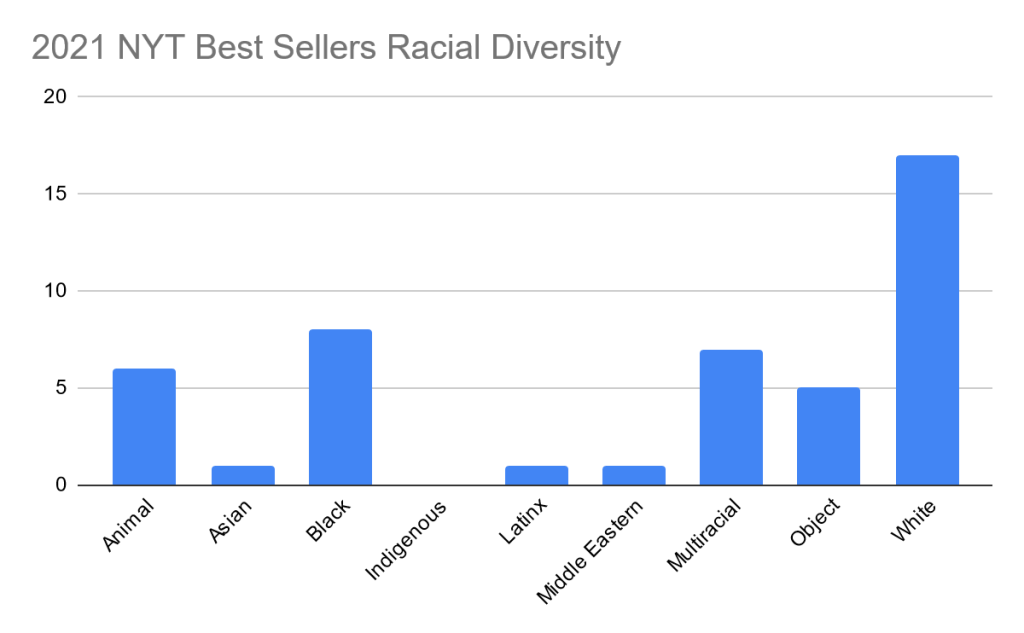
While reading my 52 books, I took note of what racial diversity was present. There are a few ways that I could do this, but I decided to keep track of the main character(s) in each book. They’re who the reader will be spending the most time with, after all. It’s not perfect data, either, but I love a good pie chart. My stats also don’t go into how these characters are depicted. Some books are represented more than once, in the case of multiple lead characters. For example, Ground Zero stars Brandon, who is cued as Latinx, and Reshmina, who is Afghani. For that book, I marked it as both Latinx and Middle-Eastern. Other books that have ensemble casts are marked as “multiracial.” To clarify: I use the term “multiracial” as it refers to race, while “multiethnic” refers to cultural identity. I’ve also included the categories of “animal” and “objects,” since a few books star critters or machines (Dog Man is categorized as “Animal,” btw). Finally, when characters’ races aren’t mentioned, White is the assumed default. Wait, don’t click away! Let me explain:

This is an issue when it comes to reading and writing fiction: if a character’s skin color is not described, most readers picture that character as White. Cover art may support this as well. It’s also really unfair, so for you novelists out there: please describe ALL your characters’ skin tones, not just some of them! The Tumblr Blog Writing With Color is an awesome resource for writing all kinds of skin tones.

Now, let’s get to the data! And if you’re uncomfortable, good. I am too.

I am far from an expert on diversity, equity, and inclusion. I also need to acknowledge that being White, cishet, and middle class, I’m speaking from a point of privilege.

To that end, I’ve started talking to people who aren’t me and have different identities and experiences one simple and important question: “Why does representation in literature matter?” I have already received some very well-thought out and in-depth answers, and I’m looking forward to reading more and sharing responses in a later post.

Until then, there are a plethora of resources online that can help you find multicultural literature, and why #WeNeedDiverseBooks.

National Poetry Month: April Book Recs.

Poetry is an art form close to my heart. I discovered poets like Shel Silverstein, Jack Prelutsky, and Bruce Lansky in early elementary school, and devoured children’s poetry collections. By the time I was ten, I was writing poetry of my own, my first real foray into creative writing. Poetry allowed me to express so many things that I was too shy to say, and in any way that I wanted to say it. While I don’t write poetry as much as I used to, I still love this artistic form. 

April is National Poetry Month, so the non-fiction books are all about writing. The fiction section – in honor of National Poetry Month – are novels in verse (or mostly in verse). 

Now, the usual disclaimer. I am a youth librarian, which means I’m most familiar with books written for young people. This means you’ll see a lot of YA and juvenile books on these lists. If you’re an adult looking for something good to read, don’t feel bad or embarrassed about reading youth books. Juvenile and YA books deal with themes and ideas that are applicable to all ages, even if the text isn’t as challenging as books written for adults. And there’s no age limit on good stories. 

I also want to remind everyone that not every book will appeal to everyone. You may hate a book that I love, and that’s okay. Not liking a book doesn’t mean that the book is bad, it just means that you don’t like it. I’ll try to appeal to a wide range of interests, but I don’t expect for you to love or even be interested in everything on this list. There’s a reader for every book, and every book has a reader. I’d love to help readers and books find each other! 

Nonfiction

Writing Fiction by Janet Burroway

There are a plethora of books that offer writing advice, but the simply titled Writing Fiction by Janet Burroway is my favorite. Each chapter takes you through a different aspect of fiction writing, be it description, plotting, dialogue, characterization, or setting. Every chapter ends with a few short stories that exemplify that chapter’s subject, along with writing exercises to challenge and inspire you. Burroway’s writing style is engaging and she understands well the angst of writing and the fear of the blank page. This is far and away the most useful book on creative writing I’ve ever used. If you’ve ever wanted to take a creative writing class, but can’t seem to fit it into your schedule or your budget, this book is the next best thing.

Putting the Fact in Fantasy edited by Dan Koboldt
Putting the Science in Fiction edited by Dan Koboldt

Most fantasy and sci-fi writers haven’t actually led a cavalry charge against the wicked king or traveled through a wormhole to a new dimension. We might not even know how to ride a horse, or have an understanding of physics beyond Newton’s laws of motion. This is where the research begins. Putting the Fact in Fantasy and Putting the Science in Fiction are collections of essays written by experts to help you bring more accuracy and realism to fantastical worlds. Fact in Fantasy includes essays about history, language, culture, and other survival and adventuring tips (My favorite is “Historically accurate ways to die”). Among other topics, Science in Fiction discusses technology, medicine, robots, space, and the far future. While you’re not going to be an expert, each essay provides a starting point for research, usually with a list of resources that you can use for further research. All writers make mistakes. The goal isn’t to be perfect. It’s to be a little less wrong.

Bird by Bird: Some Instructions on Writing and Life by Anne Lamott

In Bird by Bird, Anne Lamott shares the painful secret to writing that every writer should know: that there is no secret to writing. There’s no magic spell or secret formula for churning out best seller after best seller. The only thing you can do is to sit down, day after day, and write authentically. With humor and personal anecdotes, Lamott tackles characterization, plot, dialogue, and “shitty first drafts.” She also explains how she deals with her own self-doubt, writer’s block, professional jealousy, and learning discipline – things most writers deal with. While this book is intended for novices, there are many gems even seasoned writers can take away from each fantastic and funny chapter. I often turn to my favorite chapter, “Shitty First Drafts” when I’m frustrated with my work. It always gives me a boost and gets my butt back in the chair, working on that writing habit. 

The Making of a Poem: A Norton Anthology of Poetic Forms by Mark Strand

The Making of a Poem is more than an anthology. Each chapter is dedicated to a different poetic form, from ballads and sonnets to haiku and free verse. The chapters begin with an overview of the form, followed by a brief history, such as the sonnet’s Italian roots and its evolution to Shakespeare’s work.  Poems in each chapter feature both “classic” poems, as well as works from contemporary, 20th century poets. Finally, chapters close on an analysis of one of the poems in the chapter, alongside a brief biography of its author. The information and analyses are interesting without being overwhelming, making this great introduction to poetic techniques. 

How to Tell a Story: The Essential Guide to Storytelling from The Moth by Meg Bowles, Catherine Burns, Jenifer Hixson, Sarah Autin Jenness, and Kate Tellers

From astronauts to grandmothers, comedians and that guy sitting next you, everyone has a story. Perhaps no one understands this better than the directors of The Moth, a non-profit ground dedicated to the art of storytelling. You may be familiar with The Moth Radio Hour, in which participants tell true, personal stories of their lives. Some famous Moth storytellers include Neil Gaiman and Elizabeth Gilbert, but people from all walks of life are invited to share their stories on the Moth stage. How to Tell a Story is a guide to help you find stories from your own life, and learn to tell them with aplomb. Those of us who aren’t as keen on public storytelling will still find How to Tell a Story loaded with helpful advice for speaking with confidence, alongside strategies for toasts, eulogies, business presentations and even job interviews. The book is also interspersed with stories from The Moth storytelling programs, including stories from comedian Mike Birbiglia and actor and writer Hasan Minhaj. 

Fiction: 

Shark Girl by Kelly Bingham

Jane Arroway’s life was normal: homework, chores, friends, the occasional trip to the beach. But during an otherwise normal day at the beach, Jane is attacked by a shark. Jane survives the attack, but her right arm is amputated just above the elbow. Her story is broadcast on nation-wide news, and Jane knows that she’s going to be “shark girl” forever. Jane doesn’t want to be famous, and she certainly doesn’t want to be told that she’s “so strong” or “inspirational.” What she wants are all the things she’s lost: her artistic talent, cooking for her family, and not being stared at when she goes to the grocery store. Jane grieves for the things she’s lost and all the ways her life has changed. Gradually, Jane adapts to her new life, and starts planning a future that she thought she’d lost. Come for the shark attack, stay for the character growth. 

The Things She’s Seen by Ambelin and Ezekiel Kwaymullina

Alternative Title: Catching, Teller, Crow

Beth Teller is dead, but she’s not going anywhere. Instead, she’s sticking close to her dad, an Australian detective. He’s the only one who can see or hear Beth, or so she thinks. His grief has made him withdraw from the rest of his family, and Beth’s determined to stay at his side. When he’s sent to a remote town to investigate a mysterious fire, Beth tags along, wanting to help her dad solve the case. Their only witness is a girl who goes by Catching…who can see and talk to Beth. Enigmatic Catching speaks in cryptic verse, talking about “Snatchers” and stolen colors. Beth and her father must decode Catching’s story as they investigate, and reveal hidden truths about this quaint Australian town. The novel, starring Aboriginal girls and written by two Aboriginal authors, reflects on grief, friendship, and the effects of colonialism in Australia.

Red, White, and Whole by Rajani LaRocca

It’s 1983, and Reha wants the same things that all middle-schoolers want: to wear fashionable clothes to birthday parties instead of the dresses her mother makes her, to go to the school dance, to watch MTV and wear lip gloss. What she wants, most of all, is to fit in. But as the only Indian-American in her school, fitting in seems about as out of her grasp as the stars she’s named for. She often feels like she has two lives, and is frustrated by her immigrant parents trying to replace her American values and habits with their Indian ones. When Reha’s mother becomes seriously ill, both of her lives come together to support Reha and her family. The poetry shines with metaphors, and the layered, evolving relationship Reha has with her parents feels authentic and relatable. 

D-39: A Robodog’s Journey by Irene Latham

This isn’t your typical “a girl and her dog” story. The girl lives in a war-torn dystopia, and the dog is a robot. Twelve-year-old Klynt lives with her father on their farm in the midst of a civil war. With schools closed due to the war, Klynt has only her father and six-year-old neighbor Jopa for company. Then D-39 arrives on the farm. D-39 is a robot dog, or “robo” for short, and the only kind of dog left in the Worselands. It’s thought that all real dogs were eradicated after the onset of BrkX plague, carried by dogs, but Klynt knows better. Her mother left years ago to start the K-9 Corridor that helps bring real dogs to safety. Though no one has heard from her mother in years, Klynt believes that she’s still running the K-9 Corridor in the Wilds. Klynt has D-39 for company, bringing her companionship and joy during a time of fear. After the war reaches her home and bombardment destroys the farm, Klynt and Jopa are separated from their families. Klynt, Jopa, and D-39 set out on a treacherous journey to the Wilds to find their families, and a new home. I debated about including this book for this month’s list, as it’s written in prose poetry rather than traditional verse. But it’s a compelling and atmospheric adventure story, with a bit of whimsy, that will keep you turning pages. 

The Snow Fell Three Graves Deep by Allan Wolf

The Donner Party was perhaps the most infamous group of pioneers to travel to California. Snowbound and trapped in the Sierra Nevada mountains, the surviving members of the group resorted to cannibalism to keep themselves alive. While it’s certainly a fascinating – and horrifying – part of their story, it was not the only trouble they faced. The Snow Fell Three Graves Deep gives voice to these misguided pioneers, whose decisions led to disaster. The book is narrated by Hunger, which stalked the Donner’s wagons long before they reached the Sierras. Members of the Donner Party also tell their own stories in evocative verse: Young Patty Reed; George Donner’s wife, Tamzene; the Miwok Guides who tried to lead the Donners through the mountains; even the oxen, pulling their heavy loads. The book is historical fiction, with an incredible amount of research behind each word. The real-life people the book is based on are portrayed with respect and sympathy, and invite us to re-think our judgements of the Donner Party. Author’s notes in the back give select biographies of some of the real-life characters, notes about the decisions and creative liberties he took in writing the book, much more information on the real Donner Party, and resources for those hungry to learn more. Pun intended.

52 Books in 52(ish) Weeks Part 3: Surprise and Unsurprise

Apologies for the delay in this post! I was celebrating my Irish pride over the weekend and simply forgot. This week, I’m continuing my journey of reading youth books off the New York Times best seller lists.

As I read through all these books, there were some things that surprised me, but probably shouldn’t have, if I had thought about them for more than a few minutes. Then there was some stuff that did surprise me. Thankfully, it was usually a pleasant surprise.

Things That Surprised Me (But Shouldn’t Have)

Picture books come in series, too.

When I think of book series, I usually think of YA books and early chapter books, not picture books. I don’t know why I was surprised when I saw more books starring Little Blue Truck, the Very Hungry Caterpillar, and Pete the cat. I had plenty of different picture books as a child featuring the same characters over and over again (Madeline and Corduroy were my favorites). It just makes sense: kids can get excited to see their favorites again and again, in different stories, and the creator typically has commercial success.

In picture books, the illustrations are not just decorations.

When I read picture books, my focus goes naturally towards the words. This is probably some awful side-effect of being an adult. In some picture books, like ones for older children, this is fine: the illustrations enhance the story, but the story can be understood without it. But in many others, illustrations are as much a part of the story as the text is. If you ignore the illustrations, or only give them a glancing look, you can miss a lot of the story, as well as some of the best jokes. There are also many wonderful wordless (or very nearly wordless) picture books out there that I love. My favorite picture books are the ones where you need text and illustrations to tell a complete story.

Books are cyclical.

This is another one I should have seen coming. It didn’t surprise me to see holiday books top the list when they were in season. But it did surprise me to see the same holiday books come up again in the following year’s list, continuing on until 2023. I found out recently that this is true for YA books, as well as picture books. In 2022, Long Live the Pumpkin Queen, by Shea Ernshaw, made it onto the Best Seller list just before Halloween. Are these new holiday classics? Time will tell.

Things that Surprised Me

Things don’t move around on the Best Seller List as much as you’d think.

With a year of reading books from the New York Time’s Best Seller List, I expected I’d read a lot of things I might never have tried otherwise, as well as well-known books. I did, but found that books didn’t move around on the list as much as I thought they would. Towards the end of my year of reading, I kept having to go further down the list to find a book or author I hadn’t read yet. This was especially true for middle grade fiction. Wimpy Kid and its offshoots and Wonder never seemed to move off the list, though they did move up and down it sometimes.

YA Inexplicably on the Middle-Grade List

When I started this project, I chose to read only from the lists for picture books, children’s middle grade books, and children’s series. I decided not to read anything of the YA Best Sellers list, just because I can’t whizz through a YA novel in a week, and I did want to get this done in a year. Even so, I ended up reading four books that were unquestionably YA (Shadow and Bone, Serpent and Dove, The Cruel Prince, and Part of Your World.) There were also several others that could be either middle-grade or YA. The four YA books were all on the “Children’s Series” list – which is just called “Series” now. So perhaps it’s not that weird, but it was to me at the time.

There’s a decent amount of non-fiction on Best Sellers lists for youth.

It wasn’t until the past ten years or so that I started to enjoy non-fiction, and it wasn’t until about two years ago that I started reading it regularly. As a kid, I always thought non-fiction was boring, just stuff you read for school. In a world where Harry Potter exists, there was no way I was ever choosing an informational text instead of a boy wizard’s adventures. Most of my peers were the same way. I was surprised to see so much non-fiction on the list. I might’ve predicted Becoming: Young Reader’s Edition, but not other books of biographies. Yet the Who Is/Was series is remarkably popular, and I’ve talked to kids at my library who have become interested in history and non-fiction. I don’t see as much demand as the What Is/What Was or the newer Where Is/Was series, but they still get a lot of check-outs. These books turn history into a narrative, and pack a lot of information in each one. As far as other types of non-fiction: I had no idea that I’d see cookbooks on the same Best Sellers list, alongside books with a narrative. I just assumed that cookbooks would be their own thing. But it is cool to see kids taking an interest in non-fiction. At least they won’t have to wait until they’re in their twenties to discover that non-fiction can be fun to read, too.

Empowerment, confidence, and topical issues.

Along with nonfiction, another theme I saw in the books I read was empowerment and confidence. Books like Ambitious Girl, Living the Confidence Code, and Change Sings all focus on building confidence, and encourage kids (often girls) to chase after their dreams. There were also books focusing on topical issues as well. Books like Stamped (For Kids) and We are Water Protectors are the most obvious. The novels also had a lot of topical messages and tackled current events, too. Ground Zero was about 9/11, then jumped ahead twenty years to the war in Afghanistan, and how it affected Afghanis. Ali Cross brought up the topics of policing and race (though not to a deep extent) as well as homelessness. I can’t think of a fictional book I read as a kid that dealt with current events in such a direct way. This may have just been my reading choices; most of my favorite middle-grade books were fantasy and sci-fi, sometimes with a conservation message. Of course, you’re also talking to the person who missed the Aslan-as-Jesus metaphor when I first read The Chronicles of Narnia.

There’s a lot of diversity!

I’ll expand on this in my next post on this project. Suffice it to say, in the past, books in the U.S. have overwhelmingly featured White characters over characters of color. While the majority of characters in these books were White, I was happy to see as much racial diversity in the books as I did. This is something I’ll get into more detail with later. Until then, if that’s something you’re interested in, the Cooperative Children’s Book Center from University of Wisconsin-Madison has a lot of interesting statistics and information about diversity in children’s books (CCBC Diversity Statistics).

Women’s History Month – March Book Recs

In the U.S., March is Women’s History Month. I love learning about women’s history, so selecting only 10 books for this list was hard! There are so many women who have inspired me, and some incredible stories that are rarely heard. I want to shine a light on some women’s history that you may be unfamiliar with, as well as celebrate the women and girls leading us into the future. 

Now, the usual disclaimer. I am a youth librarian, which means I’m most familiar with books written for young people. This means you’ll see a lot of YA and juvenile books on these lists. If you’re an adult looking for something good to read, don’t feel bad or embarrassed about reading youth books. Juvenile and YA books deal with themes and ideas that are applicable to all ages, even if the text isn’t as challenging as books written for adults. And there’s no age limit on good stories. 

I also want to remind everyone that not every book will appeal to everyone. You may hate a book that I love, and that’s okay. Not liking a book doesn’t mean that the book is bad, it just means that you don’t like it. I’ll try to appeal to a wide range of interests, but I don’t expect for you to love or even be interested in everything on this list. There’s a reader for every book, and every book has a reader. I’d love to help readers and books find each other! 

Our Bodies, Ourselves by the Boston Women’s Health Book Collective

Our Bodies, Ourselves something I’d typically put on my monthly list, because it’s not exactly a book with a narrative. It’s a medical book about girls’ and women’s health that covers everything from puberty to women’s geriatric health. It also give straight-forward facts on abuse, sexuality, orientation, sex, birth control, pregnancy, and answers many questions that you (okay, me) were too afraid to ask. All the information is easily digestible, and the book never feels like it has an agenda of anything other than to inform you about your health and choices. I’ve pulled my 2005 edition out many times when I had questions (or was just plain curious) and the information was always helpful, and didn’t overwhelm me like a Google search might. The newest edition came out in 2011, but if you’re not up for a big fat book, the website ourbodiesourselves.org still has plenty of relevant information. 

Trans Bodies, Trans Selves, published by Oxford University Press, inspired by Our Bodies, Ourselves. This is another medical reference book focused on health and wellness for transgender and non-binary individuals, with its second edition published in 2022. 

Through the Glass Ceiling to the Stars by Eileen Collins and Jonathan Ward

Eileen Collins always dreamed of the stars, but the odds of her reaching them were slim. Growing up in the 1970s in a small town and a struggling family, she seemed destined to be a math teacher, rather than a pilot. Yet through hard work and perseverance, Eileen Collins became the first woman to command the Space Shuttle. This memoir covers her small-town origins, flying operational missions for the U.S. Air Force, becoming the second female test pilot for the USAF, and finally, her four space flights, including the Return to Flight mission after the Columbia Tragedy. The book is written very much like Col. Collins herself: straightforward, without frills. Her journey is a fascinating one, especially for anyone interested in the science of space flight…or those among us who were fascinated by shuttle launches, and dreamed of being among the stars. 

On a personal note, Eileen Collins has been a huge inspiration for me throughout my life. I was always fascinated by space, and seeing her become the first woman to command a Shuttle mission made me feel as though I could reach the stars too. 

Grandma Gatewood’s Walk: The Inspiring Story of the Woman Who Saved the Appalachian Trail by Ben Montgomery.

In 1955, 67-year-old Emma Gatewood told her children she was going for a walk. What she didn’t tell them was that her “walk” would be the entirety of the Appalachian Trail. For nearly five months, Emma “Grandma” Gatewood hiked from Georgia to Maine, a journey of over 2,000 miles. She was the first woman to solo thru-hike the entire trail, and a pioneer of ultra-light hiking, never carrying more than about fifteen pounds of equipment or food with her. She would go on the hike the Appalachian trail four times, and become the first person to thru-hike the AT (man or woman) three times. She even hiked the Oregon Trail – yes, that Oregon Trail – at age 71. Unfortunately, Emma endured a horrifically abusive marriage for years, and finally divorced her husband in the 1940s, at a time when it was very difficult for women to do so. Her story – and her walk – has inspired generations of hikers and helped preserve the Appalachian Trail. Be careful reading this; it may just make you want to disappear into the woods yourself.

Rejected Princesses: Tales of History’s Boldest Heroines, Hellions, and Heretics by Jason Porath. 

There are many women whose achievements and escapades you’ve never heard of before. But just because you haven’t heard of them doesn’t mean they weren’t amazing. Rejected Princesses is a collection of biographies of women who were too incredible to be turned into Disney movies, but most certainly deserved one! This book introduced me to some historical bad-asses who deserve far more recognition: Gráinne Ní Mháille (Grace O’Malley), the Irish pirate queen; Sybil Ludington, who put Paul Revere’s Midnight Ride to shame; and Emmeline Pankhurst, the controversial but incredible English suffragette. There’s also plenty of diversity, with stories of women of all races. It doesn’t shy away from their sexualities or gender identities, showing trans and non-binary individuals alongside ciswomen. Each biography is accompanied by a full-page Disney style illustration. This book is an absolute joy, and as fun as it is educational. 

Fearless Girls, Wise Women, and Beloved Daughters: Heroines in Folk Tales Around the World, edited by Kathleen Raglan 

Folk tales have always shaped our culture. Even today, fairy tales and nursery rhymes are some of children’s earliest introductions to literature. Many of the most well-known traditional tales feature strong male characters saving damsels in distress from certain doom. While there are many books today that flip the script on these old stories, Kathleen Raglan noticed a dearth of proactive heroines in familiar folk stories. Raglan collected over 100 folk tales starring folk heroines. These women and girls don’t often use brute strength to solve their problems; rather, they use wisdom, creativity, perseverance, guile, loyalty, and kindness. The collection also expands beyond Western European stories, though they are also present. Stories from many different parts of the world are included: Sub-Saharan Africa, Northern Africa and the Middle East, Asia, the Pacific, and Indigenous North Americans. 

Fiction: 

No Stopping Us Now by Lucy Jane Bledsoe

It’s 1974, and Title IX, which prohibits discrimination on the basis of sex in schools, was passed two years ago. So why aren’t Louisa and her friends allowed to have a basketball team at their school? After a feminist rally where she meets Gloria Steinem, Louisa is inspired to petition her school to start a girls’ basketball program. While she receives support, there are plenty of obstacles – and people – standing in her way. She faces public criticism, bullying, intimidation from school staff, and even threats to her college plans while she fights for her and her friends’ civil rights. Louisa is also dealing with her grandfather’s dementia, her best friend shutting her out, and her growing feelings for her teammate, Barb. Yet Louisa pushes forward, demanding equality in the face of opposition. An autobiographical novel, No Stopping Us Now celebrates sisterhood and activism in the early days of Title IX. 

The Huntress by Rose Quinn

After World War II, three lives are entwined by the Huntress, a Nazi who has long eluded justice. Nina Markova is a Soviet Pilot who joined the legendary Night Witches, an all-female unit of pilots who bombed and harassed German targets. Tough as nails Nina was the only known survivor to escape the Huntress’s clutches. She was witness to the Huntress’s ruthlessness when the Huntress murdered Nina’s traveling companion, escaped POW Sebastian. Sebastian’s brother, Ian Graham, is a wartime journalist turned Nazi hunter. He’d nearly given up on finding Seb’s killer when Nina storms back into his life. Across the sea, Bostonian Jordan McBride dreams of becoming a wartime photographer, like her heroes Margaret Bourke-White and Gerda Taro. Jordan’s father would rather have Jordan stay safe in Boston, marry her doting boyfriend, and help him run his antique business. Jordan’s new step-mother, Annelise, is much more supportive of her step-daughter’s dreams. While Jordan adores Annelise, there’s something about her that just doesn’t add up…but trying to figure out Annelise’s secrets may rob Jordan of everything she holds dear. Told in the alternating perspectives of Nina, Ian, and Jordan, The Huntress is a powerful and absolutely gripping historical fiction.

Go With the Flow by Lily Williams and Karen Schneemann

Being the new girl is hard enough, but Sasha’s first day at Hazelton High is even harder when she gets her period for the first time…while she’s wearing white pants. Close knit friends Abby, Christine, and Brit swoop in to her rescue, only to find the school’s tampon dispenser empty. Again. A new friendship is formed when Abby gives Sasha a pad and Brit lends the new girl a sweatshirt to conceal the stains. Upset about the consistent lack of period products available in her school, Abby speaks to the principal, who says providing feminine products is out of the school’s budget, even though the football team got new uniforms last year. Abby and her friends are outraged and working to end period poverty at their school. But when letter writing campaigns and blog posts don’t move the school administration, Abby makes a statement that may have gone too far. This graphic novel is both informative and entertaining, with a diverse cast (who all have diverse periods!). Menstruation for trans men and non-binary individuals is also discussed. The backmatter provides resources, information, and ways to help fight against period stigma. 

Daughters of Oduma by Moses Ose Utomi

In a West African inspired fantasy setting, girls compete in the all-female martial art of Bowing to protect their found families. Sixteen-year-old Dirt is the Second Sister of Mud Fam, and retired from Bowing. She coaches the other girls and supports their new main fighter, Webba. Webba is a strong contender to win the South God Bow tournament, which Mud Fam desperately needs to win. There are only five sisters in Mud Fam, and if their numbers drop any lower, they’ll be disbanded. When Dirt turns seventeen, she will become a woman, undergo the Scarring ceremony, and leave Mud Fam forever. Winning the tournament is crucial to recruit more members to Mud Fam. The rival Vine Fam believes that war with the Gods is imminent, and aim to destroy Mud Fam and gain new recruits for themselves. When Webba is injured by a competitor from the Vine Fam, Dirt must step up and take her place in the tournament. Out of shape and plagued by self-doubt, Dirt must train her body and mind to save her family. With fantastic worldbuilding, tenacious and complex characters, and flowing pidgin dialogue, Daughters of Oduma is an absolutely absorbing underdog story. 

He Must Like You by Danielle Younge-Ullman

Libby’s having a rough senior year. Her parents have drained her college fund, and her outburst-prone father is kicking Libby out after she graduates so he can Airbnb her room. To earn money for college and a place of her own, Libby takes a job at a local restaurant, The Goat. She’s making good money, but a drunken hookup with one of her fellow servers leaves her upset and confused, especially after a school assembly about sex and consent. When a customer sexually harasses Libby and finally pushes her too far, it’s understandable that she’d dump an entire pitcher of sangria over his head. But the harasser in question is Perry Ackerman, local hero and Libby’s mom’s boss. Libby’s family is no help in this situation, and Libby realizes she needs to make a stand for herself, her girlfriends, and for the women at The Goat who face harassment on a daily basis. Libby is a great character and seeing her take a stand and reclaim her life is immensely satisfying. The book explores the gray areas of consent and harassment, along with the effects of assault, in a thoughtful and nuanced way. It’s an important book for all teens, not just girls. 

New Year, New Me! January Book Recommendations

Welcome to my first monthly book list! Each month, I’ll be bringing you a fresh list of books all based on a different theme. If you have an idea for a themed list, please let me know!

Before we get in, there’s a few things you should know. First, I am a youth librarian, which means I’m most familiar with books written for young people. This means you’ll see a lot of YA and juvenile books on these lists. If you’re an adult looking for something good to read, don’t feel bad or embarrassed about reading youth books. Juvenile and YA books deal with themes and ideas that are applicable to all ages, even if the text isn’t as challenging as books written for adults. And there’s no age limit on good stories.

I’ll also be listing non-fiction and fiction, because there’s a lot of great non-fiction out there that needs some love, too.

I also want to remind everyone that not every book will appeal to every reader. You may hate a book that I love, and that’s okay. Not liking a book doesn’t mean that the book is bad, it just means that you don’t like it. I’ll try to appeal to a wide range of interests, but I don’t expect for you to love or even be interested in everything on this list. There’s a reader for every book, and every book has a reader. I’d love to help readers and books find each other!

New Year, New Me

Nonfiction

ADD-Friendly Ways to Organize Your Life by Judith Kolberg and Dr. Kathleen Nadeau

Thanks to the way my brain is wired, I live in a kind of an entropic mess mixed in the occasional bursts of cleaning and organizing, then promising myself “I’ll never let it get that bad again.” It always turns out to be a lie, but I try.

So when I recommend a book on organizing that actually works for me, I mean it actually works. ADD Friendly Ways… teaches you how to work with your ADD, rather than against it, to get organized. This book is written in short, helpful chapters and formatted specifically to help people with ADHD be able to sit and read it. It gives practical tips on organizing your life which are easy to follow, and offers suggestions for how to find more support if needed and to take control of your life. It’s the best organization self-help book I’ve ever used, and the only one I’ve seen that specifically addresses the role that ADHD plays in the struggle of keeping your life together.

The War of Art by Stephen Pressfield

Making stuff is hard. Whether it’s writing, drawing, dancing, or sculpting, no creative endeavor comes easily. Pressfield calls the universal force that acts against our creativity “resistance,” and it can come in many forms. It could be fear, pressure to perform, irritations in your daily life, or the fact that the new Pokemon game just dropped and how can you be expected to write when you can’t get Sprigatito out of your head? Pressfield brilliantly describes resistance, how to overcome it, and the sacred act of creating. Each short chapter is a micro pep talk for anyone experiencing resistance. It’s a small, thin book and shouldn’t take you long to read. I read it cover to cover years about five years ago and still take it off my shelf when I’m feeling stuck.

The Confidence Code/The Confidence Code for Girls and Living the Confidence Code by Clair Shipman and Katty Kay

Self-doubt. Imposter syndrome. Lack of confidence. We’ve all experienced it, especially girls and women who have internalized messages that they will never be enough. The Confidence Code is a best-selling guide to empower women to become self-assured and confident in their lives, using scientific research and proven methods of behavioral research. Following the success of The Confidence Code, the young reader’s edition, The Confidence Code for Girls aims to reach teen and tween girls struggling with inner doubt.

Living the Confidence Code is true stories of girls, ranging from grade school to teenagers, who are changing the world. These inspiring stories show how everyday girls can have a major impact on their homes, the lives of others, and the world. The word “inspiring” gets tossed around a lot, but I really mean it. After reading this book I was ready to start writing letters to the editor and began researching ways to help with period poverty in my area. If these kids can change their hometowns, I can too!

Draw Stronger: Self Care for Cartoonists and Other Visual Artists by Kriota Willberg

Whether you draw, paint, or write, creating art takes a physical toll on your body. Draw Stronger is a comic book that shows how chronic pain and injuries can occur, and provides tips to prevent and treat injuries. Fun and informative, this is a must-read for anyone who spends good chunks of time sitting at a desk drawing, writing, or typing. While this is geared mainly at visual artists, I’ve found it helpful for dealing with a repetitive strain injury caused by a lockdown’s worth of handwriting.

Fiction:

When Women Were Dragons by Kelly Barnhill

Alex is one of the many who was left behind after the Mass Dragoning of 1955, when hundreds of thousands of women transformed into dragons, wrecked a path of fiery destruction, and took to the skies. She is left with questions: did they choose to become dragons? Why did her beloved Aunt Marla change, but not her mother? Propriety forbids Alex from ever asking. Instead, she must deal with her overprotective mother, her distant father, and a younger sister obsessed with dragons. Most troubling of all, there’s the insistence that her aunt never actually existed. In a world where women are forced into small, confined roles, what happens when they (literally) rise up? Kelly Barnhill is already known for some excellent fantasy for youth, but this novel for adults does not disappoint.

A Psalm for the Wild-Built by Becky Chambers

Two hundred years ago on the moon of Panga, all robots gained consciousness. They left human society peacefully, and were given half the moon to do with as they pleased — which was to leave it untouched and observe the natural world around them. Two centuries later, Sibling Dex is a tea monk who travels the roads of Panga, offering tea, a listening ear, and small comforts to anyone who needs it. Feeling restless in their life, Dex seeks a new journey in a remote corner of the human world. Incredibly, they meet Mosscap on their way. Mosscap and Dex share the first human-robot contact in two hundred years. Mosscap comes in peace, but also bearing a question for Dex: what do humans need? Elegantly written, imaginative, and relaxing, this is one of my favorite books I’ve read recently. I want to live in this world. Thankfully, there’s a sequel as well, so you can return to Panga again.

Whistle: A New Gotham City Hero by E. Forester and Manuel Preitano

Willow Zimmerman is busy. She’s a teen activist who spends her weekends protesting at city hall to help her rundown Gotham neighborhood. Her nights are spent working at the local animal shelter to help pay her mother’s medical bills. When E. Nigma, an old friend of her mother’s, shows up in Willow’s life, he makes her a job offer she can’t refuse. Soon Willow is organizing his high-rolling (and not entirely legal) poker games for E. Nigma and his ludicrously wealthy friends. After an encounter with one of Gotham’s many notorious villains, Willow discovers she has superpowers, including telepathy with dogs. She also learns who her employer really is. The high life isn’t all it’s cracked up to be, and Willow must decide where her values truly lie, and the cost of following her convictions. The story is more about Willow growing as a person, rather than her as a superhero, but she’s such a great character you’ll be wanting to read more of her adventures.

Juliet Takes a Breath by Gabby Rivera

Juliet Palante is a self-described “closeted Puerto-Rican baby-dyke from the Bronx.” Even though her coming out didn’t go as planned, she’s still got a lot to look forward to. Juliet

has just landed her dream internship working for Harlowe Brisbane in Portland, Oregon. Harlowe is a feminist lesbian author, and the strong, empowered woman that Juliet wants to be. But life on the West Coast isn’t what Juliet had expected. She’s not sure about the New Age culture that surrounds her, or even if Harlowe’s (who is White) brand of feminism is right for her. This is a coming-of-age story that examines gaps in the mainstream feminist movement and intersectionality, all while Juliet realistically explores her own identity, and maybe even falls in love. In short: a novel to provoke thought and discussions that will ultimately leave you breathless.

Sherwood by Megan Spooner

Robin of Loxley is dead, killed in the Crusades far from the shores of England and his beloved Lady Marian. Robin was not only Marian’s betrothed, but also her best friend and closest confidant. With Robin gone and Guy of Gisbourn aiming to take his place, the poor of Nottingham have no one to speak for them. Despite the deep grief Marian carries with her, she cannot ignore the suffering of the people of Nottingham. When her friends are threatened by the dogged Gisbourn and the Sheriff of Nottingham, she will take up Robin’s mantle and become her own hero. Well-written, this is an action-packed and enjoyable re-imagining of the Robin Hood legend.

The Ballad of Songbirds and Snakes

This post contains many, many spoilers for A Ballad of Songbirds and Snakes by Suzanne Collins.

Just as I thought my days of watching teenagers kill each other for sport were over, I got dragged back in.

I’m not going to lie: I was definitely intrigued when I heard a new Hunger Games book was coming out. I couldn’t read the original trilogy fast enough. Like a lot of people, something about the Hunger Games series hooked me. Even now, I occasionally go back to those books, years after the books were read and the movies had wrapped, every so often, I still go back to the books.

I really like the original series, and I knew that I had to read The Ballad of Songbirds and Snakes.

I didn’t like it.

I don’t think that it was an objectively bad book, and if you read it and loved it–great! Just because I don’t like a book doesn’t mean that it’s awful. A Ballad of Songbirds and Snakes was the perfect book for someone…just not me.

This was something I never thought I’d say about a book, but here it is: I think Snow was the wrong choice for the protagonist.

This is one of the hard things about writing prequels. It’s not easy to build tension when we already know how Snow’s story ends. Whatever happens to Snow in this book, whatever dangerous situation he’s put in, he’s going to survive. He’s not just going to live to the end, he’s going to reign over Panem for decades.

Snow’s also hard to sympathize with. In many prequels starring the main series’s villain, we usually get a character who wants to be good and do the right thing. Typically, dire circumstances cause the protagonist to make hard choices, and lead to their inevitable moral downfall. We usually like this prequel protagonist, and feel sad knowing how things are going to end badly for them.

Unfortunately, I didn’t like Snow, even from the very start of the book. From the outset, he’s obsessed with status and regaining his family’s lost wealth, and cares for no one but himself. When he shows kindness to others – most notably his ostracized classmate Serjanus – he only does so because it will benefit him in some way. Snow was a sociopath from the start, and I didn’t find anything likable about him. Even his family’s poverty didn’t make me feel more sympathetic for him. Every time he complained about how he hated eating lima beans or cabbage, I wanted to shout at him that Katniss and her family almost starved to death in District 12, decades after Ballad takes place.

Actually, I just wanted to shout at him a lot throughout the book, but that’s largely because of the writing style.

Suzanne Collins has never been known for her subtlety. One of the main complaints I heard about the original Hunger Games books were that they spoon-fed the audience too much. I think that’s a fair criticism. Since Ballad was written in the third-person, I’d hoped that Collins had gotten away from shoving information down the reader’s throats. Unfortunately, just the opposite of that happened. It got way, way worse. Large portions of Snow’s inner monologues are about the “Three C’s”: chaos, control, and contract. He has deep discussions with one of the antagonists, Dr. Gaul, about human nature and the purpose of the Games.

The didactic nature of the prose ruined the character of Serjanus for me as well. I was certain that I would like him at the beginning of the book: a District-born boy who was raised in the Capitol. But by the end, everything that came out of h is mouth was so preachy, I couldn’t stand it. I couldn’t cheer for him trying to rebel against the Capitol. Much like Snow, I just wanted him to shut up.

The unwanted philosophy discussions weren’t the only things with the subtlety of a sledge hammer. Collins made sure that her reader would never have to think for a minute to figure out what was going on. Take the folks songs that District 12’s tribute, Lucy Gray, sings. Snow’s inner monologue explains the meaning of each verse while she explains the songs. The lyrics themselves offer insights and clues, but they’re not that hard to figure out.

That’s far from the only time something like that occurs. Shortly before the tributes go into the arena, Snow drops a hint to Lucy Gray about how she might bring a weapon, of sorts, into the arena to help her.

She noticed the empty well where the cake of powder had sat an hour earlier. ‘Did there used to be powder here?’

‘There did, but–‘ began Coriolanus [. . .] ‘I thought you might want to use your own.’ [. . .]

Maybe he’d broken a rule or two by giving her the compact and suggest she fill it with rat poison, who knew?

I did cut out some of the above quote, but in less than two pages, it’s already revealed what the plan is. There’s no chance for the reader to guess at Snow’s hint or figure it out on their own. And for people who wouldn’t catch that hint, they’re robbed of the surprise.

This was just one of many examples, so I was really happy to see a scene where everything that happened in it was left implied. Snow gets caught cheating in the Games to help Lucy Gray, and is then expelled from the Academy and forced to enlist as a Peacekeeper. He gets called to meet with the dean of the Academy, thinking he’s going to be reward. When he gets to the meeting, however, he sees that the evidence of his cheating has been found.

There, arranged on the table like lab specimens, were three items: an Academy napkin stained with grape punch, his mother’s silver compact, and a dingy white handkerchief.

The meeting could not have lasted more than five minutes. Afterword, as agreed, Coriolanus headed directly to the Recruitment Center, where he became Panem’s newest, if not shiniest, Peacekeeper.

There. Perfect. The reader already knows the details of how Snow cheated, and the consequences he would face if he was caught. I was so happy that we were finally given a scene that doesn’t spell everything out for us. Something that finally left something to the reader’s imagination.

In the very next chapter, two and a half pages are dedicated to the details of the meeting between Snow and Dean Highbottom. Nothing left implied, nothing for the reader to wonder about.

The pacing really bothered me. For a series known for its action, this book is slow and plodding. There’s such a long wait before we even get to the Games, which was something that drew a lot of people into the series. A large portion of the book is taken up with pre-Hunger Games prep. While interesting at times, it also felt bloated, and I was chomping at the bit to get to the Games themselves.

When the Hunger Games finally begin, they’re disappointingly boring. Since we’re seeing this through Snow’s eyes, not Lucy Gray’s, we don’t see half of what goes on in the arena, and hear from the tributes even less.

After the Games, Snow becomes a Peacekeeper. He gets assigned to District 12, which is where the last third of the book takes place. It was a totally new setting, and the main conflict was so different from the first two-thirds of the story, it felt like a different book. It was just a slog for me to get through.

There were also the callbacks. For the most part, I didn’t mind them. At least, not the little ones, like lamb stew, or Snow’s grandmother mentioning that a news story will “catch fire”. It was the ones that were beaten over my head that annoyed me. Snow’s utter hatred for mockingjays, for example. Also, the song “The Hanging Tree”. We get to see its inspiration, and Lucy Gray write it. Some fans may have really liked these parts, but for me…well, I’ll just leave the wise words of Patton Oswalt here (NSFW video):

I don’t give a shit where the stuff I love comes from! I just love the stuff I love!

All that said, I don’t want to end on an entirely negative note. There were plenty of things that I did like about the book. Lucy Gray was a really good, colorful character. There was some ambiguity if her feelings for Snow were actually genuine, and her ultimate fate is left unknown. It gave the reader something to wonder about, even be hopeful for. Whatever happened to her, I’m squarely in her corner.

Despite my complaints about “The Hanging Tree”, I really did like some of the song lyrics. I’ve always been a fan of folk music, even if the narration felt the need to explain every verse to me. The only reason I might watch the inevitable film is to hear how those songs sound, instead having them awkwardly read to me by my audiobook’s narrator.

While I thought the pacing wasn’t great, it was also interesting to see life in the Capitol through the eyes of its citizens, not just the Hunger Games tributes. It was neat to see how the Games evolved, when tributes were treated like criminals, not superstars.

It even improved on something that really annoyed me in the original Hunger Games series. In the original, Katniss frequently fell unconscious and then was rescued by allies. Once she woke up, her allies would explain what she missed. It came off as a bit of a lazy way to move the plot forward. But that never happens to Snow, even when the situation would have absolutely warranted him being knocked unconscious. I can appreciate that Collins actually wrote the full scenes out for the readers to see, rather than getting information fed to us after.

I didn’t love this book, and it was disappointing for me in many ways. But if you read it and loved it, great! Just because it wasn’t for me doesn’t mean it can’t be the perfect book for you.

#1000BlackGirlBooks: Amber and the Hidden City

For my next pick from the #1000BlackGirl book list, I chose Amber and the Hidden City by Milton J. Davis. After reading some pretty heavy books, I wanted to get something a bit more light-hearted. I also opted for a middle-grade book so I could read it a bit faster than some of the other novels I’ve covered on here.

And I’m really glad I did! I liked the titular Amber right away, and the writing is solid and easy to get into. Perfect for a middle grade book. There’s also not a ton of waiting around for the plot to start, which I like.

Thirteen-year-old Amber is at a crossroads in her life. After summer break, she’ll be going to a new high school that none of her friends are attending. This is especially daunting because her blunt personality makes it hard for her to make new friends. To top it all off, she just used magic for the first time in her life.

Amber visits her grandma, Corliss, during her summer vacation, hoping to figure out all these changes in her life. Corliss finally tells Amber the secret she’s hidden her whole life: she is from Marai, a magical city that has been hidden from the outside world for thousands of years. The leader of Marai, the Sana, is dying, and nobles are vying for power in attempts to become the next Sana. The villainous Bagule is a strong contender for the title, but his rule would likely spell disaster for the city. He wants to open up Marai to the world, something that other nobles strongly advise against.

You’d be forgiven for making comparisons between the book and Black Panther, even though Amber and the Hidden City was published before the Marvel film. Fortunately, other than both works featuring a mysterious African city, the stories are quite different.

Corliss reveals how she and Amber can stop Bagule’s rise to power. Amber is a seer, and her powers are just beginning to wake. They must travel to Marai, whereAmber can use her gift to select the next Sana, someone who will protect the city and help it prosper. They travel from the United States to Paris to Senegal to Dakar, and finally pass through a magical veil that brings them to Marai. Along the way they are pursued (and sometimes aided) by Aisha, a deadly shape shifter. As they travel, Amber learns to use her powers as a seer to see the inner truth of the people she encounters.

One thing I am always conscious of in fiction is how women are treated as characters. Are they shrinking violets? Are they balanced characters? How much “screen time” do they have when compared to male characters? I know that many male (but not all!) authors have difficulty portraying women in ways that female readers would find authentic.

I was absolutely delighted that female characters played a central role in the story. Amber and Corliss have their moments of doubt and fear, but that’s totally normal in the situations they’ve been thrown into. They also display courage and compassion. Amber also acts like a thirteen-year-old girl actually would. For example, when she has to share her bedroom with a boy, Amber’s pretty freaked out about it. She spends too much time in the bathroom to avoid seeing him and texts her best friend, asking what she should do in this situation.

I also really liked Aisha. She’s definitely a “true neutral” character, who puts her survival ahead of everything else. While others in the book have their own goals — Amber wants to get to Marai, Bagule wants to be Sana — Aisha only wants to do what’s best for herself. Even if this means betrayal. That’s a fine villainous trait to have, but she was just so cool that I could never make myself hate her.

That’s not to leave out the male characters, though! Amber’s great-grandfather is a source of wisdom; his apprentice, Bissau, is crucial to bringing Amber and Corliss to Marai; Bagule is appropriately despicable.

There are a couple things that I didn’t love about this book. The first is that there were still several places with grammatical issues, but nothing that some editing wouldn’t be able to fix.

The second is that we’re told over and over again that opening Marai to the rest of the world is a terrible idea. This is Bagule’s plan, and this is why he cannot be made Sana. Somehow, opening the city will bring ruin to Marai and the world.

We never find out why this is, though. Towards the end of the book, Amber’s great-grandfather implies that Marai is a cage for some dark, evil force. However, no one ever mentions it again, or even says what it is that Marai’s protecting the world from. After waiting so long for an explanation, I was a bit miffed when that was all we got. I imagine it will be expanded on more if there’s a sequel.

At this point, there is one thing left to talk about. You guessed it, it’s race!

I’ve just finished a Multicultural Literature course, and one of the first things we learned in it is basic ways to classify multicultural books. The Cooperative Children’s Book Center (CCBC) classifies diverse books in the following ways:

  • By and about – the work is by a member of a specific culture or group, and about someone in that culture or group (ex. Persepolis, by Marjane Satrapi)
  • By and not about – the work is by a member of a specific group or culture, but not about that specific group or culture. (ex. The Snowy Day, by Ezra Jack Keats)
  • About but not by – the work is about members of a specific culture or group, but not by a member of that group (ex. The Immortal Life of Henrietta Lacks, by Rebecca Skloot)

Additionally, books can be classified as “culturally neutral”, “culturally specific”, and “culturally generic”.

I would classify Amber as “by and about” – the same category that I’m trying to read more from. I’d also say that it’s “culturally generic”. It features diverse characters, and the cultures of these characters affect their decisions and reactions to events. Even so, the story is not about African cultures that Amber and Corliss encounter. The story is about their journey to Marai.

One other thing worth noting is that all the characters in the book are Black, even the most minor ones. I thought that was pretty cool. Though I’ve tried to read more diverse books, I’m not sure I’ve ever noted ones that have casts entirely made up of people of color.

When I attended the Society of Children’s Book Writers and Illustrators (SCBWI) Summer Spectacular, one of the interviews I got to watch was a conversation with authors Jason Reynolds and Nic Stone. Along with sharing their writing process, they talked about interacting with kids, Black Lives Matter, and writing diverse books. When talking about doing a reading, Jason Reynolds told this story:

This young kid raised his hand and he said, ‘how come you never write White people in your books?’ …He’s not being sort of provocative, he’s like, ten. This was an earnest question. ‘How come you never write White people in your books?’ And I said, ‘You know, in my world, sometimes I believe it’s okay for Black children to live a life uninterrupted, and that’s fine, you know?’ And then I said, ‘does it bother you?’ And he said, ‘Of course it doesn’t bother me, because they’re not that different from me.’ They’re kids! It’s all the adults who are hung up.

Jason Reynolds, 2020

I’d never thought about it like that, but now that I have, it makes sense. I’m glad I found a book with only Black characters, where they can have their adventure, uninterrupted.

Books I Didn’t Pick: How Fires End

How Fires End by Marco Rafalá is a family drama, following the life of Salvatore Vassallo using three different perspectives.

Salvatore was born in Melilli, Italy, where he lived during World War II. Salvatore’s younger brothers were accidentally killed during the war, and their deaths destroy Salvatore’s faith, and bring ruin to his family. With the help of an Italian soldier with fascist ties, Salvatore and his sister, Nella, leave Italy and immigrate to Connecticut. A generation later, Salvatore’s American-born son, David, seeks to discover his overbearing father’s secrets, with devastating consequences.

Since other “books I didn’t pick” were disappointments for me, I was a little wary coming into this one. I also don’t read a lot historical drama fiction. When I started How Fires End, the only other novel I could think to compare it to was Middlesex by Jeffery Eugenides. Both tell a multi-generational story of a family of immigrants. The family heads keep secrets from the next generation, which change their children’s lives forever. There’s a historic fiction element to both, but that’s really where the similarities end. In recent memory, the only family dramas I’ve enjoyed and felt invested in were Downton Abbey and The Poisonwood Bible, by Barbara Kingsolver. While I am familiar with the family drama/historical fiction genre, it’s not something I seek out frequently.

Why is why I was pretty surprised at how quickly I got sucked into this novel. A big part of that is just for the way that the book is written. The prose is beautiful, even poetic. The first section of the book, “David”, was a prime example of this. Throughout it, the author uses extended metaphors to show the relationship between David and his father.

Imagine an object so massive that not even light could escape the pull of its gravity. If light could not escape, nothing could. That was how my father loved me.

The metaphors in Part 1 are often related to black holes or planetary orbits, which makes sense, because David has a strong interest in astronomy. I really enjoyed them, mainly because I’m a space nerd. If they had been based on some other topic, I could see the constant metaphors getting annoying, but they worked well for me.

David’s section of the book was easily my favorite, but there was one issue I had with it. The novel is told using first-person perspective, so David is our narrator. He’s thirteen years old, but the narration doesn’t have the voice of a young teenager. Of course, thirteen-year-olds can have deep thoughts and come up with clever metaphors about their lives. But this entire section reads like an old man looking back on his life, not as a kid living it.

This is most obvious when it comes to David’s relationship with his only friend, Sam. Vincenzo says that Sam and David are paisanu.

‘They are saying, the saint is one of them, a paisanu. You know what that word means? It’s like the way you and David fought for each other. You understand? It’s the same thing.’

Sam really likes this, and calls David paisanu as an affectionate nickname. For any thirteen-year-old, especially a lonely one like David, that would be a huge deal. Later, Sam excitedly discusses his summer plans for the two of them. He talks about going to the beach, starting a band, and girls.

Sam had unspooled a thread for me to follow–a way out of the labyrinth–and I held onto it even as I knew our Ray Harryhausen days couldn’t last. Nothing did.

This just drives it home for me that David’s narration is not that of a thirteen-year-old. When you’re at that age, you often feel closer to your friends than you do to your family. No thirteen-year-old would refer to his friend as a brother, but also fully believe that their friendship will come to an end.

It’s a bit paradoxical – the prose is one of the book’s greatest strengths, and also one of its weaknesses. What this novel struggled with most was distinguishing the voices of its characters. The second section of the book is narrated by Salvatore, and the final part is told by Vincenzo. Salvatore’s and Vincenzo’s stories focus on the past: their lives in Italy, and early life in America. Though their life stories are different, the prose doesn’t change to match them. There’s no stylistic difference between David’s, Salvatore’s, or Vincenzo’s narration.

Salvatore’s section was probably the hardest for me to get through. Part of it was the aforementioned issue with voice, but it’s also just kind of a bummer. This makes sense when it comes to the three-act structure commonly used in fiction. Salvatore’s section is the second act, which is usually a downer. There were no light-hearted moments or hope spots, and getting through it was a slog for me.

At that point, I’d also become pretty attached to David. I wanted to know more about what happened after his part in the novel was over. There’s a little bit of an epilogue, but I really wanted to see more than what I got.

My one other complaint might be the dearth of female characters. David, Salvatore, and Vincenzo all have romantic interests, though they aren’t all that well fleshed out. Of them, David’s mother, probably has the most characterization, but she died when David was young. She doesn’t appear “on screen” as much as she appears in David’s faint memories of her. Salvatore’s sister, Nella, does play a significant role in the novel, yet she doesn’t appear to have any sort of life of her own outside of Salvatore and David. Of course, the first-person perspective is limited, and can only tell us how the narrators see her.

On one hand, I would have liked to see the women in this book have a stronger presence. However, the novel doesn’t feel incomplete because of that lack. It’s a very masculine novel, a book about fathers and sons. The writing style and excellent prose help hide this absence. I wouldn’t be surprised if other readers didn’t notice it at all.

While How Fires End did have its flaws, I was surprised by how much I enjoyed it. This is Marco Rafalá’s first novel, and I’d be interested in reading more from him.