Eragon 60: The End

This is it.

We made it, guys. We did it.

Nearly 500 pages and a couple unplanned hiatuses later, Eragon is finally finished.

I would normally call for a celebration at this point, but after the trials that Eragon and I both faced getting to the end of the story, I’m not sure a party isn’t what we need. No, the proper way to send off Eragon is with a stiff drink and quiet contemplation of what we’ve been through.

Or I could just review the final chapter like normal, I guess.

Eragon has finally killed Durza, and the Shade’s memories and mind flow into his. He struggles to separate himself from Durza, “weakly at first, and then more strongly”. This being the last chapter, I promise not to fuss too much about the adverb abuse in that sentence. Instead, I’ll just say this: ick.

Eragon then receives a telepathic message from “The Mourning Sage” or “the Cripple Who Is Whole”, but this mysterious person never gives Eragon his actual name, just his titles. It bugs me a little bit. Why keep your name a secret?

It’s Oromis, by the way. His name is Oromis. Was that hard?

Oromis tells Eragon that he and Saphira need to travel to the elven land, Ellesméra, and promises him answers to all Eragon’s questions. Then he instructs Eragon to stay quiet about talking with him. Which again, I have to ask, why?

I don’t really remember how the group decides to bring Eragon to Ellesméra in the second book, but if Eragon’s not allowed to talk about Oromis, it could be really awkward.

“Let’s go to the elves!”
“Eragon, why are you suddenly insistent on going to the elves?”
“You know…dragon…stuff…”

At this point Eragon knows almost nothing about Oromis or Ellesméra. I’m sure one of his companions would love to help him out and give him more information, but he’s supposed to keep it secret.

Eragon’s reunion with Saphira after the battle did make me smile, but for the most part, this chapter is just a lot of talking heads. Arya, Saphira, and Murtagh explain the results of the battle, but no one has any real emotion. Arya looks sad again, but that’s about it.

Yeah, this is what I want at the end of my exciting action-adventure story. Bland summaries of the cool stuff we didn’t get to see. The book doesn’t even end on a satisfying note. Just having it end after Eragon kills Durza would be great. You could have a heartwarming reunion with his friends, they sum up the battle, and then look hopefully towards the future together. But we get the introduction of another character, with Eragon pledging to go see this person we know nothing about.

But for sixty chapters, I’ve mocked, ridiculed, and occasionally yelled at this book. But I want to give Eragon and its author, Christopher Paolini, some credit. It really wasn’t all bad; I think there are very few books that are 100% terrible. I can see how it would appeal to teenage fantasy lovers, like it did to me so many years ago.

There are things that Paolini did well over the course of the story, and I want to acknowledge that. First, he put a huge amount of effort into worldbuilding and lore, and it paid off. Sometimes it did get a bit bloated, but it also made me seriously consider finishing reading the series. I still want to know what the Vault of Souls is!

Paolini’s descriptions, particularly of flying, were great as well. Like the lore, sometimes it could drag on for too long, but it was never difficult to visualize the various settings. A lot of the action sequences were clear and easy to follow, and had I not read them before, would probably be pretty exciting.

The storyline was formulaic, but even a generic plot can be saved by great characters. This is the real problem with Eragon: most of the characters have no personality of their own, and rarely stand out.

To be totally honest, this novel is an achievement for a teenage writer, and was way better than anything I could have come up with at that age. And it was perfect for me as a fifteen-year-old reader, who loved escaping to a world of dragons and magic.

You know, the last Eragon book came out at least five years ago. I wonder what Paolini’s working on now…

Eragon 58-59: They Did Something Smart!

I need to take a moment to applaud both our heroes and our villains for doing something smart for a change. The Varden discovers that Urgals are planning to attack their stronghold by coming up from the tunnels that run under the mountain. They respond with some strategic planning, including collapsing several tunnels so they can control where the Urgals will come out.

Even Eragon is relatable. Unlike the other fights in the book, this is the first battle that he has forewarning about. He’s filled with dread and apprehension about the upcoming fight, as most of us would be. He’s still a little dumb though, as when he’s presented with armor for Saphira, he can’t figure out that it’s not meant for a human.

Most of this chapter is about building tension for the upcoming battle, but drags out too long. The book is pretty formulaic, and doesn’t divert much from high fantasy tropes. We already know that Eragon and Saphira are going to come out on top, and that the characters that we care about are more likely than not to be fine. This isn’t A Song of Ice and Fire. Our main characters aren’t going to die, and most likely, neither will anyone we’ve just met. Maybe one or two named characters will get killed to show that the Urgals are dangerous, but not all of them. We also haven’t known these characters long enough to provoke a real emotional response if they were killed.

And then there’s this paragraph.

The men were silent, ironfisted. Their hair flowed loosely from under their helmets. Many warriors only had a sword and shield, but there were several ranks of spear- and pikemen. In the rear of the battalions, archers tested their bowstrings.

In the midst of paragraphs talking about battle preparation and how brave and stalwart the warriors are, there’s just one out-of-place sentence describing their hair. I assume that this is what Paolini pictured, and he wanted to reader to get the same image, but…it’s just so weird.

This trend of a single sentence throwing me off continues in the next chapter, when Arya announces the battle has begun “with a sorrowful expression”. Why does she look sad? She’s facing off against the people who tortured her for months. Shouldn’t she be angry, or determined to protect the Varden, or something?

That said, I actually caught myself getting sucked into this chapter. Battles are difficult to write. I appreciate that Paolini gives us details about the fight, rather than general statements like “there was a flurry of blows”. It’s also pretty easy to follow and visualize what’s going on. The only point when I was confused was during Eragon’s final confrontation with Durza. The Shade has the upper hand in their duel, and badly injuries Eragon’s back. Except they were facing each other, so I’m not really sure how his “sword smote heavily across Eragon’s back”. Perhaps an actual swordsman could explain this to me, but for now, I’m just confused.

The battle was still exciting to read, even if I knew how it ended. Arya breaks the giant star sapphire, Saphira breathes fire for the first time, and Eragon finally kills Durza. It was a satisfying climax to an otherwise unsatisfying book.

Even if there’s a scene where Eragon uses a giant slide to get from the dragonhold at the top of the mountain back to the battle. That will never not be silly.

Eragon 52-53: Tronjheim

Two states and one long hiatus later, I’m back. And so is Eragon.

Fasten your seat belts, kids, this is gonna be a long one.

Well, chapter 53, “Ajihad”, is going to be a long one. The chapter before it, “The Glory of Tronjheim” is much shorter, and a lot less interesting.

From the start of chapter 52, I thought it was going to be a bit more standard for the book. After all, it starts with Eragon’s ham-fisted and direct characterization of Murtagh while they’re stuck in a cell in Tronjheim together. Then, he goes to examine a lantern nearby. The description of the lamp takes up an entire paragraph.

I should have known then. How could I not see it?

This is not a chapter with plot. It is ten pages of description as Eragon goes from one part of the city to another.

Credit where it’s due:  I’ve given Paolini a lot of shit here, but descriptions are one thing he does well. My favorite scenes in this book are Eragon and Saphira flying, or swimming in Leona Lake. Those moments are what make me keep reading this, because they capture something magical and beautiful.

There are authors who can evoke the setting in such a way that it becomes another character. Norman Maclean’s A River Runs Through It does this magnificently and Terry Pratchett’s Ankh-Morpork is familiar to me as any city I’ve walked through in real life.

I don’t think Paolini is quite at that level yet, but I’m honestly envious of his talent for description. It’s one thing that I’m always struggling to improve in my own writing.

Hey, Paolini, wanna team up? I’ll bring the characters, you bring the setting, and together we’ll make something halfway decent!

The real problem I have with this chapter is that it just kind of drags on. Nothing happens, other than “Eragon went here and saw a pretty thing. Then he went here and saw another pretty thing.”

I’m sure there’s someone who really liked this chapter for that reason. But that wasn’t me.

The next chapter, though, is much more interesting. Eragon meets Ajihad, the leader of the Varden, and our old friend “intense” makes a comeback!

He bore himself with great dignity, exuding an intense, commanding air.

Still not great writing, but at least “intense” makes more sense here.

Then Ajihad tells Eragon something truly baffling about the bald man who went through Eragon’s memories. He has a twin brother, equally bald and magical. But the truly bewildering part is that neither of the twins have names.

How the hell do they not have names? How hard is it to give someone a name? “From now on you’re George and you’re Elliot? You like those names? Cool.” See? It’s that easy. The Varden are literally denying these mages an identity. Treating them as non-persons is just asking them to betray you.

This all gets hand-waved away, though, because Ajihad discovers Murtagh’s identity by recognizing…Morzan’s voice. Apparently Murtagh and Morzan sound similar.

Much as I want to call bullshit on the “hereditary voice tone”, I can’t, because I’m told that I have the same voice as my mom. So I’ll give this one a pass.

Anyway, Murtagh refuses to let the Twins see into his mind, while he and Ajihad toss the word “probe” around a few more times, just to make everyone uncomfortable.

And Murtagh is so, so stupid. He thinks that everyone in the Varden will treat him like an outcast if they know who he is, which is entirely possible. Or–and stay with me here, Murtagh–he could just let the Twins examine him. Not only would he have information about Galby’s court that the Varden could use, they would see that he hates Galby.

Of course, no one can see this blatantly obvious solution, so Murtagh is imprisoned indefinitely. I know conflict is supposed to propel story, but this just seems so…unnecessary.

Eragon and Ajihad go one to discuss Eragon’s adventures thus far, and Eragon tells him about fighting and presumably killing the Shade Durza. But whenever I read a description of Durza, with his white face and red hair, he just sounds like Ronald McDonald to me. I guess clowns can be scary, but a fast food mascot hardly strikes fear into my heart.

Ajihad also fills Eragon in on just how Saphira’s egg wound up in the Spine, where our hero found it. This is important information and answers a lot of questions from the beginning of the book, and normally I like backstory. What I do not like, however, is a single character droning on for pages without any pause from the dialogue.

The tl;dr version is this: Brom stole Saphira’s egg, which will only hatch when the right person touches it. The egg is ferried between the Varden and the Elves, and the kids of each group would gather ’round and touch it, and see if it hatched. If it did, Brom and the Elves would share the responsibility of training the new Rider. Arya was attacked by Durza while transporting the egg, and magically teleported it to the Spine, where Eragon found it.

A few things here.

First of all, a species that can only reproduce by the right person touching its eggs might be the worst means of keeping a species alive. No wonder the dragons died out. Galby didn’t kill them all, their poor breeding techniques did!

Secondly, Arya is a princess, because of course she is. Why is she doing the dirty work of moving the egg from place to place? Doesn’t she have princessy things to do?

And what the hell was Brom doing in Carvahall in the first place? Eragon’s village is literally on the other side of the world from both the Varden and the Elven homeland. He couldn’t have known that the egg would disappear and then reappear in the Spine. Logically, he should have been with the Varden the whole time.

I’m not sure these questions are ever actually answered. At least, not as far as I’ve read in the series. At some point it’s revealed that Eragon is actually Brom’s son, so it’s possible Brom went to Carvahall to keep an eye on him. If I wanted to confirm this, though, I’d probably have to finish reading the series, but I have good books to read instead.

After the history lesson, Ajihad also tells Eragon some of the goings-on at the Varden, including encrypted notes discussing a place called Ithrö Zhâda.

Ithrö Zhâda.

After I read that, I had to put the book down and weep for the flagrant abuse of accent marks, circumflexes, and diaereses spread throughout this book.

I strongly suspect Paolini didn’t give a flying fuck as to how things actually sounded and just put special characters all over the place because they looked cool.

Though, to be fair, I would’ve done the same thing as a fifteen-year-old novelist.

But I digress. The notes and other evidence points to the Varden having a traitor in their midst. Well, gee, I wonder who that could be. The only other people we’ve met so far who don’t have names and the Varden doesn’t treat like human beings? And if the answer “The Twins” really isn’t that obvious, why doesn’t Ajihad just have the Twins scan everyone and see if they’re the traitors?

I’m beginning to think Ajihad is not such a great leader.

I’ll leave you with one last cringey quote from Eragon, which came straight out of nowhere:

I’ll fight when needed, revel when there’s occasion, mourn when there is grief, and die if my time comes…but I won’t let anyone use me against my will.


Eragon 44-45: The Road Trip

“Water From Stone” was another chapter I was looking forward to reading, mainly because it was one that I remembered from my youth. Sad to say, I remember this chapter better than some more exciting scenes. The first pages are nothing but exposition as Eragon, Murtagh, and Saphira try to figure where they need to go after escaping Gil’ead. Compounding their problems, Arya still hasn’t awoken, making travel more difficult.

The first half of the chapter isn’t all that bad, even if it is something of an information dump. It’s a back-and-forth exchange between Murtagh and Eragon, with Saphira chiming in occasionally. Earlier, Brom’s long lectures were important so the reader could understand the rules of the world, but they felt forced to me. This one here feels a lot more natural, and the chapter moves faster because there’s more than one person participating. Their conversation, just talking about the map and future destinations, moves the plot forward, while Brom’s lessons rarely felt necessary to the overall story.

They decide to attempt to cross the Hadarac Desert, if they can find a way to keep themselves hydrated without having to carry water with them. To do this, Eragon first attempts to transform some dirt to stone. The magic he casts demands so much power that it nearly kills him. It’s the first time we see Eragon overextend himself this way. We’ve seen him pass out from using magic before, sure, but he falls unconscious so often it’s basically lost all meaning. Instead, he loses a lot of energy and is afraid the magic might kill him. It obviously doesn’t, but we also finally see the consequences of using powerful magic.

Another thing I like about this chapter is that the characters finally encounter a problem that can’t be overcome by brute force.  Eragon isn’t strong enough to turn dirt into water, and it looks as though crossing the dessert will be impossible. However, he realizes that there is water under the earth, and all he has to do is lift it up to the surface.  Finally, he manages to solve a problem by creative thinking, not his sword.

As far as the next chapter goes, there’s just…not a lot. I actually found most of the chapter to be humorous, though I’m not sure that was the intention. Eragon, Murtagh, and Saphira debate over the best way to carry the still-unconscious Arya, without her being injured by Saphira’s scales or saddle sores. They finally decide to tie Arya to Saphira’s belly, so she can fly and still carry Arya.

This is also the same sort of solution my Dungeons and Dragons group would have come to, so I can respect that.

Again, I’m not sure if this is supposed to be funny, but I got a chuckle out of it. Largely because it’s so undignified. In truth, I never liked Arya too much. She was always too haughty for me, so it’s a little satisfying to see her tied to Saphira. Especially because we can’t go a full chapter without talking about how beautiful Arya is. There’s at least one mention of her “sculpted lips” that made me groan.

Other than that, there’s not a lot in this chapter worth mentioning. Once they figure out how to transport Arya, the only other obstacle they have to worry about is crossing a river. It’s solved pretty simply by Saphira flying Eragon, Murtagh, and the horses across. This chapter is more bland than anything else, and I’ll be happy we when can go a whole chapter without mentioning Arya’s beauty.

Eragon 42-43

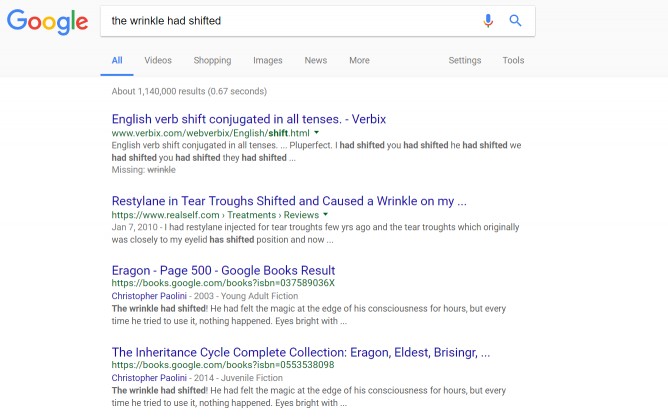
It’s been awhile since I griped about a single sentence in Eragon, but there’s one that’s just truly perplexing at the beginning of chapter 42, “Fighting Shadows”. During his captivity, Eragon is drugged, which renders him unable to use his magic. He figures out the drug is in his food, and abstains from eating or drinking until it wears off. When it does the following day,

It was dark in Eragon’s cells when he sat up with a start, electrified. The wrinkle had shifted! He had felt the magic at the edge of his consciousness for hours, but every time he tried to use it, nothing happened.

“The wrinkle had shifted”?

That’s such a weird line. I know it means that the drug has worn off, so Eragon isn’t foggy and able to do magic again, but…”wrinkle”? Is there a definition of “wrinkle” that I’ve never heard before? I know I’ve been pretty hard on Eragon, so I wanted to give it the benefit of the doubt. Maybe this was a phrase that people used and I’d never heard before, so I decided to Google it, just to be sure.

wrinkle-had-shifted

Congratulations, Paolini. You might be the first person to ever have the sentence “The wrinkle had shifted” in a published book.

Since a “wrinkle” was never mentioned before, I choose to believe that it refers to the folds in Eragon’s brain that allow him to use magic.

Not surprisingly, Eragon uses magic to break himself out of prison, at the same time Murtagh arrives in disguise to rescue him. But why wasn’t Murtagh also captured along with Eragon? Murtagh is wanted by the Empire, and it was his appearance in Gil’ead that led to Eragon’s capture. How did Murtagh get away? If it was due to Saphira’s intervention, why would she save Murtagh, and not her Rider?

What if Murtagh had been captured, and not Eragon? Eragon and Saphira could have some conflicts about risking themselves to save him, especially when he’s kept so much of his past a secret. There could have been a dilemma that wasn’t solved with swords or magic, something this book has been severely lacking.

But the plot marches ever-forward, and soon Eragon and Murtagh are rushing off to save Arya. When they find her, there’s another paragraph talking about how beautiful she is, and that she smells like pine needles. Wait, what? She’s been imprisoned and tortured for months. She shouldn’t smell nice. She should smell like iron and blood and…well, maybe elves’ sweat smells like pine needles. That’s the only thing that makes sense to me.

The most exciting part of this chapter is when Eragon duels the Shade, Durza, to try to cover Murtagh’s escape with Arya. We’ve seen Durza use magic in the prologue, but it didn’t have a lot of impact on the reader’s view of him, because we knew so little about what was going on. When Eragon and Durza engage in a sword fight, we know what’s at stake. We also have something to compare Durza to. We know that Eragon’s a gifted swordsman, but Durza is toying with him when they fight. There’s a huge gap between their skills, and so their fight is actually interesting to read, knowing Eragon is likely to lose.

The day is saved by Saphira, who ends up landing on the prison and destroying it. Normally I’m not a fan of the “Big Damn Heroes” trope, with the characters arriving right in the nick of time to save everyone. In this case I’ll forgive it, because Saphira is one of the few reasons I’ve managed to keep reading this book.

My first complaint about the next chapter, “A Warrior and a Healer”, was the abundant use of adverbs. The one that struck me as the laziest was Eragon “tiredly” healing one of Saphira’s wounds after their escape from Gil’ead.

Eragon also brings up that elves speak the Ancient Language, and most of them can use magic. This still brings me back to the question I had many chapters ago: how do elves have a conversation without casting spells and lighting everything on fire? This book goes into detail on so many things I don’t care about and have no impact on the story, but still has yet to answer that one question.

As Eragon, et. al. flee from Gil’ead, Murtagh tells him that the Urgals and Durza were working for Galby. No shit. Even as a kid, I knew that would be the case. The obvious bad guys are working for the bigger bad guy. This is just how the hierarchy of villainy works. I wasn’t shocked then, and I wasn’t shocked now.

I am, perhaps, a little more shocked and disappointed by Saphira’s explanation of all this.

A sick, angry feeling welled in his stomach. ‘The Urgals were under Galbatorix’s orders! Why would he commit such an atrocity on his own subjects?’

‘Because he is evil,’ stated Saphira flatly.

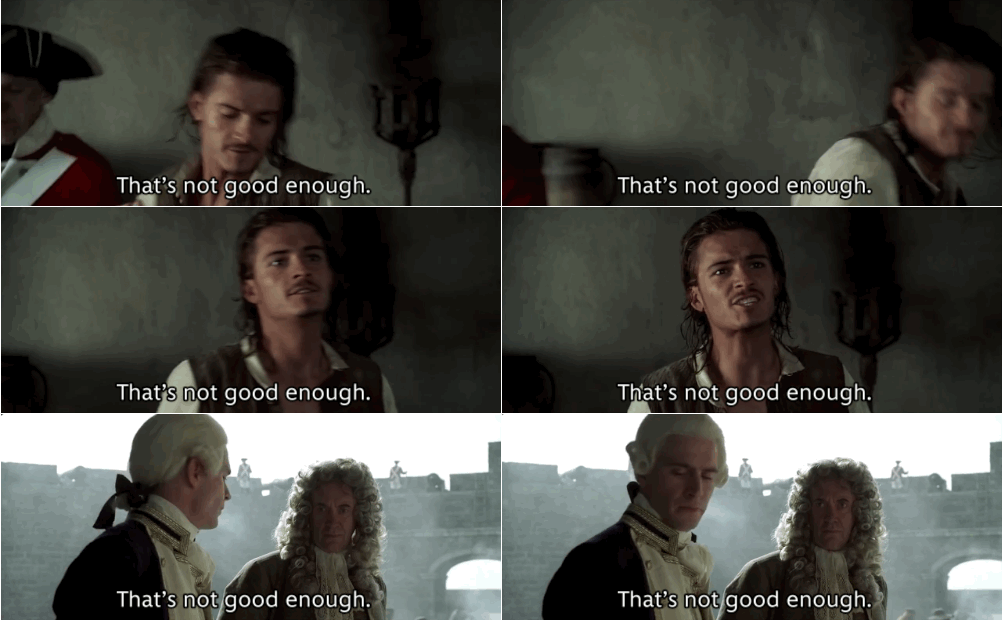
not good enough.gif

From Saphira’s perspective, this makes perfect sense. However, this is one of the big problems I have with the Inheritance series. Galby is evil because he’s crazy, and…well, that’s it. The antagonist who is evil for the sake of being evil is just a lousy villain. There’s no greater depth to them, no chance for them to be sympathetic or intriguing. If your only descriptor is “evil”, you’re not just a flat character. You’re boring and indistinguishable from the multitude of bland, oh-so-evil forgotten baddies.

After Eragon learns the not-so-shocking truth about the Urgals and Durza, he sets about to healing Arya. Paolini spends two paragraphs describing her wounds: back covered with bruises, oozing cuts, marks from whips and hot brands. Credit where it’s due: the description of Arya’s wounds is pretty horrifying, especially when you add in the fact she’s probably been tortured daily for months. So, nice one, Paolini.

But we still can’t go one chapter without mentioning how beautiful the elf is, even after she’s been brutally tortured.

[H]e could not help but notice that underneath the disfiguring marks, her body was exceptionally beautiful.

Ugh.


Eragon 35: Helgrinding Through

And we keep plunging into the literary abyss that is Eragon. But this chapter was much better than the past few because–wait for it–something actually happens!

The chapter, “Worshipers of Helgrind” starts with Eragon going out to explore the city of Dras-Leona. The chapter title comes from the citizens of Dras-Leona, who worship Helgrind, the mountain that looms above the city.

Does anyone else think that the name “Helgrind” is just a little too on the nose?

While he’s wandering through the city, Eragon finds a slave auction. He plans to use magic to free a slave that’s being bid on, but realizes that the slave would never be able to escape. So finally, finally, Eragon has learned something. He realizes that he can’t save everyone, but if he fights against the Empire, he can help a lot of people. I’m not sure if I would call this a proper turning point for his character, as he’s never wanted to join the Empire. But at least it’s something.

Going back to the “Galby is a terrible autocrat” theory, sending the Ra’zac to capture Eragon and kill his family might be the worst possible way to get Eragon on his side. It’s a great way to ensure that a unique and soon-to-be very powerful young man hates you. Why couldn’t Galby start with something more appealing: “Join me, I’ll make you a king. You’ll have power and gold and your family will be safe.” That would be a much more interesting–and challenging–test of Eragon’s character.

Back to the matter at hand, Eragon visits a cathedral in the city.  I am actually curious about what Eragon believes in. Religion was never mentioned prior to Eragon and Brom arriving in Dras-Leona, so I’m curious as to what sort of faith they have, if any. When Eragon pays his respects in the cathedral, it’s not to any god (or Helgrind), but to the cathedral and its impressive architechture.

But remember when I promised that something happened in this chapter?

Something finally happens! When Eragon goes to leave the cathedral, the Ra’zac are standing in the entrance.

Now, since it’s been far too long since I’ve made fun of a single sentence…

A sibilant hiss came from the smaller Ra’zac.

I would like to nominate “sibilant hiss” as the most redundant phrase of the book so far.

He had chased the Ra’zac for so many weeks that the pain of their muderous deed had dulled withinin him. But his vengeance was at hand. His wrath exploded like a volcano[.]

I shit you not, I laughed outloud. There must be a way to do purple prose so it’s not so unintetionally funny. This isn’t it.

Eragon does try to fight the Ra’zac, but they’ve got the city guards backing them, and he’s outnumbered. When he finally gets in touch with Saphira (and through her, Brom), they agree that they’re outnumbered* and need to flee the city. They ride as far from the city as they can in the night and set up camp. Not long after they set up camp, Eragon falls unconscious.

He falls unconscious a lot. Let’s see…I think that’s four times so far. And, glancing ahead, it’s going to happen a few more times before the book is finished. It’s gotten to the point where it’s no longer dramatic, and Eragon is more reminiscent of a fragile anime girl or flimsy romantic heroine than a badass Dragon Rider. I’m not really a fan of the constantly fainting character anymore. I first noticed this in the Hunger Games series. Whenever Eragon (or Katniss) faints, when (s)he comes to, there’s someone ready to explain what happened while (s)he was out, instead of the character experiencing it and narrating it for themselves. The literal definition of telling rather than showing. In the cases of Eragon fainting because he used magic that took a lot of energy, it makes sense. But it just keeps happening over and over again, and no longer cares the suspense that it should.

*Outgunned, outmanned, outnumbered, outplanned

Eragon 26: Literary Stockholm Syndrome

I’m beginning to worry that I have some kind of literary Stockholm Syndrome, because I’ve actually been enjoying Eragon lately.

“The Witch and the Werecat” is another chapter I was looking forward to reading. We’re properly introduced to Angela and the werecat Solembum, both of whom I’ve always rather liked.

Angela is a fictionalized version of Paolini’s sister, and that makes me wonder a couple things. First of all, how much is the real Angela like her fantasy counterpart? There’s no real way I can answer that, so the next question would be, “is it really okay to put someone you know in real life into your novel?”

My immediate thought is to recoil from the idea, but that is largely Twilight‘s fault, considering that waste of paper was originally written as a story for Stephanie Meyers’s sister. Yes, I know Eragon and Twilight are very different books, and Eragon came first, so I’m really not being fair about this. Putting a person you know in real life into a book also brings up the thought of a self-insert main character. I’ve both read and written enough fanfiction to tell you that self-inserts more often than not lead to Mary Sues and bad writing.

So I was a little wary when I came across Angela again, and I have to say that I still legitimately like the character. She’s not some beautiful woman, she’s an old, quirky witch who’s a lot of fun to watch, and I’m glad that she comes back later in the series.

Now, what about the werecat?

Eragon first sees Solembum and assumes he’s a normal cat, and tries to reach out to him with his mind. Solembum responds using the same type of mental communication Eragon shares with Saphira, and Eragon just assumes that he’s talking to her. It was probably done for humorous effect, but he can’t tell the difference between Solembum and his dragon? Really?

The werecat blinked lazily. ‘Knowing is independent of being. I did not know you existed before you bumbled in here and ruined my nap. Yet that doesn’t mean you weren’t real before you woke me.’

…Did Solembum just drop a Schrodinger reference that I would have never understood at age fourteen?

Angela, the herbalist, offers to read Eragon’s real fortune using the knuckle bones of a dragon. This was another scene that I liked a lot as a kid. When I was reading Eldest, I would frequently go back to this scene and try to figure out how all the things Angela tells him would play out.

One of the things Angela starts with is weird to me, though. After casting the bones, she says that Eragon is one of the few that is free to choose his own fate. I honestly would expect the opposite of that Saphira’s egg would have never hatched if he hadn’t touched it–I would call that destiny. I’d think that people more like Jeod and Angela, ordinary people, would have more choice in their lives than Eragon. He has to be a Dragon Rider; there’s no way he can back out.

The bones also promise an epic romance. Yeah, right. It became obvious to me when I first read this book that he would fall in love with Arya, the elf woman in the prologue. In Eldest, he does confess that he loves her, and they are friends, but she often treats Eragon with disdain. I never finished reading the third book in the series, Brisingr, but I didn’t feel a whole lotta love between the two of them there, either.

Plus, Eragon’s confession in Eldest is just cringe-worthy.

The last part of his fortune was that Eragon would be betrayed by someone in his own family. He objects to this right away, saying that his cousin Roran wouldn’t do anything like that.

I make fun of Eragon a lot here for failing to see the obvious, but this was a twist that took me by surprise when it happened near the end of Eldest, and Eragon’s long-lost brother shows up. I really think I should’ve seen that one coming.

Before Eragon leaves the shop, he receives two more pieces of advice from Solembum.

When the time comes and you need a weapon, look under the roots of the Menoa tree. Then, when all seem lost and your power is insufficient, go to the rock of Kuthian and speak your name to open the Vault of Souls.

I haven’t read far enough into the series to know what the “Vault of Souls” is, but I’m intrigued, despite myself.

Like in the previous chapter, I think the foreshadowing is handled well here. Some of the things in Eragon’s fortune happen in this book, and there’s enough information to keep me interested in learning how these things will come to pass.


Eragon 22-23: Not Half Bad

Something unusual happened. I actually liked this chapter. While I was looking forward to reading flying scenes, especially because I’m a student pilot. However, I was sure that they would only disappoint. They did not. I even loved Eragon’s anticipation as he prepares to fly with Saphira.

Saphira waited impatiently while Eragon tightened the bands around his legs. Are you ready? she asked.

He sucked in the fresh morning air. No, but let’s do it!

That is exactly how I feel when I’m getting ready to take off. I’m always nervous and excited, but pretty soon, the sheer joy of being able to fly takes over. Then the book describes Saphira’s grace, riding on updrafts, performing aerial maneuvers…and I almost exploded in nerdy joy when Eragon sees that Saphira uses her tail as a rudder. And then, then it gets even better when Saphira lets Eragon enter her mind see the world through her eyes, feel the sheer joy of flying. GOD I WANT TO DO THIS SO BAD WHY ARE DRAGONS FICTIONAL.

It’s a good thing there’s only one of me right now, because I can’t even.

Okay, time to take a deep breath, and stop fangirling.

After weeks spent tracking the Ra’zac, it seems that Eragon and Brom have finally lost the trail. That they managed to have it for that long is kind of dubious to me, but whatever, at this point I’m along for the ride. The Ra’zac appear to have taken flight, which kind of begs the question why they took so long to fly away in the first place. Also, having not found Saphira or Eragon in Carvahall, I feel like they were doing a really shitty job of finding Saphira. Wrecking Eragon’s farm was the equivalent of leaving the hero for dead in a cunning trap, and anyone who’s ever watched a Bond movie knows how that ends.

My brain just stopped for a second. I just realized the Ra’zac are Ringwraiths. I guess I can’t like this chapter anymore.

Along with the flying, though, I’m glad that the plot’s finally moving along. Eragon finds a flask of oil that’s used to burn flesh and muscle, and nothing else. That’s pretty fucked up. Brom elucidates some of them ways it could be used against your enemies and generally be cruel. The teenage version of myself (and the part of me that likes to torture characters) thinks that’s awesome. More than I want to admit.

I also like that Brom and Eragon decide to use a decidedly mundane method of tracking the Ra’zac after they find the oil. No spells, no mind-reading, just tracking where the oil was shipped from and to. It’s as simple as finding the right document. And after so much swords and sorcery, I appreciate this practical approach.

I’m glad I liked this chapter, because the next one was just padding. I really can’t see how this made it into the final cut of the novel. Eragon is curious about what the ocean is like, and Brom tells him “the sea is emotion incarnate”. What?

Most of this chapter is, essentially, a montage. Eragon and Brom traveling, practicing swordplay and learning how to use magic. So little happens in this chapter that the most memorable line might be when Eragon thinks, “Everything about me is turning hard.” He’s thinking about his muscles and how fit he’s becoming, but I’m still immature enough to snort at that. Then I remember that this book was written by a fifteen-year-old. I’m only picturing a young Christopher Paolini also laughing at that line, or trying to convince someone that it’s so deep. The latter is what I would have done at fifteen, and the former is what I’m doing now. Because I am still a child and low-hanging fruit will always make me chuckle.


Eragon 21: Do NPCs Really Need Names?

Apologies for the unexpected pause in posting; a death in my boyfriend’s family have slowed down blogging for the time being.

I wonder if I’m being too hard on Eragon. As much as I make fun of it, I love high fantasy. My favorite games are the Dragon Age series, I’ve already made references to Lord of the Rings on this blog, and obviously I fell in love with The Chronicles of Narnia before my age had even reached double digits. I’m working through A Song of Ice and Fire, and I have d20 in my purse right now, just in case a Dungeons & Dragons game pops up.

In short, I am a nerdy, and sometimes my thoughts betray how nerdy I actually am. Because, as I was reading this chapter, one of my first thoughts was, “Brom would make a great rogue…maybe who took a few levels in wizard…no, he multi-classed to Spellsword.”

Then I decided maybe I should go outside for a little bit.

When Eragon and Brom  enter another town to re-supply. Paolini runs into the same problem I have at times when I write background characters: naming them. If they’re only appearing in one scene and never again, their names are that important. But it’s really annoying to write or read “the man with the mole” or something of that ilk every time the character gets mentioned. A lot of the time, it’s just easier to give the NPC a name than refer to them by their description, however inconsequential they are. In Eragon, these bit characters often volunteer their names upon meeting Eragon and Brom. When I write brief meetings, I often don’t have the background characters give their names. Usually, I’ll have another character call them by their proper name, at which point “the man with the mole” can be called by his name in the narration. It honestly rarely occurs to me to just have minor characters introduce themselves.

I’m not sure if you’d have guessed, but the girl who blogs about fantasy books and has a home-made Jedi robe in her closet is something of an introvert. For most of my life I have been afraid of people and social situations, and especially the telephone. Even though I’m much more sociable and outgoing now than I was as a kid, I’m still not a person to generally start conversations, and it almost never occurs to me to tell someone my name. Last month I spent an hour talking to someone I met in an airport, and we had a great conversation, and I never told him my name, nor did I learn his. So my question is this: do “normal” people ever just directly introduce themselves?

Trevor, the minor character that Brom and Eragon meet, tells them that traveling has become dangerous with Urgals attacking their villages, and says that the king should be doing something about this. Brom, for whatever reason, agrees.

Wait. Didn’t we establish several chapters ago that the king is crazy and evil? Yet Brom thinks that Galby should know that Urgals are getting organized and attacking people? And no one ever thought that maybe, just maybe the Big Bad had something to do with this?

merida-headdesk

Also, we get this gem from Eragon.

“And you can do this even though you aren’t a rider?” asked Eragon.

Eragon, HOW ARE YOU THIS DUMB?!

There were a couple things I did like about this chapter, though. First, Brom teaches Eragon about communicating mentally with other sentient creatures, the same way that Eragon is able to talk to Saphira. Though years of playing DnD has made me disagree with Brom’s definition of sentience, it is a cool idea to be able to communicate with any living creature. The exposition didn’t have the clunky handling, either, as it did in some previous chapters. And there’s also this small piece of brilliance from Brom.

Think about it: you can communicate with any sentient being, though the contact may not be very clear. You could spend the entire day listening to a bird’s thoughts or understanding how an earthworm feels during a rainstorm But I’ve never found birds very interesting. I suggest starting with a cat; they have unusual personalities.

Yes. As the proud owner of one the derpiest cats on the planet, I agree so hard. Think of all the other famous fictional cats: the Cheshire Cat, the pirate cat in The Last Unicorn, and…okay, that’s all the cats I can think of, save perhaps Thackery Binx, who isn’t even really a cat.

But wouldn’t you love to know what Princess Monster Truck is thinking? I sure would.

princess-monster-truck

She is everything that is right with the internet.

Even better, my cries for more Saphira have been heard. She tackles Eragon and demands that he start flying with her so she can keep him safe. Some of her dialogue makes her sound like a concerned mom, but I’m happy she’ll be in the story more after this. Now that I’m a pilot, I’m also looking forward to reading more flying scenes, which I suspect will be much different from Eragon’s first flight.


An Ember in the Ashes

I’m back, baby! I’ll be getting back to Eragon shortly, but I’d like to take a a moment to review a more recent book, An Ember in the Ashes by Sabaa Tahir. I’ll also be posting parts of this review on GoodReads, so don’t worry–I’m only plagiarizing myself.

An Ember in the Ashes follows the stories of two main characters: Laia and Elias, with each chapter switching between their perspectives. They lead very different lives in the Empire; Laia is a poor Scholar, while Elias is one of the top students at the elite military academy, Blackcliff. When Laia’s brother is jailed for treason and her family is killed, she seeks the help of the Resistance to save him. In exchange for freeing him, she agrees to spy on the Commandant, the leader of Blackcliff. Elias dreams of freedom outside of Blackcliff and plans to desert after his graduation, even though doing so is punishable by death. When fate intervenes, Elias stays at Blackcliff, where he finally meets Laia, and their lives are forever changed.

As long as you don’t mind first-person present tense or changing character perspectives every chapter, the prose is quite good. I never came across a line that made me want to pull my hair out because it was so poorly phrased, which is more than I can say for some of the books I’ve reviewed on this blog. Even so, some of Laia’s chapters just felt like they were padding, and only part of the book to keep with the pattern of switching between the two characters. This is especially true during Part 2, when most of Laia’s chapters are just details of the Commandant’s abuse. They don’t reveal any new information about Laia or the Commandant, nor do they move the plot forward. I’m all for treating your characters horribly, but at least make sure that their suffering is for something. Laia herself is a rather insipid character. She doesn’t grow much throughout the novel, her most daring moment being when she agrees to spy for the Resistance. Even that seems out-of-character for her, as she’s quite meek and doesn’t take risks. Elias’s side of the story is more interesting, and he’s one of the few characters in the book I ended up liking. At times, I really felt that the novel could benefit by removing Laia’s chapters entirely.

Laia’s character isn’t the only one that needs to be fleshed out. The Commandant – who is also Elias’s mother – is the lead villain in the story. She is evil because…well, because she’s evil. She enjoys abusing her slaves, killing members of the Resistance, and actively tries to get others to murder Elias. Her reason behind all this? She’s evil. She’s never made even slightly sympathetic, and the readers are never really shown her motives.

The world building is also problematic. The first two chapters are in media res. It might be exciting, but because the book’s just starting out, the reader has nothing invested in the two main characters. We don’t have any reason to like them, and can’t really appreciate the impact of their actions until later in the book. Exposition in the beginning of the book feels heavy-handed and shoved in for the benefit of the audience. In later chapters it comes more naturally. Or maybe I’d just gotten used to it at that point.

An Ember in the Ashes wasn’t really a book for me. Sometimes I thought the book would redeem itself, but for everything in it that I liked, it did two things that I didn’t. At the end of the day, its flaws outweighed its strengths.

Still, if it sounds like a book you might enjoy, check it out. I just wouldn’t recommend paying full price.

I only came to read An Ember in the Ashes in the first place was because my sister and I are in a small book club. Obviously, this wasn’t my selection for the group. My sister and I were not overly thrilled with the prospect of reading yet another young adult book staring a girl in an oppressed society starting a revolution and finding true love along the way. To help keep us both sane–and give us something to smile about while we dragged ourselves through this–I texted her a one-sentence review of each chapter. Please, enjoy my descent into madness.

  • Chapter 1: I read this chapter three hours ago and I already forgot the brother’s name because that’s how little I care.
  • Chapter 2: There’s so little world building or characterization that I neither understand the importance of or care about anything that’s happening.
  • Chapter 3: All the things I dislike in this chapter won’t fit in a single sentence.
  • Chapter 4: If Elias wanted to desert, why didn’t he run when the school literally kicked him out to survive on his own for four years?
  • Chapter 5: Have I ever mentioned how much I hate first-person present tense?
  • Chapter 6: Not really loving the way the exposition was handled here, but it’s more than the rest of the book has given us so far.
  • Chapter 7: At this point, “character development” would mean that the main character develops a personality.
  • Chapter 8: Just once, I would like to read a young adult fantasy novel that never uses the word “destiny”.
  • Chapter 9: I’m a little amazed that I have the willpower to not throw this book across the room.
  • Chapter 10: You know, it is possible to write a young adult fiction without having a “chosen one”.
  • Chapter 11: Wait, when did Laia grow a spine?
  • Chapter 12: The more I think about the details of Blackcliff Academy, the less sense it makes.
  • Chapter 13: I really hope the Commandant becomes an actual character, and not just a villain who’s evil for the sake of being evil.
  • Chapter 14: OF COURSE LAIA IS SO BEAUTIFUL WITH HER GOLDEN EYES AND LONG EYELASHES AND “FULL LIPS”
  • Chapter 15: When will this end?
  • Chapter 16:  Every time this book comes close to being cool, it ruins it.
  • Chapter 17: Laia’s chapters are nothing but light torture porn.
  • Chapter 18: I seriously suspect Sabaa Tahir has mommy issues.
  • Chapter 19: This is not how you build a strong female lead.
  • Chapter 20: Changing perspectives every chapter makes the slow story progression less noticeable, and I’m not sure if Tahir is a genius, or can’t get a handle on pacing.
  • Chapter 21: All of Laia’s chapters in a nutshell: Laia is sad because someone either tells her she makes a lousy spy or hurts her.
  • Chapter 22: There’s one female character with depth, and her entire arc is about men lusting after her.
  • Chapter 23: I make a motion to replace all Laia chapters with Spiro Teluman chapters.
  • Chapter 24: Can we talk for a second about how Elias and Helene didn’t actually use their cunning to pass the Trial of Cunning?
  • Chapter 25: This chapter made me so happy because it means I’m halfway through this waste of paper.
  • Chapter 26: I strongly suspect Helene’s sudden burst of racism is because Tahir noticed she was a much better female lead than Laia.
  • Chapter 27: Generally, it takes normal human beings more than thirty-second conversations to fall in love with each other, no matter how beautiful they are.
  • Chapter 28: This is just four pages of Elias thinking Laia is hot.
  • Chapter 29: If the flirting in this chapter was any more awkward or forced, it would be the second Avengers movie. #2Burns1Stone
  • Chapter 30: This book talks about sexual violence a lot.
  • Chapter 31:  Achievement unlocked: cameo character is more intriguing than main character.
  • Chapter 32: I also vote to remove insipid and predictable love triangles.
  • Chapter 33: NOPE.
  • Chapter 34: Can we go one chapter without mentioning rape?  
  • Chapter 35: I’m not sure what I hate more: that Helene goes completely against her established character, or that Laia’s only role in this book is to be a punching bag.
  •  Chapter 36: The Helene-Elias romance subplot is so, so dumb.
  • Chapter 37:  Five bucks says the Resistance is going to betray Laia.
  • Chapter 38: And now we’ll take a break from an Ember in the Ashes to bring you a less interesting version of The Hunger Games.
  • Chapter 39: You know, this backstory would have been really useful AT THE BEGINNING OF THE FUCKING BOOK.
  • Chapter 40: There are so many logical holes in the Trial of Strength I wouldn’t be able to list them all here.
  • Chapter 41: Laia, how are you this stupid and still alive?
  • Chapter 42: So many eyerolls.
  • Chapter 43:If the Commandant knew that Laia was a slave since the Moon Festival, why didn’t she kill her much sooner?
  • Chapter 44: The “Trial of Loyalty” is really just a test of who could get to Laia the fastest.
  • Chapter 45: I call bullshit on Laia suddenly be able to take the Resistance leader hostage, in his own hideout, surrounded by his supporters.
  • Chapter 46: This is the closest thing we get to an explanation of the Commandant’s anti-social behavior, and it still fails to explain anything or make her an iota more sympathetic.
  • Chapter 47: Laia is way overdue to become a strong heroine, but when it actually happens, it just is out of character for her.
  • Chapter 48: I’m supposed to feel something at Elias’s rapidly impending death, but mostly I’m annoyed that all he’s doing is whining and quoting Serenity.
  • Chapter 49: We really shouldn’t have to wait until the second-to-last chapter of the book for the main character to do something useful.
  • Chapter 50: OH THANK GOD I’M DONE

Final Thoughts:

T81Ltam

I hated this book. The love triangles were unnecessary and sloppily written, the magical aspects go unexplained, the villains are never given any depth, Laia is almost on par with Bella Swan as a female lead, and the book doesn’t even freaking end. I’ve read 50 chapters of this crap, and nothing gets resolved: not the romantic subplots, Laia’s quest to save her brother, or even a basic explanation of Helene’s sudden magical powers. Nope, there’s a sequel coming out, and someone’s already got the movie rights.

And, to get on my soapbox for a minute, this is also on par with Twilight for bad female role models. Helene is the token strong girl, but her entire character arc is about men lusting after her, and her doing anything she can to keep Elias alive. Including swearing fealty to the man who has directly said that he’s going to rape her. Laia’s not much better, as her arc is almost entirely her getting tortured or beaten up (and then rescued by Elias)–for another male character, albeit her brother–and she doesn’t do anything proactive until the very end of the book. The one female character whose arc doesn’t revolve around a man is the Commandant, who is a heartless monster (for no fucking reason).

This book is 446 pages of drivel. Sabaa Tahir’s prose is well-written, but the characters are flat and boring, and the story has no satisfying resolution.

Screw this. It’s my turn to choose the next book for book club, and after reading Me Before YouThe Nightingale, and now, An Ember in the Ashes, I need to get away from all this stupid chick lit. If you need me, I’ll be nose deep in Do Androids Dream of Electric Sheep?