FFM 23: Your Librarian Believes in You!

Without in any way limiting the author’s exclusive rights under copyright, any use of this publication to “train” generative artificial intelligence (AI) technologies to generate text is expressly prohibited. The author reserves all rights to license uses of this work for generative AI training and development of machine learning language models.

July is Flash Fiction Month! I’ll be sharing short short stories here through the month of July. More notes at the end of the story.


Your librarian believes in you!

She believes that you can read all five books for the summer reading challenge. Really, you can! You might even find a new favorite!

Your librarian knows that you can go to storytime without crying, not even once. He knows how brave you are!

Your librarian knows that you’ll be a great volunteer. They think you ask good questions and pay attention to your tasks. Thank you so much for all your hard work!

Your librarian believes that you can use the library catalog. She’ll even show you how if you have questions. And she really trusts that you’ll be able to use it to look up every. Single. Book. on your school reading list, so she doesn’t have to. 

Your librarian is excited that you’re excited to use the computers. He would also like to let you know that you are so much smarter than that scary game on Roblox, and maybe there’s an even more fun game on the computer for you to play. 

Your librarian knows how enthusiastic you are about volunteering here. They really appreciate how you try very hard. They really think that you can do all your tasks correctly and follow simple instructions, even after you’ve proven them wrong. Keep trying!

Your librarian believes…that she needs a nap.


I had a different story planned, but it’s been a hectic day. Eight days until the end of the summer reading program. I’m exhausted.

Your librarian believes that you can Show Up for Libraries! (ALA) The Institute of Library and Museum Services is in danger of losing funding or being dismantled entirely. If you have just 5 minutes, call your representative and tell them to support IMLS and libraries! Read more about Executive Order 14238, which targets IMLS and other agencies.

“When a library is open, no matter its size or shape, democracy is open, too.”

― Bill Moyers

Your library will always be there for you. Please be there for your library.

Without in any way limiting the author’s exclusive rights under copyright, any use of this publication to “train” generative artificial intelligence (AI) technologies to generate text is expressly prohibited. The author reserves all rights to license uses of this work for generative AI training and development of machine learning language models.


I’m writing this introduction on Saturday, January 18, on my lunch break. I don’t usually work Saturdays, but today I have a Teen Advisory Board meeting. In a few hours, a group of teenagers will come into the library and tell me what kinds of things they would like to see the library provide for them. I’ll distribute scholarship information for three local colleges, tell them about a student employee position that’s just opened up, and give them advice on how to apply and what the library looks for in a job interview. After, we’ll make cards for troops stationed abroad. Elsewhere in the library, adults and kids will be using computers to access the internet, do homework, apply for jobs, or catch up on YouTube. People who don’t have internet access at home can check out hotspots. Maybe they’ll use it to access live virtual tutoring, or Ancestry.com, or Consumer Reports – all free with their library card. And, of course, there will be books. All kinds of books: novels, picture books, biographies, travel guides, comic books, board books, cookbooks, books for beginning readers and books that read to you. 

Later this month, kids will practice reading to a licensed therapy dog. People struggling with food insecurity will receive assistance in applying for SNAP benefits. Toddlers and pre-schoolers will learn pre-literacy skills at storytime (including a bilingual storytime). Free tax assistance will be available. Senior citizens will take a class to learn basic computer skills English language learners will meet to practice casual conversations. I’ll also be running my favorite activity, a tabletop roleplaying game for teens, which has become a haven for a small group of queer teens. All of this for the low, low price of free. 

Libraries are one of the few places left where you don’t have to pay anything to be there, you don’t even necessarily need to be a member. Just come in, and we’ll try to help you. 

Libraries are magical. They are also in danger. 

For many of us in the United States, the next four years are going to be a scary and difficult time. There is so much I could talk about when we discuss the second Trump administration, but I want to focus on something that this blog has always focused on: books. Well, books, literacy, and access to information. As I have said in a previous post, access to information is recognized as a basic human right by the United Nations. In an age of rampant misinformation and censorship, this is a right that needs to be safeguarded more than ever. Public libraries are on the forefront of the battle for intellectual freedom, a battle which is only going to intensify in the coming years. 

As I’ve written about before, public and school libraries are facing intense scrutiny over the materials they have on their shelves. Book bans are on the rise, and libraries and library staff are facing threats of violence, lawsuits, and even jail time. And things are going to get much, much worse. 

The Trump administration’s plans are detailed in Project 2025. This is not a document of hypotheticals; this is a road map. And this road map leads to, among other things, a direct attack on every Americans’ intellectual freedom. 

Project 2025 aims to dismantle the Department of Education, cancel funding for public services,  support censorship, and, potentially, jail teachers, librarians, and booksellers. 

That’s not hyperbole. Project 2025 classifies any LGBTQIA+ material as pornography, including picture books like the innocent And Tango Makes Three or non-fiction books intended for education, like This Book is Gay. If that wasn’t bad enough, librarians and others who distribute “pornography” to children may be required to register as sex offenders. 

Yes, you read that right. No, this is not me being melodramatic. Conflating LGBTQIA+ media with pornography is a tried and true tactic when it comes to censoring, challenging, and banning books. 

Nor am I exaggerating the potential legal consequences for librarians. So far, Indiana, Oklahoma, Tennessee, and Montana have passed laws that say school staff, public librarians, and museum employees could be jailed and/or fined thousands of dollars for distributing “obscene” material to children. 

Book challenges and bans are only going to become more frequent. Moms For Liberty, right-wing group dedicated to banning books, is strongly supported by the Heritage Foundation [PDF] (the organization behind Project 2025), by providing them with financial and even legal support.

The final thing I want to talk about regarding Project 2025 and libraries is not nearly as dramatic as everything else, but it is no less crucial. Federal funding for public services is going to be greatly reduced, up to and including eliminating the Institute of Museum and Library Services (IMLS). Most libraries already operate on string shoe budgets, and librarians and library staff are notoriously underpaid. Cutting federal funding is going to hurt the services that libraries offer, especially in rural and low-income areas. 

There is a big disconnect between politicians and their constituents in the perception of public libraries. They are valued community spaces with something for everyone – be it Talking Books for the blind, someone to walk you through an online job application, even just a safe place to exist. There’s a lot of love for libraries. In fact, there’s more public libraries than there are McDonald’s in the U.S.

To borrow some words from The Memeing Librarian: The library will always be here for you. So please be there for your library. 

I know that libraries are not going to be on the forefront of your mind as we go into this next big challenge together. However, there are simple, everyday things that you can do to support your library, free speech, and freedom of information. 

First, VOTE! Not just in big national elections, but state and local elections as well. Local elections determine so many things in your community, like commissioners, judgeships, school boards, and funding for public services like the library. 

Get a library card if you don’t already have one, and check out books. I know this seems obvious, but it’s really important. One of the things that determines funding for libraries is the number of members a library has, as well as circulation for books, DVDs, and other library materials. Some libraries even have “library of things” where you can borrow items like tools or cake pans, or seed libraries if you want to start your own garden. My library system also lends hotspots and backpacks with educational materials based on certain topics.

Attend library programs. Like I mentioned above, statistics are everything when it comes to securing funding. Library programs aren’t just for kids, either. There’s lots of stuff for adults and teenagers. Some popular recurring programs we have for adults are film discussions, “craft and chat” events, and English language learning events. Attendance is also a good way to show the library what you’re interested in seeing for future events. Many libraries also have teen advisory boards, where teens can give their input into library programs and earn community service hours. 

Volunteer. There is always something that needs to be done, whether it’s organizing books, preparing crafts for storytime, tutoring, or corralling kids during a craft-a-palooza. You could also join a Friends organization. Many libraries also have a Friends organization, which raises money for the library. Our Friends organization has helped pay for activities and guest presenters, like theatre performances and historical impersonators. 

Donate if you are able. Financial donations are obviously the most direct way you can give, but there are other things you can donate as well. Lightly used books that someone else might want to read (please don’t give us your old copy of Windows 95 for Dummies) may be added to the library’s collection or sold in a book sale to raise money. It doesn’t have to be just books, either. Last year, someone donated a huge box of Pokemon cards, which meant that every kid who attended a Pokemon program I ran got 2 cards to take home, and a holographic card if they registered for the Summer Reading Program. 

Give the library your feedback (but be nice about it). If you liked a program, if you hate the new signage, if we absolutely need to get this book or that movie. Most libraries also have online surveys and book order requests on their websites.

Tell your librarian what you love about the library. I love my job, but it’s not as easy as it looks, and there are times when I’ve fantasized about just walking out and never coming back. It’s the little wins, like helping a patron find the perfect book or a parent giving a compliment that helps us get through the day and reminding us why we do this. 

When you take a book off the shelf and decide you don’t want it, don’t put it back on the shelf. Don’t put it at the end of the shelf. Don’t leave it next to the self check-out. Please stop reshelving the books. Please. I’m begging you.

These next four years are going to be tough. Take care of yourself, take care of your loved ones, and take care of your library. 

Some sources and further reading: 

Project 2025 and Its Threat to Free Expression, Part 1 (PEN America)
Project 2025 and Its Threat to Free Expression, Part 2 (PEN America)
Project 2025 and Its Consequences for Libraries (EveryLibrary Institute, PDF)
Red states threaten libraries with prison — as blue states work to protect them (Washington Post)
Unite Against Book Bans (American Library Association)
Banned & Challenged Books (ALA)
Trans Rights Readathon
We Need Diverse Books


Indie Review: OMG UR a Teenager!

I’m a Reedsy Discovery reviewer! I received a free ARC of OMG UR a Teenager! by Leslie Young for this review.

⭐⭐⭐⭐

Twelve-year-old Kat Cruz can’t wait for her next birthday. Before she can become a teenager, though, she’ll have to make it through seventh grade. The year starts off rough when her parents buy the most run-down house in the neighborhood, and a bully snaps a picture of Kat in front of her new house. She’s constantly stuck babysitting her younger brother, who thinks he’s a superhero. Kat’s editorials in the school newspaper make a splash, but not always in a good way. She’s also crushing on her new neighbor, Will, despite the fact that his mom doesn’t seem to like her. With new challenges every day, will Kat make it to her thirteenth birthday in one piece? 

OMG UR a Teenager by Leslie Young is a contemporary slice-of-life novel full of clear, crisp writing that makes it easy for young readers to get into the story. The relatability will keep them invested throughout the book. Kat experiences things that many kids going through pre-adolescence face: bullying, the excitement and mortification of buying your first bra, and changing family dynamics. Most of all, she wants to be seen as the mature nearly-teen she is, not a child and permanent babysitter for her little brother, Max. Tween readers will understand exactly how she feels, and adults will easily recall both the joys and pains of middle school.

Kat’s family dynamic is true to life as well, with well-intentioned parents who don’t understand their daughter’s point of view, an annoying little brother that Kat loves (even if she wants to kill him sometimes), and her vivacious grandmother whose Alzheimer’s puts extra strain on the family. Kat’s and Max’s relationship is developed particularly well, showing their closeness (especially in the climax), even if they don’t always get along. However, Gran’s storyline wasn’t as well-developed, making her inclusion in the book feel unnecessary.

At times the story can feel disjointed, such as an abrupt cut from summer to Halloween. Like Gran’s story, some plot points are dropped without a conclusion. Kat’s narration is also, at times, too mature to be realistic for a twelve-year-old. While adult readers might have to stretch their suspension of disbelief at some of Kat’s inner monologues, tween readers may find her insights useful in their own lives.

Overall, OMG UR a Teenager is a warm-hearted, relatable story for tweens, and anyone who’s ever been one.

Librarianing 101: Keep Calm and Weed On

Without in any way limiting the author’s exclusive rights under copyright, any use of this publication to “train” generative artificial intelligence (AI) technologies to generate text is expressly prohibited. The author reserves all rights to license uses of this work for generative AI training and development of machine learning language models.


My husband once told me, “I love how excited you get over very boring things.” Explaining the intricacies of cataloging books or reading pages of library policy would be boring to most people, but they’re not to me. I can get into unprovoked deep dives on library science and the history of youth literature, because these are things that I care very much about. But when I get going, it turns out that most people also have at least a small amount of interest in the inner workings of a library. Instead of our normal book post today, I want to give everyone a peek behind the desk and talk about one of my favorite “boring” library things: collection development. Specifically, “deselecting” materials from the collection, called weeding. 

C’mon, I know you’re at least a little curious about how we decide to get rid of things. 

But first you need to accept a hard truth: libraries throw away books. Like, a lot of books. I know how bad this sounds. Libraries are supposed to safeguard these tomes and preserve them for the world to enjoy, right? Aren’t books precious gems that need to be saved? 

Excluding things like rare first editions and other historically important books…not really. For the vast majority of books, I think that their true value is what the reader gives them. While I’m not getting rid of anything on my personal bookshelf at home, just yesterday I happily discarded a little over thirty books without a twinge of guilt. 

While this may sound cruel to book lovers, weeding is essential to a healthy library collection. There’s the matter of space, of course: no library can fit every book its users might need. But it’s also a matter of relevance. One of those books I recently discarded was a book about A.I. that was published in 2005. A.I. is a very hot topic right now, and this is technology that will continue to shape our future. But an almost 20 year old book on the topic isn’t relevant anymore. Not only is the information in the book dated, it’s also inaccurate. Misinformation is just as bad as no information, if not worse. Weeding gives library staff an opportunity to assess the collection, and to see what needs to be updated and where gaps are. It’s a critical tool in curating a library collection that best suits the needs of its users. 

I have a love/hate relationship with weeding. Sometimes it feels great, and other times it’s really tough to make the decision of what book stays and which goes. 

How do librarians make that decision? There are a lot of factors involved in deselecting materials, and it’s best to make each decision on a book-by-book basis. 

The first thing I look at are the number of check-outs a book has, and the last time it was checked out. In library terms, we call these “grubby” and “dusty” or “dead” items. 

Grubby items are books and other materials with a lot of check-outs. Popular books that get checked out a lot are going to get worn down through the wear and tear of frequent handling. I’d love to believe that everyone treats their library books with respect and care. However, I’ve seen enough books returned with stains, torn pages, and (on a memorable occasion), live ants, so I know this is not the case. The more times a book has been checked out, the more likely it’s going to return with damage, especially if it’s a book for children. But even if nothing bad happens to those books while they’re checked out, it doesn’t mean that they’ll be in pristine condition after they’ve been checked out 50 times. Oils from our hands will get on the pages, spines can become unglued, chunks of pages can come loose or fall apart for no other reason than the fact that the book’s been used a lot. Then there’s the smell. You know it: the dusty smell of old books. If you love that smell, skip the next paragraph, because I’m about to ruin it for you. 

You know what that smell is? Human skin particles. Gross, but true. 

When I have a “grubby” book in hand, the first thing I do is check its condition. I look for torn pages, markings, damaged spines, stains, liquid damage, and, for some books, see if it passes the literal sniff test. The two grossest things I look for are mold and insects. These are both really bad things to find in a book. Mold doesn’t just present a potential health hazard. It spreads fast and can eat through entire library collections in no time. Get rid of moldy books quickly, before every book around it becomes a moldy book. 

If you find bugs in a book, hopefully they’re already dead. If you decide not to keep the book, then you’ll need to clean up the insect murder scene, make sure there are no survivors, and clean the book. Living bugs are a whole different story. There are plenty of critters who would just love to eat through those tasty, tasty pages. In fact, this is where the term “bookworm” comes from! Just like mold, bugs can literally eat their way through a library. Even insects that don’t eat books can be a problem. I spent way too long cleaning a picture book full of live ants. It was gross, time-consuming, and absolutely necessary. Insect invasions can lead to all kinds of problems for library staff and patrons. Once my library had to close due to wasps in staff areas. Turns out most people do not like their coffee covered in bees.

Determining whether to get rid of a grubby book can be challenging, since they  often become grubby due to popularity. In this case, ordering a new copy is usually the best option. However, this isn’t always possible. Funding to purchase new books might be limited, the book could be out of print, or the book might only be available in a format the library doesn’t want. For example, sometimes old picture books are no longer available in hardcover, and I can only purchase a softcover copy. Paperbacks are more easily damaged than hardcover, thin, softcover picture books can quickly be lost on the shelves between thicker books. When that’s the case, it may be time to say farewell to your much-loved book. 

“Dusty” or “dead” books are the opposite of “grubby” books. These are books that haven’t had a lot of check-outs, or books that haven’t been checked out in a long time. The definition of a “long time” depends on the library, but it’s typically between two to three years. While that’s a helpful guideline to start with, it’s by no means the only thing to take into consideration when deciding to keep or weed a book. 

First of all, low check-outs or no check-outs doesn’t mean that the book isn’t being used. It’s entirely possible that library patrons are looking at the book at the library instead of taking it home. Patrons may be reluctant or embarrassed to check out books about health, sexuality, gender identity, and other sensitive topics. This is especially true when it comes to books for teens, who may not feel safe or comfortable bringing these books home, and may not have access to them at school. 

Another consideration is the number of libraries nearby that have the same title. If a book you’re considering discarding is available in 15 other nearby libraries, you probably don’t need to hang on to it. But if you’re the only library in 30 miles who has this book, you’ll probably want to keep it, even if it doesn’t get a lot of circulation. 

You’ll also want to check the content of the book. If it’s a nonfiction book, it’s important to see how many books on the topic (or a similar one) you have. If it’s children’s nonfiction, you’ll also want to make sure you have books of varying complexity. The book a six-year-old needs to do his homework is going to be very different than the book an eleven-year-old needs, even if it covers the same topic. 

The content of the book also needs to be accurate and relevant. Some topics, like health and technology, change very rapidly, and books in those areas can become obsolete fast.

Content also matters in terms of fiction. For example, if I have to choose between a YA romance and a YA novel about drug abuse, I’m keeping the latter. Romance is always popular, which is why there’s always so much on the shelf. The book about drug abuse is probably not as much fun as a boy-meets-girl story, but it is something that is present in every community and too many families. I have always believed that fiction is a safe way to learn about a tough topic, and I try to keep books that deal with current issues on the shelf. It’s also important to have a diverse collection with books that feature characters with a variety of races, sexualities, backgrounds, and ideas. 

And that, in a nutshell, is weeding. 

Well, sort of. As I said before, deselecting materials should be done on an item-by-item basis. 

 “Grubby” and “dusty” aren’t the only criteria librarians use to decide whether or not to weed an item, but they are a helpful place to start.

Keep calm and weed on. 

Dec. Book Recs: The Runners-Up

First off: sorry for only one post in November. I was sick for a couple weeks, and then had family visiting for Thanksgiving. But don’t worry, I’ve still got plenty to say about banned books! But first…

I read a lot of books this year. Not including my Did Not Finishes and picture books, I’ve read 56 books this year. That’s a lot, even for me. The vast majority were books I read for these monthly recommendation lists. I really enjoyed working on them, but each list took a lot of time and effort. That’s why I didn’t have any lists for July or August – I was simply too busy. For 2024, I’m going to do mini-recommendation lists, with only one or two books a month. 

Even though I read a lot, not every book I read made it onto the book recommendation lists. I limited myself to only 5 fiction books and 5 nonfiction books for each list. There were some great books that I really enjoyed that just didn’t make the cut. Even so, I felt like they were still worthy of sharing. So here it is: the final recommendation list of 2023: Books that Didn’t Make the Cut, but Are Still Good.

Nonfiction

Planting Stories: The Life of Librarian and Storyteller Pura Belpré / Sembrando historias: Pura Belpré: bibliotecaria y narradora de cuentos by Anika Aldamuy Denise. Illustrated by Paola Escobar

If there’s such a thing as a legendary librarian, it would be Pura Belpré. Originally from Puerto Rico, Belpré came to New York City for her sister’s wedding, and ended up staying for most of her life. She became the first Puerto Rican to be hired by the New York Public Library. There, she discovered her talent and passion for storytelling, though the library shelves lacked the stories she loved growing up in Puerto Rico. Throughout her life, Belpré wrote many children’s books based on Puerto Rican folklore, becoming one of the first Puerto Ricans to publish works in English in the U.S. Her work helped open up the library to the Latinx residents of New York City, and her stories continue to celebrate the culture she loved. Planting Stories is a picture book biography of Belpré’s life, with beautiful illustrations on each page. 

Why it didn’t make the cut: I really wanted to include something about Pura Belpré for Hispanic Heritage Month. Unfortunately, the only biography I found aimed towards adults (The Stories I Read to the Children by Laura Sánchez-González) isn’t easy to find unless you’re prepared to buy it. I found picture book biographies, but I didn’t want to showcase more than one picture book. I’d already decided on A Land of Books by Duncan Tonatiuh. His work is just so cool. I encourage everyone to learn about Pura Belpré, or at least read some Pura Belpré award winners! 

Signs of Survival: A Memoir of the Holocaust by Renee G. Hartman with Joshua M. Green

Two Jewish sisters – one hearing, one Deaf – recount their struggle to survive during World War II. During the Nazi occupation of what was Czechoslovakia, Renee was the only hearing person in her family. She had to be her family’s ears, listening for the sound of Nazi boots coming to take her family away. Renee and her younger sister, Herta, were eventually separated from their parents and shipped to Bergen-Belsen concentration camp. Using sign language to communicate, Renee and Herta had to rely on each other to survive. Presented as an oral history, both sisters recount their lives before and after the Holocaust in a tragic story of sisterhood and survival. 

Why it didn’t make the cut: I had this book as a potential pick for Disability Pride. After reading it, I realized that it didn’t fit the theme that well. It was more Renee’s story, rather than Herta’s. Regardless, their story is still powerful and important. 

And the Spirit Moved Them: The Lost Radical History of America’s First Feminists by Helen LaKelly Hunt

When did the feminist movement begin in the United States? With Susan B. Anthony and the Seneca Falls Convention in 1848? With Gloria Steinem in the 1960s? Hunt argues that the first feminist movement in the U.S. began with women like Lucretia Mott, Maria Weston Chapman, and Grace and Sarah Doughlass in the 1830s. These women railed against the patriarchal structures that treated them as unequal partners in the abolitionist movement. They bucked tradition and began their own interracial abolitionist movement, which included the Anti-Slavery Convention of American Women in 1837. Most of these women were moved to action by their Christian faith and felt “armed by God” as they denounced pro-slavery religious figures. Including photos and documents, this book is accessible to many readers who are interested in women’s history. 

Why it didn’t make the cut: It’s religious. The women being moved by their Christian faith wasn’t just a side-note, it’s a major point Hunt makes throughout the book. Towards the end, she calls for more faith-based feminism among women (of any faith, not just Christianity). There is nothing wrong with being religious, especially if your faith guides you to help others. I didn’t like how religion-focused it was, but it’s a book that many others would enjoy and even feel inspired by. 

The Immortal Life of Henrietta Lacks by Rebecca Skloot

In 1951, Henrietta Lacks’s cells were taken from her without her consent or knowledge. These cells continued to grow and divide long after Henrietta’s death. Her “immortal” cell line has contributed to scientific and medical discoveries for decades, from a polio vaccines to studying COVID-19, and even being sent to space. Yet Henrietta’s family never learned about the HeLa cell line until 1975. While her cells have helped so many people, her family lived in poverty and, ironically, could not afford health care. Rebecca Skloot was fascinated by Henrietta Lacks and her cells, and worked with Henrietta’s daughter, Deborah, to tell the story of Henrietta, HeLa cells, and the Lacks family today. This book is impossible to put down, and examines race, class, and ethics in medicine and science.

Why it didn’t make the cut: Even if you haven’t read this book, you’ve at least heard of it. And it is absolutely worth the hype. Though I did put some award-winners and best sellers on the lists, I wanted to highlight less well known books that are still praise-worthy and meaningful. But if you haven’t read this one yet, stop reading this and go read it. Go read it now. 

Fiction

The Marrow Thieves by Cherie Dimaline 

The planet has been ravaged by climate change, which has resulted in most of the world’s population losing the ability to dream. The Indigenous people of North America can still dream, and are hunted for their bone marrow.  After French loses his parents and his brother is captured and taken to the “schools” – a parallel to the Canadian residential boarding school system – he joins a group of other Indigenous people – old and young alike – who have fled the cities to stay safe. Led by Miigwans, they travel north, living off the land and learning each other’s histories while trying to avoid becoming victims of a genocide. 

Why it didn’t make the cut: It’s a dark story. Really dark. Rape and murder are commonplace in this new world. The ending is ultimately hopeful, but it’s a long, bleak trek to reach that conclusion. The horrors the characters in this book face parallel real world atrocities committed against Indigenous Americans, most saliently with references to residential schools. It’s an important story, but a hard book to read. 

The City Beautiful by Aden Polydoros

While the rest of Chicago is marveling at the 1893 World’s Fair, Altar Rosen is working hard to earn money to bring his mother and sisters to the United States from Romania. After his best friend, Yakov, is murdered at the Fair, Altar is possessed by Yakov’s dybbuk. Unless Altar can find Yakov’s killer and bring him to justice, Yakov’s dybbuk will permanently take over Altar’s body. But there’s no justice to be found for poor Jewish immigrants, even when their bodies start piling up. Altar has no choice but to work with his old “friend” Frankie. Frankie helped Altar survive when he first arrived in America, but he has dark secrets of his own. Together, they need to track down a dangerous serial killer targeting Jewish boys all the while Altar navigates his grief and comes to understand his feelings for Frankie. A queer historical thriller, steeped in Jewish mythology. Includes content warning, glossary, and author’s note.

Why it didn’t make the cut: I really liked this book, and originally planned on using it for Pride Month. But when it comes to Pride, there’s a lot to cover, and I wanted to get as much diversity as I could when it came to the LGBTQIA+ spectrum. But I loved The Darkness Outside Us even more. It destroyed me emotionally was one of my favorite books that I read all year, and I really wanted to showcase it. The City Beautiful was still a great read, and I’m excited to share it here. 

Loving vs. Virginia: A Documentary Novel of the Landmark Civil Rights Case by Patricia Hruby Powell

Based on the true story of Richard Loving and Mildred (Jeter) Loving, this is the story of two people whose love changed U.S. history for the better. Milly, who was Black, and Richard, who was White, lived in the small town of Central Point, Virginia, surrounded by family. While Black and White folks mixed freely in Central Point, the rest of the state still had strict segregation laws, including laws against interracial marriage and “miscengenation.” Milly and Richard were married in Washington D.C. in 1958. Upon returning home, they were both arrested for “cohabitating as man and wife” and faced a year of jail time unless they left Virginia. They moved to Washington D.C., but were virtually exiled from the home they loved, unable to see their families or cross state lines together. After one of their children was hit by a car (he survived, but was injured), Milly and Richard were determined to return home. Thus began the fight of their lives for their right to be married. A novel in verse, the Lovings’ story is told from both Richard and Milly’s perspective, with illustrations throughout that enhance the reading experience. The dual perspectives during their wedding is breath-taking (especially if you listen to it on audio while reading the book, like I did). Facts about Jim Crow and anti-miscegenation laws begin each chapter. 

Why it didn’t make the cut: I loved this book, and I could’ve used it for a few different themes. But every time I’d planned to use it, I discovered another book that I wanted to highlight, and Loving vs. Virginia got pushed to the backburner. This book is one of the big reasons I wanted to share “runners-up” for December! 

Dragonfly Eyes by Cao Wenxuan. Translated by Helen Wang. 

Dragonfly Eyes is a historical fiction novel that tells the story of Ah Mei and her French grandmother, Océane. Océane married into the wealthy Shanghainese Du Meixi family in the 1920s and would eventually move to Shanghai and raise her family there. Océane adores her youngest grandchild (and only granddaughter) Ah Mei. Their close bond carries both of them through the turbulent times: Japan’s invasion of China in the 1930s, famine in the 1950s, and finally the Chinese Cultural Revolution in the 1960s and 70s. An omniscient narrator describes Ah Mei and Océane’s lives with tender details amidst the historical backdrop. Ah Mei and Océane’s loving relationship is the heart of this novel, softening the harsh blows that buffet the family.

Why it didn’t make the cut: I didn’t like it. Omniscient narrators and a thin plot made it hard for me to get into this novel. The book was lovely in its own way, it but wasn’t for me.
Banned Books Week 1: Intellectual Freedom

I can only remember my reading choices being called into question three times.

First, when I was in elementary school, my aunt saw me reading some sort of business-type book by Scott Adams, the creator of Dilbert. I was skipping the text and reading the comic strips that had been inserted on each page. My aunt laughed and asked if I understood what I was reading. I told her I was only reading the comics. She asked if I understood the comics, which I mostly didn’t, and I told her, “Some of them.”

The second time was probably in the summer of 1997, making me eight years old. I was eagerly reading a Newsweek article about the recently-launched Sojourner Mars rover. My mom asked me if I understood what I was reading. I was an above-average reader for my age, but Newsweek was still beyond me. I had no idea what the article was saying. I lied and told her that I understood it all.

The last time came when I was sixteen or seventeen, and reading The House of the Scorpion by Nancy Farmer. Whenever I set it down, I was very careful to always place it cover side up, lest someone be weirded out by the summary on the back. When I did leave it upside down once, though, my mom read the summary and asked, “What is this book you’re reading?” Considering that the summary talks about opium and a boy being harvested from a cow’s womb, I’m not surprised that it raised a few eyebrows. When I told her it was sci-fi about clones and I also thought it was weird, but good. She just kind of went, “all right then” and didn’t ask again.

But at no point has anyone ever told me, “I don’t like that, so you can’t read it.” No one has ever tried to take a book from me because it was too advanced, or because they were uncomfortable with the subject matter. I got to read whatever I wanted, even if my parents didn’t love all of it. Though my mom might occasionally “check in” if I was reading a book with mature themes, she trusted me to make my own decisions when it came to reading. Some kids aren’t that lucky.

Let’s talk about banned books.

This is the week to do it, after all. Banned Books Week was established in 1982 by the Office of Intellectual Freedom (OIF), a subdivision of the American Library Association (ALA), in response to a sudden uptick in book bans and challenges that year.

Notably, the subject of book bans made it all the way to the U.S. Supreme Court in 1982, in the case Island Tree Schools School District v. Pico. The school district had removed 11 books from the high school and middle school libraries, which the school board decreed were, “anti-American, anti-Christian, anti-Sem[i]tic, and just plain filthy.” A group of five students, led by high school senior Steven Pico, filed suit against the school board. They alleged that removing books from their school violated their First Amendment rights. In a 5-4 decision, the Supreme Court ruled that school boards did not have the right to remove books from the school library “simply because they dislike the ideas contained in those books and seek by their removal to ‘prescribe what shall be orthodox in politics, nationalism, religion, or other matters of opinion.'”

Five kids stood up for their intellectual freedom, and they saved their right to information. But book bans and challenges are still happening today, and at an alarming and unprecedented rate.

So I want to dedicate this and the next few posts to Banned Books Week, taking a look at intellectual freedom, and the threats it faces.

But first: What is intellectual freedom?

Librarians don’t take an oath when we graduate,* but if we did, it would probably look like the Library Bill of Rights. To shrink it down into just three main tenets, the Library Bill of Rights says (in brief)

  1. Everyone has a right to information, regardless of their age, sex, race, religion, orientation, gender identity, etc.
  2. Libraries facilitate these rights by providing information from all points of view, and need to challenge censorship or attempts to restrict anyone’s freedom to read and learn.
  3. Everyone has a right to privacy, and libraries need to safeguard the privacy of everyone who uses them.

I could talk about the right to privacy and libraries for a long time, but for this post, I’ll be sticking to those first two tenets. In a nutshell, this is intellectual freedom. Everyone has a right to information from all points of view, without restriction. And it’s not just me saying that. The U.N. agrees.

Everyone has the right to freedom of opinion and expression; this right includes freedom to hold opinions without interference and to seek, receive and impart information and ideas through any media and regardless of frontiers.

U.N.’s Universal Declaration of Human Rights

Censorship, book bans, and challenges all restrict our human right to information.

I’m going to pre-empt one of the most common (if not the most common) arguments for book challenges and bans: “Think of the children!”

As a youth librarian, I work with all ages of kids, from babies to teenagers. I obviously wouldn’t hand a three-year-old and a thirteen-year-old the same book. Likewise, two kids of the same age can have entirely different reading and maturity levels. A book that’s perfect for one kid might be totally wrong for another. That’s fine – there is no single book that is perfect for every person. Adults can and should provide guidance for kids when it comes to their media consumption, including books.

What shouldn’t be done is deprive others of the opportunity to access those materials. There are plenty of books that I don’t like, and ones that I disagree vehemently with. I choose not to read those books, or to read them with a critical eye. Just because I don’t like Red, White, and Royal Blue doesn’t mean that I can take it away from everyone else who might want to read it.

One more thing that I haven’t addressed yet: the right to receive information from all points of view.

This can be a hard thing when it comes to selecting materials for libraries. For instance, political pundits espouse plenty of opinions I disagree with. Yet they still have fans who want to hear from them, and who will eagerly dive into any book their favorite commentator puts out. Even if it’s misleading or potentially harmful.

At times, this has been really difficult for me. I mostly deal with juvenile and YA fiction, so I don’t have to decide if a book like Why Women Shouldn’t Vote** by John “Women are Intimidated by How Smart I Am” Smith belongs in a library. But I still have to make choices like:

Is this book where the characters appropriate sacred Indigenous practices something we want in our collection?
This books has strong misogynistic content, but the movie is extremely popular and it’s trending on #BookTok. Do we buy it?
The teens really enjoy rom-coms, but this one starts after a girl is kissed by a stranger in the dark. How would that be interpreted by the teens who read it?
This author is a slimeball and criminal, but his books get checked out a lot. Is it okay for me to buy this book and support him financially? Or is it better for me to order it so fewer people need to go out and buy the book?

I have to take all of these questions on a book-by-book basis. I reject many books because I feel that they would not suit our library patron’s needs, and I purchase others that I would never choose for myself because I know the patrons will like them. These are the times that I need to separate my professional ethics from my personal beliefs.

Everyone still has a right to read these books, no matter what your beliefs are. The library’s role is not to sort out what should and shouldn’t be read, but to provide information to those who seek it. Intellectual freedom is a human right, and Banned Books Week is a challenge to anyone who would take away that right.

So crack open The Bluest Eye, pull your copy of Perks of Being a Wallflower off the shelf, and dare to check out Flamer. Let freedom read.


*We do, however, get a cardigan alongside our diploma.
**Not a real book. I hope.

Changing Directions

I began this blog a couple years ago when I was still living with my parents, in the house I had grown up in. While I’ve never been the neatest person, one of the things preventing me from ever having a truly clean room was the veritable library of books spread throughout the house. But I loved all of them so much, even the ones that I hadn’t read in years, or the ones I was likely never going to read. Choosing which ones to part with would be an impossible decision. This is, until I made a friend who had been going through all of her old childhood books, reading them again and deciding what to keep at what to get rid of. She talked about things she’d never noticed in her books before, some of which were my favorites when I was younger. But when she mentioned racism in Madelin L’Engle’s works, I was surprised. That was something I’d never picked up on when I was younger, and I wanted to see if it was something I’d missed as a kid.

I thought blogging about my re-reads would be fun to do, and I could see and share the ways that I had grown. I also thought that this project – and it would be a long project – could help me decide which books were worth keeping, and which should find new homes. I set out some ground rules for myself, and got to work.

Then things changed. I pared down, moved to another state. I pared down again, moved to a different state. I took some books from my large collection at home, still in my parents’ house, along with most of my favorites (the Harry Potter and Fables series were too heavy to bring with me).

But I’m winding down to the end of that pile. I’ve got one manga left, which will follow Tithe, and a couple more novels, though not many.

So, as Guns N’ Rose’s once asked, “where do we go now?”

I want to continue working on this blog, but I’m not sure in what capacity. Traditional book reviews is an obvious route I could take, rather than in-depth, chapter-by-chapter reviews. I’m considering doing more YA fiction (like An Ember in the Ashes and Last Call at the Nightshade Lounge), Newbery Medal winners, and #1000BlackGirlBooks.

I’m dedicated to finishing my long-form review of Tithe and the next manga in question, but I would need to get the jump on another project now to keep a steady stream of updates. So if there’s something that you would like to see from this blog or an idea that sounds intriguing, let me know!

Tithe Prologue + Chap. 1: Me At 14

The newest book in the line-up is Tithe by Holly Black, and I’m approaching it with a little trepidation. Because I really liked Tithe, and I hope by the end of this read-through, I can continue liking it.

This is an important book for me, and that may partially be because the main character and I share the same name: Kaye. Even now, I get a small thrill from seeing my name printed in a book. But more than that, I consider Tithe my introduction to YA fiction. There’s magic, violence, romance, with an edgy teen girl taking the lead. This was my window into urban fantasy, and epigraphs, two things that I came to love. Tithe was easily one of the most influential books when it came to my own fiction writing in adolescence and young adulthood.

After I bought Tithe, I was so excited to get into it that I actually read the prologue. Before this, I’d always thought that a prologue was like an introduction to a book, written by some distinguished author about how great the book is. I was pleasantly surprised to discover that a prologue is actually part of the story, and I read prologues from there on out. So you could say Holly Black introduced me to prologues as well.

The book opens with our protagonist, Kaye Fierch, a sixteen-year-old who travels with her mother’s band. At the end of a show, one of the band members attempts to stab Kaye’s mom. Kaye stops him, and she and her mother decide to go to New Jersey, where our story kicks off.

Unfortunately, I didn’t get as sucked into the prologue as I did when I first read this. The intrigue isn’t there, and the near-stabbing was written very matter-of-factly, so it’s not terribly thrilling the second time around. I was worried that the first chapter – and the rest of the book – would be disappointing.

I was wrong on that count. At least, regarding the first chapter. It opens with Kaye and her friend Janet on a beach in New Jersey, and there’s some decent foreshadowing here. It’s mentioned how the city always smells like iron, and she always had the stinging taste of metal in her throat. The real meaning of this becomes apparent later in the book, when Kaye discovers her Otherworldly roots.

It also sent me back to a more innocent time, when I was fourteen and reading Tithe for the first time. At one point, Janet tells Kaye, “your hair’s fucked up.” I was a fairly voracious reader, but that was the first time I had ever read “fuck” in one of my books. I was so startled (and a bit giggly) that I had to show it to my mom, who scoffed. I think she had a couple second thoughts about me reading this.

It brought me back to just being fourteen, how much I loved to run when the wind was blowing hard, and getting so wound up and “high on life” just by a lively environment around me. I was the kid who danced in the rain during wild thunderstorms, who would have stuck my head out of car windows to feel the wind if my mom had let me. I loved to go fast, to feel wild and alive.

She was giddy with night air, burning like the white-hot moon. Everything smelled wet and feral like it did before a thunderstorm, and she wanted to run, swift and eager, beyond the edge of what she could see.

That, and Kaye and Janet aren’t really on the same page. They’re still friends, but Janet doesn’t really “get” Kaye. While Janet is worried about Kaye meeting boys, Kaye wants to swim naked in the ocean and look for incubi. They have completely different priorities, and the only reason they’re friends now is out of habit.

My best friend in high school didn’t really “get” me, either. We loved each other, but we would get wound up over things that the other wouldn’t care about in the slightest. The last time I saw her in person was years ago, and we realized that the only thing we had in common anymore was the past. So many people I grew up with were friends out of habit, and comfort. In college, I was stunned when I realized that my friends were my friends because they liked me, not just because we’d gone to school together for ten years.

Kaye and Janet leave the beach to meet Janet’s friends at an abandoned carousel on the boardwalk. This is a setting that I love. The carousel house is broken and disarrayed, a place that used to be bright and joyful now a place for teenagers to break into and drink. As Kaye explores it further, she discovers a beautiful carousel horse that had been left behind because its legs were shattered. It’s a place full of grit and hopelessness, but there’s a hidden beauty in it. It’s a good summary for the whole story: the blue-collar backdrop, the dangerous but enchanting realm of the faeries.

While exploring, Kaye thinks about her imaginary faerie friends she had when she was a kid, before moving to Philadlpheia with her mom.

But they never came when she was in Philadelphia. And now she was sixteen and felt like she had no imagination left.

That second sentence is…haunting. I’ve talked a bit about imagination and growing up in my read through of The Magician’s Nephew, but mainly in the context of keeping it alive once we’re no longer children. Here is something different: the loss of just that. Like the day you pick up your toys and find that the magic was gone, and the stories you told with them were meaningless. When you come to see that your toys were just plastic, there’s no secret world in your wardrobe or monsters under your bed. That you look at the world around you, and understand that there are no secrets left to uncover.

It’s something that I’ve been worrying about for a long time: if everything I write is just parroted from a better author, if I have no original ideas. If everything has been done before, what’s left for me to create? How do I repeat the same ideas and make them mine?

That feeling doesn’t go away when you mature. It only grows, and reminds you that you’re running out of time.

…That got grim.

As I mentioned, the carousel is where Kaye meets Janet’s friends, who have gathered to drink and smoke. I was a pretty straitlaced kid, and I grew up to be a pretty straitlaced adult. I used to think that Janet and her friends were just bad kids for drinking and smoking. And while I can’t say I approve of sixteen-year-olds drinking bourbon, there are so much worse things they could be doing. No, it’s not good, but it’s still better than doing harder drugs or crimes other than drinking underage. Even if it’s not a good trait to have, it’s normal for some teenagers to drink and smoke underage. Since I’ve gotten older, I have a new definition of “bad”, and underage drinking doesn’t even crack the top 10 of “worst things you can do”.

Kaye wanders away from Janet’s friends, and without knowing it, performs magic by making a broken carousel horse stand on its own. She is caught by Janet’s boyfriend, Kenny. He takes a chance to cop a feel, causing Kaye’s shirt to rip when she stumbles, shocked.

Janet spots this, and she immediately goes after Kenny. She doesn’t accuse Kaye of trying to steal her boyfriend, but rushes in to defend her friend against someone that she loves, someone she’s devoted to.

I didn’t think about this much when I first read Tithe. Because, obviously, my friends would be at my side in that unlikely scenario. But I’ve learned a lot more about the world since then. I’ve learned about victim blaming and women who tear other women down. I’ve had my own #MeToo story. Janet was never my favorite character, but she did exactly the right thing here.

Eragon 44-45: The Road Trip

“Water From Stone” was another chapter I was looking forward to reading, mainly because it was one that I remembered from my youth. Sad to say, I remember this chapter better than some more exciting scenes. The first pages are nothing but exposition as Eragon, Murtagh, and Saphira try to figure where they need to go after escaping Gil’ead. Compounding their problems, Arya still hasn’t awoken, making travel more difficult.

The first half of the chapter isn’t all that bad, even if it is something of an information dump. It’s a back-and-forth exchange between Murtagh and Eragon, with Saphira chiming in occasionally. Earlier, Brom’s long lectures were important so the reader could understand the rules of the world, but they felt forced to me. This one here feels a lot more natural, and the chapter moves faster because there’s more than one person participating. Their conversation, just talking about the map and future destinations, moves the plot forward, while Brom’s lessons rarely felt necessary to the overall story.

They decide to attempt to cross the Hadarac Desert, if they can find a way to keep themselves hydrated without having to carry water with them. To do this, Eragon first attempts to transform some dirt to stone. The magic he casts demands so much power that it nearly kills him. It’s the first time we see Eragon overextend himself this way. We’ve seen him pass out from using magic before, sure, but he falls unconscious so often it’s basically lost all meaning. Instead, he loses a lot of energy and is afraid the magic might kill him. It obviously doesn’t, but we also finally see the consequences of using powerful magic.

Another thing I like about this chapter is that the characters finally encounter a problem that can’t be overcome by brute force.  Eragon isn’t strong enough to turn dirt into water, and it looks as though crossing the dessert will be impossible. However, he realizes that there is water under the earth, and all he has to do is lift it up to the surface.  Finally, he manages to solve a problem by creative thinking, not his sword.

As far as the next chapter goes, there’s just…not a lot. I actually found most of the chapter to be humorous, though I’m not sure that was the intention. Eragon, Murtagh, and Saphira debate over the best way to carry the still-unconscious Arya, without her being injured by Saphira’s scales or saddle sores. They finally decide to tie Arya to Saphira’s belly, so she can fly and still carry Arya.

This is also the same sort of solution my Dungeons and Dragons group would have come to, so I can respect that.

Again, I’m not sure if this is supposed to be funny, but I got a chuckle out of it. Largely because it’s so undignified. In truth, I never liked Arya too much. She was always too haughty for me, so it’s a little satisfying to see her tied to Saphira. Especially because we can’t go a full chapter without talking about how beautiful Arya is. There’s at least one mention of her “sculpted lips” that made me groan.

Other than that, there’s not a lot in this chapter worth mentioning. Once they figure out how to transport Arya, the only other obstacle they have to worry about is crossing a river. It’s solved pretty simply by Saphira flying Eragon, Murtagh, and the horses across. This chapter is more bland than anything else, and I’ll be happy we when can go a whole chapter without mentioning Arya’s beauty.

Eragon 42-43

It’s been awhile since I griped about a single sentence in Eragon, but there’s one that’s just truly perplexing at the beginning of chapter 42, “Fighting Shadows”. During his captivity, Eragon is drugged, which renders him unable to use his magic. He figures out the drug is in his food, and abstains from eating or drinking until it wears off. When it does the following day,

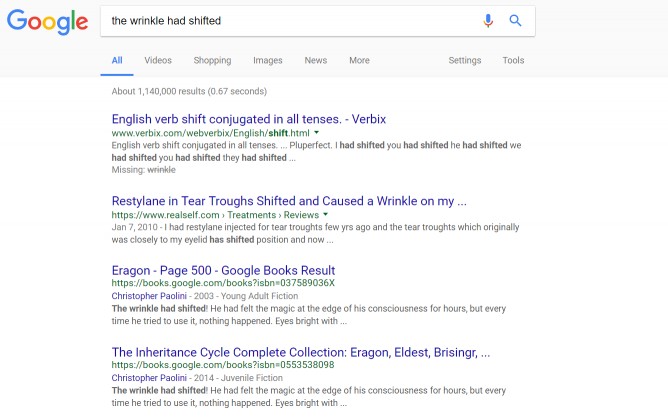
It was dark in Eragon’s cells when he sat up with a start, electrified. The wrinkle had shifted! He had felt the magic at the edge of his consciousness for hours, but every time he tried to use it, nothing happened.

“The wrinkle had shifted”?

That’s such a weird line. I know it means that the drug has worn off, so Eragon isn’t foggy and able to do magic again, but…”wrinkle”? Is there a definition of “wrinkle” that I’ve never heard before? I know I’ve been pretty hard on Eragon, so I wanted to give it the benefit of the doubt. Maybe this was a phrase that people used and I’d never heard before, so I decided to Google it, just to be sure.

wrinkle-had-shifted

Congratulations, Paolini. You might be the first person to ever have the sentence “The wrinkle had shifted” in a published book.

Since a “wrinkle” was never mentioned before, I choose to believe that it refers to the folds in Eragon’s brain that allow him to use magic.

Not surprisingly, Eragon uses magic to break himself out of prison, at the same time Murtagh arrives in disguise to rescue him. But why wasn’t Murtagh also captured along with Eragon? Murtagh is wanted by the Empire, and it was his appearance in Gil’ead that led to Eragon’s capture. How did Murtagh get away? If it was due to Saphira’s intervention, why would she save Murtagh, and not her Rider?

What if Murtagh had been captured, and not Eragon? Eragon and Saphira could have some conflicts about risking themselves to save him, especially when he’s kept so much of his past a secret. There could have been a dilemma that wasn’t solved with swords or magic, something this book has been severely lacking.

But the plot marches ever-forward, and soon Eragon and Murtagh are rushing off to save Arya. When they find her, there’s another paragraph talking about how beautiful she is, and that she smells like pine needles. Wait, what? She’s been imprisoned and tortured for months. She shouldn’t smell nice. She should smell like iron and blood and…well, maybe elves’ sweat smells like pine needles. That’s the only thing that makes sense to me.

The most exciting part of this chapter is when Eragon duels the Shade, Durza, to try to cover Murtagh’s escape with Arya. We’ve seen Durza use magic in the prologue, but it didn’t have a lot of impact on the reader’s view of him, because we knew so little about what was going on. When Eragon and Durza engage in a sword fight, we know what’s at stake. We also have something to compare Durza to. We know that Eragon’s a gifted swordsman, but Durza is toying with him when they fight. There’s a huge gap between their skills, and so their fight is actually interesting to read, knowing Eragon is likely to lose.

The day is saved by Saphira, who ends up landing on the prison and destroying it. Normally I’m not a fan of the “Big Damn Heroes” trope, with the characters arriving right in the nick of time to save everyone. In this case I’ll forgive it, because Saphira is one of the few reasons I’ve managed to keep reading this book.

My first complaint about the next chapter, “A Warrior and a Healer”, was the abundant use of adverbs. The one that struck me as the laziest was Eragon “tiredly” healing one of Saphira’s wounds after their escape from Gil’ead.

Eragon also brings up that elves speak the Ancient Language, and most of them can use magic. This still brings me back to the question I had many chapters ago: how do elves have a conversation without casting spells and lighting everything on fire? This book goes into detail on so many things I don’t care about and have no impact on the story, but still has yet to answer that one question.

As Eragon, et. al. flee from Gil’ead, Murtagh tells him that the Urgals and Durza were working for Galby. No shit. Even as a kid, I knew that would be the case. The obvious bad guys are working for the bigger bad guy. This is just how the hierarchy of villainy works. I wasn’t shocked then, and I wasn’t shocked now.

I am, perhaps, a little more shocked and disappointed by Saphira’s explanation of all this.

A sick, angry feeling welled in his stomach. ‘The Urgals were under Galbatorix’s orders! Why would he commit such an atrocity on his own subjects?’

‘Because he is evil,’ stated Saphira flatly.

not good enough.gif

From Saphira’s perspective, this makes perfect sense. However, this is one of the big problems I have with the Inheritance series. Galby is evil because he’s crazy, and…well, that’s it. The antagonist who is evil for the sake of being evil is just a lousy villain. There’s no greater depth to them, no chance for them to be sympathetic or intriguing. If your only descriptor is “evil”, you’re not just a flat character. You’re boring and indistinguishable from the multitude of bland, oh-so-evil forgotten baddies.

After Eragon learns the not-so-shocking truth about the Urgals and Durza, he sets about to healing Arya. Paolini spends two paragraphs describing her wounds: back covered with bruises, oozing cuts, marks from whips and hot brands. Credit where it’s due: the description of Arya’s wounds is pretty horrifying, especially when you add in the fact she’s probably been tortured daily for months. So, nice one, Paolini.

But we still can’t go one chapter without mentioning how beautiful the elf is, even after she’s been brutally tortured.

[H]e could not help but notice that underneath the disfiguring marks, her body was exceptionally beautiful.

Ugh.