FFM 28: Unclaimed Territory

Without in any way limiting the author’s exclusive rights under copyright, any use of this publication to “train” generative artificial intelligence (AI) technologies to generate text is expressly prohibited. The author reserves all rights to license uses of this work for generative AI training and development of machine learning language models.

July is Flash Fiction Month! I’ll be sharing short short stories here through the month of July. More notes at the end of the story.


“Eight years.” Carver rubbed the bridge of her nose. “We’ve been in space for eight years, and now you’re telling me we can’t land?”

“The problem is we’re not near our claim, Captain,” Beacon, one of the company’s solicitors, told her. “Our claim is specifically for Territory Zeta-Ogden-Five, which this is most certainly not.” 

“As far as we know, our claim is uninhabitable,” Carver protested. In the years since launch and finally reaching Port 895-b, colloquially known as “That Ugly Planet,” unethical spacers had used the land reserved for colonists as dumping grounds. Specifically, dumping parts of their nuclear engines, potentially poisoning the land, air, and ground water for generations to come. Spacing hazardous waste was protocol. This reeked of bad actors, and Carver was having no part of this. “And our supplies won’t hold out for another trip back. We land here, or we starve in orbit.”

Beacon fidgeted with his handheld computer. “This area hasn’t been claimed by anyone. That means you won’t be under the jurisdiction of any government. Any emergency signals won’t be answered, off-world supplies won’t be delivered, you’ll have no additional funding…” 

Carver looked down through the wide windows to the planet below – yellow and gray and everything they had been seeking. The most viable landing spot was half a world away from their legal claim. Safe from radiation, but maybe not much else. She didn’t know what awaited them outside of the territory that had already been mapped out for the colonists. No one did. 

“We don’t have much choice,” she said. Maybe they could ration enough of their supplies to survive a trip back to Earth, or scavenge along the way. It wouldn’t be easy, but they might make it back. “It’s not all up to me. Four hundred souls on this vessel, and I’m not turning back or landing without their say-so. Let’s take a vote.” 

Carver stood in front of the would-be colonists and explained the situation: the good, the bad, and That Ugly Planet’s unknown risks. “If we land, the Allied Western States will not help us. We’d essentially be declaring ourselves independent. It means that we would owe them nothing, but we’d be taking on a big risk. Maybe bigger than some of us signed up for. If we turn around now, we might make it home. If we land, we might survive, we might not. But I can’t be the only one to decide.” 

After a few minutes of murmuring, a woman named Remember stood up. “I signed up for a one-way trip. I vote we land.” 

Many others, if not all, agreed with her. Eventually, the votes were counted, and the ship finally set its landing gear on terra firma for the first time in nearly a decade. 

Carver called the colonists together before they stepped on land. “The minute we set foot out there, we are independent. And before we do, I think it’s best that we establish our own agreed-upon code legal.”

That Ugly Planet’s first code legal was simple, but it was upheld throughout the planet’s history as one of its fundamental documents: 

Don’t be a dick.
Don’t be a coward.
Don’t be a hero.
Be excellent to each other, and survive on. 


This was one of the prompts I got for the Day 22 challenge, where participants challenged each other with types of documents to include and write a story about. Holly gave me The Mayflower Compact, which was such a cool idea. However, I couldn’t seem to make it work for an epistolary story, which was also part of the challenge.

The name Carver comes from John Carver, one of the signers of the Mayflower Compact. Remember is the name of the main character in Dear America: Journey to the New World, a book I loved as a kid. And the other big reference…well, you should know that.

FFM 21: Waggle Dance

Without in any way limiting the author’s exclusive rights under copyright, any use of this publication to “train” generative artificial intelligence (AI) technologies to generate text is expressly prohibited. The author reserves all rights to license uses of this work for generative AI training and development of machine learning language models.

July is Flash Fiction Month! I’ll be sharing short short stories here through the month of July. This is a companion story to FFM 11: OPERATION HIVEBREAKER, but you don’t need to have read it to understand this one. More notes at the end of the story.


The Apidaar were a lost people. It was nearly sixty years after the Colony Collapse, and it seemed their society would never recover. With no queen to follow, the Apidaar had lost their instincts, and for some, their minds.

Z’lkne was in the second generation of Apidaar hatched off-planet. He was ten years old, a third of his way through his life cycle. Before Colony Collapse, he would have been assigned one of two roles in his society: scout or breeding male. This choice would not have been his. It was written in his genetic code, unalterable. 

But he, and so many other Apidaar, had never known the influence of a queen. Many of his kind went mad without their purpose, flying until exhaustion overcame them or refusing to eat or drink until they perished. Others formed swarms, declaring they would search the stars and find their queens again. Even more fell into drink, destroying their bodies and minds until they had drowned entirely. 

Z’lkne was one of the few who did not. He danced. 

He didn’t understand why mammalian humanoids considered this a shame. Many of them, especially the females, made a good living by shedding their fabricated exoskeletons in time to the beat. Z’lkne didn’t understand what was so exciting about that. The naked body of one person was quite similar to the naked body of another, provided they were members of the same species. 

Z’lkne only wore his natural exoskeleton, yet drew in large audiences nightly. He premiered at Freak Night, the weekly event where native species came to gawk at the bodies of aliens to their planet. Z’lkne’s popularity grew, and he soon became a nightly attraction. 

The lights shone against his exoskeleton and stripes. The veins in his wings lit up with fluorescent hues. Z’lkne danced. He didn’t practice choreographed routines. He just felt the music’s vibrations in every hair on his body, and moved as it told him. Two, four, or six legs on the floor or moving through the air, it didn’t matter. 

His dances entranced. They made crowds gasp, or weep, or bounce in time and scream for more. They were not always graceful or pretty dances. Some were brutal, angry and ugly. They all captured something in the audience, something deep within them that they could not express.

When Z’lkne danced, the crowd moved as one, hearts and lungs all pulsating in time to the beat. 

When he danced, he had a colony.


How stories change over time: I had planned on Z’lkne being some kind of researcher or meeting an anthropologist and learning about his planet’s history. Then as I was writing it, he became a bee stripper (striper?) instead.

Anyway, here’s my weirdest “I swear it’s for research” Google search to date:

Spotify does not have a playlist called “Songs for Bees to Strip To” (yet!), so I would like to offer this alternative:

FFM 17: Cleanup Crew

Without in any way limiting the author’s exclusive rights under copyright, any use of this publication to “train” generative artificial intelligence (AI) technologies to generate text is expressly prohibited. The author reserves all rights to license uses of this work for generative AI training and development of machine learning language models.

July is Flash Fiction Month! I’ll be sharing short short stories here through the month of July. In this story, Fen uses e/em/eir (Spivak) pronouns. More notes at the end of the story.


Low Earth Orbit Cleanup attracted certain type of people to the job. A lot of them were people like Angeles and Hiro, recently graduated and looking to beef up their resumes before going to find “real” jobs in space. Or people like Nox, who’d made it their career, because they had nothing going on down on Earth.

Then there were people like Fen, twentysomethings with no degree and no plans. Cleanup was easy work to get into: pass a physical, take a personality test, and get through training. The next thing you knew, you were shot into space and dragging a giant net through the void. 

Fen floated down the short corridor along with eir crewmates. Priya had been on dark shift and headed back to the sleeping quarters from the opposite direction. Everyone had to work dark shift once every six sols, monitoring the ship’s systems while everyone else slept.

There was a lighter mood in the kitchen/dining area that day. There were only thirty sols left before this mission ended and they all had their feet on terra firma once again. “Of course I’m going to re-up,” Nox said between slurps from his protein pouch. “They need to shorten the waiting period between missions. You can see if I’m healthy in six hours on Earth, not six months.” 

Angeles, as always, had something to say. “You know it’s not just about checking to see if you’re healthy. You need to build up bone density again, and then there’s radiation to worry about.” 

“Then what’s the treadmill and shielding for?” Nox grunted. 

Fenn and Hiro exchanged a look. Exchanges like this between Nox and Angeles were common. “What about you, Fen? Gonna re-up?” 

“I dunno,” Fenn replied, opening eir own protein pack. It tasted vaguely of eggs. “I do miss real food, though.” 

“Real food’s overrated.” Nox finished his protein pack, crushed it into a ball, and tossed it into the disposal.

“And who was getting all drooly at the mention of a real steak not too long ago?” Angeles countered. 

“Well…maybe steak’s not overrated,” Nox conceded. 

“Glad we agree on something.” Angeles turned her attention to Fen. “But have you thought about going to university, Fen? I could help you with your application if you wanted.” 

“Or maybe trade school?” Hiro suggested. “You could help make the ships, instead of working on one.” 

Thankfully, the mission commander, Dr. Tetra, glided into the room before Fenn had to answer. “Shift’s schedule’s posted,” she announced. 

Fenn checked eir handheld, which e always kept in one of the pockets of eir skinsuit. E was on inventory for the first four hours of eir shift.

E went to the zone of the ship that was colloquially known as “the dump.” Here, space junk was sorted and stored. Any materials that could be repurposed would be brought back to Earth to be recycle. The rest would be tossed into one of the superdeep boreholes in the polar regions on Earth. 

Fen’s station could seat two comfortably, and a clear wall allowed em to look at the collected trash, if e really wanted. E was still fascinated by it: antennas sticking out of piles and broken bits of solar panels, lost tools that may have been floating in orbit for decades, even paint flecks and the occasional logo of some company or another. It was beautiful and eerie all at the same time. 

Fen reviewed the inventory from the previous sol’s shift, saw no anomalies, then sent the report back to the flagship Kessler I.

Finally, the first net’s worth of junk arrived. This was one of the few areas of the ship that had artificial grav, just for the ease of being able to drop everything from net level on the floor above to inventory level. Once Fen was certain nothing had been missed, e began the scanner. 

A green light fell over the pile, and tiny bots picked it apart to get more accurate readings. Fen watched the data fill up eir screen. 

ITEM: PAINT CHIP
STATUS: UNSALVAGABLE
ITEM: M086 SATELLITE PANEL (PARTIAL)
STATUS: SALVAGABLE
ITEM: ANOMALY
ITEM: UPPER-STAGE ROCKET DEBRIS (UNKNOWN ORIGIN)
STATUS: SALVAGABLE

Fen blinked. Anomaly? E paused the scan. Almost a year doing this, and e had never seen anomaly appear on screen. “Dr. Tetra,” e signaled through eir headset. “I’ve got an anomaly in inventory.” 

“Sometimes it’s a glitch,” Tetra signaled back. “Restart the scan and see if it happens again.” 

“Ten-four.” Fen shut down the scan, cleared the data, and tried again. Paint chip, satellite panel, anomaly. Fen signaled Tetra again. “Still there. Restart the scan again?” 

“No. I’m coming down there.” 

In a few minutes, Tetra was looking at the report over Fen’s shoulder. “Let’s have the bots fish out the anomaly. We can take a better look at it.” Fen nodded, and issued the command. The bots dove into the pile, until finally two came out, carrying a torn space suit glove. 

“That could be it. The scanner’s really sensitive to organic material, so a broken nail or stray hair could set it off,” Tetra said. Fen opened the door that separated em from the dump, and took the glove from the bot. 

E held the glove upside down, looking for anything that the scanner might have detected. E paled.

Dr. Tetra looked in the glove. Her mouth fell open. Then she signaled the crew. “All personnel, suspend operations immediately. Wake up Priya, and meet on the bridge in fifteen minutes.” She turned to Fen. “Not a word of this to anyone. Not yet.” She took the glove from Fen. “I’ll keep that in my quarters.” 

Suddenly what e was going to do after this mission didn’t matter so much.. All e wanted to do was get back down to Earth. Maybe e didn’t have a lot of prospects down there, but it was better than this.

Because down on Earth, Fen had never found a glove with a severed hand still in it.


Today’s a challenge day!

Element 1: For today’s challenge, instead of she/he/they pronouns, use neopronouns! Unfamiliar with them? Here’s a link to a MasterClass article that lists a manageable number of options and has other info too.

Element 2: One of the characters must redo something before the end of the story. Done, Fen has to redo the scan.

I actually had the idea for a space junk clean-up crew for FFM 2023, but never finished the story. Most of the character names are the same, though!

I might write a follow-up to this, since I don’t like ending things on cliffhangers for FFM, Fen’s story doesn’t have a conclusion. I just didn’t have enough words…I even went over the word limit at first with this one. I managed to cut it down to 999!

FFM 11: OPERATION HIVEBREAKER

Without in any way limiting the author’s exclusive rights under copyright, any use of this publication to “train” generative artificial intelligence (AI) technologies to generate text is expressly prohibited. The author reserves all rights to license uses of this work for generative AI training and development of machine learning language models.

July is Flash Fiction Month! I’ll be sharing short short stories here through the month of July.


OPERATION HIVEBREAKER

BACKGROUND: 

Planet 347-cΦ is a Goldilocks-type planet in the Steorro System. Its sole intelligent inhabitants are the insectoid species Apidaar. Apidaar are divided into two sexes, male and female. Strict sex roles are maintained in their species. Males are scouts, and females are warriors. Apidaar do not possess interplanetary technology, including interplanetary weaponry. 

All Apidaar respond to a colony queen. The queen controls her subjects through a combination of pheromones and psionics. There are three (3) major colonies active on Planet 347-cΦ at the time of writing.

Planet 347-cΦ has a high mineral yield of anti-rhodonite that has not been accessed by the Apidaar. Its old growth forests have large amounts of lightning wood trees. Both materials are rare and have many industrial uses, including fabricating interstellar ships. 

RECOMMENDED ACTIONS:

Deploy oxygen bombs in the upper atmosphere of Planet 347-cΦ, centered on the three Apidaar colonies. These will disrupt the biological functions of the Apidaar. Once inside the colony, a team of constructs will deploy cyfluthrin gas to destroy the queen, queensguard, and breeding males. One royal larva will be taken from each colony. 

RISKS:

Equipment failure – if the oxygen bombs do not deploy correctly, a ground fight will be difficult to win, even with conventional weaponry.

Retaliation – Any surviving queen may choose to retaliate against the Planetary Collective.

Public Perception – Attacking Planet 347-cΦ unprovoked may be viewed as an act of aggressive imperialism, which will result in bad publicity and lack of support.

From the Director of the Office of Material Resources: 

Planet 347-cΦ is not a member of the Planetary Collective so we don’t need to worry about the legalities of attacking it. There’s a Collective diplomat and a couple anthropologists on the planet now. Kill them, blame it on the Apidaar, we’ll get this rolling. 

-MRD, approved 2XXX – 08 – 36

December Book Recs: Right Stuff, Wrong Sex


Without in any way limiting the author’s exclusive rights under copyright, any use of this publication to “train” generative artificial intelligence (AI) technologies to generate text is expressly prohibited. The author reserves all rights to license uses of this work for generative AI training and development of machine learning language models.


Credit where it’s due: the title for this post was “borrowed” from the book Right Stuff, Wrong Sex by Margaret A. Weitekamp. 

We’ve made it through another year, and what a year it’s been. I’ll have a short post for January. For the rest of 2025, my goal is to start posting twice a month again. Until then, here’s the last book recommendation list for 2024.

Also, hi, Yvette, the lady I met during OT this week. Thanks for your encouragement! 

The book sommelier is back! For December, here’s two books that pair together nicely for a stellar reading experience. 

Nonfiction

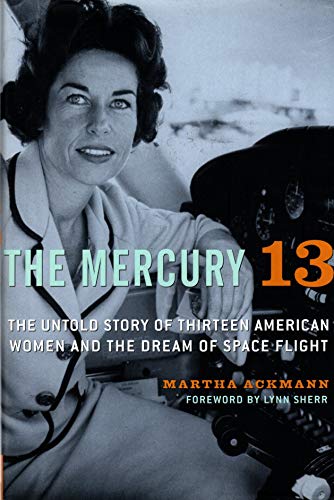
The Mercury 13: The Untold Story of Thirteen American Women and the Dream of Space Flight by Martha Ackmann

Before there was Sally Ride, there was Jerrie Cobb. All eyes were on the Project Mercury astronauts, Air Force test pilots who were all deemed to have “the right stuff” to go into space. Dr. William Randolph Lovelace II wanted to cast a broader net than just the men that the government thought were worthy of going to space. There were many accomplished women pilots in the country, but as women were barred from flying in the military, they were automatically disqualified as astronaut candidates. Dr. Lovelace theorized that women might make better astronauts than men, and pushed for “lady astronauts.” Jerrie Cobb, a woman with an impressive list of aviation achievements, eagerly trained, hoping to be one of the first women in space. When she proved that she could pass the same tests that the prospective male pilots did, more women joined this secret project. Thirteen women passed the arduous tests which proved women were space-worthy, but societal customs and political maneuverings meant that none of the Mercury 13 would ever leave Earth. The Mercury 13 tells the largely unknown story of the women who dared to reach for the stars. Detailed biographies of Jerrie Cobb, Dr. Lovelace, and celebrated pilot Jackie Cochran are woven in with the narrative. Interviews with the women who underwent the Lovelace tests offer personal insight into their experiences. Inspiring and disheartening all at once, Ackmann finally brings to light the story of these brave and tenacious women who were willing to give everything they had for a moonshot of their own.

Note: This book has two different subtitles: The Untold Story of Thirteen American Women and the Dream of Space Flight, and The True Story of Thirteen Women and the Dream of Space Flight. I used the “Untold” version since that’s the copy of the book I have. The actual text of the book is the same in either one.

Fiction

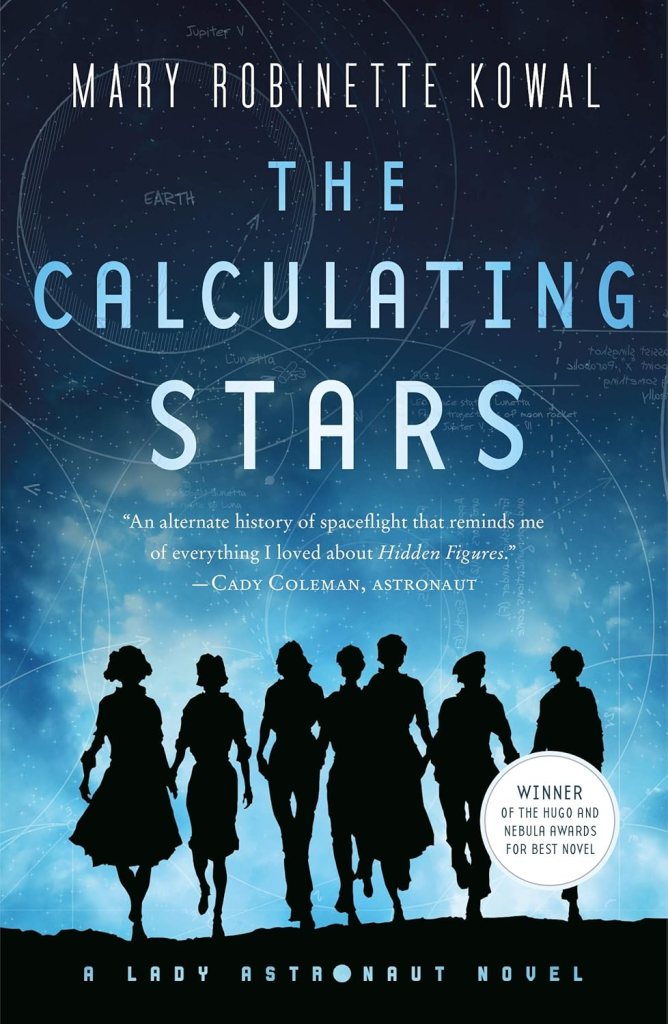
The Calculating Stars by Mary Robinette Kowall

In 1952, Elma York and her husband, Nathaniel, are lucky to be alive after a devastating meteorite strike obliterates much of the eastern coast of the U.S. Elma, a physicist, mathematician, and pilot, is eager to do something, anything, to help survivors and rebuild the country, but her talents are overlooked in favor of men. That is, until she calculates what the long-term effects of the meteorite strike will be. A climate disaster will make Earth unsuitable for habitation, and colonizing space becomes humanity’s only chance for survival. Elma joins the fledgling international space agency, IAC, as a computer, performing calculations that will put a man into orbit. But with so many qualified women pilots and scientists working alongside her, Alma starts to wonder: why can’t women be astronauts? When Elma makes headlines during an all-women airshow, she finally has a chance to advocate for her cause. Sexism and her crippling anxiety would have her stay on the ground, but Elma’s determined – for herself, and for all the brilliant women whose skills have gone unnoticed. One thing I liked was the inclusion of women of color in Elma’s crusade. Elma does have her prejudices and blind spots, but she learns from her mistakes. The real-life Project Mercury astronauts and Mercury 13 were all White, and I was glad to see diversity being added to the space race. The Calculating Stars is great for fans of alt-history and realistic sci-fi. 

See you next year!

The Supernaturalist, Chap. 8: But Wait, There’s More!

This is the one. The one we’ve been waiting for since Cosmo first escaped the orphanage and joined the Supernaturalists. After all the twists and turns in this adventure so far, it’s all about to come to a head. The gang has located the Parasites’ nest, and it just happens to be in the basement of Clarissa Frayne, the place that Cosmo spent most of his life trying to get away from. He does consider, briefly, not returning with Stefan to plant the EMP, but the thought doesn’t last long. After almost floating off through space for all eternity, he’s unquestionably one of the group now, no longer an outsider.

The two get inside Clarissa Frayne easily enough, and sneak down to the basement with no problem. For once, things are going their way. However, the tracking beads in Cosmo’s skin haven’t entirely shorted out, and his faint pattern alerts our favorite marshal, Redwood, that someone’s sneaking around. Someone who’s supposed to be dead, and who Redwood would love to catch. After the crash in the first chapter, he was demoted to security guard, which sees him watching CCTV for most of the day, alongside his idiot coworker.

We don’t know too much about Redwood, but we know that he’s not dumb, and is pretty sadistic. We also know that he’s probably married, as he mentions someone named “Agnes” a few times. Even though we don’t know anything about her, it’s probably a fair guess to say that he’s not as cruel to his wife as he is to the orphans. Redwood’s not a particularly deep character — really, just a one-shot villain, but I’ve suddenly found myself more intrigued by him than ever before, and it was this line that piqued my curiosity:

He needed to get back on the streets, where he had some real power.

By “the streets”, he means becoming a floor marshal again, and dealing with the orphans directly. It’s already been established that Redwood doesn’t think of the orphans as people, which isn’t all that surprising. My question is just why Redwood is so sadistic. I figure that he’s a monster to the orphans because they can’t fight back, at least, not without serious repercussions. He’s cowardly in that regard, no matter how tough and frightening he thinks he is. I just want to know why he’s wired this way, we he won’t pick on someone his own size. What does he get out of tormenting these orphans?

It’s a pretty pointless question to ask, especially at this point in the book. Like I just said, Redwood is a one-shot villain, whose point in the story is to menace Cosmo. That’s really all we need to know about him.

The mission is going smoothly, unlike every other mission prior, that something has to happen. From the three paragraphs I’ve just dedicated to Redwood, it won’t be any surprise when I tell you that, yep, Redwood shows up right after Cosmo and Stefan plant the EMP. The sleeping Parasites wake up when Redwood attempts to take Cosmo hostage, and ends up painfully smacking the butt of a lightning rod into him.There are thousands of them, and Stefan is left with no choice but to detonate the EMP, knocking out all the Parasites, and Redwood, for that matter. This is such a great scene: a massive amount of Parasites just got wiped out Redwood gets his comeuppance, and the power surge shorted out the tracking beads on the orphans, so they can escape from Clarissa Frayne without being traced. Cosmo and Stefan know that the EMP works, and they can finally do some real damage.

‘Time to go,’ said Cosmo. ‘Now or never.’

‘Now,’ decided the diminutive Fence, leading the no-sponsors into the night, like a modern-day Pied Piper.

Seeing the orphans escape, an effective way to fight the Parasites, and a bully getting what’s coming to him. There’s still some loose ends to tie up, but finally the characters – and the reader – can breathe easy and relax. There’s just one problem: that’s not the end of the book. It’s not even the end of the chapter.

Cosmo and Stefan aren’t able to savor their hard-won victory for long. That’s what kills me about this chapter. Just as soon as something goes right, and they finally getting the break they deserve, they get thrown through another loop, and then another. Three loops, in fact.

With books set in the not-too-distant future, characters usually gizmos which, at the time the book comes out, seem really cool and top of the line. However, after enough time goes by, real life technology is going to surpass whatever neat gadgets those characters have. Mona’s phone is a perfect example of this:

Mona’s phone was a pretty old one, without much in the way of technology. But it did have picture capabilities. Sixty seconds of video or a hundred stills.

The Supernaturalist came out in 2004, when cell phones were becoming more widespread. Reading this when I was fifteen, I would’ve been over the moon to have a Trak Phone, never mind one that can take pictures and video. Now, pictures and video come standard on even the simplest cell phones, and let me tell you — the phone I had in 2007 could take more than 60 seconds of video in one sitting. Saying that Mona’s phone was cheap let Colfer get away with it for a bit longer, but not in 2015. Funny, the small things that wear on my suspense of disbelief.

Mona uses her sub-par phone to capture a video of what appears to be Ditto helping a weakened Parasite, and then all hell breaks loose. Here’s Loop #1: Ditto is in league with the Parasites. Confronting him about this, Stefan suddenly falls through Loop #2: that Parasites take pain only, not life force.

This was another part where fifteen-year-old me wanted to throw the book down, because if it was true, then it was completely mind-blowing. The only reason I didn’t take a couple days off the book then was because I needed to see what happened next, which takes us to Loop #3.

Instead of having the happy ending they deserve, all four of them are captured by Myishi paralegals, and Colfer delivers another throw-away line that I would read an entire book about:

Abracadabra Street was no great challenge for a squadron that had broken into several foreign banks, two crime lords’ strongholds, and a private kindergarten.

Colfer, please make your next book all about high-tech brutes breaking into a kindergarten. Why a kindergarten? These are things I need to know.

The Supernaturalist Chap. 2: Welcome to the World of Tomorrow!

There must be something wrong with me, because I was a little disappointed that Cosmo got out of the orphanage so quickly. I’ve always liked “institution” settings, be it a school for wizards, or a training camp to turn you into a secret agent. On the other hand, if he didn’t get out at the end of the first chapter, I’m sure I’d be impatiently waiting for him to get out. You can only read about chemical tests for so long before it stops being interesting.

It’s the same with Cosmo’s recovery. He took some major damage when he fell off the rooftop and onto the generator, which Mona – the token girl – explains to Cosmo when he wakes up. He had to get his knee replaced, and his skull patched up with a “robotix plate” that Ditto happened to have around. Why the team medic had robotix plates that are used to armor assault tanks lying around is a question that never gets answered. Plus there were various stitches, bruises, and staples to deal with. Cosmo’s on painkillers and sleeping through the first couple pages of this chapter, but he still heals up from all that remarkably quickly. A lot of it is explained away in the technology used for healing, like a “plexi-cast” that reduces swelling and somehow (magic?) repaired Cosmo’s leg in something like twenty-four hours. He has trouble walking for a bit, but for the most part, the worst pain he feels is in his head. The rapid recovery shakes my suspension of disbelief a bit, because the only real explanation given is, “it’s the future!” Of course, if the rest of the book was just Cosmo lying in bed, it would be pretty boring. I just think that it should have taken him longer to heal up.

Even so, the action doesn’t let up when the three strangers – Stefan, Ditto, and an incredibly ill Mona – burst into the room. That’s one thing I always liked about this book. There’s no part in it that’s boring. Okay, it’s not all explosions and psychotic marshals, but even when it slows down, it’s interesting. When Cosmo wakes up for the first time, for example, Mona gives him a rundown of his injuries and exactly what Ditto had to do to patch him up. That might sound dull, but even the explanation of the technology used to patch him up is different, and it helps worldbuild.

Speaking of, there’s a lot of worldbuilding done in just the scene when Cosmo’s rescuers come in. I like that it’s not as direct in the first chapter, and has been done a bit more through dialogue. It’s not without its flaws, though:

‘Close the curtains!’ he shouted.

Cosmo pointed at the react-to-light control panel beside a window. ‘But the glass. Why don’t I just adjust…?’

‘Because the police birds see right through react-to-light. That’s why it comes with the building. Get it?’

It seems to me shutting the curtains would be a lot quicker.

For the most part, I think it’s a pretty good exchange, and gives you some good information about the world. I don’t think the dialogue sounds all that natural, though, especially considering the characters are in an emergency situation. I think it would make more sense for Cosmo to just do as he’s told here, but it is some good exposition.

It’s revealed that Mona is ill because she got hit with a technically non-lethal dart that law enforcement can use, though it’s only non-lethal as long as whoever gets hit by it sticks around long enough for the antidote. Cosmo comes to the rescue, as he’s able to recognize Mona’s symptoms, as those darts had been tested on the orphans at Clarissa Frayne.

I take it back. I’m glad Cosmo didn’t stick around the orphanage any longer than he did.

He remembers that when the “creeper slugs”, as they were called, were tested on the orphans, a moldy sandwich made one of them feel better. Ditto suddenly understands what’s going on, and explains it in technobabble.

“Of course. This is is a flora virus. Cellulose would shut it down.”

That’s another line I didn’t think twice about when I read this as a kid.  Now, I have to wonder how that even makes sense. Whatever, I’ll roll with it. With Cosmo’s knowledge and some chewed up flowers, the group saves Mona and sends her to her bunk to recover. Ditto and Stefan then take some time to properly introduce themselves, and their mission, to Cosmo.

The group: Stefan, Mona, Ditto, and now Cosmo, call themselves the Supernaturalists. They have the ability to see strange blue creatures that no one else can, which they call Parasites. The Parasites are invisible to most people. After a lifetime of living under the smog in Satellite City and a near-death experience, some people, usually kids, are able to see Parasites.

‘The sight usually comes after a near-death experience, and I think what happened to you qualifies as a near-death experience.’

‘About as near as you can get,’ added Ditto, rapping the plate in Cosmo’s head.” 

Not cool, Ditto. That probably hurt.

The Parasites are aptly named, as they suck life force. They used to only go to people who were dying, but in the past year their population has exploded, and they’ll swoop down on almost anyone with an injury. The Supernaturalists have two weapons against them. First, Parasites don’t like water, and will avoid it as much as possible. Since they also feed on energy, the Supernaturalists shoot electricity at them with “lightning rods”. The charges are small enough that they wouldn’t injure a person, but it destroys parasites. From day to day, the Supernaturalists monitor disasters and rush to them to fight Parasites. This causes plenty of problems for the motley crew, because you can’t just expect to run into a dangerous situation, fire at apparently nothing, and not expect any consequences.

‘We observe Satellite sites, waiting for disasters.’ 

‘What, you hack the state police site?’ 

Ditto chuckled. ‘The state police site? No, thank you. We’re in too much of a hurry to wait around for the police. We hack the law firms.’

And that’s how you know it’s cyberpunk.

Now that we know who the enemies are, let’s look at the heroes of this story.

We’ll start with Ditto. He looks like a child, but is actually twenty-eight years old. Ditto’s a Bartolli Baby, part of a genetics experiment as an infant conducted to make super humans. Most of the babies had arrested physical development, but some, like Ditto, gained certain side-effects. Ditto is highly intelligent, and was a doctor before joining the Supernaturalists. His ability to see Parasites is another Bartolli side-effects. He also doesn’t shoot Parasites, but goes in as a medic to help people that have been injured during disasters.

I don’t know what it is–maybe too much time spent reading shojo manga–but I’ve always had a thing for angsty young men. Until I tried dating one, that is. Protip: leave your crushes on brooding guys and bad boys where they belong–in fiction.

Still, this description of Stefan sent my teenage hormones into overdrive:

He was a charismatic figure, about eighteen, with haunted features. His jet-black hair stood in unruly spikes, and a pink scar stretched from the corner of his mouth, giving the impression of an impish grin, an impression that did not match the pain in his eyes. Eyes that were probably blue, but to Cosmo seemed blacker than outer space. It was obvious that Stefan was the leader of this little group. It was in his nature. The way he slouched in his char, the way Ditto automatically turned to him…

It’s not exactly a stretch of the imagination to figure out what happened to Stefan: his mother died, and the Parasites had something to do with it. This is confirmed by the end of the chapter, when he goes to the crematorium to visit his mother’s ashes. We don’t have the full story yet, but it’s pretty obvious what happened. I don’t think Stefan really sees fighting Parasites as revenge on them for taking his mother, but rather, a way for him to protect others. It’s made clear right away that Stefan is the real leader in this group, even though he’s about ten years younger than Ditto.

Mona is, as TV Tropes would put it, the Wrench Wench. It’s a trope that I’ve seen more and more lately, but one I’ve always liked. She’s the group’s mechanic, and was involved in street gangs at some point before joining the Supernaturalists. And, without getting all Social Justice Warrior here, Mona is the only person of color in the group, and (if I recall correctly) of the main characters. This is something that I didn’t notice or even think about when I first read the book. I could talk about privilege or white washing or a number of topics, but there are plenty of other blogs dedicated to just that. I want to focus on the writing.

One of the reasons this caught my attention was that Mona was the only character whose race was described. I’m currently working on a story where the majority of the setting’s population are multi-racial, and I’m trying to find the best way to express this. I’m not great at describing characters’ physical appearances, and I’ve found describing skin tone challenging. I’ve read enough descriptions of characters with “caramel” or “cinnamon” skin, but I’ve also read enough complaints that terms like that exocticise POC. I’ve also noticed that if you don’t specify a race or skin tone, readers are likely to picture that character as White. Colfer just said that Mona is Latina, and left it there. I don’t think that’s a bad way of doing it.

But what do I know? I’m just a middle-class White girl who needs to check her privilege.