FFM 28: Unclaimed Territory

Without in any way limiting the author’s exclusive rights under copyright, any use of this publication to “train” generative artificial intelligence (AI) technologies to generate text is expressly prohibited. The author reserves all rights to license uses of this work for generative AI training and development of machine learning language models.

July is Flash Fiction Month! I’ll be sharing short short stories here through the month of July. More notes at the end of the story.


“Eight years.” Carver rubbed the bridge of her nose. “We’ve been in space for eight years, and now you’re telling me we can’t land?”

“The problem is we’re not near our claim, Captain,” Beacon, one of the company’s solicitors, told her. “Our claim is specifically for Territory Zeta-Ogden-Five, which this is most certainly not.” 

“As far as we know, our claim is uninhabitable,” Carver protested. In the years since launch and finally reaching Port 895-b, colloquially known as “That Ugly Planet,” unethical spacers had used the land reserved for colonists as dumping grounds. Specifically, dumping parts of their nuclear engines, potentially poisoning the land, air, and ground water for generations to come. Spacing hazardous waste was protocol. This reeked of bad actors, and Carver was having no part of this. “And our supplies won’t hold out for another trip back. We land here, or we starve in orbit.”

Beacon fidgeted with his handheld computer. “This area hasn’t been claimed by anyone. That means you won’t be under the jurisdiction of any government. Any emergency signals won’t be answered, off-world supplies won’t be delivered, you’ll have no additional funding…” 

Carver looked down through the wide windows to the planet below – yellow and gray and everything they had been seeking. The most viable landing spot was half a world away from their legal claim. Safe from radiation, but maybe not much else. She didn’t know what awaited them outside of the territory that had already been mapped out for the colonists. No one did. 

“We don’t have much choice,” she said. Maybe they could ration enough of their supplies to survive a trip back to Earth, or scavenge along the way. It wouldn’t be easy, but they might make it back. “It’s not all up to me. Four hundred souls on this vessel, and I’m not turning back or landing without their say-so. Let’s take a vote.” 

Carver stood in front of the would-be colonists and explained the situation: the good, the bad, and That Ugly Planet’s unknown risks. “If we land, the Allied Western States will not help us. We’d essentially be declaring ourselves independent. It means that we would owe them nothing, but we’d be taking on a big risk. Maybe bigger than some of us signed up for. If we turn around now, we might make it home. If we land, we might survive, we might not. But I can’t be the only one to decide.” 

After a few minutes of murmuring, a woman named Remember stood up. “I signed up for a one-way trip. I vote we land.” 

Many others, if not all, agreed with her. Eventually, the votes were counted, and the ship finally set its landing gear on terra firma for the first time in nearly a decade. 

Carver called the colonists together before they stepped on land. “The minute we set foot out there, we are independent. And before we do, I think it’s best that we establish our own agreed-upon code legal.”

That Ugly Planet’s first code legal was simple, but it was upheld throughout the planet’s history as one of its fundamental documents: 

Don’t be a dick.
Don’t be a coward.
Don’t be a hero.
Be excellent to each other, and survive on. 


This was one of the prompts I got for the Day 22 challenge, where participants challenged each other with types of documents to include and write a story about. Holly gave me The Mayflower Compact, which was such a cool idea. However, I couldn’t seem to make it work for an epistolary story, which was also part of the challenge.

The name Carver comes from John Carver, one of the signers of the Mayflower Compact. Remember is the name of the main character in Dear America: Journey to the New World, a book I loved as a kid. And the other big reference…well, you should know that.

FFM 11: OPERATION HIVEBREAKER

Without in any way limiting the author’s exclusive rights under copyright, any use of this publication to “train” generative artificial intelligence (AI) technologies to generate text is expressly prohibited. The author reserves all rights to license uses of this work for generative AI training and development of machine learning language models.

July is Flash Fiction Month! I’ll be sharing short short stories here through the month of July.


OPERATION HIVEBREAKER

BACKGROUND: 

Planet 347-cΦ is a Goldilocks-type planet in the Steorro System. Its sole intelligent inhabitants are the insectoid species Apidaar. Apidaar are divided into two sexes, male and female. Strict sex roles are maintained in their species. Males are scouts, and females are warriors. Apidaar do not possess interplanetary technology, including interplanetary weaponry. 

All Apidaar respond to a colony queen. The queen controls her subjects through a combination of pheromones and psionics. There are three (3) major colonies active on Planet 347-cΦ at the time of writing.

Planet 347-cΦ has a high mineral yield of anti-rhodonite that has not been accessed by the Apidaar. Its old growth forests have large amounts of lightning wood trees. Both materials are rare and have many industrial uses, including fabricating interstellar ships. 

RECOMMENDED ACTIONS:

Deploy oxygen bombs in the upper atmosphere of Planet 347-cΦ, centered on the three Apidaar colonies. These will disrupt the biological functions of the Apidaar. Once inside the colony, a team of constructs will deploy cyfluthrin gas to destroy the queen, queensguard, and breeding males. One royal larva will be taken from each colony. 

RISKS:

Equipment failure – if the oxygen bombs do not deploy correctly, a ground fight will be difficult to win, even with conventional weaponry.

Retaliation – Any surviving queen may choose to retaliate against the Planetary Collective.

Public Perception – Attacking Planet 347-cΦ unprovoked may be viewed as an act of aggressive imperialism, which will result in bad publicity and lack of support.

From the Director of the Office of Material Resources: 

Planet 347-cΦ is not a member of the Planetary Collective so we don’t need to worry about the legalities of attacking it. There’s a Collective diplomat and a couple anthropologists on the planet now. Kill them, blame it on the Apidaar, we’ll get this rolling. 

-MRD, approved 2XXX – 08 – 36

December Book Recs: Right Stuff, Wrong Sex


Without in any way limiting the author’s exclusive rights under copyright, any use of this publication to “train” generative artificial intelligence (AI) technologies to generate text is expressly prohibited. The author reserves all rights to license uses of this work for generative AI training and development of machine learning language models.


Credit where it’s due: the title for this post was “borrowed” from the book Right Stuff, Wrong Sex by Margaret A. Weitekamp. 

We’ve made it through another year, and what a year it’s been. I’ll have a short post for January. For the rest of 2025, my goal is to start posting twice a month again. Until then, here’s the last book recommendation list for 2024.

Also, hi, Yvette, the lady I met during OT this week. Thanks for your encouragement! 

The book sommelier is back! For December, here’s two books that pair together nicely for a stellar reading experience. 

Nonfiction

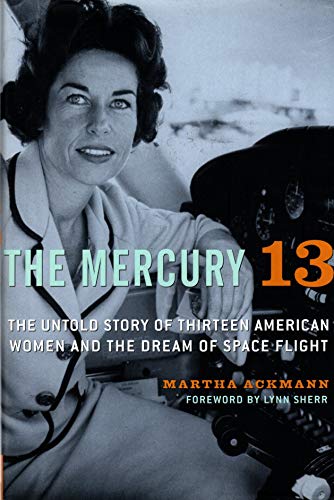
The Mercury 13: The Untold Story of Thirteen American Women and the Dream of Space Flight by Martha Ackmann

Before there was Sally Ride, there was Jerrie Cobb. All eyes were on the Project Mercury astronauts, Air Force test pilots who were all deemed to have “the right stuff” to go into space. Dr. William Randolph Lovelace II wanted to cast a broader net than just the men that the government thought were worthy of going to space. There were many accomplished women pilots in the country, but as women were barred from flying in the military, they were automatically disqualified as astronaut candidates. Dr. Lovelace theorized that women might make better astronauts than men, and pushed for “lady astronauts.” Jerrie Cobb, a woman with an impressive list of aviation achievements, eagerly trained, hoping to be one of the first women in space. When she proved that she could pass the same tests that the prospective male pilots did, more women joined this secret project. Thirteen women passed the arduous tests which proved women were space-worthy, but societal customs and political maneuverings meant that none of the Mercury 13 would ever leave Earth. The Mercury 13 tells the largely unknown story of the women who dared to reach for the stars. Detailed biographies of Jerrie Cobb, Dr. Lovelace, and celebrated pilot Jackie Cochran are woven in with the narrative. Interviews with the women who underwent the Lovelace tests offer personal insight into their experiences. Inspiring and disheartening all at once, Ackmann finally brings to light the story of these brave and tenacious women who were willing to give everything they had for a moonshot of their own.

Note: This book has two different subtitles: The Untold Story of Thirteen American Women and the Dream of Space Flight, and The True Story of Thirteen Women and the Dream of Space Flight. I used the “Untold” version since that’s the copy of the book I have. The actual text of the book is the same in either one.

Fiction

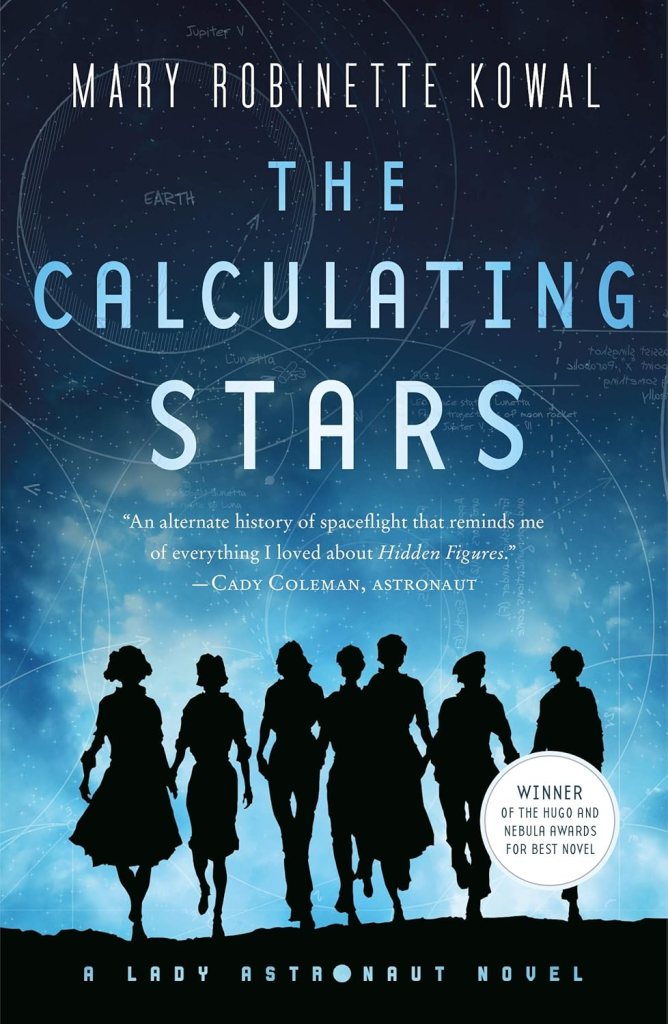
The Calculating Stars by Mary Robinette Kowall

In 1952, Elma York and her husband, Nathaniel, are lucky to be alive after a devastating meteorite strike obliterates much of the eastern coast of the U.S. Elma, a physicist, mathematician, and pilot, is eager to do something, anything, to help survivors and rebuild the country, but her talents are overlooked in favor of men. That is, until she calculates what the long-term effects of the meteorite strike will be. A climate disaster will make Earth unsuitable for habitation, and colonizing space becomes humanity’s only chance for survival. Elma joins the fledgling international space agency, IAC, as a computer, performing calculations that will put a man into orbit. But with so many qualified women pilots and scientists working alongside her, Alma starts to wonder: why can’t women be astronauts? When Elma makes headlines during an all-women airshow, she finally has a chance to advocate for her cause. Sexism and her crippling anxiety would have her stay on the ground, but Elma’s determined – for herself, and for all the brilliant women whose skills have gone unnoticed. One thing I liked was the inclusion of women of color in Elma’s crusade. Elma does have her prejudices and blind spots, but she learns from her mistakes. The real-life Project Mercury astronauts and Mercury 13 were all White, and I was glad to see diversity being added to the space race. The Calculating Stars is great for fans of alt-history and realistic sci-fi. 

See you next year!

The Supernaturalist Chap. 7: Spaaaaaace!

I don’t think there’s any rules that are set in stone when it comes to dividing chapters. As far as I can tell, you should make sure that each chapter ends on a note that will make your readers want to know what happens next, and that’s about it. How long or short each chapter is depends on the author and the story. I wish that Colfer had broken chapter seven up a bit more, though, because the chapter length feels uneven with the rest of the novel so far. For instance, Chapter 1 starts with Cosmo wanting to escape Clarissa Frayne, it ends with him doing just that. It’s nice and contained, and propels the story forward. Chapter 7, on the other hand, begins with Stefan sulking as he and Cosmo make their way home, and ends with the Supernaturalists in space. That’s a pretty big leap. There’s enough room for two or three chapters here by the time this one ends.

Stefan finally tells Cosmo his story, too, and it’s nothing we couldn’t figure out. He and his mother were in an accident and badly injured, he watched the Parasites suck his mother’s life energy away until she died. Stefan, in true Angsty Male Lead fashion, blames himself. There were plenty of hints strewn throughout the previous chapters, and his reveal really only serves to add more details to what we already knew – or, at least, assumed we knew. I like to give characters the benefit of the doubt, though, and hope that they’ll surprise me.

Though I didn’t grant this to Snape after reading Harry Potter and the Half-Blood Prince, which resulted in me feeling stupid when I read Deathly Hallows. And I only cried a little bit!

There’s also Cosmo’s awkward flirting with Mona. One great thing about fiction is that it elevates us, and takes us to places we’ve only imagined. We can live vicariously through the characters we cheer on; their triumphs are our triumphs. Our heroes are dashing and handsome and bold, and everything we’re not. Okay, saying the perfect thing at the perfect time is pretty unrealistic, and that’s why characters need to have flaws. We may want to be like them, but we also have to be able to relate to them.

Which is probably why I found Cosmo’s bungled flirting with Mona so cringe-worthy when I was a teenager, and adorable now.

‘Are you coming in, or are you just going to stand there?’ said Mona, without opening her eyes.

Cosmo tried to speak. Say something clever, he ordered his brain.

It’s not going to happen, replied his brain. You have enough spare cells for one word. Make it a good one. ‘Coffee,’ blurted Csomo. It could have been a lot worse under the circumstances.

It was so relatable to me then, because I only wished that I had the courage to talk to the guy I liked in high school. Because he was cute, and popular, and was in a band, and why would he ever want to hang out with someone like me? So, Cosmo, I applaud you, for taking a shot with a girl who you think is out of your league. However bungling a conversationalist you may be.

Mona stretched like a cat, her wiggling toes peeking out from under the unzipped sleeping bags.

‘Little piggies,’ said Cosmo’s mouth before he could stop it. [. . .]

Mona stared at him. ‘Have you ever had, like, a conversation with another person before?’

The story moves on with the Supernaturalists leaving Satellite City, and we see what the world outside the city, and the Satellite’s footprint – look like. Like the “One World Treaty” mentioned a few chapters ago, there are so many things that make me want to read more about the universe this novel takes place in. We’re never told where, geographically, Satellite City is, but outside of it is desert. The narration implies that this wasn’t here naturally, either. It was somehow man made. How? Global warming, nuclear strike, a massive build up of toxins? What turned a (presumably) habitable area into a desert? I want to know these things. Colfer, write a book explaining the basic history of The Supernaturalist universe, kplzthx.

People from the City are legitimately frightened of going to this apparent wasteland. Cosmo and Mona are curious to see what’s outside of the City, but Ditto is pretty uncomfortable with the whole idea.

Ditto shuddered. ‘This place gives me the creeps. You know they don’t have Satellite TV here? Some houses only have ten or fifteen illegal stations. What do they do all day?’

Now, this is where things start to get weird.

To find the Parasites’ nest, our rag-tag heroes need to find a way to track them, and eventually decide to use the Satellite to do so. It’s not something they can do on the ground, though, so they decide to go to space.

Okay, I can roll with a Satellite controlling everything in the city, invisible creatures sucking the life out of people, and rappelling lawyers. What I have a harder time getting behind is space travel. Even if technically they’re actually not going very far out of the Earth’s atmosphere. As a kid, I didn’t like this part because I didn’t think it fit in very well with the rest of the story.

As an adult, I don’t like this part because none of them is qualified to go to space. A big part of my current job is running a space camp for kids, I’ve met (and been hugged by) a real life astronaut, and I know way more about the International Space Station than any twentysomething with a non-STEM degree should know. In other words, I’m a space nerd. Always have been.

So, even though it’s the future and a lot of technology has changed, I’m still calling shenanigans on the space adventure.

First of all, there’s the preflight check. Mona goes through a checklist to determine if the small ship they’ll be using is safe to fly in. Which made perfect sense to me the first time I read this. Mechanic works on engines, therefore mechanic can figure out all engines.

I may not be handy, but I can still figure out basic car stuff: adding various fluids, changing wipers, fixing a flat. But those skills don’t translate to a spaceship. If the “low air pressure” came on in my car, I know exactly what to do. If it came on in the space shuttle, I wouldn’t have a clue what to do, and we would all probably die. It really bothers me that Mona, who’s most likely never worked on a spacecraft of any kind, has enough mechanical expertise to do a prelaunch check on the HALO (high-altitude low-orbit spacecraft) they’ll be using, instead of, say, the guy who actually owns it. I’m pretty sure engine work on cars, no matter how souped-up they may be, doesn’t translate to engine work on spaceships.

Of course, with so much depending on the Satellite, there are plenty of small spacecraft traveling up to it, owned by private companies. The way it’s written, it sounds like going up to the Satellite is just a regular day at the office, even if you’re not one of the “disc jockeys” who are responsible to maintain it.

But the other thing that bothered me about this foray outside the atmosphere is a throwaway line about space suits. It turns out Stefan can’t fit in the one usable suit on board, but Mona chimes in that space suits are one-size-fits-all.

Like Musica’s magical sobriety in Rave Master 2, this one line made we want to do a table flip. Because space suits are not one size fits all, and every. individual. astronaut. gets a suit fitted personally to them. This is how space works.

I think most people would give this a by, but I can’t, and the only reason for that is because I know way too much about space travel as it works right now. There’s plenty to like about this chapter, but this is one thing that I don’t.

On the plus side, we see more and more of Cosmo’s emerging personality. He’s only been with the group for a few days, and as action-packed as they were, he’s still a bit of an outsider. This is the chapter where he seals the deal, by volunteering to put on the suit that doesn’t fit Stefan and going out into space to get onboard the Satellite and use a panel that will sweep the city for energy leaks. The highest concentration of those energy leaks is where the Parasites will be drawn to, therefore, their nest. When something goes wrong with the Satellite, he ends up getting launched into space, and survives only by getting incredibly lucky. If running around on rooftops and learning Stefan’s story didn’t make him a full-fledged member of the group, this certainly did.

Cosmo’s grown from a kid with no idea about his future beyond Clarissa Frayne, and not much of a character himself, to someone pretty gutsy, and loyal to the people who took him in. So much so that he risks his life for their mission. Congratulations, Cosmo, you’re finally figuring out how to be a person, just like we both wanted.