Any use of this publication to “train” generative artificial intelligence (AI) technologies to generate text is expressly prohibited. I do not consent to this work being summarized or fed to generative AI, and anyone who does so is a big dweeb.
Content warning: this post discusses sexual abuse of a minor.
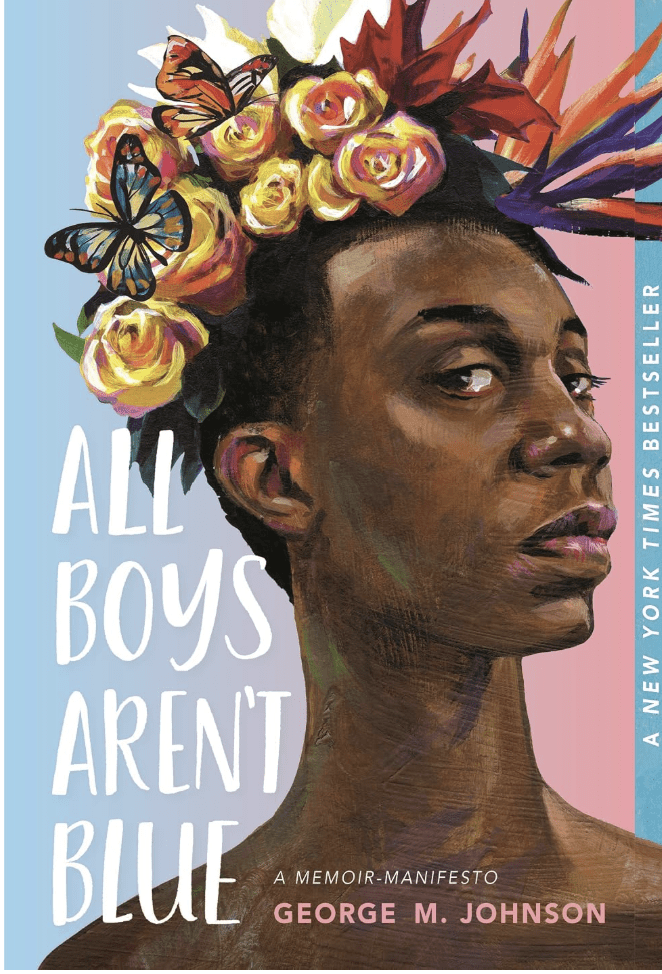
All Boys Aren’t Blue by George M. Johnson, a “memoir-manifesto” of growing up queer and Black, was published in April 2020. In the six years since its publication, it has been one of the most frequently banned and challenged books in the United States. It ranked in the top 10 most frequently challenged books in 2022, 2023, 2024, and 2025. It also got rave reviews from professional book review magazines, was a New York Times best seller, and received many accolades from various media outlets.
The book was challenged, banned, and removed from multiple schools and libraries across the U.S. for containing LGBTQ+ content and for being sexually explicit. This isn’t surprising, unfortunately. In the past 10 years, the overwhelming majority of books that have been challenged and banned are because of LGBTQ+ or sexual content, as well as discussions of race, prejudice, and discrimination.
So, I sat down to read it.
All Boys Aren’t Blue is the story of Johnson’s life, beginning in kindergarten and ending with his college graduation. It has a violent start: Johnson gets his teeth kicked in when he and his cousins were jumped walking home from school. With that kind of start, I expected a trauma-laced memoir. However, All Boys Aren’t Blue is much sweeter than I anticipated
The book is divided into four sections: A Different Kid, Family, Teenagers, and Friends. “A Different Kid” is about Johnson’s early childhood. Johnson was effeminate and sassy from a young age, which made him stand out from the other children. While he might not have understood that he was gay yet, he did understand that he wasn’t like the other kids. Much of this section is about his experience growing up as a Black boy. One chapter I really liked was “‘Honest Abe’ Lied to Me.” It talked about the importance of teaching Black history, but also how Black history has been whitewashed in schools. The chapter title comes from the prevailing narrative that Abraham Lincoln freed enslaved people because he was a Good White Man, when the truth is more complicated.
He also takes on the thought-terminating cliché “it was the norm” when it comes to justifying enslavement. The book Cultish: The Langauge of Fanaticism by Amanda Montell introduced me to the term “thought-terminating cliché.” A thought-terminating cliché is a pithy phrase usually used to stop a conversation or dismiss an argument. You’ve probably heard and used dozens of these: it is what it is; everything happens for a reason; pray on it; it was the norm. A thought-terminating cliché discourages you from diving deeper into a topic. I don’t think all thought-terminating clichés are necessarily bad. Sometimes you really do just need to say “c’est la vie” and move on with your life. But when you become aware of thought-terminating clichés, you can ask yourself what the purpose of using it might be.
Johnson writes,
You’ll find that people often use the excuse ‘it was the norm’ when discussing racism, homophobia, and anything else in our history they are trying to absolve themselves of. Saying that something was ‘a norm’ of the past is a way not to have to deal with its ripple effects in the present. It removes the fact that hate doesn’t just stop because a law or the time changed. Folks use this excuse because they are often unwilling to accept how full of phobias and -isms they are themselves—or at least how they benefit from social structures that privilege them.
While most of the first section is about Johnson growing up as a Black boy, he also shares his early experiences of anti-queer sentiment. This is most notable in the chapters “Honeychild” and “F**s Play Football, Too.” Both of these chapters center around masculinity, and how Johnson’s peers perceive him for not conforming to their expectations of what boys should act like.
“Part 2: Family” is where we start getting into some of the controversery surrounding this book. Yet it’s also full of such tender stories of family love. It opens with a letter to Johnson’s younger brother, sharing memories of growing up together and looking towards the future. Later, there’s a loving letter to Johnson’s mother. Johnson explores his relationship with his father, and how they had a hard time connecting, until Johnson’s dad discovered their common interest in football.
The first section of this memoir didn’t mean much to me, but I’m also not the target demographic. This is where it started to resonate with me. Johnson and I are close in age, and I think our dads share the same characteristics of many men of their generation. They’re not always great at expressing emotion, but they show their love in other ways. For both of our dads, that means gifts and acts of service. While Johnson and his dad used sports as a way to connect, my dad and I used nature. He may not be a talkative person, but the way he always makes sure we’re prepared for a hike and does more than he needs to whenever I need a hand says it all.
Another sweet chapter is “Nanny: The Caregiver, the Hustler, My Best Friend.” Johnson talks about the ways his grandmother shaped his life, teaching him how to hustle at flea markets, and helping him start his own “business” selling candy. As he looks back on all the things Nanny did with him, he realizes that Nanny loved him in exactly the way that he needed.
It took me until the end of high school to realize what she was doing with all of this hustling. It wasn’t simply because she thought I was smart and should learn how to create income. It wasn’t simply because she wanted me to be a caring person who gave back to the community. She wanted me to be all those things, yes, but most importantly, she didn’t want me to be alone. [. . .] I was becoming isolated around the age of ten, and she saw it. [. . .] Like the natural born caregiver she was, my grandmother frequently placed me before herself. Even if that meant she was carrying a young child with her everywhere, she wasn’t going to let me be alone. Nanny decided that she would be my circle.
Every child should be so lucky as to have a grandmother like Nanny.
The chapter “Losing Hope” is where I expected most of the controversy to lie. Hope was Johnson’s cousin, a trans woman. Some of the controversy comes from the inclusion of a trans person, which is enough to get many books challenged today. It doesn’t matter that nothing salacious happens in the chapter, only that Hope exists and her family loves and supports her. That’s enough to challenge a book.
But another part of the controversy comes from the language Johnson uses. At the start of the chapter he uses Hope’s deadname and calls her a boy. At the very beginning, Johnson writes “I’m going to write this in the only language I knew at the time—in my adolescent years before I had a full understanding of transphobia and the actions that feed into it.”
This chapter is full of love and admiration for Hope. She helped Johnson understand that he was queer, and that the LGBTQ+ community exists. At the beginning of the chapter Johnson and Nanny learn that Hope is transitioning. Johnson refers to Hope by her chosen name throughout the chapter, though initially the other members of his family use her deadname. The whole family eventually starts calling Hope by her name and using the correct pronouns. Johnson is still young, and he’s learning about gender identity along with his family. As they do, their language changes.
As a cis person, I didn’t have a problem with this. If Johnson had kept calling Hope by her deadname or continued using the wrong pronouns, it would have been an issue for me. Johnson learned and changed his language when he was a kid; the way he’s written this chapter reflects that evolution. It makes narrative sense. Yet, I think critiques of this chapter for the language Johnson uses are totally valid as well.
A couple years ago I went to BAM! – Books, Art, Music Festival in West Palm Beach, FL. There are some big name authors at the event every year, running panels and signing books.1 George M. Johnson was a featured author one a panel about YA books and metal health. At the panel, the authors were asked if there was anything in their books that they would write differently now, and Johnson mentioned this chapter. He wasn’t certain if he would or should change it for future reprints. So if you’re waffling on your feelings on this chapter, don’t worry: Johnson is too.
That brings us to “Part 3: Teenagers.”
This is also the section of the book where Johnson writes about experiencing sexual abuse. If you’d rather not read this, skip down to “Part 4: Friends” in bold letters.
Johnson was sexually abused by an older male cousin. In plain text, Johnson details what this cousin did to him. It’s graphic and deeply uncomfortable to read. This chapter is also commonly cited as a justification for this book’s removal from schools and libraries. To be honest, I understand this reasoning. Johnson lived through a horrible thing, and of course I want to shield young people from it.
However, this isn’t a novel. This is a memoir, and it is something a real person survived. This event is ugly and disgusting, but it’s still part of Johnson’s story. Sexual abuse is also a part of many, many people’s real life stories.2 Survivors should be able to talk about their experiences. Sharing them can be healing, empowering, and can give comfort and guidance to others. If you can live through it, you should be allowed to read about it.
Many challenges to All Boys Aren’t Blue call this chapter pornographic. It is explicit, but I don’t find it pornographic. Pornography is hard to define, but I think the creator’s intention really matters. In my opinion, pornography is something that is purposefully created to arouse the audience. Sexual assault, especially when it involves a minor, should not be conflated with pornography. Even our language around sexual acts involving minors has changed in recent years. What was once commonly known as “child porn” is now referred to as child sex abuse material, or CSAM. That’s exactly what it is: abuse.
This chapter was the most troubling for me to read, for many reasons. It was one of the rare times when I understood the complaints leveled at this book. It made me question who the intended audience is. While I believe that kids can and should read about hard things, should they read about it with this level of detail? If I were handing this book to someone in the library, what would I say?
I also want to talk about how the chapter ends. After he grew up, Johnson realized that his cousin had likely been sexually abused as well. He understands the probable reasons his cousin abused him. Johnson’s final note about this event in his life is really important:
This story is complicated, but I don’t want it to be confusing. I was an adult when I found empathy for my cousin, a choice I made in processing all that happened that night. I want to reiterate his actions were wrong, and I was a victim. It is not a requirement that you ever find empathy for an abuser. Make it a requirement to hold your abuser accountable.
The rest of this section is stories of high school and starting college, and what it was like for Johnson to hide his sexuality. There’s nothing as shocking as what we just read in this section, or in the rest of the book, for that matter.
Part 4: Friends
“Part 4: Friends” has another controversial chapter, entitled “Losing My Virginity Twice” which recounts Johnson’s first consensual sexual experiences. There are straightforward details, like before, but the descriptions of sex are short. Because it’s between two consenting adults, it’s also not nearly as uncomfortable to read. He also makes that point that sex should be pleasurable, and you should be able to tell your partner when something doesn’t feel good — a lesson that everyone should take to heart, no matter their gender or orientation.
Finally, the book concludes with the unexpected death of one of Johnson’s frat brothers, college graduation, and an afterword from Johnson. In it, he writes,
Whether this book is a bestseller or a flop, if one person is helped by my story, then it was all worth it.
Then I had to figure out how I felt about it.
I guess the first thing that I would say about the book is that it’s fine. The prose isn’t bad, but it’s not stellar. Many of Johnson’s stories are very sweet. I didn’t get much out of it as a reader. That’s okay. I’m not the target audience. I’m sure that this book has been deeply meaningful to many people; I’m just not one of them.
When I read a challenging book like this, I ask myself, “as a librarian, who would I hand this to?”
With All Boys Aren’t Blue, that’s a really difficult question. Not because I think it should be removed, but because the sexual content gives me pause. As much as I want young queer and BIPOC individuals to be able to see themselves in their books, I wouldn’t hand this to a child or young teen. I would recommend this to someone 16 or older, which is prime time for figuring out who you are. While I have mixed feelings on trigger warnings, I would also recommend that this hypothetical reader read the author’s note at the start of the book, since the memoir goes into some sensitive territory.
My library does not have a separate call number for teen non-fiction. All non-fiction is shelved either in the children’s or adult sections. All Boys Aren’t Blue is shelved in the adult section, and I think that’s the right choice. While I don’t think this book is appropriate for elementary or middle school libraries, I’d argue that it does belong in high school libraries.
I will leave you with Johnson’s words from a letter he wrote at in defense of All Boys Aren’t Blue, which was facing a book ban in New Jersey. You can read more about this library board meeting at PEN America or Buzzfeed.
So in this hunt to protect teens, does it ever cross your mind that removing or restricting this life-saving story for LGBTQ students only harms them more or how removing this life-saving story for Black teens harms them? Or do you not care? That’s really what this fight is over — removing LGBTQ stories and Black stories.
National Sexual Assault Hotline (US): 1-800-656-4673
Online chat Available
National Domestic Abuse Hotline (US)
1−800−787−3224
1-800-787-3224 (TTY)
En Espanol
Rape, Abuse, Incest National Network (RAINN)
List of Domestic Abuse Hotlines (Worldwide)
Rape Crisis Network Europe
+44 (0)141 331 4180
info@rapecrisisscotland.org.uk
National Child Abuse Hotline (US)
Call: 1-800-422-4453
Text: 1-800-422-4453
GLAAD Resource List
The Trevor Project
Lifeline: 1-866-488-7386
Text: START to 678-678
Online chat available
National Center for Transgender Equality
Parents, Family & Friends of Lesbians and Gays (PFLAG)
Trans Peer Support Lifeline (US): 877-565-8860
Q Chat Space
Mermaids Helpline (UK): 0844 334 0550
Asexuality Visibility and Education Network (AVEN)
- I also meet Elliot Schreffer there, author of The Darkness Outside Us. As he signed my book I told him he needed to apologize for making me cry at work. He refused. ↩︎
- According to a study from the United States Health and Human Servies, between the years 2009-2013, 63,000 children annually experience sexual abuse. Read more at RAINN.com: Facts and Statistics: The Scope of the Problem ↩︎

