Unknown's avatar

Posts by booksoverlookedblog

Part time writer, full time bad-ass

The Terrible, Horrible, No Good, Very Bad YA Parents

This post discusses suicidal thoughts and behaviors. If you are in need of help, please see the “Resources” page (located on the sidebar), or use one of the following:

National Suicide Prevention Hotline (US): 1-800-273-8255
Crisis Counseling via text: US and Canada: text 741741
UK: text 85258 | Ireland: text 086 1800 280
Find help: https://suicidepreventionlifeline.org/help-yourself/


I’ve mentioned in a couple other posts that parents in YA novels have a tendency to be…well, terrible parents. This is presuming that they’re alive in the first place, considering how many YA protagonists are plucky orphans.

Living parents often have only a small role in the books they inhabit, so sometimes they may as well not even be there. Sometimes, too, the ones who are involved in the hero’s life are involved in the worst way. I can’t go through every example of parents in YA books not doing their job, but here’s a rundown of some of the most egregious examples of bad parenting I’ve seen recently. Let me see some of the terrible YA parenting you’ve seen!

This page contains spoilers for the following books:
Speak by Laurie Halse Anderson
Miss Peregrine’s Home for Peculiar Children by Ransom Riggs
Valiant by Holly Black
Brave Story by Miyuki Miyabe
A Drop of Night by Stephen Bachmann
13 Reasons Why by Jay Asher

Miss Peregrine’s Home for Peculiar Children by Ransom Riggs

Miss Peregrine feels like the mildest of these examples, so that’s where I’ll begin. The story kicks off with the main character, Jacob, traumatized after witnessing the violent death of his grandfather. Jacob and his father, Franklin, travel to the remote island where Grandpa Portman grew up. To his credit, Franklin does seem to care about Jacob’s mental health and well-being, but his main interest in the island is studying the native birds. He lets Jacob romp across the island alone, even after he acknowledges it’s a potentially dangerous place. He’s far more interested in bird-watching and the local beers to actually pay attention to his kid, even though he’s the reason they’re on the island in the first place.

It’s pretty standard neglectful parenting for these kinds of books, but it was Franklin’s last scene in the novel that disappointed me most. At the end of the book, Jacob decides that he needs to stay in 1940 with the peculiar children. But first, he wants to say goodbye to his father and explain what’s going on.

Jacob doesn’t get a chance to speak. Franklin instead calls Jacob crazy, and says that his friends are imaginary. One of the peculiar children show him her speciality ability, and Franklin faints. It’s a quick way to pass over a hard conversation, and now Jacob can leave his family behind without too much guilt. Because, you know, at least he tried to explain. Franklin just didn’t want to hear it.

A Drop of Night by Stephen Bachmann

This is a novel where the plot itself starts based on some poor parenting decisions. This book changes perspectives between the characters, Anouk and Auriele. Auriele is a young noblewoman living in France during the revolution. Her father builds a palace underground for his family to hide from the revolutionaries. When they break into her home, Auriele must flee to the subterranean palace with her sisters and mother. Auriele’s mother is too frightened to go, so she lets herself be killed by the revolutionaries instead, in front of her daughters.

Let me be clear: She could have escaped. Her kids did. But she actually ran back into her mansion to be killed.

At the very least, it served as foreshadowing, as she had a reason to be frightened of going underground. But I can’t say the same about our protagonist’s parents.

The novel’s real main character is Anouk, a seventeen-year-old genius who speaks five languages fluently, read all the psychology books in her local library, and is already studying art history at a college level. If that’s not insufferable enough for a single character, she’s also incredibly unlikeable, self-centered, and rude to everyone she meets. She blames this on – you guessed it – her parents!

Anouk reveals that she was adopted, and her parents adored her. Then, as she got older, Anouk’s parents had a biological child of their own. As soon as Anouk’s little sister was born, her parents totally forgot about her, ignored her, or actively resented her. Anouk even postulates that the reason her parents supported her studying abroad was because they wanted her away from them.

What?! It doesn’t matter if your kid was adopted or biological, or you have one of each. You love them the same. Anouk’s parents lived with her and loved her for at least a decade before her little sister came along. Love isn’t a switch you can turn on and off. If it was, breakups and funerals would be a lot easier.

Since this makes no sense to me, and because Anouk is so unpleasant, my headcanon is that her perception of her family is really skewed, and they would be perfectly nice to her if she wasn’t such a jerk.

Valiant by Holly Black

I liked most of the Holly Black books I’ve read, but I didn’t care for this one, even in high school. It was darker and edgier than my fifteen-year-old self was ready for, mainly because of the drug use in it. I should have known that this would be a bumpy ride from the beginning, though, after the main character, Val, discovers that her mother has been sleeping with Val’s boyfriend. This causes Val to run away and take up with three other homeless teenagers on the streets of New York City. Good job, mom.

To her credit, Val’s mom does try to contact her and get her to come home, but still. Boundaries, people.

Heads up: These last entries get pretty dark.

Brave Story by Miyuki Miyabe

This is a Japanese fantasy novel in which eleven-year-old Wataru flees to a magical world during a family crisis. Wataru’s father is leaving his mother for another woman, who is also pregnant with his child. Obviously, Wataru’s mother is devastated.

I need to preface this next bit by saying that I know that Japan and the United States have two very different cultures, and what Wataru’s mother does next may not be as shocking to a Japanese reader as it was to an American reader, namely me.

But it still should be at least a little shocking, because she tries to kill herself and Wataru after her husband leaves them. Japan does have one of the highest rates of suicide worldwide, and historically, some methods of suicide were seen as honorable. While I can’t know how a Japanese reader would feel about this suicide attempt, it certainly eeks me out. Having Wataru’s mom attempt suicide is already dark for what’s ostensibly a children’s book. That she attempts to kill Wataru too crosses the line, and should be disturbing for any reader.

What’s even weirder is how much I love this book, even after all this. If you like epic fantasy with a JRPG twist (and some seriously dark moments), I really recommend this one.

Thirteen Reasons Why by Jay Asher

Of course one of the most controversial books from the past few years would make it on this list. This entry is also based solely on the book, not the Netflix show, as I haven’t watched it.

And what a book it is! I could go on for a long time about its messaging, but that’s for another post.

If you don’t know the premise of 13 Reasons Why yet, here it is: Hannah Baker killed herself, and recorded tapes explaining why she did so. The tapes were then given to the people who were her “13 Reasons”.

This entry might be a surprising one, considering that Hannah’s parents played such a small role in the novel. But that’s entirely the point.

You see, in this book’s universe, adults don’t exist. The few that we do see are inept and only push Hannah further into her depression. Hannah’s parents are only mentioned a couple times, and we never see them “on screen”, like we do with a couple of her teachers. They may as well be non-existent.

I understand that kids have a secret world that adults around them, including their parents, are never fully privy to. Hannah’s parents probably didn’t know the depths of her depression, yet they knew that something was wrong. Hannah was grounded because she’d started receiving poor grades, so we know they didn’t totally ignore her. Even so, there’s no indication that they ever tried to help her out of the darkness she was drowning in, or even look to see if it was there.

Kids, and young adults, need support from the adults in their lives for plenty of different reasons. But it’s not always easy for them to get it: they might not know where to look, or know how to ask. They might not want to ask. It’s the adult’s job – parent, teacher, older sibling – to notice that the kid needs help. A cry for help shouldn’t go ignored.

Which is why this final entry pisses me off so much.

Speak by Laurie Halse Anderson

Like the novel itself, this example is short and to the point. Melinda has been through a traumatic event that has nearly made her mute, and no one knows what happened to her. Her parents only know that she’s changed since entering high school. She’s deeply unhappy and feels lost in her own life.

I’ll let Melinda tell the rest of it.

I open up a paper clip and scratch it across the inside of my left wrist.
[ . . .] I draw windowcracks of blood, etching line after line until it stops hurting. It looks like I arm wrestled a rosebush.

Mom sees the wrist at breakfast.

Mom: I don’t have time for this, Melinda.

Nope. Nope. NOPE NOPE NOPE NOPE.

If you are in crisis or having suicidal thoughts, please seek help. Remember you are not alone. Consider reaching out to family, friends, or use one of the resources listed.

And I’m sorry if your parents are as bad as any of these.

On October 5, we’ll be returning to the review format with Sound by Alexandra Duncan. Hope to see you there!

I Read 30 YA books in 15 Weeks

As I’ve mentioned before, I’m working on getting a Master’s in Library and Information Science. As you might imagine, an MLIS degree requires a lot of reading. Unfortunately, most of that reading is very dry, detailing cataloging techniques or which almanacs are best suited to find information for patrons. It’s valuable for my future work, but it’s boring as hell. Which is why I was so excited when I took a class on young adult literature, and my professor said that we’d be reading 30 YA books over the course of the semester. I was initially elated, cracking open my to-be-read list and asking for reading suggestions on Facebook. Because of school and work, I didn’t have a ton of time. I spent weekends binge-reading and writing page goals in my planner, next to all the other assignments and appointments I had to take care off.

Here’s what I learned from reading 30 YA books in 15 weeks.

Read about high school, dream about high school.

I read Speak and The Absolutely True Diary of a Part-Time Indian over one weekend. Both books star teenagers going through their freshman year of high school. I didn’t have a great high school experience, but thankfully it wasn’t nearly as bad as Melinda’s in Speak. Even so, I’ve never wished to go back or felt that those were my “glory days”. After reading so much so fast, all I could dream about was high school. I was more than happy forgetting all those little details, but apparently my subconscious still remembers them. Getting older isn’t always easy, but waking up in my own apartment and remembering I’m 31 and never have to go back to high school is a huge relief.

I kind of understand some censorship.

I don’t like censorship as a general rule. I talk about this more in-depth in an upcoming post, but the idea of banning a book because someone doesn’t like its content drives me crazy. I know that we want to protect kids, and there are scary things in the world. I also think kids are more resilient than we give them credit for. Challenging books because they contain ideas that might be uncomfortable or against someone’s views feels insulting to me. I understand wanting to preserve kids’ innocence for as long as possible, but I also think we need to have faith in them and let them learn to think for themselves.

And then I read The Devil’s Mixtape by Mary Borsellino.

This was a brilliantly written book, with some beautiful prose and shifting point of views. It’s also intended for a teen audience, with passages filled with validation for young adults who feel lost or alone. It will also give you nightmares, because one of those POVs is from Ella, the mastermind behind a mass shooting known as Cobweb. Ella’s chapters are disturbing and twisted. If this book was well-known in the U.S., I could almost guarantee it would be one of ALA’s most frequently challenged books. Though I tend to scoff at book challenges, this is one of the few times I could understand it.

Ella talks about iconography, and how she immortalized herself through the shooting. She writes about other serial killers with admiration, and the reader sees her path to becoming a murderer. It took me two attempts to finish this book in its entirety because the Ella passages are just so brutal. So much in this book is about saving teens like Ella, helping them find ways to be who they are. My fear is that someone who feels like Ella, who wants to burn the world, will read a book like this and only take away something meaningful from the darkest, most twisted parts of it.

I want to be clear: I don’t think that books or video games or heavy metal music makes anyone psychotic. I’m also against censorship and would fight against a proposed challenge to The Devil’s Mixtape, and any other book. At the same time, I totally understand why well-meaning adults would want to keep a book like this out of a kid’s hands.

Parents in YA Lit are stupid.

I talked about this a little in a post about Tithe, but parents in these books are so incredibly neglectful. If they’re even alive, and not downright abusive. Part of this is just par for the course for the age group. You can’t go on adventures and save the world if your mom is nagging you to clean your room. There’s a few instances where this isn’t the case — I love Starr’s parents in The Hate U Give, for example — but for the most part parents are obstacles, or totally ignored. I’ve started compiling a list of stupid parenting decisions I’ve seen throughout my reading, and I’ll be posting it shortly.

Just because you add cell phones doesn’t make it modern.

In 2010, Lois Duncan, author of I Know What You Did Last Summer and other thriller novels got an opportunity to give her novels a facelift. She modernized the novels by giving characters cell phones and changing their outfits, but not a whole lot else. Not knowing about these revisions, I was totally confused when characters from a book that was originally published in the 1970s started talking about cell phones and the Iraq War. After reading the updated version, the changes were not only pointless, but distracting. For instance, the character’s cell phones are always conveniently dead, so they’re never actually used or come into the plot in any significant way.

Even with the dead cell phones, the rest of the story hasn’t been updated to match. For example, Barry is losing interest in his girlfriend, Helen. He tries to dissuade her from wanting to marry him by saying that if he got married, he wouldn’t want a wife who works. This wouldn’t have been so outdated in the 1970s, when women were entering the workforce in earnest. Today, it’s just misogynistic. Julie’s mother also quit working to raise her daughter, and only went back to work as a substitute teacher after her husband died. That’s not enough to support a household. How does she manage to pay Julie’s cell phone bills?

Non-fiction books need more love.

If you asked me what my favorite genre is, I’m unlikely to say “non-fiction”. I associate it with dry books about old wars or politicians, and things that I don’t care about in general. I only started warming up to non-fiction after reading A River Runs Through It by Norman Maclean. After that I read The Immortal Life of Henrietta Lacks by Rebecca Skloot, and the autobiographies West With the Night by Beryl Markham and Born a Crime by Trevor Noah. I really enjoyed all of them, but thought of those books as outliers in the non-fiction genre. They weren’t boring, and reading them never felt like a chore. I was once even late to work because I’d stayed up too late reading The Immortal Life of Henrietta Lacks. Thankfully, my boss was a voracious reader, and understood. In fact, he was the one who leant me his copy of A River Runs Through It in the first place.

Non-fiction can still be pretty hit or miss with me, but I’ve definitely warmed up to it. As a teenager, though, I would only ever seek out non-fiction as part of a school assignment. I’m sure many teenagers today feel the same way. That’s a shame, because there’s some really great non-fiction that follows a narrative format and reads like a novel.

It’s not just teenagers who ignore non-fiction, either. Awards for YA books disproportionately honor fiction, and may not even allow non-fiction to be nominated. Fortunately, the Young Adult Library Services Association began the Nonfiction Award in 2010. If you’re like me and don’t think you enjoy non-fiction books, I urge you to take a look at the winners and honorees. You’ll probably find something you really enjoy. Give it a chance!

First Person Present Tense is a Thing Now

I picked up The Hunger Games in 2012, and got sucked in right away. The writing style was so different from what I normally read–that is, first person present tense. Until then, I don’t think I’d read any book that used present tense like that. I found it quite jarring and direct, but it fit with Katniss’s character. Later, I read The Help, also written in first person present tense. It was a way of writing that gave the novel a unique voice and helped the books stand out from their contemporaries. Then I read Divergent, which wasn’t my favorite book, and found the first-person present tense kind of annoying. I thought it was too direct and didn’t flow well. Instead of making the book better, it made it harder for me to read.

As I started reading all these YA books, I noticed that this was becoming a common way of writing. Here’s a list of the books for I read for my YA Lit course that use first person present tense:

Speak by Laurie Halse Anderson (1999)
The Fault in our Stars by John Green (2012)
Simon vs. the Homo Sapien Agenda by Becky Albertalli (2015)
Sound by Alexandra Duncan (2015)
A Drop of Night by Stefan Bachman (2016)
The Clockwork Dynasty by Daniel H. Wilson (2017)
The Things She’s Seen by Amberlin Kwaymullina & Ezekiel Kwaymullina (2018)
On The Come Up by Angie Thomas (2019)

These aren’t the only books I’ve come across that use this narration format, just the ones I’ve read for this project. I’m not any sort of novel historian, but there’s definitely been in uptick in it since the 2010s. I’m tempted to blame it on the success of The Hunger Games, though of course I have no proof of that. I don’t mind it as much as I used to, but I still find it jarring at times. Take this brief passage from A Drop of Night, which irked me way too much.

I tear into the bathroom, drag on the same clothes I flew here in. Skinny jeans, chunky-knit gray sweater with a kangaroo pocket, the brogues. Hope dinner isn’t a formal affair. Open the hall door. And almost knee Lilly in the face.

Short, terse sentences like this are better used for intense scenes, but most of the book is written in the same style. To be clear: I actually enjoyed A Drop of Night, but the author’s style didn’t always work for me.

I guess the point I’m trying to make is that first-person present tense is a Thing now. It’s become so prevalent in novels – at least, in YA novels – that it no longer stands out by itself. It doesn’t pack the same punch it used to. Now that it’s been normalized, it’s up to the author to make the book stand out on its own. Unfortunately, not all authors are up to the task.

This summer, I was fortunate to attend the SCBWI’s Summer Spectacular. Phillip Pullman, one of my favorite authors, was the keynote speaker. I was totally engrossed in his talk, but I had to pause the video and write down exactly what he had to say about present-tense writing.

I don’t like to be confined in one person’s mind. A variant of this is the present tense, which is a scourge of present day writing. I can’t read books written in the present tense. The implausibility barrier is just too high. I can’t believe that this character is A: running down the road, B: writing about it, and C: seven years old.

Phillip Pullman, 2020

I have played with present tense in my own writing, and I can see its use. Even so, I let out a cheer when I found out an author I love and I are in agreement about this.

Switching Point of View Is a Thing Now, Too

So you’ve got a really great idea for a character and a story they could fit into. But you also have a great idea for ANOTHER character and another story they could fit into. Well, you could always work on a companion piece, or a sequel, or a prequel, or–oh, you don’t want to do those things? You want to squish them in the same book together? Even though they lived hundreds of years apart?

Well, I’ve got great news for you! With our newly patented switching-POV mechanics, your novel can have TWO protagonists and TWO storylines for the price of one! Does it need to make sense? No! Should it be balanced between characters? Of course not! Is it trendy? Absolutely!

Okay, books that change point of view characters are not necessarily new. Little Women, first published in 1868, switched chapters between the March sisters frequently. A Game of Thrones was first published in 1996, and also uses changing POVs to tell the story. I’ve just seen it used so much more lately, especially in YA novels. And, despite my introduction to the topic, I don’t always hate POV switches. There are plenty novels that use it as an effective storytelling technique. When done right, having more than one POV character enhances the story and adds depth to it. This is exactly the case with novels like A Game of Thrones and The Clockwork Dynasty. It makes sense to tell the stories in separate chapters, because the characters may be separated by hundreds of miles, or even hundreds of years. I also liked how The Things She’s Seen used two points of view to tell the story, but one character’s chapters are told in prose, and the other’s in poetry. It’s ambitious to weave together multiple narratives and still have the story come together.

However, There are plenty of times when I’ve seen this technique used badly. For every good example of POV switches I’ve seen, there’s two that are done poorly. I’ve read quite a few novels where the perspective changes to show you what a different character is thinking or feeling, rather have the narration illustrate it.When this isn’t done well, it feels lazy and becomes a crutch for the author to take a writing shortcut.

Another problem is authors using alternating perspectives as padding. This was one of the (admittedly many) problems I had with the novel An Ember in the Ashes. The book alternates between two characters’ perspectives: Laia and Elias. During the second act, Laia’s chapters are pretty boring. They don’t move the plot forward or reveal anything new about the characters. It really felt like Laia’s chapters were only there because the author had decided the POV had to change every chapter, regardless of the needs of the narrative. The result was a book that had a lot of wasted space and could have been much shorter.

The one that drove me craziest for this project was A Drop of Night. There, the reader is given two different perspectives: one of the main character, Anouk, and the other of Auriele. Auriele lived two hundred years before Anouk was born. Her chapters don’t appear on a consistent basis, and they add very little to the story as a whole. They’re barely connected to Anouk’s story. The small amount of valuable information we do get from Auriele’s perspective could have been revealed much more effectively in the main storyline. It would raise the stakes for Anouk and keep up the tension of the mystery at hand.

While I might not love POV switches, they do have their place and can be used to enhance a story and make it better. Even so, it’s all too easy to use them as a crutch, and readers can see through that. If you’re going to have multiple perspectives, make sure they’re an essential part of the story. If you could omit entire chapters and still have the novel largely intact, it’s time to re-think, edit, and re-write as needed.

Overall, I had a lot of fun reading all these books, even if it was at a marathon pace. The class was really great and I learned a lot about the history of YA books and currently publishing trends. If this is something you’re interested in, I recommend the book Young Adult Literature: From Romance to Realism by Michael Cart. It’s very informative and easy to digest, and one of the better textbooks I’ve ever had.

I also want to say that if you’re over the age of 18, there’s absolutely no shame in reading or enjoying books made for younger audiences. Many of these books have themes, ideas, and conflicts that run just as deep as novels intended for adults. Just because the characters are younger doesn’t mean that they’re not worthwhile books for adults as well as teenagers.

Additionally, if you typically like YA but have gotten a little tired of YA tropes, I recommend looking up the Alex Awards. This is a literary award that honors adult books that would appeal to YA fans. It can be pretty refreshing when you don’t think you can stand another book about a sixteen-year-old living in a dystopia.

Right now, I’m in my fifth semester at school, taking classes devoted to children’s literature and children’s librarianship. After I’ve concluded that semester, I hope I’ll be able to come back with a similar post about insights into children’s literature.

Come back and visit on September 21, when I’ll be looking at one of the most ubiquitous tropes in YA fiction: bad parents.

Hope to see you then! Happy reading!

I’m reading novels and I’m still alive

So. It’s been awhile.

It’s been over a year since my last post, and I’m pretty bummed about that. This is largely due to grad school, which precludes an awful lot of reading I would do for fun, never mind blogging about what I’m reading. That, and trying to plan a wedding during some very weird times.

Wedding planning pro-tip: don’t have a wedding during a pandemic.

However, I did get the opportunity to read more — a lot more — when I took a young adult literature class. Looking over the syllabus, I saw that we were required to read 30 YA novels over the course of the semester. This was the most excited I’ve ever been to do homework. Plus, it gave me the excuse to sit around reading all day, because now it was an assignment.

All this marathon reading inspired a couple forthcoming posts, and helped kick-start this blog back up. I’ll be playing around with the look of the blog as well, so don’t be alarmed if the layout changes.

So, what’s coming next?

I plan on returning to updating every other week, starting September 7! I’m still reading books from the #1000BlackGirlBooks list and reviewing them here. I realized that I had made a pretty crucial error in some of my initial picks, too, and decided to amend that. In short, I’m going to strive to read only books by non-White authors for these posts. There is one exception to this, but only because I read the book and drafted the post before I made that rule.

I’m also planning on doing reviews on books that I didn’t pick for myself. In other words, books that I’ve received in some way or another, but wouldn’t necessarily choose to read. So far, I’ve had fun – and some discomfort – from reading out my comfort zone.

There will also be posts that don’t belong in either of these categories as well. For example, next week I’ll be going over some of the things I learned from binge reading 30 YA books in 15 weeks.

I’ve also considered starting some kind of reading/writing vlog for awhile now. I have a couple planned already, and they may be posted occasionally in lieu of a normal post. I’m not 100% comfortable with recording myself yet, so I’m not entirely sure how I’m going to do this, and I’m sure there will be a bit of experimenting before I get something that I’m happy with and works well.

Before I end this post, I’ll just remind everyone here that I have a Ko-Fi now! The little tea fairy underneath my profile picture will also take you to it. Donations are never expected, and always appreciated! ❤

Again, the first post of the reboot will be on September 7, and will update on every other Monday. I’m looking forward to writing this blog again, and I hope you’re looking forward to reading it.

NOLA Gals

Before I get into NOLA Gals, I need to apologize for posting late. I’d been traveling, and also began my grad program last week. Luckily, I still managed to find enough time to finish this novel.

NOLA Gals by Barbara J. Rebbeck gives us Essence and Grace, two fourteen-year-old girls brought together by Hurricane Katrina, and Harper Lee’s classic novel, To Kill a Mockingbird.

Essence and her little sister Chardonnai are poor Black refugees from New Orleans in the wake of Hurricane Katrina. They go from their flooded home to the Superdome, then to the Astrodome. There, they meet Grace, a rich White teenager, who’s volunteering with her dad. Grace and Essence bond over To Kill a Mockingbird. Soon, Essence and Chardonnai are taken in by Grace’s family while hoping to reunite with their own.

Reading that summary, you’re probably thinking the same thing I was: two girls from different worlds become friends and bridge the race and class gap between them. And that does happen, but the novel feels more like a love letter to Harper Lee than a coherent novel. Even the author’s Afterwords was about Lee’s book, rather than the story I’d just finished.

I’ve read To Kill A Mockingbird twice and seen the movie multiple times. It’s a fantastic work and I really enjoy it. The constant references to Mockingbird were frustrating because readers who aren’t familiar with it would get as much out of the out of Nola Gals as they could. It also reminded me that I could be reading a better book.

After a promising start, I found myself losing interest in NOLA Gals. It wasn’t a hard book to read, and natural disaster stories fascinate me. I had to learn to manage my expectations. I don’t mean that in a bad way, but I had come into the book with certain assumptions that didn’t get fulfilled.

The first issue I met with was that NOLA Gals was listed as a young adult novel. The term “young adult” puts me in mind of Harry Potter or The Hunger Games. I expected it to be both accessible, but have depth. As I read, though, I realized that NOLA Gals isn’t what I normally think of YA fiction. It read more like a middle-grade novel. There’s nothing wrong with that; even now I read middle-grade books. It just meant that I had to change my expectations about this book, and once I did, found it more enjoyable.

One of the biggest tells was the lack of subtlety on the part of our antagonists, the elitist families whose children attend the prestigious St. Catherine’s high school. These parents and students don’t believe that the Black refugees from Hurricane Katrina belong at their school, and they have no qualms about showing it.

‘This whole New Orleans business…these strange girls…” Mr. Townsend said, putting his arm around his wife.

‘Now honey, don’t sound like a southern bigot. As long as they keep their distance and don’t really mix in with our girls.’

‘You know they call themselves ‘gals.’ That New Orleans is as corrupt as the day is long. Some say Katrina was a fitting punishment for their sins,’ Mrs. Booth said, stroking her husband’s arm.

‘I thought the Woodsons had more sense than to take those girls in. I hope they are checking to see if the little brats have stolen them blind yet.’ [. . .]

‘You know there are black students at Saint Cat’s already,’ Mrs. Townsend said. ‘I saw a couple the last time I was there for a bake sale.’

‘Oh, yes, but you can’t compare them to those NOLA kids. Their dads are all professional. They almost belong. At least they can pay the tuition.’

We’re living in a weird time when it comes to race, with, unfortunately, more people feeling comfortable sharing their true racist rhetoric. However, most racism tends to be subtle. In a conversation like this in real life, you’re going to get more dog whistles that someone straight up saying, “The Black kids don’t belong here.” Especially in 2005 and 2006, when we didn’t have actual White supremacists marching through the streets.

I even remember Kanye West’s outburst during a Katrina telethon when he told the world, “George Bush doesn’t care about Black people!”

Watching with my mom, we were both stunned, jaws hanging open. “Even if it’s true,” my mom started, “you can’t just say that!”

Sad to think that was a more innocent time.

I could get over the blatant hate – managing expectations –  but I had a harder time getting past some of the writing itself. Writers are so often told, “show, don’t tell” to the point where it’s become cliché, but is nevertheless advice the author badly needed to hear.

I’ll give you the most egregious example. Essence and Chardonnai were separated from their family, and their grandmother died in the hurricane’s aftermath. They have no idea if their mother is alive or dead. When they finally reunite for the first time in more than a month, this is what we get.

The doorbell rang and there was Dr. Woodson and my mama. I was so happy I jumped into her arms.


That’s it. There’s no emotional payoff for what should be a moving scene. I’d been looking forward to the girls’ reunion with their mother. There should be a lot of different, possibly conflicting emotions here: joy, relief, sorrow, anger. Instead, we get a couple sentences that make what could have been a touching and memorable moment totally forgettable.

To me, a great novel needs solid prose, interesting, well-developed characters, and a plot I can really sink my teeth into. It’s okay if a book is lacking in any of these aspects; great. characters can make up for overused tropes, or a gripping plot helps me ignore bad writing. Since we’ve already looked at the writing, let’s take a look at the characters.

Grace is a spoiled fourteen-year-old who loves sipping stolen drinks poolside with her friends, American Idol, and her forbidden MySpace page. She’s very much a typical teenager at the start of the book. After volunteering at the Astrodome to help Katrina refugees, her world opens up. She befriends Essence and Chardonnai, welcoming them into her home and school. Grace goes from a bratty teenager to a conscientious, hard working girl over the course of the novel.

Then there’s her counterpart, Essence. Unfortunately, the main trait I would use to describe her is “scared”. “Scared”, however, isn’t a personality type so much as a reaction to her situation. The hurricane left her traumatized, and we don’t see much of her before Katrina strikes. We do know that she’s protective of her little sister, a bit stubborn, and feels out of place after she leaves New Orleans. Most of Essence’s story is spent worrying about her family, and wishing she were home. But apart from that, I don’t know if there’s much left to day about Essence.

And that’s where our plot comes in. It meanders about like a slice-of-life story, but doesn’t feel cohesive. Grace and Essence’s paths diverge and become disconnected with one another. There are plot hooks that never get resolved. But the characters lack something that makes them, and the story, compelling. They lack any agency of their own. Both girls are swept along by circumstances outside of their control: Essence by the hurricane, and Grace by pressure from her school and family.

This would actually be fine for Essence, at least for awhile. Being adrift and losing her family would make anyone feel helpless and vulnerable. It’s a major part of her character arc. Unfortunately, it doesn’t go anywhere beyond that, apart from making a couple surly comments. I kept waiting for Essence to have her big moment, to take a stand. But it never happened. She was dragged through the story without taking an active role in it.

Grace’s treatment is a little better as we watch her develop into a kinder, more worldly person. The experiences she has that help her grow are thrust upon her for the most part, usually at the behest of her parents and teachers. To be fair, that’s true for most fourteen-year-olds. She also has a moment of courage in the climax, defending Mockingbird in front of the racist parents who want it removed from the school’s curriculum.

At another critical moment, though, Grace fails to act. Essence and Chardonnai are taken back to New Orleans by their estranged father, and no one in Houston knows where they’ve gone. After a few weeks, Grace receives a letter from Essence. In it, Essence tells Grace where she is, but asks her not to tell anyone. After about ten seconds of feeling guilty, Grace decides that she’ll keep Essence’s secret.

Which brings me to my final disappointment with this book: the important stuff happens off-screen.

The resolution of the climax for both girls – missing Essence and Grace’s defence of Mockingbird – are written as afterthoughts. In the last chapter, Grace and Essence meet again in New Orleans. In just a couple sentences, we’re told that Mockingbird will remain a part of the school’s curriculum, and that Grace finally told her parents about Essence’s letter. Instead of potentially interesting internal conflict, a lot of things get hand-waved away for a suspiciously happy ending.

NOLA Gals started out promising, and there were parts of the book that were genuinely moving. The short chapters written from the point of view of Hurricanes Katrina and Rita were fantastic, and even a little frightening. It was a book that had a lot of ideas that never quite fed into each other smoothly. Although I must concede that this book wasn’t written with me in mind. If it’s something you think you would enjoy, check it out for yourself.

At this point, I have to ask myself: did I learn anything from the book? To be completely honest, I didn’t think it gave me much insight until I started reflecting on dialogue choice while writing this. I feel like, when I was growing up in the late 90s and early 2000s, racism was treated kind of like sex. You could assume other people were engaged in it, you would whisper about it, but you’d never just straight up talk about it. Or if you did – and this is still the case – you hedge your controversial statements with, “it was a joke!” or, “I’m just sayin’.” Maybe that’s not how things really were, and I was ignorant. But that’s how I perceived it.

But I look around me now, and there’s less hedging. People feel bolder, safer in saying what they mean without a qualifier. Things are becoming more like the party scene, where racists – surrounded by their friends – feel comfortable to expose their hate. They feel justified in having it.

I want to say that I don’t like the direction that we’re going in with this. But, looking around me, that’s not fair to say. It’s not a “direction”. This is where we are right now.

And while I felt that NOLA Gals could use some polishing, I’ve got to give credit where it’s do. To characters like Grace and Essence, like Scout and Atticus, and to people like Barbara Rebbeck and Harper Lee.

The Color Purple

I decided to dive into #1000BlackGirlBooks by starting with The Color Purple by Alice Walker. It’s one of those many classics that I’ve never read. In fact, the only Alice Walker I’ve ever read was her short story, “Everyday Use”. For such a famous author whose work is so well known, it’s a shame that I’ve read so little of her work.

Going into this, everything I knew about the story itself could be written on a post-it note:

  1. It’s about sisters, I think
  2. Oprah was in the movie
  3. Something about shaving an abusive husband

When I got the book from my library, I was surprised at how thin it was. I’d been expecting something thick, a door stopper of a novel, because isn’t what the classics usually are? I was honestly afraid I wouldn’t be able to finish it in a timely manner, so I was a bit relieved to see that it wasn’t even 300 pages long. The Carl Hiaasen novel I’d just finished was longer than that, and Hiaasen isn’t exactly high-brow reading.

The second thing that surprised me was the readability. When I think classic novels, I usually think of long, flowery prose and hard to follow sequences. As much as I love reading, I do struggle a bit with purple prose and old timey novels.

Here, there’s two distinct voices telling the story. The first is Celie, whose passages are direct and often sparse, especially towards the beginning of the book. Nettie, Celie’s younger sister, is educated, and her letters reflect this. Through their letters – some received, some unsent – we learn the story of their lives over the course of decades. This is another remarkable thing about the novel to me. It covers such a long span of time, but it doesn’t waste words or drag it out. It never feels like a slog.

Alice Walker doesn’t pull any punches, either. On the first page, Celie is raped by the man she thinks is her father. By the second page, she’s had two children by him.

From what little I knew about the book before I read it, I knew Celie had an abusive husband. I didn’t know that she was abused long before he came into her life. Celie’s narration is concise in the beginning, but even so, I can feel her suffering and how trapped she is. For a long time, she lives in a world dominated by violent men with no way out. This is evident in even the way Celie refers to her husband, as only “Mr. _____”. He’s a source of fear and pain for Celie. It’s only near the end of the book, thirty years after it begins, that she calls him by his first name. Before she was able to forgive him, Mr. ____ had to show that he could change and do right by the woman he tormented. Celie also had to find her courage to leave him and start a life of her own. She wouldn’t be able to do this, though, without the help of Shug Avery.

There’s a lot of themes in the book: racism, sexism, spirituality. But the theme that spoke to me most was that of sisterhood and female empowerment.

Celie’s life with Mr. ____ is fraught with abuse, a cycle that continues when her step-son, Harpo, get married. Harpo loves his new wife, Sofia, but doesn’t know how to make her “mind” him. Celie tells Harpo to beat her. I initially thought this was Celie’s advice because abuse is all she knows. Later on, though, she tells Sofia that it’s because she’s jealous of her, because Sofia can fight back. And she does, frequently, hitting Harpo harder than he hits her.

Celie’s life only starts to turn around with the arrival of Shug Avery, a singer and Mr. ____’s former lover. Celie takes care of her while she’s sick, and they fall in love with each other. Shug intervenes and stops Mr. ____ from beating Celie, and helps her find the courage within her to defy Mr. ____ and eventually leave him for good. Celie starts a life of her own, making a living selling pants – Shug’s suggestion – and has her own house and store by the end of the book. Celie was in such a dark, hopeless place that she could hardly conceive of a way out. Shug’s love raises Celie up and gives her a new lease on life. Towards the end of the book, Shug leaves Celie for a younger man. Celie is heartbroken, but it doesn’t stop her from living her life.

Shug’s role really can’t be understated in this book. She’s a catalyst for so much in Celie’s life. Shug helps her find her long-lost sister (and her children, by proxy), leave her abusive husband, and stand on her own two feet.

But she also encourages Celie to rethink her views on God and religion.

Ain’t no way to read the bible and not think God white, she say. Then she sigh. When I found out I thought God was white, and a man, I lost interest. You mad cause he don’t seem to listen to your prayers. Humph! Do the mayor listen to anything colored say? [. . .]

Here’s the thing, say Shug. The thing I believe. God is inside you and inside everybody else. You come into the world with God. But only them that search for it inside find it. And sometimes it just manifest itself even if you not looking, or don’t know what you looking for. Trouble do it for most folks, I think. Sorrow, lord. Feeling like shit.

It? I ast.

Yeah, It. God ain’t a he or a she, but a It.

But what do it look like? I ast.

Don’t look like nothing, she say. [. . .]

She say, My first step from the old white man was trees. Then air. Then birds. Then other people. But one day when I was sitting quiet and feeling like a motherless child, which I was, it come to me: that feeling of being part of everything, not separate at all. I knew that if I cut a tree, my arm would bleed. And I laughed and cried and I run all around the house. I knew just what it was. In fact, when it happen, you can’t miss it.

I’d like to tell you a little but about about my relationship with God and religion, though it’s constantly a work in progress. I was raised Catholic, went to mass every Sunday and volunteered at Sunday school. My parents put me in Catholic school when I was seven, not for religious reasons, but because my parents weren’t happy with the public school my sister and I attended. I went to Catholic school for ten years straight, and I was a believer. I said my prayers every night, got the sacraments, got confirmed.

And, of all things, it was the night I got confirmed – when the Holy Spirit is sealed within my heart – that started to shake things up. I’d received a book of “prayers for teens”, and out of curiosity, opened up to a prayer for non-believers. It asked Jesus to convert all non-Christians to Christianity so they wouldn’t go to hell. I’m not sure what I’d expected, but this certainly wasn’t it.

This really rubbed me the wrong way. I had non-Christian friends who were kinder, more generous and all around better people than some of the Christians I knew. But they couldn’t get into heaven just because, as George Carlin put it, “they pray to a different invisible man than the one you pray to”?

Yeah, no.

After that, the Catholic church’s doctrine started chafing me. Jesus preached love and tolerance, and so often the church’s teachings felt exactly the opposite of that. Then a tragedy occurred in my family that shook me and my faith to the core. I couldn’t understand why God would let this happen, what was the point of allowing it to happen? I was angry and confused and felt betrayed. After yelling, “Hey God, fuck you!” I declared myself an atheist.

I missed having that faith. But years later, when I tried to reach for it, there was nothing there. Praying was like talking to a wall, or having a conversation on the phone with no one on the other line.

I found my own faith instead, inspired by the loving connections I’d made with my friends. I prayed to my aunt and grandma for guidance. I’ve sent wishes and hopes and dreams out into the universe, and seen more of God and miracles in fog rolling in over hills, or hidden depths of kindness in strangers.

What I believe now is a grab bag: a mix of agnosticism and spirituality, praying to saints and ancestors, thumbing rosary beads while keeping God the Father out of it. There’s no set doctrine, no homilies, no guilt for breaking an arbitrary rule put down by an organization built two thousand years ago. What I do and do not believe in have boundaries that are constantly changing, and I float somewhere between them.

All this to say, I felt Shug’s speech about seeing God in all things – not just a bearded White man in the sky – more personally than I thought I would. When I first picked up this book, I thought it would strike a chord in me, but I never imagined it would be this chord.

There was something else that stuck to me, too. Because with the theme of female empowerment, I cannot forget the other half of this book: Nettie, and Sisterhood.

I tend to be drawn to sister stories. It doesn’t take a genius to see why. My only other sibling is my older sister, who I’ve mentioned in the blog quite a few times. It’s pretty obvious that she’s been a huge influence on my throughout my life. We’re exceptionally close, best friends or worst enemies and not much in between. When I was a kid, I wanted to be just like her, and do whatever she did. I was her shadow, and I let her get away with way more than I should have.

I did so because I loved her and admired her. If someone hurt her, it hurt me, too. No matter how much we fought, and the end of the day, I wanted to protect her.

That was one of the first thing that struck me, in the very beginning of the book. Celie has been raped by her stepfather, and notices that he is now turning his attentions to Nettie. At the same time, Nettie is seeing someone else, a potentially dangerous man. Caught between a rock and a hard place, Celie pushes Nettie to accept her suitor. She tries to protect her sister as best she can, even if it means sending Nettie to someone else who could hurt her. It doesn’t work out, and Celie is, essentially, sold into a marriage with Mr. ___ instead.

Celie only sees Nettie once during the early years of her marriage with Mr. ___. Nettie has run away from home and her abusive step-father, seeking safety with her sister. Mr. ___ sends her away, and Celie tells her to look for the preacher’s wife, Corrine, to help her. While she’s leaving, Nettie fights off Mr. ____’s rape attempt, and he vows to punish her and Celie for it. He hides all of the letters Nettie sends Celie, which go unread for years.

I was already pretty hooked when I got to this point. When Celie finds Nettie’s letters, I knew I was doomed. There was no way I’d be able to put the book down until I saw the sisters reunited.

Nettie becomes a missionary in Africa, and in her early letters, she’s so excited. She’s traveling, meeting people, and getting an education. She also truly believes that she and her new family will succeed as missionaries where others have failed for one reason: they’re Black. But when Nettie reaches the Olinka tribe, she finds that she’s still the “other”. She may be the same race as the Olinka people, but she’s still an American with a very different culture. Part of Nettie’s story is her and her family becoming accepted in the tribe, while at the same time challenging the tribe’s traditions.

This made me think of Alice Walker’s short story, “Everyday Use”. You can read the full text here, but I’ll give a quick summary. In this story, a woman named Dee comes home with her new boyfriend to visit her mother and sister. The story is about heritage: Dee’s trying to get closer to her African roots, while her mother believes that her daughters’ heritage is all around them. You can read the story in a few different ways, but I always felt a little sorry for Dee. She’s reaching and trying to connect to a culture that isn’t her own, which doesn’t have a place in her family’s world. While we can’t know what happens to Dee at the end of her story, we do know that Nettie comes to embrace the Olinka tribe while at the same time fighting against cultural practices that hurt the girls in the tribe.

To be totally honest, I didn’t connect with Nettie’s story the way I did with Celie’s. Maybe it’s because she doesn’t come back into the story for a long time after she disappears. Or that her story is quite different from Celie’s, more about finding family than finding herself.

After she and Celie separate, Nettie is taken in by the preacher, Samuel, whose family includes a wife and two adopted children. They bring Nettie on their missionary trip because Samuel suspects the children are actually Nettie’s, which stirs some jealousy in Corrine. Years later, Nettie uncovers the truth: the children are Celie’s that they both had thought were killed by their step-father. When Nettie, Samuel, and the children finally return to America, Nettie writes that she is bringing “our children” home.

There’s a lot that I could say about this book, talking about Nettie’s journey or Sophia’s time as a maid to a wealthy White family. But I’m sure that’s been discussed time and time again by people both more well-read and worldly than me. Instead, I want to focus on the relationship between Nettie and Celie. Celie puts herself in harm’s way to protect her sister. In return, Nettie brings Celie’s children back to her. Alongside that, she gives Celie knowledge about the world through her letters, and endless, consistent love.

That’s important. Because Mr. ___ and his children don’t love her, and her allies don’t stay by her side forever. Even Shug leaves her for a young man at one point. Nettie writes Celie letters that go unread for years, that she knows her sister might never see. But she also never stops writing them, even if Celie doesn’t reply. At least, not on paper.

The novel opens with two words, “Dear God.” Celie used to write letters to God in her head, until she finally finds Nettie’s letters. After, her letters all begin with, “Dear Nettie,” indicating both her newfound spirituality, and a connection with her sister that she thought she’d lost.

These aren’t the only things worthy of discussion in the novel. There’s so much that I could get into, but these were the things that made The Color Purple so compelling to me. It’s a story of changes, of family, and sisterhood lost and found. It’s about becoming your own hero, with the ones who love you raising you up.

And I wish I could just end this post with, “it’s a wonderful book, go read it,” but I won’t get away with that. It’s time to talk about that elephant in the room: race. And it’s going to be uncomfortable for me to do, especially because I’m fairly sure I’ll be sticking my foot in my mouth. But I wanted to start reading these book to broaden my figurative and literary horizons, and I think I would be remiss if I didn’t talk about race in some capacity.

This is going to sound strange, but I can’t help draw comparisons to the way I treat race to the way others might treat sex or death. That is, it’s something that you don’t talk about. Or if you do, you only talk about it with confidantes. Most people have little formal education about the above topics; a lot of your knowledge on the subject may come from entertainment, if you don’t have any experience with it. And when you finally do engage with it, it’s not easy. It can be scary. And it can definitely leave you feeling like an idiot.

That being said, let’s talk about race in The Color Purple.

One of the first things I’ve noticed is that the characters aren’t explicitly described as Black until Nettie goes to Africa. As the Writing With Color blog points out, authors will often only describe a character’s skin tone if they’re not White, as though White is the default race for every character. And without that description, it seems likely many readers will picture that character as White. I’m curious to know that if I had read this book without knowing anything about it, would I have pictured the characters were Black? Maybe it’s an experiment I’ll test out some day.

Another thing that struck me was Sofia’s role as a maid to the White mayor and his family. As I mentioned in another post, Roxane Gay’s review of The Help really made me think about what I’d taken away from that book and movie. In The Help, the maid Abileen loved the children she took care of, and the main character, Skeeter, was deeply attached to the maid who raised her. But Sofia isn’t Abileen or Minny. She describes being a maid as slavery, and she goes for years without seeing her children. When she is finally released, the mayor’s daughter, Eleanor Jane, continues to visit Sofia. Eleanor Jane brings her young son to visit Sofia as well, cooing over the baby and asking Sofia how much she loves him. Sofia snaps that no, she doesn’t love the baby.

I just don’t understand, say Miss Eleanor Jane. All the other colored women I know love children. The way you feel is something unnatural.

I love children, say Sofia. But all the colored women that say they love yours is lying… Some colored people so scared of whitefolks they claim to love the cotton gin.

Despite Eleanor Jane’s insistence that her son won’t grow up to be racist, Sofia knows otherwise. No matter how much Eleanor Jane cares for Sofia, her son is still going to learn the prejudices of those around him. Saying that he’s not going to be racist is a nice idea, but it’s not going to happen.

What this made me think of is something I’m a little more familiar with – benevolent sexism. Put simply, benevolent sexism is the idea that women are beautiful, amazing creatures that are to be cherished and protected. It’s more palatable and subtle than your “get back in the kitchen and make me a sandwich” hostile sexism, but it’s still sexism. So I wondered: what does benevolent racism look like?

So I did what I do best: read. I found a few scholarly articles on the topic, and I’m making my way through them. In the meantime, though, I’ll leave you with this definition of benevolent racism from the first paper I read:

[B]enevolent racism is not predicated on the usual process of de-racialization. That is, rather than invoking the liberal idea of “neutrality” or color-blindness as a way to dodge, deny, or defend the racialized social system that supports White privilege (as with other types of post-civil rights racisms), benevolent racism ostensibly acknowledges and often condemns a system of White privilege. However, it does so in a way that further legitimizes and reinforces racist attitudes, policies, and practices in the name of “benevolent” aims–i.e., in the name of supporting, empowering, and/or defending the Black community (Esposito, Romano, 2014).

Other than The Color Purple, work cited:

ESPOSITO, L., & ROMANO, V. (2014). “Benevolent Racism: Upholding Racial Inequality in the Name of Black Empowerment.” Western Journal of Black Studies, 38(2), 69–83.
1000 Black Girl Books

Before I get into my new project, I want to announce an update schedule change. Alongside working full time and trying to plan a wedding, I’ll be starting grad school to get my MLIS next month. I want to keep updating at regular intervals, so I’ve decided to post here every other week. I’ll also be posting about each book as a whole, rather than chapter-by-chapter reviews. If you have a Twitter account, you can follow me @nortonwriter14, where I’ll tweet every time the blog is updated. I’ll also occasionally post about books, the writing process, and probably about space and/or cats.

Thank you to everyone who’s read with me this far!


For three years, give or take a couple hiatuses, I’ve worked on this blog, reviewing nostalgic books, one chapter at a time. Originally, I wanted to see which old books were worth keeping, and which should find new homes. I’ve downsized a lot since those early days. There are still books that I brought with me from state to state that I’d love to review here, and maybe someday I’ll get to them. But as my life has changed, I think it’s time for this blog to change as well.

I’d debated with myself about what that change should be – one idea I had was reading through Newberry Medal winners – but inspiration struck during a trip to the local library. I was on a tour as part of my volunteer orientation when the librarian pointed out a wall of books near the children’s section. “This is something new we’re trying,” she told me. “1000 Black Girl Books.”

#1000BlackGirlBooks was founded by thirteen-year-old Marley Dias, who’s collected over 11,000 books featuring Black female protagonists. The full list can be found at Grassroots Community Foundation.  I’m a voracious reader, and I was curious to see how many of the books I’ve read made it on to the list.

Four. And of those four, only one was written by a Black author.

I went to my bookshelves and scanned titles, asking myself, “how many of these books are written by White authors? How many of them have characters of color?”

The answer was, “very few”.

I was so disappointed in myself. For all I reminded myself to check my privilege or “stay woke”, my own personal library was incredibly lacking. And that’s when I decided: I needed to step out of my literary bubble.

To be totally honest, I’m a little nervous about doing this. I can’t pretend to be enlightened, or even have a solid foundation to discuss race on. I grew up in a town and went to schools full of de facto segregation, all without knowing it. I saw White heroes everywhere, and Black sidekicks without ever thinking deeply about. Because I loved The Help until I read a Roxane Gay’s take on it, exposing the work’s flaws and all my ignorance with it.

Going through this blogging project, I know I’m going to say the wrong thing. I’m going to stick my foot in my mouth, and there are times when I just won’t “get it”. I know reading books isn’t going to completely eliminate the prejudices and biases that I have. But only by acknowledging and challenging them will I be able to change them. And this is how I’m combating them: with empathy, and information, and books.

Dramacon 6: Finale

But it doesn’t end there.

After being assaulted by Derek, Christie wisely runs away from her drunk, violent ex-boyfriend to Matt’s hotel room. He’s sharing it with his friend, Greta, and Sandra, his sister. Everyone’s surprised to see Christie turn up at their door, crying and with her shirt torn open. When they find out what happened, Matt is furious and wants to fight Derek. Sandra stops him, saying that getting arrested won’t fix anything.

All of this is moot, though, because Matt beats the crap out of Derek anyway. The only reason I bring it up at all is because the characters acknowledge that reporting assault to the police is something they could do, but only in the context of Derek calling the cops on Matt. No one ever suggests that Christie report Derek for assault, which is what started the whole mess.

Ah, well. I already talked about that enough in the last post. Let’s move on to the morning after.

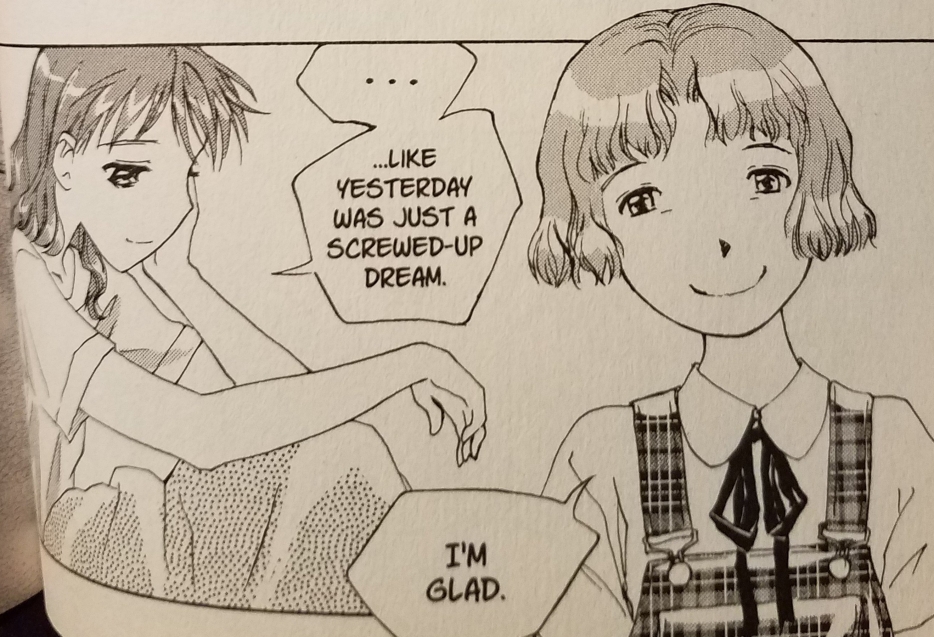
We need to talk about a couple panels starring Greta, a character who’s so forgettable her face has no features. 20190304_1112408281691373915480480.jpg

I’ve always been baffled by Greta’s response. “I’m glad”? What does that even mean?! She’s glad that Christie’s traumatic experience feels surreal? Like they can pretend the night before just didn’t happen? Because they do for the rest of the series.

But as the con ends, so does the manga. Christie meets back up with the group she came with, and says goodbye to Matt.

She leaves, reflecting on her con experience. Her heart is broken, and she’s been through a really scary event. But she has Matt’s phone number, and the book ends on a hopeful note. Christie looks forward to going back to the con again, which I take to mean that the good outweighed the bad.

And I want to talk about how the attempted rape hung a pall over the rest of the series, but…well, the final page left me smiling, too. In my chapter notes, I even wrote about how cute the series is as a whole. Except…

The attempted rape scene is so much darker than the rest of the series. I thought it was unnecessary and poorly handled in later books. And yet I’m still left with warm, fuzzy feelings at the end.

There are few works of fiction that I’m 100% satisfied with. That this blog exists is proof enough of that. So the question remains: was there enough that Dramacon did right, that it outweighs the things it did wrong?

Surprisingly, my mom helped me figure out the answer to this question. I moved out from my parents’ house around three years ago, leaving my mess behind. Now retired, my mom’s taking on the daunting task of hauling my old bedroom out. It’s almost like a new branch of archaeology: digging through layers of dust and old clothes to find any treasures worth keeping. Which is why I get texts every so often with pictures of various objects, most notably books. One of these pictures was of a cupboard that housed a considerable amount of manga. “What do you want me to do with these?” She asked.

“You can get rid of most of it,” I told her. “But keep Dragon Knights and Dramacon.”


I will be taking a break starting today, and will return with a brand spankin’ new reading and writing project on April 8! Thanks for reading along with me!

Dramacon 5: A Little Problematic

This one gets pretty heavy. Content warning here at the bottom of the page. Click here if you want it.

My original plan was to combine the final two chapters of Dramacon into one post, since they both cover the climax of the book. But in writing this post, it turns out there’s a lot to discuss, so I’ll just be sticking with the penultimate chapter here.

And what a climax it is.

Christie got a huge, much needed lift from meeting Lida Zeff, and it helped her enjoy the con a lot more. The night ends in a J-pop dance, which was also one of my favorite things to do at a con. Christie’s having so much, until Derek starts flirting with other girls in front of her again. She joins up with Matt’s friends instead, who she got to know over the course of the con.

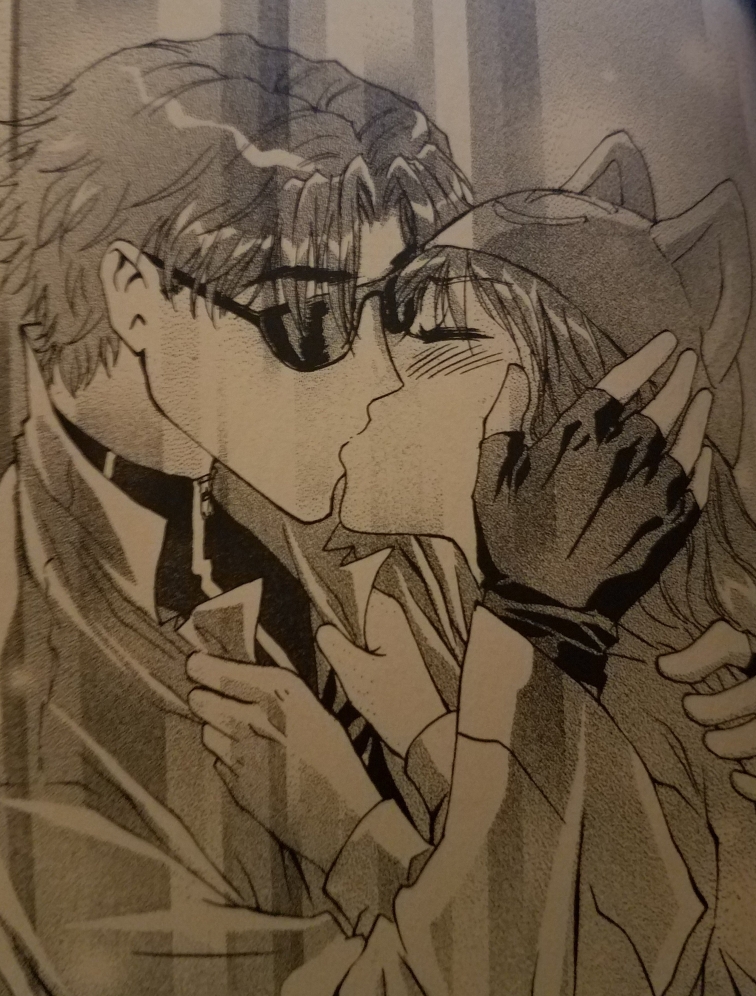
Christie goes to speak with Matt, and this ends up happening:

20190225_1151127312765306810366160.jpg

Squee~!

I’ll admit it: I squealed when I read that the first time. And when I read it through again this time.

Yes, Christie is technically cheating, which is generally frowned upon. But because Derek has no redeeming qualities, I doubt anyone really cares. I certainly don’t. And while Matt has been rough around the edges, he at least tries to apologize and improve his behavior.

Derek catches them kissing, and back at the hotel he and Christie have an explosive fight. Christie stands up to him and doesn’t back down this time. Her courage isn’t rewarded, though. Drunk and infuriated, Derek attacks Christie and attempts to rape her.

Yeah, you read that right. Romantic comedy Dramacon, full of jokes and pop culture references, just had an attempted rape scene.

One of the reasons I was a little nervous to read Dramacon was because I really liked the series and I wanted to continue liking it. I’ve grown up a lot since I first read Dramacon, and my understanding of sexual assault has changed over the years.

I’ve written about other books that use sexual violence as a plot device in the past here. I’m still never sure how I feel about sexual assault in fiction in general. Personally, it’s not something I like to see in books and movies, but it’s something that unfortunately happens in real life. And art is supposed to reflect life, right? At the same time, it’s also supposed to be an escape from our everyday lives. Is there a middle ground between these two things? Does there need to be?

I’ve mentioned before that I personally feel that sexual assault in fiction needs to be handled carefully, and with purpose. If a character is assaulted, then it either needs to bring out something new in the character, add something to the plot, and not trivialize the survivor’s experience.

Christie does get away from Derek, but the scene is scary and tense. It doesn’t play into a common rape myth that rape is only perpetrated by strangers. In fact, most rape survivors know their assailant.

But Dramacon doesn’t do a great job dealing with the aftermath. There’s only one chapter after this, so we don’t see much of Christie’s long-term reaction. I always wondered if Derek and Christie go to the same school. Does she still have to see him every day, even after they broke up? Is she scared to change classes, knowing that she might see the man who hurt her in the hallways?

In the final book, two years after the events of the first, Christie sees Derek again. She’s stunned to see him and probably scared. To make the situation even worse, he’s with his pregnant fiancée.

Put yourself in Christie’s shoes for a minute. You’ve just seen your abusive ex with another woman. What do you say to your ex and their partner?

A couple years ago, I found myself with a chance to confront my emotionally abusive ex-boyfriend. And good God, I seized upon that chance. All the pain and anger inside me, all the damage inflicted on me came pouring out. I’d been a toy to him, but I made sure he knew how small and pathetic he was. If I had a chance to talk to his partner, I would sure as hell tried to warn them about who they were dating.

Christie doesn’t do any of that. She chat amiably with Derek’s fiancée and they even exchange emails. She just acts like nothing had happened. There’s no warning, just a joke about how Christie must have some stories about Derek when they were teenagers. This whole scene is so problematic for me.

Maybe this is to show that Christie’s matured, or forgiven Derek. It’s been two years, after all. But being assaulted doesn’t just go away in real life. Something like that can stay with you and follow you throughout your life, affecting your mental health, self-worth, and relationships for years to come.

Dramacon is a fun, light-hearted romantic comedy, so spending the rest of it watching Christie recover from trauma would be totally opposite from the tone of the series. Since it brings out nothing new in the character or story, this momentary dark shift is just unnecessary. We already knew Derek was a bad boyfriend. I don’t think that the story needed to go as dark as attempted rape for Christie to run away from him. If Chmakova wanted to show that Derek was violent, he could have hit Christie, or pulled her hair, like he does in the following chapter. Any sort of physical violence should have been enough to prompt Christie to run away from him, and trigger Matt to beat Derek to a pulp. All of this could have happened without creating a huge problem for readers like me, and the tone of the story as a whole.

National Sexual Assault Hotline (US): 1-800-656-4673
RAINN Resources for Sexual Assault Survivors and Their Loved Ones
Rape Crisis Network Europe

Content warning: Discussion of rape and sexual assault in fiction. No graphic descriptions or images.


Dramacon 4: Meeting Your Heroes

I’ll admit it: reading this makes me miss anime conventions. I loved the energy, the camaradiere, the panels, and meeting people as dorky as I was. I stopped going in part because they’re so expensive, but mainly because I lost interest in anime over time. But I have plenty of good memories at Anime Boston and Anime North when I was still in college.

During my second year at Anime North, I met Dramacon‘s creator, Svetlana Chmakova. It was my second year at Anime North, and she’d just put out a new series, Night School. I bought a print for her to sign, entitled, “The Writing Process (as Explained by a Kitten in a Box)”. It was as cute as it sounds. I still have it hanging above my desk.

20190218_1502595781578974788377762.jpg

When I met her, I wanted to say how much I enjoyed her work. I also wanted to tell her that when she referred to herself as a writer in the bonus pages, she made me feel like one day I could create comics too.

I was so nervous waiting in that line, and when it was finally my turn to meet her, I was too starstruck to say anything. I smiled and she greeted me and signed my print. I thanked her and walked away, feeling shaky, but elated.

Since then, I’ve had opportunities to meet one of my favorite actors and a personal hero. I learned from my inability to say anything meaningful to Ms. Chmakova. I decided on what I wanted to tell those people that I admired days in advance, and practiced it. When I finally met them, even if I was shaking or so overwhelmed I cried, my God, I said it.

I mention this now because in this chapter, Christie has the chance to meet Lida Zeff, her favorite manga creator. Unlike me, though, she didn’t totally blow it. I know firsthand how scary and exciting it is to meet someone you look up to. For most of the book, Christie is pretty meek and let Derek walk all over her. I would have thought she’d be like me, too nervous to say anything to her hero.

Instead, she embraces the chance to meet Lida Zeff. Who, as luck would have it, read Christie’s comic and wants to talk with the author about it. Christie’s pretty surprised by this. The day before, Derek had shown Lida the comic at a panel for a critique. According to him, Lida had said the comic was trash and that they needed to go back to school.

When Christie meets Lida, the manga artist clarifies the situation. She gave him an honest critique of his work, saying that he has promise, but would need art school to work at a professional level. Derek doesn’t know how to take a critique, and focused on the most negative aspects of it. But to be honest, I understand his perspective. I think it takes time to learn how to take a critique and not be totally wounded from it. Derek’s probably eighteen, and this con is his comic’s big debut. Until the con, the only feedback he may have gotten on it was from his friends, who are pretty biased.  It’s one of the few times in the manga where I have some understanding of why he’s being such a jerkass.

20190218_1505424282208343390105336-e1550593539692.jpg

Christie takes her chance to ask Lida for an honest critique of her writing. It’s a brave thing to do, and it shows a level of maturity that her boyfriend doesn’t have. Come to think of it, there’s plenty of creators – from amateurs to seasoned professionals – who don’t want to be critiqued at all. That willingness to learn, even if it hurts, puts her a head above other young writers. If you don’t take any critiques, if you don’t learn anything new, you’re going to be stuck in the same place as an artist. Or, as sci-fi and fantasy author Holly Lisle put it:

“If you assume that the words that flow from your fingertips were dictated to you by God and are thus sacred and immune from revision, only you and God are ever going to read them.”

Dramacon 3: Big Eyes, Big Mouth

In the last post,I talked about how Christie grows as a character throughout the series. At first she’s a shy girl who lets everyone walk all over her. By the final volume, she’s a self-confident young woman taking steps towards a writing career.

She’s not there, yet, though. When she and Matt go for a coffee, she shows more of the “real” Christie. She’s witty and teases Matt, and it’s totally out of character of what we know of her. So much so that Matt calls Christie out on it.20190204_1128112218555465877020755.jpg

It’s kind of a jarring shift that gets hand-waved off. I interpreted it as Christie acting like her true self, a side of personality that gets subdued when Derek’s around.

We also get more information about Christie and Matt’s life outside the con. He’s a freshman in college, she’s a barely legal high school junior. I’m glad that the manga makes a point about Christie’s age. Otherwise, I’d just be too weirded out by the age difference to enjoy the story. Christie’s age also works well in terms of her character. It offers an explanation for her naivety, and reflects in her relationship with Derek. She’s in an unhappy, floundering relationship, but is still trying to make it work. She holds on to Derek too long because when you’re young and in love, you think you’re going to be that way forever.

We learn more about Matt, too, but not the full story yet. He wears sunglasses at all times, which Christie finds disconcerting. When she takes them off, she apologizes after seeing what he’s hiding. The audience doesn’t know exactly what she saw, but it’s enough to make her understand why he’s always wearing his trademarked sunglasses. Their banter and flirting come to an abrupt stop when Derek returns to the hotel and catches them in the act. He’s not happy with her, but she finally stands up to him. For a minute. 20190204_1130395556471477410251673.jpg

But when Derek says that he came back to the hotel to check on her – the bare minimum of what a good boyfriend should be doing – she instantly caves. It’s fair, I guess. I can’t get mad at Christie for not having a total change of character in a span of only a few pages.

Derek’s real motivation for returning to the hotel was to sleep with Christie while they had the room to themselves. It’s established earlier in the book that Christie lost her virginity to Derek, which is one of the reasons she’s holding on to him longer than she should. But she’s also expressed discomfort about sex throughout the book so far, to the point where she can barely say the word “sex”. Her blush when Derek pulls her close and general hesitation about sex  lead me to believe that she was pressured into sleeping with him for the first time.20190204_1133072403960851287740108.jpg

One of the things that’s disappointing to me reading this now is that Derek is just flat, flat, flat. He’s a bad boyfriend, and at no point is he given a shot at redemption. He’s manipulative and an all around antagonist. I would have liked to see more nuance from him, other than, “he’s a jerk.”

Well, I think Matt is right about this one.

20190204_1136338776193966375028142.jpg