Update on Federal Funding for Libraries

A quick update to my post on libraries in the Trump administration.

Things are…not great.

On March 14, Trump issued an executive order to eliminate “to the maximum extent consistent with applicable law” the Institute of Museum and Library Services (IMLS), along with other really necessary things like the United States Interagency Council on Homelessness, and Minority Business Development Agency.  

Sticking to my wheelhouse, this is a huge blow to libraries. The IMLS provides grants to libraries and museums across the country. In Florida, where I live, it also funds projects like the interlibrary loan system, statewide research bases, digitization and access to state resources , and technology grants to libraries. One of these technology grants directly affects my library system and the equipment that we can provide for library programs. 

The Executive Order states that these federal agencies are required to “statutory functions and associated personnel to the minimum presence and function required by law.” The good(?) news is that IMLS has “statutory function” (aka is required by law) to provide grants to state and tribal libraries. The bad news is that the statute expires this year. This means that the fight is for reauthorization. There is hope – the statute was reauthorized during the previous Trump administration with broad partisan support. 

There’s strength in numbers. Call your U.S. Representative’s office and tell them you support reauthorization. I know calling your reps can be a bit nerve-wracking, so to make things easier, I’ve written a script:

Hi, this is [Name], and I’m a constituent from [City, State] I am calling to ask [Rep. Name] to support the reauthorization of the Institute of Library and Museum Services. Federal funding helps libraries support their communities through education and accessibility. 

[If you like, add a personal sentence or two about the value of libraries and/or museums.]

Thank you for your time and consideration. 

If you’re leaving a voicemail, include your zip code or home address. 

Some resources:
Executive Order: Continuing the Reduction of the Federal Bureaucracy
Every Library Institute: Understanding IMLS’s “Shall” and “May” langauges
American Alliance of Museums: IMLS 2017 [PDF]
ALA Statement on White House assault on the Institute of Museum and Library Services
ALA: Show Up For Our Libraries

March 2025 Book Recs: Women’s History Month

Without in any way limiting the author’s exclusive rights under copyright, any use of this publication to “train” generative artificial intelligence (AI) technologies to generate text is expressly prohibited. The author reserves all rights to license uses of this work for generative AI training and development of machine learning language models


March is Women’s History Month in the U.S.! Women’s History Month began in California in 1978 as “Women’s History Week.” It was kicked off the week of March 8, International Women’s Day. In 1987, Congress designated March as Women’s History Month. It’s kind of crazy to me that Women’s History Month isn’t even 40 years old yet! 

Women’s History Month is a time to celebrate the achievements and contributions of women that have often been left out of history books. It’s also a time to celebrate the women and girls leading us into the future. 

Quick note: There won’t be a book list for April, but you’ll be getting extra for May.

Nonfiction

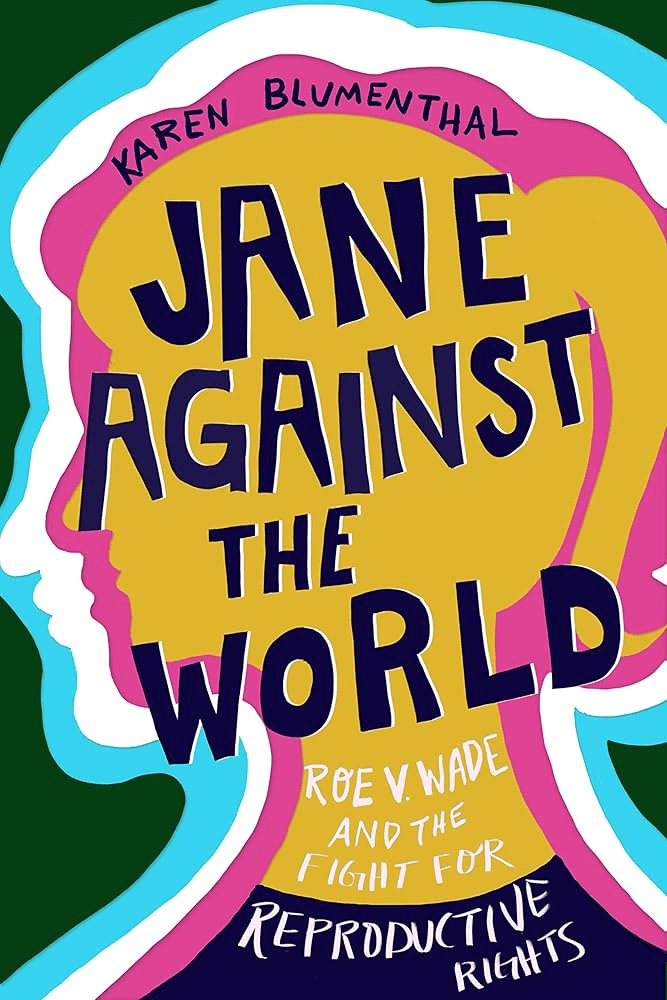
Jane Against the World: Roe v. Wade and the Fight for Reproductive Rights by Karen Blumenthal 

I can think of no topic that’s as controversial or ignites as many passionate debates than abortion. But how did we get here? How did women get abortions and reproductive care before Roe vs. Wade? And what comes after it? Jane Against the World looks at the history of abortion and birth control in the United States, reform and repeals, and Roe vs. Wade. The book is broken into four parts. Restrictions is dedicated to the history of abortion and abortion providers in the United States from the 1800s to the 1960s, and highlights the Comstock Act of 1873, about which much debate has arisen following the Dobbs vs. Jackson Women’s Health Organization in 2022. Reform covers reform of abortion laws, legal gray areas of performing abortions, and the beginnings of the pro-life movement, and the road to Roe v. Wade. In part 3, Roe v. Wade, Blumenthal breaks down the complex case in a way that every reader can understand, and goes into detail on court memos, opinions, especially Justice Harry Blackmum’s contribution to the Court’s decision. After Roe chronicles the pushback against Roe v. Wade, including violence against abortion providers and laws that restrict abortion at the state level. Written in 2019 and published in 2020, this book does not include the Dobbs decision that overturned Roe in 2022. While abortion is not an easy topic to read about or discuss, it’s very important to understand how we got to where we are today. 

Fiction

When the Mapou Sings by Nadine Pinede


This novel in verse begins in 1936, two years after the United States ended its occupation of Haiti. While things are still dangerous for those who would speak up against the government, Lucille and her best friend Fifina have big plans of their own. Hungry for knowledge, they dream of opening up a school for girls. Lucille’s world crashes down around her when Fifina’s father is imprisoned, Fifina disappears, and Lucille’s beloved Mapou tree is cut down by the section chief. After receiving a dream from the Mapou, Lucille confronts the section chief, hoping to find Fifina. This act of defiance puts her and her family in danger, and Lucille is forced to leave her home. She works first as a maid for a wealthy Haitian woman, and then for an American woman in Haiti for research. Lucille doesn’t know quite what to make of Mamzelle Hurston, but the two develop a special bond during their time together. Working for Mamzelle Hurston opens up new doors for Lucille, even though it may lead her into danger and hard decisions. This is a fictionalized account of the real servant of Zora Neale Hurston during the time Hurston lived in Haiti, working on Their Eyes Were Watching God. Fictionalizing real people can be a touchy subject, but the setting and themes are thought-provoking. While I thought the ending tied things up just a little too neatly, I wanted to highlight this book because it takes place during a unique time in history which gets very little attention.

Dusty List: Into the Sublime

Without in any way limiting the author’s exclusive rights under copyright, any use of this publication to “train” generative artificial intelligence (AI) technologies to generate text is expressly prohibited. The author reserves all rights to license uses of this work for generative AI training and development of machine learning language models.


I read a lot of YA books. I like them, and I’m also in charge of the YA section at my library. That means a lot of weeding, and a lot of ordering new books. 

I wrote a post all about how librarians decide what items to get rid of, but didn’t really talk about how materials get added to the collection. That’s because each library will handle it a bit differently, but there is one thing they all rely on: reviews.

I don’t mean reviews from Amazon or Goodreads, but professional reviews from sources like Kirkus or Library Journal are hugely important. Professional book reviews give a synopsis of the book, a sentence or two about the writing, and often a note about whether or not it’s worth purchasing. After reading the reviews for Into the Sublime, I ordered it, and put it on my TBR list. Thrillers and horrors circulate very well among teens at my library, and with the creepy cover art, I thought this one would be a hit. 

Two years later, it landed on an inventory list as a “dusty book” – that is, it’s been sitting at the library for two years and hasn’t been checked out. That usually means it’s time to “send it to a nice library upstate” ….aka discard it. No one wanted to read this book. 

No one, that is, but me. 

Welcome to the first edition of the Dusty List, reading the YAs that everyone else has overlooked. Let’s start the descent with Into the Sublime, a survival horror by Kate A. Boorman.

Amelie’s best friend was her cousin, Sasha. They were both part of Dissent, a group of teenage thrill-seekers who took on death-defying challenges. The group broke up after Sasha suffered a terrible accident at a Dissent challenge, but Amelie’s not ready to let it go. She wants to keep the promise she made to Sasha, and go on the adventure they never got to do together: finding a legendary subterranean lake, the Sublime. The legends say that the lake has the power to change things, and there’s a lot that Amelie wants to change. She and three other girls, Gia, H, and Devon, set out on a day trip to find the Sublime. Days later, Amelie and two other girls emerge from the cave, covered in blood. 

Only they know what happened in the dark. And Amelie is ready to talk. 

Into the Sublime is a framed narrative that starts with an email sent from Amelie to an unknown recipient, then the story jumps back to three months prior. Amelie is found in the Colorado wilderness, covered in blood, and the two girls who were found with her are being transported to the hospital. Two police officers watch over Amelie while they wait for her parents to arrive, and Amelie starts telling them the story of what happened. But how much of it is the truth? How much is manipulation? And what happened to the fourth girl? 

Using this framing device was a brilliant move for a number of reasons. First, it and the prologue email sucked me into the novel right away. Most of the story is told from Amelie’s first person perspective of her time in the cave. Between each section there are interludes written from the perspective of Officer Vargas, who treats Amelie with sympathy and suspicion in equal amounts. Vargas’s investigation reveals new information that Amelie hasn’t given us, which adds a few twists and ramps up the mysteries. It also serves as a break from Amelie’s story. The bulk of the novel takes place in the cave, and there are a lot of intense scenes. Cutting to the present with the cops gives readers a breather, and Vargas’s narration offers us another interpretation of all that Amelie’s said.

There’s another reason this works well for adult readers. For the first few chapters, you’re going to need to hit your willing suspension of disbelief button pretty hard. As with a lot of horror fiction, the characters make bad choices that lead them into dangerous situations. Yet knowing that trope wasn’t enough for me to overlook all the mistakes the girls made before they even reached the cave. Most of them were wildly unprepared to do a day hike, let alone any kind of caving. They fail to follow even the most basic safety rules when it comes to hiking, and even leave behind necessary supplies, like extra water and flashlights. 

I had to dust off my old psychology degree to get past that. Let’s take a quick peek into the teenage mind. There are two mindsets adolescents have that contribute to risk-taking. Of course, adults can also have these mental constructs, though typically not as strongly as a teenager would. First is the “personal fable.” The personal fable is, in TikTok speak, “main character syndrome.” Part of this is believing that bad things won’t happen to them. So, sure, just because Amelie’s cousin broke her neck during a Dissent stunt doesn’t mean that Amelie will. After all, she’s the one who came up with the plan. She’s got directions to the lake. She’s immune. 

The other mindset is called the “imaginary audience.” This is where you feel like the spotlight’s always on you. No matter what you’re doing, someone is watching. The “imaginary audience” doesn’t seem to have as much influence on Amelie’s and the other girls’ behavior at first, especially given the small number of characters in the story. But as the story unfolds, the reader can see how much Amelie’s perception of the other girls and their perception of her shifts the dynamics between the characters. 

I’ve said time and time again that the thing that draws me into a is the characters. Into the Sublime is an exception to that rule. Amelie and her companions Gia, H, and Devon are all interesting in their own ways, especially as they each have different motives for wanting to find the Sublime. But by the end of the book I didn’t like most of the characters, with the exception of H. At first I thought Devon, with her unique outlook, would be my favorite, but that changed by the end of the novel. 

Even if the characters were people I’d never want to be friends with in real life, I kept reading, because I just had to know how it all ended. The girls’ changing loyalties and motivations throughout the book ratchets up the tension until the very end, and keeps the reader guessing. 

I also really liked the setting. Most of the book, aside from the intervals with the police officers, takes place in the cave. Caving is challenging and often dangerous, even when you know what you’re doing. Getting lost, losing your light, bottomless pits, and squeezes could all end in disaster. The environment by itself is frightening enough, especially considering how unprepared the girls are. The scares only intensify with eerie encounters and dangerous changes in the cave. 

I do have a couple minor nit-picks1 other than what I’ve mentioned here, but overall I liked this book a lot. I think there is a bit of a high barrier for entry, especially for adult readers, but it’s a well-written, thrilling adventure. If you’re into survival stories with a bit of horror, check this one out. 

Literally check it out. It’s on the dusty list. 

  1. Very minor. Like, “why does so much of Gia’s dialogue end in a question mark when she’s making a statement?” nit-picks. ↩︎

Feb. 2025 Book Recommendations: Black History Month

Without in any way limiting the author’s exclusive rights under copyright, any use of this publication to “train” generative artificial intelligence (AI) technologies to generate text is expressly prohibited. The author reserves all rights to license uses of this work for generative AI training and development of machine learning language models.


Welcome back! Thank you to everyone who read, shared, or commented on my most recent post about libraries in the Trump administration. Please take care of yourselves and keep fighting for your loved one, and supporting community organizations like your library. 

Just a couple blog updates before we start on this month’s book list. First, there probably won’t be recommendation lists for April, July, August, or December, unless I’m really inspired and suddenly have a surge in free time. I do a lot of reading for these lists, not just the 2-4 recommended books, and it takes up a lot of time. I’ve read a lot of really great stuff and things that I might not have picked up otherwise, but it also makes it harder to find the time to read other things, including books for blog posts. All that said, I am doing much better than I was months ago, and I’m going to once again endeavor to write two posts a month. 

February is Black History Month in the U.S.! Though Black History Month was first officially recognized by President Gerald Ford in 1976. However, Black History Month goes back much further than that. It was actually started in 1926 as “Negro History Week” by historian and author Carter G. Woodson.  Black History Month honors the contributions and celebrates the triumphs of Black Americans, while acknowledging the hardships and struggles caused by systemic racism. 

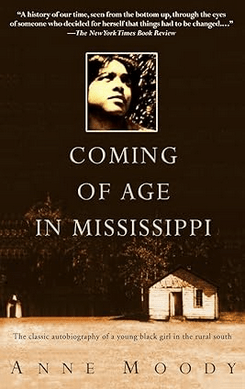
Coming of Age in Mississippi by Anne Moody

Anne Moody (born Essie Mae) was born to two poor sharecroppers in 1940 in Centerville, Mississippi. An observant and intelligent young woman, Moody would go on to graduate from Tougaloo College and become actively involved in the Civil Rights movement in the 1960s, participating in sit-ins and joining organizations the NAACP, Student Non-Violent Coordinating Committee (SNCC), and the Congress of Racial Equality (CORE). She endured harassment and violence, but her anger and determination kept her fighting against racism and sexism. Published in 1968, Moody’s memoir is broken into four parts. Childhood begins with Moody at a young age and ends with her eighth grade graduation. This section her family’s struggles with poverty and Moody working as a maid for White families, some of which were White supremacists with ties to the Ku Klux Klan. In High School,  Moody learns about the murder of Emmet Till, an event that would shape her worldview forever. She is witness to a rash of violence against Black people in her community, including a family burnt to death in their own home. She also travels to New Orleans and works to become financially independent. In College, Moody finds her calling as an activist and community organizer, beginning with a protest against her junior college after one of her classmates finds maggots in the dining hall food. Finally, The Movement chronicles Moody’s involvement in the Civil Rights movement, including being beaten at a sit-in and working for CORE. Given the time period the memoir was written in, some of the language is dated, but Moody’s experiences also feel fresh and immediate. A great choice for anyone looking for a personal account of the Civil Rights movement. 

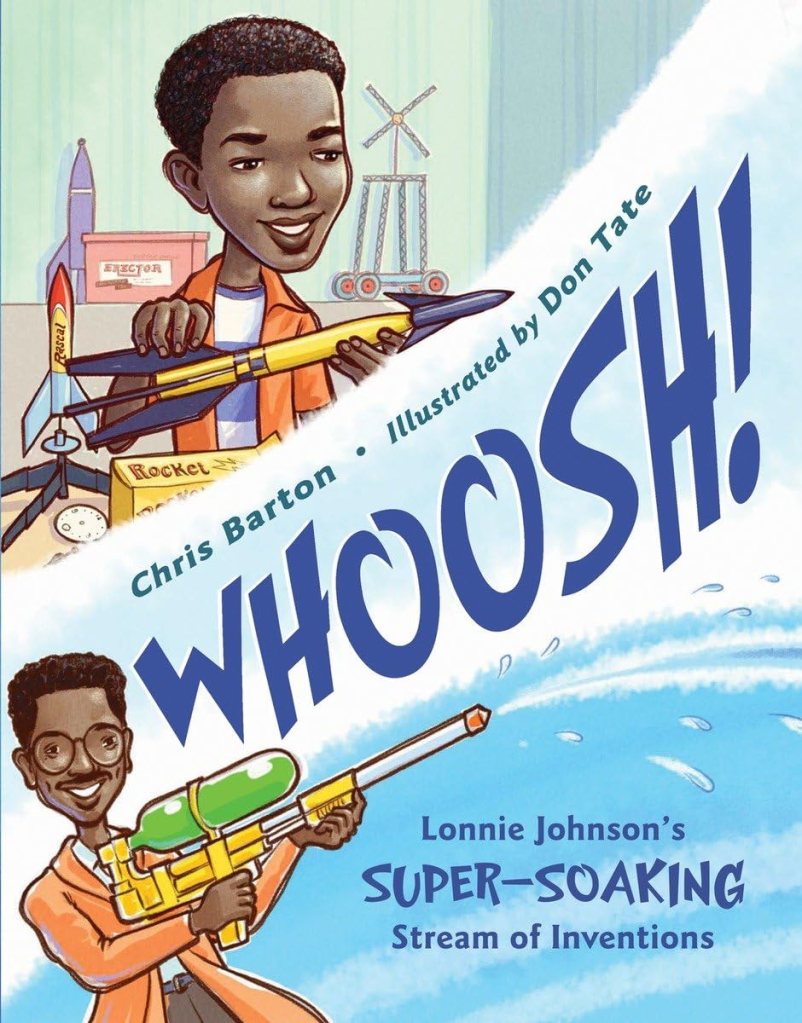
Bonus Book: Whoosh! Lonnie Johnson’s Super-Soaking Stream of Inventions by Chris Barton

Lonnie Johnson is an inventor and former NASA engineer, but for many kids (and more than a few adults), his greatest invention is the Super-Soaker. This picture book biography tells Lonnie’s story of building a robot, helping the Galileo space probe get to Jupiter, and finding the inspiration to make this summertime staple. An unsung hero of childhood, thank you, Lonnie, for so many great memories. 

Fiction

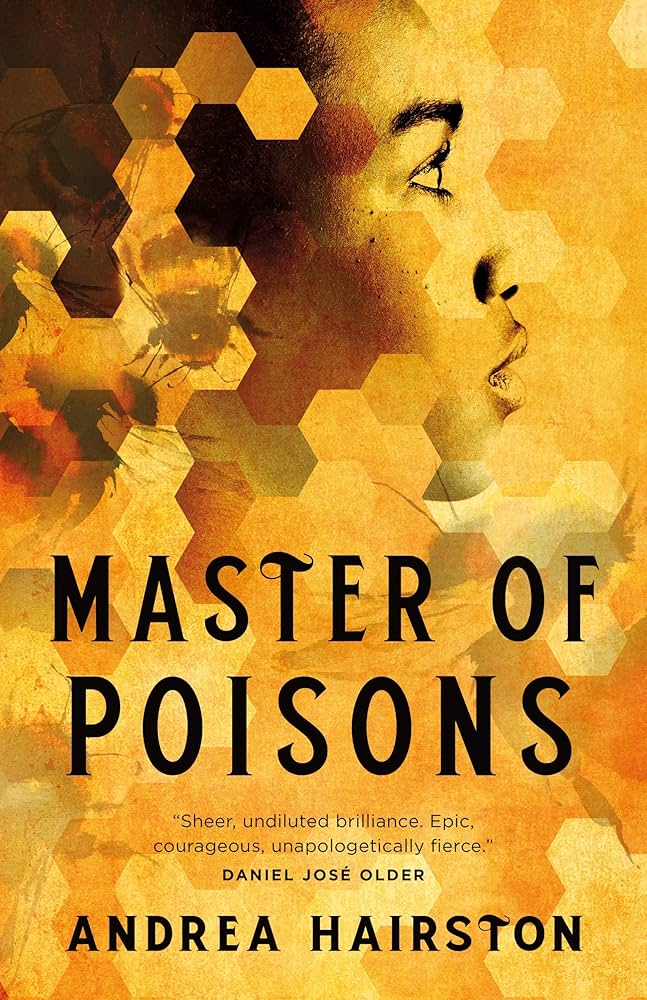
Master of Poisons by Andrea Hairston

A poison desert stretches across the Arkhysian Empire. Djola, Master of Poisons, has been tasked by the emperor to find a way to halt its spread. He is working to create a “map to the future” and heal the land by mastering the secret and powerful conjure Xhalan Xhala. As the poison desert continues to spread, Djola is exiled from Emperor Azizi’s Council. The only way he can return to his family is to find Xhalan Xhala, and stop the desert once and for all. 

Young Awa is able to traverse the Smokelands, an ethereal place of dreams and magic that reflects the physical world. At the age of 12, her father sells her to the Green Masters, a nomadic group of storytellers and warriors who can use powerful conjure. Awa is in training to be a griot (storyteller), and her ability to cross the Smokelands and special connection to bees may make her the next griot of griots like her mentor, Yari. 

Hairston creates a vivid African-inspired fantasy world, rich with folklore and African traditions. This complex story is written with lyrical prose that makes the novel utterly captivating. Hairston has three other historical-fantasy books that would also be good fits for Black History Month (Redwood and Wildfire, Will Do Magic for Small Change, and Archangels of Funk), but Master of Poisons sucked me in from the first page.

Your library will always be there for you. Please be there for your library.

Without in any way limiting the author’s exclusive rights under copyright, any use of this publication to “train” generative artificial intelligence (AI) technologies to generate text is expressly prohibited. The author reserves all rights to license uses of this work for generative AI training and development of machine learning language models.


I’m writing this introduction on Saturday, January 18, on my lunch break. I don’t usually work Saturdays, but today I have a Teen Advisory Board meeting. In a few hours, a group of teenagers will come into the library and tell me what kinds of things they would like to see the library provide for them. I’ll distribute scholarship information for three local colleges, tell them about a student employee position that’s just opened up, and give them advice on how to apply and what the library looks for in a job interview. After, we’ll make cards for troops stationed abroad. Elsewhere in the library, adults and kids will be using computers to access the internet, do homework, apply for jobs, or catch up on YouTube. People who don’t have internet access at home can check out hotspots. Maybe they’ll use it to access live virtual tutoring, or Ancestry.com, or Consumer Reports – all free with their library card. And, of course, there will be books. All kinds of books: novels, picture books, biographies, travel guides, comic books, board books, cookbooks, books for beginning readers and books that read to you. 

Later this month, kids will practice reading to a licensed therapy dog. People struggling with food insecurity will receive assistance in applying for SNAP benefits. Toddlers and pre-schoolers will learn pre-literacy skills at storytime (including a bilingual storytime). Free tax assistance will be available. Senior citizens will take a class to learn basic computer skills English language learners will meet to practice casual conversations. I’ll also be running my favorite activity, a tabletop roleplaying game for teens, which has become a haven for a small group of queer teens. All of this for the low, low price of free. 

Libraries are one of the few places left where you don’t have to pay anything to be there, you don’t even necessarily need to be a member. Just come in, and we’ll try to help you. 

Libraries are magical. They are also in danger. 

For many of us in the United States, the next four years are going to be a scary and difficult time. There is so much I could talk about when we discuss the second Trump administration, but I want to focus on something that this blog has always focused on: books. Well, books, literacy, and access to information. As I have said in a previous post, access to information is recognized as a basic human right by the United Nations. In an age of rampant misinformation and censorship, this is a right that needs to be safeguarded more than ever. Public libraries are on the forefront of the battle for intellectual freedom, a battle which is only going to intensify in the coming years. 

As I’ve written about before, public and school libraries are facing intense scrutiny over the materials they have on their shelves. Book bans are on the rise, and libraries and library staff are facing threats of violence, lawsuits, and even jail time. And things are going to get much, much worse. 

The Trump administration’s plans are detailed in Project 2025. This is not a document of hypotheticals; this is a road map. And this road map leads to, among other things, a direct attack on every Americans’ intellectual freedom. 

Project 2025 aims to dismantle the Department of Education, cancel funding for public services,  support censorship, and, potentially, jail teachers, librarians, and booksellers. 

That’s not hyperbole. Project 2025 classifies any LGBTQIA+ material as pornography, including picture books like the innocent And Tango Makes Three or non-fiction books intended for education, like This Book is Gay. If that wasn’t bad enough, librarians and others who distribute “pornography” to children may be required to register as sex offenders. 

Yes, you read that right. No, this is not me being melodramatic. Conflating LGBTQIA+ media with pornography is a tried and true tactic when it comes to censoring, challenging, and banning books. 

Nor am I exaggerating the potential legal consequences for librarians. So far, Indiana, Oklahoma, Tennessee, and Montana have passed laws that say school staff, public librarians, and museum employees could be jailed and/or fined thousands of dollars for distributing “obscene” material to children. 

Book challenges and bans are only going to become more frequent. Moms For Liberty, right-wing group dedicated to banning books, is strongly supported by the Heritage Foundation [PDF] (the organization behind Project 2025), by providing them with financial and even legal support.

The final thing I want to talk about regarding Project 2025 and libraries is not nearly as dramatic as everything else, but it is no less crucial. Federal funding for public services is going to be greatly reduced, up to and including eliminating the Institute of Museum and Library Services (IMLS). Most libraries already operate on string shoe budgets, and librarians and library staff are notoriously underpaid. Cutting federal funding is going to hurt the services that libraries offer, especially in rural and low-income areas. 

There is a big disconnect between politicians and their constituents in the perception of public libraries. They are valued community spaces with something for everyone – be it Talking Books for the blind, someone to walk you through an online job application, even just a safe place to exist. There’s a lot of love for libraries. In fact, there’s more public libraries than there are McDonald’s in the U.S.

To borrow some words from The Memeing Librarian: The library will always be here for you. So please be there for your library. 

I know that libraries are not going to be on the forefront of your mind as we go into this next big challenge together. However, there are simple, everyday things that you can do to support your library, free speech, and freedom of information. 

First, VOTE! Not just in big national elections, but state and local elections as well. Local elections determine so many things in your community, like commissioners, judgeships, school boards, and funding for public services like the library. 

Get a library card if you don’t already have one, and check out books. I know this seems obvious, but it’s really important. One of the things that determines funding for libraries is the number of members a library has, as well as circulation for books, DVDs, and other library materials. Some libraries even have “library of things” where you can borrow items like tools or cake pans, or seed libraries if you want to start your own garden. My library system also lends hotspots and backpacks with educational materials based on certain topics.

Attend library programs. Like I mentioned above, statistics are everything when it comes to securing funding. Library programs aren’t just for kids, either. There’s lots of stuff for adults and teenagers. Some popular recurring programs we have for adults are film discussions, “craft and chat” events, and English language learning events. Attendance is also a good way to show the library what you’re interested in seeing for future events. Many libraries also have teen advisory boards, where teens can give their input into library programs and earn community service hours. 

Volunteer. There is always something that needs to be done, whether it’s organizing books, preparing crafts for storytime, tutoring, or corralling kids during a craft-a-palooza. You could also join a Friends organization. Many libraries also have a Friends organization, which raises money for the library. Our Friends organization has helped pay for activities and guest presenters, like theatre performances and historical impersonators. 

Donate if you are able. Financial donations are obviously the most direct way you can give, but there are other things you can donate as well. Lightly used books that someone else might want to read (please don’t give us your old copy of Windows 95 for Dummies) may be added to the library’s collection or sold in a book sale to raise money. It doesn’t have to be just books, either. Last year, someone donated a huge box of Pokemon cards, which meant that every kid who attended a Pokemon program I ran got 2 cards to take home, and a holographic card if they registered for the Summer Reading Program. 

Give the library your feedback (but be nice about it). If you liked a program, if you hate the new signage, if we absolutely need to get this book or that movie. Most libraries also have online surveys and book order requests on their websites.

Tell your librarian what you love about the library. I love my job, but it’s not as easy as it looks, and there are times when I’ve fantasized about just walking out and never coming back. It’s the little wins, like helping a patron find the perfect book or a parent giving a compliment that helps us get through the day and reminding us why we do this. 

When you take a book off the shelf and decide you don’t want it, don’t put it back on the shelf. Don’t put it at the end of the shelf. Don’t leave it next to the self check-out. Please stop reshelving the books. Please. I’m begging you.

These next four years are going to be tough. Take care of yourself, take care of your loved ones, and take care of your library. 

Some sources and further reading: 

Project 2025 and Its Threat to Free Expression, Part 1 (PEN America)
Project 2025 and Its Threat to Free Expression, Part 2 (PEN America)
Project 2025 and Its Consequences for Libraries (EveryLibrary Institute, PDF)
Red states threaten libraries with prison — as blue states work to protect them (Washington Post)
Unite Against Book Bans (American Library Association)
Banned & Challenged Books (ALA)
Trans Rights Readathon
We Need Diverse Books


December Book Recs: Right Stuff, Wrong Sex


Without in any way limiting the author’s exclusive rights under copyright, any use of this publication to “train” generative artificial intelligence (AI) technologies to generate text is expressly prohibited. The author reserves all rights to license uses of this work for generative AI training and development of machine learning language models.


Credit where it’s due: the title for this post was “borrowed” from the book Right Stuff, Wrong Sex by Margaret A. Weitekamp. 

We’ve made it through another year, and what a year it’s been. I’ll have a short post for January. For the rest of 2025, my goal is to start posting twice a month again. Until then, here’s the last book recommendation list for 2024.

Also, hi, Yvette, the lady I met during OT this week. Thanks for your encouragement! 

The book sommelier is back! For December, here’s two books that pair together nicely for a stellar reading experience. 

Nonfiction

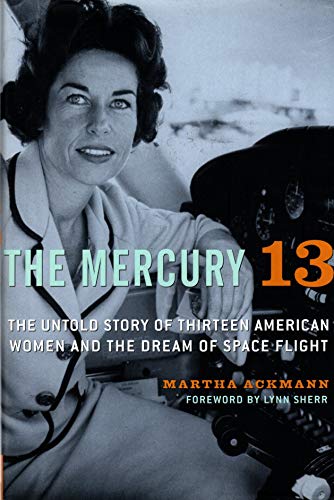
The Mercury 13: The Untold Story of Thirteen American Women and the Dream of Space Flight by Martha Ackmann

Before there was Sally Ride, there was Jerrie Cobb. All eyes were on the Project Mercury astronauts, Air Force test pilots who were all deemed to have “the right stuff” to go into space. Dr. William Randolph Lovelace II wanted to cast a broader net than just the men that the government thought were worthy of going to space. There were many accomplished women pilots in the country, but as women were barred from flying in the military, they were automatically disqualified as astronaut candidates. Dr. Lovelace theorized that women might make better astronauts than men, and pushed for “lady astronauts.” Jerrie Cobb, a woman with an impressive list of aviation achievements, eagerly trained, hoping to be one of the first women in space. When she proved that she could pass the same tests that the prospective male pilots did, more women joined this secret project. Thirteen women passed the arduous tests which proved women were space-worthy, but societal customs and political maneuverings meant that none of the Mercury 13 would ever leave Earth. The Mercury 13 tells the largely unknown story of the women who dared to reach for the stars. Detailed biographies of Jerrie Cobb, Dr. Lovelace, and celebrated pilot Jackie Cochran are woven in with the narrative. Interviews with the women who underwent the Lovelace tests offer personal insight into their experiences. Inspiring and disheartening all at once, Ackmann finally brings to light the story of these brave and tenacious women who were willing to give everything they had for a moonshot of their own.

Note: This book has two different subtitles: The Untold Story of Thirteen American Women and the Dream of Space Flight, and The True Story of Thirteen Women and the Dream of Space Flight. I used the “Untold” version since that’s the copy of the book I have. The actual text of the book is the same in either one.

Fiction

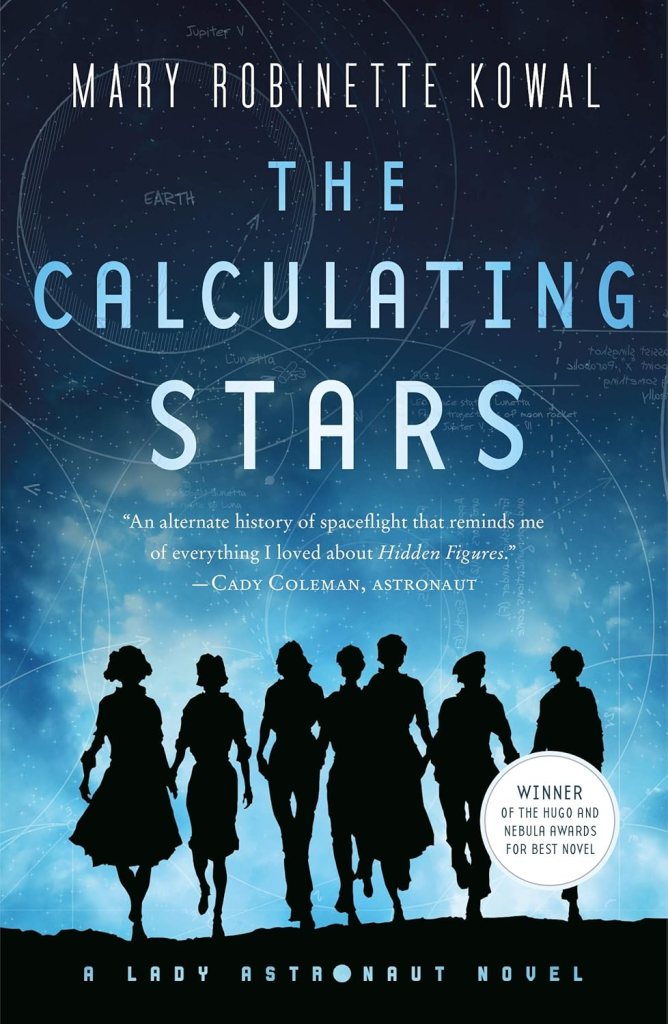
The Calculating Stars by Mary Robinette Kowall

In 1952, Elma York and her husband, Nathaniel, are lucky to be alive after a devastating meteorite strike obliterates much of the eastern coast of the U.S. Elma, a physicist, mathematician, and pilot, is eager to do something, anything, to help survivors and rebuild the country, but her talents are overlooked in favor of men. That is, until she calculates what the long-term effects of the meteorite strike will be. A climate disaster will make Earth unsuitable for habitation, and colonizing space becomes humanity’s only chance for survival. Elma joins the fledgling international space agency, IAC, as a computer, performing calculations that will put a man into orbit. But with so many qualified women pilots and scientists working alongside her, Alma starts to wonder: why can’t women be astronauts? When Elma makes headlines during an all-women airshow, she finally has a chance to advocate for her cause. Sexism and her crippling anxiety would have her stay on the ground, but Elma’s determined – for herself, and for all the brilliant women whose skills have gone unnoticed. One thing I liked was the inclusion of women of color in Elma’s crusade. Elma does have her prejudices and blind spots, but she learns from her mistakes. The real-life Project Mercury astronauts and Mercury 13 were all White, and I was glad to see diversity being added to the space race. The Calculating Stars is great for fans of alt-history and realistic sci-fi. 

See you next year!

Nov. 2024 Recs: Native American Heritage Month

Without in any way limiting the author’s exclusive rights under copyright, any use of this publication to “train” generative artificial intelligence (AI) technologies to generate text is expressly prohibited. The author reserves all rights to license uses of this work for generative AI training and development of machine learning language models.


November is Native American Heritage Month! Native American Heritage Month was established in 1990 to recognize and celebrate the diverse cultures of Indigenous Americans. There are 574 federally recognized Indigenous nations in the United States. Native Land Digital contains a map which shows the original territories of Indigenous peoples across the globe. I encourage everyone to check it out and learn about the original inhabitants of your area. 

Nonfiction

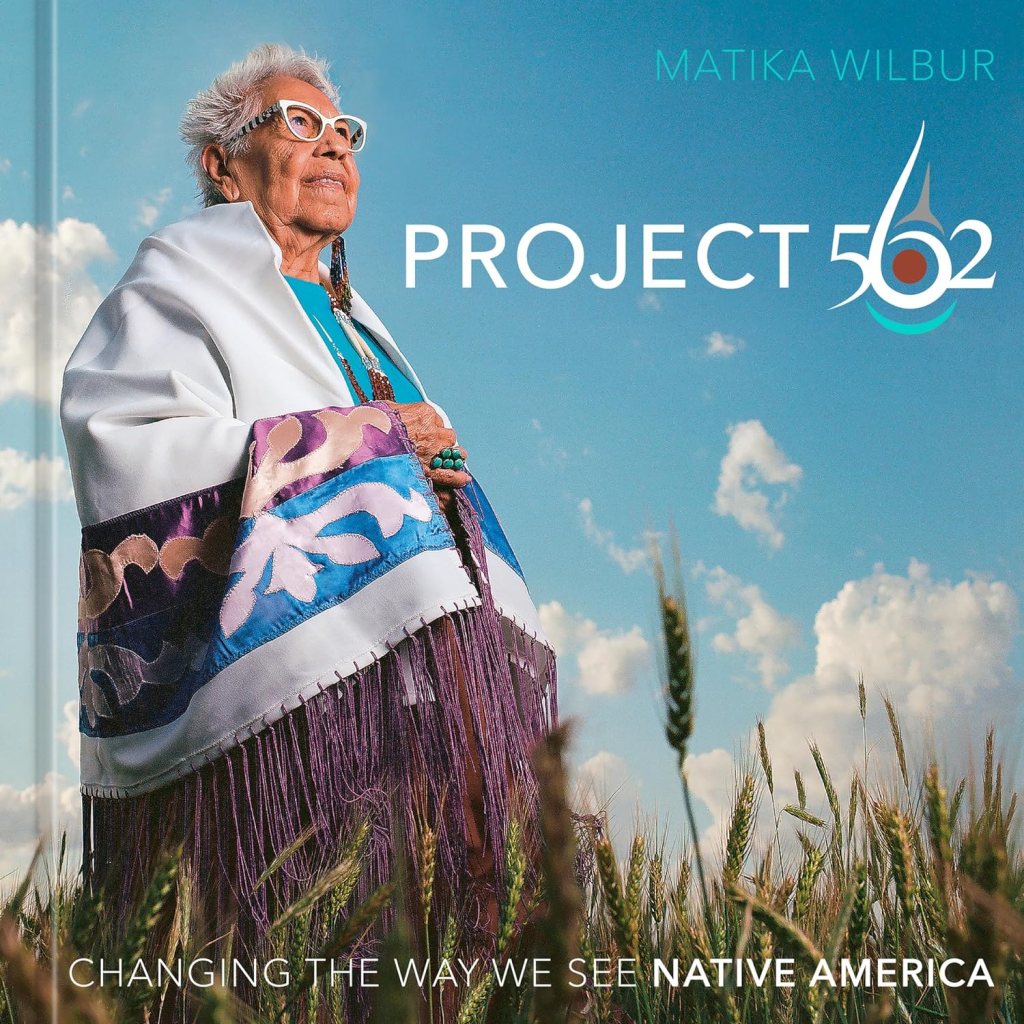
Project 562: Changing the Way We See Native America by Matika Wilbur

“Representation without us is representation done to us.” With these words, Matika Wilbur introduces Project 562, a photojournalism project that shares the lives of Indigenous People across the United States. Traveling thousands of miles, Wilbur set out to interview and photograph someone from each Indigenous nation. (Note: when the project began in 2012, there were 562 federally recognized Indigenous Nations; there are now 574.) Wilbur’s portrait photography is gorgeous, each accompanied by the subject’s story: an Ojibwe man harvesting wild rice; Two Spirit powwow dancers; a woman recounting how boarding school has shaped her family for generations; the teen beauty queen who entered the pageant because everyone told her she wouldn’t win. This work captures the diversity of contemporary Indigenous people while honoring tradition and heritage. Wilbur’s beautiful work is not to be missed, and serves as a reminder that  “Indigenous existence is all around us. It is up to us to listen.”

Fiction

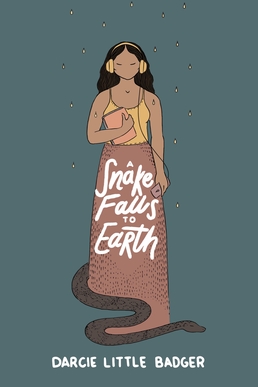
A Snake Falls to Earth by Darcie Little Badger

Nina, a Lipan Apache teen living in Texas, has family mysteries to solve. Specifically, the last story her great-great grandmother Rosita would ever tell her. There’s one big problem: Rosita told the story in Spanish and Lipan Apache, and Nina has no idea what she was trying to say. As she painstakingly works on translating the story, she discovers more mysteries. Did Rosita really see a fish-girl in her seemingly bottomless well? Why does Grandma get sick when she leaves the land that’s been in her family for generations? And are those mysterious people who come to her father’s bookstore really animal-people from the Reflecting World? 

Meanwhile, in the Reflecting World, Oli is a timid cottonmouth snake reluctantly forced into adulthood. After a rough start, Oli makes a life for himself. It’s not always easy, though he tries to steer clear of the catfish cultists and bear bounty hunters. When his best friend, a toad named Ami, falls ill, Oli is terrified that Ami’s species is facing extinction – a death sentence for the animal-people in this world. If he can get to the human world, maybe he can find out what’s happening to Ami’s species and fix it. With a pair of rambunctious coyote sisters and a red-tailed hawk at his side, Oli is ready to go to the ends of the earth (or fall to it) to save his friend. 

October 2024 Recs: Spooky Season

It’s spooky season! While I am not a huge fan of horror, I can appreciate how the genre can work on multiple levels. Scary stories are excellent ways to examine human nature and society…and perfect for keeping you up on dark and stormy nights. 

Nonfiction

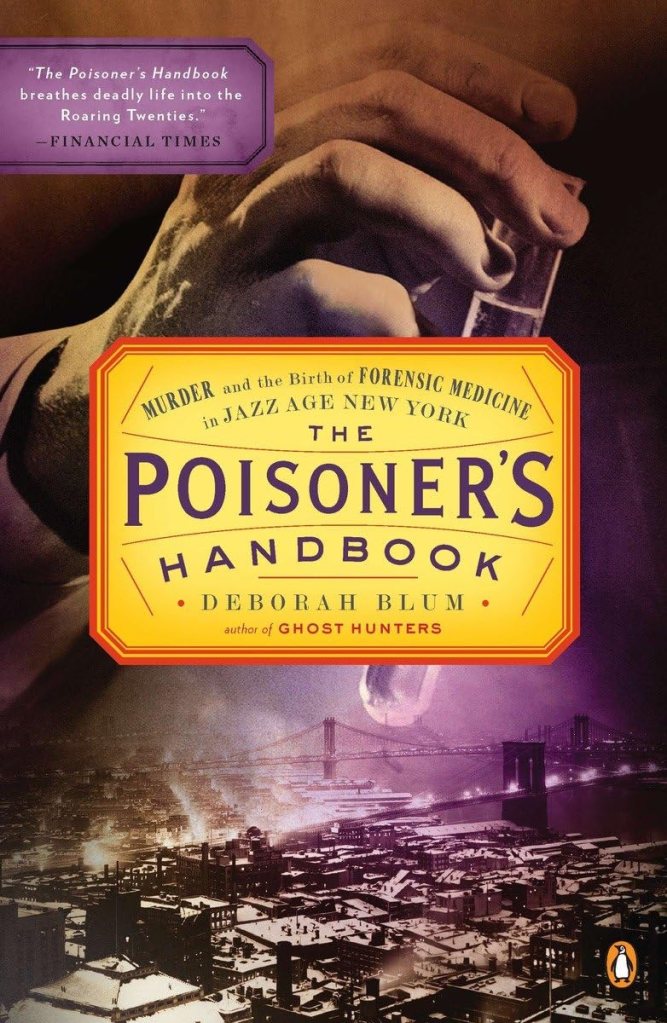
The Poisoner’s Handbook:  Murder and the Birth of Forensic Medicine in Jazz Age New York by Deborah Blum

Prohibition-era New York City was a hotbed of political corruption, organized crime, and poison. Poison was a deadly fact of life, found in the bootlegged liquor of speakeasies, beauty tonics, and in the hands of impatient heirs and jealous spouses. New York City’s chief medical examiner, Charles Norris, set out to change things. With his assistant Alexander Gettler, the NYC medical examiner’s office became the birthplace of forensic medicine. Working long hours, they examined corpses, exhumed bodies, and invented groundbreaking new tests to identify poisons, and put poisoners behind bars. Each chapter is centered on a different poison: chloroform and cyanide to kill, methyl alcohol served in speakeasies, industrial poisons such as tetraethyl lead and radium, and more. The Poisoner’s Handbook is a perfect for lovers of true crime and science history, though there are moments where a strong stomach is helpful.

Lakewood by Megan Giddings

After the death of her grandmother, college student Lena Johnson takes over the role of head of household. Her mother, Deziree, suffers from a mysterious serious illness (or possibly illnesses)  which has racked up more medical debt than the Johnson family can afford. Sometimes, it’s a choice between paying for water or paying for medicine. When Lena gets invited to take part in a research study that pays beyond well and offers amazing health insurance for Deziree, she thinks she’s found her way out. Lena moves to the sleepy town of Lakewood to become a test subject in a secretive government research project. She knows that what she’s doing is risky, but she is willing to endure everything for her mother’s sake. When will the risks become too big, and what will the consequences be when they do? Drawing from the historical medical exploitation of BIPOC individuals (Lena is Black; the experimenters are all White), Lakewood is a slow burn horror that will get under your skin…in more ways than one.

Sep. 2024 Recs: Hispanic Heritage Month

Without in any way limiting the author’s exclusive rights under copyright, any use of this publication to “train” generative artificial intelligence (AI) technologies to generate text is expressly prohibited. The author reserves all rights to license uses of this work for generative AI training and development of machine learning language models.

Just a couple blog updates before we get started with this month’s book list. First: most of my stuff for Flash Fiction Month has been taken down, but there’s still a few stories I decided to leave on here. Second: until the end of the year, I’ll only be posting book recommendation lists here with any consistency. I may have a couple extra posts every so often (I’m working on one now!) but don’t expect them regularly.


September marks the beginning of Hispanic Heritage Month! Hispanic Heritage Month celebrates the achievement, culture, and traditions of Latinx Americans of Mexican, Central American, South American, Caribbean, and Spanish ancestry.

Hispanic Heritage Month officially begins on September 15, and goes until October 15. The mid-month start date is because many Hispanic countries declared their independence from Spain in September. Costa Rica, El Salvador, Guatemala, Honduras, and Nicaragua all declared independence on September 15, 1821. Mexico declared its independence on September 16, 1810, and Chile did so on September 18, 1810. Over 150 years later, years later, Belize would declare independence from Great Britain on September 21, 1981.

For this month’s list, I’ve chosen to only feature graphic novels. I love graphic novels for many reasons, one of which is accessibility. They’re great for reluctant readers, or people who find reading difficult. Graphic novels are also not just for kids! They’re a unique medium that combines art and text to tell stories that can be as emotional, complex, and well-told as any novel. If you’ve never read a comic book as an adult, give ‘em a shot. There’s a ton of great stuff out there! 

¡Vamos a leer!

Nonfiction

Mexikid: A Graphic Memoir by Pedro Martín

Pedro calls himself a Mexikid. His parents and older siblings came to the U.S. as immigrants, while he and his younger siblings were born in the United States. With nine kids, life in the Martín house is cramped and chaotic, and Pedro can’t believe that Apá wants to bring their Revolution-era Abuelito from Mexico to live with them. Even more unbelievable, the whole family – all 11 of them – are driving down to Mexico to pick him up. This rollicking road trip is full of pranks, half-bananas, and family legends about Abuelito. Once they arrive, though, Pedro starts to doubt the legends – and himself. Can this old man really be “The Mexican Jedi” he’s heard so much about, and how can artsy Pedro connect with him? Is Pedro “Mexican enough” to really be a part of his extended family? And can he really step up to help his parents, like his older sister believes he can? This is a humorous and often moving memoir, told from the backseat of a Winnebago.

Fiction 

Invisible by Christina Diaz Gonzalez and Gabriela Epstein 

People think that George, Sara, Dayara, Nico, and Miguel must be the same because they all speak Spanish. The five middle schoolers know differently: the only thing they have in common is that they speak Spanish, and they’re all assigned to clean the cafeteria before school starts. At first, the kids only see the categories their classmates fit into: the brain, the weirdo, tough kid, the entitled rich kid, and the athlete. When George meets a young girl and her mom that really need help, the kids band together. As they do, they learn that there’s more to all of them than just their labels. Each kid has their own problems, and their own strengths and weaknesses. Yet they’re united in their compassion, and determined to help someone truly in need. Can this middle school breakfast club really make a difference in someone’s life? Or will they remain invisible? 

August Updates

Well, I made it through July, and it was exhausting. So, what’s next? Like I mentioned back in June, I’m going to take August off. My FFM stories will be up through August, and then I’ll be taking them down. I’ve been considering doing some sort of subscription here or on Patreon and posting more original work behind a (very cheap, like $1 a month) paywall. This isn’t to make money, really, but to protect the work from plagiarism and AI training (plagiarism of the future!).

What’s the difference between a writer and a large cheese pizza?
The cheese pizza can feed a family.

I’ll be back in September with book recommendations for Hispanic Heritage Month. I’m going to try to get back to two posts a month by the end of the year, but I am still dealing with stuff and have to take it one day at a time. See you back here in a month!