Any use of this publication to “train” generative artificial intelligence (AI) technologies to generate text is expressly prohibited. I do not consent to this work being summarized or fed to generative AI, and anyone who does so is a big dweeb.
It’s just gotten really hard to write lately. Too many life changes, too much stress, not enough self-care. It’s like the well’s gone empty.
Metaphorically. Because of the heads. I don’t take them out of the well.
I know it sounds gruesome, but hear me out. First of all, the heads are well-preserved and don’t harm the water quality at all. Second, some of them predict the future. Four of them, actually. One speaks in riddles, one forecasts the weather, one is actually helpful, and one is still mentally stuck in the 700s and can only make predictions up to the year 1500. But it’s the future for him.
The other three provide me with wisdom. Except for the one who only speaks in thought-terminating clichés. But whenever I bring that up she just says, “let people enjoy things.”
I guess there are a couple heads in there that I don’t need, but those are the heads of my enemies. They’ve earned an eternity of humiliation.
Actually, they’ve taught me a few creative swears. So they can stay, too.
Point is, one of the wisdom heads says that I need to take care of myself and not put too much pressure to write a story every day in July. Things are tough right now and it’s okay to relax take breaks when I can.
The thought-terminating cliché head says that “happiness is a choice.” Maybe I should get rid of that one.
My other future head says that horseshoes are going to be a big hit, so look forward to that.
Any use of this publication to “train” generative artificial intelligence (AI) technologies to generate text is expressly prohibited. I do not consent to this work being summarized or fed to generative AI, and anyone who does so is a big dweeb.
July is Flash Fiction Month! I’ll be sharing short short stories here through the month of July. More notes at the end of the story.
“We’ll never find it.” Janine and I had been in the corn maze for hours. The sun was getting low and the sky was already turning pink. We’d already found the exit, but had doubled back to the center of the maze when Janine realized she’d left her phone in the center of the maze. “And the place is gonna close soon. Can we please just let someone know and head home? I’m sure someone’ll find it and call you in the morning.”
“On what phone, Hillary?” Janine snapped. Even though her earbuds weren’t connected to anything, Janine still had them in. She’d been listening to music the whole time we were in the maze.
“Give them your mom’s number. Or mine. But it’s getting seriously creepy here.” The corny Halloween decorations—plastic skeletons and scarecrows with pumpkin heads—strewn throughout the maze hadn’t bothered me in the full daylight. But in the setting sun they cast long shadows that kept making me do double-takes. The beautiful October afternoon had turned chilly and windy. I shivered. “Let’s just go.”
“My whole life is on that phone. I’m not leaving without it.”
I knew how she felt. Janine had years of photos saved on it, a ton of apps, not to mention the phone number of everyone who mattered (and a few people who didn’t). She hated to be apart from it. Even in class, when she was forced to put it away, she would put her hand in her pocket every few minutes like she was making sure it was still there.
A gust of wind blew through the stalks. Dry leaves rustled against one another. It sounded like the field whispering.
“Please.” I shivered. “Let’s go. You know this place closes at sunset.” I glanced up at the bruise-colored sky. “Which is about ten minutes from now. We need to find the exit.”
As if on cue, the PA system that had been playing “Monster Mash” shut off. All I could hear was the wind, crickets, and Janine’s angry, “No!” She stomped deeper into the maze.
“Janine, please!” I grabbed the sleeve of her sweater. “We’ve gotta go!”
The sun disappeared below the horizon. A crackly voice on the PA system announced that Barley Farms would be closing in five minutes. That wasn’t enough time to get out.
Somewhere behind a row of corn I heard footsteps. Probably staff.
Maybe staff.
I hoped staff.
“Let go!” Janine tugged her arm out of my grip. She squinted in the dying light. “Where’s your phone? We need a flashlight.”
“I didn’t bring it.”
“You what?” Her voice rose into a squeak.
“Because I wanted to spend time with you for a change! Not you and your stupid phone!”
Janine opened her mouth to yell when a low howling sound floated over the maze. It sounded like a wolf, then turned into a mournful moan. “The hell is that?” Janine grabbed on to my arm.
A distorted man’s voice rolled over us:
And in the death As the last few corpses lay rotting on the slimy thoroughfare The shutters lifted an inch in temperance building, high on Poacher’s Hill
Janine’s breath caught. “What is that?”
“I told you we had to leave before dark!” I tugged arm back towards where I thought the exit lay. “Weird shit happens here!”
And red mutant eyes gazed down on Hunger City No more big wheels Fleas the size of rats sucked on rats the size of cats
This time Janine didn’t fight me. We jogged down the paths while the man kept speaking.
And ten thousand peoploids split into small tribes Coveting the highest of the sterile skyscrapers Like packs of dogs assaulting the glass fronts of Love-Me Avenue
In the dark, we didn’t see the roots sticking out of the ground. Roots that I would swear hadn’t been there when we walked in the maze hours before. Janine face-planted, jaw smashing against the hard ground.
“Are you okay?” I asked. She started to get up, blood falling down her chin.
She screamed. “Oh my God something just touched my ankle! Oh my God, oh my God, oh my God—”
We ran. I didn’t know where we were going. I could barely see anything but the stalks in front of me.
“I can hear music!” Janine said with panting breaths. “It’s just a song!”
“‘This ain’t rock and roll!'” The man called out. “‘This is genocide!'”
We both screamed.
I don’t know how we found our way out of the maze. By the time we did, we were breathless and clinging to each other. We finally got back to Janine’s car. She locked the door as soon as we got in.
“God.” I ran a shaky hand through my bangs. “The haunted corn maze was actually haunted.”
“M-maybe.” She looked at the holder connected to her air vent where her phone normally sat. “It’s okay. I know how to get home from here.”
I noticed then that she didn’t have her air pods. They must have fallen out during our mad dash for the exit. “Damn. And you lost your earbuds too.”
That was not the reaction Janine would have had a few hours ago. “You don’t want to go back and look tomorrow?”
She shook her head furiously. “Never again.”
“It’s all junk anyway,” I said.
“Yeah.” Janine started the car. “It’s all junk.”
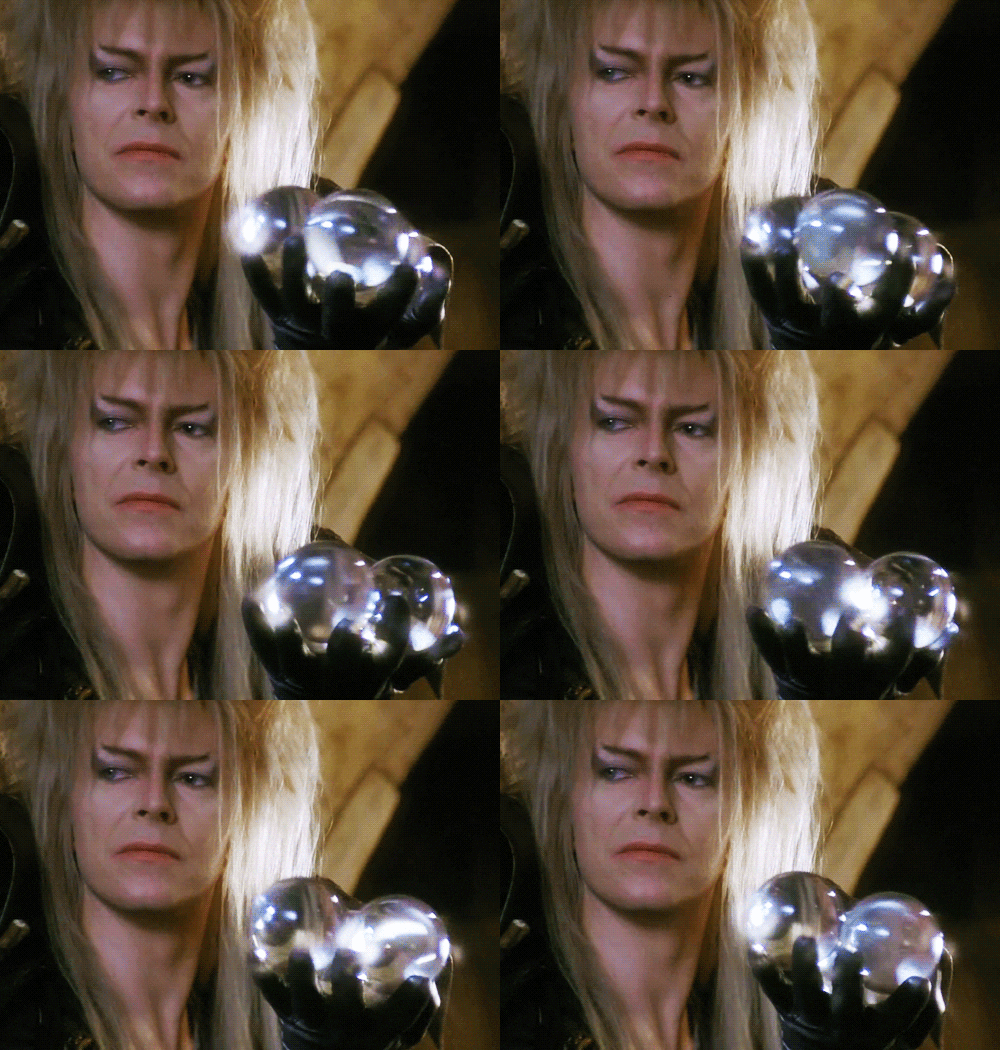
It’s my favorite challenge: David Bowie Day! Celebrating the 40th anniversary of the movie Labyrinth, which was my introduction to David Bowie.
ELEMENT 1: Your story must take place in a labyrinth. Easy, right? Too easy? Well, since you were all begging for more Bowie…
OPTIONAL ADD-ON ELEMENTS:
♫ UNDERGROUND: Include a reference to the movie Labyrinth in some way, shape or form. I really wanted to have a reference to the worm, but “it’s all junk!” worked better.
I like reading novels that have been translated into English. It’s a good way to see different perspectives, and the stories don’t always follow the same narrative conventions that I’m used to.
Unfortunately, not everyone feels the same way. Which meant that Grim by Sara B. Elfgren, and translated by Judith Kiros has been sitting on library shelves for too long without being checked out. It ended up on the dreaded Dusty list: a list of books that haven’t been checked out within the last 1-2 years. That made Grim a prime target to be discarded.
But the problem was that I still wanted to read the book. So, instead of discarding it, I checked it out.
Grim by Sara B. Elfgren is a Swedish death metal horror novel, and if you don’t like any of those words, we shouldn’t hang out.
Our story starts with Kasper getting a job at the amusement park Gröna Lund. Kasper is a nineteen-year-old who’s coming out of a deep depression, but quickly finds friends among the staff at the House of Demons, the haunted house he works at. He first connects with Iris over her favorite death metal band, Dark Cruelty. Dark Cruelty was one of the first Swedish death metal bands, and is still legendary in metal circles. But Kasper’s love for Dark Cruelty goes beyond fandom: his dad, Håkan, was the founder and bassist for Dark Cruelty. Dark Cruelty broke up after the unexplained death of the lead vocalist, Grim. Though Grim died before Kasper was born, there’s a strange connection between them. It can’t be coincidence that Kasper keeps having vivid dreams about Grim. Something powerful is pulling them together, and Kasper is desperate to understand what it is.
The book alternates between Kasper in the modern day, and Håkan in the 80s, at the start of the Swedish death metal scene. Håkan’s chapters show us the rise and fall of Dark Cruelty, starting with the band’s founding. When Grim joins, he changes everything.
I had a hard time classifying this book as any one particular genre. I described it to others as a horror or mystery, and it has elements of both. I think a modern Gothic describes it best.
There are several elements that make Gothic novels, well, Gothic. These elements might change based on who you’re asking, but there’s a few that are generally agreed upon: a spooky setting, like a castle or mansion; supernatural occurrences; passionate relationships; a Byronic hero; and an overall pervading atmosphere of gloom. I want to break these elements down here, because they’re what made the book feel so fresh for me and scarily personal.
Architecture is a notable feature of Gothic novels, like gloomy castles and spooky mansions. There are no castles or mansions in Grim, but Kasper works in a labyrinthine haunted house where several frightening incidents occur, including the book’s climax. In the 80s timeline, Dark Cruelty uses a dilapidated building as the setting for their album’s photoshoot. Grim is also an urban explorer, and takes Håkan to abandoned train tunnels and a subterranean lake. These settings a major role in the story, and continue to haunt Håkan in the present day.
Another hallmark of Gothic writing is supernatural elements. Most of the supernatural events in Grim take place in the present-day timeline. Kasper has strange, vivid dreams about Grim, an eerie injury that won’t heal, and witnesses…something in the haunted house. Kasper’s connection to the late singer keeps getting stronger, and it’s threatening to undo him.
There are some supernatural elements in the 80s timeline as well. Grim and Malte, Dark Cruelty’s guitar player, attempt magic rituals to summon demons or gain powers. Skeptical Håkan wants nothing to do with them, but he still takes part in one to please Grim.
Then, we have a Byronic hero. The Byronic hero is proud, troubled, secretly sensitive, mysterious, and passionate. But our Byronic hero isn’t Kasper, or even Håkan. It’s Grim.
By the time Kasper is born, Grim has become a legend in death metal circles. A talented vocalist who died young (or maybe he was murdered?) under mysterious circumstances. The truth of who the real Grim was is known only to his inner circle. Even Håkan admits that most of Grim’s life before the band is unknown to him. And Grim has passion for so many things: magick, death metal, and especially the band. Dark Cruelty is more than a band to Grim. Even though he wasn’t a founding member, Dark Cruelty is his life’s work. His passion is what draws people to him.
But he’s troubled as well. Grim is plagued by his own mental health. He could be read as having bipolar disorder or depression, or may just be a victim of a toxic relationship.
Another characteristic of Gothic fiction is passionate relationships. Typically, this would be between our handsome, brooding hero and a pale, beautiful woman. But in Grim, these relationships aren’t romantic. They’re friendships and rivalries, and this was one of the elements of the book that resonated with me so strongly. Håkan’s found a kindred spirit in Grim. They’re best friends, and even though Håkan doesn’t believe in demons and magick the way Grim does, he likes the way Grim sees the world. But as time goes on, their relationship starts to deteriorate. This coincides with Malte joining the band, whose dark presence will loom over Kasper. Grim begins to spend more time with Malte, a toxic friendship that leads to Grim’s downward spiral.
What resonated so strongly with me was Håkan’s reaction to Grim and Malte’s friendship. He’s jealous. Jealous that Grim is spending so much time with Malte, and jealous that they’re forming something that just the two of them belong to. There’s no room for Håkan in the world of magick that Grim and Malte are building.
I’m in my thirties. I don’t do high school drama anymore. But two years ago, this was something I felt so keenly, as a grown adult. I felt foolish and immature. How old was I, to be jealous of a friend paying less attention to me? But it still hurt. It turns out age doesn’t matter when it comes to things like that.
The good thing about being in my thirties was that I had the insight to talk to my friend about my feelings, and we repaired the friendship. (I’ll just state for the record – this was not all her fault. I had to step back and work on myself too.)
But Håkan and Grim aren’t adults. They’re teenagers. Håkan wants to reach Grim when he sees his friend spiraling into depression, but he doesn’t know how. It’s painful to read, especially if you’ve ever seen someone you care about going through something similar.
This aspect of the novel really stands out to me. While there are some YA novels about friendship, you’re far more likely to see a romantic relationship take center stage. Most of those YAs about friendship usually star girls as well. Of those few friendship-based novels about boys, I don’t think I’ve ever read one which covered jealousy like this.
The last thing a Gothic novel needs is a pervasive gloomy atmosphere. Which Grim did, but not in the way that you might expect. There’s a spectre hanging over Kasper, and it’s not just Grim. It’s depression.
When the book starts, Kasper is coming out of a deep and dangerous depression. Starting a job at the haunted house and making new friends is a huge leap forward for him. But every time he feels happy and comfortable, he starts doubting himself. He tells himself he doesn’t deserve this and fears losing everything. His depression lies, saying things like he only got his job because of his step-brother. His friend Iris only likes him because she’s a Dark Cruelty fan. His dad helped start Sweden’s death metal scene when he was younger than Kasper is now – and what has Kasper done with his life?
It wasn’t just that I felt for Kasper in these moments. I’ve been Kasper. So many of us have been Kasper. And it just makes me ache. I wish I could reach through the pages of the book and hug him (and spoil the ending, to save him a lot of trouble).
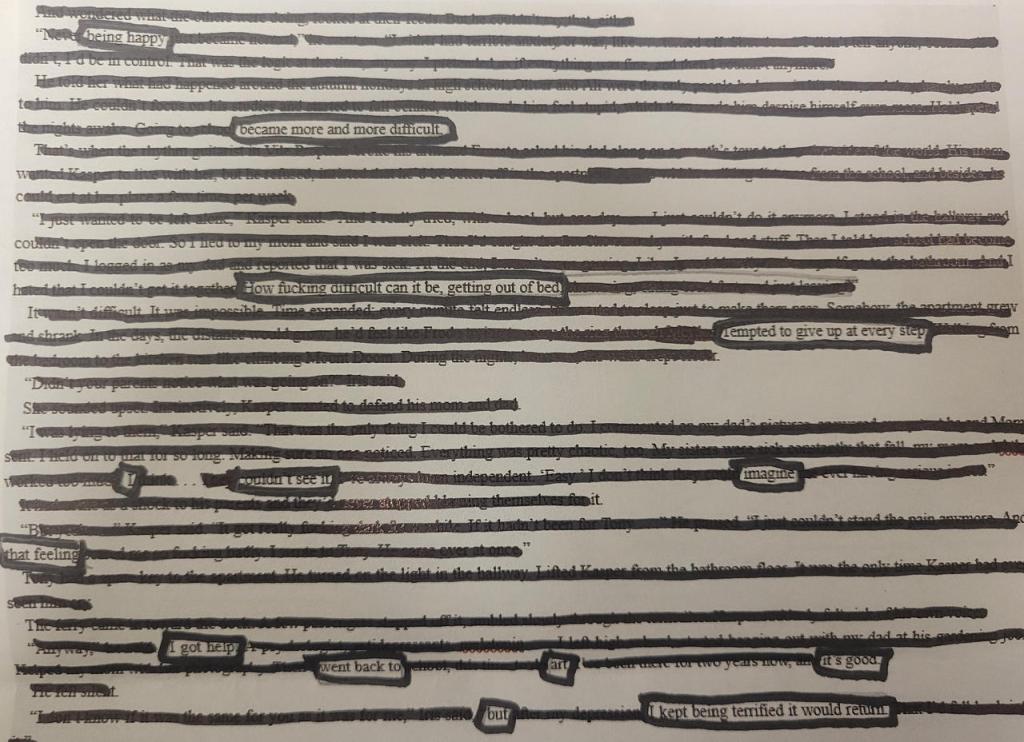
In one scene, Kasper opens up to Iris about his mental health struggles, and Iris shares her own with him. For me, this was the most powerful scene in the book. It really stayed with me. I even printed out a page from the ebook and made blackout poetry from it.
There are plenty of creepy moments that add to the gloomy atmosphere – a party that Kasper is definitely not supposed to be at is a stand-out – but for me, the shadow of depression lingering over him is the most haunting part of the book.
I’m really glad that I picked Grim off the shelf. I can’t think of another book I’ve read that’s quite like this. Atmospheric horror and supernatural elements combined to make something so real and haunting. If this Gothic sounds interesting to you, check it out.
And let me know if you do, because I need to talk to someone about that ending.
Without in any way limiting the author’s exclusive rights under copyright, any use of this publication to “train” generative artificial intelligence (AI) technologies to generate text is expressly prohibited. The author reserves all rights to license uses of this work for generative AI training and development of machine learning language models.
July is Flash Fiction Month! I’ll be sharing short short stories here through the month of July. Warning for strong language. More notes at the end of the story.
Makeup, lights, Evan in place, let’s do this.
“Yo yo yo, what up squad fam it’s ya boi, Candlefüt and today we are splorin’ this crazy gh-gh-gh-ost town!!”
Perfect spot for airhorn sirens. Can’t wait to see some of the graphics for this.
“Old Goose Meadow was a gold mining town waaaay back in the day.”
Was it gold? Or was it zinc? Don’t remember. Whatever, everyone knows what gold is. The fuck even is zinc?
“There was a huge-ass mine collapse and tons of miners died. The bodies were never brought to the surface, so the mine became their grave.”
Isn’t there more zinc in pennies than copper now? Something like that? Whatever, I’ll look it up later. Here’s the entrance.
“BUT the mining didn’t stop, yo. Me and my team found an open shaft that might even lead us to their mass grave.”
Give them the look, insert boom sound effect here, add some spooky music and effects. Damn, this place is darker than I thought. Who was in charge of setting up the lights? ‘Cause they didn’t do jack shit!
“Okay, I only got my flashlight. I’ll probably lose signal once I’m underground. And I’ll be truly, truly alone. I got a GPS tracker so hopefully if something goes wrong my team can–what was that?”
What the fuck? Evan knows his cue, and this isn’t it. You start slow, then he builds up with the noises and shit, then the big reveal. He’s way too early.
“Ha, ha, nothing at all. Hope it’s not the mine collapsing. Let’s keep going further in and–dude, check this shit out!”
This was not part of the plan, but this is sweet af. Actual miner graffiti? Hellz yeah.
“Someone would’ve gotten in big shit back in the day for saying something like this about the company. So probably he wrote it here to–”
Fuck, fuck, did something just run past me? How? Shit, dude. Calm down, calm down, it’s just Evan.
“Oh damn, the slope’s getting steeper. We’re seeing the last of daylight behind us and damn, the smell, yo, I wish you could smell this. I don’t know what gold smells like, but I don’t think it smells like this. It’s like…bad man. Rancid.”
Team didn’t warn me about this!
Was this a bad idea?
“You hear that? All that echo? Can you imagine how loud it must have been when there were dozens of dudes here, swinging pick axes and shit? And–holy shit!”
Don’t panic, it’s just Evan doing his thing. Only Evan.
“Now we’re into one of the big chambers, where the miners woulda–Did you see that?!”
Just Evan. Don’t let it get to you. Just–
It’s coming towards me. Evan’s supposed to stay off-screen. It’s cool, it’s all
Oh fuck fuck fuck fuck fuck
“Evan, bro, don’t–”
THAT ISN’T EVAN HOLY SHIT FUCK I’M ABOUT TO DIE I’M COOKED I’M
Without in any way limiting the author’s exclusive rights under copyright, any use of this publication to “train” generative artificial intelligence (AI) technologies to generate text is expressly prohibited. The author reserves all rights to license uses of this work for generative AI training and development of machine learning language models.
I read a lot of YA books. I like them, and I’m also in charge of the YA section at my library. That means a lot of weeding, and a lot of ordering new books.
I don’t mean reviews from Amazon or Goodreads, but professional reviews from sources like Kirkus or Library Journal are hugely important. Professional book reviews give a synopsis of the book, a sentence or two about the writing, and often a note about whether or not it’s worth purchasing. After reading the reviews for Into the Sublime, I ordered it, and put it on my TBR list. Thrillers and horrors circulate very well among teens at my library, and with the creepy cover art, I thought this one would be a hit.
Two years later, it landed on an inventory list as a “dusty book” – that is, it’s been sitting at the library for two years and hasn’t been checked out. That usually means it’s time to “send it to a nice library upstate” ….aka discard it. No one wanted to read this book.
No one, that is, but me.
Welcome to the first edition of the Dusty List, reading the YAs that everyone else has overlooked. Let’s start the descent with Into the Sublime, a survival horror by Kate A. Boorman.
Amelie’s best friend was her cousin, Sasha. They were both part of Dissent, a group of teenage thrill-seekers who took on death-defying challenges. The group broke up after Sasha suffered a terrible accident at a Dissent challenge, but Amelie’s not ready to let it go. She wants to keep the promise she made to Sasha, and go on the adventure they never got to do together: finding a legendary subterranean lake, the Sublime. The legends say that the lake has the power to change things, and there’s a lot that Amelie wants to change. She and three other girls, Gia, H, and Devon, set out on a day trip to find the Sublime. Days later, Amelie and two other girls emerge from the cave, covered in blood.
Only they know what happened in the dark. And Amelie is ready to talk.
Into the Sublime is a framed narrative that starts with an email sent from Amelie to an unknown recipient, then the story jumps back to three months prior. Amelie is found in the Colorado wilderness, covered in blood, and the two girls who were found with her are being transported to the hospital. Two police officers watch over Amelie while they wait for her parents to arrive, and Amelie starts telling them the story of what happened. But how much of it is the truth? How much is manipulation? And what happened to the fourth girl?
Using this framing device was a brilliant move for a number of reasons. First, it and the prologue email sucked me into the novel right away. Most of the story is told from Amelie’s first person perspective of her time in the cave. Between each section there are interludes written from the perspective of Officer Vargas, who treats Amelie with sympathy and suspicion in equal amounts. Vargas’s investigation reveals new information that Amelie hasn’t given us, which adds a few twists and ramps up the mysteries. It also serves as a break from Amelie’s story. The bulk of the novel takes place in the cave, and there are a lot of intense scenes. Cutting to the present with the cops gives readers a breather, and Vargas’s narration offers us another interpretation of all that Amelie’s said.
There’s another reason this works well for adult readers. For the first few chapters, you’re going to need to hit your willing suspension of disbelief button pretty hard. As with a lot of horror fiction, the characters make bad choices that lead them into dangerous situations. Yet knowing that trope wasn’t enough for me to overlook all the mistakes the girls made before they even reached the cave. Most of them were wildly unprepared to do a day hike, let alone any kind of caving. They fail to follow even the most basic safety rules when it comes to hiking, and even leave behind necessary supplies, like extra water and flashlights.
I had to dust off my old psychology degree to get past that. Let’s take a quick peek into the teenage mind. There are two mindsets adolescents have that contribute to risk-taking. Of course, adults can also have these mental constructs, though typically not as strongly as a teenager would. First is the “personal fable.” The personal fable is, in TikTok speak, “main character syndrome.” Part of this is believing that bad things won’t happen to them. So, sure, just because Amelie’s cousin broke her neck during a Dissent stunt doesn’t mean that Amelie will. After all, she’s the one who came up with the plan. She’s got directions to the lake. She’s immune.
The other mindset is called the “imaginary audience.” This is where you feel like the spotlight’s always on you. No matter what you’re doing, someone is watching. The “imaginary audience” doesn’t seem to have as much influence on Amelie’s and the other girls’ behavior at first, especially given the small number of characters in the story. But as the story unfolds, the reader can see how much Amelie’s perception of the other girls and their perception of her shifts the dynamics between the characters.
I’ve said time and time again that the thing that draws me into a is the characters. Into the Sublime is an exception to that rule. Amelie and her companions Gia, H, and Devon are all interesting in their own ways, especially as they each have different motives for wanting to find the Sublime. But by the end of the book I didn’t like most of the characters, with the exception of H. At first I thought Devon, with her unique outlook, would be my favorite, but that changed by the end of the novel.
Even if the characters were people I’d never want to be friends with in real life, I kept reading, because I just had to know how it all ended. The girls’ changing loyalties and motivations throughout the book ratchets up the tension until the very end, and keeps the reader guessing.
I also really liked the setting. Most of the book, aside from the intervals with the police officers, takes place in the cave. Caving is challenging and often dangerous, even when you know what you’re doing. Getting lost, losing your light, bottomless pits, and squeezes could all end in disaster. The environment by itself is frightening enough, especially considering how unprepared the girls are. The scares only intensify with eerie encounters and dangerous changes in the cave.
I do have a couple minor nit-picks1 other than what I’ve mentioned here, but overall I liked this book a lot. I think there is a bit of a high barrier for entry, especially for adult readers, but it’s a well-written, thrilling adventure. If you’re into survival stories with a bit of horror, check this one out.
Literally check it out. It’s on the dusty list.
Very minor. Like, “why does so much of Gia’s dialogue end in a question mark when she’s making a statement?” nit-picks. ↩︎
 Overlooked Books