Dec. 2025 Book Recs: Just Books I Liked


Without in any way limiting the author’s exclusive rights under copyright, any use of this publication to “train” generative artificial intelligence (AI) technologies to generate text is expressly prohibited.


Quick announcement before we begin: I’ve decided that I will not be doing book recommendation lists in 2026. Making these lists has been a great experience, and I’ve read a lot of excellent books that I might not have picked up otherwise. They’ve really helped me diversify my book shelves and read outside my comfort zone, and I hope they’ve done the same for you too. 

It’s also a lot of work. I don’t just read two books a month – I “sample” several, which usually means reading at least 100 pages. Most of the reading I’ve done for the past two years has been just for these recommendation lists, and it’s time to take a break and read…well, whatever I want. Maybe I’ll finally get around to Sunrise on the Reaping. This doesn’t mean that the blog is finished, though. I’ll still be doing “books I didn’t pick” and “dusty” titles, and hopefully more. I’d really love to do something about literature and theatre, and Shakespeare adaptations. (But have you ever read Shakespeare? It’s hard.) 

Let’s get into the final book recommendation list: Just Stuff I Liked. These are books that are worthy of sharing, but never made it onto a list before. Here are some of my favorite books in the last few years that never made it to the blog.

Nonfiction

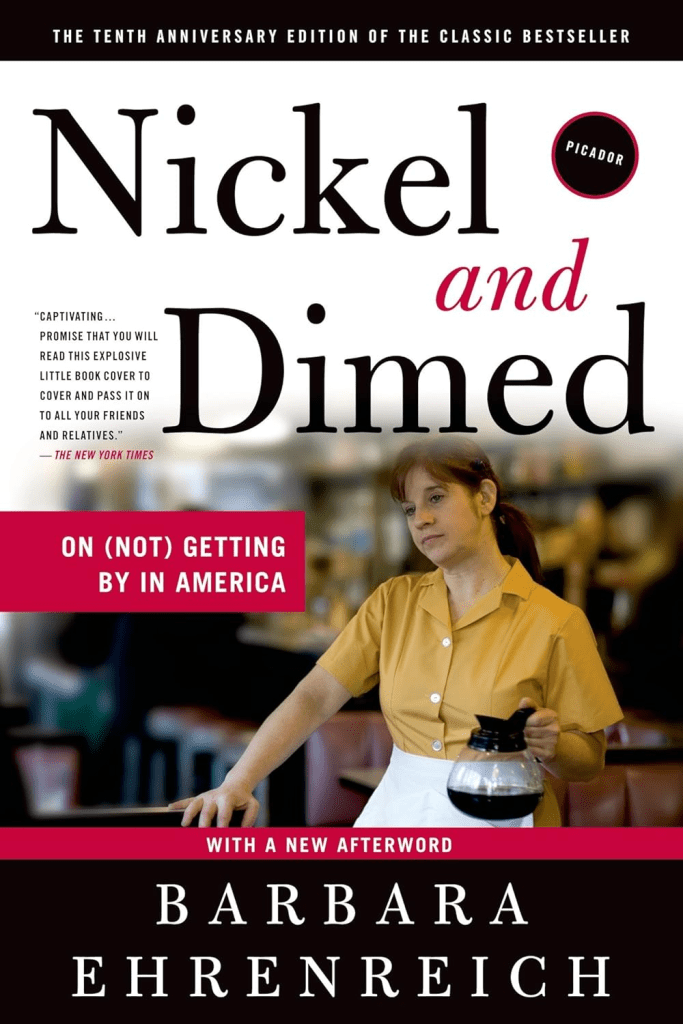
Nickel and Dimed: On (Not) Getting by in America by Barbara Ehrenreich

First published in 2001, Nickel and Dimed has remained scarily relevant for over twenty years. Between 1998 and 2000, writer Barbara Ehrenreich voluntarily joined the ranks of the working poor. She worked as a maid, nursing home aid, waitress, and Wal-Mart associate to understand the lived realities of millions of Americans below the poverty line. This book documents her experiences and struggles, such as working through pain and finding housing within her budget. The experiment ended when Ehrenreich faced homelessness, or, as she put it, she could no longer afford to work at Wal-Mart. Along with issues with housing, she also looks at food insecurity, the impact of manual labor on employees’ health, and hiring practices that veer into discriminatory. While the numbers have changed since this book was published, the facts have not. Nickel and Dimed remains a revelatory must-read for Americans today. 

Her Space, Her Time: How Trailblazing Women Scientists Decoded the Hidden Universe by Shohini Ghose

Women have long been involved in scientific fields, but have rarely gotten acknowledged for their work until recent history. Her Space, Her Time finally gives some of these brilliant women their much overdue credit. In the late 19th Century, astronomer Annie Jump Cannon helped create Harvard’s Classification Scheme, which is still used today, while being paid less than her male counterparts. Lise Meitner and her nephew Otto Frisch published the first paper on nuclear fission. Meitner’s longtime collaborator Otto Hahn was awarded the Nobel Prize for this discovery, and Meitner was left in obscurity. We all know Marie Curie, but what about Harriet Brooks or Bibha Chowdhuri? Each chapter focuses on a different scientific top, such as astronomy, physics, or chemistry, and the women who helped revolutionize their fields of study. Ghose explains complex scientific concepts in an understandable way, perfect for science lovers who chickened out of taking physics in high school (read: me). I learned so much from this book, not only about science, but also about the phenomenal women who helped shape our understanding of the universe, from the smallest sub-atomic particles to the Big Bang.

The Soul of an Octopus: A Surprising Explorating Into the Wonder of Consciousness  by Sy Montgomery


The intelligence and physiology of octopuses1 make them among the most fascinating animals on the planet. Naturalist Sy Montgomery was intrigued by octopus consciousness before she had the chance to meet one in person. At her casual visits to the aquarium, she felt that they were watching her as much as she was watching them. Montgomery first met the Pacific Octopus Athena, who eagerly latched on to Montgomery’s arm. Athena was strong enough to pull Montgomery into her icy tank, but instead was playful and curious. Thus began a series of octopus friends that Montgomery got to observe from their youth to death: Octavia, Kali, and Karma. Octopuses are highly intelligent animals that require toys and stimulation to keep them occupied; a bored octopus can be dangerous to itself and its handlers. They also have distinct personalities (Montgomery notes that Kali was aptly named) and strong emotions. Soul of an Octopus offers a compelling look at octopus consciousness both like and unlike our own. 

Patriot: A Memoir by Alexei Navalny

This story of Alexei Navalny’s life begins when he nearly died. While flying from Tomsk, Siberia to Moscow, he was poisoned with the nerve agent Novichok. He spent 18 days in a coma, and spent several months recovering in Berlin. Navalny knew who his would-be assassin was: Vladimir Putin. Navalny has been an outspoken critic of Putin’s regime and leader of the opposition party, the Anti-Corruption Foundation. He began writing his memoir while recovering from the poisoning, and ended it in prison. First is Navalny’s biography, where he recounts growing up before and after the fall of the Soviet Union and his education and early years as a lawyer. He writes about how he became the Russian opposition leader, and the dangerous and life-altering consequences for him and his family. One chilling chapter details Navalny returning to Russia after his poisoning, despite knowing that he will likely be arrested once he returns. The second half of the book is Navalny’s prison diaries and social media posts. He shares his experience in prison, including a hunger strike when he was denied medical care. The entries become sparser as his punishments in prison worsen, and Navalny would be killed in a prison above the Arctic Circle. Despite bleak circumstances, his writing never veers into self-pity or nihilism. Instead, he writes passionately about his work and condemns the invasion. Navalny also never loses his sharp sense of humor, adding some surprising moments of levity. While not an easy read, it is a powerful memorial and a stark reminder of how important it is to stand against authoritarianism. 

Musicophilia: Tales of Music and the Brain by Oliver Sacks

Ah, music! Who doesn’t love a great song that you can sing along to? Well, if you have amusia, a symphony may sound like pots and pans banging together. Musical hallucinations are real, too, and can cause a great deal of distress. But many of us love music, and our brains do, too. Oliver Sacks, best known for his work The Man Who Mistook His Wife For a Hat, takes a look into the good, the bad, and the utterly strange ways that music affects our brains. The book opens with the case of Tony Cicoria, a man who never had more than a casual interest in music. Then he was struck by lightning. Cicoria survived, but was struck by another passion: classical music. Within three months of his recovery, he was spending almost all of his time playing piano and composing music. His new obsession lasted decades. This is only one of the stories about the mysterious relationship between music and the human brain. Others include a man with amnesia whose memory lasts only seconds, but can still read and play music, a musician with severe Tourette’s whose tics diminish greatly only when he performs, among others. The therapeutic effects of music on people with Parkinson’s and Alzheimer’s is shown as well. Sacks never turns these narratives into freak shows, but writes compassionately about the power of music and the mysteries of the human brain. 

Fiction

Gravity by Sarah Deming

Gravity Delgado is a force to be reckoned with. This young woman is a fierce, undefeated boxer, preparing for the 2016 Olympics in Rio. She’s been training since she was twelve, but her biggest challengers are the ones that she faces outside the ring. Her alcoholic mother, responsibilities for her younger brother, and a heady romance all threaten Gravity’s rising star. She still has her supportive aunt and cousin, as well as her found family at the gym in her corner. Still, Gravity’s biggest obstacle might be herself. The boxing matches are exciting to read, and include both the physical and mental aspects of a bout. Gravity makes mistakes and occasionally stumbles, but you’ll be cheering for her in and out of the ring. A novel that pulls no punches in the best way. 

The Truth About Everything by Bridget Farr

Fifteen-year-old Lark knows how to drive, fix an engine, and catch her own food, but she can barely read. She and her parents know the end is coming, and they’ll be the only ones left standing after the inevitable downfall of America. Raised by two doomsday preppers, Lark has never questioned the conspiracy theories that she was raised on. Then Lark gets her period for the first time. She thinks that she’s miscarrying, something that has happened to her mother many times before, but doesn’t know how she could have gotten pregnant in the first place. After her mother explains what her period is, Lark starts to wonder what else her parents haven’t told her? Lark secretly enrolls herself in high school, where new knowledge conflicts with everything she’s been taught at home. She’s hungry to learn, even when it means uncovering painful truths. But soon, Lark finds herself at a crossroads. What is the real truth? And what will Lark have to sacrifice for it? Pairs well with Educated by Tara Westover. 

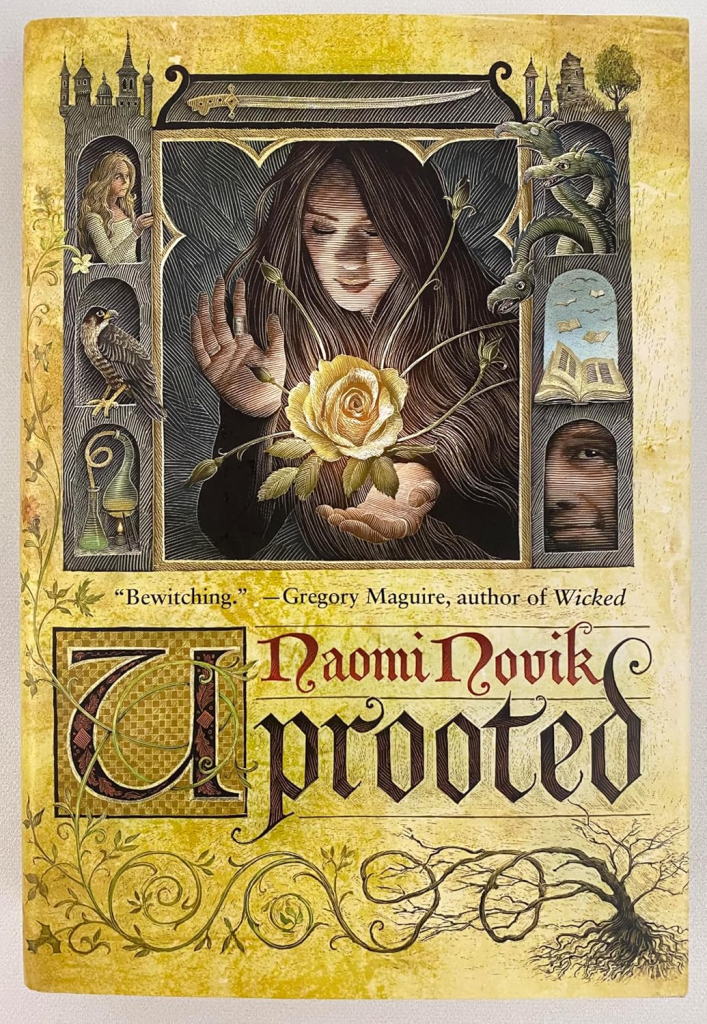
Uprooted by Naomi Novik

Once every ten years, the Dragon takes a village girl into his tower in the corrupt Wood. When she leaves a decade later, with jewels and finery, she is irrevocably changed and leaves the village forever. But the Dragon isn’t a scaly creature that breathes fire. He is a seemingly ageless, enigmatic wizard. Agnieszka has no fear of being taken. The Dragon only takes the most remarkable young ladies, and she’s nothing special. Though no one says it, everyone believes that Kasia, Agnieszka’s best friend, will be the one he picks. Yet it is Agnieszka the Dragon, reluctantly on his part. She is a witch, and her newly-found powers could be devastating if the corruption of the Wood reaches her. Agnieszka and the Dragon have a rocky start, but their mutual dislike of each other must be put aside when the Wood threatens her home. The well-developed characters, rich, Eastern European-inspired setting, and fantastic storytelling will leave you spellbound. 

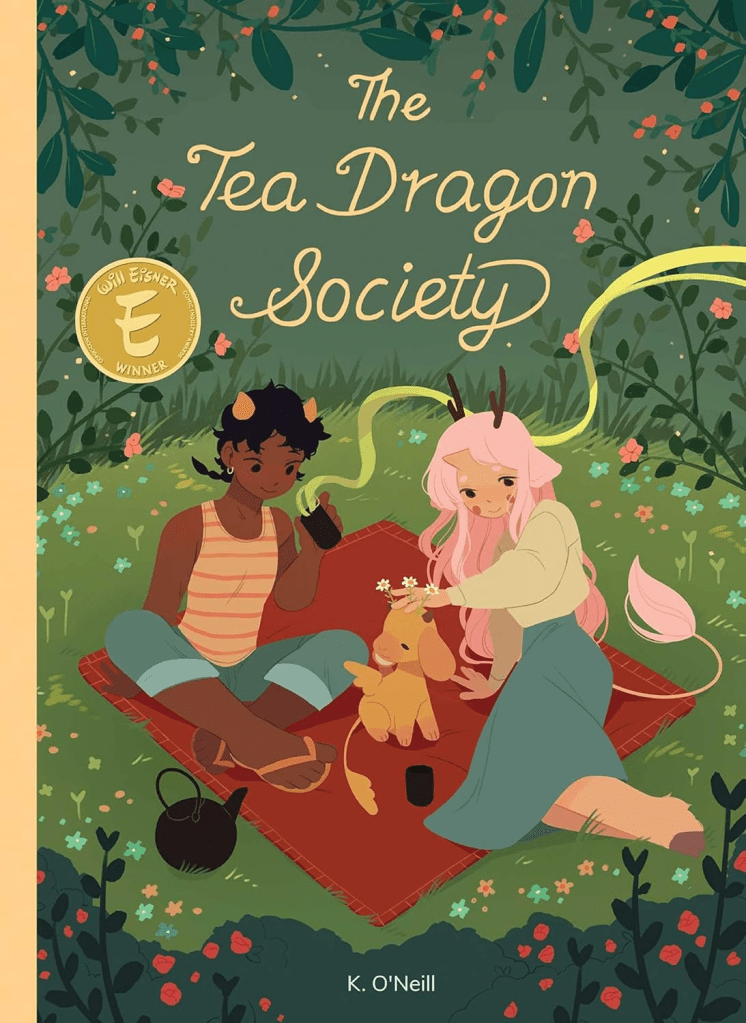
The Tea Dragon Society by K. O’Neil

Half-human, half-goblin Greta is an apprentice blacksmith in a world where the old crafts are fading. Greta helps a lost tea dragon – a small dragon that grows tea leaves – find its caretakers, and she is introduced to the Tea Dragon Society. Like blacksmithing, the care and cultivation of tea dragons is a dying art. The Tea Dragon Society is made up now only of Hesekiel, his partner Erik, and a shy girl named Minette. As a year passes, Greta learns to care for the dragons alongside Minette, assuring Hesekiel that the Tea Dragon Society will go on. I’ve enjoyed O’Neil’s other graphic novels, and The Tea Dragon Society embodies so much of what I love about their work. The artwork is soft, with no heavy outlines, adding to the whimsical feel of the world. It features a diverse cast in a simple but visually beautiful story. The Tea Dragon Society is the graphic novel equivalent of sliding into a warm bubble bath…maybe with a nice cup of tea. 

Long Way Down by Jason Reynolds

Will’s older brother, Shawn, has just been murdered. Will knows the rules of his neighborhood: don’t cry, don’t snitch, always get revenge. Will takes Shawn’s gun, and take the elevator from his eighth-floor apartment down to the first floor. The doors open on the seventh floor, and Shawn’s friend Buck gets on. Except Buck shouldn’t be here – he was already shot to death. On each floor, another ghost gets on. All of them played a role in Will’s life, and all of them were victims of gun violence. Each tells Will their stories, challenging his resolve. Can he kill his brother’s killer? Should he? This is a short, intense novel in verse that will stay with you long after you turn the final page.  

  1. Yes, that is the correct pluralization. Octopodes is acceptable, octopi is right out.  ↩︎

Dusty List: Into the Sublime

Without in any way limiting the author’s exclusive rights under copyright, any use of this publication to “train” generative artificial intelligence (AI) technologies to generate text is expressly prohibited. The author reserves all rights to license uses of this work for generative AI training and development of machine learning language models.


I read a lot of YA books. I like them, and I’m also in charge of the YA section at my library. That means a lot of weeding, and a lot of ordering new books. 

I wrote a post all about how librarians decide what items to get rid of, but didn’t really talk about how materials get added to the collection. That’s because each library will handle it a bit differently, but there is one thing they all rely on: reviews.

I don’t mean reviews from Amazon or Goodreads, but professional reviews from sources like Kirkus or Library Journal are hugely important. Professional book reviews give a synopsis of the book, a sentence or two about the writing, and often a note about whether or not it’s worth purchasing. After reading the reviews for Into the Sublime, I ordered it, and put it on my TBR list. Thrillers and horrors circulate very well among teens at my library, and with the creepy cover art, I thought this one would be a hit. 

Two years later, it landed on an inventory list as a “dusty book” – that is, it’s been sitting at the library for two years and hasn’t been checked out. That usually means it’s time to “send it to a nice library upstate” ….aka discard it. No one wanted to read this book. 

No one, that is, but me. 

Welcome to the first edition of the Dusty List, reading the YAs that everyone else has overlooked. Let’s start the descent with Into the Sublime, a survival horror by Kate A. Boorman.

Amelie’s best friend was her cousin, Sasha. They were both part of Dissent, a group of teenage thrill-seekers who took on death-defying challenges. The group broke up after Sasha suffered a terrible accident at a Dissent challenge, but Amelie’s not ready to let it go. She wants to keep the promise she made to Sasha, and go on the adventure they never got to do together: finding a legendary subterranean lake, the Sublime. The legends say that the lake has the power to change things, and there’s a lot that Amelie wants to change. She and three other girls, Gia, H, and Devon, set out on a day trip to find the Sublime. Days later, Amelie and two other girls emerge from the cave, covered in blood. 

Only they know what happened in the dark. And Amelie is ready to talk. 

Into the Sublime is a framed narrative that starts with an email sent from Amelie to an unknown recipient, then the story jumps back to three months prior. Amelie is found in the Colorado wilderness, covered in blood, and the two girls who were found with her are being transported to the hospital. Two police officers watch over Amelie while they wait for her parents to arrive, and Amelie starts telling them the story of what happened. But how much of it is the truth? How much is manipulation? And what happened to the fourth girl? 

Using this framing device was a brilliant move for a number of reasons. First, it and the prologue email sucked me into the novel right away. Most of the story is told from Amelie’s first person perspective of her time in the cave. Between each section there are interludes written from the perspective of Officer Vargas, who treats Amelie with sympathy and suspicion in equal amounts. Vargas’s investigation reveals new information that Amelie hasn’t given us, which adds a few twists and ramps up the mysteries. It also serves as a break from Amelie’s story. The bulk of the novel takes place in the cave, and there are a lot of intense scenes. Cutting to the present with the cops gives readers a breather, and Vargas’s narration offers us another interpretation of all that Amelie’s said.

There’s another reason this works well for adult readers. For the first few chapters, you’re going to need to hit your willing suspension of disbelief button pretty hard. As with a lot of horror fiction, the characters make bad choices that lead them into dangerous situations. Yet knowing that trope wasn’t enough for me to overlook all the mistakes the girls made before they even reached the cave. Most of them were wildly unprepared to do a day hike, let alone any kind of caving. They fail to follow even the most basic safety rules when it comes to hiking, and even leave behind necessary supplies, like extra water and flashlights. 

I had to dust off my old psychology degree to get past that. Let’s take a quick peek into the teenage mind. There are two mindsets adolescents have that contribute to risk-taking. Of course, adults can also have these mental constructs, though typically not as strongly as a teenager would. First is the “personal fable.” The personal fable is, in TikTok speak, “main character syndrome.” Part of this is believing that bad things won’t happen to them. So, sure, just because Amelie’s cousin broke her neck during a Dissent stunt doesn’t mean that Amelie will. After all, she’s the one who came up with the plan. She’s got directions to the lake. She’s immune. 

The other mindset is called the “imaginary audience.” This is where you feel like the spotlight’s always on you. No matter what you’re doing, someone is watching. The “imaginary audience” doesn’t seem to have as much influence on Amelie’s and the other girls’ behavior at first, especially given the small number of characters in the story. But as the story unfolds, the reader can see how much Amelie’s perception of the other girls and their perception of her shifts the dynamics between the characters. 

I’ve said time and time again that the thing that draws me into a is the characters. Into the Sublime is an exception to that rule. Amelie and her companions Gia, H, and Devon are all interesting in their own ways, especially as they each have different motives for wanting to find the Sublime. But by the end of the book I didn’t like most of the characters, with the exception of H. At first I thought Devon, with her unique outlook, would be my favorite, but that changed by the end of the novel. 

Even if the characters were people I’d never want to be friends with in real life, I kept reading, because I just had to know how it all ended. The girls’ changing loyalties and motivations throughout the book ratchets up the tension until the very end, and keeps the reader guessing. 

I also really liked the setting. Most of the book, aside from the intervals with the police officers, takes place in the cave. Caving is challenging and often dangerous, even when you know what you’re doing. Getting lost, losing your light, bottomless pits, and squeezes could all end in disaster. The environment by itself is frightening enough, especially considering how unprepared the girls are. The scares only intensify with eerie encounters and dangerous changes in the cave. 

I do have a couple minor nit-picks1 other than what I’ve mentioned here, but overall I liked this book a lot. I think there is a bit of a high barrier for entry, especially for adult readers, but it’s a well-written, thrilling adventure. If you’re into survival stories with a bit of horror, check this one out. 

Literally check it out. It’s on the dusty list. 

  1. Very minor. Like, “why does so much of Gia’s dialogue end in a question mark when she’s making a statement?” nit-picks. ↩︎

Indie Review: OMG UR a Teenager!

I’m a Reedsy Discovery reviewer! I received a free ARC of OMG UR a Teenager! by Leslie Young for this review.

⭐⭐⭐⭐

Twelve-year-old Kat Cruz can’t wait for her next birthday. Before she can become a teenager, though, she’ll have to make it through seventh grade. The year starts off rough when her parents buy the most run-down house in the neighborhood, and a bully snaps a picture of Kat in front of her new house. She’s constantly stuck babysitting her younger brother, who thinks he’s a superhero. Kat’s editorials in the school newspaper make a splash, but not always in a good way. She’s also crushing on her new neighbor, Will, despite the fact that his mom doesn’t seem to like her. With new challenges every day, will Kat make it to her thirteenth birthday in one piece? 

OMG UR a Teenager by Leslie Young is a contemporary slice-of-life novel full of clear, crisp writing that makes it easy for young readers to get into the story. The relatability will keep them invested throughout the book. Kat experiences things that many kids going through pre-adolescence face: bullying, the excitement and mortification of buying your first bra, and changing family dynamics. Most of all, she wants to be seen as the mature nearly-teen she is, not a child and permanent babysitter for her little brother, Max. Tween readers will understand exactly how she feels, and adults will easily recall both the joys and pains of middle school.

Kat’s family dynamic is true to life as well, with well-intentioned parents who don’t understand their daughter’s point of view, an annoying little brother that Kat loves (even if she wants to kill him sometimes), and her vivacious grandmother whose Alzheimer’s puts extra strain on the family. Kat’s and Max’s relationship is developed particularly well, showing their closeness (especially in the climax), even if they don’t always get along. However, Gran’s storyline wasn’t as well-developed, making her inclusion in the book feel unnecessary.

At times the story can feel disjointed, such as an abrupt cut from summer to Halloween. Like Gran’s story, some plot points are dropped without a conclusion. Kat’s narration is also, at times, too mature to be realistic for a twelve-year-old. While adult readers might have to stretch their suspension of disbelief at some of Kat’s inner monologues, tween readers may find her insights useful in their own lives.

Overall, OMG UR a Teenager is a warm-hearted, relatable story for tweens, and anyone who’s ever been one.

Banned Book: Flamer by Mike Curato

This is the last post of the year! I will be taking a break in January and be back in February.


New on the ALA’s Banned Book list this year is the graphic novel Flamer by Mike Curato. If you’re a picture book aficionado, you might already be familiar with his work, such as the Little Elliot series.

In 2022, Flamer became challenged and banned books in the U.S. due to LGBTQIA+ content, and being considered as “sexually explicit.” Despite this, the book has received high praise from critics, but I think the blurb on the cover says it all.

This book will save lives.

Jarret J. Krosoczka

Fourteen-year-old Aiden Navarro isn’t excited to go to high school. He was frequently bullied at his Catholic middle school, and fears that public high school will be much worse. His parents’ frequent fights don’t make his home life easy, either. Thankfully, he has an escape during the summer at sleep away Boy Scout camp. Aiden loves scouting, but the Summer of ’95 isn’t going to be like any camp experience he’s had before. As the summer goes on, Aiden finds himself drawn to his confidant bunk mate, Elias. At first Aiden thinks that he admires Elias’s confidence and friendly nature. It can’t be a crush, right? That would make Aiden gay. And if being gay is a sin that can condemn you to hell (and get you kicked out of Boy Scouts), then it must be pretty bad. And Aiden isn’t a bad kid.

So he can’t be gay…right?

The last two weeks of summer camp are filled with some great memories – and also some terrible ones. Though Aiden makes great friends and loves camp, he’s also subjected to homophobic and racist bullying. When things look at their bleakest, Aiden wonders: does his life really have value?

The comic is in black and white, except when fire and a few other important objects are depicted. Flames are yellow, red, and orange, the only colors in the book. It’s used to great effect, especially in the climax and resolution.

Non-spoiler review: Flamer hits on heavy real-life topics that many tweens and teens can relate to. The main themes of identity and growing up are relevant to everyone, not just LGBTQIA+ youth. There is some mild sexual content, so I’d recommend this book to kids 13-14 and older.

I want to talk about the reasons that Flamer was challenged, banned, removed, or relocated.

One of the reasons was that Flamer is “sexually explicit.” Is it? Well, I think that depends on who you ask. Explicit-ness can be subjective and your feelings about what is and is not “sexually explicit” can change with time and experience. Some of the things that made me blush when I was fourteen I’m totally comfortable with now and I wouldn’t consider “explicit” today. Whether you find the sexual content in the book offensive or too much is really up to your own comfort levels. For me, the sexual content in Flamer was a little uncomfortable to read, but it wasn’t graphic. It seemed realistic and fit with the overall theme and story of the book. I can’t really object to it.

The other major complaint against Flamer is that it contains LGBTQIA+ content. And, well, duh. It’s a story about a young teenager accepting himself as gay.

As we saw earlier, LGBTQIA+ content was a really common reason given to challenge/ban books for the last 10 years. I won’t beat around the bush: this is homophobia and transphobia. There’s no other way to explain it. Otherwise, why would perfectly innocent (and adorable) books like And Tango Makes Three or This Day in June be challenged so frequently? I wouldn’t hand an elementary-age child Flamer; it’s not appropriate for the age group. But a cute picture book about a same-sex couple like Prince and Knight? Well, I wouldn’t have a problem suggesting that to a young child.

Because queer people (and penguins) exist. Everyone – from all walks of life – need to see themselves represented in media, but I think this is especially true for kids. Our early experiences shape our lives, and it’s important to see ourselves reflected in what we watch and read. Simply put, if you can’t see it, you can’t be it.

Beyond this point, there are going to be spoilers. If you’re interested in reading Flamer, check it out before you scroll down. I’d hate to ruin the (awesome) ending for you.

Content warning: there will be mentions of suicide from here on out. If that’s not something you want to read about, it’s okay to sit this one out. Mental health resources can be found at the bottom of this post.

Towards the end of Flamer, Aiden feels that everyone has turned against him. His best friend hasn’t written him back after he hinted at being gay in his most recent letter to her; a camp counselor he looked up to was removed from camp after he was discovered to be gay; Elias has been avoiding Aiden after Aiden surprised him with a kiss on his cheek. After yet another day of harsh bullying, Aiden can’t see how his life will ever get better. It feels like it would be better to end it now, and save himself years of misery. He runs to the camp’s outdoor chapel with a pocket knife and plans to take his own life.

Before Aiden can harm himself, he is taken to a strange place filled with darkness and fire. In a beautiful sequence, he speaks to “the fire of life” within himself. It challenges him: why is Aiden trying to destroy them both? They are not weak. They deserve to live. In this encounter, Aiden realizes that his life may not be as easy as his friends’, but it still has value. He still deserves to live. No matter what happens, he is enough. Just as he is.

It’s a powerful moment.

Even more powerful when you consider that suicide is the second leading cause of death among teens in the United Sates. LGBTQIA+ youth are at a higher risk for suicide, especially when they live in environments that are not supportive of their identities.

LGBTQ youth are not inherently prone to suicide risk because of their sexual orientation or gender identity but rather placed at higher risk because of how they are mistreated and stigmatized in society.

The Trevor Project, Facts about LGBTQ Youth Suicide, 2021

Aiden is fictional. But his feelings are real to those who’ve lived through them. The impact that Flamer can have on its readers is also very real. No matter how bad things have been for Aiden, or how bad they might get, he knows that he as value as a human being. And that’s a really great message, especially for teenagers. Even more so for LGBTQIA+ youth who need to see someone with the same struggles they’re going through, and come through it feeling strong.

One last thing to really drive the message home: Flamer is true. Well, parts of it. Flamer is a semi-autobiographical graphic novel, inspired by author and illustrator Mike Curato’s experiences as a gay Boy Scout in the 90s. In an author’s note at the end of the book, Curato shares some of his internal conflicts when he was Aiden’s age, and some memories from camp.

Including his suicide attempt in the camp’s chapel.

Curato survived, and went on to become a much-loved, award-winning illustrator. And now his story – and Aiden’s – is there to tell kids like him you are worthwhile. You are valued. You are enough.

And I cannot imagine why anyone who would be so cruel as to take that message away from kids who so badly need to hear it.

National Suicide Prevention Hotline (US): 1-800-273-8255
List of Suicide Crisis Lines (Worldwide)
The Trevor Project Lifeline: 1-866-488-7386 | Text: START to 678-678 | Online chat available
Q Chat Space

More resources can be found here: https://booksoverlookedblog.com/resources/

Indie Review: Hounds of Gaia

I’m a Reedsy Discovery reviewer! I received a free ARC of Hounds of Gaia by Sean Tirman for this review.

⭐⭐⭐

Home to notorious criminals fleeing justice, the asteroid Deadwood was never a safe place. But something far deadlier lurks just under the surface of the mining colony. Something brutal and merciless, that leaves only death and gore in its wake. The Contractor Foxhound doesn’t know that. She’s only here to catch a human trafficker called Fink, and get back to Earth to collect the bounty on his head. Neither does Sister Penelope, a nurturing and peace-loving woman striving to protect the forgotten children of Deadwood. Foxhound’s, Fink’s, and Penelope’s lives collide with devastating results, but the real danger is closer to them than they think.

Hounds of Gaia starts with a bang, steadily building up the horror of the tunnels underneath Deadwood. The action-packed prologue is sure to keep readers turning pages.

The worldbuilding is extremely detailed, which works well in the first few chapters of the book. It’s interesting and immersive, and makes the reader more interested in the setting. Yet as the story unfolds, the exposition becomes clunky and often unnecessary. These information dumps bring the action of the story to a shrieking halt, and sometimes repeat information that the reader already knows. It also took away some of the mystery about Foxhound’s identity. Most readers will be able to figure out where she comes from long before it’s ever revealed.

The uninterrupted action sequences themselves are excellent. Thrilling chases through seedy neighborhoods, criminals hopped up on elicit drugs, futuristic weapons, and bouts with some truly evil villains will keep readers on the edge of their seats.

While the setting is given great depth, the heroes are not. The three protagonists – Foxhound, Penelope, and a girl with no name – all suffer from thin characterization. Foxhound is a tough woman with a job to do; Penelope is a kind woman who cares deeply about the children in her care; the girl is an innocent child. Those are their character traits, and not much else. As this is the start of a series, however, there is plenty of room for character growth and development in coming books.

On the antagonist side of things, Fink and his criminal associates are utter delights whenever they appear. They revel in their villainy, which is really fun to read. Like the other characters, they aren’t fully fleshed out, but given their role in the story (and how fun they are), they don’t need to be.

Overall, Hounds of Gaia has a lot of potential for a sci-fi series. Sci-fi fans who enjoy plot-driven stories and detailed worldbuilding will enjoy this book, and the ending will keep readers curious for the next volume.

Indie Review: Curse of the Terracotta Warriors

I’m a Reedsy Discovery reviewer! I received a free ARC of Curse of the Terracotta Warriors by Mark Douglas for this review.

⭐⭐⭐

When the police come to Maddie Jones’s school, she thinks they’re going to arrest her for one of her many pranks. But the truth is much worse: her archaeologist dad has been kidnapped (Or dadnapped?). Maddie is certain this has something to do with the shipment of Qin dynasty terracotta warriors that just arrived at her dad’s museum from China. With the help of her two younger brothers, Maddie will face untold dangers and unravel ancient secrets to get her dad back. And she thought climbing the rock wall in gym class was tough…

Curse of the Terracotta Warriors is an action-packed book that moves quickly. Almost every chapter ends in a cliffhanger, which keeps the reader tuning pages. Unfortunately, much of the action sequences in Part One can feel repetitive, and the novel would have benefited from tightening up the first third of the book.

Maddie is, far and away, the star of the novel. She’s bold, a natural troublemaker with a snarky personality that will instantly endear her to readers. Told from Maddie’s first-person point of view, her clear voice and colorful narration will leave readers cheering for her through the most dire situations.

There are a few writing pitfalls throughout the book. Capitalization is occasionally inconsistent, with some character’s names or the start of sentences not being capitalized while common nouns are. Another instance sees Maddie “hurtling” over an obstacle rather than “hurdling” it. These aren’t major issues, and nothing that another proofing wouldn’t fix.

The Chinese setting of Xi’an is bland and feels shallow and poorly researched. Characters refer to “Chinese letters” and the “Chinese alphabet” when it’s common knowledge that Mandarin does not have an alphabet. The characters also watch CNN in their hotel room in Xi’an and use Wi-Fi at a Starbucks to do research, despite the fact that Chinese media is heavily censored. The Chinese setting doesn’t pop enough, and these inaccuracies show through.

Even so, Curse of the Terracotta Warriors is a fun, entertaining romp with a vivacious protagonist that’s tough to put down. Its short, action-packed chapters make this a great pick for reluctant readers, and middle-grade kids who love adventures.

52 Children’s Books in 52(ish) Weeks: The Books

52 Books in 52 Weeks: The Quest
Part 1: The Books – You’re here, silly!
Part 2: The Authors

This next series of posts have been a year in the making. In January 2021, I announced that I would attempt to read one book a week off the New York Times‘s children’s best seller lists.* Admittedly, I didn’t quite manage to read a book a week, but I did manage to read all 52 books in 52 weeks…and then some. In my original post about this project, I set up a few rules for myself. First, I wouldn’t re-read books I’ve already read before, and would cycle through the separate lists for picture books, middle-grade hardcovers, and middle-grade series. As the year went on, I had to make another rule about not repeating authors or franchises. Mostly this was to ensure that I was getting a better sample of what kids are reading today, but also because I can only stand so much Diary of a Wimpy Kid and its spin-off books. My rule about not reading The Ickabog (and it was on the list for months!) had to be changed into not reading anything by JK Rowling. It wasn’t a problem for most of the year, but towards the end, her middle-grade book The Christmas Pig topped the list. I also decided that I would not be reading any cookbooks. It’s not just because I’m bad at cooking, but because I was looking for books with narrative.

Why did I chose to embark on this project? My husband asked me this when I was griping about a book I didn’t like. I didn’t do it just for the blog (though that was definitely a consideration). I like kids’ books, but mainly, I did it because at the time, my goal was to become a children’s librarian. (Mission accomplished!) While I had a good idea of what’s going on in the world of YA lit, I wasn’t sure what was popular among kids twelve and under today. I figured that I could use the best seller list as a guide to get a taste of what kids are reading.

I had quite a few different observations going through this project, which I’ll writing about in other posts. To start this off, though, I have some microreviews on the books I read for the past year.

Week 1 (Jan 3.): Five More Sleeps Til Christmas, by Jimmy Fallon. Illustrated by Rich Deas.

Cute, nice illustrations, and Jimmy Fallon had a fun virtual story time reading.

Week 2 (Jan. 11): Rowley Jefferson’s Awesome Friendly Adventure by Jeff Kinney.

I never liked Greg Heffley much, but I was 100% here for Rowley’s wholesome adventure. Only someone with Kinney’s clout would even be able to publish a book like this. I’m kinda jealous.

Week 3 (Jan. 17): Wings of Fire: The Dragonet Prophecy by Tui T. Sutherland.

I was surprised at how dark this book got, but I would have loved this series as a kid. I was definitely curious to see what happens later in the series. If I had more time, I’d read the whole main series just to see what happens next. I might still try the graphic novels.

Week 4 (Jan. 24): Little Blue Truck’s Valentine’s by Alice Shertle. Illustrated by Jill McElmurry.

Super cute, but I would have liked it better if the illustrations depicted the winter season rather than fall. Valentine’s Day is a winter holiday, after all!

Week 5 (Jan. 31): Little Leaders, by Vashti Harrison.

I really liked this collection of biographies, and learned about important Black women that I hadn’t heard of before. I do wish the illustrations had been a bit more dynamic; most figures were like paper dolls with the same face, with only their clothes and hair to distinguish them from one another.

Week 6 (Feb. 7): Dog Man, by Dav Pilkey.

I have the same “clout” suspicion as I did with Jeff Kinney, but Dog Man was a silly, fun comic book. Of course, I may be biased, since I was a fan of Captain Underpants as a kid. My favorite parts, though, were the notes warning Harold and George about how disruptive their comics were. And it doesn’t matter if kids are reading something simple, as long as they’re reading!

Week 7 (Feb. 14):  Ambitious Girl, by Meena Harris. Illustrated by Marissa Valdez.

I loved this book! It shows empowered women and characters of color, and its message is important for every kid to hear. 

Week 8 (Feb. 21): Ground Zero, by Alan Gratz.

I could write an entire post about this book. Harrowing, gripping, and emotional, without the “America, fuck yeah!” attitude I had expected. I think Reshmina’s eloquence and insightfulness on the war in Afghanistan stretched the believability a little thin for me, but she made excellent points. A novel that would definitely help kids understand the horrors of 9/11 and its aftermath better.

Week 9 (Feb. 28): Baby Sitter’s Club Graphix, by Ann M. Martin. Illustrated by Reina Telgemeir.

I never read The Baby-Sitter’s Club books as a kid, and reading the graphic novel didn’t make me feel as though I’d missed out on anything special. I do like Raina Telgemeier’s work, and it was kind of cool to see these books get updated for a new generation of readers. 

Week 10 (Mar 7.): Love from the Very Hungry Caterpillar, by Eric Carle.

Very cute, and good for the whole year, not just Valentine’s Day. Needed more holes.  Rest well, Eric Carle.

Week 11 (Mar. 14):  Living the Confidence Code, by Katty Kay, Clare Shipman, and JillEllyn Riley.

This book is full of real-life stories of girls becoming leaders around the world. It was easy to read and uplifting. I found it inspiring, and recommended it to a friend with a tween daughter.

Week 12: (Mar. 21): Crave, by Tracy Wolff.

I didn’t understand the appeal of Twilight then, and I don’t understand the appeal of Crave now. I will say that the book was very funny, but I don’t think that was the author’s intention.

Week 13 (Mar. 28): How To Catch a Leprechaun, by Adam Wallace. Illustrated by Andy Elerkton.

Simple, cute, and fun! It reminded me of St. Patrick’s Day when I was still in elementary school.

Week 14 (Apr. 4): Becoming: Adapted for Young Readers, by Michelle Obama.

It looks like not a lot changed from the original version to the adapted edition. Unfortunately, I found most of the book pretty boring, but I’ve never been a huge fan of biographies. Even so, I can see someone other than me finding this memoir meaningful and inspiring.

Week 15 (Apr. 11): The Lightning Thief, by Rick Riordan.

I’ve always been interested in Greek mythology, but I didn’t love this book. Even so, it’s a quick-paced adventure that I’m sure middle-grade fantasy lovers will enjoy.

Week 16 (Apr. 18): Pete the Cat: Big Easter Adventure, by James Dean and Kim Dean.

Admittedly, I’ve been a fan of Pete the Cat for awhile now. Cute and colorful, and I love Pete’s grumpy face. 

Week 17 (Apr.  25): Wonder, by R.J. Palacio.

Heartwarming without being overly-cheesy. If you have a disability, or love someone who has a disability, this will hit very close to home. I liked it so much I even started reading one of the side stories.

Week 18 (May 2):  Shadow and Bone, by Leigh Bardugo.

I was pretty underwhelmed considering the hype around this book, but I liked it enough to check out the sequel. Even if I didn’t make it that far in the sequel before giving up.

Week 19 (May 9) We Are Water Protectors, by Carol Lindstrom and Michaela Goade.

Beautiful and moving artwork, and an important book for every audience. 

Week 20 (May 16): The One and Only Bob, by Katherine Applegate and Patricia Casteleo.

I haven’t read the first book in the series (or watched the movie based on it), but Bob was a distinct, vibrant character and the story didn’t go the way I expected. Enjoyable.

Week 21 (May 23): Five Nights at Freddy’s: Fazbear Frights by Scott Cawthon.

A collection of stories about the titular pizza place. Fans may love it, but I’d put it into the category of, “Well, at least they’re reading.” 

Week 22 (May 30):   Peace Train, by Cat Stevens and Peter H. Reynolds

The illustrations were simple, but I liked the bright colors. I think it works better as a song than a picture book, but it was nice enough.

Week 23 (Jun. 6): Stamped (For Kids), by Jason Reynolds, Ibram X. Kendi, and Sonja Cherry-Paul.

I wish this was the sort of education I had on race as a kid, not just “Martin Luther King, Jr. solved everything.” Even the kids’ version can be uncomfortable to read, but it’s important to understand how deeply rooted racism is in America. Teaching kids about race and racism early gives me hope for the next generation of leaders. If kids are empathetic and receptive to this kind of learning, I hope our future leaders can make great strides against racism in the U.S.

Week 24 (Jun. 13): What Was/What Is… series. I read What Was Hurricane Katrina, by Robin Koontz.

Informative in a way that’s easy for kids to digest without ever talking down to them. It didn’t try to hide unpleasant truths about living conditions during and after the hurricane, and tied it back to current events and the danger of climate change. I was pleasantly surprised.

Week 25 (June 25):  Strange Planet: The Sneaking, Hiding Vibrating Creature by Nathan W. Pyle. 

This is such a strange idea for a picture book, especially if you’re not already familiar with the Strange Planet comics. Like the comic, this book is all about using context clues to figure out what the characters are saying. For some kids this could be a fun way to learn new words, but for others, especially younger ones, I think the vocabulary would be too hard.

Week 26 (Jun 27): The Game Master: Summer Schooled by Matt and Rebecca Zamolo.

There are much worse YouTuber books, but this one doesn’t have much to recommend to it unless you’re already a fan of the channel.  It changes perspective without any rhyme or reason, and the readers aren’t given enough information about the puzzles to solve them along with the characters.

Week 27 (Jul. 4): The Last Kids on Earth, by Max Brailler.

The monster apocalypse is terrifying, but it’s also kind of a kid’s paradise. This fun, funny romp through the end of the world has the feel of a comic book. It would be perfect for a reluctant reader, or anyone with a zombie apocalypse plan.

Week 28 (Jul. 11): The Bench, by Meghan Markel. Illustrated by Christian Robinson.

This is a very sweet book, though the narration addresses an adult rather than a child. The illustrations were simple, but I liked how they showed a lot of diversity.

Week 29 (Jul. 18): Ali Cross: Like Father, Like Son by James Patterson.

I thought some of its handling of current events was clumsy or heavy-handed, but I liked this fast-paced mystery well enough. Not enough to check out the other book in the series, but enjoyable for what it was.

Week 30 (Jul. 25): Carry On, by Rainbow Rowell.

There’s so much backstory to get through, especially in the first part of the book, that it feels like you’re coming in part way through the series instead of the first book. I liked the magic system, but the novel got bogged down by all the exposition. Even so, it was a fun read, and I’d recommend it to any Harry Potter fans who are mad at JK Rowling.

Week 31 (Aug 1): The Pigeon Has To Go to School by Mo Willems

Is there any children’s librarian who DOESN’T like Mo Willems? The pigeon books talk directly to the reader and makes it interactive. Plus, who hasn’t been nervous before their first day of school?

Week 32 (Aug 8): Amari and the Night Brothers by B.B. Alston.

I had a hard time getting into this one. I think I’m just burnt-out with youth fantasy series, especially ones that feature some sort of trial/rite of passage. There were a lot of information dumps, especially in the beginning, and sometimes it felt like I was just waiting for the real action to start.

Week 33 (Aug. 15): Serpent & Dove, by Shelby Mahurin

I liked this book way more than I thought I would. It’s marketed as a supernatural YA romance, but there’s action, intrigue, and some really great characters. I didn’t love the third act, or the ending, but I’m sure I’ll be reading the sequel.

Week 34 (Aug. 22): Three Little Engines, by Bob McKinnon

I was a little wary when I saw that one of my favorite books as a child had gotten a sequel, but this one did a fine job. Instead of the importance of determination, this book focused on teaching empathy, and how sometimes people need a little help. The message that sometimes saying “I think I can” isn’t enough detracts from the original <em>Little Engine That Could</em> a little bit, but overall I think it’s a worthy follow-up.

Week 35 (Aug. 29):  Black Boy Joy: 17 Stories Celebrating Black Boyhood, edited by Kwame Mbalia.

In a word: warmhearted. This is an anthology of short stories all starring Black boys by talented authors. There’s a variety of genres, too. Along with contemporary stories, there’s also science-fiction, fantasy, and poetry. “Extinct” by Dean Atta was my favorite, but each story will leave you smiling.

Week 36 (Sep. 5): The Cruel Prince, by Holly Black

I went back and forth on this book. I was excited to read this series, but also a little apprehensive. It eventually hooked me, but it didn’t stay. About 3/4s of the way through I realized I didn’t like any of the characters and didn’t care what happened to any of them. While I am curious about how the rest of the series plays out, I don’t think I’ll be reading any more books in it.

Week 37 (Sep. 12): We Don’t Eat Our Classmates! by Ryan T. Higgins

I loved this book! It’s funny, Penelope is an adorable T-Rex, and it teaches about empathy in a memorable, humorous way.

(And empathy is delicious.)

Week 38 (Sep. 19): We Are Family, by LeBron James and Andrea Williams

This was much better than I expected it to be for a celebrity book, though I have a feeling LeBron James didn’t do the bulk of the writing. I thought some of the plot lines needed more development, but it’s an easy read that will appeal to basketball fans and student athletes.

Week 39 (Sep. 26): A Twisted Tale series, by Liz Braswell. I read Part of Your World. 

I had a pretty good time with this book. The story did meander a bit in the middle without much progress, but overall I liked it. I’d pick up another book in the series for a light, fun read.

Week 40 (Oct. 3): Gustavo, the Shy Ghost, by Flavia Z. Drago

I never thought I would relate to an illustrated ghost so much. I definitely felt like Gustavo as a kid (and sometimes still do!) so I loved seeing him take a risk and make friends.

Week 41 (Oct. 10): Beasts and Beauty, by Soman Chainani. Illustrated by Julia Iredale.

This was such a cool book! Creative twists on classic fairy tales in ways that I couldn’t guess were coming. (including feminist morals, a gay Sleeping Beauty, a Black Snow White). 

Week 42 (Oct. 17): A Good Girl’s Guide to Murder, by Holly Jackson.

I’ve never been a fan of mysteries, but I devoured this one. I think including things like the main character’s capstone journal and other visual aids helped me get into it. By the time the book switched over to conventional narration entirely, I was totally hooked. I thought the characters could be developed more, but the story was so gripping I couldn’t put it down. 

Week 43 (Oct. 24): The Bad Seed Presents: The Good, the Bad, and the Spooky, by Jory John. Illustrated by Pete Oswald. 

I’ve read a couple of The Bad Seed books and I really like the art style. I thought this one was a bit wordier than the ones I’ve read in the past, though I might not be remembering properly. I didn’t like this one as much as the other ones I’ve read, but it’s a cute Halloween story with tricks and treats.

Week 46 (Nov. 14): Change Sings by Amanda Gorman. Illustrated by Loren Long.

Amanda Gorman is a talented poet, but the illustrations are where this book truly shines. They show a group of diverse kids doing things to help their community and one another, making a big difference when they’re all together. I especially liked the end, where the reader is dared to join in and help make change.

Week 44 (Oct. 31): The Beatryce Prophecy by Kate DiCamilo. Illustrated by Sophie Blackall.

The set up is a bit generic for an adult who’s read fantasy novels for most of her life, but I liked the characters, especially Beatryce and Answelica. A sweet, short story that would be great for kids getting into fantasy.

Week 45 (Nov. 7): I Survived series by Lauren Tarshis. I read I Survived Gettysburg. 

I’ve seen these books around, and I’ve always been curious about them. I Survived Gettysburg is a fast-paced story starring a brave boy who escaped from slavery with his younger sister. It’s not the most in-depth historical fiction for youth that I’ve read, but the author has a helpful FAQ and other reading recommendations for kids who are interested in learning more about the Civil War.


Week 47 (Nov. 21): Black Ballerinas by Misty Copeland. Illustrated by Salena Barnes.

Here’s my confession: I am an uncultured swine who doesn’t care about ballet. The illustrations are beautiful, but the biographies didn’t really hold my interest. However, I understand that it’s important to highlight Black women in this predominantly White dance form. I hope children of color will be able to see themselves in this book, and know that they can break barriers like the ballerinas in the book…and Misty Copeland.


Week 48 (Nov. 28): Warriors: The Broken Code by Erin Hunter

This book is a good introduction if you’re not already familiar with the Warriors series. I wasn’t enthralled by it, but if I were ten, I’m sure it would have been one of my favorite books.


Week 49 (Dec. 5): Aaron Slater, Illustrator, by Andrea Beaty. Illustrated by Douglas Roberts.

I already really liked this picture book series, and this is another solid entry, featuring a child with dyslexia who learns to tell stories his own way.


Week 50 (Dec. 12): Out of My Heart by Sharon Draper

The plot is pretty thin: Melody, a girl with severe cerebral palsy, goes to summer camp. But Melody is such a good character and the book is so warm-hearted, reading it was like sliding into a bubble bath.


Week 51 (Dec. 10): Magic Tree House Series by Mary Osborne Pope. I read Knights at Dawn.

There’s plenty to capture kids’ imaginations in this fast-paced adventure, while also educating readers on some historical facts.


Week 52 (Dec. 26): Construction Site on Christmas Night by Sherri Duskey Rinker. Illustrated by Ag Ford.

I liked this cute, rhyming book, but I have just one gripe: why are all these construction vehicles boys? I loved construction vehicles when I was young, and I’m sure a lot of little girls do, too.

*Fun fact: Harry Potter is the reason the New York Times began a separate list for children’s best sellers. People were so tired of the Harry Potter books taking up slots on the regular best seller list, a separate best seller list had to be created.
BIDP: Save Your Breath

For the next round of “Books I Didn’t Pick”, I read Save Your Breath by Melinda Leigh. This is the most recent in Leigh’s Dane series, which revolves around the eponymous attorney, her fiancé, PI Lance Kruger, and his assistant, Lincoln Sharp.

I haven’t read any thriller novels since I was in high school, and I’ve never really liked mystery books. I didn’t think that Save Your Breath would be something that was fun for me to read. But I’m trying to read outside my usual genres, and assured myself that, however bad this got, at least I wasn’t reading another romance novel.

I opened the first page, and finished the entire book in about a two weeks.

I get pegged as a fast reader, but that’s not entirely the truth. I don’t read faster than the average person, I just read a lot. It still can take me several weeks or or a couple months to finish a book. Which is why finishing Save Your Breath within two weeks was a bit of an accomplishment for me, and shows how compelling I found the book.

Though there is one thing I need to point out: when I read Save Your Breath, I was midway through two children’s literature courses. Throughout the semester I would read at least 60 children’s and middle grade books, and it was just so refreshing to read a book intended for an adult audience. Busy as I was with school and work, it would have been easy to let Save Your Breath fall by the wayside. Even so, I kept coming back to it, day after long day.

The writing technique was fine. I know that’s a boring way to put it, but that’s about all I can say. The prose wasn’t anything spectacular, but it wasn’t bad, either. Every sentence said just what it needed to, and got out of the way for the next one. It got the job done – no more, no less.

Though Save Your Breath is part of a series, it worked as a standalone novel. Whenever a main character from the series appeared, they reader got a little bit of background about them. That way, I could understand who everyone was, their role, and their relationship with the other main characters.

I’ve seen this used in other book series, like Janet Evanovich’s Stephanie Plum books, or The Dresden Files. It makes it easy for readers to pick up the newest book without having to know everything that happened in the ones before it. I imagine this could be annoying for readers who have been following the series for a long time, but it was helpful for me.

The downside of novel series where a new reader can jump in at any point is that changes to the status quo often come very slowly. Going back to Janet Evanovich for a moment, the 27th Stephanie Plum novel (not counting side-stories) was released in November 2020. In it, Stephanie Plum is still torn between the same two love interests she’s had since the first book, which came out over twenty years ago.

Not to throw shade on Evanovich or the Stephanie Plum series, of course! I’ve read some of the books and enjoyed them, but this is the only comparable example I have at the moment. Like I said, I don’t read the thriller/mystery genre much.

From Save Your Breath, at least, I did get a feeling that big changes for the characters do happen more frequently. At the beginning, for example, Morgan and Lance are engaged, which is not how they started the series.

I didn’t feel like I got to know the characters very well, especially Lincoln. Morgan, Lance and Lincoln are all intelligent, tenacious people with different skill sets. They care about each other and are protective of the people they love. Looking back on the book now, it’s hard for me to pick out individual character traits beyond that. Morgan is a mother, and Lance is a good step-father to her kids, but I can’t think of any distinct characteristics of them beyond that.

I think the characters would have come across more strongly if I had read the previous books in the series. Save Your Breath also deals with a crime that’s personal to the characters: Lincoln’s girlfriend, Olivia, has been kidnapped. Lincoln is justifiably concerned, and working around the clock to do anything he can to find her. The other characters note that he’s so worried that he’s not acting like himself. This makes sense, but because I haven’t read the other books in the series, I don’t know what he’s really like as a person. So, pros and cons of jumping into a serial series!

Like I said before, I’m not a big fan of mysteries. Even so, I was pretty drawn in by the set-up. True crime writer Olivia Cruz has an ethical dilemma about what information she should put in the book she’s working on. She calls Lincoln to ask him for advice during lunch the next day, and is kidnapped from her home. Morgan, Lance, and Lincoln must learn who took her, why, and most important, how they can bring her home safely.

The more they uncover, the more the mystery deepens. Murder, suicide, and a homegrown militia all come into play. Each moving part offers another clue to the story. If nothing else, this book got me to understand the appeal of mysteries novels better. I liked trying to put the clues together, and I was really interested to see how they all tied together.

This next paragraph is a little spoiler-y, so skip it if you plan on reading this book later.

Unfortunately, the clues did not all tie together. I liked the rouges’ gallery of suspects involved in Olivia’s disappearance, and I was especially intrigued about the para-military survivalist organization that one of them ran. And what was the ethical dilemma that Olivia wasn’t sure if she should put in her book? It was a question that I thought the entire plot hinged on. But it turned out that very little of those details actually mattered. The true culprit and motive for Olivia’s kidnapping had very little to do with those questions. Another reader might have appreciated the subversion of expectations, but it left me feeling disappointed and disgruntled. A lot of interesting plot points had been built up, only to ultimately fall flat. The otherwise exciting events of the book became filler in the wake of the novel’s conclusion.

Despite the above complaints, I liked Save Your Breath for the most part. It was easy to read, and I’d be open to trying out another thriller novel when I need something a bit less dense than what I normally pick out for myself. Maybe during my next semester at school, it’ll be a nice breath of fresh air….

Books I Didn’t Pick: How Fires End

How Fires End by Marco Rafalá is a family drama, following the life of Salvatore Vassallo using three different perspectives.

Salvatore was born in Melilli, Italy, where he lived during World War II. Salvatore’s younger brothers were accidentally killed during the war, and their deaths destroy Salvatore’s faith, and bring ruin to his family. With the help of an Italian soldier with fascist ties, Salvatore and his sister, Nella, leave Italy and immigrate to Connecticut. A generation later, Salvatore’s American-born son, David, seeks to discover his overbearing father’s secrets, with devastating consequences.

Since other “books I didn’t pick” were disappointments for me, I was a little wary coming into this one. I also don’t read a lot historical drama fiction. When I started How Fires End, the only other novel I could think to compare it to was Middlesex by Jeffery Eugenides. Both tell a multi-generational story of a family of immigrants. The family heads keep secrets from the next generation, which change their children’s lives forever. There’s a historic fiction element to both, but that’s really where the similarities end. In recent memory, the only family dramas I’ve enjoyed and felt invested in were Downton Abbey and The Poisonwood Bible, by Barbara Kingsolver. While I am familiar with the family drama/historical fiction genre, it’s not something I seek out frequently.

Why is why I was pretty surprised at how quickly I got sucked into this novel. A big part of that is just for the way that the book is written. The prose is beautiful, even poetic. The first section of the book, “David”, was a prime example of this. Throughout it, the author uses extended metaphors to show the relationship between David and his father.

Imagine an object so massive that not even light could escape the pull of its gravity. If light could not escape, nothing could. That was how my father loved me.

The metaphors in Part 1 are often related to black holes or planetary orbits, which makes sense, because David has a strong interest in astronomy. I really enjoyed them, mainly because I’m a space nerd. If they had been based on some other topic, I could see the constant metaphors getting annoying, but they worked well for me.

David’s section of the book was easily my favorite, but there was one issue I had with it. The novel is told using first-person perspective, so David is our narrator. He’s thirteen years old, but the narration doesn’t have the voice of a young teenager. Of course, thirteen-year-olds can have deep thoughts and come up with clever metaphors about their lives. But this entire section reads like an old man looking back on his life, not as a kid living it.

This is most obvious when it comes to David’s relationship with his only friend, Sam. Vincenzo says that Sam and David are paisanu.

‘They are saying, the saint is one of them, a paisanu. You know what that word means? It’s like the way you and David fought for each other. You understand? It’s the same thing.’

Sam really likes this, and calls David paisanu as an affectionate nickname. For any thirteen-year-old, especially a lonely one like David, that would be a huge deal. Later, Sam excitedly discusses his summer plans for the two of them. He talks about going to the beach, starting a band, and girls.

Sam had unspooled a thread for me to follow–a way out of the labyrinth–and I held onto it even as I knew our Ray Harryhausen days couldn’t last. Nothing did.

This just drives it home for me that David’s narration is not that of a thirteen-year-old. When you’re at that age, you often feel closer to your friends than you do to your family. No thirteen-year-old would refer to his friend as a brother, but also fully believe that their friendship will come to an end.

It’s a bit paradoxical – the prose is one of the book’s greatest strengths, and also one of its weaknesses. What this novel struggled with most was distinguishing the voices of its characters. The second section of the book is narrated by Salvatore, and the final part is told by Vincenzo. Salvatore’s and Vincenzo’s stories focus on the past: their lives in Italy, and early life in America. Though their life stories are different, the prose doesn’t change to match them. There’s no stylistic difference between David’s, Salvatore’s, or Vincenzo’s narration.

Salvatore’s section was probably the hardest for me to get through. Part of it was the aforementioned issue with voice, but it’s also just kind of a bummer. This makes sense when it comes to the three-act structure commonly used in fiction. Salvatore’s section is the second act, which is usually a downer. There were no light-hearted moments or hope spots, and getting through it was a slog for me.

At that point, I’d also become pretty attached to David. I wanted to know more about what happened after his part in the novel was over. There’s a little bit of an epilogue, but I really wanted to see more than what I got.

My one other complaint might be the dearth of female characters. David, Salvatore, and Vincenzo all have romantic interests, though they aren’t all that well fleshed out. Of them, David’s mother, probably has the most characterization, but she died when David was young. She doesn’t appear “on screen” as much as she appears in David’s faint memories of her. Salvatore’s sister, Nella, does play a significant role in the novel, yet she doesn’t appear to have any sort of life of her own outside of Salvatore and David. Of course, the first-person perspective is limited, and can only tell us how the narrators see her.

On one hand, I would have liked to see the women in this book have a stronger presence. However, the novel doesn’t feel incomplete because of that lack. It’s a very masculine novel, a book about fathers and sons. The writing style and excellent prose help hide this absence. I wouldn’t be surprised if other readers didn’t notice it at all.

While How Fires End did have its flaws, I was surprised by how much I enjoyed it. This is Marco Rafalá’s first novel, and I’d be interested in reading more from him.

Books I Didn’t Pick: The First Girl Child

Picking out a book for someone else can be a challenging task. Everyone has their personal tastes, and it can be hard to find something that suits that person well. Take me, for example. I love sci-fi, but I couldn’t make it though the sci-fi classic, Dune. Other people love it, but it just wasn’t for me. In this not-so-creatively titled series, “Books I Didn’t Pick”, I’ll be looking at books that were chosen for me, most of which I would probably not pick if left to my own devices. Even so, I try to be open to different writers and genres, hoping to find something new that I enjoy.

For the very first edition of “Books I Didn’t Pick”, we have The First Girl Child by Amy Harmon, which was sent to me as part of a writer’s subscription box.

The First Girl Child was billed as a historical fantasy romance, and I figured that two outta three ain’t bad when it came to genres I was interested in. Reading through it, though, I came to discover that it failed at being any of those things.

Historical fiction isn’t something I got into until I was an adult, but I can appreciate the difficulty of writing it. It needs to feel grounded enough that even if the events and characters never really existed, you believe that they could have happened at some point. As I’m writing this, I recently finished a historical fiction unit for one of my classes, and discovered that I’m very picky about historical fiction that I actually enjoy. It either needs to be from an era I have an interest in, or feature spunky girls going against societal norms. The First Girl Child at least had the former: it’s a story about Vikings!

The First Girl Child takes place on the fictional island of Saylok, home of five fierce Viking tribes. I was here for it: high seas, adventures, shield maidens and fierce warriors. At least, that’s what I wanted to see. I got next to none of that. Viking raids are mentioned in passing, the only female warrior we actually see is almost immediately killed off, and most of the book takes place at the main temple on the island. Instead of seafaring exploits, we get shallow politics that feel like they were lifted from A Song of Ice and Fire without the nuance, or compelling characters to carry it through. Aside from an occasional reference to Odin, there is virtually nothing to separate Saylok’s culture from any other generic Medieval group.

It also bothers me that the author only had the characters pray to Odin or her OC Norse god, Saylok, and completely neglected Freya and the Vanir. The book is centered on the island’s residents being unable to conceive female children, but no one ever has the bright idea to pray to a fertility goddess.

Okay, so the historical fiction element was lacking. Maybe the fantasy aspects would be better? They definitely started out strong. In this world, magic comes from drawing ancient runes, and then activating the runes with blood. In the prologue, Dagmar and his sister Desdemona discover they have “rune blood” after entering a cave with runes carved on the walls. Runes are powerful forms of magic, and Desdemona uses them to curse all of Saylok. She also prophesies that no one but her son will be able to break the curse.

Aside from the set-up, the runes are hardly ever used. Dagmar uses them to pray for protection for Bayr, but they never make a meaningful appearance until the end. Because the runes are underutilized, the resolution felt like a deus ex machina. The book justifies this by saying that rune magic is dangerous, and its secrets are guarded closely. Even so, I’m a bit miffed about the lost potential.

Women were also forbidden from using rune magic. In doing some research for this post, I found that siedh, or a type of Norse magic, was often associated with women rather than men, so there’s another big X in the historical fiction column.

Then last, but not least, comes the romance.

Oh boy, here we go.

I’m not sure how fair it is for me to discuss romance as a genre. I’ve reviewed some romance manga here, but it’s often not something I’ll typically go for. Still, I tried to keep an open mind. Amy Harmon is the author of several romance novels, and she has a following. Thus, I expected the romance between Bayr and Alba to have some of the strongest writing in the book.

The relationship between them just strikes me as rather icky, though. Bayr sees Alba for the first time when she’s an infant and he’s a young child, and immediately says that he loves her. I chose to interpret this as platonic love, because Alba had just been born. It’s not as squicky as, say, Jacob imprinting on Renesmee in Breaking Dawn, but it’s in the same ballpark.

Bayr sees himself as Alba’s protector, and the two have a brother-sister relationship when they’re growing up. Bayr leaves the Temple Mount where they both live when he’s around twelve, and returns years later as and adult man. When he sees Alba again, they are suddenly in love, despite (a) not seeing each other in years and (b) being raised as brother and sister. In fact, Bayr’s lowest point in the book is when he believes Alba to be his biological sister. She isn’t, but it drives the “icky” factor home even more.

Even if I put that aside, I don’t see this as a great romance. There’s no build up; you don’t see them gradually fall in love. They meet, they’re in love, that’s it. Sometimes that’s okay, but we don’t see their relationship grow in any meaningful way. It’s just banal, and what should be the driving force of the book its least interesting aspect.

As far as characters and pacing go…

In my experience, good characters can save a mediocre plot, and vice-versa. I thought the plot itself was fine, though clumsily executed. As far as the characters go…I honestly don’t remember a thing about them. In writing this post, I tried to think of some key traits of each one. Bayr is strong and protective. His uncle, Dagmar, is intelligent and protective. Alba is…demanding of Bayr’s attention? If the only thing I can remember about the heroine of a romance novel is their connection to another character, that’s a problem. Even the antagonist was generically evil in a way that made him neither compelling, nor someone that I loved to hate.

The pacing bugged me. The novel starts with Bayr’s birth, and ends once he (spoiler!) becomes king of Saylok, so it obviously can’t capture every moment of his life in the book’s 400 pages. A lot of Bayr’s life is done in a sort of written montage, with important, specific scenes written out in detail. I think this works well when Bayr’s a kid, but not so much when he’s an adult. Most disappointing for me was when he leaves the Temple Mount where he was raised, and joined his grandfather’s clan. Apart from one scene that depicts his (admittedly badass) initiation into the clan, a lot of his skill and character development during those years is covered in just a few paragraphs. I want to see how he changed from the shy, stammering “Temple Boy” into a leader and warrior, but I never got more than a glance at his journey.

I was obviously pretty disappointed with this book. Even though I have my favorite genres and authors, I like stepping out of my reading comfort zone and trying something new. It can be hit and miss sometimes, and this book was clearly a miss.

I don’t want to end on an entirely negative note, and there were some things I liked about the book. First, despite my complaints, it’s well-written. I may not have cared for the story, but the prose was pretty good. I also think that it started out strong, and the magic system was cool, even if it wasn’t used to its full potential. I also liked the character of Desdemona, despite the fact that she was barely in the story.

In S.R. Ranganathan’s Laws of Library Science, laws 2 and 3 are:

2. Every reader her or his book
3. Every book its reader.

This was not my book, and I was not its reader. But if this sounds like a novel you would enjoy, by all means, check it out! You might be the reader it needs.