Indie Review: OMG UR a Teenager!

I’m a Reedsy Discovery reviewer! I received a free ARC of OMG UR a Teenager! by Leslie Young for this review.

⭐⭐⭐⭐

Twelve-year-old Kat Cruz can’t wait for her next birthday. Before she can become a teenager, though, she’ll have to make it through seventh grade. The year starts off rough when her parents buy the most run-down house in the neighborhood, and a bully snaps a picture of Kat in front of her new house. She’s constantly stuck babysitting her younger brother, who thinks he’s a superhero. Kat’s editorials in the school newspaper make a splash, but not always in a good way. She’s also crushing on her new neighbor, Will, despite the fact that his mom doesn’t seem to like her. With new challenges every day, will Kat make it to her thirteenth birthday in one piece? 

OMG UR a Teenager by Leslie Young is a contemporary slice-of-life novel full of clear, crisp writing that makes it easy for young readers to get into the story. The relatability will keep them invested throughout the book. Kat experiences things that many kids going through pre-adolescence face: bullying, the excitement and mortification of buying your first bra, and changing family dynamics. Most of all, she wants to be seen as the mature nearly-teen she is, not a child and permanent babysitter for her little brother, Max. Tween readers will understand exactly how she feels, and adults will easily recall both the joys and pains of middle school.

Kat’s family dynamic is true to life as well, with well-intentioned parents who don’t understand their daughter’s point of view, an annoying little brother that Kat loves (even if she wants to kill him sometimes), and her vivacious grandmother whose Alzheimer’s puts extra strain on the family. Kat’s and Max’s relationship is developed particularly well, showing their closeness (especially in the climax), even if they don’t always get along. However, Gran’s storyline wasn’t as well-developed, making her inclusion in the book feel unnecessary.

At times the story can feel disjointed, such as an abrupt cut from summer to Halloween. Like Gran’s story, some plot points are dropped without a conclusion. Kat’s narration is also, at times, too mature to be realistic for a twelve-year-old. While adult readers might have to stretch their suspension of disbelief at some of Kat’s inner monologues, tween readers may find her insights useful in their own lives.

Overall, OMG UR a Teenager is a warm-hearted, relatable story for tweens, and anyone who’s ever been one.

May Book Recs: Asian-American and Pacific Islander Heritage Month

Without in any way limiting the author’s exclusive rights under copyright, any use of this publication to “train” generative artificial intelligence (AI) technologies to generate text is expressly prohibited. The author reserves all rights to license uses of this work for generative AI training and development of machine learning language models.


May is Asian American and Pacific Island Heritage Month in the U.S.! AAPI Month began as Asian/Pacific Heritage Week in 1978, and was extended to the entire month of May in 1990. In 2009, the obserservance’s name was changed to Asian American and Pacific Islander Heritage Month. Asia and the Pacific island are both huge places with numerous cultures, and a short list like this can’t possibly cover every country. I’ve decided to showcase four books for this month, with one book focusing on Asia, and one on the Pacific Islands for each category. 

As a reminder: I don’t distinguish YA from adult books on these lists. This is a deliberate choice, for several different reasons I might get into on another post. However, if you are dead-set on not reading any books outside your demographic age, here’s a simple guide: if the main character is a teenager, it’s probably a YA book; if the main character is an adult, it’s probably an adult book. This isn’t always the case, and I do try to note when books featuring teen characters would be better suited for older audiences.

Without further ado, here’s some books to celebrate AAPI month!

Nonfiction

No Country for Eight-Spot Butterflies: A Lyric Essay by Julian Aguon

Julian Aguon is a Chamorro human rights lawyer and the founder of Blue Ocean Law, which specializes in Indigenous rights and environmental justice. He’s also a passionate and talented writer, as exemplified in No Country for Eight-Spot Butterflies. This book is a collection of his essays, speeches, and poems, but it’s also a love letter to the young people of Guam. “The Ocean Within” encourages high school graduates to imagine, dream big, and “get quiet” when they search for their destiny. Other essays discuss threats to the natural world, through climate change and increased militarization of Guam, despite its residents’ protests. Loss and grief are also central themes, shown in deeply personal writing. Though some entries are painful (“Fighting Words” is particularly difficult to read), overall, the book encourages its readers to make changes in the world, even if it’s only in a small way. My favorite essay was “Nikki and Me,” which resonated so strongly with me I had to read it twice. 

Family Style by Thien Pham

Thien’s first memory is “the saltiness of fish…and the sweetness of rice” when he was a young child on a refugee boat traveling from Vietnam to Thailand. Food is the prominent framing device in this graphic novel memoir, which shows Thien’s life first as a refugee, then as a Vietnamese immigrant, and finally as a U.S. citizen. Each period of his life is marked by an important food, from the bánh cuốn his mother cooked in a refugee camp in Thailand to the ham and cheese croissants that signify the Pham family gaining financial independence in the United States. Thien chronicles his family’s story of starting a new life in America with help from other Vietnamese refugees. Challenges included learning English, financial hardships, and strange cafeteria food. At times Thien questions his cultural identity, trying to understand what it means to be Vietnamese and American. While parts of Thien’s story are harrowing, particularly his journey to Thailand, the graphic novel is well-balanced with humorous and touching memories as well. 

Fiction

The Lies We Tell by Kate Zhao

When someone asks Anna Xu why she wants to go to Brookings for college, she tells them that it’s a prestigious school, and the in-state tuition will save her a lot of money. What she doesn’t say is that she wants to solve the murder of Melissa Hong, a Brookings student and Anna’s former babysitter. College life isn’t want Anna thought it would be, with a roommate who loves to party, and her old academic rival, Chris Lu, keeps popping up in unexpected places. At least she has Jane on Friend Me, the school’s friend-finding app. Anna’s investigation is derailed when Chris’s family’s bakery is vandalized with a racial slur, and strange things start happening to her and other Asian students on campus. Is Melissa Hong’s killer still out there? Anna needs to find out what happened to Melissa fast…before the same thing happens to her. 

Dragonfruit by Makiia Lucier

In the Nominomi sea, “dragonfruit” – seadragon eggs – are said to be able to undo a person’s greatest sorrow, though at a price. Hanalei knows this is true: after she and Princess Oliana were poisoned, Hanalei’s father stole dragonfruit intended for the princess to save his young daughter. Hanalei survived, though her father did not, and the princess remains in a coma. Hanalei spent the next ten years of her life in exile, but the sight of a pregnant seadragon gives her hope. After an encounter with dangerous dragon hunters, Hanalei arrives back in her home kingdom of Tamarind. There, she reunites with her childhood friend, Prince Samahitamahenele. She and Sam finally have a chance to save Princess Oliana, but they are not the only ones seeking the dragonfruit. Dangers await them across the waves, and even if they reach the dragonfruit first, what price will they pay? Dragonfruit is a lush and imaginative fantasy steeped in Pacific Islander mythology and imagery. 

Banned Books 3: Other

This is the final entry of our banned books triptych. I’d wanted to talk about this in my previous post, but I got a little carried away and couldn’t find a good place for it. (tl;dr: “This is America. You want to live in North Korea, you can live in North Korea. I don’t want to. I want to live in America.” – Ron Swanson)

Now we come to the most common reason books have been challenged or banned: that strange, nebulous category of “other.” 

And let me tell you: “other” is wild. Some of my favorite reasons given include a book using the phrase “poo poo head” (Super Diaper Baby by Dav Pilkey) and the Harry Potter books for having real curses and spells.

The curses and spells used in the books are actual curses and spells; which when read by a human being risk conjuring evil spirits into the presence of the person reading the text.

Rev. Dan Reehill

I am extremely disappointed. In the many years I’ve been reading Harry Potter,  I have never once summoned an evil spirit. Not even by accident. And if those are real spells in the book, there must be a hell of a delay effect on them. There’s a few people that have overdue Avada Kedavras coming for them.

But most of the “other” reasons given are way less amusing. You can read my list here, or check out the ALA’s list of most challenged books to see reasons why books were challenged. There’s a lot to go through, so I’m only going to discuss a few here. Specifically, the ones that really grind my gears.

Think of the children! 

Books that will, somehow, damage children if they read it. This is the justification that book challengers use all the time. Some of the books whose challenges fall under this broad category are: 

Beyond Magenta: Transgender Teens Speak Out by Susan Kuklin (2015, 2019, 2021) for the effect it would have on young people
A Day in the Life of Marlon Bundo by Jill Twiss (2018, 2019) – “designed to pollute the morals of its readers”
Fifty Shades of Grey by E.L. James (2013, 2015) – concerns that “teenagers will want to try it”
Of Mice and Men by John Steinbeck (2020) – negative effect of slurs on students
Prince and Knight by Daniel Haack (2019) – would lead to confusion, curiosity, and gender dysphoria

Some of these are valid concerns. I wouldn’t want teenagers reading Fifty Shades of Grey. Classics like Of Mice and Men, Huckleberry Finn, and To Kill a Mockingbird have all come under fire for racial slurs and stereotyping, and those are fair criticisms. When I read Huckleberry Finn and To Kill a Mockingbird for English class in high school, my teacher addressed the issue head-on. He told the class that these books had slurs in them, and we were going to discuss the language in the book. He also made it clear that we were not to use those words outside of book discussions. Whether this had any impact on the language the students used outside of class I couldn’t say; I didn’t hear many racial slurs being thrown around before or after we read those books. But my high school was also pretty homogeneous, with White Catholic kids as far as the eye could see. In a more diverse school, I can see how books with slurs could be a problem. 

I still love To Kill a Mockingbird, though it’s important to acknowledge its failings: White savior, slurs, and false accusations of rape. When I encountered these criticisms, it forced me to re-evaluate the novel and think about it from different perspectives. Yes, it is problematic. Does that mean it belongs in a classroom? At this point, I think there’s enough literature available by people of color telling their own stories that it can be reasonably replaced with something more relevant and less patronizing to students of color. 

Does that mean it should be removed from schools or public libraries? 

My answer should be pretty obvious. I say no. With each (worthy) critique I found of Mockingbird, it made me understand the text in a new way and look at it with a more critical eye. It’s important to revisit the classics and look over what made them great, what makes them not-so-great today, and what value they still have in the modern day. Turn those not-so-great things into discussions and teachable moments, and use them as an opportunity to practice critical thinking on something that is pertinent to today’s reality. 

Most of the other cries to “think of the children” are not so well-intentioned. As you can see in the examples given here, would-be book banners fear that kids will be exposed to anything that isn’t heterosexual and cisgendered. It’s anti-LGBTQIA+ fear mongering coming from deeply misinformed individuals at best and outright bigots at worst. Reading a book where two men fall in love is not going to make anyone gay  any more than reading a book where a man and a woman fall in love will make them straight. It’s so obvious that I shouldn’t even need to say that, but here we are. That fear alone is homophobic and transphobic, as it implies that being queer or nonbinary is lesser or undesirable.

Even without that baseless fear, these “concerned parents” don’t want kids to see LGBTQIA+ content because…well, because. Because their religion tells them it’s wrong, or because the subject makes them uncomfortable, or because they’re simply afraid of stories that introduce experiences that are different from their own. 

Censoring, challenging, and banning books with LGBTQIA+ content hurts kids. It hurts queer, questioning, and nonbinary kids who need to see themselves in media, to know that they aren’t alone. For straight, cisgender kids, they can learn empathy and become allies. Many who want LGBTQIA+ books out of school libraries cite “parental rights,” saying that parents should be able to decide what books kids can and can’t read. But what a few parents want can’t speak for every parent. Parents – especially those who have LGBTQIA+ kids – may want their kids to read books that others are fighting so hard to take away. A few parents cannot and should not speak for an entire community. 

Instead of “think of the children,” let the children think for themselves. 

This book is indoctrination! 

Of the books that I looked at, there were only two books that were explicitly accused of indoctrinating their readers: The Hate U Give by Angie Thomas, and Prince and Knight by Daniel Haack and Stevie Lewis. But books are frequently challenged because they are perceived as promoting some kind of agenda, be it religious, political, or something else. The word “indoctrination” might not be in a book challenge itself, but the fear of it is there. 

Some of the books that this would apply to:

And Tango Makes Three by Peter Parnell, Justin Richardson, and Henry Cole (2012. 2014, 2017, 2019) – “promotes the homosexual agenda”
The Curious Incident of the Dog in the Night-Time by Mark Haddon (2015) – atheism
The Kite Runner by Khalid Hosseini (2012, 2014, 2017) – promotes Islam; would “lead to terrorism”
Melissa by Alex Gino (2016, 2017, 2018, 2019, 2020) – encouraged children to change their bodies with hormones
Stamped: Racism, Anti-Racism, and You by Ibram X. Kendi and Jason Reynolds (2020) – using “selective storytelling incidents” 

Sigh. 

I once knew a man who disparaged public schools and universities, saying that all they did was brainwash students. He was homeschooled in a very Christian household, but never stopped to think that what he had learned could also be considered “brainwashing.”* His education was also based on an agenda, but one created by his family rather than the state. He was still being taught what someone else deemed to be important. The things we learn when we’re young stick with us, whether or not they’re explicitly taught. 

When you pick up a book that contains information or ideas outside your realm of experience, you can analyze it critically, you can learn from it, you can forget about it, you can close yourself off and reject it. Encountering new ideas and perspectives can be challenging. I’ve certainly experienced that.  When I read How to Be Anti-Racist by Ibram X. Kendi, I found myself bristling at some of the content. I had to remind myself that I was reading this book to learn, even if it meant reading things where my knee-jerk reaction was to reject the information. 

Books with diverse perspectives are important tools to understand the world and things outside of our experiences. Opening the world up to new ideas and helping readers to think critically about new information is the opposite of indoctrination. 

By taking books away from would-be readers (who, in terms of banned books, are mostly youth), you limit the amount and type of information they can receive. If those readers can’t have access to a wide variety of material and are limited to only reading things that are “approved” by one authority or another…

Well, that is what I call indoctrination. 

To avoid controversy/Controversial issues

Beyond Magenta: Transgender Teens Speak Out by Susan Kuklin (2015, 2019, 2021) – to “ward off complaints”
Melissa by Alex Gino (2016, 2017, 2018, 2019, 2020) – to avoid controversy
All American Boys by Jason Reynolds and Brandon Kiely (2020) – “too much of a sensitive issue right now” 

Let me say this first: I get it. I’ve only had one real complaint about a book (so far) and it was a little scary. A woman was furious about a Sesame Street board book which showed the character wearing masks and social distancing. Thankfully, she didn’t make a request to remove the book from the library. I only listened to what she had to say and helped her find books for her kids (who, incidentally, were much too old for board books). It shocked me a little bit, but thankfully nothing more came of it. 

When it comes to books with controversial topics, I understand taking caution. As I mentioned in my last post, recently libraries have lost funding and even faced threats of violence for materials that they have on the shelf. 

Removing materials over challenges that may never happen is a form of self-censorship. I refer back to the ALA Library Bill of Rights, which states, in part:

II. Libraries should provide materials and information presenting all points of view on current and historical issues. Materials should not be proscribed or removed because of partisan or doctrinal disapproval.

III. Libraries should challenge censorship in the fulfillment of their responsibility to provide information and enlightenment.

I understand the fear of having “controversial” books on the shelves. But I’m also disappointed. Removing or restricting access to these books feels like capitulating to bullies. Granted, maybe there was a real fear of violence in these cases, but it’s frustrating to see. You can’t challenge censorship by removing materials for a “just in case” scenario.

And, finally, the most bonkers reason given to challenge or ban a book comes from Melissa by Alex Geno:

Because schools and libraries should not “put books in a child’s hand that require discussion”

Then what are schools and libraries for

What are books for, if not to inform and entertain? To introduce new ideas and new ways of seeing the world, even if it’s a view you’re not familiar with? To maybe even learn something new about yourself?

Schools and libraries absolutely should put books in children’s hands that require critical thinking. Books that feed curious brains and answer questions, either with facts or through the lens of fiction. This is the whole point of intellectual freedom. 

Intellectual freedom is a fundamental human right, the basis of democracy and free speech. 

And anyone who tries to abridge that freedom is a poo poo head.

*Disclaimer: This is just one example of a person I knew who was homeschooled. There are lots of good reasons to homeschool kids, and just because kids are homeschooled doesn’t mean that they’ll be closed off to new experiences.

Indie Review: Hounds of Gaia

I’m a Reedsy Discovery reviewer! I received a free ARC of Hounds of Gaia by Sean Tirman for this review.

⭐⭐⭐

Home to notorious criminals fleeing justice, the asteroid Deadwood was never a safe place. But something far deadlier lurks just under the surface of the mining colony. Something brutal and merciless, that leaves only death and gore in its wake. The Contractor Foxhound doesn’t know that. She’s only here to catch a human trafficker called Fink, and get back to Earth to collect the bounty on his head. Neither does Sister Penelope, a nurturing and peace-loving woman striving to protect the forgotten children of Deadwood. Foxhound’s, Fink’s, and Penelope’s lives collide with devastating results, but the real danger is closer to them than they think.

Hounds of Gaia starts with a bang, steadily building up the horror of the tunnels underneath Deadwood. The action-packed prologue is sure to keep readers turning pages.

The worldbuilding is extremely detailed, which works well in the first few chapters of the book. It’s interesting and immersive, and makes the reader more interested in the setting. Yet as the story unfolds, the exposition becomes clunky and often unnecessary. These information dumps bring the action of the story to a shrieking halt, and sometimes repeat information that the reader already knows. It also took away some of the mystery about Foxhound’s identity. Most readers will be able to figure out where she comes from long before it’s ever revealed.

The uninterrupted action sequences themselves are excellent. Thrilling chases through seedy neighborhoods, criminals hopped up on elicit drugs, futuristic weapons, and bouts with some truly evil villains will keep readers on the edge of their seats.

While the setting is given great depth, the heroes are not. The three protagonists – Foxhound, Penelope, and a girl with no name – all suffer from thin characterization. Foxhound is a tough woman with a job to do; Penelope is a kind woman who cares deeply about the children in her care; the girl is an innocent child. Those are their character traits, and not much else. As this is the start of a series, however, there is plenty of room for character growth and development in coming books.

On the antagonist side of things, Fink and his criminal associates are utter delights whenever they appear. They revel in their villainy, which is really fun to read. Like the other characters, they aren’t fully fleshed out, but given their role in the story (and how fun they are), they don’t need to be.

Overall, Hounds of Gaia has a lot of potential for a sci-fi series. Sci-fi fans who enjoy plot-driven stories and detailed worldbuilding will enjoy this book, and the ending will keep readers curious for the next volume.

Dec. Book Recs: The Runners-Up

First off: sorry for only one post in November. I was sick for a couple weeks, and then had family visiting for Thanksgiving. But don’t worry, I’ve still got plenty to say about banned books! But first…

I read a lot of books this year. Not including my Did Not Finishes and picture books, I’ve read 56 books this year. That’s a lot, even for me. The vast majority were books I read for these monthly recommendation lists. I really enjoyed working on them, but each list took a lot of time and effort. That’s why I didn’t have any lists for July or August – I was simply too busy. For 2024, I’m going to do mini-recommendation lists, with only one or two books a month. 

Even though I read a lot, not every book I read made it onto the book recommendation lists. I limited myself to only 5 fiction books and 5 nonfiction books for each list. There were some great books that I really enjoyed that just didn’t make the cut. Even so, I felt like they were still worthy of sharing. So here it is: the final recommendation list of 2023: Books that Didn’t Make the Cut, but Are Still Good.

Nonfiction

Planting Stories: The Life of Librarian and Storyteller Pura Belpré / Sembrando historias: Pura Belpré: bibliotecaria y narradora de cuentos by Anika Aldamuy Denise. Illustrated by Paola Escobar

If there’s such a thing as a legendary librarian, it would be Pura Belpré. Originally from Puerto Rico, Belpré came to New York City for her sister’s wedding, and ended up staying for most of her life. She became the first Puerto Rican to be hired by the New York Public Library. There, she discovered her talent and passion for storytelling, though the library shelves lacked the stories she loved growing up in Puerto Rico. Throughout her life, Belpré wrote many children’s books based on Puerto Rican folklore, becoming one of the first Puerto Ricans to publish works in English in the U.S. Her work helped open up the library to the Latinx residents of New York City, and her stories continue to celebrate the culture she loved. Planting Stories is a picture book biography of Belpré’s life, with beautiful illustrations on each page. 

Why it didn’t make the cut: I really wanted to include something about Pura Belpré for Hispanic Heritage Month. Unfortunately, the only biography I found aimed towards adults (The Stories I Read to the Children by Laura Sánchez-González) isn’t easy to find unless you’re prepared to buy it. I found picture book biographies, but I didn’t want to showcase more than one picture book. I’d already decided on A Land of Books by Duncan Tonatiuh. His work is just so cool. I encourage everyone to learn about Pura Belpré, or at least read some Pura Belpré award winners! 

Signs of Survival: A Memoir of the Holocaust by Renee G. Hartman with Joshua M. Green

Two Jewish sisters – one hearing, one Deaf – recount their struggle to survive during World War II. During the Nazi occupation of what was Czechoslovakia, Renee was the only hearing person in her family. She had to be her family’s ears, listening for the sound of Nazi boots coming to take her family away. Renee and her younger sister, Herta, were eventually separated from their parents and shipped to Bergen-Belsen concentration camp. Using sign language to communicate, Renee and Herta had to rely on each other to survive. Presented as an oral history, both sisters recount their lives before and after the Holocaust in a tragic story of sisterhood and survival. 

Why it didn’t make the cut: I had this book as a potential pick for Disability Pride. After reading it, I realized that it didn’t fit the theme that well. It was more Renee’s story, rather than Herta’s. Regardless, their story is still powerful and important. 

And the Spirit Moved Them: The Lost Radical History of America’s First Feminists by Helen LaKelly Hunt

When did the feminist movement begin in the United States? With Susan B. Anthony and the Seneca Falls Convention in 1848? With Gloria Steinem in the 1960s? Hunt argues that the first feminist movement in the U.S. began with women like Lucretia Mott, Maria Weston Chapman, and Grace and Sarah Doughlass in the 1830s. These women railed against the patriarchal structures that treated them as unequal partners in the abolitionist movement. They bucked tradition and began their own interracial abolitionist movement, which included the Anti-Slavery Convention of American Women in 1837. Most of these women were moved to action by their Christian faith and felt “armed by God” as they denounced pro-slavery religious figures. Including photos and documents, this book is accessible to many readers who are interested in women’s history. 

Why it didn’t make the cut: It’s religious. The women being moved by their Christian faith wasn’t just a side-note, it’s a major point Hunt makes throughout the book. Towards the end, she calls for more faith-based feminism among women (of any faith, not just Christianity). There is nothing wrong with being religious, especially if your faith guides you to help others. I didn’t like how religion-focused it was, but it’s a book that many others would enjoy and even feel inspired by. 

The Immortal Life of Henrietta Lacks by Rebecca Skloot

In 1951, Henrietta Lacks’s cells were taken from her without her consent or knowledge. These cells continued to grow and divide long after Henrietta’s death. Her “immortal” cell line has contributed to scientific and medical discoveries for decades, from a polio vaccines to studying COVID-19, and even being sent to space. Yet Henrietta’s family never learned about the HeLa cell line until 1975. While her cells have helped so many people, her family lived in poverty and, ironically, could not afford health care. Rebecca Skloot was fascinated by Henrietta Lacks and her cells, and worked with Henrietta’s daughter, Deborah, to tell the story of Henrietta, HeLa cells, and the Lacks family today. This book is impossible to put down, and examines race, class, and ethics in medicine and science.

Why it didn’t make the cut: Even if you haven’t read this book, you’ve at least heard of it. And it is absolutely worth the hype. Though I did put some award-winners and best sellers on the lists, I wanted to highlight less well known books that are still praise-worthy and meaningful. But if you haven’t read this one yet, stop reading this and go read it. Go read it now. 

Fiction

The Marrow Thieves by Cherie Dimaline 

The planet has been ravaged by climate change, which has resulted in most of the world’s population losing the ability to dream. The Indigenous people of North America can still dream, and are hunted for their bone marrow.  After French loses his parents and his brother is captured and taken to the “schools” – a parallel to the Canadian residential boarding school system – he joins a group of other Indigenous people – old and young alike – who have fled the cities to stay safe. Led by Miigwans, they travel north, living off the land and learning each other’s histories while trying to avoid becoming victims of a genocide. 

Why it didn’t make the cut: It’s a dark story. Really dark. Rape and murder are commonplace in this new world. The ending is ultimately hopeful, but it’s a long, bleak trek to reach that conclusion. The horrors the characters in this book face parallel real world atrocities committed against Indigenous Americans, most saliently with references to residential schools. It’s an important story, but a hard book to read. 

The City Beautiful by Aden Polydoros

While the rest of Chicago is marveling at the 1893 World’s Fair, Altar Rosen is working hard to earn money to bring his mother and sisters to the United States from Romania. After his best friend, Yakov, is murdered at the Fair, Altar is possessed by Yakov’s dybbuk. Unless Altar can find Yakov’s killer and bring him to justice, Yakov’s dybbuk will permanently take over Altar’s body. But there’s no justice to be found for poor Jewish immigrants, even when their bodies start piling up. Altar has no choice but to work with his old “friend” Frankie. Frankie helped Altar survive when he first arrived in America, but he has dark secrets of his own. Together, they need to track down a dangerous serial killer targeting Jewish boys all the while Altar navigates his grief and comes to understand his feelings for Frankie. A queer historical thriller, steeped in Jewish mythology. Includes content warning, glossary, and author’s note.

Why it didn’t make the cut: I really liked this book, and originally planned on using it for Pride Month. But when it comes to Pride, there’s a lot to cover, and I wanted to get as much diversity as I could when it came to the LGBTQIA+ spectrum. But I loved The Darkness Outside Us even more. It destroyed me emotionally was one of my favorite books that I read all year, and I really wanted to showcase it. The City Beautiful was still a great read, and I’m excited to share it here. 

Loving vs. Virginia: A Documentary Novel of the Landmark Civil Rights Case by Patricia Hruby Powell

Based on the true story of Richard Loving and Mildred (Jeter) Loving, this is the story of two people whose love changed U.S. history for the better. Milly, who was Black, and Richard, who was White, lived in the small town of Central Point, Virginia, surrounded by family. While Black and White folks mixed freely in Central Point, the rest of the state still had strict segregation laws, including laws against interracial marriage and “miscengenation.” Milly and Richard were married in Washington D.C. in 1958. Upon returning home, they were both arrested for “cohabitating as man and wife” and faced a year of jail time unless they left Virginia. They moved to Washington D.C., but were virtually exiled from the home they loved, unable to see their families or cross state lines together. After one of their children was hit by a car (he survived, but was injured), Milly and Richard were determined to return home. Thus began the fight of their lives for their right to be married. A novel in verse, the Lovings’ story is told from both Richard and Milly’s perspective, with illustrations throughout that enhance the reading experience. The dual perspectives during their wedding is breath-taking (especially if you listen to it on audio while reading the book, like I did). Facts about Jim Crow and anti-miscegenation laws begin each chapter. 

Why it didn’t make the cut: I loved this book, and I could’ve used it for a few different themes. But every time I’d planned to use it, I discovered another book that I wanted to highlight, and Loving vs. Virginia got pushed to the backburner. This book is one of the big reasons I wanted to share “runners-up” for December! 

Dragonfly Eyes by Cao Wenxuan. Translated by Helen Wang. 

Dragonfly Eyes is a historical fiction novel that tells the story of Ah Mei and her French grandmother, Océane. Océane married into the wealthy Shanghainese Du Meixi family in the 1920s and would eventually move to Shanghai and raise her family there. Océane adores her youngest grandchild (and only granddaughter) Ah Mei. Their close bond carries both of them through the turbulent times: Japan’s invasion of China in the 1930s, famine in the 1950s, and finally the Chinese Cultural Revolution in the 1960s and 70s. An omniscient narrator describes Ah Mei and Océane’s lives with tender details amidst the historical backdrop. Ah Mei and Océane’s loving relationship is the heart of this novel, softening the harsh blows that buffet the family.

Why it didn’t make the cut: I didn’t like it. Omniscient narrators and a thin plot made it hard for me to get into this novel. The book was lovely in its own way, it but wasn’t for me.

To Sleep in a Sea of Stars: A Scripted Summary

This is a companion post to my review for To Sleep in a Sea of Stars by Christopher Paolini.

When I’m reading books that I find challenging, especially classics, I sometimes boil each chapter down to its most basic plot points, and format my notes as a very short script. It’s fun, and it helps me keep track of things. To Sleep in a Sea of Stars has a dense plot with a lot of elements to it, so much so that giving an honest, spoiler-free review is kind of impossible. So, for those of you who haven’t read it and don’t plan to, or maybe you’d like a refresher, this is for you. If you are interested in reading the book and want to avoid spoilers, skip this post.

Part 1: Exogenesis

Chapter 1: Dreams

Alan: Will you marry me?
Kira: Yes!
(An awkward sex scene happens.)

Chapter 2: Reliquary

Kira: I’m going to check out these weird ruins.
Alan: Don’t.
Kira: I’m doing it. Neat, alien ruins! Alien space dust! *falls unconscious*

Chapter 3: Extenuating Circumstances

Crew: ‘Sup, Kira. You got a weird xeno organism enveloping your body so you’ve been in cryo sleep a week. Also we’re on a military ship and they’re investigating what happened at the ruins.
Kira: Damn, we lost our bonus checks. This is my biggest concern.

Chapter 4: Anguish

Kira: Well, here I am in the med bay.
Xeno: *kills all of Kira’s friends*

Chapter 5: Madness

Major Tschetter: Well, we can’t put you in cryo sleep because of the xeno. Dr. Carr will examine you and the xeno.
Carr: *does intense and invasive tests on the xeno*
Xeno: Haha, you can’t destroy me muthafuckas!!
Kira: It’s not working, stop.
Carr: *blasts Kira with lasers* Nah.
Kira: Ow. *rips giant laser machine off wall* We’re done here.

Chapter 6: Shouts and Echoes

Carr: Nothing is working, we can’t get the xeno off of you and you’re dangerous, so we’re gonna throw you out of an airlock.
Kira: So…are you gonna vent me or what, ’cause I’ve been in here forever?
Aliens: *attack ship*

Chapter 7: Countdown

Aliens: Pew pew!
Kira: I can understand what the aliens are saying?!
(A hole gets blown in the ship’s hull, which sucks Carr, Kira, fragments of the xeno, and an alien out into space.)

Chapter 8: Out & About

Kira: Ack, I’ve been flung into space space, but the xeno is protecting me. No, you don’t get to read about the wonder or terror of going into the void, the mystery of which has inspired humankind since the dawn of time. All you need to know about this is that the xeno is cool. Anyway, I’m in a shuttle now. Hope I don’t die.

Chapter 9: Choices

Kira: Ship, send a distress signal.
Ship: Can’t.
Captain Tschetter: Go to 61-Cygni.
(Military chatter happens.)
Kira: Gonna set the ship on a course and examine my entire body. Here’s a paragraph to let the reader know that the xeno is everywhere, but it’s still important to know that I’m “smooth as a doll*” between my legs. In case anyone was wondering.

Chapter 10: Exeunt I

Kira: Xeno, thanks for saving my life even though you killed my friends and fiancé. We can communicate now. Its name is the Safe Blade it does weird stuff. Now I’m gonna float in space for awhile.

Part II: Sublimare

Chapter 11: Awakening

Vishal: Welcome to the spaceship Wallfish. I’m ship’s doctor. We found you in your shuttle and rescued you.
Trig: I’m the plucky team mascot.
Falconi: I’m the captain. And we have a ship mind. His name is Gregorovich and he’s a little crazy. We’ve also got Nielson, Hwa-Jung and Sparrow.
Kira: That’s a big deal.
Me: What’s a ship mind and why is it a big deal?

Chapter 12: Wallfish

Kira: I’m hanging out with the refugees on the Wallfish who are escaping the alien war I started.
Inare: I’m wacky, have a cat, and give cryptic advice. Does this remind you of anyone?
Kira: I’m getting flashes of information about the Jellies but I don’t understand it.
Veera: We’re entropists. We’re very smart
Jorrus: and we have more advanced technology
Veera: than the rest of human society
Jorrus: and we talk like this
Veera: all the time.
Kira: I can understand the Jellies’ language, I need to get on one of their ships and stop them.

Chapter 13: Assumptions

Gregorovich: Sup meatbag.
Kira: Falconi, we need to change our route so I can investigate the Jellies.
Falconi: Nah.
Kira: There could be a lot of money in it for you.
Falconi: ‘kay.
Kira: Also, I finally got a chance to look at myself. I’ve been through a ton physical and mental trauma I’ve been through, including being responsible for the death of my fiancé…BUT WHO WILL FIND ME ATTRACTIVE NOW?!
Falconi: Heads up, Jellies coming our way

Chapter 14: Kriegsspeil

Trig: I used to live on a space station and it sucked.
(Pew pew space battles between the Jellies and UMC aka the space army)
Falconi: Okay, the Jelly ship is damaged, let’s check it out.

Chapter 15: Extremis

Kira: Okay, we’re going on this ship. It’ll probably be dangerous. Who’s in?
Veera: Yes
Jorrus: We are in.
Wallfish Crew: Let’s do this!

Chapter 16: Near & Far

(on board the Jelly ship)
Everyone: pew pew!
(Trig gets captured immediately)
Jellies: The Soft Blade is here!
(Kira grabs Trig and gets the hell out of dodge. A Jelly gets onto the Wallfish and holds a child captive. Sparrow saves the kid and is almost killed. Using the Soft Blade, Kira kills the Jelly.)

Chapter 17: Icons & Indications

Sparrow: Ow. I’m gonna live, but this is gonna hurt.
Kira: Gonna look into the information we got from the Jelly ship. I learned a little about their past and about this crazy powerful weapon called the Staff of Blue. We’ve gotta get it before the Jellies do. I also don’t know anything else about it.
(A Jelly gets onto the ship again, and is killed.)

Chapter 18: Nowhere to Hide

Kira: I’m searching star charts until I can find the one I saw in my vision that will lead us to the Staff of Blue.
Nielson: Ah, shit, more Jellies incoming.
Kira: No, those aren’t Jelly ships. It’s some new kind of alien.
(The new alien ships start firing.)

Chapter 19: Graceling

Falconi: Okay, we’re offloading the refugees here.
Refugee: Ah feck off yah hatchet-faced bint. An you, let me go, yah walloping, misbegotten graceling.*
(Kira almost kills the the offensively Scottish refugee with the Soft Blade)
Kira: Shit.
Veera: Kira, take this token
Jorrus: It will allow you to
Veera: Go to our home base if you
Jorrus: Don’t want to help the UMC
Inare: Eat the path.*
Falconi: Well, we’re going to be questioned by the UMC after our excursion on the Jelly ship.
Kira: Let’s do this.

Chapter 20: Darmstadt

UMC Officer Akawe: Tell me everything that’s going on.
Kira: I understand the Jellies’ language and they’re after me because I have the Soft Blade.
Akawe: Well, shit. And there’s another alien species called the nightmares that are attacking humans and Jellies.
Kira: We need to find the Staff of Blue to defeat them.
Akawe: Let’s do that then.

Chapter 21: Exposure

Falconi: Space marines, all aboard to find the Staff of Blue!
Jorrus: We are
Veera: Here too for
Jorrus: The mission.
Falconi: Kira, go see Sparrow to get training so you don’t accidentally stab anyone again.
Veera: We’ve discovered
Jorrus: The Jellies and nightmares
Veera: Are not the same
Jorrus: Even if they look similar.

Chapter 22: Lessons

Kira: The Soft Blade eats through stuff while I sleep, like my bed and blanket.
Sparrow: Time for training. I used to have a military career until things went sour. But I’m gonna use that experience to train you to get the Soft Blade to do what you want.
(The crew prepares the ship for a long FTL journey)
Kira: Since we’re all working together, I have a right to know why you guys aren’t allowed on the Planet Ruslan.
Falconi: Fair enough. We introduced an invasive species to the planet and it caused severe damage to the ecosystem.
Kira: Ha! That’s hilarious!
Me: Kira, you are a BIOLOGIST.
Sparrow: Everyone’s getting ready for cyro sleep. Since you can’t go into cyro anymore, Kira, make sure you practice with the Soft Blade while we travel.

Chapter 23: Exeunt II

Gregorovich: Just you and me while I power down the ship.
Kira: Yep. Gonna mostly hibernate and get up once a week to train. I’ll have some weird dreams/visions too.
(Three moths pass.)

Part III: Apocalypsis

Chapter 24: Past Sins

Kira: We’re in the star system where the Staff should be. We just need to find the right planet now. Oh, there it is.
Nielson: Have some of my backstory.
Sparrow: Let’s do more training and see how far you’ve come. Have some of my backstory too, while we’re at it.
Trig: And some of mine, too!
Kira: Let’s find the Staff, all of us. That means me, the crew, the space marines, and Trig, who is a teenager. Yes, Trig, you’re coming with us, even though we have highly trained space marines who are trained for this kind of thing and are also grown-ass adults.

Chapter 25: A Caelo Usque ad Centrum

Kira: Let’s get down to his planet and find the Staff. And here come the Jellies to attack us. Again.

Chapter 26: Shards

Kira: We finally landed on the planet. It’s full of alien ruins, which is pretty cool.
(Jelly ships keep appearing. It’s a pew pew race to find the Staff. Kira and Falconi finally find it. It’s broken. Nightmares appear.)

Chapter 27: Terror

(Jellies attack humans. Trig is super wounded.)
Tschetter: We come in peace! Yes, I’m still alive, and I’m with the Jellies now. The nightmares are attacking Jellies and humans and we’re kinda screwed without the Staff. The xeno is an artifact from The Vanished, a powerful ancient alien race that gave them and us a huge leap forward in technology. The nightmares are after it too.
(A new alien, the Seeker, breaks loose.)
Kira: This is super bad! Run!

Chapter 28: Sic Itur ad Astra

(The Seeker is basically unkillable. It is scary and awesome and will never be mentioned again once our heroes get away.)
Tschetter: I’m sticking with the Jellies. We have a chance to make peace between us and them. Now get on their ship, the Wallfish can’t land here!
Falconi: I cannot believe we’re doing this.
Kira: And here come more nightmares to attack us.

Chapter 29: Into the Dark

Nightmares: Join the Maw!
Kira: Oh shit! This crazy vision I just had showed me that the nightmares are a freakish combo of Jellies and Dr. Carr from from way back in chapter five. They serve the Maw, which I sort of created, and live only to feed it. Gotta cut my own arm off now to escape from a nightmare.

Chapter 30: Necessity

Falconi: We have a friendly Jelly on our ship now, but right now we need to focus on getting the hell out of dodge. But the Wallfish isn’t fast enough to outrun the Jellies or nightmares.
Kira: Maybe Itari, the Jelly, can mess with our FTL drive and make it go faster.
Itari: Sure can. Since you have the xeno and the Staff of Blue is broken, you’re now our best weapon against the Jellies.

Chapter 31: Sins of the Present

Falconi: Why are the nightmares bothering you so much?
Kira: Because I accidentally made them, killed my friends, and started this war.
Falconi: Stop feeling guilty.
Kira: ‘Kay.

Chapter 32: Exeunt III

Falconi: The Jellies and nightmares are having a hard time finding us. We’re going to the Sol System.
Kira: Cool. Akawe and I are going to interview the Jelly.
Itari: Here’s some of my people’s history and facts about our biology. But the big news is we have an evil alien overlord named Ctein. The friendly Jellies want to destroy him and free our people.
(The crew goes into cyro sleep for the journey.)

Part IV: Fidelitatis

Chapter 33: Dissonance

(The crew arrives in the Sol System.)
Falconi: Holy hell, it’s a war zone.
Nielson & Vishal: Gotta see if our families are okay.
UMC: Now that you’re in the area, we need to talk to you. And by talk I mean imprison.

Chapter 34: Orsted Station

(The UMC interrogates the Wallfish crew.)
UMC Stohl: Well, fuck. Anyway, thanks for the info. We sent a bunch of space marines to kill everyone at the upcoming meeting between humans and Jellies where they might be able to make peace and take down Ctein.
Kira: Fuck that, I’m getting out of here.

Chapter 35: Escape!

(Kira breaks out of her cell and rescues the crew. The Soft Blade grows to an enormous size to protect everyone during the escape. They get back to the Wallfish.)
Jorrus: My hive mind with Veera broke. She can’t talk right now.
Me: Thank fuck.
Falconi: Cool, more nightmares are here.

Chapter 36: Necessity II

Falconi: This is a lot. Crew, you up for working with friendly Jellies and taking down Ctein?
Crew: Yep.
Gregorovich: Nope.
(Gregorovich locks down the ship. Hwa-Jung shuts him down. The Wallfish resumes normal fuctionining.)
Kira: Well, that was a thing. Let’s move on with our kill Ctein plan.

Chapter 37: Exeunt IV

Kira: I’ll try talking to Gregorovich. Yeah, he’s still pretty crazy. Time to hibernate while we make another long journey to the meeting spot.

Part V: Malignitatem

Chapter 38: Arrival

Kira: Daaaamn the Soft Blade grew crazy plants while I was asleep. It even grew a new arm for me.
Falconi: I sent out a warning that the UMC is coming, but it’s going to take awhile before we hear back.
Itari: Here’s some more facts about my species and our history.
Falconi: Kira, let’s get to know each other better.
Kira: Okay.
Falconi: Well, we’re close to the meeting spot, and we’re not alone.

Chapter 39: Necessity

(The crew wakes up from cyro. The friendly Jellies have arrived.)
Tschetter: I’m still alive. We lost track of the Seeker and it’s just flying around in space now, doing whatever it wants. If you think this will be resolved later in the book, you’re wrong. Anyway, Ctein is close by, and we’re gonna be sneaky sneaks, infiltrate his ship, and kill him.
Falconi: Okay, crew, this is a lot. We sill doing this?
Crew: Yep.
(The UMC arrives.)
UMC Klein: We’re actually here to kill all the Jellies, including the friendlies. But I guess you guys can give killing Ctein a go first.

Chapter 40: Integratum

Crew: We’ll be facing off against Ctein in 7 hours. Who knows if we’ll live or die. If only we had Gregorovich here, we need him.
Kira: I bet the Soft Blade could fix his brain. (The Soft Blade fixes brain damage, because of course it does.) I’m going to talk to him. Then I’ll get to know Hwa-Jung better. Now I’ll go have sex with Falconi. Falconi, how brave are you?
(As it turned out, he was very brave. Very brave indeed.*)
Kira: I had another vision. I learned that the Soft Blade is a Seed, meant to create life, not be used as a weapon.
Falconi: Let’s go kill Ctein.

Chapter 41: Ferro Comitante

(The Wallfish attacks Ctein’s ship. The Jellies from Ctein’s ship board the Wallfish. Action happens.)
Gregorovich: I’m back and better than ever at a crucial moment to save the day! Let’s ram our ship into Ctein’s.
Falconi: Let’s go kill Ctein.
Gregorovich: The nightmares are here. And they’ve brough the Maw with them.

Chapter 42: Astorum Irae

Kira: Oh fuck.
Falconi: Let’s focus on killing Ctein.
(They navigate Ctein’s ship with Itari’s help. There is action. Jorrus is killed. The Soft Blade becomes insanely big to protect the crew.)
Kira: Everyone on my side is incapacitated. Guess I have to face Ctein on my own.
Ctein: I see you.*

Chapter 43: Sub Specie Aeternitatis

(Ctein and Kira have an cinematic and pretty awesome space battle. Kira kills Ctein.)

Chapter 44: Exeunt V

Falconi: The Maw and the nightmares are coming, and our weapons aren’t hurting the Maw at all.
Kira: Maw, leave my friends alone and I’ll join you. The Soft Blad will feed you life forever.
Maw: Om nom nom
Kira: I forgive you.
(With the magical act of forgiveness, Kira and the Soft Blade absorb the Maw.)

Part VI: Quietus

Chapter 45: Recognition

(Kira is basically a god now and builds a space station out of nothing.)

Chapter 46: Unity

Kira: I made this space station for humans and Jellies to live peacefully together. I also healed Trig and made this thing called the Staff of Green which will basically grow infinite food. But I also learned that there are somehow 7 copies of the Maw running around in space.

Chapter 47: Decession

(Kira and the crew say their goodbyes.)
Kira: I’m off to find the other copies of the Maw. Y’all be good while I’m gone.

Chapter 48: Exeunt VI

(Kira searches for the Maws. She learns her family is alive after everything that’s happened. She goes to hibernate in her ship until she finds the other Maw copies.)

The End.

*Actual dialogue/narration
BIDP: Where the Crawdads Sing

Where the Crawdads Sing by Delia Owns was released in 2018 to great acclaim. Consequently, I’ve heard praise for the novel for a few years now, but never read it. I added it to my ever-growing “To Be Read” list at the recommendation of just…so many people, but there were always different books that intrigued me. Crawdads was one of many books that I’d get around to reading “someday.”

And then: book club. Yes, the same small book club that forced me to read An Ember in the Ashes got back together. And, as you might have guessed, the first book we picked was Where the Crawdads Sing.

I am the type of person who dismisses popular things out of hand. When a lot of people praise something to high heaven, I tend to roll my eyes and stay away. Especially when it sounds like something that Facebook moms with “Live, Laugh, Love” wall art would be enamored by. However, I am trying to be less judgmental and open to new things, so I picked up Crawdads without complaint.

There was one through line I heard through all the praise the book received: that it was beautifully written. However, no one casually talking about the book ever seems to mention the characters or the plot. This worried me a bit. If you’ve read any of my other reviews, you’ll know that what really draws me into a story, more than anything, is the characters. Would this be a beautiful book, but devoid of emotion and characters I would actually care about? There was only one way to find out.

I have to agree with the same thing that everyone says: the prose is beautiful. It’s lush with description and metaphor, and is easily the novel’s strongest point. I wasn’t surprised when a movie based on the book was announced, but I had my doubts about how well it would work. Removing the narration is like removing the heart of the original work. Though I haven’t seen the movie myself, I think the many mixed and critical reviews show the importance of the actual writing in the book. The story suffers without it.

Looking beyond the beautiful prose, the plot can feel thin at times. For example, the book starts with the (probable) murder of Chase Andrews, a character that the protagonist, Kya, has been involved with. The investigation and Kya’s subsequent arrest feels more like a framing device for the story. Near the end of the novel, Kya is arrested and goes to trial after being arrested for Chase’s murder. Until that point, the murder mystery doesn’t feel fully integrating into Kya’s story.

The book uses an omniscient narrator, which I generally don’t like. Omniscient narrators make me feel like I’m looking at a character through a window, and not like I can connect with them or get in their heads. It felt like there was a lot of telling and not enough showing when it came to characters’ emotions.

She’d given love a chance; now she wanted simply to fill the empty spaces. Ease the loneliness while walling off her heart.

Over time, I grew to like it. Even though the narrator knows everything, it doesn’t give the whole story away. While the book opens with the mystery of Chase Andrews’s suspected murder, the reader doesn’t get an actual, final answer to the who-dun-it (if anyone dun it at all) until the final pages.

Considering the premise of the book – an abandoned girl living alone in a marsh for years – I expected this to be a survival narrative. A coming-of-age story in the style Island of the Blue Dolphins or Hatchet, perhaps. Especially after the book points out that it’s easy to find your dinner in a marsh, provided you didn’t mind digging up shellfish or fishing.

Kya observes and studies the marsh and great detail, and she relies on it for her survival, though not in the way I expected. For much of the novel she sells mussels, and uses the money she earns to buy groceries and supplies. She receives secondhand clothes from two characters, Jumpin’ and Mabel, who become parental figures to her. It is a survival story in that it’s about a girl living alone and in poverty, and raising herself to adulthood. While she does ultimately live off the land, it’s not in the direct way that I’d anticipated.

Towards the middle of the book, I realized, with growing horror, that this was a romance novel. Romance isn’t one of my favorite genres, but I usually like it as a B-plot. But this was no B-plot. The bulk of the book focuses on Kya’s romantic relationships with two boys from town, Tate and Chase.

I was a disappointed. I wanted Hatchet, but what I got was a banal love triangle. Kya falls in love with Tate, but he leaves her to go to college, and doesn’t come back into her life for years. Lonely and heartbroken, Kya lets herself fall for Chase.

A lot of the plot was predictable from here on out. Anyone who’s ever watched a romantic comedy could figure out what would happen next.

We know who Chase is from the start of the book. He’s a star quarterback in high school, which in fiction about a weird girl is usually synonymous with “asshole.” He comes from a prominent family in town who look down on people like Kya as “marsh trash.” He’s known to cheat on his partners, and even Kya understands that becoming romantically involved with him could be disastrous.

On the other hand, Tate is a nice, smart boy who loves and respects the marsh. He teaches Kya to read and helps open her to the wider world. Which of these two do you think she’s going to end up with? It’s not hard to figure out.

I really wasn’t that into the romance aspect of the novel until I saw it in a different light. Instead of a generic love story, Kya’s relationships with Tate and Chase could be read as an extended metaphor for humans’ relationships with the marsh. Chase sees the marsh as a thing to be used, either for hunting, fishing, or draining the water for land development. It’s much the same way as he treats Kya. She’s a curiosity, an exotic adventure, someone to bed for the bragging rights of having slept with the feral marsh girl. He uses Kya and discards her when she no longer suits his needs.

Like most people, Chase knew the marsh as a thing to be used, to boat and fish, or drain for farming, so Kya’s knowledge of its critters, currents, and cattails intrigued him. But he scoffed at her soft touch, cruising at slow speeds, drifting silently past deer, whispering at birds’ nests.

Tate loves the marsh for what it is. Where some people only see it as a swampy wasteland, Tate understands its intrinsic beauty. He dedicates his life to studying and protecting the marsh. Similarly, he doesn’t reject Kya out of hand as “marsh trash” as the other townspeople do. He appreciates Kya for who she is, and doesn’t try to tame or change her. He gives her the tools she needs to expand her world, and by doing so, helps protect her and the marsh.

Overall, I liked Where the Crawdads Sing well enough. I’m glad I kept an open mind about it, but it’s not a book I’d re-read. The plot as a bit thin and I didn’t always like the narrative style. Even so, the prose is excellent and the book can be read on a couple different levels. If you’re looking for a well-written, even relaxing book, this is for you. The audiobook also has a wonderful reader, Cassandra Campbell.

But I think I’ll stick with Hatchet and Grandma Gatewood’s Walk for now, thanks.

52 Books in 52 Weeks: Best Sellers & Diversity

This is the final post in my 52 Books project, and it covers an enormous topic: diversity in youth literature.

This is a hugely important topic to me. I didn’t grow up in an area with a lot of diversity of race, religion, or otherwise. Like many small town kids, my window to the wider world came from media: books, TV, and movies. Growing up, my impressions of people who were different from me came from what I saw and read.

But good representation is even more important if you’re part of a group that isn’t depicted frequently in media, or depicted stereotypically. This is especially true for children and teens. Think back to your childhood heroes for a minute. Who did you admire, and why? As I’ve mentioned before, one of my heroes was astronaut Eileen Collins, the first woman to command the Space Shuttle. I followed her career with great interest, dreaming of the day I would be the first person on Mars. While I’m not an astronaut, she inspired a lifelong interest in space, aviation, and most importantly to my current career, STEAM education.

All people, but kids especially, need to see themselves in the books they read or shows they watch. If you can’t see it, you can’t be it.

Things are changing in the publishing industry. Since 1985, the Cooperative Children’s Book Center has kept track of youth literature by and about Black, Indigenous, and People of Color. While we certainly have more BIPOC voices than before, publishing remains White and male dominated. It’s also important to see how many debut writers of color are published each year. Kwame Alexander and Jason Reynolds may top the charts (and with good reason), but one or two voices can’t speak for an entire group of people.

Another reason this is so important for me is because I’m a public librarian in Florida. Florida is one of the most diverse states in the U.S.A., and I live in one of the most diverse counties within that state. Florida is also banning books and removing them from schools left, right, and center. Legislation like the “Don’t Say Gay” law, bans on teaching critical race theory, and even blocking AP African American Studies in schools have forced teachers and school media specialists to go through their libraries and remove books, or risk losing their jobs. I won’t get into all of this right now – that’s another post entirely. But I will say that anti-LGBTQAI+ and removing discussions of race in the classroom is both infuriating, and a disservice to our kids. Kids have the right to information and books, and to learn about the wider world, and politicians are robbing them of that freedom in a reactionary attempt to appeal to their base.

None of these laws target public libraries yet. I feel that I have a responsibility to the kids and families that I work with to keep our collections diverse and inclusive, so every kid can see themselves as heroes and leaders.

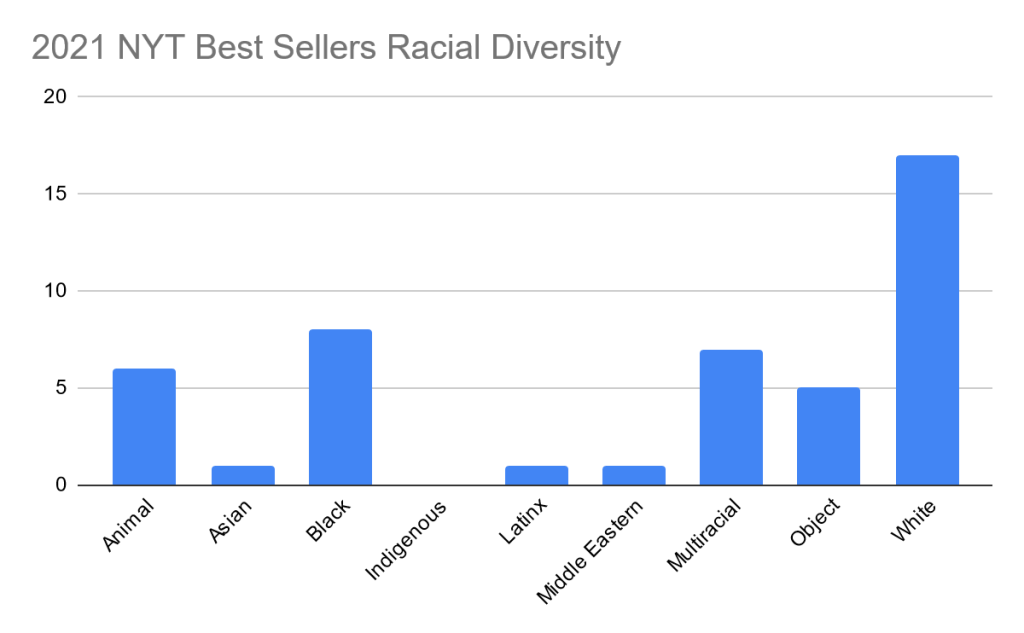
While reading my 52 books, I took note of what racial diversity was present. There are a few ways that I could do this, but I decided to keep track of the main character(s) in each book. They’re who the reader will be spending the most time with, after all. It’s not perfect data, either, but I love a good pie chart. My stats also don’t go into how these characters are depicted. Some books are represented more than once, in the case of multiple lead characters. For example, Ground Zero stars Brandon, who is cued as Latinx, and Reshmina, who is Afghani. For that book, I marked it as both Latinx and Middle-Eastern. Other books that have ensemble casts are marked as “multiracial.” To clarify: I use the term “multiracial” as it refers to race, while “multiethnic” refers to cultural identity. I’ve also included the categories of “animal” and “objects,” since a few books star critters or machines (Dog Man is categorized as “Animal,” btw). Finally, when characters’ races aren’t mentioned, White is the assumed default. Wait, don’t click away! Let me explain:

This is an issue when it comes to reading and writing fiction: if a character’s skin color is not described, most readers picture that character as White. Cover art may support this as well. It’s also really unfair, so for you novelists out there: please describe ALL your characters’ skin tones, not just some of them! The Tumblr Blog Writing With Color is an awesome resource for writing all kinds of skin tones.

Now, let’s get to the data! And if you’re uncomfortable, good. I am too.

I am far from an expert on diversity, equity, and inclusion. I also need to acknowledge that being White, cishet, and middle class, I’m speaking from a point of privilege.

To that end, I’ve started talking to people who aren’t me and have different identities and experiences one simple and important question: “Why does representation in literature matter?” I have already received some very well-thought out and in-depth answers, and I’m looking forward to reading more and sharing responses in a later post.

Until then, there are a plethora of resources online that can help you find multicultural literature, and why #WeNeedDiverseBooks.

52 Books in 52(ish) Weeks Part 3: Surprise and Unsurprise

Apologies for the delay in this post! I was celebrating my Irish pride over the weekend and simply forgot. This week, I’m continuing my journey of reading youth books off the New York Times best seller lists.

As I read through all these books, there were some things that surprised me, but probably shouldn’t have, if I had thought about them for more than a few minutes. Then there was some stuff that did surprise me. Thankfully, it was usually a pleasant surprise.

Things That Surprised Me (But Shouldn’t Have)

Picture books come in series, too.

When I think of book series, I usually think of YA books and early chapter books, not picture books. I don’t know why I was surprised when I saw more books starring Little Blue Truck, the Very Hungry Caterpillar, and Pete the cat. I had plenty of different picture books as a child featuring the same characters over and over again (Madeline and Corduroy were my favorites). It just makes sense: kids can get excited to see their favorites again and again, in different stories, and the creator typically has commercial success.

In picture books, the illustrations are not just decorations.

When I read picture books, my focus goes naturally towards the words. This is probably some awful side-effect of being an adult. In some picture books, like ones for older children, this is fine: the illustrations enhance the story, but the story can be understood without it. But in many others, illustrations are as much a part of the story as the text is. If you ignore the illustrations, or only give them a glancing look, you can miss a lot of the story, as well as some of the best jokes. There are also many wonderful wordless (or very nearly wordless) picture books out there that I love. My favorite picture books are the ones where you need text and illustrations to tell a complete story.

Books are cyclical.

This is another one I should have seen coming. It didn’t surprise me to see holiday books top the list when they were in season. But it did surprise me to see the same holiday books come up again in the following year’s list, continuing on until 2023. I found out recently that this is true for YA books, as well as picture books. In 2022, Long Live the Pumpkin Queen, by Shea Ernshaw, made it onto the Best Seller list just before Halloween. Are these new holiday classics? Time will tell.

Things that Surprised Me

Things don’t move around on the Best Seller List as much as you’d think.

With a year of reading books from the New York Time’s Best Seller List, I expected I’d read a lot of things I might never have tried otherwise, as well as well-known books. I did, but found that books didn’t move around on the list as much as I thought they would. Towards the end of my year of reading, I kept having to go further down the list to find a book or author I hadn’t read yet. This was especially true for middle grade fiction. Wimpy Kid and its offshoots and Wonder never seemed to move off the list, though they did move up and down it sometimes.

YA Inexplicably on the Middle-Grade List

When I started this project, I chose to read only from the lists for picture books, children’s middle grade books, and children’s series. I decided not to read anything of the YA Best Sellers list, just because I can’t whizz through a YA novel in a week, and I did want to get this done in a year. Even so, I ended up reading four books that were unquestionably YA (Shadow and Bone, Serpent and Dove, The Cruel Prince, and Part of Your World.) There were also several others that could be either middle-grade or YA. The four YA books were all on the “Children’s Series” list – which is just called “Series” now. So perhaps it’s not that weird, but it was to me at the time.

There’s a decent amount of non-fiction on Best Sellers lists for youth.

It wasn’t until the past ten years or so that I started to enjoy non-fiction, and it wasn’t until about two years ago that I started reading it regularly. As a kid, I always thought non-fiction was boring, just stuff you read for school. In a world where Harry Potter exists, there was no way I was ever choosing an informational text instead of a boy wizard’s adventures. Most of my peers were the same way. I was surprised to see so much non-fiction on the list. I might’ve predicted Becoming: Young Reader’s Edition, but not other books of biographies. Yet the Who Is/Was series is remarkably popular, and I’ve talked to kids at my library who have become interested in history and non-fiction. I don’t see as much demand as the What Is/What Was or the newer Where Is/Was series, but they still get a lot of check-outs. These books turn history into a narrative, and pack a lot of information in each one. As far as other types of non-fiction: I had no idea that I’d see cookbooks on the same Best Sellers list, alongside books with a narrative. I just assumed that cookbooks would be their own thing. But it is cool to see kids taking an interest in non-fiction. At least they won’t have to wait until they’re in their twenties to discover that non-fiction can be fun to read, too.

Empowerment, confidence, and topical issues.

Along with nonfiction, another theme I saw in the books I read was empowerment and confidence. Books like Ambitious Girl, Living the Confidence Code, and Change Sings all focus on building confidence, and encourage kids (often girls) to chase after their dreams. There were also books focusing on topical issues as well. Books like Stamped (For Kids) and We are Water Protectors are the most obvious. The novels also had a lot of topical messages and tackled current events, too. Ground Zero was about 9/11, then jumped ahead twenty years to the war in Afghanistan, and how it affected Afghanis. Ali Cross brought up the topics of policing and race (though not to a deep extent) as well as homelessness. I can’t think of a fictional book I read as a kid that dealt with current events in such a direct way. This may have just been my reading choices; most of my favorite middle-grade books were fantasy and sci-fi, sometimes with a conservation message. Of course, you’re also talking to the person who missed the Aslan-as-Jesus metaphor when I first read The Chronicles of Narnia.

There’s a lot of diversity!

I’ll expand on this in my next post on this project. Suffice it to say, in the past, books in the U.S. have overwhelmingly featured White characters over characters of color. While the majority of characters in these books were White, I was happy to see as much racial diversity in the books as I did. This is something I’ll get into more detail with later. Until then, if that’s something you’re interested in, the Cooperative Children’s Book Center from University of Wisconsin-Madison has a lot of interesting statistics and information about diversity in children’s books (CCBC Diversity Statistics).

Women’s History Month – March Book Recs

In the U.S., March is Women’s History Month. I love learning about women’s history, so selecting only 10 books for this list was hard! There are so many women who have inspired me, and some incredible stories that are rarely heard. I want to shine a light on some women’s history that you may be unfamiliar with, as well as celebrate the women and girls leading us into the future. 

Now, the usual disclaimer. I am a youth librarian, which means I’m most familiar with books written for young people. This means you’ll see a lot of YA and juvenile books on these lists. If you’re an adult looking for something good to read, don’t feel bad or embarrassed about reading youth books. Juvenile and YA books deal with themes and ideas that are applicable to all ages, even if the text isn’t as challenging as books written for adults. And there’s no age limit on good stories. 

I also want to remind everyone that not every book will appeal to everyone. You may hate a book that I love, and that’s okay. Not liking a book doesn’t mean that the book is bad, it just means that you don’t like it. I’ll try to appeal to a wide range of interests, but I don’t expect for you to love or even be interested in everything on this list. There’s a reader for every book, and every book has a reader. I’d love to help readers and books find each other! 

Our Bodies, Ourselves by the Boston Women’s Health Book Collective

Our Bodies, Ourselves something I’d typically put on my monthly list, because it’s not exactly a book with a narrative. It’s a medical book about girls’ and women’s health that covers everything from puberty to women’s geriatric health. It also give straight-forward facts on abuse, sexuality, orientation, sex, birth control, pregnancy, and answers many questions that you (okay, me) were too afraid to ask. All the information is easily digestible, and the book never feels like it has an agenda of anything other than to inform you about your health and choices. I’ve pulled my 2005 edition out many times when I had questions (or was just plain curious) and the information was always helpful, and didn’t overwhelm me like a Google search might. The newest edition came out in 2011, but if you’re not up for a big fat book, the website ourbodiesourselves.org still has plenty of relevant information. 

Trans Bodies, Trans Selves, published by Oxford University Press, inspired by Our Bodies, Ourselves. This is another medical reference book focused on health and wellness for transgender and non-binary individuals, with its second edition published in 2022. 

Through the Glass Ceiling to the Stars by Eileen Collins and Jonathan Ward

Eileen Collins always dreamed of the stars, but the odds of her reaching them were slim. Growing up in the 1970s in a small town and a struggling family, she seemed destined to be a math teacher, rather than a pilot. Yet through hard work and perseverance, Eileen Collins became the first woman to command the Space Shuttle. This memoir covers her small-town origins, flying operational missions for the U.S. Air Force, becoming the second female test pilot for the USAF, and finally, her four space flights, including the Return to Flight mission after the Columbia Tragedy. The book is written very much like Col. Collins herself: straightforward, without frills. Her journey is a fascinating one, especially for anyone interested in the science of space flight…or those among us who were fascinated by shuttle launches, and dreamed of being among the stars. 

On a personal note, Eileen Collins has been a huge inspiration for me throughout my life. I was always fascinated by space, and seeing her become the first woman to command a Shuttle mission made me feel as though I could reach the stars too. 

Grandma Gatewood’s Walk: The Inspiring Story of the Woman Who Saved the Appalachian Trail by Ben Montgomery.

In 1955, 67-year-old Emma Gatewood told her children she was going for a walk. What she didn’t tell them was that her “walk” would be the entirety of the Appalachian Trail. For nearly five months, Emma “Grandma” Gatewood hiked from Georgia to Maine, a journey of over 2,000 miles. She was the first woman to solo thru-hike the entire trail, and a pioneer of ultra-light hiking, never carrying more than about fifteen pounds of equipment or food with her. She would go on the hike the Appalachian trail four times, and become the first person to thru-hike the AT (man or woman) three times. She even hiked the Oregon Trail – yes, that Oregon Trail – at age 71. Unfortunately, Emma endured a horrifically abusive marriage for years, and finally divorced her husband in the 1940s, at a time when it was very difficult for women to do so. Her story – and her walk – has inspired generations of hikers and helped preserve the Appalachian Trail. Be careful reading this; it may just make you want to disappear into the woods yourself.

Rejected Princesses: Tales of History’s Boldest Heroines, Hellions, and Heretics by Jason Porath. 

There are many women whose achievements and escapades you’ve never heard of before. But just because you haven’t heard of them doesn’t mean they weren’t amazing. Rejected Princesses is a collection of biographies of women who were too incredible to be turned into Disney movies, but most certainly deserved one! This book introduced me to some historical bad-asses who deserve far more recognition: Gráinne Ní Mháille (Grace O’Malley), the Irish pirate queen; Sybil Ludington, who put Paul Revere’s Midnight Ride to shame; and Emmeline Pankhurst, the controversial but incredible English suffragette. There’s also plenty of diversity, with stories of women of all races. It doesn’t shy away from their sexualities or gender identities, showing trans and non-binary individuals alongside ciswomen. Each biography is accompanied by a full-page Disney style illustration. This book is an absolute joy, and as fun as it is educational. 

Fearless Girls, Wise Women, and Beloved Daughters: Heroines in Folk Tales Around the World, edited by Kathleen Raglan 

Folk tales have always shaped our culture. Even today, fairy tales and nursery rhymes are some of children’s earliest introductions to literature. Many of the most well-known traditional tales feature strong male characters saving damsels in distress from certain doom. While there are many books today that flip the script on these old stories, Kathleen Raglan noticed a dearth of proactive heroines in familiar folk stories. Raglan collected over 100 folk tales starring folk heroines. These women and girls don’t often use brute strength to solve their problems; rather, they use wisdom, creativity, perseverance, guile, loyalty, and kindness. The collection also expands beyond Western European stories, though they are also present. Stories from many different parts of the world are included: Sub-Saharan Africa, Northern Africa and the Middle East, Asia, the Pacific, and Indigenous North Americans. 

Fiction: 

No Stopping Us Now by Lucy Jane Bledsoe

It’s 1974, and Title IX, which prohibits discrimination on the basis of sex in schools, was passed two years ago. So why aren’t Louisa and her friends allowed to have a basketball team at their school? After a feminist rally where she meets Gloria Steinem, Louisa is inspired to petition her school to start a girls’ basketball program. While she receives support, there are plenty of obstacles – and people – standing in her way. She faces public criticism, bullying, intimidation from school staff, and even threats to her college plans while she fights for her and her friends’ civil rights. Louisa is also dealing with her grandfather’s dementia, her best friend shutting her out, and her growing feelings for her teammate, Barb. Yet Louisa pushes forward, demanding equality in the face of opposition. An autobiographical novel, No Stopping Us Now celebrates sisterhood and activism in the early days of Title IX. 

The Huntress by Rose Quinn

After World War II, three lives are entwined by the Huntress, a Nazi who has long eluded justice. Nina Markova is a Soviet Pilot who joined the legendary Night Witches, an all-female unit of pilots who bombed and harassed German targets. Tough as nails Nina was the only known survivor to escape the Huntress’s clutches. She was witness to the Huntress’s ruthlessness when the Huntress murdered Nina’s traveling companion, escaped POW Sebastian. Sebastian’s brother, Ian Graham, is a wartime journalist turned Nazi hunter. He’d nearly given up on finding Seb’s killer when Nina storms back into his life. Across the sea, Bostonian Jordan McBride dreams of becoming a wartime photographer, like her heroes Margaret Bourke-White and Gerda Taro. Jordan’s father would rather have Jordan stay safe in Boston, marry her doting boyfriend, and help him run his antique business. Jordan’s new step-mother, Annelise, is much more supportive of her step-daughter’s dreams. While Jordan adores Annelise, there’s something about her that just doesn’t add up…but trying to figure out Annelise’s secrets may rob Jordan of everything she holds dear. Told in the alternating perspectives of Nina, Ian, and Jordan, The Huntress is a powerful and absolutely gripping historical fiction.

Go With the Flow by Lily Williams and Karen Schneemann

Being the new girl is hard enough, but Sasha’s first day at Hazelton High is even harder when she gets her period for the first time…while she’s wearing white pants. Close knit friends Abby, Christine, and Brit swoop in to her rescue, only to find the school’s tampon dispenser empty. Again. A new friendship is formed when Abby gives Sasha a pad and Brit lends the new girl a sweatshirt to conceal the stains. Upset about the consistent lack of period products available in her school, Abby speaks to the principal, who says providing feminine products is out of the school’s budget, even though the football team got new uniforms last year. Abby and her friends are outraged and working to end period poverty at their school. But when letter writing campaigns and blog posts don’t move the school administration, Abby makes a statement that may have gone too far. This graphic novel is both informative and entertaining, with a diverse cast (who all have diverse periods!). Menstruation for trans men and non-binary individuals is also discussed. The backmatter provides resources, information, and ways to help fight against period stigma. 

Daughters of Oduma by Moses Ose Utomi

In a West African inspired fantasy setting, girls compete in the all-female martial art of Bowing to protect their found families. Sixteen-year-old Dirt is the Second Sister of Mud Fam, and retired from Bowing. She coaches the other girls and supports their new main fighter, Webba. Webba is a strong contender to win the South God Bow tournament, which Mud Fam desperately needs to win. There are only five sisters in Mud Fam, and if their numbers drop any lower, they’ll be disbanded. When Dirt turns seventeen, she will become a woman, undergo the Scarring ceremony, and leave Mud Fam forever. Winning the tournament is crucial to recruit more members to Mud Fam. The rival Vine Fam believes that war with the Gods is imminent, and aim to destroy Mud Fam and gain new recruits for themselves. When Webba is injured by a competitor from the Vine Fam, Dirt must step up and take her place in the tournament. Out of shape and plagued by self-doubt, Dirt must train her body and mind to save her family. With fantastic worldbuilding, tenacious and complex characters, and flowing pidgin dialogue, Daughters of Oduma is an absolutely absorbing underdog story. 

He Must Like You by Danielle Younge-Ullman

Libby’s having a rough senior year. Her parents have drained her college fund, and her outburst-prone father is kicking Libby out after she graduates so he can Airbnb her room. To earn money for college and a place of her own, Libby takes a job at a local restaurant, The Goat. She’s making good money, but a drunken hookup with one of her fellow servers leaves her upset and confused, especially after a school assembly about sex and consent. When a customer sexually harasses Libby and finally pushes her too far, it’s understandable that she’d dump an entire pitcher of sangria over his head. But the harasser in question is Perry Ackerman, local hero and Libby’s mom’s boss. Libby’s family is no help in this situation, and Libby realizes she needs to make a stand for herself, her girlfriends, and for the women at The Goat who face harassment on a daily basis. Libby is a great character and seeing her take a stand and reclaim her life is immensely satisfying. The book explores the gray areas of consent and harassment, along with the effects of assault, in a thoughtful and nuanced way. It’s an important book for all teens, not just girls.