Dec. Book Recs: The Runners-Up

First off: sorry for only one post in November. I was sick for a couple weeks, and then had family visiting for Thanksgiving. But don’t worry, I’ve still got plenty to say about banned books! But first…

I read a lot of books this year. Not including my Did Not Finishes and picture books, I’ve read 56 books this year. That’s a lot, even for me. The vast majority were books I read for these monthly recommendation lists. I really enjoyed working on them, but each list took a lot of time and effort. That’s why I didn’t have any lists for July or August – I was simply too busy. For 2024, I’m going to do mini-recommendation lists, with only one or two books a month. 

Even though I read a lot, not every book I read made it onto the book recommendation lists. I limited myself to only 5 fiction books and 5 nonfiction books for each list. There were some great books that I really enjoyed that just didn’t make the cut. Even so, I felt like they were still worthy of sharing. So here it is: the final recommendation list of 2023: Books that Didn’t Make the Cut, but Are Still Good.

Nonfiction

Planting Stories: The Life of Librarian and Storyteller Pura Belpré / Sembrando historias: Pura Belpré: bibliotecaria y narradora de cuentos by Anika Aldamuy Denise. Illustrated by Paola Escobar

If there’s such a thing as a legendary librarian, it would be Pura Belpré. Originally from Puerto Rico, Belpré came to New York City for her sister’s wedding, and ended up staying for most of her life. She became the first Puerto Rican to be hired by the New York Public Library. There, she discovered her talent and passion for storytelling, though the library shelves lacked the stories she loved growing up in Puerto Rico. Throughout her life, Belpré wrote many children’s books based on Puerto Rican folklore, becoming one of the first Puerto Ricans to publish works in English in the U.S. Her work helped open up the library to the Latinx residents of New York City, and her stories continue to celebrate the culture she loved. Planting Stories is a picture book biography of Belpré’s life, with beautiful illustrations on each page. 

Why it didn’t make the cut: I really wanted to include something about Pura Belpré for Hispanic Heritage Month. Unfortunately, the only biography I found aimed towards adults (The Stories I Read to the Children by Laura Sánchez-González) isn’t easy to find unless you’re prepared to buy it. I found picture book biographies, but I didn’t want to showcase more than one picture book. I’d already decided on A Land of Books by Duncan Tonatiuh. His work is just so cool. I encourage everyone to learn about Pura Belpré, or at least read some Pura Belpré award winners! 

Signs of Survival: A Memoir of the Holocaust by Renee G. Hartman with Joshua M. Green

Two Jewish sisters – one hearing, one Deaf – recount their struggle to survive during World War II. During the Nazi occupation of what was Czechoslovakia, Renee was the only hearing person in her family. She had to be her family’s ears, listening for the sound of Nazi boots coming to take her family away. Renee and her younger sister, Herta, were eventually separated from their parents and shipped to Bergen-Belsen concentration camp. Using sign language to communicate, Renee and Herta had to rely on each other to survive. Presented as an oral history, both sisters recount their lives before and after the Holocaust in a tragic story of sisterhood and survival. 

Why it didn’t make the cut: I had this book as a potential pick for Disability Pride. After reading it, I realized that it didn’t fit the theme that well. It was more Renee’s story, rather than Herta’s. Regardless, their story is still powerful and important. 

And the Spirit Moved Them: The Lost Radical History of America’s First Feminists by Helen LaKelly Hunt

When did the feminist movement begin in the United States? With Susan B. Anthony and the Seneca Falls Convention in 1848? With Gloria Steinem in the 1960s? Hunt argues that the first feminist movement in the U.S. began with women like Lucretia Mott, Maria Weston Chapman, and Grace and Sarah Doughlass in the 1830s. These women railed against the patriarchal structures that treated them as unequal partners in the abolitionist movement. They bucked tradition and began their own interracial abolitionist movement, which included the Anti-Slavery Convention of American Women in 1837. Most of these women were moved to action by their Christian faith and felt “armed by God” as they denounced pro-slavery religious figures. Including photos and documents, this book is accessible to many readers who are interested in women’s history. 

Why it didn’t make the cut: It’s religious. The women being moved by their Christian faith wasn’t just a side-note, it’s a major point Hunt makes throughout the book. Towards the end, she calls for more faith-based feminism among women (of any faith, not just Christianity). There is nothing wrong with being religious, especially if your faith guides you to help others. I didn’t like how religion-focused it was, but it’s a book that many others would enjoy and even feel inspired by. 

The Immortal Life of Henrietta Lacks by Rebecca Skloot

In 1951, Henrietta Lacks’s cells were taken from her without her consent or knowledge. These cells continued to grow and divide long after Henrietta’s death. Her “immortal” cell line has contributed to scientific and medical discoveries for decades, from a polio vaccines to studying COVID-19, and even being sent to space. Yet Henrietta’s family never learned about the HeLa cell line until 1975. While her cells have helped so many people, her family lived in poverty and, ironically, could not afford health care. Rebecca Skloot was fascinated by Henrietta Lacks and her cells, and worked with Henrietta’s daughter, Deborah, to tell the story of Henrietta, HeLa cells, and the Lacks family today. This book is impossible to put down, and examines race, class, and ethics in medicine and science.

Why it didn’t make the cut: Even if you haven’t read this book, you’ve at least heard of it. And it is absolutely worth the hype. Though I did put some award-winners and best sellers on the lists, I wanted to highlight less well known books that are still praise-worthy and meaningful. But if you haven’t read this one yet, stop reading this and go read it. Go read it now. 

Fiction

The Marrow Thieves by Cherie Dimaline 

The planet has been ravaged by climate change, which has resulted in most of the world’s population losing the ability to dream. The Indigenous people of North America can still dream, and are hunted for their bone marrow.  After French loses his parents and his brother is captured and taken to the “schools” – a parallel to the Canadian residential boarding school system – he joins a group of other Indigenous people – old and young alike – who have fled the cities to stay safe. Led by Miigwans, they travel north, living off the land and learning each other’s histories while trying to avoid becoming victims of a genocide. 

Why it didn’t make the cut: It’s a dark story. Really dark. Rape and murder are commonplace in this new world. The ending is ultimately hopeful, but it’s a long, bleak trek to reach that conclusion. The horrors the characters in this book face parallel real world atrocities committed against Indigenous Americans, most saliently with references to residential schools. It’s an important story, but a hard book to read. 

The City Beautiful by Aden Polydoros

While the rest of Chicago is marveling at the 1893 World’s Fair, Altar Rosen is working hard to earn money to bring his mother and sisters to the United States from Romania. After his best friend, Yakov, is murdered at the Fair, Altar is possessed by Yakov’s dybbuk. Unless Altar can find Yakov’s killer and bring him to justice, Yakov’s dybbuk will permanently take over Altar’s body. But there’s no justice to be found for poor Jewish immigrants, even when their bodies start piling up. Altar has no choice but to work with his old “friend” Frankie. Frankie helped Altar survive when he first arrived in America, but he has dark secrets of his own. Together, they need to track down a dangerous serial killer targeting Jewish boys all the while Altar navigates his grief and comes to understand his feelings for Frankie. A queer historical thriller, steeped in Jewish mythology. Includes content warning, glossary, and author’s note.

Why it didn’t make the cut: I really liked this book, and originally planned on using it for Pride Month. But when it comes to Pride, there’s a lot to cover, and I wanted to get as much diversity as I could when it came to the LGBTQIA+ spectrum. But I loved The Darkness Outside Us even more. It destroyed me emotionally was one of my favorite books that I read all year, and I really wanted to showcase it. The City Beautiful was still a great read, and I’m excited to share it here. 

Loving vs. Virginia: A Documentary Novel of the Landmark Civil Rights Case by Patricia Hruby Powell

Based on the true story of Richard Loving and Mildred (Jeter) Loving, this is the story of two people whose love changed U.S. history for the better. Milly, who was Black, and Richard, who was White, lived in the small town of Central Point, Virginia, surrounded by family. While Black and White folks mixed freely in Central Point, the rest of the state still had strict segregation laws, including laws against interracial marriage and “miscengenation.” Milly and Richard were married in Washington D.C. in 1958. Upon returning home, they were both arrested for “cohabitating as man and wife” and faced a year of jail time unless they left Virginia. They moved to Washington D.C., but were virtually exiled from the home they loved, unable to see their families or cross state lines together. After one of their children was hit by a car (he survived, but was injured), Milly and Richard were determined to return home. Thus began the fight of their lives for their right to be married. A novel in verse, the Lovings’ story is told from both Richard and Milly’s perspective, with illustrations throughout that enhance the reading experience. The dual perspectives during their wedding is breath-taking (especially if you listen to it on audio while reading the book, like I did). Facts about Jim Crow and anti-miscegenation laws begin each chapter. 

Why it didn’t make the cut: I loved this book, and I could’ve used it for a few different themes. But every time I’d planned to use it, I discovered another book that I wanted to highlight, and Loving vs. Virginia got pushed to the backburner. This book is one of the big reasons I wanted to share “runners-up” for December! 

Dragonfly Eyes by Cao Wenxuan. Translated by Helen Wang. 

Dragonfly Eyes is a historical fiction novel that tells the story of Ah Mei and her French grandmother, Océane. Océane married into the wealthy Shanghainese Du Meixi family in the 1920s and would eventually move to Shanghai and raise her family there. Océane adores her youngest grandchild (and only granddaughter) Ah Mei. Their close bond carries both of them through the turbulent times: Japan’s invasion of China in the 1930s, famine in the 1950s, and finally the Chinese Cultural Revolution in the 1960s and 70s. An omniscient narrator describes Ah Mei and Océane’s lives with tender details amidst the historical backdrop. Ah Mei and Océane’s loving relationship is the heart of this novel, softening the harsh blows that buffet the family.

Why it didn’t make the cut: I didn’t like it. Omniscient narrators and a thin plot made it hard for me to get into this novel. The book was lovely in its own way, it but wasn’t for me.
To Sleep in a Sea of Stars: A Scripted Summary

This is a companion post to my review for To Sleep in a Sea of Stars by Christopher Paolini.

When I’m reading books that I find challenging, especially classics, I sometimes boil each chapter down to its most basic plot points, and format my notes as a very short script. It’s fun, and it helps me keep track of things. To Sleep in a Sea of Stars has a dense plot with a lot of elements to it, so much so that giving an honest, spoiler-free review is kind of impossible. So, for those of you who haven’t read it and don’t plan to, or maybe you’d like a refresher, this is for you. If you are interested in reading the book and want to avoid spoilers, skip this post.

Part 1: Exogenesis

Chapter 1: Dreams

Alan: Will you marry me?
Kira: Yes!
(An awkward sex scene happens.)

Chapter 2: Reliquary

Kira: I’m going to check out these weird ruins.
Alan: Don’t.
Kira: I’m doing it. Neat, alien ruins! Alien space dust! *falls unconscious*

Chapter 3: Extenuating Circumstances

Crew: ‘Sup, Kira. You got a weird xeno organism enveloping your body so you’ve been in cryo sleep a week. Also we’re on a military ship and they’re investigating what happened at the ruins.
Kira: Damn, we lost our bonus checks. This is my biggest concern.

Chapter 4: Anguish

Kira: Well, here I am in the med bay.
Xeno: *kills all of Kira’s friends*

Chapter 5: Madness

Major Tschetter: Well, we can’t put you in cryo sleep because of the xeno. Dr. Carr will examine you and the xeno.
Carr: *does intense and invasive tests on the xeno*
Xeno: Haha, you can’t destroy me muthafuckas!!
Kira: It’s not working, stop.
Carr: *blasts Kira with lasers* Nah.
Kira: Ow. *rips giant laser machine off wall* We’re done here.

Chapter 6: Shouts and Echoes

Carr: Nothing is working, we can’t get the xeno off of you and you’re dangerous, so we’re gonna throw you out of an airlock.
Kira: So…are you gonna vent me or what, ’cause I’ve been in here forever?
Aliens: *attack ship*

Chapter 7: Countdown

Aliens: Pew pew!
Kira: I can understand what the aliens are saying?!
(A hole gets blown in the ship’s hull, which sucks Carr, Kira, fragments of the xeno, and an alien out into space.)

Chapter 8: Out & About

Kira: Ack, I’ve been flung into space space, but the xeno is protecting me. No, you don’t get to read about the wonder or terror of going into the void, the mystery of which has inspired humankind since the dawn of time. All you need to know about this is that the xeno is cool. Anyway, I’m in a shuttle now. Hope I don’t die.

Chapter 9: Choices

Kira: Ship, send a distress signal.
Ship: Can’t.
Captain Tschetter: Go to 61-Cygni.
(Military chatter happens.)
Kira: Gonna set the ship on a course and examine my entire body. Here’s a paragraph to let the reader know that the xeno is everywhere, but it’s still important to know that I’m “smooth as a doll*” between my legs. In case anyone was wondering.

Chapter 10: Exeunt I

Kira: Xeno, thanks for saving my life even though you killed my friends and fiancé. We can communicate now. Its name is the Safe Blade it does weird stuff. Now I’m gonna float in space for awhile.

Part II: Sublimare

Chapter 11: Awakening

Vishal: Welcome to the spaceship Wallfish. I’m ship’s doctor. We found you in your shuttle and rescued you.
Trig: I’m the plucky team mascot.
Falconi: I’m the captain. And we have a ship mind. His name is Gregorovich and he’s a little crazy. We’ve also got Nielson, Hwa-Jung and Sparrow.
Kira: That’s a big deal.
Me: What’s a ship mind and why is it a big deal?

Chapter 12: Wallfish

Kira: I’m hanging out with the refugees on the Wallfish who are escaping the alien war I started.
Inare: I’m wacky, have a cat, and give cryptic advice. Does this remind you of anyone?
Kira: I’m getting flashes of information about the Jellies but I don’t understand it.
Veera: We’re entropists. We’re very smart
Jorrus: and we have more advanced technology
Veera: than the rest of human society
Jorrus: and we talk like this
Veera: all the time.
Kira: I can understand the Jellies’ language, I need to get on one of their ships and stop them.

Chapter 13: Assumptions

Gregorovich: Sup meatbag.
Kira: Falconi, we need to change our route so I can investigate the Jellies.
Falconi: Nah.
Kira: There could be a lot of money in it for you.
Falconi: ‘kay.
Kira: Also, I finally got a chance to look at myself. I’ve been through a ton physical and mental trauma I’ve been through, including being responsible for the death of my fiancé…BUT WHO WILL FIND ME ATTRACTIVE NOW?!
Falconi: Heads up, Jellies coming our way

Chapter 14: Kriegsspeil

Trig: I used to live on a space station and it sucked.
(Pew pew space battles between the Jellies and UMC aka the space army)
Falconi: Okay, the Jelly ship is damaged, let’s check it out.

Chapter 15: Extremis

Kira: Okay, we’re going on this ship. It’ll probably be dangerous. Who’s in?
Veera: Yes
Jorrus: We are in.
Wallfish Crew: Let’s do this!

Chapter 16: Near & Far

(on board the Jelly ship)
Everyone: pew pew!
(Trig gets captured immediately)
Jellies: The Soft Blade is here!
(Kira grabs Trig and gets the hell out of dodge. A Jelly gets onto the Wallfish and holds a child captive. Sparrow saves the kid and is almost killed. Using the Soft Blade, Kira kills the Jelly.)

Chapter 17: Icons & Indications

Sparrow: Ow. I’m gonna live, but this is gonna hurt.
Kira: Gonna look into the information we got from the Jelly ship. I learned a little about their past and about this crazy powerful weapon called the Staff of Blue. We’ve gotta get it before the Jellies do. I also don’t know anything else about it.
(A Jelly gets onto the ship again, and is killed.)

Chapter 18: Nowhere to Hide

Kira: I’m searching star charts until I can find the one I saw in my vision that will lead us to the Staff of Blue.
Nielson: Ah, shit, more Jellies incoming.
Kira: No, those aren’t Jelly ships. It’s some new kind of alien.
(The new alien ships start firing.)

Chapter 19: Graceling

Falconi: Okay, we’re offloading the refugees here.
Refugee: Ah feck off yah hatchet-faced bint. An you, let me go, yah walloping, misbegotten graceling.*
(Kira almost kills the the offensively Scottish refugee with the Soft Blade)
Kira: Shit.
Veera: Kira, take this token
Jorrus: It will allow you to
Veera: Go to our home base if you
Jorrus: Don’t want to help the UMC
Inare: Eat the path.*
Falconi: Well, we’re going to be questioned by the UMC after our excursion on the Jelly ship.
Kira: Let’s do this.

Chapter 20: Darmstadt

UMC Officer Akawe: Tell me everything that’s going on.
Kira: I understand the Jellies’ language and they’re after me because I have the Soft Blade.
Akawe: Well, shit. And there’s another alien species called the nightmares that are attacking humans and Jellies.
Kira: We need to find the Staff of Blue to defeat them.
Akawe: Let’s do that then.

Chapter 21: Exposure

Falconi: Space marines, all aboard to find the Staff of Blue!
Jorrus: We are
Veera: Here too for
Jorrus: The mission.
Falconi: Kira, go see Sparrow to get training so you don’t accidentally stab anyone again.
Veera: We’ve discovered
Jorrus: The Jellies and nightmares
Veera: Are not the same
Jorrus: Even if they look similar.

Chapter 22: Lessons

Kira: The Soft Blade eats through stuff while I sleep, like my bed and blanket.
Sparrow: Time for training. I used to have a military career until things went sour. But I’m gonna use that experience to train you to get the Soft Blade to do what you want.
(The crew prepares the ship for a long FTL journey)
Kira: Since we’re all working together, I have a right to know why you guys aren’t allowed on the Planet Ruslan.
Falconi: Fair enough. We introduced an invasive species to the planet and it caused severe damage to the ecosystem.
Kira: Ha! That’s hilarious!
Me: Kira, you are a BIOLOGIST.
Sparrow: Everyone’s getting ready for cyro sleep. Since you can’t go into cyro anymore, Kira, make sure you practice with the Soft Blade while we travel.

Chapter 23: Exeunt II

Gregorovich: Just you and me while I power down the ship.
Kira: Yep. Gonna mostly hibernate and get up once a week to train. I’ll have some weird dreams/visions too.
(Three moths pass.)

Part III: Apocalypsis

Chapter 24: Past Sins

Kira: We’re in the star system where the Staff should be. We just need to find the right planet now. Oh, there it is.
Nielson: Have some of my backstory.
Sparrow: Let’s do more training and see how far you’ve come. Have some of my backstory too, while we’re at it.
Trig: And some of mine, too!
Kira: Let’s find the Staff, all of us. That means me, the crew, the space marines, and Trig, who is a teenager. Yes, Trig, you’re coming with us, even though we have highly trained space marines who are trained for this kind of thing and are also grown-ass adults.

Chapter 25: A Caelo Usque ad Centrum

Kira: Let’s get down to his planet and find the Staff. And here come the Jellies to attack us. Again.

Chapter 26: Shards

Kira: We finally landed on the planet. It’s full of alien ruins, which is pretty cool.
(Jelly ships keep appearing. It’s a pew pew race to find the Staff. Kira and Falconi finally find it. It’s broken. Nightmares appear.)

Chapter 27: Terror

(Jellies attack humans. Trig is super wounded.)
Tschetter: We come in peace! Yes, I’m still alive, and I’m with the Jellies now. The nightmares are attacking Jellies and humans and we’re kinda screwed without the Staff. The xeno is an artifact from The Vanished, a powerful ancient alien race that gave them and us a huge leap forward in technology. The nightmares are after it too.
(A new alien, the Seeker, breaks loose.)
Kira: This is super bad! Run!

Chapter 28: Sic Itur ad Astra

(The Seeker is basically unkillable. It is scary and awesome and will never be mentioned again once our heroes get away.)
Tschetter: I’m sticking with the Jellies. We have a chance to make peace between us and them. Now get on their ship, the Wallfish can’t land here!
Falconi: I cannot believe we’re doing this.
Kira: And here come more nightmares to attack us.

Chapter 29: Into the Dark

Nightmares: Join the Maw!
Kira: Oh shit! This crazy vision I just had showed me that the nightmares are a freakish combo of Jellies and Dr. Carr from from way back in chapter five. They serve the Maw, which I sort of created, and live only to feed it. Gotta cut my own arm off now to escape from a nightmare.

Chapter 30: Necessity

Falconi: We have a friendly Jelly on our ship now, but right now we need to focus on getting the hell out of dodge. But the Wallfish isn’t fast enough to outrun the Jellies or nightmares.
Kira: Maybe Itari, the Jelly, can mess with our FTL drive and make it go faster.
Itari: Sure can. Since you have the xeno and the Staff of Blue is broken, you’re now our best weapon against the Jellies.

Chapter 31: Sins of the Present

Falconi: Why are the nightmares bothering you so much?
Kira: Because I accidentally made them, killed my friends, and started this war.
Falconi: Stop feeling guilty.
Kira: ‘Kay.

Chapter 32: Exeunt III

Falconi: The Jellies and nightmares are having a hard time finding us. We’re going to the Sol System.
Kira: Cool. Akawe and I are going to interview the Jelly.
Itari: Here’s some of my people’s history and facts about our biology. But the big news is we have an evil alien overlord named Ctein. The friendly Jellies want to destroy him and free our people.
(The crew goes into cyro sleep for the journey.)

Part IV: Fidelitatis

Chapter 33: Dissonance

(The crew arrives in the Sol System.)
Falconi: Holy hell, it’s a war zone.
Nielson & Vishal: Gotta see if our families are okay.
UMC: Now that you’re in the area, we need to talk to you. And by talk I mean imprison.

Chapter 34: Orsted Station

(The UMC interrogates the Wallfish crew.)
UMC Stohl: Well, fuck. Anyway, thanks for the info. We sent a bunch of space marines to kill everyone at the upcoming meeting between humans and Jellies where they might be able to make peace and take down Ctein.
Kira: Fuck that, I’m getting out of here.

Chapter 35: Escape!

(Kira breaks out of her cell and rescues the crew. The Soft Blade grows to an enormous size to protect everyone during the escape. They get back to the Wallfish.)
Jorrus: My hive mind with Veera broke. She can’t talk right now.
Me: Thank fuck.
Falconi: Cool, more nightmares are here.

Chapter 36: Necessity II

Falconi: This is a lot. Crew, you up for working with friendly Jellies and taking down Ctein?
Crew: Yep.
Gregorovich: Nope.
(Gregorovich locks down the ship. Hwa-Jung shuts him down. The Wallfish resumes normal fuctionining.)
Kira: Well, that was a thing. Let’s move on with our kill Ctein plan.

Chapter 37: Exeunt IV

Kira: I’ll try talking to Gregorovich. Yeah, he’s still pretty crazy. Time to hibernate while we make another long journey to the meeting spot.

Part V: Malignitatem

Chapter 38: Arrival

Kira: Daaaamn the Soft Blade grew crazy plants while I was asleep. It even grew a new arm for me.
Falconi: I sent out a warning that the UMC is coming, but it’s going to take awhile before we hear back.
Itari: Here’s some more facts about my species and our history.
Falconi: Kira, let’s get to know each other better.
Kira: Okay.
Falconi: Well, we’re close to the meeting spot, and we’re not alone.

Chapter 39: Necessity

(The crew wakes up from cyro. The friendly Jellies have arrived.)
Tschetter: I’m still alive. We lost track of the Seeker and it’s just flying around in space now, doing whatever it wants. If you think this will be resolved later in the book, you’re wrong. Anyway, Ctein is close by, and we’re gonna be sneaky sneaks, infiltrate his ship, and kill him.
Falconi: Okay, crew, this is a lot. We sill doing this?
Crew: Yep.
(The UMC arrives.)
UMC Klein: We’re actually here to kill all the Jellies, including the friendlies. But I guess you guys can give killing Ctein a go first.

Chapter 40: Integratum

Crew: We’ll be facing off against Ctein in 7 hours. Who knows if we’ll live or die. If only we had Gregorovich here, we need him.
Kira: I bet the Soft Blade could fix his brain. (The Soft Blade fixes brain damage, because of course it does.) I’m going to talk to him. Then I’ll get to know Hwa-Jung better. Now I’ll go have sex with Falconi. Falconi, how brave are you?
(As it turned out, he was very brave. Very brave indeed.*)
Kira: I had another vision. I learned that the Soft Blade is a Seed, meant to create life, not be used as a weapon.
Falconi: Let’s go kill Ctein.

Chapter 41: Ferro Comitante

(The Wallfish attacks Ctein’s ship. The Jellies from Ctein’s ship board the Wallfish. Action happens.)
Gregorovich: I’m back and better than ever at a crucial moment to save the day! Let’s ram our ship into Ctein’s.
Falconi: Let’s go kill Ctein.
Gregorovich: The nightmares are here. And they’ve brough the Maw with them.

Chapter 42: Astorum Irae

Kira: Oh fuck.
Falconi: Let’s focus on killing Ctein.
(They navigate Ctein’s ship with Itari’s help. There is action. Jorrus is killed. The Soft Blade becomes insanely big to protect the crew.)
Kira: Everyone on my side is incapacitated. Guess I have to face Ctein on my own.
Ctein: I see you.*

Chapter 43: Sub Specie Aeternitatis

(Ctein and Kira have an cinematic and pretty awesome space battle. Kira kills Ctein.)

Chapter 44: Exeunt V

Falconi: The Maw and the nightmares are coming, and our weapons aren’t hurting the Maw at all.
Kira: Maw, leave my friends alone and I’ll join you. The Soft Blad will feed you life forever.
Maw: Om nom nom
Kira: I forgive you.
(With the magical act of forgiveness, Kira and the Soft Blade absorb the Maw.)

Part VI: Quietus

Chapter 45: Recognition

(Kira is basically a god now and builds a space station out of nothing.)

Chapter 46: Unity

Kira: I made this space station for humans and Jellies to live peacefully together. I also healed Trig and made this thing called the Staff of Green which will basically grow infinite food. But I also learned that there are somehow 7 copies of the Maw running around in space.

Chapter 47: Decession

(Kira and the crew say their goodbyes.)
Kira: I’m off to find the other copies of the Maw. Y’all be good while I’m gone.

Chapter 48: Exeunt VI

(Kira searches for the Maws. She learns her family is alive after everything that’s happened. She goes to hibernate in her ship until she finds the other Maw copies.)

The End.

*Actual dialogue/narration

BIDP: Where the Crawdads Sing

Where the Crawdads Sing by Delia Owns was released in 2018 to great acclaim. Consequently, I’ve heard praise for the novel for a few years now, but never read it. I added it to my ever-growing “To Be Read” list at the recommendation of just…so many people, but there were always different books that intrigued me. Crawdads was one of many books that I’d get around to reading “someday.”

And then: book club. Yes, the same small book club that forced me to read An Ember in the Ashes got back together. And, as you might have guessed, the first book we picked was Where the Crawdads Sing.

I am the type of person who dismisses popular things out of hand. When a lot of people praise something to high heaven, I tend to roll my eyes and stay away. Especially when it sounds like something that Facebook moms with “Live, Laugh, Love” wall art would be enamored by. However, I am trying to be less judgmental and open to new things, so I picked up Crawdads without complaint.

There was one through line I heard through all the praise the book received: that it was beautifully written. However, no one casually talking about the book ever seems to mention the characters or the plot. This worried me a bit. If you’ve read any of my other reviews, you’ll know that what really draws me into a story, more than anything, is the characters. Would this be a beautiful book, but devoid of emotion and characters I would actually care about? There was only one way to find out.

I have to agree with the same thing that everyone says: the prose is beautiful. It’s lush with description and metaphor, and is easily the novel’s strongest point. I wasn’t surprised when a movie based on the book was announced, but I had my doubts about how well it would work. Removing the narration is like removing the heart of the original work. Though I haven’t seen the movie myself, I think the many mixed and critical reviews show the importance of the actual writing in the book. The story suffers without it.

Looking beyond the beautiful prose, the plot can feel thin at times. For example, the book starts with the (probable) murder of Chase Andrews, a character that the protagonist, Kya, has been involved with. The investigation and Kya’s subsequent arrest feels more like a framing device for the story. Near the end of the novel, Kya is arrested and goes to trial after being arrested for Chase’s murder. Until that point, the murder mystery doesn’t feel fully integrating into Kya’s story.

The book uses an omniscient narrator, which I generally don’t like. Omniscient narrators make me feel like I’m looking at a character through a window, and not like I can connect with them or get in their heads. It felt like there was a lot of telling and not enough showing when it came to characters’ emotions.

She’d given love a chance; now she wanted simply to fill the empty spaces. Ease the loneliness while walling off her heart.

Over time, I grew to like it. Even though the narrator knows everything, it doesn’t give the whole story away. While the book opens with the mystery of Chase Andrews’s suspected murder, the reader doesn’t get an actual, final answer to the who-dun-it (if anyone dun it at all) until the final pages.

Considering the premise of the book – an abandoned girl living alone in a marsh for years – I expected this to be a survival narrative. A coming-of-age story in the style Island of the Blue Dolphins or Hatchet, perhaps. Especially after the book points out that it’s easy to find your dinner in a marsh, provided you didn’t mind digging up shellfish or fishing.

Kya observes and studies the marsh and great detail, and she relies on it for her survival, though not in the way I expected. For much of the novel she sells mussels, and uses the money she earns to buy groceries and supplies. She receives secondhand clothes from two characters, Jumpin’ and Mabel, who become parental figures to her. It is a survival story in that it’s about a girl living alone and in poverty, and raising herself to adulthood. While she does ultimately live off the land, it’s not in the direct way that I’d anticipated.

Towards the middle of the book, I realized, with growing horror, that this was a romance novel. Romance isn’t one of my favorite genres, but I usually like it as a B-plot. But this was no B-plot. The bulk of the book focuses on Kya’s romantic relationships with two boys from town, Tate and Chase.

I was a disappointed. I wanted Hatchet, but what I got was a banal love triangle. Kya falls in love with Tate, but he leaves her to go to college, and doesn’t come back into her life for years. Lonely and heartbroken, Kya lets herself fall for Chase.

A lot of the plot was predictable from here on out. Anyone who’s ever watched a romantic comedy could figure out what would happen next.

We know who Chase is from the start of the book. He’s a star quarterback in high school, which in fiction about a weird girl is usually synonymous with “asshole.” He comes from a prominent family in town who look down on people like Kya as “marsh trash.” He’s known to cheat on his partners, and even Kya understands that becoming romantically involved with him could be disastrous.

On the other hand, Tate is a nice, smart boy who loves and respects the marsh. He teaches Kya to read and helps open her to the wider world. Which of these two do you think she’s going to end up with? It’s not hard to figure out.

I really wasn’t that into the romance aspect of the novel until I saw it in a different light. Instead of a generic love story, Kya’s relationships with Tate and Chase could be read as an extended metaphor for humans’ relationships with the marsh. Chase sees the marsh as a thing to be used, either for hunting, fishing, or draining the water for land development. It’s much the same way as he treats Kya. She’s a curiosity, an exotic adventure, someone to bed for the bragging rights of having slept with the feral marsh girl. He uses Kya and discards her when she no longer suits his needs.

Like most people, Chase knew the marsh as a thing to be used, to boat and fish, or drain for farming, so Kya’s knowledge of its critters, currents, and cattails intrigued him. But he scoffed at her soft touch, cruising at slow speeds, drifting silently past deer, whispering at birds’ nests.

Tate loves the marsh for what it is. Where some people only see it as a swampy wasteland, Tate understands its intrinsic beauty. He dedicates his life to studying and protecting the marsh. Similarly, he doesn’t reject Kya out of hand as “marsh trash” as the other townspeople do. He appreciates Kya for who she is, and doesn’t try to tame or change her. He gives her the tools she needs to expand her world, and by doing so, helps protect her and the marsh.

Overall, I liked Where the Crawdads Sing well enough. I’m glad I kept an open mind about it, but it’s not a book I’d re-read. The plot as a bit thin and I didn’t always like the narrative style. Even so, the prose is excellent and the book can be read on a couple different levels. If you’re looking for a well-written, even relaxing book, this is for you. The audiobook also has a wonderful reader, Cassandra Campbell.

But I think I’ll stick with Hatchet and Grandma Gatewood’s Walk for now, thanks.

52 Books in 52 Weeks: Best Sellers & Diversity

This is the final post in my 52 Books project, and it covers an enormous topic: diversity in youth literature.

This is a hugely important topic to me. I didn’t grow up in an area with a lot of diversity of race, religion, or otherwise. Like many small town kids, my window to the wider world came from media: books, TV, and movies. Growing up, my impressions of people who were different from me came from what I saw and read.

But good representation is even more important if you’re part of a group that isn’t depicted frequently in media, or depicted stereotypically. This is especially true for children and teens. Think back to your childhood heroes for a minute. Who did you admire, and why? As I’ve mentioned before, one of my heroes was astronaut Eileen Collins, the first woman to command the Space Shuttle. I followed her career with great interest, dreaming of the day I would be the first person on Mars. While I’m not an astronaut, she inspired a lifelong interest in space, aviation, and most importantly to my current career, STEAM education.

All people, but kids especially, need to see themselves in the books they read or shows they watch. If you can’t see it, you can’t be it.

Things are changing in the publishing industry. Since 1985, the Cooperative Children’s Book Center has kept track of youth literature by and about Black, Indigenous, and People of Color. While we certainly have more BIPOC voices than before, publishing remains White and male dominated. It’s also important to see how many debut writers of color are published each year. Kwame Alexander and Jason Reynolds may top the charts (and with good reason), but one or two voices can’t speak for an entire group of people.

Another reason this is so important for me is because I’m a public librarian in Florida. Florida is one of the most diverse states in the U.S.A., and I live in one of the most diverse counties within that state. Florida is also banning books and removing them from schools left, right, and center. Legislation like the “Don’t Say Gay” law, bans on teaching critical race theory, and even blocking AP African American Studies in schools have forced teachers and school media specialists to go through their libraries and remove books, or risk losing their jobs. I won’t get into all of this right now – that’s another post entirely. But I will say that anti-LGBTQAI+ and removing discussions of race in the classroom is both infuriating, and a disservice to our kids. Kids have the right to information and books, and to learn about the wider world, and politicians are robbing them of that freedom in a reactionary attempt to appeal to their base.

None of these laws target public libraries yet. I feel that I have a responsibility to the kids and families that I work with to keep our collections diverse and inclusive, so every kid can see themselves as heroes and leaders.

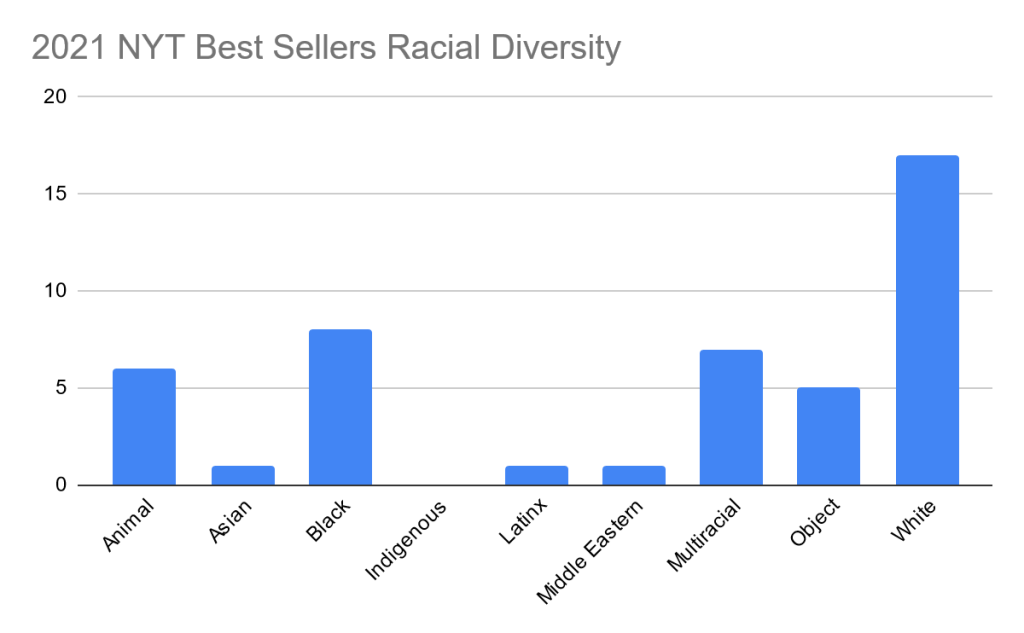
While reading my 52 books, I took note of what racial diversity was present. There are a few ways that I could do this, but I decided to keep track of the main character(s) in each book. They’re who the reader will be spending the most time with, after all. It’s not perfect data, either, but I love a good pie chart. My stats also don’t go into how these characters are depicted. Some books are represented more than once, in the case of multiple lead characters. For example, Ground Zero stars Brandon, who is cued as Latinx, and Reshmina, who is Afghani. For that book, I marked it as both Latinx and Middle-Eastern. Other books that have ensemble casts are marked as “multiracial.” To clarify: I use the term “multiracial” as it refers to race, while “multiethnic” refers to cultural identity. I’ve also included the categories of “animal” and “objects,” since a few books star critters or machines (Dog Man is categorized as “Animal,” btw). Finally, when characters’ races aren’t mentioned, White is the assumed default. Wait, don’t click away! Let me explain:

This is an issue when it comes to reading and writing fiction: if a character’s skin color is not described, most readers picture that character as White. Cover art may support this as well. It’s also really unfair, so for you novelists out there: please describe ALL your characters’ skin tones, not just some of them! The Tumblr Blog Writing With Color is an awesome resource for writing all kinds of skin tones.

Now, let’s get to the data! And if you’re uncomfortable, good. I am too.

I am far from an expert on diversity, equity, and inclusion. I also need to acknowledge that being White, cishet, and middle class, I’m speaking from a point of privilege.

To that end, I’ve started talking to people who aren’t me and have different identities and experiences one simple and important question: “Why does representation in literature matter?” I have already received some very well-thought out and in-depth answers, and I’m looking forward to reading more and sharing responses in a later post.

Until then, there are a plethora of resources online that can help you find multicultural literature, and why #WeNeedDiverseBooks.

52 Books in 52(ish) Weeks Part 3: Surprise and Unsurprise

Apologies for the delay in this post! I was celebrating my Irish pride over the weekend and simply forgot. This week, I’m continuing my journey of reading youth books off the New York Times best seller lists.

As I read through all these books, there were some things that surprised me, but probably shouldn’t have, if I had thought about them for more than a few minutes. Then there was some stuff that did surprise me. Thankfully, it was usually a pleasant surprise.

Things That Surprised Me (But Shouldn’t Have)

Picture books come in series, too.

When I think of book series, I usually think of YA books and early chapter books, not picture books. I don’t know why I was surprised when I saw more books starring Little Blue Truck, the Very Hungry Caterpillar, and Pete the cat. I had plenty of different picture books as a child featuring the same characters over and over again (Madeline and Corduroy were my favorites). It just makes sense: kids can get excited to see their favorites again and again, in different stories, and the creator typically has commercial success.

In picture books, the illustrations are not just decorations.

When I read picture books, my focus goes naturally towards the words. This is probably some awful side-effect of being an adult. In some picture books, like ones for older children, this is fine: the illustrations enhance the story, but the story can be understood without it. But in many others, illustrations are as much a part of the story as the text is. If you ignore the illustrations, or only give them a glancing look, you can miss a lot of the story, as well as some of the best jokes. There are also many wonderful wordless (or very nearly wordless) picture books out there that I love. My favorite picture books are the ones where you need text and illustrations to tell a complete story.

Books are cyclical.

This is another one I should have seen coming. It didn’t surprise me to see holiday books top the list when they were in season. But it did surprise me to see the same holiday books come up again in the following year’s list, continuing on until 2023. I found out recently that this is true for YA books, as well as picture books. In 2022, Long Live the Pumpkin Queen, by Shea Ernshaw, made it onto the Best Seller list just before Halloween. Are these new holiday classics? Time will tell.

Things that Surprised Me

Things don’t move around on the Best Seller List as much as you’d think.

With a year of reading books from the New York Time’s Best Seller List, I expected I’d read a lot of things I might never have tried otherwise, as well as well-known books. I did, but found that books didn’t move around on the list as much as I thought they would. Towards the end of my year of reading, I kept having to go further down the list to find a book or author I hadn’t read yet. This was especially true for middle grade fiction. Wimpy Kid and its offshoots and Wonder never seemed to move off the list, though they did move up and down it sometimes.

YA Inexplicably on the Middle-Grade List

When I started this project, I chose to read only from the lists for picture books, children’s middle grade books, and children’s series. I decided not to read anything of the YA Best Sellers list, just because I can’t whizz through a YA novel in a week, and I did want to get this done in a year. Even so, I ended up reading four books that were unquestionably YA (Shadow and Bone, Serpent and Dove, The Cruel Prince, and Part of Your World.) There were also several others that could be either middle-grade or YA. The four YA books were all on the “Children’s Series” list – which is just called “Series” now. So perhaps it’s not that weird, but it was to me at the time.

There’s a decent amount of non-fiction on Best Sellers lists for youth.

It wasn’t until the past ten years or so that I started to enjoy non-fiction, and it wasn’t until about two years ago that I started reading it regularly. As a kid, I always thought non-fiction was boring, just stuff you read for school. In a world where Harry Potter exists, there was no way I was ever choosing an informational text instead of a boy wizard’s adventures. Most of my peers were the same way. I was surprised to see so much non-fiction on the list. I might’ve predicted Becoming: Young Reader’s Edition, but not other books of biographies. Yet the Who Is/Was series is remarkably popular, and I’ve talked to kids at my library who have become interested in history and non-fiction. I don’t see as much demand as the What Is/What Was or the newer Where Is/Was series, but they still get a lot of check-outs. These books turn history into a narrative, and pack a lot of information in each one. As far as other types of non-fiction: I had no idea that I’d see cookbooks on the same Best Sellers list, alongside books with a narrative. I just assumed that cookbooks would be their own thing. But it is cool to see kids taking an interest in non-fiction. At least they won’t have to wait until they’re in their twenties to discover that non-fiction can be fun to read, too.

Empowerment, confidence, and topical issues.

Along with nonfiction, another theme I saw in the books I read was empowerment and confidence. Books like Ambitious Girl, Living the Confidence Code, and Change Sings all focus on building confidence, and encourage kids (often girls) to chase after their dreams. There were also books focusing on topical issues as well. Books like Stamped (For Kids) and We are Water Protectors are the most obvious. The novels also had a lot of topical messages and tackled current events, too. Ground Zero was about 9/11, then jumped ahead twenty years to the war in Afghanistan, and how it affected Afghanis. Ali Cross brought up the topics of policing and race (though not to a deep extent) as well as homelessness. I can’t think of a fictional book I read as a kid that dealt with current events in such a direct way. This may have just been my reading choices; most of my favorite middle-grade books were fantasy and sci-fi, sometimes with a conservation message. Of course, you’re also talking to the person who missed the Aslan-as-Jesus metaphor when I first read The Chronicles of Narnia.

There’s a lot of diversity!

I’ll expand on this in my next post on this project. Suffice it to say, in the past, books in the U.S. have overwhelmingly featured White characters over characters of color. While the majority of characters in these books were White, I was happy to see as much racial diversity in the books as I did. This is something I’ll get into more detail with later. Until then, if that’s something you’re interested in, the Cooperative Children’s Book Center from University of Wisconsin-Madison has a lot of interesting statistics and information about diversity in children’s books (CCBC Diversity Statistics).

Women’s History Month – March Book Recs

In the U.S., March is Women’s History Month. I love learning about women’s history, so selecting only 10 books for this list was hard! There are so many women who have inspired me, and some incredible stories that are rarely heard. I want to shine a light on some women’s history that you may be unfamiliar with, as well as celebrate the women and girls leading us into the future. 

Now, the usual disclaimer. I am a youth librarian, which means I’m most familiar with books written for young people. This means you’ll see a lot of YA and juvenile books on these lists. If you’re an adult looking for something good to read, don’t feel bad or embarrassed about reading youth books. Juvenile and YA books deal with themes and ideas that are applicable to all ages, even if the text isn’t as challenging as books written for adults. And there’s no age limit on good stories. 

I also want to remind everyone that not every book will appeal to everyone. You may hate a book that I love, and that’s okay. Not liking a book doesn’t mean that the book is bad, it just means that you don’t like it. I’ll try to appeal to a wide range of interests, but I don’t expect for you to love or even be interested in everything on this list. There’s a reader for every book, and every book has a reader. I’d love to help readers and books find each other! 

Our Bodies, Ourselves by the Boston Women’s Health Book Collective

Our Bodies, Ourselves something I’d typically put on my monthly list, because it’s not exactly a book with a narrative. It’s a medical book about girls’ and women’s health that covers everything from puberty to women’s geriatric health. It also give straight-forward facts on abuse, sexuality, orientation, sex, birth control, pregnancy, and answers many questions that you (okay, me) were too afraid to ask. All the information is easily digestible, and the book never feels like it has an agenda of anything other than to inform you about your health and choices. I’ve pulled my 2005 edition out many times when I had questions (or was just plain curious) and the information was always helpful, and didn’t overwhelm me like a Google search might. The newest edition came out in 2011, but if you’re not up for a big fat book, the website ourbodiesourselves.org still has plenty of relevant information. 

Trans Bodies, Trans Selves, published by Oxford University Press, inspired by Our Bodies, Ourselves. This is another medical reference book focused on health and wellness for transgender and non-binary individuals, with its second edition published in 2022. 

Through the Glass Ceiling to the Stars by Eileen Collins and Jonathan Ward

Eileen Collins always dreamed of the stars, but the odds of her reaching them were slim. Growing up in the 1970s in a small town and a struggling family, she seemed destined to be a math teacher, rather than a pilot. Yet through hard work and perseverance, Eileen Collins became the first woman to command the Space Shuttle. This memoir covers her small-town origins, flying operational missions for the U.S. Air Force, becoming the second female test pilot for the USAF, and finally, her four space flights, including the Return to Flight mission after the Columbia Tragedy. The book is written very much like Col. Collins herself: straightforward, without frills. Her journey is a fascinating one, especially for anyone interested in the science of space flight…or those among us who were fascinated by shuttle launches, and dreamed of being among the stars. 

On a personal note, Eileen Collins has been a huge inspiration for me throughout my life. I was always fascinated by space, and seeing her become the first woman to command a Shuttle mission made me feel as though I could reach the stars too. 

Grandma Gatewood’s Walk: The Inspiring Story of the Woman Who Saved the Appalachian Trail by Ben Montgomery.

In 1955, 67-year-old Emma Gatewood told her children she was going for a walk. What she didn’t tell them was that her “walk” would be the entirety of the Appalachian Trail. For nearly five months, Emma “Grandma” Gatewood hiked from Georgia to Maine, a journey of over 2,000 miles. She was the first woman to solo thru-hike the entire trail, and a pioneer of ultra-light hiking, never carrying more than about fifteen pounds of equipment or food with her. She would go on the hike the Appalachian trail four times, and become the first person to thru-hike the AT (man or woman) three times. She even hiked the Oregon Trail – yes, that Oregon Trail – at age 71. Unfortunately, Emma endured a horrifically abusive marriage for years, and finally divorced her husband in the 1940s, at a time when it was very difficult for women to do so. Her story – and her walk – has inspired generations of hikers and helped preserve the Appalachian Trail. Be careful reading this; it may just make you want to disappear into the woods yourself.

Rejected Princesses: Tales of History’s Boldest Heroines, Hellions, and Heretics by Jason Porath. 

There are many women whose achievements and escapades you’ve never heard of before. But just because you haven’t heard of them doesn’t mean they weren’t amazing. Rejected Princesses is a collection of biographies of women who were too incredible to be turned into Disney movies, but most certainly deserved one! This book introduced me to some historical bad-asses who deserve far more recognition: Gráinne Ní Mháille (Grace O’Malley), the Irish pirate queen; Sybil Ludington, who put Paul Revere’s Midnight Ride to shame; and Emmeline Pankhurst, the controversial but incredible English suffragette. There’s also plenty of diversity, with stories of women of all races. It doesn’t shy away from their sexualities or gender identities, showing trans and non-binary individuals alongside ciswomen. Each biography is accompanied by a full-page Disney style illustration. This book is an absolute joy, and as fun as it is educational. 

Fearless Girls, Wise Women, and Beloved Daughters: Heroines in Folk Tales Around the World, edited by Kathleen Raglan 

Folk tales have always shaped our culture. Even today, fairy tales and nursery rhymes are some of children’s earliest introductions to literature. Many of the most well-known traditional tales feature strong male characters saving damsels in distress from certain doom. While there are many books today that flip the script on these old stories, Kathleen Raglan noticed a dearth of proactive heroines in familiar folk stories. Raglan collected over 100 folk tales starring folk heroines. These women and girls don’t often use brute strength to solve their problems; rather, they use wisdom, creativity, perseverance, guile, loyalty, and kindness. The collection also expands beyond Western European stories, though they are also present. Stories from many different parts of the world are included: Sub-Saharan Africa, Northern Africa and the Middle East, Asia, the Pacific, and Indigenous North Americans. 

Fiction: 

No Stopping Us Now by Lucy Jane Bledsoe

It’s 1974, and Title IX, which prohibits discrimination on the basis of sex in schools, was passed two years ago. So why aren’t Louisa and her friends allowed to have a basketball team at their school? After a feminist rally where she meets Gloria Steinem, Louisa is inspired to petition her school to start a girls’ basketball program. While she receives support, there are plenty of obstacles – and people – standing in her way. She faces public criticism, bullying, intimidation from school staff, and even threats to her college plans while she fights for her and her friends’ civil rights. Louisa is also dealing with her grandfather’s dementia, her best friend shutting her out, and her growing feelings for her teammate, Barb. Yet Louisa pushes forward, demanding equality in the face of opposition. An autobiographical novel, No Stopping Us Now celebrates sisterhood and activism in the early days of Title IX. 

The Huntress by Rose Quinn

After World War II, three lives are entwined by the Huntress, a Nazi who has long eluded justice. Nina Markova is a Soviet Pilot who joined the legendary Night Witches, an all-female unit of pilots who bombed and harassed German targets. Tough as nails Nina was the only known survivor to escape the Huntress’s clutches. She was witness to the Huntress’s ruthlessness when the Huntress murdered Nina’s traveling companion, escaped POW Sebastian. Sebastian’s brother, Ian Graham, is a wartime journalist turned Nazi hunter. He’d nearly given up on finding Seb’s killer when Nina storms back into his life. Across the sea, Bostonian Jordan McBride dreams of becoming a wartime photographer, like her heroes Margaret Bourke-White and Gerda Taro. Jordan’s father would rather have Jordan stay safe in Boston, marry her doting boyfriend, and help him run his antique business. Jordan’s new step-mother, Annelise, is much more supportive of her step-daughter’s dreams. While Jordan adores Annelise, there’s something about her that just doesn’t add up…but trying to figure out Annelise’s secrets may rob Jordan of everything she holds dear. Told in the alternating perspectives of Nina, Ian, and Jordan, The Huntress is a powerful and absolutely gripping historical fiction.

Go With the Flow by Lily Williams and Karen Schneemann

Being the new girl is hard enough, but Sasha’s first day at Hazelton High is even harder when she gets her period for the first time…while she’s wearing white pants. Close knit friends Abby, Christine, and Brit swoop in to her rescue, only to find the school’s tampon dispenser empty. Again. A new friendship is formed when Abby gives Sasha a pad and Brit lends the new girl a sweatshirt to conceal the stains. Upset about the consistent lack of period products available in her school, Abby speaks to the principal, who says providing feminine products is out of the school’s budget, even though the football team got new uniforms last year. Abby and her friends are outraged and working to end period poverty at their school. But when letter writing campaigns and blog posts don’t move the school administration, Abby makes a statement that may have gone too far. This graphic novel is both informative and entertaining, with a diverse cast (who all have diverse periods!). Menstruation for trans men and non-binary individuals is also discussed. The backmatter provides resources, information, and ways to help fight against period stigma. 

Daughters of Oduma by Moses Ose Utomi

In a West African inspired fantasy setting, girls compete in the all-female martial art of Bowing to protect their found families. Sixteen-year-old Dirt is the Second Sister of Mud Fam, and retired from Bowing. She coaches the other girls and supports their new main fighter, Webba. Webba is a strong contender to win the South God Bow tournament, which Mud Fam desperately needs to win. There are only five sisters in Mud Fam, and if their numbers drop any lower, they’ll be disbanded. When Dirt turns seventeen, she will become a woman, undergo the Scarring ceremony, and leave Mud Fam forever. Winning the tournament is crucial to recruit more members to Mud Fam. The rival Vine Fam believes that war with the Gods is imminent, and aim to destroy Mud Fam and gain new recruits for themselves. When Webba is injured by a competitor from the Vine Fam, Dirt must step up and take her place in the tournament. Out of shape and plagued by self-doubt, Dirt must train her body and mind to save her family. With fantastic worldbuilding, tenacious and complex characters, and flowing pidgin dialogue, Daughters of Oduma is an absolutely absorbing underdog story. 

He Must Like You by Danielle Younge-Ullman

Libby’s having a rough senior year. Her parents have drained her college fund, and her outburst-prone father is kicking Libby out after she graduates so he can Airbnb her room. To earn money for college and a place of her own, Libby takes a job at a local restaurant, The Goat. She’s making good money, but a drunken hookup with one of her fellow servers leaves her upset and confused, especially after a school assembly about sex and consent. When a customer sexually harasses Libby and finally pushes her too far, it’s understandable that she’d dump an entire pitcher of sangria over his head. But the harasser in question is Perry Ackerman, local hero and Libby’s mom’s boss. Libby’s family is no help in this situation, and Libby realizes she needs to make a stand for herself, her girlfriends, and for the women at The Goat who face harassment on a daily basis. Libby is a great character and seeing her take a stand and reclaim her life is immensely satisfying. The book explores the gray areas of consent and harassment, along with the effects of assault, in a thoughtful and nuanced way. It’s an important book for all teens, not just girls. 

52 Children’s Books in 52(ish) Weeks: The Authors

52 Books in 52 Weeks: The Quest
Part 1: The Books
Part 2: The Authors – You’re here, silly!

When I embarked on my quest to read youth books off the New York Times best seller list for a year, I was a lowly library associate, dreaming of being a children’s librarian. It was really important to me to know what kids were reading, and not just what I was reading. A lot has changed since I started my quest in January 2021 – like the fact that I’m now a children’s librarian! I won’t bore you by talking endlessly about how much I love this role (it’s a lot), but knowing what’s popular and topical among kids and teens is a really important part of my job. Undertaking this challenge was a great way for me to get a feel for what kids are reading today, as well as some trends in youth book publishing.

I wanted to take a little bit to reflect on some of the things I observed during my year of NYT reading. First, the authors.

As I read, I started dividing the books’ authors into different categories in my head. I like my categories neat and organized, but authors could fit into more than one, or in none. At any rate, here’s what I’ve got:

Celebrity Authors: These are the authors who are famous, but not for writing. This included Jimmy Fallon, Michelle Obama, Scott Cawthon, Matt and Rebecca Zamolo, LeBron James, and Misty Copeland.

To be honest, if not for their celebrity, most of those books wouldn’t have ended up on the best seller list. Cawthon’s and the Zamolos’ books weren’t well-written, and they were such a slog for me to get through. If I had enjoyed the source material (Five Nights at Freddy’s and The Game Master YouTube Channel, respectively), I probably would have liked them more. Fallon’s Christmas story was cute, but no cuter than many other Christmas picture books. I did like LeBron James’s book, We Are Family, even though the writing could have been stronger (and I didn’t love all the messaging in it). The two biographies here (Becoming by Michelle Obama and Black Ballerinas by Misty Copeland) were educational, but I just wasn’t that into them. However, that’s based more on my preferences than anything with the books themselves. I simply don’t read biographies that often because they usually don’t interest me much. Even so, illustrations in Black Ballerinas were stunning.

I don’t want to imply that just because you’re a celebrity, your book is bad. I adore John Lithgow’s picture books. Steve Martin has written several well-received books. I’ve read Tina Fey’s memoir, Bossy Pants, twice. Chris Colfer, originally famous from Glee, has two popular juvenile fantasy series and YA books that people love. I’m genuinely happy to see that he’s becoming well-known for something outside of musicals. Celebrity authors are talented people, but their talents don’t necessarily include writing.

Author Celebrities: These are authors who are famous for their work. This list included Jeff Kinney, Dav Pilkey, James Patterson, and Mo Willems. It’s not surprising to see them on best seller lists, and I enjoyed a lot of the books written by authors in this category. In my previous post on this topic, I mentioned “clout” as the reason some of these books got on the best-seller list, or were even published in the first place.

I think you can see this most clearly with Rowley Jefferson’s Awesome Friendly Adventure by Jeff Kinney. Simply put, it might be the most meta-fiction book I’ve ever read. In this book, Rowley, Greg’s best friend in Diary of a Wimpy Kid series, writes a fantasy novel. Most of the book is the story that Rowley’s writing, with occasional interruption from Greg. I’m not a fan of the Wimpy Kid franchise, but I had fun with this one. Even so, I really think it only exists because the Wimpy Kid franchise is wildly (and lucratively) popular. Can you imagine if I queried an agent describing my book as, “A fantasy story written by a secondary character in another story I wrote”? I don’t think that’d go over well.

I’m a big enough person to admit I’m jealous of them. But I’m also petty enough to have that envy in the first place.

Established Authors: Slightly different from author celebrities, these are authors who are well-established in the industry, usually with a few well-received books under their belts by the time they made it to the best-seller list. These included Sharon Draper, Rainbow Rowell, and Holly Black. Of course, there’s a decent amount of cross-over with the “author celebrity” categories as well. I thought this would be the sweet spot for me: people who know their craft, with book sales to match their skills. In some cases it was, but how much I enjoyed the book really depended on the book itself. For example: I’ve loved some of Holly Black’s books in the past, and her work has been influential on me as a writer. Yet The Cruel Prince was so hard for me to get through, event though the series has been well-received.

New Authors: This was by far the smallest category. These are authors whose first books were recently published. No clout, no celebrity, just well-written books that caught on. This small group included B.B. Alston, Shelby Mahurin, and Holly Jackson. These were also some of my favorite books that I read as part of this project. Reflecting on this now, I’m glad to see these well-written books rise to the top of the charts based on their merit alone, not just who authored them.

I have a few more thoughts on this project, with some observations (some that surprised me, and some that shouldn’t have) that I’ll post at a later date. I originally wanted to include them in this same post, but things started to get lengthy. I have a lot to say (about everything, according to my family. And boss. And everyone who’s met when me when I’m drunk.) but I’ll save it for another day.

Do you also have mental categories for authors you read? What are they? What’s your favorite?

Black History Month: February Book Recs

Welcome to my February book list! Each month, I’ll be bringing you a fresh list of books all based on a different theme. 

February is Black History Month in the United States, and that’s a vast subject area. Black history in the U.S. didn’t begin in 1776, and it didn’t end with Obama’s election. For this reason, I wanted to include some Black history that isn’t discussed frequently, and maybe a couple things you’ve never heard of. 

I also wanted to highlight Black authors and illustrators. I can’t possibly list every author or illustrator worthy of reading, but if you’re interested in reading more multicultural literature from Black authors and artists, might I recommend…

Chimamanda Ngozi Adichie, Kwame Alexander, Ashley Bryan, Bryan Collier, R. Gregory Christie, Christopher Paul Curtis, Leo & Diane Dillon, Edwidge Danticat, Sharon Draper, Roxane Gay, Nikki Giovanni, Nikki Grimes, Virginia Hamilton, Victor LaVelle, Julius Lester, E.B. Lewis, Kekla Magoon, Patricia McKissack, Christopher Myers, Walter Dean Myers, Kadir Nelson, Nnedi Okorafor, Jerry Pinkney, Jason Reynolds, Christian Robinson, Javaka Steptoe, John Steptoe, Nic Stone, Mildred Taylor, Rita Williams-Garcia, Colson Whitehead, and Jacqueline Woodson. 

Now, the usual disclaimer. I am a youth librarian, which means I’m most familiar with books written for young people. This means you’ll see a lot of YA and juvenile books on these lists. If you’re an adult looking for something good to read, don’t feel bad or embarrassed about reading youth books. Juvenile and YA books deal with themes and ideas that are applicable to all ages, even if the text isn’t as challenging as books written for adults. And there’s no age limit on good stories. 

I also want to remind everyone that not every book will appeal to everyone. You may hate a book that I love, and that’s okay. Not liking a book doesn’t mean that the book is bad, it just means that you don’t like it. I’ll try to appeal to a wide range of interests, but I don’t expect for you to love or even be interested in everything on this list. There’s a reader for every book, and every book has a reader. I’d love to help readers and books find each other! 

The New Jim Crow: Mass Incarceration in the Age of Colorblindness by Michelle Alexander

While the USA has come a long way in terms of liberty and justice for all, there are still miles and miles to go. The New Jim Crow discusses mass incarceration of Black Americans, typically due to policies from Reagan’s “War on Drugs” and other anti-drug crusades that target people of color, especially young Black men. Being labeled as a felon allows for legal discrimination in housing, education, careers, and even the basic right to vote. Michelle Alexander posits that this has led to the creation of an “undercaste” of Black Americans, legally disenfranchised by the justice system. Originally published in 2010, The New Jim Crow has inspired activists to work to change the American justice system, including the creation of The Marshall Project and the Art for Justice Fund. One thing that I really appreciated about this book was that Alexander acknowledges that the information is hard to read and accept, and that the book’s not for everyone. These are hard but important truths to learn, but nothing can be changed until it’s acknowledged and challenged. 

One Last Word: Wisdom of the Harlem Renaissance by Nikki Grimes, various illustrators. 

The Harlem Renaissance produced some of the United States’ most iconic musicians, artists, actors, and writers. One Last Word is a poetry collection that celebrates the work of writers from the Harlem Renaissance, like Langston Hughes, Countee Cullen, Georgia Douglas Johnson, and many more. Alongside the original poem, Grimes remixes the work using the golden shovel method. She creates new poems from the originals, filled with truth and hope for modern readers. Vivid illustrations from accomplished artists accentuate each page. If you’re a poetry lover of any kind, this is a must read. 

The Black Jacobins by C.L.R. James

The Haitian Revolution with the most successful slave rebellion in history. It was the only one that led to the creation of a country free of enslavement, and ruled by formerly enslaved people. The widespread political, economic, and cultural effects of the Haitian Revolution still echo today. Written in 1938, The Black Jacobins by Trinidad historian C.L.R. James set outs to correct the White, Euro-centric histories that marginalized or dismissed the Revolution. The Black Jacobins gives a thorough account of the Haitian Revolution. Its central figure is Toussaint Louverture. Born into slavery, Louverture became a central figure in the Revolution, as a general, politician, and unifying symbol for Haitians. This book is essential when learning about Haitian and Caribbean history. 

The Highwaymen: Florida’s African-American Landscape Painters by Gary Monroe

The Highwaymen were a group of 26 Black landscape painters in Florida in the 1950s and 60s. They painted idealized images of Florida’s landscape: palm trees swaying in the breeze, white sand beaches, sunrise by the ocean. Segregation was deeply ingrained in Florida, and galleries refused to sell Black artists’ paintings. Instead, the Highwaymen (and one Highwaywoman) sold their paintings from door-to-door and out of the trunks of their cars. This enabled the artists to make independent livings with their paintings, away from the back-breaking work in the citrus groves. Monroe’s book tells the story of the Highwaymen, alongside full-color reproductions of their paintings. Published in 2001, the book doesn’t tell the Highwaymen’s more recent history. In 2004, they were recognized in the Florida Artists Hall of Fame, and in 2020, they won the Florida Folk Heritage Award. Today, 18 original paintings hang in the Smithsonian’s National Museum of African American History and Culture.

Heart and Soul: The Story of America and African Americans by Kadir Nelson.

This children’s book is written in the style of a grandparent telling their grandchild the history of the United States. It starts with the fact that Black folks have been in the United States just as long as White colonists, but are rarely depicted in national history. It tells the story of the struggles and triumphs Black Americans faced, covering the Revolutionary War up to the Civil Rights Movement. An epilogue depicts the storyteller voting for Barack Obama. The text is informative and accessible, even when dealing with heavy topics. The illustrations are powerful, gorgeous full-page paintings. George Washington on a horse while an enslaved man stands beside him is one of the most poignant images that you’ll remember long after you close the book. 

Fiction

Mare’s War by Tanita S. Davis

Feisty, chain-smoking Mare is anything but a conventional grandmother. Octavia and Tali, her teenage granddaughters, are mortified to be seen with her. Going on a cross-country trip with Mare at the wheel is the last thing they want to do during their summer. Mare makes a deal with them for the trip: she won’t smoke, and they won’t use their “earphones.” As the miles pass, Mare tells the girls her story: growing up in segregated Alabama, running away from home at age 17 to pursue a better life, and lying about her age to join the Women’s Army Corps during World War II. Mare shares her experiences of life in 6888th Central Postal Directory Battalion – the only battalion of Black women who served overseas in World War II. In alternating chapters of “Then” and “Now,” Octavia and Tali come to understand the experiences that shaped their grandmother, the family bond they share, and the same strengths and insecurities they share with Mare…and that it’s not so bad to be like their grandma. 

The Davenports by Krystal Marquis

In 1910, the Davenports are one of Chicago’s few wealthy Black families. As such, siblings Olivia, John, and Helen, are constantly under scrutiny. They must uphold the legacy that their formerly enslaved father built. Olivia thinks her successful courtship with Jacob, England’s most eligible Black bachelor will do the trick. That is, until she meets a civil rights activist who makes her question her privileged upbringing and shows her the horrors of Jim Crow. John and Helen are more focused on fixing horseless carriages, while Helen chafes at the limited roles women have in society. Alongside the siblings, Olivia’s best friend hatches a plan to marry John, and the siblings’ childhood friend and maid dreams of starting her own business. The book examines racism, gender norms, and classism in the often overlooked Reconstruction Era. The characters are passionate, take-charge women, and there’s plenty of romantic moments (and a couple love triangles) to swoon over.

Noor by Nnedi Okorafor

AO (Anwuli Okwudili, but she prefers “Artificial Organism”) has extensive bionic augmentations as a result of severe physical disabilities. These augmentations include artificial legs, mechanical hands, and even a brain implant.  AO accepts these augmentations as a necessary part of her life and who she is. However, the world does not see it this way. There are many who see her as a devil, more machine than woman. When an altercation at the market leaves two men dead, AO must flee. She meets a Fulani herdsman, DNA, who has been falsely labeled as a terrorist. Together, they travel across the desert to the Red Eye: a perpetual sandstorm where the wind can strip your bones clean, and the only place they might find safety. Nigerian-American Nnedi Okorafor is the master of Africanfuturism, with books like Akata Witch and the Binti trilogy. If you’re interested in sci-fi, she needs to be on your radar. 

All American Boys by Jason Reynolds and Brendan Kiely

Rashad is Black, Quinn is White, and though they got to the same school, neither boy knows the other’s name. A quick stop to a corner store on the way to the party pushes their lives together in ways they never expected or wanted. Quinn witnesses a police officer brutally beating Rashad, with little or no provocation. The narration follows both boys after the event. Rashad, recovering in the hospital, wants to be left alone to focus on his art. He doesn’t want the painful attention that comes with being the latest Black victim of police brutality. Quinn is troubled as well: the police officer is a surrogate father to him, and Quinn would have never imagined that he was capable of such violence. The large-scale issues of racism, power, and injustice are integrated seamlessly into the narrative. All American Boys was one of the most frequently challenged or banned books in 2020, for reasons including being “too much of a sensitive matter right now.” Speaking for myself, any book that makes the Top 10 most challenged books is a book I want to read.

One Crazy Summer by Rita Williams-Garcia

It’s 1968, and Delphine and her younger sisters are spending a month in California with their estranged mother, Cecile. They expect a warm welcome and a visit to Disneyland, but their trip to Oakland is nothing like they imagined. Cecile, a poet and member of the Black Panthers, resents the intrusion into her life. Instead of the mothering the girls are hoping for, she sends them to a nearby summer camp run by the Black Panthers. During the summer, Delphine participates in a Black Panther rally and becomes a young activist, all the while yearning for a true connection with the mother who left her. I love this middle-grade book for its memorable characters (particularly Delphine’s strong voice), a broader and more honest depiction of Black Panthers than typically seen in media, and the unique backdrop of 1960s Oakland. 

52 Children’s Books in 52(ish) Weeks: The Books

52 Books in 52 Weeks: The Quest
Part 1: The Books – You’re here, silly!
Part 2: The Authors

This next series of posts have been a year in the making. In January 2021, I announced that I would attempt to read one book a week off the New York Times‘s children’s best seller lists.* Admittedly, I didn’t quite manage to read a book a week, but I did manage to read all 52 books in 52 weeks…and then some. In my original post about this project, I set up a few rules for myself. First, I wouldn’t re-read books I’ve already read before, and would cycle through the separate lists for picture books, middle-grade hardcovers, and middle-grade series. As the year went on, I had to make another rule about not repeating authors or franchises. Mostly this was to ensure that I was getting a better sample of what kids are reading today, but also because I can only stand so much Diary of a Wimpy Kid and its spin-off books. My rule about not reading The Ickabog (and it was on the list for months!) had to be changed into not reading anything by JK Rowling. It wasn’t a problem for most of the year, but towards the end, her middle-grade book The Christmas Pig topped the list. I also decided that I would not be reading any cookbooks. It’s not just because I’m bad at cooking, but because I was looking for books with narrative.

Why did I chose to embark on this project? My husband asked me this when I was griping about a book I didn’t like. I didn’t do it just for the blog (though that was definitely a consideration). I like kids’ books, but mainly, I did it because at the time, my goal was to become a children’s librarian. (Mission accomplished!) While I had a good idea of what’s going on in the world of YA lit, I wasn’t sure what was popular among kids twelve and under today. I figured that I could use the best seller list as a guide to get a taste of what kids are reading.

I had quite a few different observations going through this project, which I’ll writing about in other posts. To start this off, though, I have some microreviews on the books I read for the past year.

Week 1 (Jan 3.): Five More Sleeps Til Christmas, by Jimmy Fallon. Illustrated by Rich Deas.

Cute, nice illustrations, and Jimmy Fallon had a fun virtual story time reading.

Week 2 (Jan. 11): Rowley Jefferson’s Awesome Friendly Adventure by Jeff Kinney.

I never liked Greg Heffley much, but I was 100% here for Rowley’s wholesome adventure. Only someone with Kinney’s clout would even be able to publish a book like this. I’m kinda jealous.

Week 3 (Jan. 17): Wings of Fire: The Dragonet Prophecy by Tui T. Sutherland.

I was surprised at how dark this book got, but I would have loved this series as a kid. I was definitely curious to see what happens later in the series. If I had more time, I’d read the whole main series just to see what happens next. I might still try the graphic novels.

Week 4 (Jan. 24): Little Blue Truck’s Valentine’s by Alice Shertle. Illustrated by Jill McElmurry.

Super cute, but I would have liked it better if the illustrations depicted the winter season rather than fall. Valentine’s Day is a winter holiday, after all!

Week 5 (Jan. 31): Little Leaders, by Vashti Harrison.

I really liked this collection of biographies, and learned about important Black women that I hadn’t heard of before. I do wish the illustrations had been a bit more dynamic; most figures were like paper dolls with the same face, with only their clothes and hair to distinguish them from one another.

Week 6 (Feb. 7): Dog Man, by Dav Pilkey.

I have the same “clout” suspicion as I did with Jeff Kinney, but Dog Man was a silly, fun comic book. Of course, I may be biased, since I was a fan of Captain Underpants as a kid. My favorite parts, though, were the notes warning Harold and George about how disruptive their comics were. And it doesn’t matter if kids are reading something simple, as long as they’re reading!

Week 7 (Feb. 14):  Ambitious Girl, by Meena Harris. Illustrated by Marissa Valdez.

I loved this book! It shows empowered women and characters of color, and its message is important for every kid to hear. 

Week 8 (Feb. 21): Ground Zero, by Alan Gratz.

I could write an entire post about this book. Harrowing, gripping, and emotional, without the “America, fuck yeah!” attitude I had expected. I think Reshmina’s eloquence and insightfulness on the war in Afghanistan stretched the believability a little thin for me, but she made excellent points. A novel that would definitely help kids understand the horrors of 9/11 and its aftermath better.

Week 9 (Feb. 28): Baby Sitter’s Club Graphix, by Ann M. Martin. Illustrated by Reina Telgemeir.

I never read The Baby-Sitter’s Club books as a kid, and reading the graphic novel didn’t make me feel as though I’d missed out on anything special. I do like Raina Telgemeier’s work, and it was kind of cool to see these books get updated for a new generation of readers. 

Week 10 (Mar 7.): Love from the Very Hungry Caterpillar, by Eric Carle.

Very cute, and good for the whole year, not just Valentine’s Day. Needed more holes.  Rest well, Eric Carle.

Week 11 (Mar. 14):  Living the Confidence Code, by Katty Kay, Clare Shipman, and JillEllyn Riley.

This book is full of real-life stories of girls becoming leaders around the world. It was easy to read and uplifting. I found it inspiring, and recommended it to a friend with a tween daughter.

Week 12: (Mar. 21): Crave, by Tracy Wolff.

I didn’t understand the appeal of Twilight then, and I don’t understand the appeal of Crave now. I will say that the book was very funny, but I don’t think that was the author’s intention.

Week 13 (Mar. 28): How To Catch a Leprechaun, by Adam Wallace. Illustrated by Andy Elerkton.

Simple, cute, and fun! It reminded me of St. Patrick’s Day when I was still in elementary school.

Week 14 (Apr. 4): Becoming: Adapted for Young Readers, by Michelle Obama.

It looks like not a lot changed from the original version to the adapted edition. Unfortunately, I found most of the book pretty boring, but I’ve never been a huge fan of biographies. Even so, I can see someone other than me finding this memoir meaningful and inspiring.

Week 15 (Apr. 11): The Lightning Thief, by Rick Riordan.

I’ve always been interested in Greek mythology, but I didn’t love this book. Even so, it’s a quick-paced adventure that I’m sure middle-grade fantasy lovers will enjoy.

Week 16 (Apr. 18): Pete the Cat: Big Easter Adventure, by James Dean and Kim Dean.

Admittedly, I’ve been a fan of Pete the Cat for awhile now. Cute and colorful, and I love Pete’s grumpy face. 

Week 17 (Apr.  25): Wonder, by R.J. Palacio.

Heartwarming without being overly-cheesy. If you have a disability, or love someone who has a disability, this will hit very close to home. I liked it so much I even started reading one of the side stories.

Week 18 (May 2):  Shadow and Bone, by Leigh Bardugo.

I was pretty underwhelmed considering the hype around this book, but I liked it enough to check out the sequel. Even if I didn’t make it that far in the sequel before giving up.

Week 19 (May 9) We Are Water Protectors, by Carol Lindstrom and Michaela Goade.

Beautiful and moving artwork, and an important book for every audience. 

Week 20 (May 16): The One and Only Bob, by Katherine Applegate and Patricia Casteleo.

I haven’t read the first book in the series (or watched the movie based on it), but Bob was a distinct, vibrant character and the story didn’t go the way I expected. Enjoyable.

Week 21 (May 23): Five Nights at Freddy’s: Fazbear Frights by Scott Cawthon.

A collection of stories about the titular pizza place. Fans may love it, but I’d put it into the category of, “Well, at least they’re reading.” 

Week 22 (May 30):   Peace Train, by Cat Stevens and Peter H. Reynolds

The illustrations were simple, but I liked the bright colors. I think it works better as a song than a picture book, but it was nice enough.

Week 23 (Jun. 6): Stamped (For Kids), by Jason Reynolds, Ibram X. Kendi, and Sonja Cherry-Paul.

I wish this was the sort of education I had on race as a kid, not just “Martin Luther King, Jr. solved everything.” Even the kids’ version can be uncomfortable to read, but it’s important to understand how deeply rooted racism is in America. Teaching kids about race and racism early gives me hope for the next generation of leaders. If kids are empathetic and receptive to this kind of learning, I hope our future leaders can make great strides against racism in the U.S.

Week 24 (Jun. 13): What Was/What Is… series. I read What Was Hurricane Katrina, by Robin Koontz.

Informative in a way that’s easy for kids to digest without ever talking down to them. It didn’t try to hide unpleasant truths about living conditions during and after the hurricane, and tied it back to current events and the danger of climate change. I was pleasantly surprised.

Week 25 (June 25):  Strange Planet: The Sneaking, Hiding Vibrating Creature by Nathan W. Pyle. 

This is such a strange idea for a picture book, especially if you’re not already familiar with the Strange Planet comics. Like the comic, this book is all about using context clues to figure out what the characters are saying. For some kids this could be a fun way to learn new words, but for others, especially younger ones, I think the vocabulary would be too hard.

Week 26 (Jun 27): The Game Master: Summer Schooled by Matt and Rebecca Zamolo.

There are much worse YouTuber books, but this one doesn’t have much to recommend to it unless you’re already a fan of the channel.  It changes perspective without any rhyme or reason, and the readers aren’t given enough information about the puzzles to solve them along with the characters.

Week 27 (Jul. 4): The Last Kids on Earth, by Max Brailler.

The monster apocalypse is terrifying, but it’s also kind of a kid’s paradise. This fun, funny romp through the end of the world has the feel of a comic book. It would be perfect for a reluctant reader, or anyone with a zombie apocalypse plan.

Week 28 (Jul. 11): The Bench, by Meghan Markel. Illustrated by Christian Robinson.

This is a very sweet book, though the narration addresses an adult rather than a child. The illustrations were simple, but I liked how they showed a lot of diversity.

Week 29 (Jul. 18): Ali Cross: Like Father, Like Son by James Patterson.

I thought some of its handling of current events was clumsy or heavy-handed, but I liked this fast-paced mystery well enough. Not enough to check out the other book in the series, but enjoyable for what it was.

Week 30 (Jul. 25): Carry On, by Rainbow Rowell.

There’s so much backstory to get through, especially in the first part of the book, that it feels like you’re coming in part way through the series instead of the first book. I liked the magic system, but the novel got bogged down by all the exposition. Even so, it was a fun read, and I’d recommend it to any Harry Potter fans who are mad at JK Rowling.

Week 31 (Aug 1): The Pigeon Has To Go to School by Mo Willems

Is there any children’s librarian who DOESN’T like Mo Willems? The pigeon books talk directly to the reader and makes it interactive. Plus, who hasn’t been nervous before their first day of school?

Week 32 (Aug 8): Amari and the Night Brothers by B.B. Alston.

I had a hard time getting into this one. I think I’m just burnt-out with youth fantasy series, especially ones that feature some sort of trial/rite of passage. There were a lot of information dumps, especially in the beginning, and sometimes it felt like I was just waiting for the real action to start.

Week 33 (Aug. 15): Serpent & Dove, by Shelby Mahurin

I liked this book way more than I thought I would. It’s marketed as a supernatural YA romance, but there’s action, intrigue, and some really great characters. I didn’t love the third act, or the ending, but I’m sure I’ll be reading the sequel.

Week 34 (Aug. 22): Three Little Engines, by Bob McKinnon

I was a little wary when I saw that one of my favorite books as a child had gotten a sequel, but this one did a fine job. Instead of the importance of determination, this book focused on teaching empathy, and how sometimes people need a little help. The message that sometimes saying “I think I can” isn’t enough detracts from the original <em>Little Engine That Could</em> a little bit, but overall I think it’s a worthy follow-up.

Week 35 (Aug. 29):  Black Boy Joy: 17 Stories Celebrating Black Boyhood, edited by Kwame Mbalia.

In a word: warmhearted. This is an anthology of short stories all starring Black boys by talented authors. There’s a variety of genres, too. Along with contemporary stories, there’s also science-fiction, fantasy, and poetry. “Extinct” by Dean Atta was my favorite, but each story will leave you smiling.

Week 36 (Sep. 5): The Cruel Prince, by Holly Black

I went back and forth on this book. I was excited to read this series, but also a little apprehensive. It eventually hooked me, but it didn’t stay. About 3/4s of the way through I realized I didn’t like any of the characters and didn’t care what happened to any of them. While I am curious about how the rest of the series plays out, I don’t think I’ll be reading any more books in it.

Week 37 (Sep. 12): We Don’t Eat Our Classmates! by Ryan T. Higgins

I loved this book! It’s funny, Penelope is an adorable T-Rex, and it teaches about empathy in a memorable, humorous way.

(And empathy is delicious.)

Week 38 (Sep. 19): We Are Family, by LeBron James and Andrea Williams

This was much better than I expected it to be for a celebrity book, though I have a feeling LeBron James didn’t do the bulk of the writing. I thought some of the plot lines needed more development, but it’s an easy read that will appeal to basketball fans and student athletes.

Week 39 (Sep. 26): A Twisted Tale series, by Liz Braswell. I read Part of Your World. 

I had a pretty good time with this book. The story did meander a bit in the middle without much progress, but overall I liked it. I’d pick up another book in the series for a light, fun read.

Week 40 (Oct. 3): Gustavo, the Shy Ghost, by Flavia Z. Drago

I never thought I would relate to an illustrated ghost so much. I definitely felt like Gustavo as a kid (and sometimes still do!) so I loved seeing him take a risk and make friends.

Week 41 (Oct. 10): Beasts and Beauty, by Soman Chainani. Illustrated by Julia Iredale.

This was such a cool book! Creative twists on classic fairy tales in ways that I couldn’t guess were coming. (including feminist morals, a gay Sleeping Beauty, a Black Snow White). 

Week 42 (Oct. 17): A Good Girl’s Guide to Murder, by Holly Jackson.

I’ve never been a fan of mysteries, but I devoured this one. I think including things like the main character’s capstone journal and other visual aids helped me get into it. By the time the book switched over to conventional narration entirely, I was totally hooked. I thought the characters could be developed more, but the story was so gripping I couldn’t put it down. 

Week 43 (Oct. 24): The Bad Seed Presents: The Good, the Bad, and the Spooky, by Jory John. Illustrated by Pete Oswald. 

I’ve read a couple of The Bad Seed books and I really like the art style. I thought this one was a bit wordier than the ones I’ve read in the past, though I might not be remembering properly. I didn’t like this one as much as the other ones I’ve read, but it’s a cute Halloween story with tricks and treats.

Week 46 (Nov. 14): Change Sings by Amanda Gorman. Illustrated by Loren Long.

Amanda Gorman is a talented poet, but the illustrations are where this book truly shines. They show a group of diverse kids doing things to help their community and one another, making a big difference when they’re all together. I especially liked the end, where the reader is dared to join in and help make change.

Week 44 (Oct. 31): The Beatryce Prophecy by Kate DiCamilo. Illustrated by Sophie Blackall.

The set up is a bit generic for an adult who’s read fantasy novels for most of her life, but I liked the characters, especially Beatryce and Answelica. A sweet, short story that would be great for kids getting into fantasy.

Week 45 (Nov. 7): I Survived series by Lauren Tarshis. I read I Survived Gettysburg. 

I’ve seen these books around, and I’ve always been curious about them. I Survived Gettysburg is a fast-paced story starring a brave boy who escaped from slavery with his younger sister. It’s not the most in-depth historical fiction for youth that I’ve read, but the author has a helpful FAQ and other reading recommendations for kids who are interested in learning more about the Civil War.


Week 47 (Nov. 21): Black Ballerinas by Misty Copeland. Illustrated by Salena Barnes.

Here’s my confession: I am an uncultured swine who doesn’t care about ballet. The illustrations are beautiful, but the biographies didn’t really hold my interest. However, I understand that it’s important to highlight Black women in this predominantly White dance form. I hope children of color will be able to see themselves in this book, and know that they can break barriers like the ballerinas in the book…and Misty Copeland.


Week 48 (Nov. 28): Warriors: The Broken Code by Erin Hunter

This book is a good introduction if you’re not already familiar with the Warriors series. I wasn’t enthralled by it, but if I were ten, I’m sure it would have been one of my favorite books.


Week 49 (Dec. 5): Aaron Slater, Illustrator, by Andrea Beaty. Illustrated by Douglas Roberts.

I already really liked this picture book series, and this is another solid entry, featuring a child with dyslexia who learns to tell stories his own way.


Week 50 (Dec. 12): Out of My Heart by Sharon Draper

The plot is pretty thin: Melody, a girl with severe cerebral palsy, goes to summer camp. But Melody is such a good character and the book is so warm-hearted, reading it was like sliding into a bubble bath.


Week 51 (Dec. 10): Magic Tree House Series by Mary Osborne Pope. I read Knights at Dawn.

There’s plenty to capture kids’ imaginations in this fast-paced adventure, while also educating readers on some historical facts.


Week 52 (Dec. 26): Construction Site on Christmas Night by Sherri Duskey Rinker. Illustrated by Ag Ford.

I liked this cute, rhyming book, but I have just one gripe: why are all these construction vehicles boys? I loved construction vehicles when I was young, and I’m sure a lot of little girls do, too.

*Fun fact: Harry Potter is the reason the New York Times began a separate list for children’s best sellers. People were so tired of the Harry Potter books taking up slots on the regular best seller list, a separate best seller list had to be created.

New Year, New Me! January Book Recommendations

Welcome to my first monthly book list! Each month, I’ll be bringing you a fresh list of books all based on a different theme. If you have an idea for a themed list, please let me know!

Before we get in, there’s a few things you should know. First, I am a youth librarian, which means I’m most familiar with books written for young people. This means you’ll see a lot of YA and juvenile books on these lists. If you’re an adult looking for something good to read, don’t feel bad or embarrassed about reading youth books. Juvenile and YA books deal with themes and ideas that are applicable to all ages, even if the text isn’t as challenging as books written for adults. And there’s no age limit on good stories.

I’ll also be listing non-fiction and fiction, because there’s a lot of great non-fiction out there that needs some love, too.

I also want to remind everyone that not every book will appeal to every reader. You may hate a book that I love, and that’s okay. Not liking a book doesn’t mean that the book is bad, it just means that you don’t like it. I’ll try to appeal to a wide range of interests, but I don’t expect for you to love or even be interested in everything on this list. There’s a reader for every book, and every book has a reader. I’d love to help readers and books find each other!

New Year, New Me

Nonfiction

ADD-Friendly Ways to Organize Your Life by Judith Kolberg and Dr. Kathleen Nadeau

Thanks to the way my brain is wired, I live in a kind of an entropic mess mixed in the occasional bursts of cleaning and organizing, then promising myself “I’ll never let it get that bad again.” It always turns out to be a lie, but I try.

So when I recommend a book on organizing that actually works for me, I mean it actually works. ADD Friendly Ways… teaches you how to work with your ADD, rather than against it, to get organized. This book is written in short, helpful chapters and formatted specifically to help people with ADHD be able to sit and read it. It gives practical tips on organizing your life which are easy to follow, and offers suggestions for how to find more support if needed and to take control of your life. It’s the best organization self-help book I’ve ever used, and the only one I’ve seen that specifically addresses the role that ADHD plays in the struggle of keeping your life together.

The War of Art by Stephen Pressfield

Making stuff is hard. Whether it’s writing, drawing, dancing, or sculpting, no creative endeavor comes easily. Pressfield calls the universal force that acts against our creativity “resistance,” and it can come in many forms. It could be fear, pressure to perform, irritations in your daily life, or the fact that the new Pokemon game just dropped and how can you be expected to write when you can’t get Sprigatito out of your head? Pressfield brilliantly describes resistance, how to overcome it, and the sacred act of creating. Each short chapter is a micro pep talk for anyone experiencing resistance. It’s a small, thin book and shouldn’t take you long to read. I read it cover to cover years about five years ago and still take it off my shelf when I’m feeling stuck.

The Confidence Code/The Confidence Code for Girls and Living the Confidence Code by Clair Shipman and Katty Kay

Self-doubt. Imposter syndrome. Lack of confidence. We’ve all experienced it, especially girls and women who have internalized messages that they will never be enough. The Confidence Code is a best-selling guide to empower women to become self-assured and confident in their lives, using scientific research and proven methods of behavioral research. Following the success of The Confidence Code, the young reader’s edition, The Confidence Code for Girls aims to reach teen and tween girls struggling with inner doubt.

Living the Confidence Code is true stories of girls, ranging from grade school to teenagers, who are changing the world. These inspiring stories show how everyday girls can have a major impact on their homes, the lives of others, and the world. The word “inspiring” gets tossed around a lot, but I really mean it. After reading this book I was ready to start writing letters to the editor and began researching ways to help with period poverty in my area. If these kids can change their hometowns, I can too!

Draw Stronger: Self Care for Cartoonists and Other Visual Artists by Kriota Willberg

Whether you draw, paint, or write, creating art takes a physical toll on your body. Draw Stronger is a comic book that shows how chronic pain and injuries can occur, and provides tips to prevent and treat injuries. Fun and informative, this is a must-read for anyone who spends good chunks of time sitting at a desk drawing, writing, or typing. While this is geared mainly at visual artists, I’ve found it helpful for dealing with a repetitive strain injury caused by a lockdown’s worth of handwriting.

Fiction:

When Women Were Dragons by Kelly Barnhill

Alex is one of the many who was left behind after the Mass Dragoning of 1955, when hundreds of thousands of women transformed into dragons, wrecked a path of fiery destruction, and took to the skies. She is left with questions: did they choose to become dragons? Why did her beloved Aunt Marla change, but not her mother? Propriety forbids Alex from ever asking. Instead, she must deal with her overprotective mother, her distant father, and a younger sister obsessed with dragons. Most troubling of all, there’s the insistence that her aunt never actually existed. In a world where women are forced into small, confined roles, what happens when they (literally) rise up? Kelly Barnhill is already known for some excellent fantasy for youth, but this novel for adults does not disappoint.

A Psalm for the Wild-Built by Becky Chambers

Two hundred years ago on the moon of Panga, all robots gained consciousness. They left human society peacefully, and were given half the moon to do with as they pleased — which was to leave it untouched and observe the natural world around them. Two centuries later, Sibling Dex is a tea monk who travels the roads of Panga, offering tea, a listening ear, and small comforts to anyone who needs it. Feeling restless in their life, Dex seeks a new journey in a remote corner of the human world. Incredibly, they meet Mosscap on their way. Mosscap and Dex share the first human-robot contact in two hundred years. Mosscap comes in peace, but also bearing a question for Dex: what do humans need? Elegantly written, imaginative, and relaxing, this is one of my favorite books I’ve read recently. I want to live in this world. Thankfully, there’s a sequel as well, so you can return to Panga again.

Whistle: A New Gotham City Hero by E. Forester and Manuel Preitano

Willow Zimmerman is busy. She’s a teen activist who spends her weekends protesting at city hall to help her rundown Gotham neighborhood. Her nights are spent working at the local animal shelter to help pay her mother’s medical bills. When E. Nigma, an old friend of her mother’s, shows up in Willow’s life, he makes her a job offer she can’t refuse. Soon Willow is organizing his high-rolling (and not entirely legal) poker games for E. Nigma and his ludicrously wealthy friends. After an encounter with one of Gotham’s many notorious villains, Willow discovers she has superpowers, including telepathy with dogs. She also learns who her employer really is. The high life isn’t all it’s cracked up to be, and Willow must decide where her values truly lie, and the cost of following her convictions. The story is more about Willow growing as a person, rather than her as a superhero, but she’s such a great character you’ll be wanting to read more of her adventures.

Juliet Takes a Breath by Gabby Rivera

Juliet Palante is a self-described “closeted Puerto-Rican baby-dyke from the Bronx.” Even though her coming out didn’t go as planned, she’s still got a lot to look forward to. Juliet

has just landed her dream internship working for Harlowe Brisbane in Portland, Oregon. Harlowe is a feminist lesbian author, and the strong, empowered woman that Juliet wants to be. But life on the West Coast isn’t what Juliet had expected. She’s not sure about the New Age culture that surrounds her, or even if Harlowe’s (who is White) brand of feminism is right for her. This is a coming-of-age story that examines gaps in the mainstream feminist movement and intersectionality, all while Juliet realistically explores her own identity, and maybe even falls in love. In short: a novel to provoke thought and discussions that will ultimately leave you breathless.

Sherwood by Megan Spooner

Robin of Loxley is dead, killed in the Crusades far from the shores of England and his beloved Lady Marian. Robin was not only Marian’s betrothed, but also her best friend and closest confidant. With Robin gone and Guy of Gisbourn aiming to take his place, the poor of Nottingham have no one to speak for them. Despite the deep grief Marian carries with her, she cannot ignore the suffering of the people of Nottingham. When her friends are threatened by the dogged Gisbourn and the Sheriff of Nottingham, she will take up Robin’s mantle and become her own hero. Well-written, this is an action-packed and enjoyable re-imagining of the Robin Hood legend.