Eragon 52-53: Tronjheim

Two states and one long hiatus later, I’m back. And so is Eragon.

Fasten your seat belts, kids, this is gonna be a long one.

Well, chapter 53, “Ajihad”, is going to be a long one. The chapter before it, “The Glory of Tronjheim” is much shorter, and a lot less interesting.

From the start of chapter 52, I thought it was going to be a bit more standard for the book. After all, it starts with Eragon’s ham-fisted and direct characterization of Murtagh while they’re stuck in a cell in Tronjheim together. Then, he goes to examine a lantern nearby. The description of the lamp takes up an entire paragraph.

I should have known then. How could I not see it?

This is not a chapter with plot. It is ten pages of description as Eragon goes from one part of the city to another.

Credit where it’s due:  I’ve given Paolini a lot of shit here, but descriptions are one thing he does well. My favorite scenes in this book are Eragon and Saphira flying, or swimming in Leona Lake. Those moments are what make me keep reading this, because they capture something magical and beautiful.

There are authors who can evoke the setting in such a way that it becomes another character. Norman Maclean’s A River Runs Through It does this magnificently and Terry Pratchett’s Ankh-Morpork is familiar to me as any city I’ve walked through in real life.

I don’t think Paolini is quite at that level yet, but I’m honestly envious of his talent for description. It’s one thing that I’m always struggling to improve in my own writing.

Hey, Paolini, wanna team up? I’ll bring the characters, you bring the setting, and together we’ll make something halfway decent!

The real problem I have with this chapter is that it just kind of drags on. Nothing happens, other than “Eragon went here and saw a pretty thing. Then he went here and saw another pretty thing.”

I’m sure there’s someone who really liked this chapter for that reason. But that wasn’t me.

The next chapter, though, is much more interesting. Eragon meets Ajihad, the leader of the Varden, and our old friend “intense” makes a comeback!

He bore himself with great dignity, exuding an intense, commanding air.

Still not great writing, but at least “intense” makes more sense here.

Then Ajihad tells Eragon something truly baffling about the bald man who went through Eragon’s memories. He has a twin brother, equally bald and magical. But the truly bewildering part is that neither of the twins have names.

How the hell do they not have names? How hard is it to give someone a name? “From now on you’re George and you’re Elliot? You like those names? Cool.” See? It’s that easy. The Varden are literally denying these mages an identity. Treating them as non-persons is just asking them to betray you.

This all gets hand-waved away, though, because Ajihad discovers Murtagh’s identity by recognizing…Morzan’s voice. Apparently Murtagh and Morzan sound similar.

Much as I want to call bullshit on the “hereditary voice tone”, I can’t, because I’m told that I have the same voice as my mom. So I’ll give this one a pass.

Anyway, Murtagh refuses to let the Twins see into his mind, while he and Ajihad toss the word “probe” around a few more times, just to make everyone uncomfortable.

And Murtagh is so, so stupid. He thinks that everyone in the Varden will treat him like an outcast if they know who he is, which is entirely possible. Or–and stay with me here, Murtagh–he could just let the Twins examine him. Not only would he have information about Galby’s court that the Varden could use, they would see that he hates Galby.

Of course, no one can see this blatantly obvious solution, so Murtagh is imprisoned indefinitely. I know conflict is supposed to propel story, but this just seems so…unnecessary.

Eragon and Ajihad go one to discuss Eragon’s adventures thus far, and Eragon tells him about fighting and presumably killing the Shade Durza. But whenever I read a description of Durza, with his white face and red hair, he just sounds like Ronald McDonald to me. I guess clowns can be scary, but a fast food mascot hardly strikes fear into my heart.

Ajihad also fills Eragon in on just how Saphira’s egg wound up in the Spine, where our hero found it. This is important information and answers a lot of questions from the beginning of the book, and normally I like backstory. What I do not like, however, is a single character droning on for pages without any pause from the dialogue.

The tl;dr version is this: Brom stole Saphira’s egg, which will only hatch when the right person touches it. The egg is ferried between the Varden and the Elves, and the kids of each group would gather ’round and touch it, and see if it hatched. If it did, Brom and the Elves would share the responsibility of training the new Rider. Arya was attacked by Durza while transporting the egg, and magically teleported it to the Spine, where Eragon found it.

A few things here.

First of all, a species that can only reproduce by the right person touching its eggs might be the worst means of keeping a species alive. No wonder the dragons died out. Galby didn’t kill them all, their poor breeding techniques did!

Secondly, Arya is a princess, because of course she is. Why is she doing the dirty work of moving the egg from place to place? Doesn’t she have princessy things to do?

And what the hell was Brom doing in Carvahall in the first place? Eragon’s village is literally on the other side of the world from both the Varden and the Elven homeland. He couldn’t have known that the egg would disappear and then reappear in the Spine. Logically, he should have been with the Varden the whole time.

I’m not sure these questions are ever actually answered. At least, not as far as I’ve read in the series. At some point it’s revealed that Eragon is actually Brom’s son, so it’s possible Brom went to Carvahall to keep an eye on him. If I wanted to confirm this, though, I’d probably have to finish reading the series, but I have good books to read instead.

After the history lesson, Ajihad also tells Eragon some of the goings-on at the Varden, including encrypted notes discussing a place called Ithrö Zhâda.

Ithrö Zhâda.

After I read that, I had to put the book down and weep for the flagrant abuse of accent marks, circumflexes, and diaereses spread throughout this book.

I strongly suspect Paolini didn’t give a flying fuck as to how things actually sounded and just put special characters all over the place because they looked cool.

Though, to be fair, I would’ve done the same thing as a fifteen-year-old novelist.

But I digress. The notes and other evidence points to the Varden having a traitor in their midst. Well, gee, I wonder who that could be. The only other people we’ve met so far who don’t have names and the Varden doesn’t treat like human beings? And if the answer “The Twins” really isn’t that obvious, why doesn’t Ajihad just have the Twins scan everyone and see if they’re the traitors?

I’m beginning to think Ajihad is not such a great leader.

I’ll leave you with one last cringey quote from Eragon, which came straight out of nowhere:

I’ll fight when needed, revel when there’s occasion, mourn when there is grief, and die if my time comes…but I won’t let anyone use me against my will.
 

Eragon 50-51: Oh, The Angst

I’ve recently finished reading Fool Moon by Jim Butcher, the second novel in The Dresden Files. It was a fun read, with likable protagonists and lots of action. There was one thing that drove me crazy about it, though: every chapter had to end on a cliffhanger. I understand why authors do this, and I’ve done it in my own writing, but when it happens every chapter, it gets a little tiring, not to mention formulaic. You can predict how each chapter is going to go: Harry is in trouble, gets himself out of trouble, winds up in worse trouble. Repeat as necessary.

Again, I understand the benefits of doing this, but it begins to lose impact the more it happens. This is why when a chapter ends with Eragon passing out and getting himself captured for the twelfth time, I really don’t care.

Of course, this may be because I don’t care about the character himself, because he’s dumb.

Murtagh revealing that he’s the son of Morzan is actually a pretty good cliffhanger, though. We’re left waiting for the emotional fallout, rather than waiting to see if Eragon gets rescued again. (Spoiler: he does. He always does.) But this new inforation is the real obstacle to their friendship. Or, rather, the friendship we’re told they have, because whenever we see them talking, they’re usually arguing.

As expected, there’s a lot of a shock and sudden distrust. Saphira and Eragon are immediately defensive and wary. Saphira doesn’t even want to leave Eragon’s side, afraid that Murtagh will attack him. Eragon doesn’t give him the benefit of the doubt, which I might yell at him about, except that it makes sense for his character. At this point, he’s still only sixteen, and he’s never been a font of wisdom. Even Saphira, who I’ve critiqued for maybe being just a little too wise, is concerned. She’s still a young dragon, and she’s finally acting her age, too. That, and she has plenty of reason to hate the son of Morzan.

Fortunately, Saphira does manage to have some common sense and points out that if Murtagh really wanted to hurt Eragon, he would have done so already. Murtagh’s parentage is a rather distressing subject for him, and has said more than once that he never asked to be born. Eragon treats Murtagh rather coldly, even after Saphira talks sense into him. Instead of coming across as cautious, or savvy, it makes Eragon look more like a jerk than ever.

But that’s only for a few pages. Soon enough, the army of Urgals are on top of them. The trio only has a few more hours to get Arya the antidote she needs, so the pressure is on. It’s actually a pretty exciting chapter, especially when Saphira starts fighting the Urgals. She can’t breathe fire yet, but her ferocity is really impressive, even when it seems they’re hopelessly outnumbered.

There was also a scene that I related to a little too well. Eragon believes that he’s found the entrance to the Varden, but the door won’t open. He quickly realizes he’s on the wrong side of the lake. I might make fun of this, except I have no sense of direction. At all. This is totally something I would do.

Near the end of the chapter, Eragon is knocked into the river, and he, Murtagh,  Arya and Saphira are rescued by two members of the Varden. The scene is a little hard to understand and visualize, but it’s one of the rare cases where a confusing action scene actually works. It helps accentuate the chaos of the battle and the rescue, and the characters’ own confusion.

In the next chapter, Eragon, et. al. are taken inside the mountain to be questioned. It’s made clear early on that the Varden are dangerous, not just a rag-tag bunch of lovable scrappers. Throughout the series, there’s supposed to be some ambiguity as to whether the Varden are a group of rebels fighting for a just cause, or terrorists fighting the rightful ruler of the land. And while the leaders do morally questionable things (*cough* Elva *cough*), on the whole, you’re supposed to cheer for them, because they are soundly the good guys. This is one of the few times when we see that there is a darker side to them.

Eragon and Murtagh are questioned by a magician who is using magic to probe into their minds. Isn’t this…a little unnecessary? This guy is obviously high level, and “Zone of Truth” is only a second-level spell. Considering that you can make just about anything happen with the right words and phrasing in the Ancient Language, there had to be an easier way to form a spell that would have Eragon and Murtagh tell the truth, without breaking into their heads.

It backfires on him anyway, because Murtagh is able to block the man from entering his mind, and with Saphira’s help, Eragon is able to hide some of his memories as well. And while Eragon is a jerk on many levels, he at least doesn’t reveal the secret of Murtagh’s parentage. Good on you, Eragon.

As for the magician himself, who literally doesn’t have a name, could it be any more obvious that he’s evil?

‘Now, remove the defenses from around your mind [. . .] If you try to hide anything from me, I will take what I want by force…which would drive you mad. If you don’t submit, your companion will be killed.’ [. . .]

‘You’d better not harm him, Egraz Carn, else the king will have words for you.’

The bald man looked at him irritably, then faced Eragon with a small smile. ‘Only if he resists.’ [. . .]

He paid keen attention to so many things Eragon considered irrelevant, such as his mother, Selena, and seemed to linger on purpose so as to prolong the suffering.

So when he and his twin betray the Varden in the next book, absolutely no one is surprised. The Varden really needs to screen their mages better.

Even so, this chapter made me remember why I liked Murtagh so much. He’s a total badass. He refused to allow the mage to pick his brain, and shows impressive mental strength. He’s able to fight off the mage’s attack until another member of the Varden commands Magey to stop.

Most of the rest of the chapter is Murtagh giving Eragon–and the readers–his history. While I’m not a big fan of information dumps, it works here, because he’s also answering the questions the readers want to know. I’ll also give Paolini props for giving us the full story, instead of just handwaving plot holes with, “that’s a story for another time”.

It soon becomes clear that Murtagh’s parentage is a distressing subject for him. Morzan was an abusive alcoholic, and Murtagh’s mother was trapped in the relationship, doing his bidding.

Now this is one of the moments where I can see how I’ve changed. I’ve always been the girl going, “I’m a strong independent woman who don’t need no man!” and, in high school, really hated Murtagh’s mom. I thought she was so weak, staying with an abusive man for years, when she should have just walked away. Why didn’t she just up and leave?

Now I’m older, and I understand things better. I didn’t know then that leaving an abusive relationship is incredibly hard and frightening. Even the strongest person would have a difficult time with that. Even moreso when your abuser is capable of riding dragons and using magic and can kill you at fifty paces.

All that said, there are still some issues with this. Murtagh was raised in Galby’s palace, and only escaped a few months ago. Apart from Brom, he’s the most worldly character in this book. He’s the dark and brooding one, the one with survival skills. While he was trained to fight in the palace, so his swordsmanship makes sense, but the rest? I’m not buying it.

He only met Galby a few times, and tells Eragon about one of their meetings with some of the most awkward phrasing.

His words were entrancing, like a snake whispering gilded lies into my ears. A more convincing and frightening man I’ve never heard. [. . .] For a long time he was silent, but then he extended his hand and asked, “Will you, O son of my friend? serve me as I labor to bring about this paradise?” [. . .] the dream he had painted was too compelling, too seductive to ignore. Ardor for this mission filled me, and I fervently pledged myself to him.

Paolini, listen up. Use purple prose, or use beige prose, I don’t care. But stop switching between the two with no rhyme or reason, especially when Murtagh’s never spoken like that before.

He goes on to talk about how he came to realize that Galby was evil and insane, and that he decided to escape. Of course, he does this with some of the most awkwardly written dialogue in the book so far.

As soon as I was free of his presence, I and my faithful servant, Tornac, made ready for flight. We left that very night, but somehow Galbatorix anticipated my actions, for there were soldiers waiting for us outside the gates. Ah, my sword was bloody, flashing in the lantern glow.

Ugh.

Murtagh explains that he started following the Ra’zac in the hopes that they could lead him to a dragon, which begs the question: Why?

He wants to be free from Galby and his father’s shadow, so why does he follow the king’s most trusted servants around? He’s terrified his past will be revealed, but then why align himself with a Dragon Rider? I can only assume it’s so he has a powerful ally should he ever need one, but an easier and much better solution to his predicament is obvious. He could have just disappeared. His birth was a secret, and Algaesia’s a big place. Murtagh could have just changed his name, found a new city, and made a new life for himself.

For that matter, he doesn’t need to be so afraid of what the Varden will do to him if they find out about his heritage. He spent almost his entire life in Galby’s court, and once he shows them that he’s defected, he’d become a valuable resource to them.

I get it. Plot is propelled forward by characters making stupid choices. Murtagh is an important character throughout the series, and becomes Eragon’s foil by the end of the second book. You wouldn’t get that if he’d just disappeared, which would be the sensible option.

I guess what I’m not buying is the whole “Murtagh finds Eragon by following people he shouldn’t have been following if he’s so scared about getting caught” excuse.

I think this is another missed opportunity for character development. Murtagh’s out in the world on his own for the first time. He must be scared, uncertain, and confused. Probably angry, too, feeling betrayed by Galby. There’s an enormous amount of potential to create not just a great character arc, but a great character. Unfortunately, emotions come last while the plot is railroaded forward. Instead of an intriguing character, we’re left with a two-dimensional figure who has a few moments of greatness, but then falls as flat as the rest of the cast.

There is at least one way Murtagh outshines Eragon as a character.

Eragon is Algaesia’s biggest idiotball. Murtagh is its biggest drama queen.

Eragon 48-49: Dithering Without Empathy

I think this chapter was written so we would stop liking Murtagh. And to that effect, it backfired terribly. At least, for me. It starts when he gets called “emotionless”, which is supposed to read like Murtagh’s a cold, bad dude, but he and Eragon both have so little established personality, it doesn’t really distinguish them in any way.

But the real conflict comes when Eragon and Murtagh encounter a group of slavers, and I can’t figure out just why the slavers are here. They’re outside the Empire now, and we haven’t seen any evidence of human life beyond its borders, besides our heroes. Why are they searching out here, and who are they going to sell any captured slaves to? Or would they trek them back across the desert? This has to be the most inefficiently run business on the continent.

Eragon and Murtagh dispatch the slavers without much trouble, save one: Torkenbrand. He’s injured and unarmed, and Murtagh kills him before giving him a chance to surrender. No, it’s not exactly a heroic thing to do, but there weren’t a lot of options, either. Torkenbrand had already seen Arya, knew she was an elf, and even if he couldn’t capture them, he would certainly be blabbing about them. Maybe pick up a nice reward from the Empire for information about the people that they clearly want captured.

Eragon, however, doesn’t really understand this, and he’s pissed that Murtagh killed Torkenbrand before giving him the chance to surrender. Which also begs the question, what would they have done with him, had he surrendered? Keep him as a prisoner while they ride to the Varden? Or send him running off, so he can tell everyone about Arya?

This leads into the cringiest dialogue I’ve read in awhile.

‘I’m only trying to stay alive,’ stated Murtagh. ‘No stranger’s life is more important than my own.

‘But you can’t indulge in wanton violence. Where is your empathy?’ Eragon growled, pointing at the head.

‘Empathy? Empathy? What empathy can I afford my enemies? Shall I dither about whether to defend myself because it will cause someone pain?’

Yes, please continue this ham-fisted dialogue that just really drives home how morally superior Eragon is to Murtagh.

To Eragon, the world is black and white. You are good, or you are evil. There’s no in-between. But he’s also a Dragon Rider, and his life is going to be filled with hard decisions, where there isn’t a clear right or wrong answer. It would have been interesting to use this moment to show him grappling with morality, to try to see that Murtagh could be a killer, and also his friend, or to wonder if the end truly justifies the means. And he does, a little bit, when he tells Saphira he’s confused. But by the time morning comes around, he decides that killing Torkenbrand was murder, and that Murtagh was in the wrong.

As the serious progresses, Eragon does go on to do some rather morally dubious things. In Brisingr, he and Roran rescue Sloan (hey, remember Sloan?) from the Ra’zac, who have tortured him to the point where he lost his eyes. However, Eragon decides that this isn’t punishment enough for the butcher, as he betrayed Carvahall to the Ra’zac. So, naturally, Eragon decides to tell the only person Sloan cares about, his daughter, that her father was killed. He then leaves Sloan in the desert, after essentially having cursed him to never be allowed to contact his daughter again.

Eragon does this because he can’t bring himself to kill Sloan while he’s so helpless, even though he acknowledges that killing him would be the merciful thing to do. Instead, Eragon makes Sloan’s life infinitely more difficult and painful. You know, after he’s already been tortured for months.

Our hero, everyone.

Maybe I shouldn’t be judging Eragon’s actions two books from now, or point out his hypocrisy for things that he hasn’t done yet.

Too bad. I did it anyway.

At last Saphira understands moral ambiguity, and discusses it with Eragon as the next chapter opens.

‘It was a hasty deed and ill considered, but Murtagh tried to do the right thing. The men who buy and sell other humans deserve every misfortune that befalls them. If we weren’t committed to helping Arya, I would hunt down every slaver and tear them apart!’

‘Yes,’ said Eragon miserably, ‘but Torkenbrand was helpless. He couldn’t shield himself or run. A moment more and he probably would have surrendered. Murtagh didn’t give him that chance. If Torkenbrand had at least been able to fight, it wouldn’t have been so bad.’

‘Eragon, even if Torkenbrand had fought, the results would have been the same. You know as well as I do that few can equal you or Murtagh with the blade. Torkenbrand would have still died, though you seem to think that it would have been more honorable in a mismatched duel.’

‘I don’t know what’s right!’ admitted Eragon, distressed. ‘There aren’t any answers that make sense.’

‘Sometimes,’ said Saphira gently, ‘there are no answers. Learn what you can about Murtagh from this. Then forgive him. And if you can’t forgive, at least forget, for he meant you no harm, however rash the act was. Your head is still attached, yes?’

This is my reminder that that the only reason I’ve continued reading this book is Saphira.

Although I’ve been quite critical of the book and Eragon’s character in general, I really like his talk with Saphira. Eragon seems to be learning that things aren’t always as straight forward as they seem, and I love that he’s wrestling with this new lesson. It’s one of the few times in this book so far that I really felt that Eragon does have an inner world. In a few pages, he suddenly had more character development than he’s gotten for the past ten chapters.

I want to see Eragon change and grow more over the course of the novel, as main characters are meant to do. These changes are more obvious in the beginning of the novel, I think, than near the end. I’m happy to see Eragon struggle with ideals, and finally have to deal with a conflict that can’t be solved with swords and sorcery. This is a good step in Eragon’s journey, though I doubt we’ll get many more moments like this until the book ends.

Because the orcs Urgals are coming! The Urgals are coming!

When Eragon flies on Saphira’s back to get a better look at the approaching horde, she ends up flying too high so there’s not enough oxygen for Eragon, and he passes out. Again. At this point, it’s like losing consciousness has become his hobby.

At least the description of their flight and the mountains below them is nice.

The Urgals, it turns out, are some kind of super-breed, called the Kull, which makes them even stronger and deadlier than their regular counterparts. You know, like Uruk-hai, but they’re not Uruk-hai at all, guys. They’re Kull. See? There’s a world of difference.

On one hand, I know that we’re getting close to the climax of the book, and need to up the ante a little bit. We’ve already seen Eragon take on Urgals and lesser swordsmen without too much of a problem, but the sudden appearance of the Kull feels a bit lazy and contrived to me. Putting the obvious Orc/Urgal parallels aside, the approaching army kind of came out of nowhere. The Varden’s location is incredibly well-hidden, and Eragon and Murtagh escaped pursuit by fleeing across the desert. So are the Kull just being sent to the vast mountain range in hopes of getting lucky and finding the Varden, or did they find Eragon’s location? Or really, are they just here because the story demands it?

Though as much shit as I give Eragon, he and Saphira actually come up with an effective plan to deter the Kull. Namely, dropping boulders on them from a distance. Practical, and effective!

They still remained focused on getting Arya to the Varden as quickly as possible, though, and soon it becomes apparent that Murtagh (who still hasn’t left for some reason) is caught between the Kull army, and going to the Varden. He finally reveals why he doesn’t want to go: he’s Morzan’s son, one of the Foresworn that put Galby on the throne.

That was a wham line for me as a kid. I was expecting some dark and angsty backstory, but I hadn’t thought that he’d be related to Morzan at all. It was a genuine surprise, in part because Morzan is mentioned so infrequently compared to Galby. I was also happy that Galby isn’t Morzan’s father, because even this book knew when it was drifting a little too close to Star Wars.

Here’s one thing I’ve noticed about re-reading Eragon: it’s not nearly as fun as the other books I’ve re-read for this blog. In part this is because Eragon is a nincompoop and the prose can be cringey, but it’s also because I know everything that’s going to happen. I know all the twists, and the things that kept the book engaging for me have already been revealed.

Well, we’ve got less than a dozen chapters to go, and I’ve spent too much time explaining the sunk cost fallacy  reading it to stop now.

Eragon 42-43

It’s been awhile since I griped about a single sentence in Eragon, but there’s one that’s just truly perplexing at the beginning of chapter 42, “Fighting Shadows”. During his captivity, Eragon is drugged, which renders him unable to use his magic. He figures out the drug is in his food, and abstains from eating or drinking until it wears off. When it does the following day,

It was dark in Eragon’s cells when he sat up with a start, electrified. The wrinkle had shifted! He had felt the magic at the edge of his consciousness for hours, but every time he tried to use it, nothing happened.

“The wrinkle had shifted”?

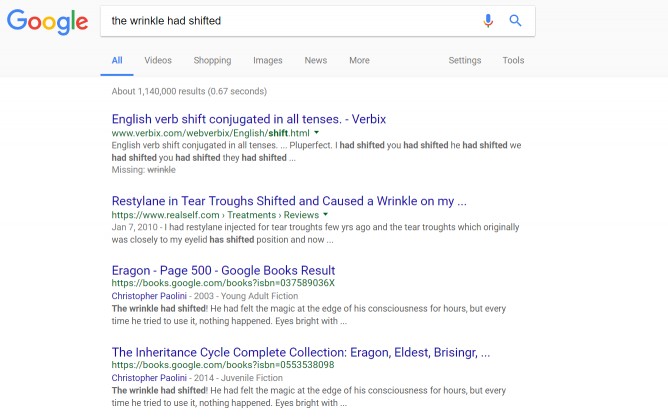
That’s such a weird line. I know it means that the drug has worn off, so Eragon isn’t foggy and able to do magic again, but…”wrinkle”? Is there a definition of “wrinkle” that I’ve never heard before? I know I’ve been pretty hard on Eragon, so I wanted to give it the benefit of the doubt. Maybe this was a phrase that people used and I’d never heard before, so I decided to Google it, just to be sure.

wrinkle-had-shifted

Congratulations, Paolini. You might be the first person to ever have the sentence “The wrinkle had shifted” in a published book.

Since a “wrinkle” was never mentioned before, I choose to believe that it refers to the folds in Eragon’s brain that allow him to use magic.

Not surprisingly, Eragon uses magic to break himself out of prison, at the same time Murtagh arrives in disguise to rescue him. But why wasn’t Murtagh also captured along with Eragon? Murtagh is wanted by the Empire, and it was his appearance in Gil’ead that led to Eragon’s capture. How did Murtagh get away? If it was due to Saphira’s intervention, why would she save Murtagh, and not her Rider?

What if Murtagh had been captured, and not Eragon? Eragon and Saphira could have some conflicts about risking themselves to save him, especially when he’s kept so much of his past a secret. There could have been a dilemma that wasn’t solved with swords or magic, something this book has been severely lacking.

But the plot marches ever-forward, and soon Eragon and Murtagh are rushing off to save Arya. When they find her, there’s another paragraph talking about how beautiful she is, and that she smells like pine needles. Wait, what? She’s been imprisoned and tortured for months. She shouldn’t smell nice. She should smell like iron and blood and…well, maybe elves’ sweat smells like pine needles. That’s the only thing that makes sense to me.

The most exciting part of this chapter is when Eragon duels the Shade, Durza, to try to cover Murtagh’s escape with Arya. We’ve seen Durza use magic in the prologue, but it didn’t have a lot of impact on the reader’s view of him, because we knew so little about what was going on. When Eragon and Durza engage in a sword fight, we know what’s at stake. We also have something to compare Durza to. We know that Eragon’s a gifted swordsman, but Durza is toying with him when they fight. There’s a huge gap between their skills, and so their fight is actually interesting to read, knowing Eragon is likely to lose.

The day is saved by Saphira, who ends up landing on the prison and destroying it. Normally I’m not a fan of the “Big Damn Heroes” trope, with the characters arriving right in the nick of time to save everyone. In this case I’ll forgive it, because Saphira is one of the few reasons I’ve managed to keep reading this book.

My first complaint about the next chapter, “A Warrior and a Healer”, was the abundant use of adverbs. The one that struck me as the laziest was Eragon “tiredly” healing one of Saphira’s wounds after their escape from Gil’ead.

Eragon also brings up that elves speak the Ancient Language, and most of them can use magic. This still brings me back to the question I had many chapters ago: how do elves have a conversation without casting spells and lighting everything on fire? This book goes into detail on so many things I don’t care about and have no impact on the story, but still has yet to answer that one question.

As Eragon, et. al. flee from Gil’ead, Murtagh tells him that the Urgals and Durza were working for Galby. No shit. Even as a kid, I knew that would be the case. The obvious bad guys are working for the bigger bad guy. This is just how the hierarchy of villainy works. I wasn’t shocked then, and I wasn’t shocked now.

I am, perhaps, a little more shocked and disappointed by Saphira’s explanation of all this.

A sick, angry feeling welled in his stomach. ‘The Urgals were under Galbatorix’s orders! Why would he commit such an atrocity on his own subjects?’

‘Because he is evil,’ stated Saphira flatly.

not good enough.gif

From Saphira’s perspective, this makes perfect sense. However, this is one of the big problems I have with the Inheritance series. Galby is evil because he’s crazy, and…well, that’s it. The antagonist who is evil for the sake of being evil is just a lousy villain. There’s no greater depth to them, no chance for them to be sympathetic or intriguing. If your only descriptor is “evil”, you’re not just a flat character. You’re boring and indistinguishable from the multitude of bland, oh-so-evil forgotten baddies.

After Eragon learns the not-so-shocking truth about the Urgals and Durza, he sets about to healing Arya. Paolini spends two paragraphs describing her wounds: back covered with bruises, oozing cuts, marks from whips and hot brands. Credit where it’s due: the description of Arya’s wounds is pretty horrifying, especially when you add in the fact she’s probably been tortured daily for months. So, nice one, Paolini.

But we still can’t go one chapter without mentioning how beautiful the elf is, even after she’s been brutally tortured.

[H]e could not help but notice that underneath the disfiguring marks, her body was exceptionally beautiful.

Ugh.


Eragon 35: Helgrinding Through

And we keep plunging into the literary abyss that is Eragon. But this chapter was much better than the past few because–wait for it–something actually happens!

The chapter, “Worshipers of Helgrind” starts with Eragon going out to explore the city of Dras-Leona. The chapter title comes from the citizens of Dras-Leona, who worship Helgrind, the mountain that looms above the city.

Does anyone else think that the name “Helgrind” is just a little too on the nose?

While he’s wandering through the city, Eragon finds a slave auction. He plans to use magic to free a slave that’s being bid on, but realizes that the slave would never be able to escape. So finally, finally, Eragon has learned something. He realizes that he can’t save everyone, but if he fights against the Empire, he can help a lot of people. I’m not sure if I would call this a proper turning point for his character, as he’s never wanted to join the Empire. But at least it’s something.

Going back to the “Galby is a terrible autocrat” theory, sending the Ra’zac to capture Eragon and kill his family might be the worst possible way to get Eragon on his side. It’s a great way to ensure that a unique and soon-to-be very powerful young man hates you. Why couldn’t Galby start with something more appealing: “Join me, I’ll make you a king. You’ll have power and gold and your family will be safe.” That would be a much more interesting–and challenging–test of Eragon’s character.

Back to the matter at hand, Eragon visits a cathedral in the city.  I am actually curious about what Eragon believes in. Religion was never mentioned prior to Eragon and Brom arriving in Dras-Leona, so I’m curious as to what sort of faith they have, if any. When Eragon pays his respects in the cathedral, it’s not to any god (or Helgrind), but to the cathedral and its impressive architechture.

But remember when I promised that something happened in this chapter?

Something finally happens! When Eragon goes to leave the cathedral, the Ra’zac are standing in the entrance.

Now, since it’s been far too long since I’ve made fun of a single sentence…

A sibilant hiss came from the smaller Ra’zac.

I would like to nominate “sibilant hiss” as the most redundant phrase of the book so far.

He had chased the Ra’zac for so many weeks that the pain of their muderous deed had dulled withinin him. But his vengeance was at hand. His wrath exploded like a volcano[.]

I shit you not, I laughed outloud. There must be a way to do purple prose so it’s not so unintetionally funny. This isn’t it.

Eragon does try to fight the Ra’zac, but they’ve got the city guards backing them, and he’s outnumbered. When he finally gets in touch with Saphira (and through her, Brom), they agree that they’re outnumbered* and need to flee the city. They ride as far from the city as they can in the night and set up camp. Not long after they set up camp, Eragon falls unconscious.

He falls unconscious a lot. Let’s see…I think that’s four times so far. And, glancing ahead, it’s going to happen a few more times before the book is finished. It’s gotten to the point where it’s no longer dramatic, and Eragon is more reminiscent of a fragile anime girl or flimsy romantic heroine than a badass Dragon Rider. I’m not really a fan of the constantly fainting character anymore. I first noticed this in the Hunger Games series. Whenever Eragon (or Katniss) faints, when (s)he comes to, there’s someone ready to explain what happened while (s)he was out, instead of the character experiencing it and narrating it for themselves. The literal definition of telling rather than showing. In the cases of Eragon fainting because he used magic that took a lot of energy, it makes sense. But it just keeps happening over and over again, and no longer cares the suspense that it should.

*Outgunned, outmanned, outnumbered, outplanned

Eragon 32-33: Sunk Cost Fallacy

The next two chapters are mercifully short, but not exactly exciting. They did not, however, end with me shouting about Eragon’s stupidity, so that’s a slight plus. Chapter 32, “The Mire of Dras-Leona” is only a few pages, most of which is exposition about the city. I don’t mind it so much here, because it’s not convoluted rules of the universe. Brom is more like a tour guide than mentor here, and it’s a nice change of pace. I can just relax and accept what he’s saying, instead of scratching my head and cringing at lengthy and convoluted explanations.

One thing I did like in this chapter is that Saphira and Eragon discuss exactly what he plans to do after killing the Ra’zac. They don’t dwell on it too long, but I think it’s still a good point to bring up. If revenge is your character’s driving motivation, what do they do once they’ve achieved their goal? Saying, perhaps, that there are no jobs as the Dread Pirate Roberts available.

Before I get into the next chapter, I also want to point out that the inn Eragon and Brom are staying is is called “The Golden Globe”. Yeah.

The following chapter, “Trail of Oil” is pretty short, and pretty lazy. Brom and Eragon split up to search the city and see if they can track down the oil the Ra’zac use. Eragon wanders around the city and learns next to nothing, but Brom comes back with good information, which he then relays to Eragon. Just like everything else in this book. I feel like Paolini really skimmed over this. Brom discovering helpful information and just explaining it to Eragon is a lot easier than having Eragon learn something for himself. Worldbuilding and tutoring Eragon is one thing, but I’m getting really sick of this.

I’m also beginning to think that Galby is really terrible at being a dictator. Brom learns that he’s coming to Dras-Leona to punish the city’s leader for not being as obedient as the king would like. Okay, I can buy that. But Brom also says this is the first time Galby has left his stronghold in at least a decade.

Here’s the thing: I don’t get it. Galby is a threat to Eragon and Saphira, largely because he wants them under his control. He’s a threat to the as-of-yet unseen rebels, the Varden, because they openly oppose him. But the majority of the people he rules are not dragons, Dragon Riders, or rebels. It seems like the only thing he really cares about is ruling the dragons, not actually ruling the land or its people. He seems rather lackadaisical when it comes to being an evil dictator. Right now, it seems like he’s only a threat to Eragon and the Varden. We’re told over and over again that Galby’s evil, he’ll destroy everything you know and love, but we never really see it, and I’m definitely not feeling it. If Galby wants to be a true evil dictator, worthy of actually being reviled, he really needs to broaden his horizons.

Chapter 33 marks the halfway point of the novel. And so far, I’ve been pretty disappointed. When I decided to re-read Eragon, I knew that it wouldn’t ever be as good as it was when I was fourteen. I did not expect it to be so…boring. Most of the novel so far has been Eragon asking questions and Brom giving him the answers. If I didn’t know all this beforehand, it would probably be more interesting to me, but it’s really hard to get into this book and actually enjoy it.

This also might explain why I didn’t re-read Eragon after I first finished it until now. It’s not just that I knew the bulk of the story. There are books that I’ve read and re-read dozens of times, even after I know the story. It’s because of beautiful writing, or because something in it touched me, or because I just didn’t want to leave the story’s world. These are the books that you keep thinking about long after you’ve turned the last page.

Then there’s Eragon. I’ve critiqued the writing, the plot, the characters, and I’m not even sure that I should continue this endeavor. Only my pride (and the sunk cost fallacy) has really kept me from tossing the book out right now.


Eragon 30-31: Stew Today, Stew Tomorrow, Stew Forever

I need to discuss one thing that has bugged me for a long time.

Why is it always stew?

As Dianne Wynne Jones wrote in The Tough Guide to Fantasy Land: 

Stew is the staple food in Fantasyland, so be warned.  You may shortly be longing passionately for omelette, steak, or baked beans, but none of these will be forthcoming, indoors or out.  Stew will be what you are served to eat every single time.  Given the disturbed nature of life in this land, where in camp you are likely to be attacked without warning, and in an inn prone to be the centre of a tavern brawl, Stew seems to be an odd choice as staple food, since, on a rough calculation, it takes forty times as long to prepare as steak.  But it is clear the inhabitants have not yet discovered fast food.  The exact recipe for Stew is of course a Management secret, but it is thought to contain meat of some kind and perhaps even vegetables.  Do not expect a salad on the side.

William Goldman also captures this wonderfully in The Princess Bride: 

This was after stew. But then, so is everything. When the first man crawled out of the slime and went to make his home on land, what he had for dinner that night was stew.

Okay, stew is great if you’ve got tough meet or vegetables, but you’ve also got to have time to cook it. In this one situation it might be acceptable, because Eragon’s been unconscious for two days, so I’m sure that Brom had plenty of time to hang out for eight hours and make a stew. And while I’ve been praising Brom for generally being smarter than his charge, he and Saphira just pulled a serious bonehead move. Namely, leaving his unconscious charge alone at camp while he and Saphira go Urgal hunting. If that wasn’t bad enough, Eragon can’t get in contact with Saphira, so he has no idea where they are or what’s going on. So he just hangs out and eats his goddamn stew.

But, seriously, Brom. You’ve made it abundantly clear that Eragon is in danger and a lot of people are after him. Why the hell would you leave the obviously prone Dragon Rider alone, never mind out of reach of his dragon?

When Brom and Saphira return, Brom explains that he was hunting down the Urgals Eragon had encountered earlier, and he’s rightfully pissed.

‘[T]hat piece of magic nearly killed you! You’ve been sleeping for two days. There were twelve Urgals. Twelve! But that didn’t stop you from trying to throw them all the way back to Teirm, now did it? What were you thinking? Sending a rock through each of their heads would have been the smart thing to do. But no, you had to knock them unconscious so they could run away later. I’ve spent the last two days trying to track them down. Even with Saphira, three escaped! [. . .] You don’t even deserve to be called a Rider after this, boy.’

Why the hell would Eragon even bother keeping the Urgals alive? He could have dispatched them from the safety of Saphira’s back, or at least had her attack them, not land in front of them and try to talk to hostile enemies. Just…ugh. I know that main characters have to make mistakes, but our designated hero is just so beast-headed I’m having a hard time feeling sympathetic for him at all.

As much as I love pissed-off Brom, it’s not enough to off-set the disappointment that comes at the end of the chapter. Brom starts drilling Eragon with different combat scenarios, but we don’t get to actually hear what Eragon’s ideas are. I’d have liked to hear at least once of the scenarios and Eragon’s answers, but readers can’t have nice things.

Moving forward, the next chapter might be the most cringe-worthy one yet, because this is where Eragon truly begins his descent into Mary Suedom.

The chapter begins with Eragon scrying on Arya–sorry, the raven-haired elf maiden–and she not only knows that she’s being scryed on, but also is able to acknowledge Eragon. Does this ever get explained why she can do this? I really don’t remember.

The explanation might just be, “because she’s an elf”. Or, as Brom explains,

[I]f you ever have the misfortune to fight and elf–trained or not, female or male–expect to lose. They, along with dragons and other creatures of magic, are many times stronger than nature intended. Even the weakest elf could easily overpower you.’

Elves are a race of goddamn Mary Sues. Whatever you do, they will always be better at it, and be prettier than you. In the sequel, Eldest, Eragon lives among the elves, and I remember hating them. With the exception of maybe Eragon’s new mentor, I found most of the elves to be haughty and completely insufferable. Remember that pretty blond girl at school who was popular and got good grades and was gifted in a million different ways? And was really mean? The elves in the Eragon universe are just mean, pretty high school girls repeated a million times. Even Arya is hard to like in Eldest.

Of course, elves aren’t the only Sues to be accounted for. I’ve tried to give Eragon something of a pass on this, because sometimes plot demands that a main character have traits associated with Mary Sues. He’s also made enough dumb choices so far to help keep him out of that category. But then he had to go and break his wrist, and Brom makes him continue learning swordplay using his left hand instead of his right. He becomes adept at using his left hand, eventually beating Brom when they spar.

Brom shook his head. ‘I can teach you nothing more of the sword. Of all the fighters I’ve met, only three of them could have defeated me like that, and I doubt any of them could have done it with their left hand.’ He smiled ruefully. ‘I may not be as young as I used to be, but I can tell that you’re a talented and rare swordsman.’

Yep. Then that happened. I don’t think he’s an irredeemable Sue yet, but he’s getting there.

Ugh.

I made a note to discuss the overly-complicated rules of a wizard duel as well, but I’d rather talk about the one saving grace in this chapter.

Saphira. It’s Saphira. If not for her, I probably would have thrown this nonsense across the room long ago. I’m beginning to suspect that Paolini made Saphira’s scenes so enjoyable so that readers would forget about the rest of the pitfalls in the story. In this chapter, Brom, Eragon, and Saphira arrive at Dras-Leona, which is on the banks of Leona Lake. Eragon and Saphira go for a swim, diving from the air into the cold water, leaping into the air from the the water…it’s kind of magical.

Eragon 26: Literary Stockholm Syndrome

I’m beginning to worry that I have some kind of literary Stockholm Syndrome, because I’ve actually been enjoying Eragon lately.

“The Witch and the Werecat” is another chapter I was looking forward to reading. We’re properly introduced to Angela and the werecat Solembum, both of whom I’ve always rather liked.

Angela is a fictionalized version of Paolini’s sister, and that makes me wonder a couple things. First of all, how much is the real Angela like her fantasy counterpart? There’s no real way I can answer that, so the next question would be, “is it really okay to put someone you know in real life into your novel?”

My immediate thought is to recoil from the idea, but that is largely Twilight‘s fault, considering that waste of paper was originally written as a story for Stephanie Meyers’s sister. Yes, I know Eragon and Twilight are very different books, and Eragon came first, so I’m really not being fair about this. Putting a person you know in real life into a book also brings up the thought of a self-insert main character. I’ve both read and written enough fanfiction to tell you that self-inserts more often than not lead to Mary Sues and bad writing.

So I was a little wary when I came across Angela again, and I have to say that I still legitimately like the character. She’s not some beautiful woman, she’s an old, quirky witch who’s a lot of fun to watch, and I’m glad that she comes back later in the series.

Now, what about the werecat?

Eragon first sees Solembum and assumes he’s a normal cat, and tries to reach out to him with his mind. Solembum responds using the same type of mental communication Eragon shares with Saphira, and Eragon just assumes that he’s talking to her. It was probably done for humorous effect, but he can’t tell the difference between Solembum and his dragon? Really?

The werecat blinked lazily. ‘Knowing is independent of being. I did not know you existed before you bumbled in here and ruined my nap. Yet that doesn’t mean you weren’t real before you woke me.’

…Did Solembum just drop a Schrodinger reference that I would have never understood at age fourteen?

Angela, the herbalist, offers to read Eragon’s real fortune using the knuckle bones of a dragon. This was another scene that I liked a lot as a kid. When I was reading Eldest, I would frequently go back to this scene and try to figure out how all the things Angela tells him would play out.

One of the things Angela starts with is weird to me, though. After casting the bones, she says that Eragon is one of the few that is free to choose his own fate. I honestly would expect the opposite of that Saphira’s egg would have never hatched if he hadn’t touched it–I would call that destiny. I’d think that people more like Jeod and Angela, ordinary people, would have more choice in their lives than Eragon. He has to be a Dragon Rider; there’s no way he can back out.

The bones also promise an epic romance. Yeah, right. It became obvious to me when I first read this book that he would fall in love with Arya, the elf woman in the prologue. In Eldest, he does confess that he loves her, and they are friends, but she often treats Eragon with disdain. I never finished reading the third book in the series, Brisingr, but I didn’t feel a whole lotta love between the two of them there, either.

Plus, Eragon’s confession in Eldest is just cringe-worthy.

The last part of his fortune was that Eragon would be betrayed by someone in his own family. He objects to this right away, saying that his cousin Roran wouldn’t do anything like that.

I make fun of Eragon a lot here for failing to see the obvious, but this was a twist that took me by surprise when it happened near the end of Eldest, and Eragon’s long-lost brother shows up. I really think I should’ve seen that one coming.

Before Eragon leaves the shop, he receives two more pieces of advice from Solembum.

When the time comes and you need a weapon, look under the roots of the Menoa tree. Then, when all seem lost and your power is insufficient, go to the rock of Kuthian and speak your name to open the Vault of Souls.

I haven’t read far enough into the series to know what the “Vault of Souls” is, but I’m intrigued, despite myself.

Like in the previous chapter, I think the foreshadowing is handled well here. Some of the things in Eragon’s fortune happen in this book, and there’s enough information to keep me interested in learning how these things will come to pass.


Eragon 22-23: Not Half Bad

Something unusual happened. I actually liked this chapter. While I was looking forward to reading flying scenes, especially because I’m a student pilot. However, I was sure that they would only disappoint. They did not. I even loved Eragon’s anticipation as he prepares to fly with Saphira.

Saphira waited impatiently while Eragon tightened the bands around his legs. Are you ready? she asked.

He sucked in the fresh morning air. No, but let’s do it!

That is exactly how I feel when I’m getting ready to take off. I’m always nervous and excited, but pretty soon, the sheer joy of being able to fly takes over. Then the book describes Saphira’s grace, riding on updrafts, performing aerial maneuvers…and I almost exploded in nerdy joy when Eragon sees that Saphira uses her tail as a rudder. And then, then it gets even better when Saphira lets Eragon enter her mind see the world through her eyes, feel the sheer joy of flying. GOD I WANT TO DO THIS SO BAD WHY ARE DRAGONS FICTIONAL.

It’s a good thing there’s only one of me right now, because I can’t even.

Okay, time to take a deep breath, and stop fangirling.

After weeks spent tracking the Ra’zac, it seems that Eragon and Brom have finally lost the trail. That they managed to have it for that long is kind of dubious to me, but whatever, at this point I’m along for the ride. The Ra’zac appear to have taken flight, which kind of begs the question why they took so long to fly away in the first place. Also, having not found Saphira or Eragon in Carvahall, I feel like they were doing a really shitty job of finding Saphira. Wrecking Eragon’s farm was the equivalent of leaving the hero for dead in a cunning trap, and anyone who’s ever watched a Bond movie knows how that ends.

My brain just stopped for a second. I just realized the Ra’zac are Ringwraiths. I guess I can’t like this chapter anymore.

Along with the flying, though, I’m glad that the plot’s finally moving along. Eragon finds a flask of oil that’s used to burn flesh and muscle, and nothing else. That’s pretty fucked up. Brom elucidates some of them ways it could be used against your enemies and generally be cruel. The teenage version of myself (and the part of me that likes to torture characters) thinks that’s awesome. More than I want to admit.

I also like that Brom and Eragon decide to use a decidedly mundane method of tracking the Ra’zac after they find the oil. No spells, no mind-reading, just tracking where the oil was shipped from and to. It’s as simple as finding the right document. And after so much swords and sorcery, I appreciate this practical approach.

I’m glad I liked this chapter, because the next one was just padding. I really can’t see how this made it into the final cut of the novel. Eragon is curious about what the ocean is like, and Brom tells him “the sea is emotion incarnate”. What?

Most of this chapter is, essentially, a montage. Eragon and Brom traveling, practicing swordplay and learning how to use magic. So little happens in this chapter that the most memorable line might be when Eragon thinks, “Everything about me is turning hard.” He’s thinking about his muscles and how fit he’s becoming, but I’m still immature enough to snort at that. Then I remember that this book was written by a fifteen-year-old. I’m only picturing a young Christopher Paolini also laughing at that line, or trying to convince someone that it’s so deep. The latter is what I would have done at fifteen, and the former is what I’m doing now. Because I am still a child and low-hanging fruit will always make me chuckle.


Eragon 21: Do NPCs Really Need Names?

Apologies for the unexpected pause in posting; a death in my boyfriend’s family have slowed down blogging for the time being.

I wonder if I’m being too hard on Eragon. As much as I make fun of it, I love high fantasy. My favorite games are the Dragon Age series, I’ve already made references to Lord of the Rings on this blog, and obviously I fell in love with The Chronicles of Narnia before my age had even reached double digits. I’m working through A Song of Ice and Fire, and I have d20 in my purse right now, just in case a Dungeons & Dragons game pops up.

In short, I am a nerdy, and sometimes my thoughts betray how nerdy I actually am. Because, as I was reading this chapter, one of my first thoughts was, “Brom would make a great rogue…maybe who took a few levels in wizard…no, he multi-classed to Spellsword.”

Then I decided maybe I should go outside for a little bit.

When Eragon and Brom  enter another town to re-supply. Paolini runs into the same problem I have at times when I write background characters: naming them. If they’re only appearing in one scene and never again, their names are that important. But it’s really annoying to write or read “the man with the mole” or something of that ilk every time the character gets mentioned. A lot of the time, it’s just easier to give the NPC a name than refer to them by their description, however inconsequential they are. In Eragon, these bit characters often volunteer their names upon meeting Eragon and Brom. When I write brief meetings, I often don’t have the background characters give their names. Usually, I’ll have another character call them by their proper name, at which point “the man with the mole” can be called by his name in the narration. It honestly rarely occurs to me to just have minor characters introduce themselves.

I’m not sure if you’d have guessed, but the girl who blogs about fantasy books and has a home-made Jedi robe in her closet is something of an introvert. For most of my life I have been afraid of people and social situations, and especially the telephone. Even though I’m much more sociable and outgoing now than I was as a kid, I’m still not a person to generally start conversations, and it almost never occurs to me to tell someone my name. Last month I spent an hour talking to someone I met in an airport, and we had a great conversation, and I never told him my name, nor did I learn his. So my question is this: do “normal” people ever just directly introduce themselves?

Trevor, the minor character that Brom and Eragon meet, tells them that traveling has become dangerous with Urgals attacking their villages, and says that the king should be doing something about this. Brom, for whatever reason, agrees.

Wait. Didn’t we establish several chapters ago that the king is crazy and evil? Yet Brom thinks that Galby should know that Urgals are getting organized and attacking people? And no one ever thought that maybe, just maybe the Big Bad had something to do with this?

merida-headdesk

Also, we get this gem from Eragon.

“And you can do this even though you aren’t a rider?” asked Eragon.

Eragon, HOW ARE YOU THIS DUMB?!

There were a couple things I did like about this chapter, though. First, Brom teaches Eragon about communicating mentally with other sentient creatures, the same way that Eragon is able to talk to Saphira. Though years of playing DnD has made me disagree with Brom’s definition of sentience, it is a cool idea to be able to communicate with any living creature. The exposition didn’t have the clunky handling, either, as it did in some previous chapters. And there’s also this small piece of brilliance from Brom.

Think about it: you can communicate with any sentient being, though the contact may not be very clear. You could spend the entire day listening to a bird’s thoughts or understanding how an earthworm feels during a rainstorm But I’ve never found birds very interesting. I suggest starting with a cat; they have unusual personalities.

Yes. As the proud owner of one the derpiest cats on the planet, I agree so hard. Think of all the other famous fictional cats: the Cheshire Cat, the pirate cat in The Last Unicorn, and…okay, that’s all the cats I can think of, save perhaps Thackery Binx, who isn’t even really a cat.

But wouldn’t you love to know what Princess Monster Truck is thinking? I sure would.

princess-monster-truck

She is everything that is right with the internet.

Even better, my cries for more Saphira have been heard. She tackles Eragon and demands that he start flying with her so she can keep him safe. Some of her dialogue makes her sound like a concerned mom, but I’m happy she’ll be in the story more after this. Now that I’m a pilot, I’m also looking forward to reading more flying scenes, which I suspect will be much different from Eragon’s first flight.