Eragon 32-33: Sunk Cost Fallacy

The next two chapters are mercifully short, but not exactly exciting. They did not, however, end with me shouting about Eragon’s stupidity, so that’s a slight plus. Chapter 32, “The Mire of Dras-Leona” is only a few pages, most of which is exposition about the city. I don’t mind it so much here, because it’s not convoluted rules of the universe. Brom is more like a tour guide than mentor here, and it’s a nice change of pace. I can just relax and accept what he’s saying, instead of scratching my head and cringing at lengthy and convoluted explanations.

One thing I did like in this chapter is that Saphira and Eragon discuss exactly what he plans to do after killing the Ra’zac. They don’t dwell on it too long, but I think it’s still a good point to bring up. If revenge is your character’s driving motivation, what do they do once they’ve achieved their goal? Saying, perhaps, that there are no jobs as the Dread Pirate Roberts available.

Before I get into the next chapter, I also want to point out that the inn Eragon and Brom are staying is is called “The Golden Globe”. Yeah.

The following chapter, “Trail of Oil” is pretty short, and pretty lazy. Brom and Eragon split up to search the city and see if they can track down the oil the Ra’zac use. Eragon wanders around the city and learns next to nothing, but Brom comes back with good information, which he then relays to Eragon. Just like everything else in this book. I feel like Paolini really skimmed over this. Brom discovering helpful information and just explaining it to Eragon is a lot easier than having Eragon learn something for himself. Worldbuilding and tutoring Eragon is one thing, but I’m getting really sick of this.

I’m also beginning to think that Galby is really terrible at being a dictator. Brom learns that he’s coming to Dras-Leona to punish the city’s leader for not being as obedient as the king would like. Okay, I can buy that. But Brom also says this is the first time Galby has left his stronghold in at least a decade.

Here’s the thing: I don’t get it. Galby is a threat to Eragon and Saphira, largely because he wants them under his control. He’s a threat to the as-of-yet unseen rebels, the Varden, because they openly oppose him. But the majority of the people he rules are not dragons, Dragon Riders, or rebels. It seems like the only thing he really cares about is ruling the dragons, not actually ruling the land or its people. He seems rather lackadaisical when it comes to being an evil dictator. Right now, it seems like he’s only a threat to Eragon and the Varden. We’re told over and over again that Galby’s evil, he’ll destroy everything you know and love, but we never really see it, and I’m definitely not feeling it. If Galby wants to be a true evil dictator, worthy of actually being reviled, he really needs to broaden his horizons.

Chapter 33 marks the halfway point of the novel. And so far, I’ve been pretty disappointed. When I decided to re-read Eragon, I knew that it wouldn’t ever be as good as it was when I was fourteen. I did not expect it to be so…boring. Most of the novel so far has been Eragon asking questions and Brom giving him the answers. If I didn’t know all this beforehand, it would probably be more interesting to me, but it’s really hard to get into this book and actually enjoy it.

This also might explain why I didn’t re-read Eragon after I first finished it until now. It’s not just that I knew the bulk of the story. There are books that I’ve read and re-read dozens of times, even after I know the story. It’s because of beautiful writing, or because something in it touched me, or because I just didn’t want to leave the story’s world. These are the books that you keep thinking about long after you’ve turned the last page.

Then there’s Eragon. I’ve critiqued the writing, the plot, the characters, and I’m not even sure that I should continue this endeavor. Only my pride (and the sunk cost fallacy) has really kept me from tossing the book out right now.
 

Eragon 30-31: Stew Today, Stew Tomorrow, Stew Forever

I need to discuss one thing that has bugged me for a long time.

Why is it always stew?

As Dianne Wynne Jones wrote in The Tough Guide to Fantasy Land: 

Stew is the staple food in Fantasyland, so be warned.  You may shortly be longing passionately for omelette, steak, or baked beans, but none of these will be forthcoming, indoors or out.  Stew will be what you are served to eat every single time.  Given the disturbed nature of life in this land, where in camp you are likely to be attacked without warning, and in an inn prone to be the centre of a tavern brawl, Stew seems to be an odd choice as staple food, since, on a rough calculation, it takes forty times as long to prepare as steak.  But it is clear the inhabitants have not yet discovered fast food.  The exact recipe for Stew is of course a Management secret, but it is thought to contain meat of some kind and perhaps even vegetables.  Do not expect a salad on the side.

William Goldman also captures this wonderfully in The Princess Bride: 

This was after stew. But then, so is everything. When the first man crawled out of the slime and went to make his home on land, what he had for dinner that night was stew.

Okay, stew is great if you’ve got tough meet or vegetables, but you’ve also got to have time to cook it. In this one situation it might be acceptable, because Eragon’s been unconscious for two days, so I’m sure that Brom had plenty of time to hang out for eight hours and make a stew. And while I’ve been praising Brom for generally being smarter than his charge, he and Saphira just pulled a serious bonehead move. Namely, leaving his unconscious charge alone at camp while he and Saphira go Urgal hunting. If that wasn’t bad enough, Eragon can’t get in contact with Saphira, so he has no idea where they are or what’s going on. So he just hangs out and eats his goddamn stew.

But, seriously, Brom. You’ve made it abundantly clear that Eragon is in danger and a lot of people are after him. Why the hell would you leave the obviously prone Dragon Rider alone, never mind out of reach of his dragon?

When Brom and Saphira return, Brom explains that he was hunting down the Urgals Eragon had encountered earlier, and he’s rightfully pissed.

‘[T]hat piece of magic nearly killed you! You’ve been sleeping for two days. There were twelve Urgals. Twelve! But that didn’t stop you from trying to throw them all the way back to Teirm, now did it? What were you thinking? Sending a rock through each of their heads would have been the smart thing to do. But no, you had to knock them unconscious so they could run away later. I’ve spent the last two days trying to track them down. Even with Saphira, three escaped! [. . .] You don’t even deserve to be called a Rider after this, boy.’

Why the hell would Eragon even bother keeping the Urgals alive? He could have dispatched them from the safety of Saphira’s back, or at least had her attack them, not land in front of them and try to talk to hostile enemies. Just…ugh. I know that main characters have to make mistakes, but our designated hero is just so beast-headed I’m having a hard time feeling sympathetic for him at all.

As much as I love pissed-off Brom, it’s not enough to off-set the disappointment that comes at the end of the chapter. Brom starts drilling Eragon with different combat scenarios, but we don’t get to actually hear what Eragon’s ideas are. I’d have liked to hear at least once of the scenarios and Eragon’s answers, but readers can’t have nice things.

Moving forward, the next chapter might be the most cringe-worthy one yet, because this is where Eragon truly begins his descent into Mary Suedom.

The chapter begins with Eragon scrying on Arya–sorry, the raven-haired elf maiden–and she not only knows that she’s being scryed on, but also is able to acknowledge Eragon. Does this ever get explained why she can do this? I really don’t remember.

The explanation might just be, “because she’s an elf”. Or, as Brom explains,

[I]f you ever have the misfortune to fight and elf–trained or not, female or male–expect to lose. They, along with dragons and other creatures of magic, are many times stronger than nature intended. Even the weakest elf could easily overpower you.’

Elves are a race of goddamn Mary Sues. Whatever you do, they will always be better at it, and be prettier than you. In the sequel, Eldest, Eragon lives among the elves, and I remember hating them. With the exception of maybe Eragon’s new mentor, I found most of the elves to be haughty and completely insufferable. Remember that pretty blond girl at school who was popular and got good grades and was gifted in a million different ways? And was really mean? The elves in the Eragon universe are just mean, pretty high school girls repeated a million times. Even Arya is hard to like in Eldest.

Of course, elves aren’t the only Sues to be accounted for. I’ve tried to give Eragon something of a pass on this, because sometimes plot demands that a main character have traits associated with Mary Sues. He’s also made enough dumb choices so far to help keep him out of that category. But then he had to go and break his wrist, and Brom makes him continue learning swordplay using his left hand instead of his right. He becomes adept at using his left hand, eventually beating Brom when they spar.

Brom shook his head. ‘I can teach you nothing more of the sword. Of all the fighters I’ve met, only three of them could have defeated me like that, and I doubt any of them could have done it with their left hand.’ He smiled ruefully. ‘I may not be as young as I used to be, but I can tell that you’re a talented and rare swordsman.’

Yep. Then that happened. I don’t think he’s an irredeemable Sue yet, but he’s getting there.

Ugh.

I made a note to discuss the overly-complicated rules of a wizard duel as well, but I’d rather talk about the one saving grace in this chapter.

Saphira. It’s Saphira. If not for her, I probably would have thrown this nonsense across the room long ago. I’m beginning to suspect that Paolini made Saphira’s scenes so enjoyable so that readers would forget about the rest of the pitfalls in the story. In this chapter, Brom, Eragon, and Saphira arrive at Dras-Leona, which is on the banks of Leona Lake. Eragon and Saphira go for a swim, diving from the air into the cold water, leaping into the air from the the water…it’s kind of magical.

Eragon 26: Literary Stockholm Syndrome

I’m beginning to worry that I have some kind of literary Stockholm Syndrome, because I’ve actually been enjoying Eragon lately.

“The Witch and the Werecat” is another chapter I was looking forward to reading. We’re properly introduced to Angela and the werecat Solembum, both of whom I’ve always rather liked.

Angela is a fictionalized version of Paolini’s sister, and that makes me wonder a couple things. First of all, how much is the real Angela like her fantasy counterpart? There’s no real way I can answer that, so the next question would be, “is it really okay to put someone you know in real life into your novel?”

My immediate thought is to recoil from the idea, but that is largely Twilight‘s fault, considering that waste of paper was originally written as a story for Stephanie Meyers’s sister. Yes, I know Eragon and Twilight are very different books, and Eragon came first, so I’m really not being fair about this. Putting a person you know in real life into a book also brings up the thought of a self-insert main character. I’ve both read and written enough fanfiction to tell you that self-inserts more often than not lead to Mary Sues and bad writing.

So I was a little wary when I came across Angela again, and I have to say that I still legitimately like the character. She’s not some beautiful woman, she’s an old, quirky witch who’s a lot of fun to watch, and I’m glad that she comes back later in the series.

Now, what about the werecat?

Eragon first sees Solembum and assumes he’s a normal cat, and tries to reach out to him with his mind. Solembum responds using the same type of mental communication Eragon shares with Saphira, and Eragon just assumes that he’s talking to her. It was probably done for humorous effect, but he can’t tell the difference between Solembum and his dragon? Really?

The werecat blinked lazily. ‘Knowing is independent of being. I did not know you existed before you bumbled in here and ruined my nap. Yet that doesn’t mean you weren’t real before you woke me.’

…Did Solembum just drop a Schrodinger reference that I would have never understood at age fourteen?

Angela, the herbalist, offers to read Eragon’s real fortune using the knuckle bones of a dragon. This was another scene that I liked a lot as a kid. When I was reading Eldest, I would frequently go back to this scene and try to figure out how all the things Angela tells him would play out.

One of the things Angela starts with is weird to me, though. After casting the bones, she says that Eragon is one of the few that is free to choose his own fate. I honestly would expect the opposite of that Saphira’s egg would have never hatched if he hadn’t touched it–I would call that destiny. I’d think that people more like Jeod and Angela, ordinary people, would have more choice in their lives than Eragon. He has to be a Dragon Rider; there’s no way he can back out.

The bones also promise an epic romance. Yeah, right. It became obvious to me when I first read this book that he would fall in love with Arya, the elf woman in the prologue. In Eldest, he does confess that he loves her, and they are friends, but she often treats Eragon with disdain. I never finished reading the third book in the series, Brisingr, but I didn’t feel a whole lotta love between the two of them there, either.

Plus, Eragon’s confession in Eldest is just cringe-worthy.

The last part of his fortune was that Eragon would be betrayed by someone in his own family. He objects to this right away, saying that his cousin Roran wouldn’t do anything like that.

I make fun of Eragon a lot here for failing to see the obvious, but this was a twist that took me by surprise when it happened near the end of Eldest, and Eragon’s long-lost brother shows up. I really think I should’ve seen that one coming.

Before Eragon leaves the shop, he receives two more pieces of advice from Solembum.

When the time comes and you need a weapon, look under the roots of the Menoa tree. Then, when all seem lost and your power is insufficient, go to the rock of Kuthian and speak your name to open the Vault of Souls.

I haven’t read far enough into the series to know what the “Vault of Souls” is, but I’m intrigued, despite myself.

Like in the previous chapter, I think the foreshadowing is handled well here. Some of the things in Eragon’s fortune happen in this book, and there’s enough information to keep me interested in learning how these things will come to pass.


Eragon 22-23: Not Half Bad

Something unusual happened. I actually liked this chapter. While I was looking forward to reading flying scenes, especially because I’m a student pilot. However, I was sure that they would only disappoint. They did not. I even loved Eragon’s anticipation as he prepares to fly with Saphira.

Saphira waited impatiently while Eragon tightened the bands around his legs. Are you ready? she asked.

He sucked in the fresh morning air. No, but let’s do it!

That is exactly how I feel when I’m getting ready to take off. I’m always nervous and excited, but pretty soon, the sheer joy of being able to fly takes over. Then the book describes Saphira’s grace, riding on updrafts, performing aerial maneuvers…and I almost exploded in nerdy joy when Eragon sees that Saphira uses her tail as a rudder. And then, then it gets even better when Saphira lets Eragon enter her mind see the world through her eyes, feel the sheer joy of flying. GOD I WANT TO DO THIS SO BAD WHY ARE DRAGONS FICTIONAL.

It’s a good thing there’s only one of me right now, because I can’t even.

Okay, time to take a deep breath, and stop fangirling.

After weeks spent tracking the Ra’zac, it seems that Eragon and Brom have finally lost the trail. That they managed to have it for that long is kind of dubious to me, but whatever, at this point I’m along for the ride. The Ra’zac appear to have taken flight, which kind of begs the question why they took so long to fly away in the first place. Also, having not found Saphira or Eragon in Carvahall, I feel like they were doing a really shitty job of finding Saphira. Wrecking Eragon’s farm was the equivalent of leaving the hero for dead in a cunning trap, and anyone who’s ever watched a Bond movie knows how that ends.

My brain just stopped for a second. I just realized the Ra’zac are Ringwraiths. I guess I can’t like this chapter anymore.

Along with the flying, though, I’m glad that the plot’s finally moving along. Eragon finds a flask of oil that’s used to burn flesh and muscle, and nothing else. That’s pretty fucked up. Brom elucidates some of them ways it could be used against your enemies and generally be cruel. The teenage version of myself (and the part of me that likes to torture characters) thinks that’s awesome. More than I want to admit.

I also like that Brom and Eragon decide to use a decidedly mundane method of tracking the Ra’zac after they find the oil. No spells, no mind-reading, just tracking where the oil was shipped from and to. It’s as simple as finding the right document. And after so much swords and sorcery, I appreciate this practical approach.

I’m glad I liked this chapter, because the next one was just padding. I really can’t see how this made it into the final cut of the novel. Eragon is curious about what the ocean is like, and Brom tells him “the sea is emotion incarnate”. What?

Most of this chapter is, essentially, a montage. Eragon and Brom traveling, practicing swordplay and learning how to use magic. So little happens in this chapter that the most memorable line might be when Eragon thinks, “Everything about me is turning hard.” He’s thinking about his muscles and how fit he’s becoming, but I’m still immature enough to snort at that. Then I remember that this book was written by a fifteen-year-old. I’m only picturing a young Christopher Paolini also laughing at that line, or trying to convince someone that it’s so deep. The latter is what I would have done at fifteen, and the former is what I’m doing now. Because I am still a child and low-hanging fruit will always make me chuckle.


Eragon 21: Do NPCs Really Need Names?

Apologies for the unexpected pause in posting; a death in my boyfriend’s family have slowed down blogging for the time being.

I wonder if I’m being too hard on Eragon. As much as I make fun of it, I love high fantasy. My favorite games are the Dragon Age series, I’ve already made references to Lord of the Rings on this blog, and obviously I fell in love with The Chronicles of Narnia before my age had even reached double digits. I’m working through A Song of Ice and Fire, and I have d20 in my purse right now, just in case a Dungeons & Dragons game pops up.

In short, I am a nerdy, and sometimes my thoughts betray how nerdy I actually am. Because, as I was reading this chapter, one of my first thoughts was, “Brom would make a great rogue…maybe who took a few levels in wizard…no, he multi-classed to Spellsword.”

Then I decided maybe I should go outside for a little bit.

When Eragon and Brom  enter another town to re-supply. Paolini runs into the same problem I have at times when I write background characters: naming them. If they’re only appearing in one scene and never again, their names are that important. But it’s really annoying to write or read “the man with the mole” or something of that ilk every time the character gets mentioned. A lot of the time, it’s just easier to give the NPC a name than refer to them by their description, however inconsequential they are. In Eragon, these bit characters often volunteer their names upon meeting Eragon and Brom. When I write brief meetings, I often don’t have the background characters give their names. Usually, I’ll have another character call them by their proper name, at which point “the man with the mole” can be called by his name in the narration. It honestly rarely occurs to me to just have minor characters introduce themselves.

I’m not sure if you’d have guessed, but the girl who blogs about fantasy books and has a home-made Jedi robe in her closet is something of an introvert. For most of my life I have been afraid of people and social situations, and especially the telephone. Even though I’m much more sociable and outgoing now than I was as a kid, I’m still not a person to generally start conversations, and it almost never occurs to me to tell someone my name. Last month I spent an hour talking to someone I met in an airport, and we had a great conversation, and I never told him my name, nor did I learn his. So my question is this: do “normal” people ever just directly introduce themselves?

Trevor, the minor character that Brom and Eragon meet, tells them that traveling has become dangerous with Urgals attacking their villages, and says that the king should be doing something about this. Brom, for whatever reason, agrees.

Wait. Didn’t we establish several chapters ago that the king is crazy and evil? Yet Brom thinks that Galby should know that Urgals are getting organized and attacking people? And no one ever thought that maybe, just maybe the Big Bad had something to do with this?

merida-headdesk

Also, we get this gem from Eragon.

“And you can do this even though you aren’t a rider?” asked Eragon.

Eragon, HOW ARE YOU THIS DUMB?!

There were a couple things I did like about this chapter, though. First, Brom teaches Eragon about communicating mentally with other sentient creatures, the same way that Eragon is able to talk to Saphira. Though years of playing DnD has made me disagree with Brom’s definition of sentience, it is a cool idea to be able to communicate with any living creature. The exposition didn’t have the clunky handling, either, as it did in some previous chapters. And there’s also this small piece of brilliance from Brom.

Think about it: you can communicate with any sentient being, though the contact may not be very clear. You could spend the entire day listening to a bird’s thoughts or understanding how an earthworm feels during a rainstorm But I’ve never found birds very interesting. I suggest starting with a cat; they have unusual personalities.

Yes. As the proud owner of one the derpiest cats on the planet, I agree so hard. Think of all the other famous fictional cats: the Cheshire Cat, the pirate cat in The Last Unicorn, and…okay, that’s all the cats I can think of, save perhaps Thackery Binx, who isn’t even really a cat.

But wouldn’t you love to know what Princess Monster Truck is thinking? I sure would.

princess-monster-truck

She is everything that is right with the internet.

Even better, my cries for more Saphira have been heard. She tackles Eragon and demands that he start flying with her so she can keep him safe. Some of her dialogue makes her sound like a concerned mom, but I’m happy she’ll be in the story more after this. Now that I’m a pilot, I’m also looking forward to reading more flying scenes, which I suspect will be much different from Eragon’s first flight.


Eragon 20: Sad Resignation to Keep Reading

The first thing I wrote upon starting chapter 20 was, “This was a lot more fun when I was drunk”. Yes, I was unnecessarily angry at a fictional character during the last chapter, but at least I felt something other than sad resignation to keep reading. For awhile, I thought that might be the only note I’d write down, as this chapter is a lot of exposition, and not much else.

I’ve talked a bit about world-building in novels, and I’ve said that in general, I like it better when the characters learn the rules of the universe as the readers do. It feels much more natural, and you’re not overwhelmed with a ton of information at once. Eragon is starting to show me the drawbacks of that method. It makes sense for the story, as Eragon starts out as a know-nothing dragon rider. However, the chapters that are nothing but exposition and conversation are starting to wear on me. Eragon accidentally using magic for the first time, and Brom’s angry admonitions of him were part of the story, though. Despite my earlier criticisms, they were exciting. This chapter is just a casual conversation, written to explain to Eragon and the readers how magic works.

I guess one of the things I don’t like about this chapter is that there’s nothing that breaks up the dialogue until the end. I know that it’s important to get information to the reader, but there’s got to be a better way of doing it than this.

Aside from that, I have several questions, not the least of which is, “why doesn’t Saphira have more screen time?”

Seriously.

Other than that, the Dragon Riders apparently kept their magic a secret, even at the height of their power, so their enemies wouldn’t be able to use it against them. I guess that explains why Eragon was so surprised that he could use magic, but it seems like something like that would be hard to keep a secret. It also really bothers me that Eragon has yet to make the connection that Brom was a Rider.

Brom also mentions that Shades and sorcerers get their magic from spirits, which makes it different from the Riders’ magic. “Spirits” largely gets glossed over in this book, and the next, with the only information we get about them being that they’re bad news. I don’t know if they’re elaborated on any further in the last two books in the series. I’d like to know more, but this chapter certainly wasn’t a good place to add even more details.

It’s also revealed that every person has two names, one that they’re given when they’re born, and a “true” name, which reflects who they really are. Sharing your true name is dangerous, as anyone who knows it has complete control over you. Since I will not likely be reading the final two books anytime soon, I let my curiosity get the better of me and Googled what Eragon’s true name is. This is what Christopher Paolini had to say:

I felt that giving them to readers would spoil some of the mystery and power they hold. You could say the whole Inheritance Cycle encompasses Eragon’s true name. But its short form is a secret between Eragon, Saphira, Glaedr, and Arya.

Aw, come on! I wanna know!


Eragon 19: Goddammit, Brom.

Full disclosure: I was not entirely sober when I read this chapter. My notes reflect this.

img_0930

In my defense, I’m of legal age, was safely at home, and the worst thing that happened was I got irrationally angry at a fictional character. That last part is not so different from when I’m sober, but this time I was just louder about it.

After so recently declaring that Brom was probably the best character in the book, where did this hatred come from? Let’s find out.

Eragon finds Brom wounded and unconscious, which prompted my note, “Seriously Brom, get your shit together”. I remember Brom being mad at Eragon for using magic, but I didn’t remember that he was wounded in this chapter. It’s a bit disappointing, because Brom’s been a much better character than Eragon. As the mentor figure, I really expected him to do a lot better against two Urgals, which I’m sure he’s slayed hundreds of before. And his excuse is, “I’m old, I can’t fight as well as I used to” is kind of crap, too. Because, you know, he’s an immortal Dragon Rider.

Saphira’s ignorance on the whole matter is also annoying. She doesn’t know what happened to Eragon or why he can suddenly use magic. However, it’s been established that Saphira has some kind of ancestral memory. She fled the Ra’zac because she knew they were bad news, even mentioning a specific battle that Eragon had never heard of. But dragons have been bonded to Riders for centuries, to the point where they’re dependent on to touch of a Rider to even hatch. If Saphira does have this racial memory, why wouldn’t she know that Riders can use magic?

After that question, most of my notes devolve into complaints about Brom, and how he never intended to teach Eragon magic. That seems pretty ridiculous to me. Maybe Brom didn’t want Eragon using magic so early in their journey, but keeping it from him entirely is pretty dumb.They’re eventually going to be facing off against the only remaining Dragon Rider, who we already know is insanely powerful. They’ll need to utilize every weapon they have to defeat Galby, but without using magic, Eragon would be at a huge disadvantage.

Brom explains that using magic is a huge risk, and casting a spell takes your own strength, which is why Eragon passed out after killing the Urgals. If you’re not strong enough to cast the spell, you’ll die. It’s understandable that Brom wanted to protect Eragon, but wouldn’t he be safer if he knew the risks of using magic before he actually tried it? Keeping him ignorant about it could have been much worse.

I do have one more question about magic, and it’s one that I’ve wondered about since I first read this book. To cast a spell, you have to say something in the Ancient Language, the language of the elves. “Brisingr”, for example, is the word for “fire”. To be able to use magic effectively, you need a strong command of the Ancient Language. I do like this idea, because it means there’s really no limit to what magic can do. Much more interesting than picking out set spells from a book. Even better, Eragon’s poor grammar using the Ancient Language becomes a plot point in the sequel.

But Eragon also becomes fluent in the Ancient Language in Eldest, and regularly holds conversations with the elves using it. What’s the difference between talking and using magic? Could he be casting spells while he tries to ask someone about their day? How is everything not on fire?


Eragon Chap. 17-18: An Orc By Another Name Still Stinks

Chapter 17 is full of great storytelling and characterization, and was such a gripping read that I had a hard time putting the book down. Or, you know, the opposite of that.

A lot of this book consists of the main characters traveling from place to place to place and having adventures on the way. Essentially, it’s a fantasy novel’s version of a road trip movie. Real-life road trips are usually pretty fun. Going to new places, meeting new people, singing along to the radio with your friends. The things that make road trips appealing and fun that we forget about all the massive inconveniences they entail. Things like getting lost, or sitting cramped in the backseat piled high with luggage, or constantly getting stuck in the middle seat with your seat on the hump, and your friends uncomfortable squished in on either side of you.

This chapter is dedicated to the parts of the road trip we’d rather forget. Like when I got really sick and wound up puking in a gas station parking lot. Most of this chapter consists of Eragon and Brom being miserable as they travel the plains, dealing with strong winds, thirst, and spending hours in the saddle. Even though this chapter doesn’t really reveal anything new about the characters or the plot, I at least appreciate that it’s not a comfortable trip. It does add a sense of realism, and it would be a pretty boring chapter if everything was nice and easy.

As a student glider pilot, I also enjoyed Saphira’s demonstration of how high winds and flying don’t mix. In the gales of a storm, Saphira has difficulty landing and her open wings caused her to keep getting blown away, including somersaulting in the as she tries to land. I’m not sure if it was meant to be comical, but I was amused by it nonetheless.

As much as I enjoyed watching Saphira try to land, and fail, a lot of chapter 17 felt like padding. The following chapter is much more interesting, when Brom and Eragon arrive in the town of Yazuac. I do feel a bit bad for Saphira, though. Because they have to keep her a secret, Saphira constantly gets left behind when Eragon and Brom go into a populated area. It makes sense, but I wish she had more screen time.

Their arrival in Yazuac is eerie, and the whole town is still and quiet. This is because, and Eragon soon finds out, the entire town is dead and has been put into one big pile of corpses. I didn’t really feel the horror that I should have when I read this, though maybe it’s because I knew it was coming. Eragon, at least, was horrified, and threw up. Which is a perfectly acceptable reaction to seeing a pile of dead bodies, if you ask me. I wonder if my indifference to this slaughter is also because “one is a tragedy, a million is a statistic”. Maybe it’s the writing, or maybe it’s because I’m a bad person. Hm.

This is also the chapter where Eragon has his first run-in with Urgals. In other words, orcs with a different name. I know that every high fantasy book has to have some bland, low-level mooks for the hero to plow through, but is it too much to ask for something other than “huge men with horns”? In the sequel, Eldest, the Urgals are more fleshed out as a race with their own social order and customs. Watching humans and Urgals try to work as allies is way more interesting than having them as generic enemies. But we’re still stuck in Eragon right now, and don’t get to see that.

Eragon kills two Urgals, shooting his bow and calling out “Brisingr!” as he does. “Brisingr”, as we later learn, is the elvish word for “fire”, and Eragon has used magic for the first time.

It’s a little too convenient for me. Not that Eragon used magic without any guidance–I’ll accept that, it is a fantasy story, after all–but that he knew the word “brisingr”. He’s heard Brom say it once, and thought it was a swear. I kind of think he wouldn’t remember one word in a pretty tight spot. In high stress situations, expanding my vocabulary is not on the forefront of my mind. I mean, I had to stop writing for about a minute today because I couldn’t remember the word “inevitable” as I was about to type it. If I were fighting monsters, the only thing I might be saying is, “fuck, fuck, fuck!”

Eragon 15-16: Br’om is the Ma’in Char’acter We Dese’rve

Here we are once again, with the short chapter-long chapter couplet. The first paragraph or so is actually pretty relatable, with Eragon remembering Garrow’s death and not wanting to get up and face the world. I think we’ve all done that at some point. After a loved one has died, sometimes the hardest thing to do is get out of bed.

I also want to share one line with you.

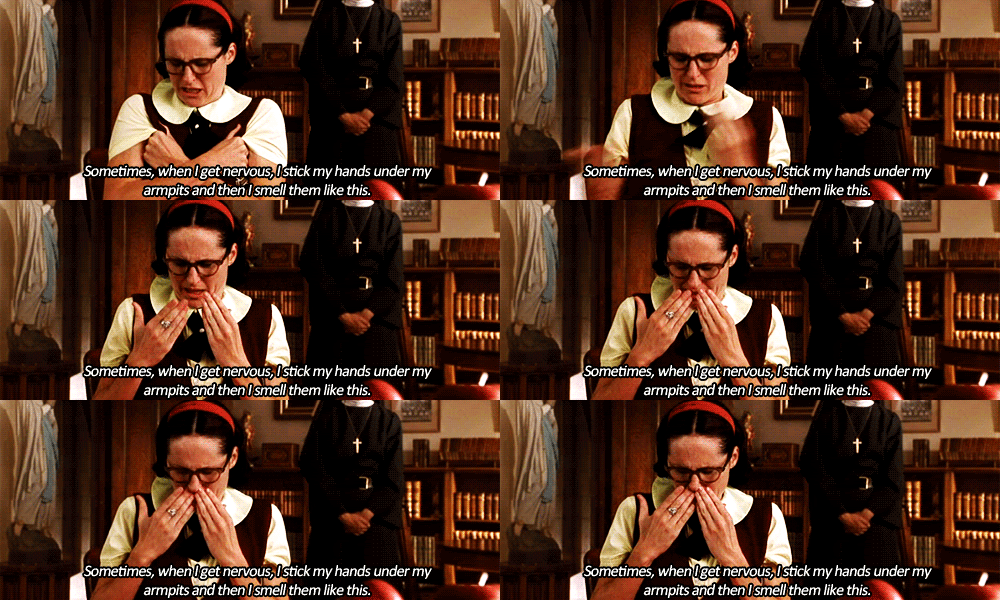
“He jammed his cold fingers in his armpits and crouched by the fire until the food was ready.”

Does that remind you of anything?

mary catherine gallagher

Ah, the 90s. A time when the women were strong, the men were good-looking, and the children are all wondering what the hell I’m referencing.

This chapter is (appropriately) called “Saddle Making”, in which Brom makes a saddle for Saphira out of a leather apron. Except I highly doubt that Brom is able to make a saddle for a dragon – albeit a young one – out of a single apron. Never mind the extra straps he cuts for when Saphira grows larger. Also, how the hell hasn’t Eragon figured out Brom’s a Dragon Rider?

Obi-Brom Kenobi is the source for all information on dragons up to this point. He has a “mysterious” past, and knows way more than any simple storyteller should. He can communicate with Saphira with his mind, build a dragon saddle, and freaking gives Eragon an actual Dragon Rider’s sword. Why the pretense, Brom? And why are you so dumb, Eragon? How have you not put the pieces together yet?!

Sighing and shaking my head, it’s time to move on to chapter 16. The first part of this chapter is largely exposition, and I’m pretty okay with how it’s been done, mostly because it makes sense with the story. Eragon has questions about dragons, and Brom answers them. What I like about this is that it’s not all done in Brom’s dialogue, nor is it done completely as narration. It actually strikes a good balance between the two. A surprise bonus of this is that I don’t have to read too much overly-flowery dialogue. Yay!

There is something I’ve always wondered about, though. Brom says that dragons don’t hatch until conditions are right for them to be born, which usually meant there was enough food for them. Dragons that the Riders used, though, would only hatch when the right Rider touched their egg. In other words, Saphira might have never hatched if Eragon hadn’t found her egg.

What happened to the “wild” dragons that were mentioned? I also find it hard to believe that dragons – notable for being a proud race – would leave the future of their species to humans and elves. Sure, Galby (I refuse to write his full name one more time) killing dragons and Riders didn’t help matters, but eggs only hatching when the right person touches them? Yeah, you’re going to wind up with an endangered species right there.

If the Eragon-verse had tumblr, I can only imagine what it would be like. “Dragons only hatch when humans or elves touch their eggs? SO RACIST. Check your privilege!”

Along with learning about dragons, Eragon asks Brom about how he got the sword of another Dragon Rider. Brom tells him that he doesn’t want to reveal it yet, and, “I don’t want to keep you ignorant, far from it.”

EXCEPT YOU TOTALLY ARE.

The sword’s history is revealed in the second book, if I recall correctly, and it would be pretty upsetting for Eragon to learn. I won’t hold it against Brom for not telling him, but…God, Brom just tell him you’re a Dragon Rider. It’s obvious to anyone who’s not Eragon.

One good thing about the book is that Eragon isn’t a total Mary Sue right away. During this chapter, he and Brom start practicing swordplay, and Eragon gets his ass kicked time and time again. He develops his sword skills throughout the book, and I like that he isn’t a “natural”. He has to learn, struggle, and get his ass handed to him. And since he’s been driving me crazy, reading about him covered in bruises fills me with a kind of smug satisfaction. Especially since Brom is a much more interesting character, and I’d be pretty happy if he lit out on his own with Saphira.

There’s also one more thing that’s really bugging me. Let’s see if you can spot it in this chapter summary.

Eragon takes his sword, Za’roc, so he can fight the Ra’zac while he’s traveling outside Utgard.

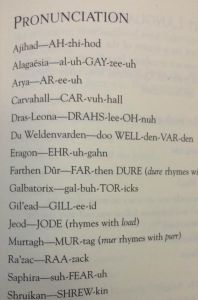
I’m not even halfway through the book, and I am so sick of these unpronounceable names with apostrophes.

Wait. I stand corrected. They’re not unprouncable.

pronunciation

But I feel like if you have to put a pronunciation guide in your novel, you’ve done something wrong.

Eragon Chap. 14: Dragon Advice

I’m not sure I get Saphira. She was my favorite character when I first read this book, mostly by logic of “ohmygodohmygodDRAGON”. She tries to give Eragon sage advice while he grieves, but I’m not sure of its validity:

Anguish enveloped Eragon as he awoke. [. . .] “I can’t live with this,” he moaned.

“Then don’t.” Saphira’s words reverberated in his head.

…did Saphira just suggest that Eragon kill himself?

Even now, I still like her character, and some of her dialogue.

The worth is in the act. Your worth halts when you surrender the will to change and experience life. But options are before you; choose one and dedicate yourself to it. The deeds will give you new hope and purpose.

But Saphira’s only a few months old at this point, though. She’s still a baby; the only human she’s seen up close until this point is Eragon. She understands how his mind works, but there’s no real reason for her to know anything about the world outside Eragon’s farm. Do dragons have some kind of ancestral memory that allows them to dole out advice like an older, wiser dragon? It’s the only explanation that would make sense to me, because Saphira knows things that there’s no way Eragon could have taught her.

On the other hand, some of her advice might be terrible.

Saphira was right. Nothing mattered anymore except the act itself.

We’ve also encountered the dead parent trope again. I’ll probably talk about this in more depth in a separate post, but I’m really sick of this. The laconic version is this: characters are more interesting when they have more to lose. Even if it leads to cheesy lines like this:

“Nothing is more dangerous than an enemy with nothing to lose,” he thought, “Which is what I have become.”

I used to love that quote when I was fourteen–a year younger than Eragon, actually. Growing up, I was bullied, ignored, never felt welcome in my school. I was an angry kid, an angrier teenager, and a line like that really spoke to me. For a long time I felt like it was me against the world, that everyone was my enemy. Since I felt so unwanted, I didn’t really see the point in playing nice with others. You might be able to imagine the unfortunate cycle that led to. The idea of a hero, fighting with no one on his side–and presumably winning–was very appealing to me.

At Saphira’s encouragement, Eragon decides to leave Carvahall and hunt down the Ra’zac, who destroyed his home and killed Garrow. Now, I know that we need the real adventure to start somehow, but I don’t like Saphira’s sudden change of heart. When the Ra’zac first came to Carvahall, she was so scared that she took off in a frenzied flight, taking Eragon with her. She was so terrorized that she wouldn’t even tell Eragon what was going on, and he was rebuffed when he tried to reach her with their mind-link.

Have you ever been so afraid of something that you couldn’t speak, or literally ran away from? I can almost guarantee that you would not be charging directly towards whatever it is you fear just because a teenager gave you a short lecture about running away.

Saphira’s fear was real and palpable, but nope, let’s forget that it ever happened. She’s over it now!

As they’re leaving town, Brom also comes to join Eragon and Saphira’s quest. He tries to sound mysterious about how he knows so much about dragons and the Ra’zac, but he’s not fooling anyone. Anyone who’s picked up a book or watched a movie like this already knows that he’s going to end up being a former dragon rider, and no doubt “Saphira” was also the name of his dragon. It doesn’t take a genius to figure that out. So why so the smokescreen? I honestly don’t remember if Brom ever gives a real reason for not telling Eragon about his past right away. I hope he does, and that it’s not something stupid.

This post is a bit lengthy, so I won’t go on to the next chapter right now. I will, however, leave you with this quote:

Brom’s eyebrows beetled with anger.

Beetled“?