Eragon 26: Literary Stockholm Syndrome

I’m beginning to worry that I have some kind of literary Stockholm Syndrome, because I’ve actually been enjoying Eragon lately.

“The Witch and the Werecat” is another chapter I was looking forward to reading. We’re properly introduced to Angela and the werecat Solembum, both of whom I’ve always rather liked.

Angela is a fictionalized version of Paolini’s sister, and that makes me wonder a couple things. First of all, how much is the real Angela like her fantasy counterpart? There’s no real way I can answer that, so the next question would be, “is it really okay to put someone you know in real life into your novel?”

My immediate thought is to recoil from the idea, but that is largely Twilight‘s fault, considering that waste of paper was originally written as a story for Stephanie Meyers’s sister. Yes, I know Eragon and Twilight are very different books, and Eragon came first, so I’m really not being fair about this. Putting a person you know in real life into a book also brings up the thought of a self-insert main character. I’ve both read and written enough fanfiction to tell you that self-inserts more often than not lead to Mary Sues and bad writing.

So I was a little wary when I came across Angela again, and I have to say that I still legitimately like the character. She’s not some beautiful woman, she’s an old, quirky witch who’s a lot of fun to watch, and I’m glad that she comes back later in the series.

Now, what about the werecat?

Eragon first sees Solembum and assumes he’s a normal cat, and tries to reach out to him with his mind. Solembum responds using the same type of mental communication Eragon shares with Saphira, and Eragon just assumes that he’s talking to her. It was probably done for humorous effect, but he can’t tell the difference between Solembum and his dragon? Really?

The werecat blinked lazily. ‘Knowing is independent of being. I did not know you existed before you bumbled in here and ruined my nap. Yet that doesn’t mean you weren’t real before you woke me.’

…Did Solembum just drop a Schrodinger reference that I would have never understood at age fourteen?

Angela, the herbalist, offers to read Eragon’s real fortune using the knuckle bones of a dragon. This was another scene that I liked a lot as a kid. When I was reading Eldest, I would frequently go back to this scene and try to figure out how all the things Angela tells him would play out.

One of the things Angela starts with is weird to me, though. After casting the bones, she says that Eragon is one of the few that is free to choose his own fate. I honestly would expect the opposite of that Saphira’s egg would have never hatched if he hadn’t touched it–I would call that destiny. I’d think that people more like Jeod and Angela, ordinary people, would have more choice in their lives than Eragon. He has to be a Dragon Rider; there’s no way he can back out.

The bones also promise an epic romance. Yeah, right. It became obvious to me when I first read this book that he would fall in love with Arya, the elf woman in the prologue. In Eldest, he does confess that he loves her, and they are friends, but she often treats Eragon with disdain. I never finished reading the third book in the series, Brisingr, but I didn’t feel a whole lotta love between the two of them there, either.

Plus, Eragon’s confession in Eldest is just cringe-worthy.

The last part of his fortune was that Eragon would be betrayed by someone in his own family. He objects to this right away, saying that his cousin Roran wouldn’t do anything like that.

I make fun of Eragon a lot here for failing to see the obvious, but this was a twist that took me by surprise when it happened near the end of Eldest, and Eragon’s long-lost brother shows up. I really think I should’ve seen that one coming.

Before Eragon leaves the shop, he receives two more pieces of advice from Solembum.

When the time comes and you need a weapon, look under the roots of the Menoa tree. Then, when all seem lost and your power is insufficient, go to the rock of Kuthian and speak your name to open the Vault of Souls.

I haven’t read far enough into the series to know what the “Vault of Souls” is, but I’m intrigued, despite myself.

Like in the previous chapter, I think the foreshadowing is handled well here. Some of the things in Eragon’s fortune happen in this book, and there’s enough information to keep me interested in learning how these things will come to pass.


Eragon 20: Sad Resignation to Keep Reading

The first thing I wrote upon starting chapter 20 was, “This was a lot more fun when I was drunk”. Yes, I was unnecessarily angry at a fictional character during the last chapter, but at least I felt something other than sad resignation to keep reading. For awhile, I thought that might be the only note I’d write down, as this chapter is a lot of exposition, and not much else.

I’ve talked a bit about world-building in novels, and I’ve said that in general, I like it better when the characters learn the rules of the universe as the readers do. It feels much more natural, and you’re not overwhelmed with a ton of information at once. Eragon is starting to show me the drawbacks of that method. It makes sense for the story, as Eragon starts out as a know-nothing dragon rider. However, the chapters that are nothing but exposition and conversation are starting to wear on me. Eragon accidentally using magic for the first time, and Brom’s angry admonitions of him were part of the story, though. Despite my earlier criticisms, they were exciting. This chapter is just a casual conversation, written to explain to Eragon and the readers how magic works.

I guess one of the things I don’t like about this chapter is that there’s nothing that breaks up the dialogue until the end. I know that it’s important to get information to the reader, but there’s got to be a better way of doing it than this.

Aside from that, I have several questions, not the least of which is, “why doesn’t Saphira have more screen time?”

Seriously.

Other than that, the Dragon Riders apparently kept their magic a secret, even at the height of their power, so their enemies wouldn’t be able to use it against them. I guess that explains why Eragon was so surprised that he could use magic, but it seems like something like that would be hard to keep a secret. It also really bothers me that Eragon has yet to make the connection that Brom was a Rider.

Brom also mentions that Shades and sorcerers get their magic from spirits, which makes it different from the Riders’ magic. “Spirits” largely gets glossed over in this book, and the next, with the only information we get about them being that they’re bad news. I don’t know if they’re elaborated on any further in the last two books in the series. I’d like to know more, but this chapter certainly wasn’t a good place to add even more details.

It’s also revealed that every person has two names, one that they’re given when they’re born, and a “true” name, which reflects who they really are. Sharing your true name is dangerous, as anyone who knows it has complete control over you. Since I will not likely be reading the final two books anytime soon, I let my curiosity get the better of me and Googled what Eragon’s true name is. This is what Christopher Paolini had to say:

I felt that giving them to readers would spoil some of the mystery and power they hold. You could say the whole Inheritance Cycle encompasses Eragon’s true name. But its short form is a secret between Eragon, Saphira, Glaedr, and Arya.

Aw, come on! I wanna know!


Eragon 19: Goddammit, Brom.

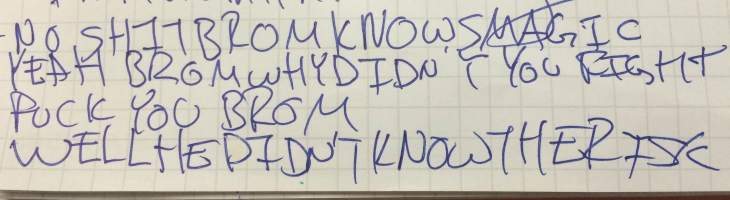
Full disclosure: I was not entirely sober when I read this chapter. My notes reflect this.

img_0930

In my defense, I’m of legal age, was safely at home, and the worst thing that happened was I got irrationally angry at a fictional character. That last part is not so different from when I’m sober, but this time I was just louder about it.

After so recently declaring that Brom was probably the best character in the book, where did this hatred come from? Let’s find out.

Eragon finds Brom wounded and unconscious, which prompted my note, “Seriously Brom, get your shit together”. I remember Brom being mad at Eragon for using magic, but I didn’t remember that he was wounded in this chapter. It’s a bit disappointing, because Brom’s been a much better character than Eragon. As the mentor figure, I really expected him to do a lot better against two Urgals, which I’m sure he’s slayed hundreds of before. And his excuse is, “I’m old, I can’t fight as well as I used to” is kind of crap, too. Because, you know, he’s an immortal Dragon Rider.

Saphira’s ignorance on the whole matter is also annoying. She doesn’t know what happened to Eragon or why he can suddenly use magic. However, it’s been established that Saphira has some kind of ancestral memory. She fled the Ra’zac because she knew they were bad news, even mentioning a specific battle that Eragon had never heard of. But dragons have been bonded to Riders for centuries, to the point where they’re dependent on to touch of a Rider to even hatch. If Saphira does have this racial memory, why wouldn’t she know that Riders can use magic?

After that question, most of my notes devolve into complaints about Brom, and how he never intended to teach Eragon magic. That seems pretty ridiculous to me. Maybe Brom didn’t want Eragon using magic so early in their journey, but keeping it from him entirely is pretty dumb.They’re eventually going to be facing off against the only remaining Dragon Rider, who we already know is insanely powerful. They’ll need to utilize every weapon they have to defeat Galby, but without using magic, Eragon would be at a huge disadvantage.

Brom explains that using magic is a huge risk, and casting a spell takes your own strength, which is why Eragon passed out after killing the Urgals. If you’re not strong enough to cast the spell, you’ll die. It’s understandable that Brom wanted to protect Eragon, but wouldn’t he be safer if he knew the risks of using magic before he actually tried it? Keeping him ignorant about it could have been much worse.

I do have one more question about magic, and it’s one that I’ve wondered about since I first read this book. To cast a spell, you have to say something in the Ancient Language, the language of the elves. “Brisingr”, for example, is the word for “fire”. To be able to use magic effectively, you need a strong command of the Ancient Language. I do like this idea, because it means there’s really no limit to what magic can do. Much more interesting than picking out set spells from a book. Even better, Eragon’s poor grammar using the Ancient Language becomes a plot point in the sequel.

But Eragon also becomes fluent in the Ancient Language in Eldest, and regularly holds conversations with the elves using it. What’s the difference between talking and using magic? Could he be casting spells while he tries to ask someone about their day? How is everything not on fire?


Eragon Chap. 17-18: An Orc By Another Name Still Stinks

Chapter 17 is full of great storytelling and characterization, and was such a gripping read that I had a hard time putting the book down. Or, you know, the opposite of that.

A lot of this book consists of the main characters traveling from place to place to place and having adventures on the way. Essentially, it’s a fantasy novel’s version of a road trip movie. Real-life road trips are usually pretty fun. Going to new places, meeting new people, singing along to the radio with your friends. The things that make road trips appealing and fun that we forget about all the massive inconveniences they entail. Things like getting lost, or sitting cramped in the backseat piled high with luggage, or constantly getting stuck in the middle seat with your seat on the hump, and your friends uncomfortable squished in on either side of you.

This chapter is dedicated to the parts of the road trip we’d rather forget. Like when I got really sick and wound up puking in a gas station parking lot. Most of this chapter consists of Eragon and Brom being miserable as they travel the plains, dealing with strong winds, thirst, and spending hours in the saddle. Even though this chapter doesn’t really reveal anything new about the characters or the plot, I at least appreciate that it’s not a comfortable trip. It does add a sense of realism, and it would be a pretty boring chapter if everything was nice and easy.

As a student glider pilot, I also enjoyed Saphira’s demonstration of how high winds and flying don’t mix. In the gales of a storm, Saphira has difficulty landing and her open wings caused her to keep getting blown away, including somersaulting in the as she tries to land. I’m not sure if it was meant to be comical, but I was amused by it nonetheless.

As much as I enjoyed watching Saphira try to land, and fail, a lot of chapter 17 felt like padding. The following chapter is much more interesting, when Brom and Eragon arrive in the town of Yazuac. I do feel a bit bad for Saphira, though. Because they have to keep her a secret, Saphira constantly gets left behind when Eragon and Brom go into a populated area. It makes sense, but I wish she had more screen time.

Their arrival in Yazuac is eerie, and the whole town is still and quiet. This is because, and Eragon soon finds out, the entire town is dead and has been put into one big pile of corpses. I didn’t really feel the horror that I should have when I read this, though maybe it’s because I knew it was coming. Eragon, at least, was horrified, and threw up. Which is a perfectly acceptable reaction to seeing a pile of dead bodies, if you ask me. I wonder if my indifference to this slaughter is also because “one is a tragedy, a million is a statistic”. Maybe it’s the writing, or maybe it’s because I’m a bad person. Hm.

This is also the chapter where Eragon has his first run-in with Urgals. In other words, orcs with a different name. I know that every high fantasy book has to have some bland, low-level mooks for the hero to plow through, but is it too much to ask for something other than “huge men with horns”? In the sequel, Eldest, the Urgals are more fleshed out as a race with their own social order and customs. Watching humans and Urgals try to work as allies is way more interesting than having them as generic enemies. But we’re still stuck in Eragon right now, and don’t get to see that.

Eragon kills two Urgals, shooting his bow and calling out “Brisingr!” as he does. “Brisingr”, as we later learn, is the elvish word for “fire”, and Eragon has used magic for the first time.

It’s a little too convenient for me. Not that Eragon used magic without any guidance–I’ll accept that, it is a fantasy story, after all–but that he knew the word “brisingr”. He’s heard Brom say it once, and thought it was a swear. I kind of think he wouldn’t remember one word in a pretty tight spot. In high stress situations, expanding my vocabulary is not on the forefront of my mind. I mean, I had to stop writing for about a minute today because I couldn’t remember the word “inevitable” as I was about to type it. If I were fighting monsters, the only thing I might be saying is, “fuck, fuck, fuck!”

Eragon 6-7: Exposition for Two

When you’re writing something that doesn’t take place in the real world, you have to find some way to tell the audience the “rules” of the universe. There are two main ways authors do this: by directly stating what those rules are (The Hunger Games loves this) or Character A telling Character B explaining the rules. In most cases, Character B is some kind of newcomer–like Obi-Wan teaching Luke about the Force, for instance.

Most authors use a mix of both methods, which works well, but I prefer the latter. I think it helps the story flow more naturally, and helps keep the reader in the world a bit more easily. And then there are chapters like this.

Eragon goes into town, and meets with Brom the storyteller in a chapter that is nothing but exposition. Eragon, naturally, wants to learn more about dragons and the Dragon Riders, and has plenty of questions about both. The whole chapter is Eragon asking questions, and Brom giving him the answers. We learn about the history of the Riders, and more about dragons themselves. Even though I generally prefer this method of getting information to the readers, for some reason I don’t like it here. I can’t exactly pinpoint why. Part of it might just be that it feels lazy–Paolini couldn’t figure out how to wedge all this in, so he put it here. Or maybe it’s the length of the chapter that bothers me. It’s pretty long–longer than the last two combined. There’s not a lot of action, just a back-and-forth. I just don’t like large information dumps, and I wonder if cutting out some of the details of this chapter would have helped me like it better. Of course, this is also my second time reading the book, so I already know what Brom’s going to say. Obviously, this stuff isn’t going to be as interesting to me the second time around.

Well, whatever. I didn’t like the way the information was shoved down my throat. I also had one head-scratching moment, wherein Brom describes a war between the dragons and the elves. It was a huge war that left the land devastated, but it only lasted…five years? Okay, that’s a long time for a human war, but we’re talking about creatures that live for centuries. Five years seems a little short.

Moving on to the next chapter.

Chapter 7 is another unevenly short chapter, not quite four pages long. On their way back to the farm, Eragon’s cousin Roran announces that he’s accepted an offer of work in another town. Eragon doesn’t really want Roran to leave, and suggests he wait until spring. Roran disagrees, and says he will be leaving shortly while they’re waiting for winter. Even though this isn’t a book about the division of farm labor, I still need to ask: where the hell are all the farmhands? It’s only Roran, Eragon, and Eragon’s Uncle Garrow working on the farm. How do just the three of them manage to keep it running and productive? How did Garrow and his now deceased wife manage to do it before Eragon and Roran were old enough to help? And for that matter, why doesn’t Garrow have, like, ten other kids to do farm work?

It’s been said that when you’re writing science-fiction, you get one lie, and you have to then work within the confines of that lie. Everything else has to follow the rules. Fantasy, I think, is a little broader, but still follows that principle. f you’re writing about dragons, that’s fine, because dragons are mythological creatures and you can do what you want with them, as long as you follow the basic rules. Things like dragons fly, breathe something dangerous, and could kill you several times over.

Suspension of disbelief is a funny thing. I’m all for dragons and magic–that’s why I picked up this book in the first place. It’s the small, nagging details that bother me. You want to write about a dragon that flies and breathes fire? Cool. Go ahead. But if you’re writing about something that exists in real life, that readers know about, then you have to make it realistic. Realistic details in a fantasy setting make the world plausible. It’s not the fantasy elements that will drive readers away. What will turn them if is when they don’t see the familiar reflected in the extraordinary.

That was kind of an unexpected rant. Anyway, the dragon was finally named “Saphira”, surprising absolutely no one. First of all, she’s a bright blue dragon. Second of all, you know another Saphira was important to Brom, just from the way he said it.

Anyway, moral of the story? It’s cool if your main character can shoot fireballs from his hand or whatever, but if he, say…lived in the 21st Century and didn’t have an email account, I would seriously have to question both the author’s writing choices and their* perception of what is normal in the world.


*Strunk and White be damned, I’m totally okay with “they” as a singular gender neutral pronoun.

The Magician’s Nephew, Chap. 15: Why We Read

Oh, Narnia. It’s here that we go our separate ways…for now. Books transport you into a whole new world, and the best part is, they can do it over and over again. Of course, you wouldn’t be here if you didn’t know that already. As I’ve mentioned earlier, I never actually read any of the books after Prince Caspian. Re-reading The Magician’s Nephew now makes me want to go back and read through the entire Narnia series. I think I’d like to go back and read the rest of the books and see what I missed. Aware, of course, of all the religious symbolism, racism, and sexism that I missed the first time around.

The final chapter is perhaps the most insightful; at the very least, it gave me the most to think about as a child. Aslan takes Polly, Digory, and the sleeping Uncle Andrew back to the Woods Between the Worlds and shows them a hollow in the grass.

‘When you were last here,’ said Aslan, ‘that hollow was a pool, and when you jumped into it you came to the world where a dying sun shone over the ruins of Charn. There is no pool now. That would is ended, as if it had never been. Let the race of Adam and Eve take warning.’

‘Yes, Aslan,’ said both the children. But Polly added, ‘But we’re not quite as bad as that world, are we, Aslan?’

‘Not yet, Daughter of Eve,’ he said. ‘Not yet. But you are growing more like it. It is not certain that some wicked one of your race will not find out a secret as evil as the Deplorable Word and use it to destroy all living things. And very soon, before you are an old man and an old woman, great nations in your world will be ruled by tyrants who care no more for joy and justice and mercy than the Emperor Jadis.’

This book was published in 1955, though it takes place before World War I. I can’t help but think that Aslan’s warning to the children about the Deplorable Word was a thinly veiled reference to the atomic bomb. I couldn’t have known that when I read this more than a decade ago, nor could I understand just how bad the world could really be.

Now I see that our world is a scary place, and I’ve been very fortunate to have a comfortable life. Perhaps the question I’ve asked myself the most over the past two years, the one that I can’t answer, is, “Is the world getting worse, or am I just paying more attention?”

Unfortunately, I’m usually an optimist.  I want to believe that there is more good than bad, that love will conquer hate. More and more, it seems like the opposite of that is true.

But there’s some good in this world, Mr. Frodo, and it’s worth fighting for.

And that fight is terribly, terribly frustrating. Because everyday I want to change the world, but I’m just one person.

And that’s why we need books. Because Digory and Polly protect Narnia from the evil they brought into it; because Digory saves his mother with a magical apple. Because they give us simple solutions to our complex problems. Because the world is terrible, the characters we love go through endless trials and tribulations, and things turn out okay.

Because real life needs more happy endings.

Final Verdict: Keep

For now, anyway. This will likely make it to the collection of children’s books my mom has on the unlikely chance that I’ll ever give her a grandchild.

I’ll be taking next week off, but starting on May 30, I’ll be back with Angelic Layer by CLAMP, which just happens to be the first manga I ever read. Stay tuned!

The Magician’s Nephew, Chap. 14: All Allegories Aside, Though…

I thought the last two chapters of this book would be rather short, but it turns out they’re more substantial than I remember. Well, maybe not the first part of this chapter, which is all about Uncle Andrew. The animals have now put him in a home-made cage and have tried to feed him their favorite foods, which resulted in squirrels pelting him with nuts and a bear throwing a honey comb at him, for example. It’s kind of funny, but like the toffee dinner, just takes up too much time. I guess it’s his comeuppance for being disagreeable ant the beginning of the book, but now it just feels undeserved. Ever since Jadis arrived, he’s no longer scary or threatening. He’s already learned his lesson; cut the guy some slack. And now that I can’t unsee all the religious parallels, it’s obvious that Uncle Andrew represents atheism, as he simply refuses to hear the animals–and Aslan–talking.

I do like that the animals want to keep Uncle Andrew as a pet, though.

There was more time spent on Uncle Andrew’s treatment than there was on the coronation of the new king and queen of Narnia, wherein C.S. Lewis shows us how little he knows about blacksmithing. The dwarves make crowns for them right then and there, with apparently very little effort. I actually do know a bit about smithing (because college was a weird time), and I think it’s preeeetty doubtful that the animals were able to make a fire that would get hot enough in just a few minutes to make gold and silver crowns on. Whatever, I’ll give it a shrug and chalk it up to magic. I’m fairly certain that this is a point no one else cares about except me.

And while I’m sure that the coronation is terribly important for the history of Narnia, it may be the least interesting part of this chapter. It’s not Digory plants the tree that I really care about what’s going on. Aslan confirms what the Witch told him–that taking an apple from the tree would make him live forever, and heal his mother. However, Aslan also tells him

‘Understand, then, that it would have healed her; but not to your joy or hers. The day would have come when both you and she would have looked back and said it would have been better to die in that illness.’

…chilling.

And reveals yet another difference between myself now and the elementary school student who read this long ago. Back then, I couldn’t comprehend regret like that, nor could I understand why anyone would think they’re better off dead. I could only think of it as a curse, and use the irrational explanation of magic to comprehend something that wasn’t rational to me.

Now, unfortunately, I understand regret perfectly well, and can see why someone would rather be dead than alive.

Like I said, growing up is harsh.

To end on a lighter note, I’m glad that Digory is rewarded for his honesty, and loyalty to Aslan, by being allowed to take an apple for his sick mother. That’s probably the best message this book has for kids, whether or not it’s read as a religious allegory.

I really love the idea that the magical fruit itself is neither good nor evil, and it’s all about the person who takes the fruit. The tree would protect Narnia, whether or not its fruit was stolen, but the land it protected would change. Because Digory took the apple at Aslan’s bidding, Narnia will become a kind and gentle world. Had he stolen it, Narnia would have become cold and cruel. I really like the idea that the fruit will do its job, no matter what, but the intent of the one who takes it truly determines what happens. I wish my good intentions had that much power in real life.

The Magician’s Nephew, Chap. 13: Does This Remind You of Anything?

There’s apparently a lot I’ve forgotten about this book, but some parts I remember vividly. Chapter 13 has one of those scenes. Recalling the disappointment of re-reading the previous chapter, though, I approached this one with caution.

Polly, Digory, and Fledge all find what’s simply called “The Place”, where the magical tree is growing. It has high walls and golden gates, warning against climbing the walls or stealing the fruit from one of the trees. Digory goes into the garden alone, and there’s a few paragraphs dedicated to that decision.

Near the end of a lot of fantasy stories, the main character finds often her or himself facing off against their main antagonist alone. I’m never sure how I feel about this trope, because if their allies are readily available, then they should also join in the fight. There should be a reason given as to why the protagonist has to go it alone. If the supporting cast is busy fighting a dragon, and the main character is the only one that can kill the sorcerer, fine. If you go it alone for drama, or tradition’s sake…that’s sort of dumb. The movie Labyrinth probably has the weakest excuse, with Sarah facing off against Jareth (and his mighty crotch) by herself because, “that’s the way it’s done”. I understand that it’s an important moment for the character to stand up to something to face their fears, but sometimes doing it alone out of choice is impractical.

In this case, the only reason Digory goes into the grove alone is because Polly and Fledge can see that it’s a “private place”, somewhere you wouldn’t want to walk into unless you’ve been invited. I’m actually okay with this. Maybe it’s the way this scene was written, or maybe it’s because even from the air, all three characters could feel that this place was special. I’m also okay with this because Digory isn’t in any apparent danger, nor has he been since Jadis ran off.

This chapter was probably the most memorable in the book, and holds up very well even now.  Digory is sorely tempted to take one of the apples for his own, and tries to rationalize eating one for himself. Just like we all do, when we want something really badly but know that we shouldn’t. It also shows us the magical quality of the fruit, that he had been planning on returning it to Aslan right away, until he smells it. This passage was as difficult for me to read, because I love fruit, and they all sounded so delicious.

The most important part of the chapter, (and the novel, if you ask me), is Digory finding Jadis in the garden, happily eating one of the apples. It’s made her stronger, but also made her skin and hair completely white, setting her up as the White Witch in The Lion, the Witch, and the Wardrobe. It’s obvious she hasn’t been invited into the garden and that she’s stolen the apple for herself. She tries to convince Digory to eat one as well and become strong and immortal like her. When he refuses, she aims below the belt.

‘Do you not see, Fool, that one bite of the apple would heal her? You have it in your pocket. We are here by ourselves and the Lion is far away. Use your Magic and go back to your own world. A minute later you can be at your Mother’s bedside, giving her the fruit. Five minutes later you will see the color coming back to her face. She will tell you the pain is gone. Soon she will tell you she feels stronger. Then she will fall asleep–think of that; hours of sweet, natural sleep, without pain, without drugs.  Next day everyone will be saying how wonderfully she has recovered. Soon she will be quite well again. All will be well again. [. . .] And what would your Mother think if she knew that you could have taken her pain away and given her back her life and saved your Father’s heart from being broken, and that you wouldn’t–that you’d rather run messages for a wild animal in a strange world that is no business of yours?’

Holy shit.

This is the reason I’ve remembered this chapter so well. Growing up with a sick aunt and chronic illness as a backdrop in everyday life, I would have given just about anything for an apple like that. I remember holding my breath while this scene was read to me. Of course I wanted Digory to take the apple back to Aslan. That was the right thing to do. I hoped that Aslan would be able to heal Digory’s mother, but what if he couldn’t? The Witch said that it was Digory’s only chance at eternal life–what if it was the only way to heal his mother?

I connected with this passage, this dilemma so well. I was such a shy and straight-laced kid, always doing what I was told. If I were in Digory’s shoes, though, I may have very well stolen an apple for my sick aunt. It’s a test of faith; how loyal Digory feels towards Aslan, or how much he wants to save his mother. He hesitates, though, giving Jadis an opportunity to remind him that she’s evil. The reminder is all Digory needs to refuse, and leave with Polly and Fledge to return to Aslan with the magic fruit.

I chose to read The Magician’s Nephew again for a few reasons. It was the first in the Narnia series I ever read; I thought I remembered the basic story well enough and…

Well, this last one just makes me sound silly.

It took me awhile to come around to the “Aslan is Jesus” allegory. Sure, it made sense–Aslan comes around at Christmas, is killed for Edmund’s sake and  is then reborn (which just about made me cry)…it’s not a difficult connection to make. I never liked it all that much because it sort of demystified this really cool, powerful character. When I was a child, it made Aslan feel less approachable. As an adult, it’s because I’m not terribly religious, and don’t enjoy having religion shoved down my throat, even if it’s in the form of a fuzzy lion. Because, c’mon, you can’t watch the Disney Narnia movies and tell me that you don’t want to cuddle with Aslan.

But back to the point…I chose The Magician’s Nephew because I thought it wouldn’t be overly religious.

Oh, how wrong I was.

The scene that I remembered the best was nothing more than a gender-swapped Garden of Eden story. How the hell did I miss that? If it were any more transparent, this book would be made of glass.

Aslan help me, I’m an idiot.

The Magician’s Nephew, Chap. 12: Strawberry’s Disappointing Adventure

This was a chapter that I was really excited to get to. I remembered it being so magical. Aslan gives Strawberry wings, and he becomes Fledge, Narnia’s first flying horse. He takes Polly and Digory on an adventure, flying far above Narnia. They explore the world, eat toffees, and have a marvelous time. What more could a child want in a story?

As an adult, however, it turns out that this chapter leaves a lot to be desired. I expected that my childhood memory of this chapter wouldn’t hold up to the reality, and I was right. I just wasn’t aware of how right I was actually going to be. It starts promising, with Digory agreeing to find the magical tree that will protect Narnia. There’s also a very sweet part where Aslan grieves with Digory about his ill mother.

‘But please, please–won’t you–can’t you give me something that will cure Mother?’ Up till then he had been looking at the Lion’s great feet and huge claws on them; now, in his despair, he looked up at its face. What he saw surprised him as much as anything in his whole life. For the tawny face was bent down near his own and (wonder of wonders) great shining tears stood in the Lion’s eyes. They were such big, bright tears compared with Digory’s own that for a moment he felt as if the Lion must really be sorrier about his mother than he was himself.

But this chapter is mostly description, like Digory describing the land to Aslan. When Polly and Digory are riding on Fledge’s back, most of the narrative is description of what they’re flying over. The “adventure” isn’t so much a story, as it is a nice sight-seeing tour.

On the other hand, they’re the first humans to ever see all this, so I guess that’s exciting. Of course I would have loved to be riding on a flying horse through a brand-new world. But I don’t get that thrill from reading this. It’s like going through a photo album of someone else’s vacation. You try to care, you really want to, but you just can’t make yourself.

Man, growing up sucks.

There’s also a disproportionate amount of time dedicated to the children having dinner. There are two pages that are just Digory and Polly trying to figure out what they’re going to eat when they stop flying for the night. Polly has some toffees in her pocket, so they decide that will be their meal.

The little paper bag was very squashy and sticky when they finally got it out, so that it was more a question of tearing the bag off the toffees than of getting the toffees out of their bag.

Okay, great, but what about the adventure?

Some grown-ups (you know how fussy they can be about that sort of thing) would rather have gone without supper altogether than eaten those toffees.

No, I still eat candy for dinner sometimes. So about this adventure…

There were nine of them all told. It was Digory who had the bright idea of eating four each and planting the ninth; for, as he said, ‘if the bar off the lamp-post turned into a little light-tree, why shouldn’t this turn into a toffee-tree?’ So they dibbled a small hole in the earth and buried the piece of toffee.

Man, the word toffee sounds weird now. You ever notice how you say a word a lot, and it loses its meaning? Toffee, toffee, toffee…

At least there’s still magic, when the toffee does grow into a toffee tree overnight. That’s pretty cool.

There is one small detail in this chapter that I still really like. When Polly and Digory go to sleep, Fledge spreads his wings over them to keep them warm at night. It sounds cozy, and of course I would love to have a pegasus to snuggle with at night. In fact, a great deal of my wish-fulfillment stories I wrote in sixth grade were based on that exact premise.

The Magician’s Nephew, Chap. 11: Bit Characters and Other Matters

I’ve praised some of the ideas C.S. Lewis had, but there’s one thing that’s a little harder to get over: the chapter titles. Some of them are just so incredibly bland. Take a look:

Chapter 6: The Beginning of Uncle Andrew’s Troubles
Chapter 7: What Happened at the Front Door
Chapter 10: The First Joke and Other Matters

And we’ve finally reached Chapter 11: Digory and His Uncle Are Both in Trouble.

The first half of this chapter is nothing but the animals trying to figure out what, exactly, Uncle Andrew is. They eventually decide that he’s a tree, and plant him in the ground. It’s amusing, but it has nothing to do with the rest of the story. To be honest, I’m not even sure why Uncle Andrew even had to come to Narnia with the other characters. He’s been demoted from intriguing Magician to comic relief, by way of misfortune. At this point, he has nothing to do with the rest of the story. I also don’t like to see clever and brave Polly relegated to the background. She should have a much bigger part in the story right now; certainly, she deserves a bigger role than Uncle Andrew. Much more so than the Cabby as well, who has only just been given a name. Seriously, we learn his horse’s name before his.

Aslan decrees the Cabby, Frank, will be king of Narnia. This is presumably because Frank is the only human adult in the group who isn’t evil. This also begs the question why Aslan wanted a human to run the country in the first place. So far, Uncle Andrew, Jadis, and Digory (to a point) haven’t been shining examples of our species. All the sentient beings in Narnia are either animals or some kind of mythological creature, like dryads and fauns. Why not let one of its native people rule the country, maybe someone that Aslan specifically chose for his council? And how is Frank going to know what’s best for the animals, talking or otherwise? It reminds me of reading an X-rated fanfiction that was clearly written by a virgin. Maybe you know what’s supposed to happen, but it’s obvious to everyone reading it that you’ve got no clue what you’re writing about.

Do you think C.S. Lewis was pro-Imperialism?

Despite that head-scratcher, I’m kind of okay with Aslan’s reasons that Frank qualifies as king. Writing this during an election year, I wish politics really were this simple and straightforward.

“‘Begging your pardon, sir,’ he said, ‘and thank you very much I’m sure (which my Missus does the same) but I ain’t no sort of chap for a job like that. I never ‘ad much eddycation, you see.’

‘Well,’ said Aslan, ‘can you use a spade and a plow and raise food out of the earth?’

‘Yes, sir, I could do a bit of that sort of work: being brought up to it, like.’

‘Can you rule these creatures kindly and fairly, remembering they are not slaves like the dumb beasts of the world you were born in, but Talking Beasts and free subjects?’

‘I see that, sir,’ replied the Cabby. ‘I’d try to do the square thing by them all.’

‘And would you bring up your children and grandchildren to do the same?’

‘It’d be up to me to try, sir. I’d do my best: wouldn’t we, Nellie?’

‘And you wouldn’t have favorites either among your own children or among the other creatures or let any hold under another or is use it hardly?’

‘I never could abide such goings on, sir, and that’s the truth. I’d give ’em what for if I caught ’em at it,’ said the Cabby.”

“And will you build a wall between Narnia and Archenland, and deport all Archenlanders who have not legally come to this country?”*

But between Uncle Andrew being planted in the ground and Frank becoming king, Aslan has to deal with Digory, as he was the one who woke Jadis and brought her into Narnia. Aslan says that Digory must find a magical tree far away, take one of its fruits, and plant it in Narnia. This tree will help protect Narnia from Jadis for hundreds of years. When Digory owns up to the role he had in waking Jadis, his exchange with Aslan is a little…disappointing.

“‘She woke up,’ said Digory wretchedly. And then, turning very white, ‘I mean, I woke her. Because I wanted to know what would happen if I struck a bell. Polly didn’t want to. It wasn’t her fault. I–I fought her. I know I shouldn’t have. I think I was a bit enchanted by the writing under the bell.’

‘Do you?’ asked Aslan; still speaking very low and deep.

‘No,’ said Digory. ‘I see now I wasn’t. I was only pretending.'”

But that was so cool! It was scary and intriguing and now you’re saying that the magic was all in Digory’s head?

Thanks for taking away the scariest part of the book, Aslan.

Digory, you broke Narnia. C.S. Lewis, you broke my heart.

*Please note that Donald Drumpf’s point of view does not reflect the author’s, and that Drumpf is a tool.**
**Though it is worth saying that the Calormenes are C.S. Lewis’s view of Muslims, and are not portrayed in a flattering light. So really, building a wall between Narnia and Calormen would make more sense for this predictable joke.

†Please don’t vote for Trump. Please, please, please.