FFM 15: It’s Not Rocket Science

Without in any way limiting the author’s exclusive rights under copyright, any use of this publication to “train” generative artificial intelligence (AI) technologies to generate text is expressly prohibited. The author reserves all rights to license uses of this work for generative AI training and development of machine learning language models.

July is Flash Fiction Month! I’ll be sharing short short stories here through the month of July. More notes at the end of the story.


I was trying to pay attention to an article about building an electric generator when my slate got warm in my pocket. I pulled it out of my pocket, just a thin rectangle of brightly polished copper with a few words written on it. I recognized Theo’s handwriting before I even read the message. Can you come over? Stressed af.

I wasn’t getting anywhere in my work (if anything, it was putting me to sleep), and I knew how worn down final exams were making him. Can do, I replied. Set up the beacon.

It was a quick trip to Theo’s dorm room on Earth. After much hemming and hawing about transferring schools, he’d finally applied to Embry-Riddle. I might have come from a magical land, but Florida was a whole other universe compared to Buffalo. 

Theo barely looked up from his laptop when I arrived. “You’ll get wrinkles if you keep frowning like that,” I told him by way of greeting. 

He shut his laptop and turned to me. The worries in his face disappeared. “You don’t need to worry about that.” 

“Because I don’t worry.” I grinned and took a seat on his bed. 

“Liar.” Theo sat next to me and poked the top of one of my slightly tapered ears. 

“Thank you for noticing.” Like a lot of people who have some Fae blood, lying isn’t easy for me. It took a lot of practice to get this good. “Are exams killing you?”

Theo buried his face in his hands. “Yes. A million times yes,” he groaned, his voice muffled. 

“Do you want to help me build a generator instead?” I asked hopefully. 

“For the last time, Alex, I’m not that kind of scientist.” He leaned against my side. 

This was the confusing part. Theo and I had been together, broken up, and now…now I wasn’t so sure what we were. It was something deeper than just friendship, but we weren’t lovers, either. Theo and I have always been pretty touchy with each other, even from the start. Not weird for Fae, but weird for humans, especially Americans. So I liked when he leaned into me, and he relaxed when I put my arm around his shoulders. I didn’t know what it all meant, and I don’t think Theo did, either. 

“Right, you’re a space man.” 

“Astrophyscist. Except I won’t be if I don’t graduate, and I’m not going to graduate because I’m going to fail my statistical physics class and end up living in a cardboard box holding a sign that says ‘will calculate for food.’” All his words came out in one breath. Theo pressed his forehead against my shoulder. 

“Hey, hey,” I said in a soothing voice. I ran my fingers through Theo’s thick, dark hair. “You’re gonna pass. And then there’s only one semester left, you’ll graduate, start counting stars or launching rockets or whatever you do. And I’ll brag that I know the guy who sent a satellite to Uranus.”

We both laughed at the dumb joke. It was always good to see Theo smile. He straightened up a little, then took my hand in his. “And you’ll have figured out how to build a magical power grid.”

“That, or I’ll have lost my mind working on it.”

He let go of my hand and stretched his arms over his head. “You’ll figure it out.” He lied down on his side, and gestured for me to join him. His twin bed was narrow, but I squeezed between him and the wall. 

We lay there together for a moment, our knees touching, so close that I could feel his breath on my face. Theo took my hand again, rubbing his thumb over mine. “Tell me more about this future where it’s just you and me and everything’s okay.”

“No math,” I promised. “We’ll go on our gay little adventures, kill some monsters, fall in love.” 

“You’re not exactly a monster slayer.” 

“No, I’ll leave that part up to you.” You’d think the magical half-Fae prince would be decent with a sword, but it turns out a pissed off and confused human can be more useful than a trained warrior when you’re in a tight spot. 

“And the ‘fall in love’ part?” Theo asked. 

My heart stopped for a second. I was the one who broke up with him. I needed time to learn how to be a whole person, not just the Trickster Prince who’d hid behind a mask of pranks and games. It was a fun mask, but a mask nonetheless. 

Theo’s eyes were beautiful, dark brown flecked with gold. 

“Already there,” I said in a whisper. “You?”

Theo raised my hand to his lips. “And I never left.”


Surprise! You’ve been pronouncing Theo wrong. This Theo uses the French pronunciation, which is Tee-oh. He has Lebanese heritage, and there’s a big French influence in Lebanon, particularly among Maronite Catholics. Or, as I like to say, “it’s French because he’s Lebanese.”

Here’s another pair of characters from my novel, Prince Alexander, better known as Puck, and his boyfriend(?) Theo. This story would take place a few years after the novel, with Theo getting close to graduating from college. I chose to write from Puck’s first-person POV, since that’s how I’m writing the novel. Puck is also one of Mairead and Fiadh’s kids and Korbyn’s cousin.

This is also a challenge!

Element 1: We love prompts (and would love it if you fed more of them to us ;)). Today, we want you to pick a prompt from the Prompt Bank 2025. Any prompt, any number of them as long as the number is at least 1. Difficulty choosing? Let the 2025 Prompt Generator make the choice for you!

I used two prompts from bunnythewriter: (not the exact wording, but close enough!)

“Tell me more about this future, where it’s just you and me and everything is finally okay.” and “We’ll go on our gay little adventures, y’know fall in love, kill some monsters.” because it was such a Puck response.

Element 2: We would also like your wordcount to be palindromic (that is, one that reads the same backwards as forwards, such as 121 or 747 or 666). Why? We just think they [palindromes] are neat. This story is 787 words.

Optional element: include a generator of any kind in your story. Done! Puck would love to bring modern technology to the Otherworld, but the problem is that smartphones can’t run on magic…or can they?
FFM 7: Questions on the Roof


Without in any way limiting the author’s exclusive rights under copyright, any use of this publication to “train” generative artificial intelligence (AI) technologies to generate text is expressly prohibited. The author reserves all rights to license uses of this work for generative AI training and development of machine learning language models.

July is Flash Fiction Month! I’ll be sharing short short stories here through the month of July. More notes at the end of the story.


“Where have you been lately?” Violet asked. She and Dain were at their usual place, the rooftop of a closed tailor shop. It wasn’t uncommon to see people on rooftops, given that almost every Sylph had the ability to fly. 

“Working,” he replied with a shrug. 

“Uh-huh.” Violet cocked her head. “For who? Because I know it ain’t for Jax anymore.” 

“For myself.” 

Violet crossed her arms. “Really? After all we’ve gone through, you’re gonna lie to me now?” She pulled a slightly crumpled joint out of her pocket and stuck it between her lips. 

“Yep.” A tiny smile came over Dain’s face. Irritated seemed to be Violet’s default state. It was always fun to add to it. “I’m taking a break. I’ll get back to it soon.”

Violet’s dark eyes widened. “Shit, Dain. Someone’s got something on you.”

“No one’s got anything on me,” Dain snapped back, though the blue-gray feathers on his wings started to fluff up. “It’s just something I have to do.”

“Forgive me if I don’t believe you,” Violet huffed, then stood up. “I’m off. Can’t risk being seen with you.”

Dain started after her. “Relax. It’s not like that, okay?” He couldn’t have his oldest friend leave him now. And especially couldn’t have her talking to his old crew that he was on someone else’s payroll. Jax might have tolerated Dain going solo for a time, but if he knew the truth, Dain was dead where he stood. 

“Then what is it like?” Violet propped her hand on her hip. Her sparrow wings were already spread, ready to take off. 

I’m working with the cops was the worst thing that Dain could say, but the partial truth he went with wasn’t that much better. “It’s a girl.”

That might have appeased anyone else, but he and Violet had done a little more than fly and smoke together multiple times in the past. No attachment beyond friendship, they’d said. But there were times when both of them hadn’t been good about following that rule. 

Violet folded her wings. “What’s her name?”

“It’s no one you know,” Dain replied. 

“Is she pretty?” Violet asked, walking back towards Dain. 

“Why do you want to know?” He frowned. 

“Just wondering who’s good looking enough to make you give up your livelihood.” 

She wasn’t jealous, Dain realized. Or, if she was, it was taking a backseat to Violet’s curiosity. She was still searching for information. “She’s pretty, she drives me crazy, I’m taking a break because it would be best for both of us. Happy?” 

“No.” Violet went back to the edge of the roof. “You’re throwing away everything for a girl? We’ve both done stupid things, but that might be the dumbest one I’ve ever heard.” 

Violet turned away before Dain could get a proper look at her face, but he heard it in her voice. “You’ve got talent, talent that people would kill for.”

“Oh, they’ve tried,” Dain said. 

“But a pair of big blue eyes comes along and–”

“They’re yellow.” The words were out before he could stop himself.

Violet spun on her heels. “She’s real?” 

Dain’s heart fluttered in his chest. Cordelia was very real. And her eyes were big. 

And she did, in fact, make him crazy. Not in the puppy love kind of way, but in an infuriating, self-righteous kind of way. Like how she just knew what he’d been through, and how he should have chosen another path. 

But she had listened when he set the record straight. And apologized. Cops didn’t apologize for anything, but she did.

It didn’t change the fact that she was always pushing him to do what she wanted, and she didn’t tolerate any bullshit from him and…

…and he kind of liked that he challenged her. 

But Dain especially couldn’t stand how she acted so tough with her magic powers and all, but was afraid of flying in open air. So he held her hand when they flew long distance sometimes, and it was nice that he could help her. 

“She’s not just real,” Violet said, her jaw dropping open slightly. “You’re in love.” 

“I’m not in love,” Dain shot back. 

Now you’re lying to me.” Violet smirked. 

“Absolutely not. She’s pretty, sure, but she’s infuriating and she cares about everything so much and…”

And they did kiss once. Just once. But it was after the fire and their adrenaline was pumping and it was making them do crazy things. 

It had been a very good kiss, though. 

“There it is.”  Violet grinned as the realization washed over Dain’s face. 

Dain forced his expression into a grimace. “Get outta here.” 

Yes, he was in love with Cordelia. But that didn’t mean he was happy about it.


Today’s story was inspired by this prompt from bunnythewriter: Yes I’m in love with her, but I’m not HAPPY about it! 

See, Mom, I can write straight romance, too!

Dain and Cordelia are characters from a novel I’m taking a break on (read: it’s such a mess I can’t bear to look at). As you might have guessed, they have something of a rivalmance. Dain also made an appearance in my 2023 FFM.

I would really love to finish their story one day, but it needs a serious overhaul.

FFM 3: Love is a Battlefield

Without in any way limiting the author’s exclusive rights under copyright, any use of this publication to “train” generative artificial intelligence (AI) technologies to generate text is expressly prohibited. The author reserves all rights to license uses of this work for generative AI training and development of machine learning language models.

July is Flash Fiction Month! I’ll be sharing short short stories here through the month of July.

Name pronunciation:

Fiadh – Fee-uh
Onóra – Oh-nor-uh
Mairead – Mahr-ee-ed
Caoimhe – Kee-vah

More notes on this story are at the end of the post.


“Fiadh, be sensible.” Onóra finished tying her younger sister’s hair into a series of knots and braids. “You might love a human, but you’ll never be allowed to marry one.” She opened Fiadh’s jewelry box to find baubles for her sister’s horns. “Ugh–what’s this?” 

Onóra pinched a long piece of fabric between her thumb and forefinger. It might have been white once, but was stained with sweat and dark splotches of blood. “Mairead made it for me,” Fiadh replied with a smile. “One of my hand wraps. I still prefer bare-knuckle, but she insisted. I was afraid that it would make my punches too soft.” She formed a fist. “It didn’t.”

“Well, those days are over.” Onóra dropped the wrap on the floor and found some bells for Fiadh’s antlers. “You’re next in line for the throne now. If you keep going like this, both you and Mairead are going to get hurt.”

Fiadh glanced at the wrap. “We’ve both already been hurt. I’m not giving her up. Not for anything.” 


The ball was beautiful, as always. Food and wine were plentiful, as were Fiadh’s suitors. Men and women alike had traveled far for the promise of a dance with the eventual queen. Each partner was more tedious than the last. It was like they had all read from the same “How to Woo a Princess” handbook, feeding her the same praise again and again. Every so often someone would add in something about what their clan could offer the crown.

Fiadh knew that fending off so many potential mates would be irritating, but she hadn’t expected it to be so boring. They would give her gems and dote on her, when what she wanted was a woman who made hand wraps and challenged her. 

She stopped mid-dance with a handsome púca. At least, they might have been handsome. It wasn’t easy to tell with shapeshifters. “Pardon me. I must speak with my mother.” 

Fiadh rarely asked Queen Caoimhe permission for anything, and her request shocked her mother. Caoimhe nearly refused, until Fiadh swore that she would be true to her word. Only then did the queen allow Fiadh to make her announcement. 

The music stopped, and Fiadh called for attention. “I know many of you have come seeking my hand. Your words are kind, but they do not easily sway me. I believe in action. I will only marry someone who can defeat me in unarmed combat. No weapons, no befuddling magic, just a good fight.

“Anyone who wishes to challenge me, come to the training yard at dawn.” 


Eight challengers lined up on the edge of the sparring ring. Her first opponent was Aos Sí like her, but a muscled warrior with fists like stones. They would feel like boulders if they hit her. 

So she wouldn’t get hit. 

Fiadh’s opponent had the advantage in size, but she was faster. She dodged his first swings, then threw a jab to his face. He caught her fist in his massive hand, but not the hook that came for his side. Fiadh moved in. Her foe couldn’t adapt quickly enough to avoid the battering that Fiadh was giving him. If he tried to punch, she slipped out of reach and countered with an uppercut. 

He finally surrendered. Fiadh grinned at her audience. “Right, who’s next?” 


By the fifth bout, Fiadh was getting worn down. By the sixth one, she was making mistakes. She’d beaten her opponent again, but she had a bloody nose and bloodier knuckles. 

Fiadh caught her breath and gestured for her next suitor to come forward: the same púca that she’d cut her dance short with. Fiadh licked her lips. Even at full strength, a shapeshifter would be difficult to deal with. Fiadh had barred magic that affected the senses from the matches, but anything that altered the participants’ bodies was fair game. 

“Another dance, Your Highness?” The púca bowed and looked up to give her a coy smile.

“Gladly.” 

The two fighters circled each other for a moment, sizing the other up. Fiadh made the first move, feinting to the left then striking with a jab to the right. The púca responded instantly, slamming a fist into her side. For a minute they exchanged blows with equal fury. An unexpected hit to Fiadh’s jaw sent her sprawling. 

She gasped. No one had ever knocked her down in a fight before. As she got to her knees, she saw that the púca had partially shifted. Their arms and hands were thick as an ape’s, packing more power with each punch than before. 

Fiadh didn’t stand. She put her hands on the ground changed. Her limbs lengthened; dark hair sprouted along her body. Her antlers enlarged and flattened, until she’d taken on another form: the Irish Elk. 

The púca barely had time to react before Fiadh swept them up with her antlers. She tossed the púca to the ground, not quite gently, and rested a massive hoof on their chest. Not enough to hurt, but enough that they would feel its pressure. 

The púca surrendered. 

Fiadh gave a short victory bugle. She snorted and stomped her hoof, awaiting her next opponent.

No one moved. Then a hooded figure stepped forward. The challenger held out a hand, and Fiadh touched her nose to it and inhaled. She stomped her hoof again, indicating she was ready for the final fight. 

The challenger tapped Fiadh on the nose. 

Fiadh wobbled where she stood, then collapsed. Her elk form melted away as she cried out, “I’ve been defeated! I’ve been bested!” 

The crowd gasped, and all eyes went to the stranger. She pulled the hood away from her face. A face that was utterly, utterly human. The woman helped Fiadh to her feet.

Fiadh grabbed the woman’s hand and raised both of theirs in the air. “Meet my betrothed: Lady Mairead!” 

The uproar was instantaneous. Queen Caoimhe’s face was red with rage, while Onóra just looked shocked…and then started applauding. 

Mairead kissed Fiadh’s cheek. “Let’s get you cleaned up. Why didn’t you wear the wraps?” 


They’re baaaaack! Fiadh and Mairead are characters from the novel I’m currently writing. They’re the main character’s parents. They’re both dead by the time the novel starts, but they have such a fun (and long) backstory that I’ve been writing pieces of it for FFM. There were a few stories about Fiadh, Mairead, and their kids last year. I’ve had a lot of fun writing these “bonus stories” that take place before the novel starts, so I’ll probably have a few more of them this year.

This story was also inspired by the Khutulun. Legend says that she was a great wrestler and would only marry a many who could defeat her. Any losers had to give her a horse. According to some stories, she had 50 horses before she had a husband. Good for you, girl.

This is also for today’s challenge: I Cannot Use That.

Element 1: Pick an item you have interacted with today. Its size, function, location or current state of existence do not matter. What matters is that you have interacted with it today and that you include said item in your story. – the hand wraps

Element 2: That said, your protagonist is not allowed to use the item you chose at all in the story. The reason why is up to you.

Element 3: As tempting as it would be to allow for the briefest of “I cannot use that” shenanigans, we are rather hungry for words after a long hibernation. Your story must be at minimum 300 words long. Because it’s day 3 and this is element number 3, you know? – this was the easiest one for me to do!

Books I Didn’t Pick: The First Girl Child

Picking out a book for someone else can be a challenging task. Everyone has their personal tastes, and it can be hard to find something that suits that person well. Take me, for example. I love sci-fi, but I couldn’t make it though the sci-fi classic, Dune. Other people love it, but it just wasn’t for me. In this not-so-creatively titled series, “Books I Didn’t Pick”, I’ll be looking at books that were chosen for me, most of which I would probably not pick if left to my own devices. Even so, I try to be open to different writers and genres, hoping to find something new that I enjoy.

For the very first edition of “Books I Didn’t Pick”, we have The First Girl Child by Amy Harmon, which was sent to me as part of a writer’s subscription box.

The First Girl Child was billed as a historical fantasy romance, and I figured that two outta three ain’t bad when it came to genres I was interested in. Reading through it, though, I came to discover that it failed at being any of those things.

Historical fiction isn’t something I got into until I was an adult, but I can appreciate the difficulty of writing it. It needs to feel grounded enough that even if the events and characters never really existed, you believe that they could have happened at some point. As I’m writing this, I recently finished a historical fiction unit for one of my classes, and discovered that I’m very picky about historical fiction that I actually enjoy. It either needs to be from an era I have an interest in, or feature spunky girls going against societal norms. The First Girl Child at least had the former: it’s a story about Vikings!

The First Girl Child takes place on the fictional island of Saylok, home of five fierce Viking tribes. I was here for it: high seas, adventures, shield maidens and fierce warriors. At least, that’s what I wanted to see. I got next to none of that. Viking raids are mentioned in passing, the only female warrior we actually see is almost immediately killed off, and most of the book takes place at the main temple on the island. Instead of seafaring exploits, we get shallow politics that feel like they were lifted from A Song of Ice and Fire without the nuance, or compelling characters to carry it through. Aside from an occasional reference to Odin, there is virtually nothing to separate Saylok’s culture from any other generic Medieval group.

It also bothers me that the author only had the characters pray to Odin or her OC Norse god, Saylok, and completely neglected Freya and the Vanir. The book is centered on the island’s residents being unable to conceive female children, but no one ever has the bright idea to pray to a fertility goddess.

Okay, so the historical fiction element was lacking. Maybe the fantasy aspects would be better? They definitely started out strong. In this world, magic comes from drawing ancient runes, and then activating the runes with blood. In the prologue, Dagmar and his sister Desdemona discover they have “rune blood” after entering a cave with runes carved on the walls. Runes are powerful forms of magic, and Desdemona uses them to curse all of Saylok. She also prophesies that no one but her son will be able to break the curse.

Aside from the set-up, the runes are hardly ever used. Dagmar uses them to pray for protection for Bayr, but they never make a meaningful appearance until the end. Because the runes are underutilized, the resolution felt like a deus ex machina. The book justifies this by saying that rune magic is dangerous, and its secrets are guarded closely. Even so, I’m a bit miffed about the lost potential.

Women were also forbidden from using rune magic. In doing some research for this post, I found that siedh, or a type of Norse magic, was often associated with women rather than men, so there’s another big X in the historical fiction column.

Then last, but not least, comes the romance.

Oh boy, here we go.

I’m not sure how fair it is for me to discuss romance as a genre. I’ve reviewed some romance manga here, but it’s often not something I’ll typically go for. Still, I tried to keep an open mind. Amy Harmon is the author of several romance novels, and she has a following. Thus, I expected the romance between Bayr and Alba to have some of the strongest writing in the book.

The relationship between them just strikes me as rather icky, though. Bayr sees Alba for the first time when she’s an infant and he’s a young child, and immediately says that he loves her. I chose to interpret this as platonic love, because Alba had just been born. It’s not as squicky as, say, Jacob imprinting on Renesmee in Breaking Dawn, but it’s in the same ballpark.

Bayr sees himself as Alba’s protector, and the two have a brother-sister relationship when they’re growing up. Bayr leaves the Temple Mount where they both live when he’s around twelve, and returns years later as and adult man. When he sees Alba again, they are suddenly in love, despite (a) not seeing each other in years and (b) being raised as brother and sister. In fact, Bayr’s lowest point in the book is when he believes Alba to be his biological sister. She isn’t, but it drives the “icky” factor home even more.

Even if I put that aside, I don’t see this as a great romance. There’s no build up; you don’t see them gradually fall in love. They meet, they’re in love, that’s it. Sometimes that’s okay, but we don’t see their relationship grow in any meaningful way. It’s just banal, and what should be the driving force of the book its least interesting aspect.

As far as characters and pacing go…

In my experience, good characters can save a mediocre plot, and vice-versa. I thought the plot itself was fine, though clumsily executed. As far as the characters go…I honestly don’t remember a thing about them. In writing this post, I tried to think of some key traits of each one. Bayr is strong and protective. His uncle, Dagmar, is intelligent and protective. Alba is…demanding of Bayr’s attention? If the only thing I can remember about the heroine of a romance novel is their connection to another character, that’s a problem. Even the antagonist was generically evil in a way that made him neither compelling, nor someone that I loved to hate.

The pacing bugged me. The novel starts with Bayr’s birth, and ends once he (spoiler!) becomes king of Saylok, so it obviously can’t capture every moment of his life in the book’s 400 pages. A lot of Bayr’s life is done in a sort of written montage, with important, specific scenes written out in detail. I think this works well when Bayr’s a kid, but not so much when he’s an adult. Most disappointing for me was when he leaves the Temple Mount where he was raised, and joined his grandfather’s clan. Apart from one scene that depicts his (admittedly badass) initiation into the clan, a lot of his skill and character development during those years is covered in just a few paragraphs. I want to see how he changed from the shy, stammering “Temple Boy” into a leader and warrior, but I never got more than a glance at his journey.

I was obviously pretty disappointed with this book. Even though I have my favorite genres and authors, I like stepping out of my reading comfort zone and trying something new. It can be hit and miss sometimes, and this book was clearly a miss.

I don’t want to end on an entirely negative note, and there were some things I liked about the book. First, despite my complaints, it’s well-written. I may not have cared for the story, but the prose was pretty good. I also think that it started out strong, and the magic system was cool, even if it wasn’t used to its full potential. I also liked the character of Desdemona, despite the fact that she was barely in the story.

In S.R. Ranganathan’s Laws of Library Science, laws 2 and 3 are:

2. Every reader her or his book
3. Every book its reader.

This was not my book, and I was not its reader. But if this sounds like a novel you would enjoy, by all means, check it out! You might be the reader it needs.

Dramacon 6: Finale

But it doesn’t end there.

After being assaulted by Derek, Christie wisely runs away from her drunk, violent ex-boyfriend to Matt’s hotel room. He’s sharing it with his friend, Greta, and Sandra, his sister. Everyone’s surprised to see Christie turn up at their door, crying and with her shirt torn open. When they find out what happened, Matt is furious and wants to fight Derek. Sandra stops him, saying that getting arrested won’t fix anything.

All of this is moot, though, because Matt beats the crap out of Derek anyway. The only reason I bring it up at all is because the characters acknowledge that reporting assault to the police is something they could do, but only in the context of Derek calling the cops on Matt. No one ever suggests that Christie report Derek for assault, which is what started the whole mess.

Ah, well. I already talked about that enough in the last post. Let’s move on to the morning after.

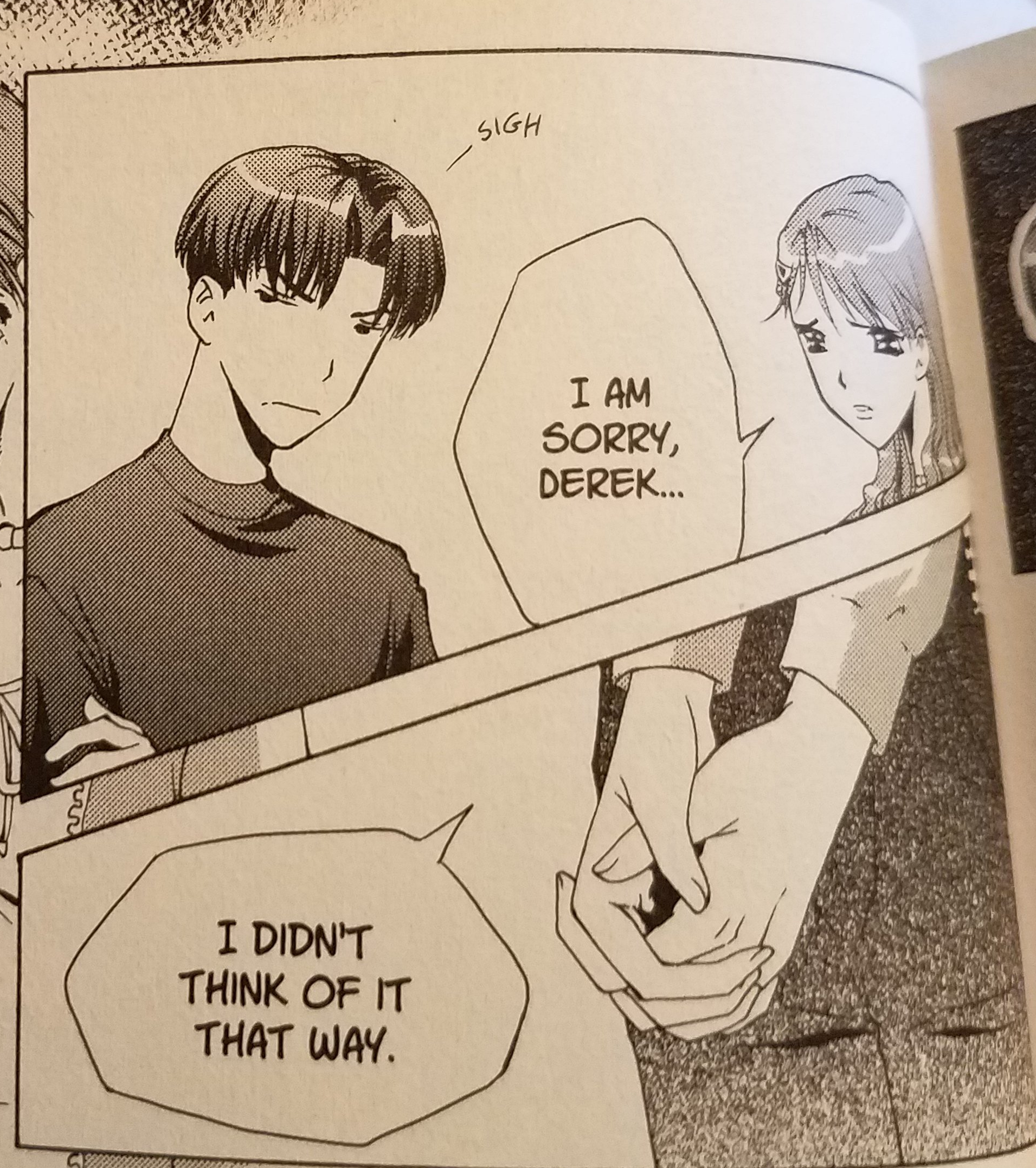
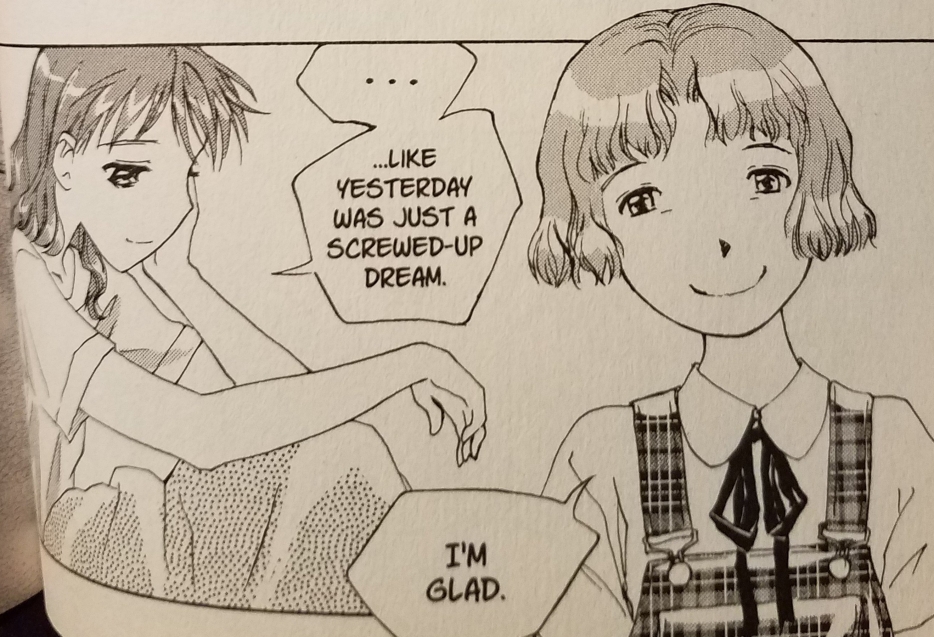
We need to talk about a couple panels starring Greta, a character who’s so forgettable her face has no features. 20190304_1112408281691373915480480.jpg

I’ve always been baffled by Greta’s response. “I’m glad”? What does that even mean?! She’s glad that Christie’s traumatic experience feels surreal? Like they can pretend the night before just didn’t happen? Because they do for the rest of the series.

But as the con ends, so does the manga. Christie meets back up with the group she came with, and says goodbye to Matt.

She leaves, reflecting on her con experience. Her heart is broken, and she’s been through a really scary event. But she has Matt’s phone number, and the book ends on a hopeful note. Christie looks forward to going back to the con again, which I take to mean that the good outweighed the bad.

And I want to talk about how the attempted rape hung a pall over the rest of the series, but…well, the final page left me smiling, too. In my chapter notes, I even wrote about how cute the series is as a whole. Except…

The attempted rape scene is so much darker than the rest of the series. I thought it was unnecessary and poorly handled in later books. And yet I’m still left with warm, fuzzy feelings at the end.

There are few works of fiction that I’m 100% satisfied with. That this blog exists is proof enough of that. So the question remains: was there enough that Dramacon did right, that it outweighs the things it did wrong?

Surprisingly, my mom helped me figure out the answer to this question. I moved out from my parents’ house around three years ago, leaving my mess behind. Now retired, my mom’s taking on the daunting task of hauling my old bedroom out. It’s almost like a new branch of archaeology: digging through layers of dust and old clothes to find any treasures worth keeping. Which is why I get texts every so often with pictures of various objects, most notably books. One of these pictures was of a cupboard that housed a considerable amount of manga. “What do you want me to do with these?” She asked.

“You can get rid of most of it,” I told her. “But keep Dragon Knights and Dramacon.”


I will be taking a break starting today, and will return with a brand spankin’ new reading and writing project on April 8! Thanks for reading along with me!

Dramacon 5: A Little Problematic

This one gets pretty heavy. Content warning here at the bottom of the page. Click here if you want it.

My original plan was to combine the final two chapters of Dramacon into one post, since they both cover the climax of the book. But in writing this post, it turns out there’s a lot to discuss, so I’ll just be sticking with the penultimate chapter here.

And what a climax it is.

Christie got a huge, much needed lift from meeting Lida Zeff, and it helped her enjoy the con a lot more. The night ends in a J-pop dance, which was also one of my favorite things to do at a con. Christie’s having so much, until Derek starts flirting with other girls in front of her again. She joins up with Matt’s friends instead, who she got to know over the course of the con.

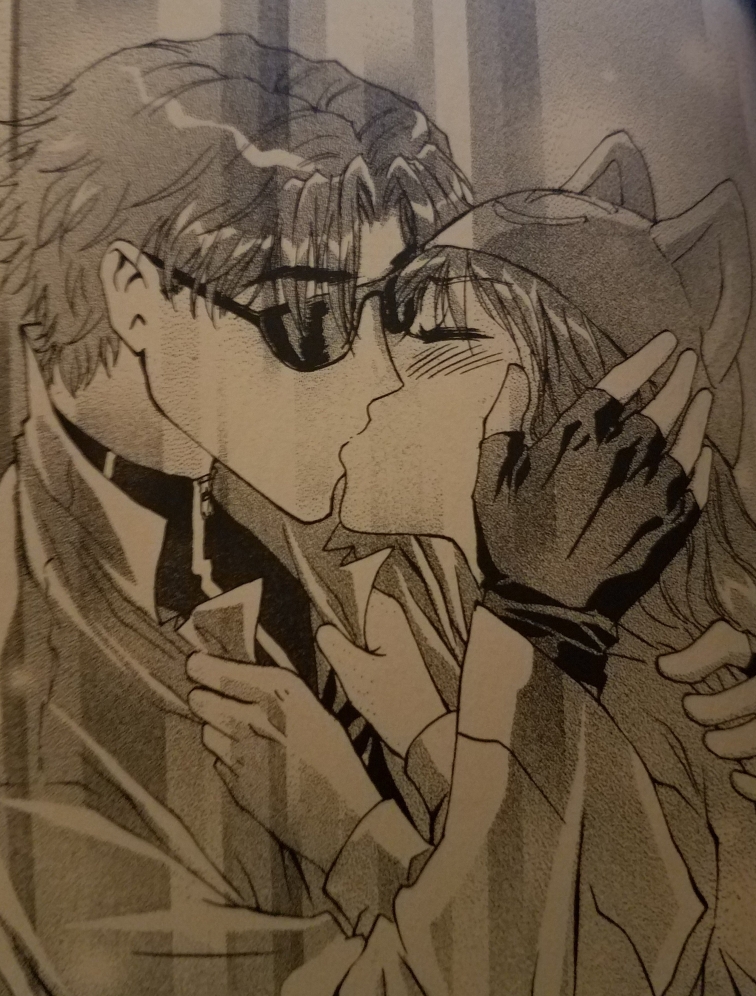
Christie goes to speak with Matt, and this ends up happening:

20190225_1151127312765306810366160.jpg

Squee~!

I’ll admit it: I squealed when I read that the first time. And when I read it through again this time.

Yes, Christie is technically cheating, which is generally frowned upon. But because Derek has no redeeming qualities, I doubt anyone really cares. I certainly don’t. And while Matt has been rough around the edges, he at least tries to apologize and improve his behavior.

Derek catches them kissing, and back at the hotel he and Christie have an explosive fight. Christie stands up to him and doesn’t back down this time. Her courage isn’t rewarded, though. Drunk and infuriated, Derek attacks Christie and attempts to rape her.

Yeah, you read that right. Romantic comedy Dramacon, full of jokes and pop culture references, just had an attempted rape scene.

One of the reasons I was a little nervous to read Dramacon was because I really liked the series and I wanted to continue liking it. I’ve grown up a lot since I first read Dramacon, and my understanding of sexual assault has changed over the years.

I’ve written about other books that use sexual violence as a plot device in the past here. I’m still never sure how I feel about sexual assault in fiction in general. Personally, it’s not something I like to see in books and movies, but it’s something that unfortunately happens in real life. And art is supposed to reflect life, right? At the same time, it’s also supposed to be an escape from our everyday lives. Is there a middle ground between these two things? Does there need to be?

I’ve mentioned before that I personally feel that sexual assault in fiction needs to be handled carefully, and with purpose. If a character is assaulted, then it either needs to bring out something new in the character, add something to the plot, and not trivialize the survivor’s experience.

Christie does get away from Derek, but the scene is scary and tense. It doesn’t play into a common rape myth that rape is only perpetrated by strangers. In fact, most rape survivors know their assailant.

But Dramacon doesn’t do a great job dealing with the aftermath. There’s only one chapter after this, so we don’t see much of Christie’s long-term reaction. I always wondered if Derek and Christie go to the same school. Does she still have to see him every day, even after they broke up? Is she scared to change classes, knowing that she might see the man who hurt her in the hallways?

In the final book, two years after the events of the first, Christie sees Derek again. She’s stunned to see him and probably scared. To make the situation even worse, he’s with his pregnant fiancée.

Put yourself in Christie’s shoes for a minute. You’ve just seen your abusive ex with another woman. What do you say to your ex and their partner?

A couple years ago, I found myself with a chance to confront my emotionally abusive ex-boyfriend. And good God, I seized upon that chance. All the pain and anger inside me, all the damage inflicted on me came pouring out. I’d been a toy to him, but I made sure he knew how small and pathetic he was. If I had a chance to talk to his partner, I would sure as hell tried to warn them about who they were dating.

Christie doesn’t do any of that. She chat amiably with Derek’s fiancée and they even exchange emails. She just acts like nothing had happened. There’s no warning, just a joke about how Christie must have some stories about Derek when they were teenagers. This whole scene is so problematic for me.

Maybe this is to show that Christie’s matured, or forgiven Derek. It’s been two years, after all. But being assaulted doesn’t just go away in real life. Something like that can stay with you and follow you throughout your life, affecting your mental health, self-worth, and relationships for years to come.

Dramacon is a fun, light-hearted romantic comedy, so spending the rest of it watching Christie recover from trauma would be totally opposite from the tone of the series. Since it brings out nothing new in the character or story, this momentary dark shift is just unnecessary. We already knew Derek was a bad boyfriend. I don’t think that the story needed to go as dark as attempted rape for Christie to run away from him. If Chmakova wanted to show that Derek was violent, he could have hit Christie, or pulled her hair, like he does in the following chapter. Any sort of physical violence should have been enough to prompt Christie to run away from him, and trigger Matt to beat Derek to a pulp. All of this could have happened without creating a huge problem for readers like me, and the tone of the story as a whole.

National Sexual Assault Hotline (US): 1-800-656-4673
RAINN Resources for Sexual Assault Survivors and Their Loved Ones
Rape Crisis Network Europe

Content warning: Discussion of rape and sexual assault in fiction. No graphic descriptions or images.


Dramacon 1: Welcome to the Jungle

From the amount of manga reviews on this blog, it won’t come as a surprise to anyone that I was an otaku when I was growing up. When I got to college, I started losing interest in anime, partly because I was cut off from my steady stream of Adult Swim and weekly allowance to buy manga. There were still some series I liked and followed, though, and Dramacon was one of them. I read this series for the first time only a month before my first anime convention. I was so excited to go, and ended up using it a template of what a con would be like.

It wasn’t exactly like Dramacon, though. I waited in line for six hours for registration, and by the time we were let into the con, all the panels were over and the merchants’ room was closed. We got to see the masquerade show and visit the artists’ alley. It was a fun and tiring time, and I really hoped that my next con would go a little smoother.

That’s the kind of memory that stirs up when I start Dramacon now. The excitement and anticipation of going to my first con, not really knowing what to expect, and at times being overwhelmed with it all.

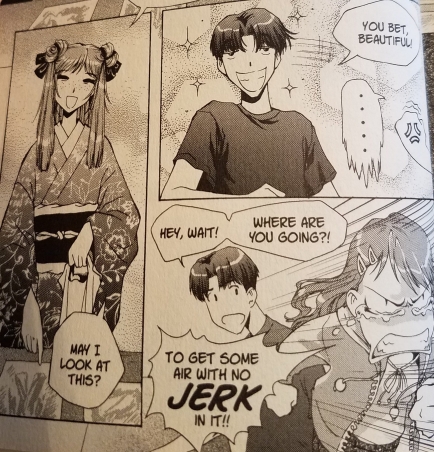
I like the way the manga starts as well. Christie, her boyfriend Derek, and two friends are going to an anime convention. She and Derek have a booth at in the artist alley to sell a comic that they’ve created together. It’s the first day of the con, and she’s already having a hard time. Along with her friends accompanying them to the con driving her crazy, Derek is blatantly flirting with girls right in front of her. This all gets covered in the first couple pages. There’s not a lot of build-up and background, because it’s not needed.

20190114_1101102952099284417078401.jpg

  Read from left to right!

The art’s not as good as I remember, and something about the way the artist Svetlana Chamakova draws mouths bothers me. I’m not entirely sure what it is, and complaining that they look “cartoonish” seems silly when I’m talking about a comic. They’re overexaggerated, which is okay for humorous scenes, but the first few pages are all done in this style. It makes Christie’s dilemma look funny, which makes it harder for me to take her seriously when she’s mad at Derek.

20190114_110319-13601096343203408769.jpg

That’s right. She’s mad at him, but she’s the one apologizing.

And rightly so. Derek is a tool, but Christie also lets him walk all over her. Throughout the course of the series, Chriss gets more confident and learns to stick up for herself, but that doesn’t happen here. Frustrated with her boyfriend, she runs off into the crowd, where she meets Matt.

I think this was the real appeal of the story to me: that serendipitous meeting with a handsome stranger at a con. Of course I secretly fantasized about meeting someone at a con and having a runaway 72-hour romance with them. I did meet some cool people, and developed a short-lived crush on one of them, but nothing ever came of it. I didn’t keep in touch with the people I met, and never got kissed by a cute cosplayer.

Christie’s story is the one my teenage heart always wanted to have, but following it would come with some serious drawbacks. Other than having a jerk boyfriend, Christie is also dumb in the way she approached the con as a whole. For instance: she didn’t know her favorite manga artist and writer would be there. At the last con I went to, I went specifically for a chance to meet an actor I loved. Christie also didn’t know that there was a program detailing the different panels and events going on. How did she miss this? I’ve never been to a con where there wasn’t a program right at the entrance or registration booths.

If I really wanted to get into the nitty gritty, I guess this could be read as Derek trying to gaslight his girlfriend,  but to be totally honest, I just don’t think he’s that smart. He’s an asshole, though, but Christie is a wet blanket. Until Chriss stands up to him, he’s going to get away with everything.

Tithe 11: Aftermath

The movie Far and Away is the story of two Irish immigrants making their way in America during the 1890s. Towards the end of Act 2, the main characters are freezing and living on the streets of New York City. They break into an empty home where they could finally eat, but declare their love for each other and make out instead.

That scene drives me crazy. The food is right there, you haven’t eaten in days, and you’re going to ignore it so you can play house?

I think this illustrates why romance really isn’t the genre for me. Characters swept away by love when the solution to so many of their problems is right in front of them. I feel like so many protagonists in romance novels are just stupid.

That’s what bugs me about Tithe, even as we creep towards the end of the book. Roiben and Kaye have escaped the Unseelie Court with their lives, but Kaye is hardly worried about the consequences of the uncompleted Tithe or the death of the Unseelie Queen. When Kaye and Roiben kiss again, the scene is meant to titillate, but doesn’t exactly move the story along.

Kaye’s more concerned with getting things settled with Roiben: explaining the plan, and how she wanted to tell him she was a pixie but never got the chance. They have some of their most “normal” conversations so far during this chapter. I’ll admit, the awkwardness between the two now that they’re no longer in danger is pretty cute.

All this to say, romance really isn’t the genre for me. I like Tithe for the fantasy, but I could take or leave the romantic subplot. Maybe I’m just too old. I’m closer to 30 than 20, and no longer the YA target demographic.

Roiben, presumably older and wiser, at least, calls Kaye out on her skewed priorities.

‘Kaye, Faery is a place governed by a set of customs both severe and binding. What you have done has consequences.’

‘Everything has consequences,’ she said, ‘and the consequence of this is that the solitary fey are free again, you’re free, and the bad Queen is dead. That seems pretty over to me.’

Kaye doesn’t really understand what these “consequences” are until she sees several news stories detailing the chaos the solitary fae created on their first night of freedom.

Roiben spoke as he began to pace the room. ‘Everything is always easier when considered black and white, isn’t it? Your friends, after all, are good and wise, so all solitary fey must be good and wise. Your friends must have some respect and fear and knowledge of humans, so all solitary fey will follow in that example.’

Kaye has a hard lesson to learn, but doesn’t get much time to dwell on it. Kaye soon learns that Corny is missing and is still in the Unseelie Court, most likely with Nephamael.

I didn’t really think about this too much when I was a kid, but we have a gender reversal here. Instead of Kaye needing to be saved, it’s the girl going back into danger to save the guy.

Tithe 2: Tall, Dark, and Brooding

I really expected that the magic of re-reading Tithe for the first time in years would be gone as soon as Kaye stumbled across her love interest, Roiben. I opened the book, armed with my incredible ability to nit-pick everything, and came away more or less satisfied with the second chapter.

No, let’s be honest, I got totally sucked in again.

It didn’t really start that way, though. Kaye flees the carousel and her own embarrassment, and starts on her way home. She’s more upset about how she made the broken carousel horse stand up on its own than about Kenny groping her, which makes sense, I guess, but in her situation, that’s not the thing I’d be hyper-focusing on. When she does think about Kenny, she’s more worried about what Janet will think, and what Kenny will tell people.

But the opening of the chapter is rendered less frustrating to me thanks to the lovely descriptions of Kaye’s walk home. I can vividly picture the wet woods at night, walking through the rain in the dark, cold and scared. I’m really envious of Holly Black’s descriptive abilities. She can make the scene come to life and paint a picture with her words, without making it drag on.

As Kaye makes her way home, she comes across a beautiful wounded man. She realizes that he is a faerie, but not like the faeries that were her childhood friends. The ones she had seen as a child were small and mischievous and playful, what most people would think of when they hear the word “faery”. Roiben, who Kaye finds here, is tall and handsome, more a warrior elf than a fun-loving sprite. The modern idea of fae is more like what we see in Disney movies: beautiful winged women granting wishes and turning you into a princess or a real boy. Tinkerbell may actually be closer to a traditional fae, with her jealousy nearly leading to the death of Wendy.

But for the most part, that Disney idea was what I grew up with. Charming creatures that would help you with your housework and friendly elves that made toys and shoes. A character like Roiben, in my book, was an entirely different species, like an elf from Lord of the RingsTithe was my first real introduction to the more traditional look at faeries, seeing their dark and dangerous side that went hand-in-hand with their beauty.

Roiben, by the way, was exactly what my fourteen-year-old self was looking for. Tall, handsome, dark and mysterious. He was in pain, he was broken, and I found that irresistible. Five years later, I found my own beautiful angsty man and knew that I could fix him, that I could be the light to his darkness.

If there are any teenage girls out there reading this now: I do not recommend attempting this. You cannot fix him, you will only get hurt in the process. Love your tall, dark, and brooding man in fiction, and leave him there.

Before I finish up this post, there is just one thing I need to point out.

She let out a breath she hadn’t known she was holding.

It’s not a bad line, and I can’t think of a better way to describe that sudden un-tightening of your chest after your see relief from a tense situation. But this line is used so much in fiction that it’s almost become another character. I know I’m guilty of using it way too much.

To be totally honest, this is probably something I would have never noticed, if not for one of my favorite tweets ever.

Someday I want to write a YA novel where the main character lets out a breath she knew damn well that she was holding.

P.S.: I’m on Twitter, like all the cool kids: https://twitter.com/nortonwriter14

Paradise Kiss 10 + Omake

Well, it’s finally time to wrap up Paradise Kiss.

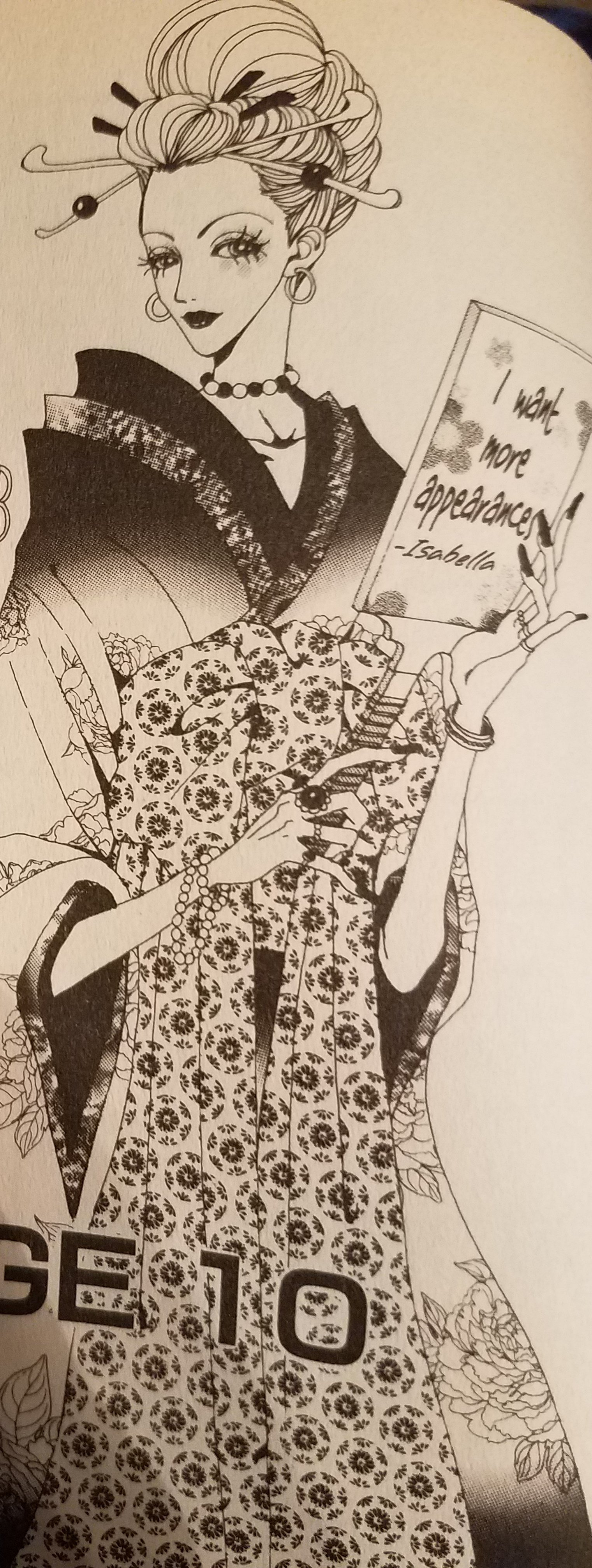
The final chapter is also the shortest in the book, but I’ll start with the cover page.

Isabella more appearances
Me too, Isabella. Me too.

I remember liking Isabella’s character the first time I read through Paradise Kiss. Isabella was the first transgender character I was aware of who wasn’t treated as a punchline. One of my favorite side stories showed her shared childhood with George, when she was being raised as a boy. The first dress George made was a gift for her, and helped her find her identity as Isabella. Throughout the manga she shows herself to sweet and caring, and has a deep bond with George, sticking with him through thick and thin.

The first volume focused mostly on Yukari and Miwako, so there wasn’t a lot of room for Isabella this time around. But this cover page almost makes me want to continue reading Paradise Kiss just to see more of her.

Unfortunately, that’s not going to happen in this book’s final chapter. But we do see Yukari start to grow up. Up to this point, she’s idolized her crush, Tokumori. But in this chapter she starts to see his flaws, too, and realizes he can be mean and petty. Instead, she turns her attention towards George, waiting for him to call her.

Except that she pretends that she’s not. This is another instance of “so high school”: acting like you’re not waiting for him to call, or pretending that this guy isn’t in your mind all day. When they finally do meet up, Yukari shouts at George for making her wait and for not calling, and George gives her a chance to back out of modeling. Tears running down her face, Yukari says that she’ll keep working, and she and George finally share their first kiss.

There is a lot of high drama and angst, and Yukari and George’s relationship ultimately doesn’t last. But it’s still rather sweet: your first kiss, and your first love. That’s also pretty high school, but in a good way.

The last section of this book is the “omake”, or bonus. Omakes are sometimes at the end of a manga volume that might show behind-the-scenes creation, or just have the characters being silly. What caught my attention, though, was just how dated it was. There’s a reference to the Sega Dreamcast, discontinued in 2001, and Geocities, closed in 2009.

Time waits for no man, I suppose. For no man, and no manga.