Paradise Kiss 9: So High School

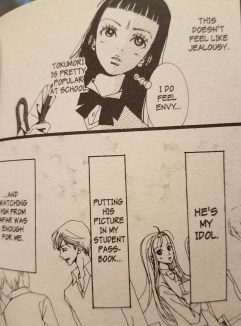
This chapter reminded me why Paradise Kiss is a great series for high schoolers, and  no one else. After her close call with George, Yukari meets back up with Miwako, who’s been crying and is clearly upset.

Something struck me about Paradise Kiss here, which makes it stand out from other drama/romance manga. The “Ordinary World” portion of the story is barely there.

In a lot of manga, particularly shojo manga, the first chapter is normally dedicated to showing the protagonist’s every day life before her world is turned upside down by a handsome stranger. This usually includes friends, family, and school life, if she has one. But Paradise Kiss doesn’t give us that introduction. It starts with Yukari running into Arashi and Isabella by chance, and goes from there. We don’t really see what her life was like before this.

Then again, we don’t really need to. At the start of the manga, she doesn’t have much personality, but develops as a character over time, with the help of her colorful new friends. Her backstory unfolds throughout the story, and here it focuses on her crush on Tokumori. Later books will also explore Yukari’s relationship with her demanding mother, and the rest of the characters’ pasts as well.

Here we learn that Yukari is a good friend, even if the only person in her “ordinary world” we’ve seen her interact with is Tokumori. When she sees that Miwako’s been crying, she wants Miwako to tell her about what happened, even if it’s something that Yukari won’t like to hear.

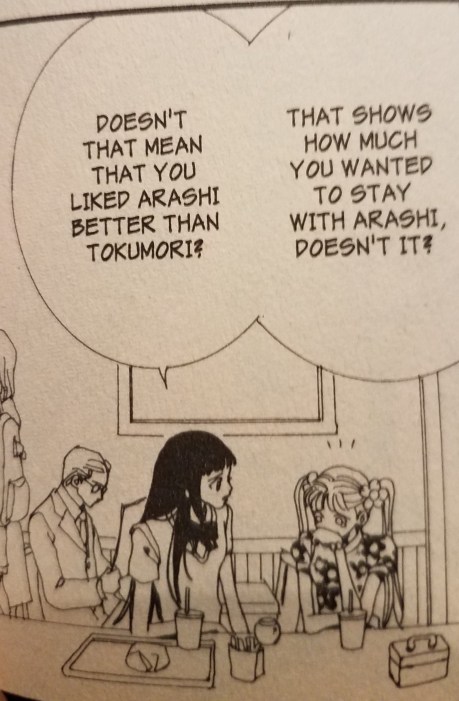
As Miwako explains the love triangle between her, Tokumori, and Arashi, the only thing I wrote in my notes was, “so high school”.

I don’t think that teenagers are too young to fall in love and have deep and meaningful relationships, or that relationship drama magically ends when you graduate. What tipped the “so high school” balance for me wasn’t just the drama, but Miwako’s idealization of Arashi and and Yukari’s naive advice to her.

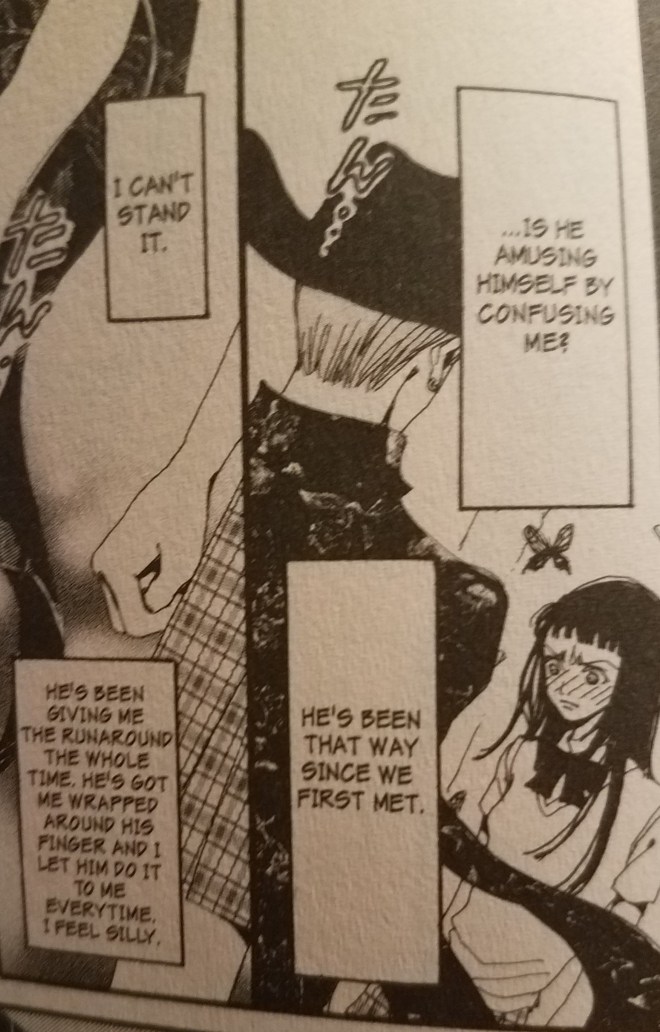
For some context: when Miwako lived close to both Arashi and Tokumori, she fell for both of them, and they fell for her. Arashi demanded that she choose between the two. After Miwako chose Arashi, he said that he never wanted her to see Tokumori again. Arashi’s already shown himself to be rude and brash, and we can add “jealous” and “possessive” to his list of negative traits. These are traits that Miwako could have romanticized. He’s jealous because he cares so much about her, while ignoring the other implications of his jealousy.

20180729_1843315851879524899115920.jpgYukari doesn’t help much when it’s her turn to give advice. She admits that she’s probably the worst person to give Miwako advice on her love life, and when she does, it sounds like…well, it sounds like it’s ripped straight of a shojo manga.

In this situation, it’s the blind leading the blind, and with no other experience to build on, they both have to let their emotions be the guide.

And that is why this is “so high school”.

Paradise Kiss 8: Frozen Yogurt of Romance

The eighth chapter of Paradise Kiss begins and ends with shots of Miwako and her talk with Tokumori, but for the most part focuses on the budding relationship between George and Yukari. I mentioned before that I don’t like the way George goes out of his way to get under Yukari’s skin, and Yukari explains exactly why.

Yukari hits the nail on the head with her narration:

20180722_1752184815253862150810233.jpg

There’s an ambiguous zone between flirting and an actual relationship, and being stuck there indefinitely is maddening. George is keeping Yukari there because it’s fun for him to see her flustered, even if he does actually like her. George is the frozen yogurt of boyfriends:

tenor

Yukari decides to take control of the situation, rather than let George keep manipulating her. She challenges him in a way that kind of sounds…well, just as bad as George’s attitude.

20180722_1754344125354592681240561.jpg

As they are about to kiss, George gets a call, and answers his phone instead of paying attention to Yukari. This was a pretty telling moment for the character: he cares about fashion and his work more than he cares about her. This is also a great moment of foreshadowing. Spoiler alert for an almost twenty-year-old* manga: George and Yukari do not have a happily ever after. In the end, they drift apart, focusing more on their careers than each other.

Chapter 8 was short, and I don’t have a snappy way to end this, except to say that George is a heel, but so is Yukari.


Paradise Kiss 7: The Trouble With George

Chapter 7 begins with Yukari going Tokumori to get tea, and (unbeknownst to him), reunite with Miwako. As they head to the cafe, George passes by them, and doesn’t say anything. Yukari doesn’t know what to think of this, and spends a page just trying to figure out why George ignored her.

Some of Paradise Kiss has gotten better since I’ve gotten older, but not this scene. Yukari over-analyzes George’s non-reaction to her as only a teenage girl can. I would know. I used to do it, too. What might have been relatable to me ten years ago is now just annoying, and it makes me glad that I’ve matured beyond that mentality. Well, mostly.

Tokumori notices Yukari acting weird, and asks her if something’s wrong. This leads to a discussion about school and their futures, and Yukari learns that Tokumori has the same doubts that she does. Yukari is surprised by this, and her reflections confirm my suspicions that this is actually the first real conversation she’s had with him.

Lazy editing job is lazy.

This is a strike against Yukari in my book. Through this read-through, I found that I liked her because she had her own doubts, along with a fairly cynical attitude that often matches mine. But idealizing someone without even trying to talk to them, this “love from afar”, just seems so immature.

When Yukari and Tokumori meet Miwako at the cafe, the two childhood friends are reunited in…a very awkward fashion. Yukari hadn’t warned either of them that the other would be there, wanting it to be a surprise. She hadn’t taken into consideration that Tokumori may have had feelings towards Miwako when they were younger, but that Miwako had chosen Arashi over him.

Yukari makes her escape from the awkward situation, leaving Tokumori and Miwako by themselves to catch up together. She decides to head, of all places, to the Paradise Kiss studio. There she runs into George, who tells her he didn’t greet her because he was jealous of seeing Yukari with another guy.

At this point, I’m sure that Yukari’s attraction to George is largely because she’s the only guy she’d been able to speak candidly with so far. Arashi is nothing but rude to her, and her relationship with Tokumori is distant at best. He also balances Yukari out in some aspects. He has passion and drive, whereas she is full of doubt and uncertainty. In fact, that’s the key difference between Yukari and the Yazawa Arts students: Yukari doesn’t know where she wants to go, but they know exactly what they want in their futures.

The end of this chapter marks the beginning of a possible relationship with George, but it feels rather superficial. This is maybe the fourth time we’ve seen Yukari and George talk to on another, and most of those conversations have been about modeling for the fashion show. He treats her more as a vehicle to showcase his work than as a person.

I’m trying to find the right words to explain just why I don’t like George, but I think what bothers me most about him is his sense of entitlement. Apart from his conversation with Yukari at the library – which he planned – he’s largely indifferent to her. Yet, he admits he was jealous of seeing her with someone else, a classmate who Yukari was well within her rights to be with. Additionally, he asks Yukari, almost mockingly, if she’s falling in love with him. Since the chapter ends there, we don’t see Yukari’s response other than some nervousness, and we don’t know if George will reciprocate a confession of feelings…or if he’s just trying to get under Yukari’s skin.


Paradise Kiss 5-6: Shall We Model?

I’ve decided to combine chapters 5 and 6 in a single post, as not a whole lot happens in chapter 5. Yukari agrees to model for the Paradise Kiss studio, and the Yazawa Arts kids throw a party to celebrate. Thinking the champagne at the party is non-alcoholic, Yukari accidentally gets drunk and falls asleep at the studio. She misses cram school, and George takes her home.

There’s not a lot of substance in this chapter. As I read through it, I only ended up making two notes: there wasn’t a lot of George this time around, and the art is very pretty.

The sexual tension ramps up at the end of the chapter, when George takes Yukari home. He leans in, and it looks as though he’s going to kiss her. Instead, he only tries to wipe her makeup off, so Yukari won’t get in trouble with her parents.

A lot of romance fiction, as I understand now, is really about the build-up between the presumptive couple. I don’t really feel this moment of a potential kiss, though. Maybe it’s because I already know where the series is going, or because George still hasn’t gotten a lot of screen time so far. Maybe romance stories just aren’t my cup of tea.

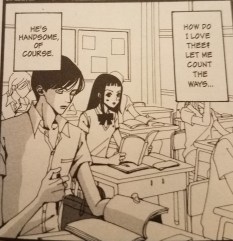
At least it’s nice to look at.20180709_1158188767141281503960383.jpg

The next chapter has a bit more story to it, and goes back to the potential love triangle between Yukari, Miwako, and Tokumori. Love square, if you include Arashi in that as well.

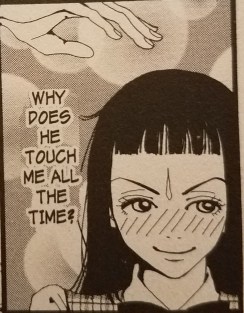
I also noticed another moment that might not translate well to American audiences. After several instances of non-sexual physical contact between Yukari and George, Yukari wonders, “why does he always touch me?” It was something that I wouldn’t have even thought of the significance of when I first read this.20180709_1157294692829488967709785.jpg

I took three semesters of Japanese in college with a professor who taught the class with a large focus on Japan’s culture. The personal stories he told us and some of the cultural difference between his life in Japan and in America are things that I remember long after I’ve forgotten katakana and how to conjugate verbs.

In college, many of my friends were very physically affectionate. There were always lots of hugs, play fighting, and back scratches. During my first semester taking Japanese, there was a girl who sat next to me and often hugged me. Then one evening, my professor addressed the class about our American habits that wouldn’t be permissible in a Japanese classroom.  Make sure your cell phones are off, always arrive on time, and please, cool it with the hugs. The lesson was further reinforced when we watched the Japanese film Shall We Dance? Our sensei explained that the film had been inspired by the fascination of American couples, openly taking each other in their arms, and dancing. Watching the American version of the film only further accentuates the differences between American and Japanese culture when it comes to touch.

Americans still like their space, but casual touching between friends or relatives isn’t uncommon. Whereas in Japan, touching others, particularly those you don’t know well, wouldn’t happen often. George constantly touching Yukari could be seen as downright weird, or George may be implying that they have a deeper relationship than they actually do.

Chapter 6 also gave me the first real reminder of how much time had passed since this manga was published. The first volume of Paradise Kiss was released in 2000, and for the most part, it holds up well. However, there are a few instances where (as TV Tropes puts it) Technology Marches On. Here’s the first one, when Yukari and Miwako exchange phone numbers.20180709_144952104498298163815428.jpg

Had this come out today, those phones would have looked very different. Furthermore, Miwako has to teach Yukari how to become “pen pals” with her. There’s no way a seventeen-year-old today wouldn’t know how to do that. Later in the chapter, Yukari wants to invite Miwako, Arashi, and Tokumori out for tea but doesn’t know how to get in touch with them. Then she remembers that she has Miwako’s phone number. Had this come out today, or even five years ago, Yukari wouldn’t even have had to wonder. Texting has basically become second nature.

20180709_1159415981331058126958235.jpg

The reason Yukari wanted to invite Arashi and Miwako out to tea is so they can reunite with their childhood friend, Tokumori. Yukari had been startled, and a little jealous, when she realized that Miwako and Tokumori knew each other. This is because Yukari has a big crush on Tokumori, or at least is trying to convince herself she does.

When Yukari’s mind wanders over to George, she tries to shove him out of her mind. Instead, she even makes herself list the things she likes about Tokumori, and manages to come up with about three things. Then, when she asks him to tea, the conversation is…incredibly awkward.

All this makes me wonder: Has Yukari ever actually had a conversation with Tokumori before, outside of exchanging pleasantries? Until now, we’ve seen him compliment her new haircut, and nothing else. No wonder she’s attracted to George: he’s handsome, interesting, and they’ve had real conversations together, even if it’s only once or twice.

Paradise Kiss 4: Childhood Friends

Something didn’t occur to me until just now as we dive further into Paradise Kiss: we’ve never seen Yukari’s “ordinary day”. Most stories, particularly those that follow a monomyth structure, usually have this “ordinary day” at the beginning, where we can see what the main character’s life is like before the adventure starts. This gives us a frame of reference for how the character’s life is about to be turned upside down, be it by hatching a dragon or meeting someone new. But we haven’t gotten your typical “ordinary world” with Paradise Kiss. There’s maybe two pages in the beginning of the book that focus on Yukari’s thoughts before she gets spotted by Arashi and Isabella, and taken to their studio.

And yet, without a typical ordinary day sequence, we get a good sense of what her life is like. School, then cram school, all the while wondering what she wants out of her future. I think the strangeness of going to the studio and meeting George and his crew would have been better emphasized by showing this ordinary day, particularly for non-Japanese audiences, but it’s not necessary.

I only noticed this because chapter four is the first time we actually see Yukari at school, but we know from her narration that school is one of the biggest stressors in her life. We also – finally – meet Hiro Tokumori. Tokumori is one of Yukari’s classmates, and she has a big crush on him. In the first chapter, Yukari accidentally leaves her student passbook in the studio, where she happens to have a picture of Tokumori. She is

mortified at the thought that George might have seen the picture.

However, the day at school doesn’t last long, and we don’t see much of Tokumori. What I like about the Paradise Kiss studio crew is that, even if they haven’t had much screen time yet, I can already see some of their inner worlds, Miwako’s in particular. But not so with Tokumori. I’ve read the entire Paradise Kiss series before this, and honestly…I can’t remember a thing about his personality.

At this point, Tokumori’s presence and the photo is really only there to show Yukari’s budding attraction to George, though she won’t admit it yet, and probably doesn’t know it herself. It turns out George never saw the photo of Tokumori, and Yukari’s incredibly relieved. Here we see the beginnings of a conflict that has nothing to do with the fashion show. Yukari has a big crush, and she doesn’t want George to know about it. As I mentioned in my last entry, a good romance should have some realism to it, and this is exactly it.

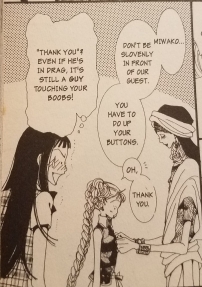
After school, Yukari goes back to the studio, though she hasn’t decided yet whether she wants to model or not. She receives 20180625_102741133643277095666020.jpga shock after interrupting Arashi and Miwako making out on a pool table in the studio. Even though Yukari has stopped looking down on the art school kids by now, there’s still a gulf between her and them. It’s not that she’s shocked at the making out, that would surprise most people. But rather, Isabella, who is transgender, helping Miwako button up her shirt after.

While Miwako and Arashi are both pretty comfortable with Isabelle, Yukari can’t help thinking of her as a man, and it’s one of those things that gets brought up a couple times in this volume. To her (and Yazawa’s) credit, Yukari doesn’t say anything hateful to Isabella about her being transgender. Right now it’s just something she’s geeked out about, but as the series progresses, that strange feeling Yukari has towards Isabella fades away, and soon Isabella’s gender identity isn’t an issue for her.

Embarrassed about the situation, Yukari offers to go out and get tea for everyone, and Miwako tags along. While they’re alone, Miwako asks Yukari about the photo of Tokumori in her student passbook, incorrectly assuming that Tokumori is Yukari’s boyfriend. As it turns out, Miwako, Arashi, and Tokumori used to live together in the same apartment. When I first read this, I assumed that they meant the same actual apartment, but now I realize that they could mean just the apartment building. It’s not entirely clear.

I only recently learned that before Paradise Kiss, Yazawa published another manga, Gokinjo Monogatari, which follows Miwako’s older sister, Mikako. Gokinjo Monogatari may answer some of the questions I have about Miwako’s and Arashi’s past, but I’ve yet to read it.

As far as the childhood friends turned lovers trope, I don’t hate it, but it’s not my favorite, either. I just don’t see it as all that realistic, depending on the age of the characters. I can buy high school sweethearts who fell in love, parted ways, and came back together. But I don’t think falling in love with your childhood friend that you’ve spent most of your life with is that realistic. Part of this is the Westermarck effect, which hypothesizes that children who live closely together during their early years will not find each other attractive as they grow older, seeing each other more as brothers and sisters than potential mates. Like most social theories, it can’t be proven or disproved, so I would like to offer up one of my own:

You just get sick of each other.

When you spend almost all of your days with one person, there are times when you’re going to get tired of each other. You’ll get irritated and fight, and need to take a break, be it for a few hours or a few days. It doesn’t mean that you don’t care about each other, it just means you need a break. This happens with friends, siblings, lovers, just about anyone who lives in constant close contact with another person. Often, the root cause of many of the fights I had with my sister were just because we’d spent too much time together.

This is actually addressed in the manga, when Arashi and Miwako are going through a rough patch. Miwako is concerned about Arashi’s silence, and he just tells her that when you’ve talked to someone else almost every day of your life, at some point you’re going to run out of things to say. The usual cutesyness of the childhood friends trope gets undercut by the problems in their relationship, one of which is the love triangle between Miwako, Arashi, and their childhood friend, Tokumori.

Most of the chapter is dedicated to Yukari getting to know Miwako better, and her shared past with Tokumori. Miwako is quickly becoming my favorite character in the book. While referring to herself in third person drives me crazy, she’s adorable and chipper, like a ray of technicolor sunshine. Between Arashi’s brash attitude and Yukari’s cynicism, Miwako brings some joy into an otherwise dramatic series.

Paradise Kiss 3

I’m still working on the question of “is Paradise Kiss objectively good?” as I read through this book. To be honest, I’m liking it a lot more than I thought I would. One thing that I forgot about romance manga, though, is that the plot and character development tends to move more slowly than, say, an action or fantasy manga. And there’s nothing wrong with that. Romance isn’t just about the main characters falling in love, or the steamy scenes everyone looks forward to. They’re about attraction, longing, and the tantalizing conflicts that make the relationship seem impossible.

A good romance needs nuance and realism without leaving behind the fantasy: of a gorgeous man stealing a kiss, or a smile from that mysterious woman on the train, or that meet-cute in the book store you’ve always secretly wanted.

The third chapter of Paradise Kiss shows us the first real interaction between Yukari, and her future lover, George. At least, first interaction where Yukari isn’t freaking out.

The slow pace feels relaxing and real as they meet “by chance” in the library, though Yukari later learns that George had planned it. There, she starts to see another side of George, one that wasn’t apparent when she herself was being swept away – literally – by the other characters who want Yukari to model for them. In this one-on-one setting, Yukari starts to see George’s ambition and work ethic. She’s also envious that George knows what he wants to do with his life and has a dream, while Yukari isn’t sure what hers really is.

Yukari’s inner conflict about not knowing what she wants to do is very relatable. Like many people, she’s done what she’s been told: good family, good background, go to school, prepare for college. This hasn’t made her happy, and she doesn’t know, exactly, what will. She doesn’t know what her passions are. It’s an uncomfortable place to be. If the Paradise Kiss students are shining stars, Yukari is a white dwarf.

The real significance of this scene is that Yukari shares her troubles and feelings with George. Before, we’ve only known about them through her narration, and she’s moved to tears because George wanted to listen to her problems. Which kind of makes me wonder, what kind of lonely life does she have, where George is the only person who wants to listen to her?

Biggest Bullshit Moments in Snow Drop, Part 2

Unfortunately, Snow Drop doesn’t end with So-Na getting away from her horrible father. Instead, the story only goes downhill from there, bringing us bigger and bigger moments of utter shit. Watch out, it only gets worse.

Volume 7: Easily Forgiven, and True Love
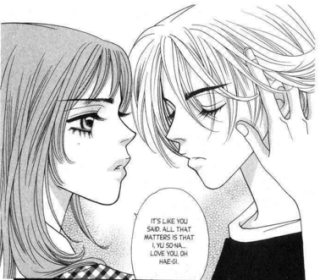

Watch out, this one’s a two-parter. Volume 7 is a tribute to bad decisions. Hae-Gi and So-Na return to her home, so Hae-Gi can ask her father for permission to date her. So much for that independence she was trying to achieve. Dear old Dad finally reveals why he’s so against their relationship: Hae-Gi’s brother, Gae-Ri, was the one who kidnapped So-Na years before. In retaliation, So-Na’s father had Gae-Ri and his accomplices killed.
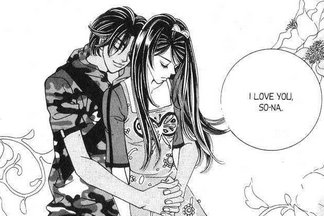
You’d think that would be enough to break up Hae-Gi and So-Na, or at the very least, make them re-think the relationship. While So-Na does show some hesitation about moving forward, about five minutes later Hae-Gi says that he doesn’t care what happened between their families, just that he loves So-Na. I love my boyfriend, too, but if his parents killed my sister, I don’t think we’d continue seeing each other.

It doesn’t matter, though, because So-Na and Hae-Gi run away together. I used to think that was romantic and brave, but now I think it’s really dumb. So-Na clearly has a death wish, as she keeps saying that as long as she and Hae-Gi can die together, she’ll be happy. What?

But even more than that, what bothers me is this “one true love” nonsense. Remember, Hae-Gi and So-Na are seventeen. They’re in high school. Think back to the people you dated in high school. I became enamored with the first guy I ever dated when I discovered that he was a Lord of the Rings fan, just like me. Or the second person I dated in high school, who I was first interested in because he was an anime fan. Because clearly liking the same thing means that you’ll be together forever. The idea that you’ll find the person you’re meant to be with forever in high school, to me, is a load of crap.The first person you date is most likely not going to be the person you’re going to marry, and they’re definitely not going to be worth dying over.

Volume 8: So-Na Dates Hwi-Rim
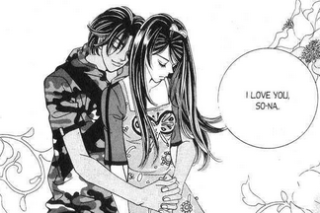
Or, put another way, So-Na willingly dates the man who tried to rape her

There are so many problems with this. I’m not even sure where to start.

Rape in fiction is a quandary, and we could argue all day about using it as a plot device, as a way to show character, and whether or not it’s okay to use. It may make me uncomfortable, and I may not like to see rape used in fiction, but does that mean it should never be used? I believe – and this is just my own opinion – that if rape (or in this case, attempted rape) is used in a story, it has to be necessary; it can’t just be for shits’n’giggles. That is, it should propel the story forward, reveal something new about the characters involved, and not trivialize the victim’s experience.

So-Na’s kidnapping traumatized her for years, and left her reclusive and depressed, and she admits to being suicidal before the series began. Sure, it’s not the happiest backstory, but her reaction to it, I think, is normal and expected of someone who’s been through that. However, Hwi-Rim’s attempted rape doesn’t have that same effect on her. Even if it So-Na didn’t suffer long term effects from it (which she didn’t), I don’t think she would want to be anywhere near Hwi-Rim, let alone dating him. This is what I mean about trivializing the victim. The attempted rape is all but forgotten, and the only hang-ups she has about dating Hwi-Rim is that he’s not Hae-Gi. And the reason Hwi-Rim tried to rape So-Na in the first place was because he loved her.

For some context, Hae-Gi and his family were exiled to America, and So-Na wants to date someone to forget about him. She chooses Hwi-Rim because…well, I don’t know. If she wanted to date someone, she could have gone out with, say the class president who asked her out, and by the way, hasn’t tried to fucking rape her. 

I think the lessons Snow Drop is telling us is that:

1. Rape is an expression of love.

2. Attempted rape has no lasting traumatic effects on the victim.

3. A romantic relationship with your would-be rapist is okay and probably healing.

I just…if I had a week, I couldn’t tell list all the reasons that explain how fucked up that all is.

Volume 9: So-Na Has No Identity Outside of Hae-Gi
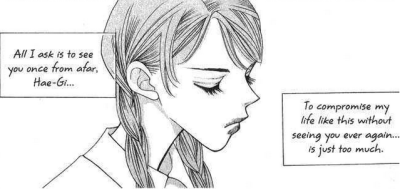
This book is much more mild than the last few, but there’s still one thing in it that really bothers me. So-Na is now going to a different school and has made friends with the “delinquent” girls. This is supposed to show us how depressed and self-destructive So-Na’s become since Hae-Gi was exiled, but I think it misses its mark. It doesn’t make me pity So-Na; in fact, I think it makes me dislike her a lot. I think this is just my own mentality, though. Maybe this hit harder for other readers, but I’ve always been the girl going, “I don’t need no man!” I hate when a girl loses her lover, and falls to pieces. Part of that is because I don’t think I’ve ever seen the reverse – a man losing his lover as well as the will to live – but I hate how tied in So-Na’s mental health is to Hae-Gi. When she’s strong, it’s because she has Hae-Gi’s support. When she’s weak, it’s because he’s gone. Her dependency on him for her own happiness and well-being is cringe-worthy at best, and falls into “Bella jumps off cliff to see her ex-boyfriend” territory at worst. This is exactly why I said I didn’t want this series falling into unsuspecting hands. It’s not romantic, it’s not tragic; it’s a teenage girl making bad choices because she’s going through a break up. So-Na, just get a dramatic haircut or something and move on with your life, like a normal eighteen-year-old.

Oh well. At least no one was sexually assaulted in this volume.

Moment of Redemption: Hae-Gi and So-Na’s Reunion
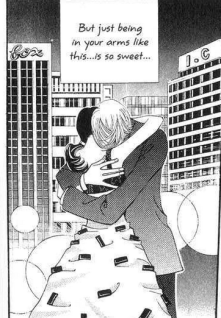
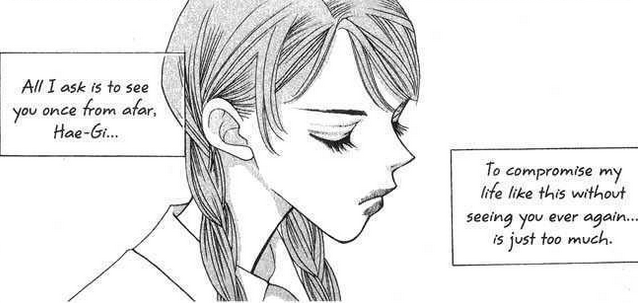
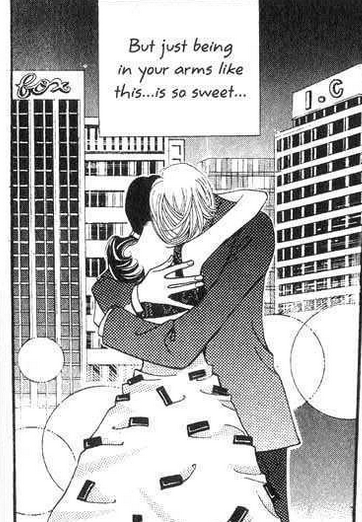
At this point, Hae-Gi and So-Na have not seen each other in at least a year. So-Na travels to America with Hwi-Rim just so she can see him. Literally, just to look at him. Because she swore that she would never see Hae-Gi again, So-Na has no plans to interact with him. When she does get a glimpse at him, though, she’s so overwhelmed she has to run away. Hae-Gi spots her and chases after her, and the couple finally meets again. It’s sad and romantic, and I love the artwork in this scene.

Volume 10: Ha-Da Rapes Ko-Mo

It’s not graphic, but I still don’t want to put a picture up. Please enjoy this royalty-free picture of inter-species friendship instead.

I’ll try to make this quick, because I’m not sure how much more I can stomach. Ha-Da accidentally gets Ko-Mo high as balls (it’s a long story), and has sex with him. That’s bad enough, especially considering that Ko-Mo has spent most of the series trying to get Ha-Da to leave him alone. But, because Ha-Da is a “hero” in the story and we’re supposed to be cheering for him, Ha-Da having sex with a drugged up Ko-Mo can’t be seen as a villainous thing. We’re supposed to like this guy, after all. Instead of Ko-Mo being horribly scarred or attempting to kill Ha-Da (which he’s done), he falls in love. Ko-Mo falls in love with his rapist.

You here that, fellas? If they keep saying “no”, what they need from you is a good dicking.

Fuck. That.

This is even more troubling to me that So-Na dating Hwi-Rim. Hwi-Rim’s attempted rape of So-Na was portrayed as monstrous and violent, but Ha-Da’s rape of Ko-Mo was portrayed as romantic. All Ko-Mo needed to finally say yes to Ha-Da was a shitton of drugs.

This might be the worst thing I’ve ever read. And I once read a graphic fanfiction about Princess Leia and Optimus Prime.

Volume 11: Snow Drop Just Keeps Going
At least Romeo and Juliet stayed dead.

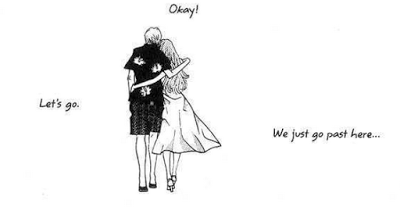
Snow Drop‘s tagline advertises the manhwa as “a Romeo & Juliet style romance”. I’d say that’s accurate, as both works feature feuding families and teenagers making stupid decisions. It really looked So-Na and Hae-Gi were going to go the same way as the original star-crossed couple, when they are shot and stabbed by their own family members. As they lay dying in the hospital, So-Na sees her mother and Hae-Gi in the afterlife. They are amazingly happy, but decide that they want to live together. They don’t die, their families forgive each other, and even Ko-Mo returns his feelings for Ha-Da. It’s a happy ending for everyone!

Except it doesn’t end there. The second half of the book looks like it belongs in a completely different series. The big conflict is that Hae-Gi wants to marry So-Na, but she thinks they’re too young. Finally, she says something sensible. Had I been the creator, I would have either killed them off, and let the second half of this book be about their families, or I would have ended it with Hae-Gi’s and So-Na’s happy ending.

Volume 12: Choi Kyuang-ah Just Gives Up


Choi Kyuang-ah is the creator of Snow Drop, by the way.

I’ve got nothing against happy endings. I think real life needs more happy endings. Even after such a dramatic series where everything is doom and gloom, it’s nice to see So-Na and Hae-Gi succeed, and eventually get married, with their parents approval. In fact, one of my favorite moments comes at their wedding, with So-Na’s father and Hae-Gi’s mother respectfully bowing to one another. But it just drags on and on after that. In fact, most of the book doesn’t even focus on Hae-Gi and So-Na. A good portion of it is dedicated to Hwi-Rim finding love (with a high school student…), and glamour shots of Hae-Gi and So-Na kissing and declaring how much they love each other. The only thing resembling a plot towards the end is So-Na being upset that she likely won’t be able to have children. Flash forward, and we see her, Hae-Gi, and their new baby.

Everyone getting what they want and living happily ever after isn’t a bad ending, but there are two things that bother me about it. First of all, a lot of this really feels inflated and unnecessary. It makes me wonder if Kyuang-ah actually intended for the series to end this way, or if there was some sort of contract stipulation that said “you need to create X number of chapters”. In one of the bonus comics illustrating her life, she even says that the ending was originally going to be much darker. I have to wonder if she gave us the light and fluffy ending because she wanted to, or if it was a case of editorial meddling.

The other thing that bugs me about the ending is that it just doesn’t fit with the rest of the series. Snow Drop is convoluted, violent, and over-the-top dramatic. This ending is so happy, and comes to the characters so easily, makes it feel like it was ripped from a completely different manga. It’s just…too happy, and too neat.

Final Final Verdict:

If you haven’t lost your lunch yet, I’ll be back on soon with The Magician’s Nephew by C.S. Lewis.