Unknown's avatar

Posts by booksoverlookedblog

Part time writer, full time bad-ass

Paradise Kiss 4: Childhood Friends

Something didn’t occur to me until just now as we dive further into Paradise Kiss: we’ve never seen Yukari’s “ordinary day”. Most stories, particularly those that follow a monomyth structure, usually have this “ordinary day” at the beginning, where we can see what the main character’s life is like before the adventure starts. This gives us a frame of reference for how the character’s life is about to be turned upside down, be it by hatching a dragon or meeting someone new. But we haven’t gotten your typical “ordinary world” with Paradise Kiss. There’s maybe two pages in the beginning of the book that focus on Yukari’s thoughts before she gets spotted by Arashi and Isabella, and taken to their studio.

And yet, without a typical ordinary day sequence, we get a good sense of what her life is like. School, then cram school, all the while wondering what she wants out of her future. I think the strangeness of going to the studio and meeting George and his crew would have been better emphasized by showing this ordinary day, particularly for non-Japanese audiences, but it’s not necessary.

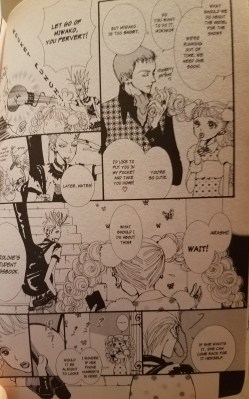
I only noticed this because chapter four is the first time we actually see Yukari at school, but we know from her narration that school is one of the biggest stressors in her life. We also – finally – meet Hiro Tokumori. Tokumori is one of Yukari’s classmates, and she has a big crush on him. In the first chapter, Yukari accidentally leaves her student passbook in the studio, where she happens to have a picture of Tokumori. She is

mortified at the thought that George might have seen the picture.

However, the day at school doesn’t last long, and we don’t see much of Tokumori. What I like about the Paradise Kiss studio crew is that, even if they haven’t had much screen time yet, I can already see some of their inner worlds, Miwako’s in particular. But not so with Tokumori. I’ve read the entire Paradise Kiss series before this, and honestly…I can’t remember a thing about his personality.

At this point, Tokumori’s presence and the photo is really only there to show Yukari’s budding attraction to George, though she won’t admit it yet, and probably doesn’t know it herself. It turns out George never saw the photo of Tokumori, and Yukari’s incredibly relieved. Here we see the beginnings of a conflict that has nothing to do with the fashion show. Yukari has a big crush, and she doesn’t want George to know about it. As I mentioned in my last entry, a good romance should have some realism to it, and this is exactly it.

After school, Yukari goes back to the studio, though she hasn’t decided yet whether she wants to model or not. She receives 20180625_102741133643277095666020.jpga shock after interrupting Arashi and Miwako making out on a pool table in the studio. Even though Yukari has stopped looking down on the art school kids by now, there’s still a gulf between her and them. It’s not that she’s shocked at the making out, that would surprise most people. But rather, Isabella, who is transgender, helping Miwako button up her shirt after.
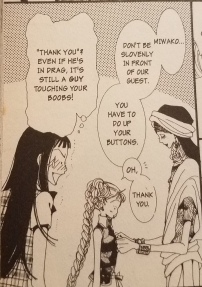
While Miwako and Arashi are both pretty comfortable with Isabelle, Yukari can’t help thinking of her as a man, and it’s one of those things that gets brought up a couple times in this volume. To her (and Yazawa’s) credit, Yukari doesn’t say anything hateful to Isabella about her being transgender. Right now it’s just something she’s geeked out about, but as the series progresses, that strange feeling Yukari has towards Isabella fades away, and soon Isabella’s gender identity isn’t an issue for her.

Embarrassed about the situation, Yukari offers to go out and get tea for everyone, and Miwako tags along. While they’re alone, Miwako asks Yukari about the photo of Tokumori in her student passbook, incorrectly assuming that Tokumori is Yukari’s boyfriend. As it turns out, Miwako, Arashi, and Tokumori used to live together in the same apartment. When I first read this, I assumed that they meant the same actual apartment, but now I realize that they could mean just the apartment building. It’s not entirely clear.

I only recently learned that before Paradise Kiss, Yazawa published another manga, Gokinjo Monogatari, which follows Miwako’s older sister, Mikako. Gokinjo Monogatari may answer some of the questions I have about Miwako’s and Arashi’s past, but I’ve yet to read it.

As far as the childhood friends turned lovers trope, I don’t hate it, but it’s not my favorite, either. I just don’t see it as all that realistic, depending on the age of the characters. I can buy high school sweethearts who fell in love, parted ways, and came back together. But I don’t think falling in love with your childhood friend that you’ve spent most of your life with is that realistic. Part of this is the Westermarck effect, which hypothesizes that children who live closely together during their early years will not find each other attractive as they grow older, seeing each other more as brothers and sisters than potential mates. Like most social theories, it can’t be proven or disproved, so I would like to offer up one of my own:

You just get sick of each other.

When you spend almost all of your days with one person, there are times when you’re going to get tired of each other. You’ll get irritated and fight, and need to take a break, be it for a few hours or a few days. It doesn’t mean that you don’t care about each other, it just means you need a break. This happens with friends, siblings, lovers, just about anyone who lives in constant close contact with another person. Often, the root cause of many of the fights I had with my sister were just because we’d spent too much time together.

This is actually addressed in the manga, when Arashi and Miwako are going through a rough patch. Miwako is concerned about Arashi’s silence, and he just tells her that when you’ve talked to someone else almost every day of your life, at some point you’re going to run out of things to say. The usual cutesyness of the childhood friends trope gets undercut by the problems in their relationship, one of which is the love triangle between Miwako, Arashi, and their childhood friend, Tokumori.

Most of the chapter is dedicated to Yukari getting to know Miwako better, and her shared past with Tokumori. Miwako is quickly becoming my favorite character in the book. While referring to herself in third person drives me crazy, she’s adorable and chipper, like a ray of technicolor sunshine. Between Arashi’s brash attitude and Yukari’s cynicism, Miwako brings some joy into an otherwise dramatic series.
Paradise Kiss 3

I’m still working on the question of “is Paradise Kiss objectively good?” as I read through this book. To be honest, I’m liking it a lot more than I thought I would. One thing that I forgot about romance manga, though, is that the plot and character development tends to move more slowly than, say, an action or fantasy manga. And there’s nothing wrong with that. Romance isn’t just about the main characters falling in love, or the steamy scenes everyone looks forward to. They’re about attraction, longing, and the tantalizing conflicts that make the relationship seem impossible.

A good romance needs nuance and realism without leaving behind the fantasy: of a gorgeous man stealing a kiss, or a smile from that mysterious woman on the train, or that meet-cute in the book store you’ve always secretly wanted.

The third chapter of Paradise Kiss shows us the first real interaction between Yukari, and her future lover, George. At least, first interaction where Yukari isn’t freaking out.

The slow pace feels relaxing and real as they meet “by chance” in the library, though Yukari later learns that George had planned it. There, she starts to see another side of George, one that wasn’t apparent when she herself was being swept away – literally – by the other characters who want Yukari to model for them. In this one-on-one setting, Yukari starts to see George’s ambition and work ethic. She’s also envious that George knows what he wants to do with his life and has a dream, while Yukari isn’t sure what hers really is.

Yukari’s inner conflict about not knowing what she wants to do is very relatable. Like many people, she’s done what she’s been told: good family, good background, go to school, prepare for college. This hasn’t made her happy, and she doesn’t know, exactly, what will. She doesn’t know what her passions are. It’s an uncomfortable place to be. If the Paradise Kiss students are shining stars, Yukari is a white dwarf.

The real significance of this scene is that Yukari shares her troubles and feelings with George. Before, we’ve only known about them through her narration, and she’s moved to tears because George wanted to listen to her problems. Which kind of makes me wonder, what kind of lonely life does she have, where George is the only person who wants to listen to her?

Paradise Kiss 2: Meet the Cast

The second chapter of Paradise Kiss gives us a proper introduction to George, Yukari’s love interest. Yukari had left her student passbook at the studio, and George takes Yukari to his high school with the promise of returning it. Yukari is more than a little freaked out when he picks her up, especially after George’s cryptic promise to take her to “Paradise”.

In this chapter we learn more about our cast, and I was a little surprised to find that I actually liked Yukari this time around. When I first read this years ago, I thought she was just a downer, who spent most of her time complaining and being stand-offish. Now I understand her character better. She’s a young woman who’s uncertain what she wants to do with her life, but knows that she wants something more than what she has now. Everyone can relate to that.

George, on the other hand…I never liked George. When I was younger, he struck me as too arrogant to be truly likable, and too forward with Yukari for me to be comfortable with. At the moment I can’t cast judgement on the romance aspect of their relationship, as it doesn’t start until the end of the book, but I can still say that his arrogance remains intact, and I still don’t like him for it.

Then there are the others in “Paradise Kiss”, the fashion studio that George and his friends run. This chapter focuses on Miwako and Arashi, with the pattern designer Isabella out of the spotlight. As much as I hate the way Miwako talks (culturally relevant, yes, but still annoying), I can’t help but like her. She’s bright and sunny and struggles with her own insecurities as an artist. For example, Miwako’s older sister is also a fashion designer, and Miwako wanted to follow her sister’s footsteps. However, Miwako also says that she’s not talented enough to be a designer. Everything she designs comes out looking too much like something her sister would make, and she doesn’t have an artistic style of her own.

That one stung a little bit. When I was a kid, I wanted to do everything my sister did. I grew out of that, but I still admire my older sister and look up to her in a lot of ways. But I also understand Miwako’s self-doubt, especially as I’m trying to make a career for myself as a writer. You’re worried about finding an original idea, or everything sounds the same, or comes to close to a book you’re reading. It can be a struggle to find your own voice. Miwako has kind of given up on doing just that, but is still dedicated to helping George and making clothes.

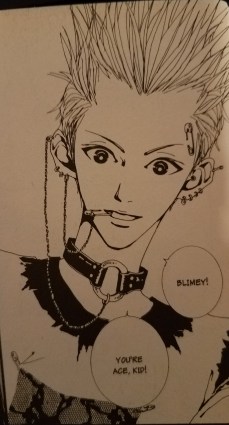
Then there’s Arashi. My question is: is he supposed to be British? Like, a British punk? He frequently says “blimey” and his dialogue is written to evoke a vaguely English accent. But he’s Japanese, right? I don’t recall any backstory where Arashi went to England for a study abroad, or anything like that…

That said, Arashi’s speaking patterns may have something to do with dialect, regional language differences. These are details that may be a bit confusing when translating a manga from Japanese too English. For example, in one translated manga I read, a Kansai dialect was written to sound like a country accent, or slang. Is this just Tokyopop’s way of trying to do that?

As for the character  himself…Are you British or not?!when I picked the manga up for the first time, Arashi was the character I really wanted to like. I loved his punk look, especially the safety pin lip ring.

But he’s rude and abrasive, though at the time I allowed his perceived hotness to make up for that. Now that the hotness factor has faded for me, he’s just a jerk. Miwako, why are you dating him? You could do so much better.

Paradise Kiss 1: Welcome to Paradise

There’s been a theme in the books I’ve been choosing for this blog. You may have noticed it: “Here is a book from my youth that I liked, does it still hold up?” While the answer changes depending on the book, I’m taking a slightly different approach to this new series. Because instead of taking something I loved, I’m taking a series that I didn’t really care for, but probably should have.

Paradise Kiss by Ai Yazawa is, to me, the Cowboy Bebop of the shojo genre. I’ve heard it praised to high heaven for its art style, the story, the characters, and clothes. Definitely the clothes. I am led to believe that it is objectively good.

But, like Cowboy Bebop, I really didn’t care for it, and was a failure of an otaku for that reason. However, when I watched Bebop when I was older and in college, I enjoyed the show much more. I first read Paradise Kiss at age fourteen, borrowed from my older sister, who loved the series.

Now I’m going to dive back into the world of high fashion and teen drama, while keeping two questions in mind:

  1. Has Paradise Kiss improved with age, specifically my age?
  2. Is it objectively good?

Let’s get started.

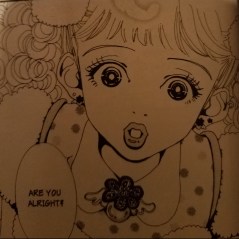
One of my main hang-ups about Paradise Kiss when I was younger was that I really didn’t like the main characters, Yukari and George. I remember them being both pretty stand-offish and arrogant, and it doesn’t take long in the first chapter for Yukari to show how judgmental she can be. But I was surprised at how similar we are in the first panel.

20180604_102709.jpgIt’s not just Yukari’s cynicism that I can relate to, though I have that in spades. But as I’m writing this, I’m living in a large city for the first time in my life. Getting anywhere is a terror, and what would be a five minute drive at home takes a good fifteen minutes here. It’s full of lines and crowds, which can be really anxiety producing for someone like me. I’ve lived here for the better part of a year now, and there are still aspects of it I haven’t gotten used to. And I will never, ever like city driving.
Maybe I really did need to be older to enjoy this. Older and grumpier.

Another thing that I like about this book, for the most part, is the art. It’s very stylized and different from a lot of the manga I was reading at the time. I really like that it’s more “mature” looking and the characters’ eyes don’t take up the majority of their faces. Flipping through the pages of this book, there are only a couple things about the overall art style that I don’t like.

The first is the hands. Close-ups show the hands to be long and knobbly, which fits with the style. I just can’t get over the giant monster hands.

The second thing that bothers me is the character Miwako’s lips.

Terrible photo quality is terrible

They’re emphasized in a way that they’re almost cartoonish, and I can’t figure out why. At first I thought it was to show that she’s wearing lipstick or makeup, but Yukari doesn’t get fish lips when she has make up on.

20180604_103045.jpg

My final issue with the book’s art is the panel layout, though that’s probably not Yazawa’s fault. Tokyopop, the publisher, is notorious for shrinking panels or cutting them, which is what most likely happened here. Furthmore, Paradise Kiss was originally published in a magazine, which would have given the artist more room for spacing out her panels. Shrinking it down to book size, unfortunately, makes the pages look crowded.

20180604_103130.jpg

Storywise, Paradise Kiss moves pretty quickly. It ought to, as it’s only 5 books long. We’re barely introduced to Yukari before she is accosted by Arashi and Isabella, two members of the titular Paradise Kiss fashion studio. Yukari is so shocked she faints. They take her to their studio, where they ask her to be their model. The ball’s a’rollin’. I could complain that the story moves a bit too quickly, except Yazawa does a great job of characterizing Yukari even in this fast-moving introduction. We also meet Arashi, Isabella, and Miwako, whose first impressions are likewise true to their characters as well. And at least this way we don’t have to get dragged through the introductory period of “Yukari is unhappy with her life and wants something more.” We get that right away, and learn more about her as the first chapter progresses.

As manga go, though, I’d say this one is not for beginners. This series is heavily rooted in Japanese culture, and if you’re unfamiliar with it, some of the significance of the story can go over your head, or drive you crazy. For example, Yukari is constantly worried about studying and getting into a good college, and complains about all the pressure on her. This isn’t uncommon for most high school students, but here it’s brought up to the level of melodrama…if you read it as an American. But Japanese students are under an insane amount of pressure to keep good grades and go to good schools. There are entrance exams not just for college, but high schools, junior high school, and even elementary schools. When I studied the Japanese language in college, my professor told us that there was a saying in Japan: if you get five hours of sleep, you fail; if you get four hours of sleep, you pass. While I can’t tell you how true this proverb is, it does show the high expectations placed on students.

Another thing that was driving me crazy until I looked it up was Miwako’s speech. She never says “I”, but always refers to herself as “Miwako”.

20180604_103237.jpg

I really couldn’t figure out why she was speaking this, and I’ve it done with other young female characters before. I suspected that this was a way for Yazawa to portray Miwako’s innocence or childishness. After a few minutes of Googling (Read the answer here!) I learned that women under thirty in Japan will refer to themselves by their first name rather than a first person pronoun. However, they would only do this in informal and private settings, like home, but not at school, and not with strangers. So Miwako referring to herself as “Miwako” also shows her character, but not in a way that I expected. When she calls herself Miwako, it tells a Japanese reader that she’s comfortable in the studio, and that she’s friendly enough to use her first name around someone she’s just met. To an American like me, it just sounds weird until I learned the deeper meaning.

Eragon: Final Thoughts

Sometimes, after watching a bad movie or reading a bad book, I like to think about what could improve it. If there was one thing I would change about the movie The Warriors, for example, I would have cast younger actors. Not even necessarily better actors, but younger.

As I read through Eragon, I wondered what might the the one thing I that could have been done differently to improve the book. Most of my complaints about the book were related to its characters. The majority of the cast just wasn’t interesting or sympathetic. But saying “make the characters suck less” is much too broad of a generalization. “Give Eragon a personality” is better, but I came upon something truly befitting the spirit of Eragon.

A formulaic story needs some formulaic improvement. As it stands, Eragon isn’t a well-developed character; he’s just reaction. To give him some depth and make him more relatable, my suggestion would have Eragon go through the Kubler-Ross Stages of Grief. Eragon loses so much over the course of the book: his uncle, his home, and his mentor.

When Garrow and Brom are killed, Eragon cries a lot and tries to honor the deceased. Then he adds their names to the list of reasons to kill the Ra’zac. And…that’s kind of it.

But if you’ve ever lost someone that you care about, you know the grief doesn’t just go away. It’s surreal, there’s a pain you can’t describe, and it never really goes away. Not totally.

Or, as Lemony Snicket put it so perfectly:

It is useless for me to describe to you how terrible Violet, Klaus, and even Sunny felt in the time that followed. If you have ever lost someone very important to you, then you already know how it feels, and if you haven’t, you cannot possibly imagine it.

It is a curious thing, the death of a loved one. We all know that our time in this world is limited, and that eventually all of us will end up underneath some sheet, never to wake up. And yet it is always a surprise when it happens to someone we know. It is like walking up the stairs to your bedroom in the dark, and thinking there is one more stair than there is. Your foot falls down, through the air, and there is a sickly moment of dark surprise as you try and readjust the way you thought of things.

We’ll start off with denial. To summarize, denial is when you can’t believe that the loss really happened. Suddenly your world is flipped upside down.

Denial can be over in hours; it can last for days. Looking back through the book, it seems like Eragon skips this stage entirely. In fairness, when Garrow and Brom die, there is a sense of urgency, and he can’t take the time to fully process what’s happened. And while we see him cry, we don’t see him shocked, or numb.

But let us see him turn ahead, thinking he saw Brom out of the corner of his eye. Let him believe, however falsely, that someday he can return to his home village a hero. Then the true weight of his loss becomes apparent and tangible to the reader.

Next in the Kubler-Ross stages of grief is Anger. Anger in grief can be directed at anyone and anything: yourself, your family, a co-worker, God. Since Eragon’s first instinct is to vow revenge on the Ra’zac who killed Garrow and Brom, he’s kind of got this one in the bag. But we could do more with it.

What if, instead of just vowing revenge, Eragon turns his anger towards Saphira? After all, without her, Garrow wouldn’t have been killed. Maybe if she hadn’t been so scared of the Ra’zac and stayed to fight them, he would still be alive. Or if she’d tried to fight them after she and Eragon were captured, instead of giving in? These are questions that Eragon will never know the answer to. He lashes out at his dragon, his closest companion who has done everything in her power to protect him. He blames her for their deaths, wants to send her away. But their minds are connected forever, all the while Saphira tries to remain close to Eragon, no matter how he claims he hates her. That is something that I would like to read.

Next, we move on to bargaining. Bargaining might be easier to understand from the perspective of someone who’s dying, or someone whose loved one is in the process of dying. “God, if you let me get out of this one, if you let me live until Christmas, if you give me a few more years, I’ll do whatever you want.” After a loss, bargaining can manifest itself in regrets and “if onlys”. If only I had prayed harder, if only I’d really given the doctors a piece of my mind, if only my actual dragon hadn’t run away or surrendered so quickly. This could easily feed into the hypothetical anger Eragon might have had towards Saphira nicely.

After bargaining is depression. This is probably what most people think of when they hear the word “grief”. Depression is sadness, but it also runs deeper than that. Depression is a feeling of hopelessness, where every day can be a struggle to get out of bed. It steals away your energy and replaces it with feelings of worthlessness. People tell you to keep your chin up, but you can’t see a way out.

Depression sucks, and it’s hard to shake. It’s also not often considered socially acceptable for men to express depression and sadness. In fact, it’s not uncommon for depression to manifest in men as anger, because anger is an “acceptable” emotion for men to display.

This would make adventuring pure hell. Eragon accepts that he and Saphira couldn’t do anything to save Garrow and Brom, and understand that there is nothing that can bring them back. He is apologetic for his anger at Saphira. But he begins to see himself as helpless. After all, he’s the first new Dragon Rider in decades, and yet he can’t protect a small village. Should he continue this journey, or just cut his losses and go somewhere no one can find him, away from the Empire? Every day is a struggle to continue towards the Varden. Because, surely, they’ll see how weak he is, that Saphira should have chosen someone else to be her Rider. He keeps these feelings of inadequacy quiet, but Saphira knows how they trouble him. Despite all the times he’s lashed out at her, she stands by him, reassuring him that she made the right choice, offering him the support he needs to get through this dark time.

As we come to the book’s climax, Eragon also begins to reach the stage of acceptance. Acceptance doesn’t mean that Eragon’s “okay” with his losses or has somehow overcome the pain of them. It means he acknowledges that Garrow, Brom, and that his life will have to go on without them. As he battles with the Varden against the Urgals, Eragon thanks Brom for his training and guidance, without which he wouldn’t have made it far. He can think of his home, knowing he can never truly return, but also knowing that when he fights against the Empire, he is fighting for Carvahall. When the battle is over, he can look back at all the things he’s learned, and will grow from it. After contact with Oromis, who will become Eragon’s next teacher, he is able to re-emerge from his grief know that there is a future.

And that, ladies and gentlemen, is how I would improve Eragon.

Eragon 60: The End

This is it.

We made it, guys. We did it.

Nearly 500 pages and a couple unplanned hiatuses later, Eragon is finally finished.

I would normally call for a celebration at this point, but after the trials that Eragon and I both faced getting to the end of the story, I’m not sure a party isn’t what we need. No, the proper way to send off Eragon is with a stiff drink and quiet contemplation of what we’ve been through.

Or I could just review the final chapter like normal, I guess.

Eragon has finally killed Durza, and the Shade’s memories and mind flow into his. He struggles to separate himself from Durza, “weakly at first, and then more strongly”. This being the last chapter, I promise not to fuss too much about the adverb abuse in that sentence. Instead, I’ll just say this: ick.

Eragon then receives a telepathic message from “The Mourning Sage” or “the Cripple Who Is Whole”, but this mysterious person never gives Eragon his actual name, just his titles. It bugs me a little bit. Why keep your name a secret?

It’s Oromis, by the way. His name is Oromis. Was that hard?

Oromis tells Eragon that he and Saphira need to travel to the elven land, Ellesméra, and promises him answers to all Eragon’s questions. Then he instructs Eragon to stay quiet about talking with him. Which again, I have to ask, why?

I don’t really remember how the group decides to bring Eragon to Ellesméra in the second book, but if Eragon’s not allowed to talk about Oromis, it could be really awkward.

“Let’s go to the elves!”
“Eragon, why are you suddenly insistent on going to the elves?”
“You know…dragon…stuff…”

At this point Eragon knows almost nothing about Oromis or Ellesméra. I’m sure one of his companions would love to help him out and give him more information, but he’s supposed to keep it secret.

Eragon’s reunion with Saphira after the battle did make me smile, but for the most part, this chapter is just a lot of talking heads. Arya, Saphira, and Murtagh explain the results of the battle, but no one has any real emotion. Arya looks sad again, but that’s about it.

Yeah, this is what I want at the end of my exciting action-adventure story. Bland summaries of the cool stuff we didn’t get to see. The book doesn’t even end on a satisfying note. Just having it end after Eragon kills Durza would be great. You could have a heartwarming reunion with his friends, they sum up the battle, and then look hopefully towards the future together. But we get the introduction of another character, with Eragon pledging to go see this person we know nothing about.

But for sixty chapters, I’ve mocked, ridiculed, and occasionally yelled at this book. But I want to give Eragon and its author, Christopher Paolini, some credit. It really wasn’t all bad; I think there are very few books that are 100% terrible. I can see how it would appeal to teenage fantasy lovers, like it did to me so many years ago.

There are things that Paolini did well over the course of the story, and I want to acknowledge that. First, he put a huge amount of effort into worldbuilding and lore, and it paid off. Sometimes it did get a bit bloated, but it also made me seriously consider finishing reading the series. I still want to know what the Vault of Souls is!

Paolini’s descriptions, particularly of flying, were great as well. Like the lore, sometimes it could drag on for too long, but it was never difficult to visualize the various settings. A lot of the action sequences were clear and easy to follow, and had I not read them before, would probably be pretty exciting.

The storyline was formulaic, but even a generic plot can be saved by great characters. This is the real problem with Eragon: most of the characters have no personality of their own, and rarely stand out.

To be totally honest, this novel is an achievement for a teenage writer, and was way better than anything I could have come up with at that age. And it was perfect for me as a fifteen-year-old reader, who loved escaping to a world of dragons and magic.

You know, the last Eragon book came out at least five years ago. I wonder what Paolini’s working on now…

Eragon 58-59: They Did Something Smart!

I need to take a moment to applaud both our heroes and our villains for doing something smart for a change. The Varden discovers that Urgals are planning to attack their stronghold by coming up from the tunnels that run under the mountain. They respond with some strategic planning, including collapsing several tunnels so they can control where the Urgals will come out.

Even Eragon is relatable. Unlike the other fights in the book, this is the first battle that he has forewarning about. He’s filled with dread and apprehension about the upcoming fight, as most of us would be. He’s still a little dumb though, as when he’s presented with armor for Saphira, he can’t figure out that it’s not meant for a human.

Most of this chapter is about building tension for the upcoming battle, but drags out too long. The book is pretty formulaic, and doesn’t divert much from high fantasy tropes. We already know that Eragon and Saphira are going to come out on top, and that the characters that we care about are more likely than not to be fine. This isn’t A Song of Ice and Fire. Our main characters aren’t going to die, and most likely, neither will anyone we’ve just met. Maybe one or two named characters will get killed to show that the Urgals are dangerous, but not all of them. We also haven’t known these characters long enough to provoke a real emotional response if they were killed.

And then there’s this paragraph.

The men were silent, ironfisted. Their hair flowed loosely from under their helmets. Many warriors only had a sword and shield, but there were several ranks of spear- and pikemen. In the rear of the battalions, archers tested their bowstrings.

In the midst of paragraphs talking about battle preparation and how brave and stalwart the warriors are, there’s just one out-of-place sentence describing their hair. I assume that this is what Paolini pictured, and he wanted to reader to get the same image, but…it’s just so weird.

This trend of a single sentence throwing me off continues in the next chapter, when Arya announces the battle has begun “with a sorrowful expression”. Why does she look sad? She’s facing off against the people who tortured her for months. Shouldn’t she be angry, or determined to protect the Varden, or something?

That said, I actually caught myself getting sucked into this chapter. Battles are difficult to write. I appreciate that Paolini gives us details about the fight, rather than general statements like “there was a flurry of blows”. It’s also pretty easy to follow and visualize what’s going on. The only point when I was confused was during Eragon’s final confrontation with Durza. The Shade has the upper hand in their duel, and badly injuries Eragon’s back. Except they were facing each other, so I’m not really sure how his “sword smote heavily across Eragon’s back”. Perhaps an actual swordsman could explain this to me, but for now, I’m just confused.

The battle was still exciting to read, even if I knew how it ended. Arya breaks the giant star sapphire, Saphira breathes fire for the first time, and Eragon finally kills Durza. It was a satisfying climax to an otherwise unsatisfying book.

Even if there’s a scene where Eragon uses a giant slide to get from the dragonhold at the top of the mountain back to the battle. That will never not be silly.

Eragon 56-57: Fantasy Pet Peeves

The next chapter’s title, “Hall of the Mountain King”, made me hesitate. I was certain that this was just going to be another long chapter full of description and little else. I was wrong on one count: it isn’t full of description. But the “little else” part rings true. Here, Eragon meets the dwarf king Hrothgar, and…that’s it. Hrothgar, who plays so small a role in the overarching story that it’s hard to care about anything he says. Not that he gives Eragon (or the reader) a lot of new information.

It does, however, hit on one of my more recent pet peeves about high fantasy stories.

Why is everything so ancient? There’s a sword that was forged hundreds of years ago, an unbroken history with few (if any) holes in it dating back a thousand years? Why did all the technology advancement stop at medieval siege weaponry? You had a millennium for your race to develop actual advanced technology, and the best you can come up with is a sword?

It shouldn’t take that long for someone to figure out gunpowder, or indoor plumbing.

For some perspective, humans flew in manmade aircraft for the first time in 1903.  Not even a century later, we landed on the moon.

I understand that technology advances exponentially, and that we–the human race–were stuck with primitive technology and weaponry like swords and shields for so long because people centuries ago didn’t live that long. Medical science has helped us stay alive longer, along with basic education and knowledge in regards to our own health and well-being. So I acknowledge that it is realistic for a society in a medieval setting to have not made much progress. For the humans, at least. But for the long-lived and disease resistant dwarves and elves? What’s their excuse?

I bring this up because the dwarf king Hrothgar is super old, which he says himself.

For eight millennia–since the dawn of our race–dwarves have ruled under Farthen Dûr. We are the bones of the land, older than both the fair elves and the savage dragons. [. . .]

I am old, human–even by our reckoning–old enough to have seen the Riders in all their fleeing glory, old enough to have spoken with their last leader, Vrael, who paid tribute to me within these very walls.

According to the Inheritance Wiki (There really is a Wiki for everything), roughly 100 years have gone by between Vrael’s death via crotch shot and Saphira’s hatching.

Hrothgar takes a lot of pride in his heritage, as well as his age. But then, after Eragon says he wouldn’t be interested in the throne once Galby is slain, Hrothgar says this:

Certainly you would be a kinder king than Galbatorix, but no race should have a leader who does not age or leave the throne.

Oh, you mean a king like you, Hrothgar? Or what about the immortal elves, and their queen, who also doesn’t age or die easily?

This would sound more like a piece of wisdom if it wasn’t mired in hypocrisy.

Eragon’s refusal of the throne, at least, sounds like he’s good for the sake of being good. There’s nothing wrong with that; not every character needs to be gritty and angsty with a dark side. It could be an admirable trait, if there was anything else distinguishing about Eragon’s personality. He’s just there, reacting to the situations around him, and doesn’t stand out as an individual in any way.

In the next chapter, Eragon is tested by the Varden to show both his magical abilities and swordsmanship. The Twins are up first, and ask Eragon to do a variety of magical tasks. He faces a few new challenges dealing with them, but after the initial task, we don’t get to see any of it. Everything else is glossed over, so we don’t get to see his creative solutions to the problems. In other chapters we’ll get paragraphs upon paragraphs of description, but when there’s something I actually want to read, it’s shoved out of the way.

In the final task, the Twins challenge Eragon to “summon the essence of silver” from a ring. Eragon doesn’t know how to do this, and they are interrupted by Arya. When he asks her about what the Twins were asking, Arya explains that they were asking him to do…

Something not even they can accomplish. It is possible to speak the true name of an object in the ancient language and summon its true form. It takes years of work and great discipline, but the reward is complete control over the object.

Let’s back up here.

In that (a), the Twins are magically stronger than Eragon and incapable of doing this task.

And (b), magic that is too strong for the caster to wield will lead to that caster’s death

I conclude that (c) the Twins just straight up tried to kill Eragon, while Arya and several others watched.

And no one, not Arya, not Orik, no one thinks that this is weird, or the Twins are evil. In fact, it never gets brought up again!

And I know that victim-blaming is bad, but if the Varden is this obtuse, they deserved to get betrayed.

After that attempt on Eragon’s life is ignored, Arya challenges him to a duel. Eragon is a bit hesitant to fight her at first. Even though she’s out and walking around, she’s still healing after months of torture and poisoning. She’s still in a weakened state…and beats Eragon easily.

This scene illustrates everything I hate about the elves in this series. Arya’s so beautiful, everyone stares at her as she crosses the training ground. Her voice gives Eragon chills. By all rights, she should have lost the duel, but comes out on top. All of this for one reason: she’s an elf.

The elves are immortal, infallible…and insufferable. They are a race of Mary Sues, and we are supposed to be in awe of their abilities. I’m not, though. Sometimes I wish I could just reach through the pages and wring Arya’s perfect neck.

Sadly, there is one more gripe I have to get out before we’re done with this chapter. Eragon goes to visit Murtagh in his cell. Murtagh is pretty comfortable, and says that even if he were free, he probably would spend most of his time in there anyway.  When asked why, he replies:

You know well enough. No one would be at ease around me, knowing my true identity, and there would always be people who wouldn’t limit themselves to harsh looks or words.

Seriously, Murtagh, you’re still on this? Like, four people know that you’re Morzan’s son, and two of them are Eragon and Saphira. It’s not like you’re going to wander around yelling, “I’m Morzan’s son! I’m Morzan’s son!”

I guess being a drama queen is better than being devoid of personality, but not by much.

Eragon 54-55: Stupid is as Stupid Does

Okay, I just need to know–how did the Twins ever get to be part of the Varden?

Just read Orik’s, Eragon’s Dwarf friend, description of them:

Their talents lie in scheming and plotting for power–to everyone else’s detriment. Deynor, Ajihad’s predecessor, allowed them to join the Varden because he needed their support…you can’t oppose the Empire without spellcasters who can hold their own on the field of battle. They’re a nasty pair, but they do have their uses.

How. Can no one. Suspect them.

Everyone knows that they’re evil and sadistic. It’s spelled out right in front of them. And yet no one, no one, even thinks that these two are responsible for the Varden’s information being leaked to the Empire?

This is so frustrating to me, that I’m just going to go ahead and say it: maybe the Varden deserved to get betrayed for being that oblivious.

Apart from that gripe, most of this chapter is nothing but backstory and world building, but it’s at least more interesting than a lot of the stuff in the beginning of the book. Paolini put a lot of thought into what it would be like to have a civilization housed inside a mountain, so props for those details.

I do have to give him credit for what I thought was just a throw-away scene the first time I read Eragon, however.  A woman comes up to Eragon with a baby, saying that the child has no family and asks Eragon to bless her. After some thought, Eragon does so, blessing in the Ancient Language by saying, “Let luck and happiness follow you and may you be shielded from misfortune.”

Pretty good blessing, right? Well, it turns out, Eragon messed up the blessing, and in fact said, “may you be a shield from misfortune”. Being shielded from and being a shield are two very different things, and this “blessing” is really a curse that comes back in a big way in the second book.

I really love how poor grammar leads to a major plot point later on in the story.

The following chapter is blessedly short, where Eragon finds out that Angela and Solembum are with the Varden as well, for some reason. Angela explains that when she realized Eragon was a Dragon Rider, she decided to head to the Varden, because something big was about to happen. Eragon tells her his story since he last saw her, and she’s rather wary when he mentions Murtagh. Apparently, she knows who he is.

Wait, wasn’t his birth kept secret? I guess I can just wave it off as Angela being some kind of witch and knowing plot-related things.

They discuss the Shade, Durza, as well. But there’s something that caught my attention when Angela explains how Shades are created.

Ordinary sorcerers are just that, ordinary–neither better nor worse than the rest of us. They use their magical strength to control spirits and the spirits’ powers. Shades, however, relinquish that control in their search for greater power and allow their bodies to be controlled by spirits.

So…Eragon’s magic, and the magic of the other characters, comes from manipulating spirits? This is the first time spirits have ever been mentioned in this book. It turns out that they’re really freaking important! If they’re the base of magic in this world, and responsible for creating Eragon’s current antagonist, then why is this the first time we’re hearing about them at all?

Even in Eldest, we don’t have an opportunity to learn more about spirits. Eragon asks his new teacher, Oromis, for information about them, and Oromis refuses to tell him anything. I never finished Brisingr, but as far as I read, I don’t recall any more explanations as to what spirits are or how they fit in with the magic of this world.

Yes, this may be a high-fantasy story with dragons and magic, but I want explanations for that magic, dammit!

Angela also mentions something that someone should have done something about before. Explaining how she got into Tronjheim, she tells Eragon that the magic users in the Varden wanted her to join their “secret group”, which is controlled by the Twins.

Wait, what?

Okay, if there’s a secret group (a rebellion within a rebellion?) and they’ve done a good job of hiding it, it would make sense that neither Ajihad nor Orik know about it. Since Angela is largely here for shits’n’giggles and wants her presence to remain hidden, she wouldn’t have any reason to report it.

Eragon and Saphira are here to take refuge and owe the Varden their lives. Ajihad has told them their is a traitor in their midst. That there’s a secret mage group led by the Twins who everyone agrees are bad news is a giant red flag.

Eragon is too stupid to notice this, and asks whether the Twins question her, as they did him.

Then he asks about the architecture of Tronjheim. Not the secret mage group. For all his curiosity, he can’t be bothered to find out anything more about something that is actually interesting and has potentially huge ramifications.

Eragon better be glad he’s fictional, because I want to smack him for that one. I’ll just try to be satisfied knowing that willful ignorance here comes back to bite him in the ass.

Eragon 52-53: Tronjheim

Two states and one long hiatus later, I’m back. And so is Eragon.

Fasten your seat belts, kids, this is gonna be a long one.

Well, chapter 53, “Ajihad”, is going to be a long one. The chapter before it, “The Glory of Tronjheim” is much shorter, and a lot less interesting.

From the start of chapter 52, I thought it was going to be a bit more standard for the book. After all, it starts with Eragon’s ham-fisted and direct characterization of Murtagh while they’re stuck in a cell in Tronjheim together. Then, he goes to examine a lantern nearby. The description of the lamp takes up an entire paragraph.

I should have known then. How could I not see it?

This is not a chapter with plot. It is ten pages of description as Eragon goes from one part of the city to another.

Credit where it’s due:  I’ve given Paolini a lot of shit here, but descriptions are one thing he does well. My favorite scenes in this book are Eragon and Saphira flying, or swimming in Leona Lake. Those moments are what make me keep reading this, because they capture something magical and beautiful.

There are authors who can evoke the setting in such a way that it becomes another character. Norman Maclean’s A River Runs Through It does this magnificently and Terry Pratchett’s Ankh-Morpork is familiar to me as any city I’ve walked through in real life.

I don’t think Paolini is quite at that level yet, but I’m honestly envious of his talent for description. It’s one thing that I’m always struggling to improve in my own writing.

Hey, Paolini, wanna team up? I’ll bring the characters, you bring the setting, and together we’ll make something halfway decent!

The real problem I have with this chapter is that it just kind of drags on. Nothing happens, other than “Eragon went here and saw a pretty thing. Then he went here and saw another pretty thing.”

I’m sure there’s someone who really liked this chapter for that reason. But that wasn’t me.

The next chapter, though, is much more interesting. Eragon meets Ajihad, the leader of the Varden, and our old friend “intense” makes a comeback!

He bore himself with great dignity, exuding an intense, commanding air.

Still not great writing, but at least “intense” makes more sense here.

Then Ajihad tells Eragon something truly baffling about the bald man who went through Eragon’s memories. He has a twin brother, equally bald and magical. But the truly bewildering part is that neither of the twins have names.

How the hell do they not have names? How hard is it to give someone a name? “From now on you’re George and you’re Elliot? You like those names? Cool.” See? It’s that easy. The Varden are literally denying these mages an identity. Treating them as non-persons is just asking them to betray you.

This all gets hand-waved away, though, because Ajihad discovers Murtagh’s identity by recognizing…Morzan’s voice. Apparently Murtagh and Morzan sound similar.

Much as I want to call bullshit on the “hereditary voice tone”, I can’t, because I’m told that I have the same voice as my mom. So I’ll give this one a pass.

Anyway, Murtagh refuses to let the Twins see into his mind, while he and Ajihad toss the word “probe” around a few more times, just to make everyone uncomfortable.

And Murtagh is so, so stupid. He thinks that everyone in the Varden will treat him like an outcast if they know who he is, which is entirely possible. Or–and stay with me here, Murtagh–he could just let the Twins examine him. Not only would he have information about Galby’s court that the Varden could use, they would see that he hates Galby.

Of course, no one can see this blatantly obvious solution, so Murtagh is imprisoned indefinitely. I know conflict is supposed to propel story, but this just seems so…unnecessary.

Eragon and Ajihad go one to discuss Eragon’s adventures thus far, and Eragon tells him about fighting and presumably killing the Shade Durza. But whenever I read a description of Durza, with his white face and red hair, he just sounds like Ronald McDonald to me. I guess clowns can be scary, but a fast food mascot hardly strikes fear into my heart.

Ajihad also fills Eragon in on just how Saphira’s egg wound up in the Spine, where our hero found it. This is important information and answers a lot of questions from the beginning of the book, and normally I like backstory. What I do not like, however, is a single character droning on for pages without any pause from the dialogue.

The tl;dr version is this: Brom stole Saphira’s egg, which will only hatch when the right person touches it. The egg is ferried between the Varden and the Elves, and the kids of each group would gather ’round and touch it, and see if it hatched. If it did, Brom and the Elves would share the responsibility of training the new Rider. Arya was attacked by Durza while transporting the egg, and magically teleported it to the Spine, where Eragon found it.

A few things here.

First of all, a species that can only reproduce by the right person touching its eggs might be the worst means of keeping a species alive. No wonder the dragons died out. Galby didn’t kill them all, their poor breeding techniques did!

Secondly, Arya is a princess, because of course she is. Why is she doing the dirty work of moving the egg from place to place? Doesn’t she have princessy things to do?

And what the hell was Brom doing in Carvahall in the first place? Eragon’s village is literally on the other side of the world from both the Varden and the Elven homeland. He couldn’t have known that the egg would disappear and then reappear in the Spine. Logically, he should have been with the Varden the whole time.

I’m not sure these questions are ever actually answered. At least, not as far as I’ve read in the series. At some point it’s revealed that Eragon is actually Brom’s son, so it’s possible Brom went to Carvahall to keep an eye on him. If I wanted to confirm this, though, I’d probably have to finish reading the series, but I have good books to read instead.

After the history lesson, Ajihad also tells Eragon some of the goings-on at the Varden, including encrypted notes discussing a place called Ithrö Zhâda.

Ithrö Zhâda.

After I read that, I had to put the book down and weep for the flagrant abuse of accent marks, circumflexes, and diaereses spread throughout this book.

I strongly suspect Paolini didn’t give a flying fuck as to how things actually sounded and just put special characters all over the place because they looked cool.

Though, to be fair, I would’ve done the same thing as a fifteen-year-old novelist.

But I digress. The notes and other evidence points to the Varden having a traitor in their midst. Well, gee, I wonder who that could be. The only other people we’ve met so far who don’t have names and the Varden doesn’t treat like human beings? And if the answer “The Twins” really isn’t that obvious, why doesn’t Ajihad just have the Twins scan everyone and see if they’re the traitors?

I’m beginning to think Ajihad is not such a great leader.

I’ll leave you with one last cringey quote from Eragon, which came straight out of nowhere:

I’ll fight when needed, revel when there’s occasion, mourn when there is grief, and die if my time comes…but I won’t let anyone use me against my will.