Unknown's avatar

Posts by booksoverlookedblog

Part time writer, full time bad-ass

Eragon 3: This is a Joke, Right?

It is truly shocking how little I care about the goings-on in Carvahall, Eragon’s village. Since I’ve read Eragon already and know what’s going to happen, there’s no tension in this chapter anymore. I wonder if this is one of the reasons I never read this book twice, despite how much I enjoyed it the first time around. So far it’s the longest chapter in the book, and it’s nothing but exposition.

Before I get into that, though, I want to pick apart the text.

“He helped himself to a piece of chicken, which he devoured hungrily.”

Does anyone else see what’s wrong with that sentence?

I’ve taken enough creative writing classes to know that you should (a) avoid adverbs and (b) use verbs for description.

I love how Stephen King put it in his memoir, On Writing:

“I believe the road to hell is paved with adverbs, and I will shout it from the rooftops. To put it another way, they’re like dandelions. If you have one on your lawn, it looks pretty and unique. If you fail to root it out, however, you find five the next day…fifty the day after that…and then, my brothers and sisters, your lawn is totally, completely, and profligately covered with dandelions. By then you see them for the weeds they really are, but by then it’s–GASP!!–too late.”

One or two adverbs here or there are okay. Too many, though, and they become annoying and repetitive, and make your writing look lazy and weak.

And this ties into into (b) use verbs for description.

Don’t get me wrong, adjectives are great. But verbs are better.

Compare:

“I don’t like it,” she said in a soft voice.

To:

“I don’t like it,” she whispered.

They both mean the same thing, but the second sentence should feel stronger and put a more immediate picture in your mind than the first. If it didn’t, I’ve clearly done something wrong here. Like adverbs, adjectives can get ungainly when they’re overused. Don’t use two words when one will suffice.

If you haven’t figured it out yet, my problem with the above sentence is two-fold. Obviously, I don’t like “hungrily”. But it’s also redundant. If Eragon is “devouring”, he’s clearly hungry; there’s no need to say he devoured something “hungrily”.

“Eragon devoured the chicken.”
“Eragon hungrily ate the chicken.”

Either of these would have been better than what we got.

I just spent way too much time picking apart one sentence that’s probably gone unnoticed by most readers.

As for the rest of this chapter, it’s mostly just exposition. A good portion of it is just the villagers talking about how much they hate the Empire. I think it would be better if it was done using more dialogue and didn’t rely on the narration so much, but it also seems to repeat itself a lot.

The most important part of this chapter comes at the end, when Brom tells the story of the Dragon Riders. They were a group of Mary Sues humans and elves who rode dragons and kept peace throughout the land. So, you know, Jedi, but with dragons. As you might imagine, some tragedy befell them, and now the Dragon Riders are no more. Or, as Brom tells it:

“‘Some saw his abrupt rise as dangerous and warned the others, but the Riders had grown arrogant in their power and ignored caution. Alas, sorrow as conceived that day.'”

Hahaha! This is another case of flowery words backfiring. “Conceived”? Really?

“Brom, how did the Riders fall?”

“Well, Eragon, when a Dragon Rider loves arrogance very much, they conceive sorrow!”

The story is about a Rider named Galbatorix…

…yes, that’s his real name. Not a name that he took after going crazy and becoming evil. Sigh.

Galbatorix’s dragon was killed, he went crazy, and the Riders refused to give him a new one. Now, Brom talks a lot about how cunning Galbatorix is, and how skilled he was with magic and a sword. Basically, a real bad-ass. When he goes to overthrow the Riders, though, he can only do it with the help of an accomplice, Morzan.

“‘Galbatorix convinced Morzan to leave a gate unbolted in the citadel Ilirea, which is now called Urû’baen.'”

Two things here: First, all of those names are so cringe-worthy. The dragon Galbatorix steals is even named “Shruikan”. You know, “shuriken” spelled wrong.

Second, Brom spent so much time telling us how dangerous Galbatorix was on his own, I’m kind of finding it hard to believe that all he needed was a gate left open instead of melting the lock with magic, or blasting it open, or disguising himself as another Rider. Once Shruikan is all grown-up, Galbatorix and thirteen other defectors kill the other Dragon Riders. Vrael, leader of the Dragon Riders, fights Galbatorix, but…well, this is the part where I nearly threw the book down with rage.

“‘As they fought, Galbatorix kicked Vrael in the fork of his legs. With that underhanded blow he gained dominance over Vrael and removed his head with a blazing sword. [. . .] And from that day, he has ruled us.”

A crotch shot?

A CROTCH SHOT?!

THE WORLD WAS CHANGED BECAUSE OF A CROTCH SHOT?!

THE ENTIRE WORLD COULD HAVE BEEN SAVED IF VRAEL WORE A CODPIECE.

WHAT IS THIS SHIT.

Eragon 1-2: SO INTENSE.

When I began this blog, I knew right away that I wanted to re-read Eragon for it, mostly to see if the book I loved as a teenager was as bad as everyone said it was. I did have one pretty big hang-up about getting it started: the length. Almost 500 pages long, reading a book this size was no mean feat for a fourteen-year-old, and might prove to be even more of a challenge for an adult with a full-time job who spends most of her weekends either traveling or working. Sometimes both. And this book gets pretty heavy as a carry-on. Plus, the table of contents alone is 3 pages long. That’s a lot of chapters to review.

Flipping through the book, I realized that the chapters don’t have even lengths. The first chapter is about 2.5 pages long, as is the second. They’re fairly quick reads, and though I expect some big, fat chapters later on in the book, right now it doesn’t seem like such an intimidating project. But I do have a good backlog of posts, so…let’s give it a shot.

Chapter one introduces us to the titular protagonist, Eragon. We learn that he’s just a teenager (because of course he is), who’s a skilled hunter and tracker. The prose isn’t bad, but there’s just something about it that feels lacking. It seems like Paolini was reaching for flowery language, but prose that is still easy to understand.

What doesn’t feel lacking is just over-the-top. Three paragraphs in, and I’m already scoffing over Eragon’s description:

“Eragon was fifteen, less than a year from manhood. Dark eyebrows rested above his intense brown eyes.”

It’s the “intense brown eyes” that gets me. That’s the kind of phrase I would have used in fanfiction when describing a character. It’s a description that just doesn’t make sense to me. When someone has “intense” eyes, I can only picture a person whose eyes are unearthly–in that they’re glowing, or can hypnotize you with a stare. For me, it’s just too vague to actually mean anything.

However, his ridiculous eyes do lead him to a blue stone, the same one that the elf was carrying in the prologue. I think that there’s supposed to be suspense here, but anyone who read the inside flap of the book can tell you right away it’s got something to do with the blue dragon on the cover. However, it does lead us to the first sentence that made me laugh out loud in this book.

“The stone was cool and frictionless under his fingers, like hardened silk.”

It’s another case of trying to using flowery language, except it backfired hilariously. I know that he’s trying to say that the stone is really smooth, but “frictionless”?

If it were truly frictionless, Eragon wouldn’t be able to hold it. It would be sliding out of his hands, slipping through the forest, and no one would ever be able to catch it. The mental image of that–a huge blue stone, forever moving across the world–is funnier than it should be to me. Maybe because right now I’m wishing that’s what would really happen.

…maybe that’d be a better way of keeping the stone safe, rather than teleporting it somewhere where it might never get found, or worse, fall into the wrong hands?

And that about does it for the first chapter. Like I said, it was pretty short. Moving on to the next…

The first two pages of this chapter are nothing but description. It’s not bad, and it wasn’t even that boring. We’re also introduced to Sloan, the butcher. I never liked Sloan; as a kid it was because he’s a dick. Now, it’s because he’s a dick to just the main character. He hates Eragon, and the reason that’s given is because Eragon isn’t afraid to venture into the mountain range where Sloan’s wife was killed.

I read the first two books completely, and almost finished the third one in this series. Some major shit happens to Sloan, and I think it’s meant to be his comeuppance for being an asshole to Eragon. It’s a pretty disproportionate punishment for just being a jerk. Even Eragon, who’s supposed to be our hero, punishes Sloan right after saving him.

I guess I should just be focusing on this book, and this chapter, but Sloan’s treatment gets taken too far.

We also see the farm that Eragon lives on, with his uncle and cousin.

Okay, I’ll accept dragons and magic and elves. I cannot accept that a farm has only three people living and working on it. If they can’t afford farmhands, shouldn’t Uncle Garrow have, like, eight kids? A farm is freaking hard to run, especially when you only have three people working on it, and one of them seems to be hunting in the woods more often than not, if Sloan’s dialogue is any indication.

Also, this is our first description of Garrow:

“His worn clothes hung on him like rags on a stick frame. A lean, hungry face with intense eyes gazed out from under graying hair.”

SO INTENSE. What does that even mean?

Eragon Prologue: A Scent that Would Change The World

Hoo, boy.

When I started this blog, I knew right away that one of the books I wanted to read for it was Eragon. I loved this book when I was fourteen, but I’m aware of all the terrible reviews it’s gotten. The main character has been called a sociopath, the overall story is said to be Star Wars with dragons, the writing’s been called proof that Paolini has access to a thesaurus. Now, it’s time for me to go back and see if any of that is true.

But before we go any further, let’s get the Star Wars thing out of the way right now. The first Star Wars movie (A New Hope)  follows a classic monomyth structure. This is where a lot of familiar storytelling devices come from: the call to adventure, the wise old man, the first failure. The protagonist succeeds and fails, and finally wins the day and learns a lesson.

Eragon, inasmuch as I remember, follows the same monomyth structure. It’s not necessarily that it’s a rip-off of Star Wars, but that it follows the same story structure that has existed…probably for as long as stories have. Can you really blame a fifteen-year-old novelist, in his first book, for using a tried and true formula?

Well, yes, I suppose you could.

Enough of that, let’s jump right in!

“Wind howled through the night, carrying a scent that would change the world.”

Oh my God.

That’s the first line of this series.

That’s the first line.

If I spotted this in a bookstore today, picked it up, and read the first sentence, I would have slammed it shut so fast. I have a terrible feeling that the awful, corny sentence I just read is going to set the tone for the rest of this book.

But I loved this book as a kid. And it was really popular! There’s gotta be a reason why so many people enjoyed it! It can’t be all bad, right?

…Right?

The prologue follows a “raven-haired” (groan) woman who is clearly on a mission, but we don’t know what that mission is. The first time I read this book, I was totally confused, and had no idea what was happening. Because I was an idiot, I took that as a good thing.

My reasoning was this:

1. The Similarillion is a great book.
2. I had no goddamn clue was was going on in The Silmarillion.
3. Therefore, if I didn’t understand what was happening in the long fantasy novel, and it had a lot of made-up words, it was good.

Now I know the opposite to be true. Confusing your audience is a good way to lose them pretty quickly. Case in point: I never actually read past the first chapter of The Silmaraillion.

Paolini tells us about a “Shade” and “Urgals” chasing our dark-haired beauty, without really explaining what they are. We can figure out that Urgals are just another flavor of orc, and a Shade is some kind of magician, presumably an evil one. I guess I can see why you’d want to use different terms than the norm when writing a book like this, but a rose by any other name still smells.

Anyway, the beautiful woman gets captured, but teleports a blue stone far away from her location. Anyway, the hero will eventually save her and–

They were right. They were right all along. This is just Star Wars.

No…I have to hold out hope. I have to believe that this isn’t just a a rip-off of a better, more beloved franchise. It’s just the monomyth structure! It’s just the monomyth structure!

Maybe if I say it enough, I’ll convince myself that it’s true.

It’s just the monomyth structure, it’s just the monomyth structure, it’s just the monomyth structure…

Trope Discussion: The Chosen One

Every so often, I’d like to take a break from revisiting old books and think about fiction itself. Specifically, tropes in fiction. That is, common reoccurring themes you’ll see in fiction. And right now, there’s one in particular that I’d like to discuss.

There was always something about this trope that rubbed me the wrong way. I used to think it was because I would see it so often. The movies above are just a tiny, tiny portion of the stories that use this “Chosen One” as part of their plot.

I used to think that it annoyed me because it’s a cliche prophecies and stories about the “Chosen One” date as far back as ancient Greece. It’s present in religion, and no doubt you’ve read a book or two wherein the main character was somehow prophesied to save everyone. Even some of my favorite series, Harry Potter and His Dark Materials fall into this.

There’s a few different reasons I don’t like this trope. First is the foregone conclusion. If Suzy’s destined to defeat the evil overlord, then it’s going to happen, period. Sure, she’ll go on an adventure getting to the bad guy, but is there any suspense left when she finally faces him? We already know that she’s going to defeat him.

Real heroism is hard, and it’s not accomplished by a single person. Look at any real-life hero. Chances are, there’s a whole mess of people behind him that helped make him a hero.  Since I work in the aviation industry, Sully Sullenberger immediately comes to mind. He was the pilot of “Miracle on the Hudson” fame, and quite rightfully hailed as a hero. But that day could have ended very differently without the plane’s whole crew, the volunteer rescuers, even the commercial ferries that came to help.

The other thing that never sat well with me is the idea of fate. When a character has a pre-determined fate, they’re not given the chance to say no to it. Sure, they can try to run from their destiny, but it always has a way of catching up to them. The prophesied character doesn’t get a chance to refuse to undertake this task.

To quote Dumbledore, “Dark times lie ahead of us and there will be a time when we must choose between what is easy and what is right.” Taking the”easy” path — whether it be joining the villain, or just going home and waiting for someone else to clean up this mess — should be incredibly tempting to follow. Following the “right” path will be challenging and dangerous, and there will be hardships along the way. When there’s no destiny attached to you, you could back out at any time. A true hero keeps going, no matter the struggle, and that makes us feel their triumphs and tragedies more deeply.

To me, heroes aren’t chosen. They’re the ones that make the choices.

Angelic Layer Chap. 5: The Art of Losing


Remember when I said we’re going to talk about Hatoko? It’s time to talk about Hatoko.

Misaki can’t land a hit on Hatoko’s angel, Suzuka. She keeps dodging Hikaru’s attacks, and Misaki can’t figure out how.

This is only Misaki’s second battle, and it shows. She’s making what is probably a rookie mistake. When she wants Hikaru to move right or left, she’s also moving her own body right and left. As soon as she figures this out, Misaki stops moving. She doesn’t give Hatoko any more hints about what she’s planning to do, and starts turning the fight around.

When we first met Hatoko, she’s just called an “Angelic Layer nut”, but it’s supposed to be a surprise when we find out that a six-year-old is the reigning champion of the game. I don’t remember if I was surprised when I first read this, but I have a feeling that I probably wasn’t.

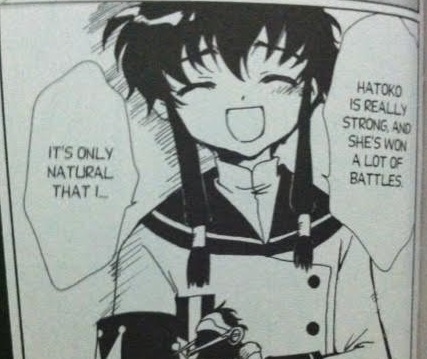
There are two things I don’t like about Hatoko’s character. The first is that she’s a six-year-old, and doesn’t act like one at all. Hatoko is intelligent, calm and collected, and sure of herself. That’s not to say that young children can’t be smart and calm (though I’ve yet to see a kindergartner as un-excitable as Hatoko), but it seems highly unlikely to me that she would be so disciplined, and so well-spoken.

No one talks like this.

She’s a just a little kid, playing with her favorite toy, and being really good at. From the child prodigies I’ve seen in various anime and manga, they all seem to be set in one mode: calm and smart. I think a prodigy character would be much more interesting if she acted…well, acted their age. A child, smarter than most adults, given tasks required of adults and lauded for their intelligence…that’s a cool idea. But what if they just wanted to go to the playground instead of doing rocket science? Or their parents want to make them go to bed, but they really want to finish finding the cure for cancer tonight? I like that idea much more than one that treats child prodigies as just a smaller version of adults.

The other thing about Hatoko that I sort of disagree with is her concept. She’s already discovered something that she’s the best at, she’s already a champion. And she’s six. So…what the hell is she going to do with the rest of her life? And even though winning is a lot of fun, and everyone likes to win, if you go into every contest knowing you’re going to win, wouldn’t things get a little boring?

Pretty soon, Hatoko will just be like a tiny Forrest Gump.

“And then I played Angelic Layer, again…and then I became world champion, again…”

Or maybe she’ll just crash and burn horribly like other child stars. I hope not.

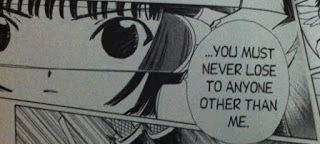
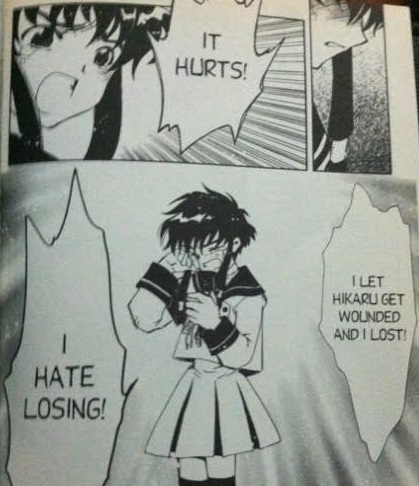
But back to Misaki and her second fight. It’s not a huge leap to guess that she’ll win the tournament, which she does. She’s the heroine of an upbeat manga, after all. But what I hadn’t been expecting, as a thirteen-year-old, was that she would lose this fight. It shouldn’t be much of a surprise to anyone that she loses to Hatoko; even Misaki accepts it.

Icchan says that the thing Misaki needed to learn to succeed in Angelic Layer was how much losing hurts.

I was a little conflicted about how I felt about this. Of course, I’m part of the “self-esteem” generation. That is, me, and people my age, all got told that we were special and unique snowflakes, that we should all believe in ourselves and have confidence. I do believe that it’s important to have self-confidence, so I’m okay with some of this.

However, I’m not okay with overly-sheltering children. Yes, kids need to be protected, but you can’t shield them from everything. You can’t stop them from failing, or save them from disappointment. The hope is that when children fail, they learn something, and strive to improve themselves. Kids need to learn how to lose, because life is full of losing and failing. Hearts get broken; dreams don’t always come true, no matter how much you want it or believe in it.

You have to learn how to fail, so you can pick up the pieces, and and strive to make yourself better.

And that’s exactly what Misaki does.

And, that’s it. We’ve reached the end of the book. It was nice to revisit these characters again, and remember the joy and excitement I felt watching Misaki’s journey through the first time. But the nostalgia isn’t enough to make me keep this book. Misaki grows up in her story, and so have I.

Final Verdict: For Sale

Next I’ll be starting up a rather long project–and I almost can’t believe I’m saying this–Eragon by Christopher Paolini. Stay tuned!

Angelic Layer Chap. 4: Sportball

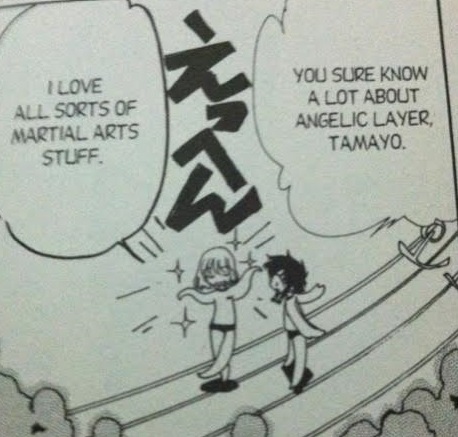
As I mentioned before, CLAMP is known for their beautiful artwork, but this series really doesn’t show it off. When Misaki interacts with characters as rambunctious as Tamayo and Icchan, a lot of the art looks like this:

I used to call it “squid art” for some reason. Maybe because the limbs look like tentacles? There’s a lot of this throughout the series, and I think it gets used way too often. I know that creating a comic is a ton of work, and not every panel will be — or even needs to be — a masterpiece. But to use a such a simplified method of drawing the characters so often just feels, well, lazy. Especially when I know that CLAMP has produced some amazing work.

Maybe I should cut them some slack. Everyone needs a breather, right?

Long anime series tend to usually have a few “filler” episodes, where the characters go to the beach and nothing important happens. You won’t see this as frequently in manga, and definitely not in Angelic Layer. The whole series is only five volumes long, so the story is quite compact. At the beginning of the book Misaki’s just learning what Angelic Layer is; by the end of this chapter, she’s in her first fight in a huge tournament. Moreover, her opponent is six-year-old Hatoko, but I’ll come back to that in chapter five.

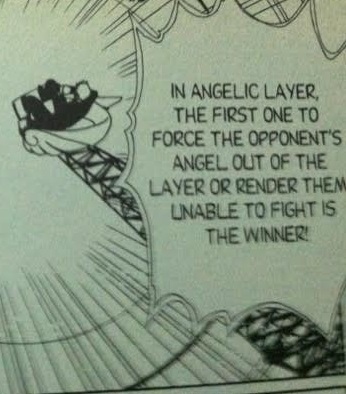
On the subject of the tournament, there are a couple things that confuse me. First of all, the announcer tells the crowd the basic rules of angelic layer: the first angel to lose all its health, or to be pushed out of the arena (the “layer”) loses. Okay, I’m down with that, but have you ever actually heard a sports caster explain the rules of the game as it’s being played? Everyone in the audience is already a fan; they know how this works. I’ve never sat down to watch the Super Bowl and heard the announcers explain the basic rules of the game while it’s going on. It might be nice if they did, because what even is football? But it just feels a little out-of-place here. It would make more sense if Icchan explained all this when he was helping Misaki learn the basics of Angelic Layer.

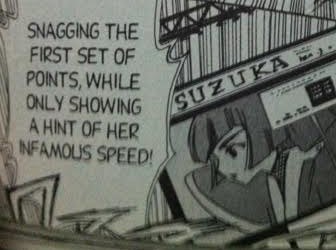
Also, those appear to be the only rules of the game. But when Hatoko’s angel, Suzuka, lands her first blows on Hikaru, Mr. Exposition the sportscaster announces that Hatoko’s got the first set of points in this match. That is the first and the last time “points” are ever mentioned.

You don’t need points to win, so I have to assume that one of the following things happened here:

(a) points refer to the angel’s health, or “hit points”

(b) translation error

(c) CLAMP changed their minds about how the match winner would be determined and forgot to go back and change it

(d) There’s a gritty underground ring of people betting on Angelic Layer matches, and gamblers have created a “points” system in case of close matches or to determine payout.

The first option makes the most sense, but I like the last one the best.

Angelic Layer, Chap. 3: Do Angels Dream of Electric Sheep?

I always liked this chapter, because a small gag in it became a big joke between my friends and me. It also explains a lot about how the game Angelic Layer actually works.

Under the guidance of her mentor, Misaki learns how to control Hikaru’s movements. I wouldn’t admit it when I was reading this in junior high, but I really hoped that Hikaru would become a real character who would bond with Misaki. But Hikaru doesn’t magically come to life when Misaki is practicing, she never speaks, and Misaki is totally in control of Hikaru. Misaki loves Hikaru, but in the end, Hikaru’s just a doll, and the love Misaki has for her only goes in one direction.

That’s a little sad.

Icchan, Misaki’s mentor, teaches her the basics of how Angelic Layer works. The angel has a special cord, and the angel’s owner, or “deus”,  wears a special headset. These allow the deus to send her thoughts to her angel and tell it how to move.

Wait.

Did I just read that right?

In this world, there is a machine that can read minds. And you’re wasting it on toys?! Of course it would be amazing if you had a toy that moved just by thinking it. But why is that the only way this technology ever gets used? 

Why is this series about a tournament? If I had a machine that could read minds, I sure as hell wouldn’t waste it on a game.

Okay, I actually might. But I’ll be damned if technology like that exists and it’s not used by the government or military. Man, this series would be so much cooler if it were about Misaki using her toys to become an international super-spy, or something.

There were so many good storytelling possibilities here, and they all ended up wasted so we could watch a twelve-year-old become a champion in a game that doesn’t exist in real life.

Remember when I said that Angelic Layer wasn’t the type of manga I’d pick up today? Yeah.

After a couple hours of practice, Icchan decides that Misaki’s ready for some real Angelic Layer. She joins a walk-on competition and makes a fool of herself at first. With a burst of inspiration from her new-found friends, though, Misaki wins her first fight; a promising start to her career as a deus.

I like Misaki because she’s sweet, because she’s a small girl who finds her courage and self-confidence doing what she loves.

So, exactly the opposite of who I was in junior high.

Angelic Layer, Chap. 2: Making Friends

Time for another action-packed episode of Angelic Layer!

Except not at all.

The first chapter was all about explaining just exactly what Angelic Layer was. In the second chapter, we learn a little bit more about the sport, and Misaki makes some friends. That last part is probably the most important for me. People read fiction for all kinds of reasons, entertainment being the most obvious. But I think wish fulfillment is also a big part of it. It’s one of my theories as to why Twilight was such a success. Bella is so bland and dull that it’s easy for readers to put themselves in her shoes.

Fortunately, Misaki is likable and has a personality (unlike Bella), but I think there’s still some wish-fulfillment for the thirteen-year-old version of me reading this. This is because junior high is pretty much the worst time of anyone’s life. It was a time when I was bullied and miserable, bushy-haired and awkward.

Maybe kids are nicer in Japan, because Misaki makes two friends with ease on her way to school. They start talking about Angelic Layer, and that’s that. I wish making friends was that easy in real life, and that the kids I went to school with were really that friendly. And even though I had more friends during middle school than I’d ever had up to that point, friendship still comes with drama, jealousies, and petty squabbles. Misaki and her friends don’t have any of that. They support each other and cheer Misaki on. It’s simple and uncomplicated. I could call it unrealistic, because relationships aren’t that straightforward. Maybe it’s the leftover strain of reading Snow Drop talking, or maybe it’s because it would be nice for things to be that easy, I’ll forgive it.

One trope that CLAMP is really fond of is a young genius character. In Chobits, it’s Minoru. Here, it’s Hatoko. I’m generally okay with it, depending on the kid. The thing withe child prodigies is that writers will sometimes forget the “child” part, and just focus on the “prodigy”. Minoru is a cool, intelligent twelve-year-old, who also dresses his persocoms (humanoid robots, for those who haven’t read it) in sexy, revealing outfits. Minoru’s calm demeanor and wisdom don’t really make him seem like a pre-teen, but I could totally see a twelve-year-old boy dressing up his robots in sexy clothes, whether he’s a genius or not.

Hatoko is six years old, and doesn’t act like it at all. She’s cheerful, but is too well-spoken and mature for her age. At six, most kids can’t sit still for more than a couple minutes. Even if she runs off from her older brother, Hatoko’s really not like that. It’s Misaki’s other friend, Tamayo, who’s bursting at the scenes with energy. I found Tamayo pretty obnoxious as a kid, and still annoying as an adult. This might be because I was similar to Tamayo when I was in eighth grade, and had a lot of self-loathing going on. Many years out of junior high later, it’s embarrassing to think that I used to act like that.

Or perhaps Tamayo is objectively annoying. Can any other Angelic Layer fans confirm or deny this?

One last thing before I go: Hikaru’s armor. The clothing angels wear is made out of special fabric and designed by their owners. Okay, I can buy Misaki sewing Hikaru’s clothes in a few hours. Hikaru’s small, and Misaki is clearly a beginner, but puts a lot of effort into the outfit. The head-scratcher here is the details of Hikaru’s outfit. Those screws and cuffs at the top of her gloves can’t be fabric. Even as a kid this bugged me.

Angelic Layer, Chap. 1: Impact Lines. So Many Impact Lines.

After the mess that was Snow Drop, I’m going to a much lighter manga: Angelic Layer, by CLAMP. CLAMP is a group of four manga artists who are known for beautiful artwork, and compelling storylines and characters.

And they also made Angelic Layer.

Angelic Layer is not the type of manga I would pick off the shelves today, and probably would have ignored even at the height of my weeaboo days. However, it will always have a special place in my heart. Angelic Layer is the first manga series I ever read. It was my gateway drug to the world of manga. Following Angelic Layer would come Rave Master, Wish, Dragon Knights, Mars…more comic books that I care to remember (or think about how much I spent on them over the years). My weekly allowance was quickly spent at Walden Books (when there was a Walden Books); my calendar marked with manga release dates. I would save up to buy anime box sets on eBay, the only place I could find them at the time.

And at the beginning of it all was Angelic Layer.

Looking back now, I can see why I was drawn to it when I was in eighth grade. The main characters were in junior high, and I had the same outlook online as the Misaki, the lead. She’s small, just like I was (and still am, but I was even shorter then), but wants to prove that she’s strong. There’s some intrigue around the mystery of her mentor’s identity and mother’s whereabouts, but it’s never heavy-handed.

It’s the story of a clumsy girl who finds self-confidence, and also something she loves.

Yes, this will be a nice change of pace after Snow Drop.

My first impression of the book was that it was a bit disappointing. Through the first chapter, I kept hoping that it would be something else. The title itself sounds so mysterious and magical, and the brief prologue tells of a girl “seduced to the realm of the angels”. That sounds like an awesome build-up for a girl to go on an epic adventure! But it’s not like that at all.

It turns out “angels” are an expensive, high-tech toy, and Angelic Layer is a game wherein two competitors have their angels fight against one another. There’s no magic involved, no real angels, no epic story line that will have Misaki saving the world. Instead, it’s all about the sport of Angelic Layer, and one newcomer to the game battling her way to the top.

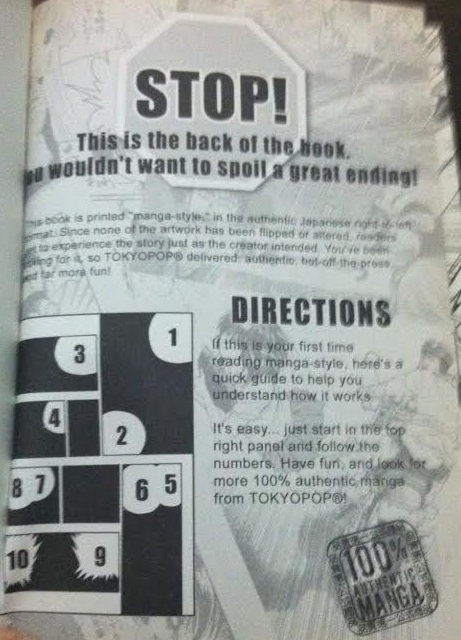
In short, not a book that I would pick up today, or even in high school. But Misaki’s likable enough, if not particularly in-depth at the moment. Maybe it was the magic of my first manga series, or the characters. Maybe it was the hope that it would turn into something more. Whatever it was, I enjoyed it, even if I had to look at the how-to-read guide every time I opened the book.

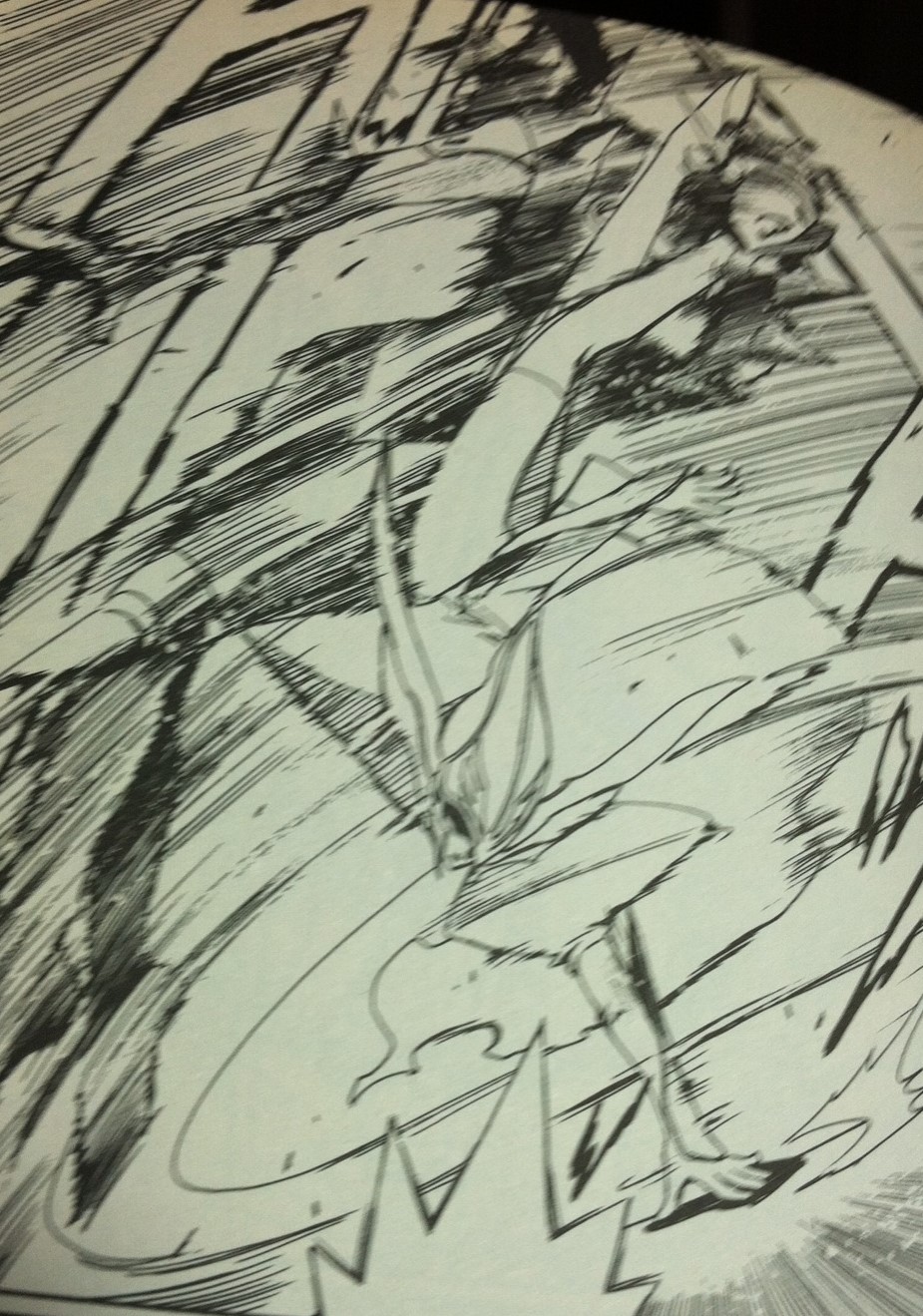
One thing that I didn’t really like as a kid was reading all the action scenes. I found them difficult to understand what was going on, largely because of the amount of impact lines and sound effects, written in katakana. I mostly relied on the characters’ narration to tell me what was happening in a battle. In the years that have passed, I’ve read a lot more comics–manga and Western–so I’ve learned how to read (and understand) action scenes much better. However, I still find it easier to follow violent action in Western comics. I think that having color helps, whereas most manga is printed in black and white. Even so, the first fight scene between two angels is still a bit confusing to me. Impact lines everywhere!

That’s why I paid more attention to the dialogue than the fights when I had a choice. It’s not a great sign of things to come, if you’re reading a tournament manga.

And, because I can’t write a single entry without at least one nitpick, I’m finding it pretty doubtful that Misaki’s never heard of Angelic Layer before moving to Tokyo. I know that one of the easiest ways to convey information to an audience is to have the world explained to another character, but Misaki just discovering the game is a little implausible, given the rest of the story’s universe. Angelic Layer tournaments are broadcasted on TV, and champions are bigger than pop idols. How did Misaki manage to miss all this? I don’t watch sports, but even I could give you a basic explanation of how each game works, and even name some players. Did Misaki live under a rock before coming to Tokyo, or what?

It’s not just me, right?

When I began this blog, it was so I could look back at all the books I’ve read over the years and decide what I wanted to do with them. I’ve made some headway now, managing to give away a few books, swap, or occasionally sell them. I’ve been enjoying re-reading them and writing about them here a great deal.

Tonight, I found myself wrapping up two books from the Angelic Layer series, three Rave Master books, the .hack manga that came out in the early 2000s, and Me Before You. Tomorrow, I’ll be mailing them out to their new homes.

I’ll be glad to cut down some of the clutter, but when I was wrapping up Angelic Layer and Rave Master, I found myself unexpectedly sad. They were the first manga I ever owned, and even though I hadn’t picked them up in years, I was still attached to the books themselves. I can’t say that it’s the end of an era–my manga phase ended long ago–or that I’m nostalgic for a better time. No one ever gets nostalgic about junior high, I can promise you that.

Because I anthropomorphize everything, I feel a little guilty that the books I’ve owned in each series are getting split up and sent to different owners. But mostly, I think I just liked having them around. But as I was packing everything up, I really wanted to flip through the pages one more time, re-read them just once more. And wonder, just for a second, if maybe I shouldn’t send them out at all.

But then I remind myself that they’ll have new owners that will (hopefully) love these books as much as I did.

Does anyone else have trouble getting rid of books? Have you ever felt emotionally attached to a physical copy of a book, even if you haven’t picked it up in years?