The Magician’s Nephew, Chap. 5: The Queen Said One Word, You Won’t BELIEVE What Happens Next

I remember a fair bit about this book since I last read it. Digory and Polly wake up the evil witch Jadis, and they inadvertently take her to the new world of Narnia. I remember that it was Jadis’s spell that put everyone to sleep, and left Charn in ruins.

What I didn’t remember was how scary Jadis actually was before Digory and Polly found her. This chapter is dedicated to her backstory, and elucidates how Charn became frozen as it is now. Unfortunately, it doesn’t give us an explanation as to why the people sitting outside her chamber start out looking kind and end up looking cruel. I suppose it was just used as a build-up to end in Jadis. That’s understandable, because this is a children’s book. I’m a little disappointed that there’s no (apparent) deeper meaning behind this, because I’m an adult reading a children’s book and expecting more depth than the author provides.

Jadis tells us that she and her sister were feuding for the throne,  giving us images that are a bit…graphic for a children’s novel.

‘I have stood here (but that was near the very end) when the roar of battle went up from every street and the river of Charn ran red.’

Holy hell. I know that children’s literature isn’t sunshine and roses all the time, but that’s pretty dark.

Like Uncle Andrew, Jadis’s backstory has a backstory, and holes that I desperately want filled in. It also shows us that she’s completely evil. I’ve been reading Clash of Kings, and some of the dialogue she has sounds like it would fit perfectly into the Game of Thrones series.

‘Then I spoke the Deplorable Word. A moment later I was the only living thing under the sun.’

‘But the people?’ gasped Digory.

‘What people, boy?’ asked the Queen.

‘All the ordinary people,’ said Polly, ‘who’d never done you any harm. And the women, and the children, and the animals.’

‘Do you understand?’ said the Queen (still speaking to Digory). ‘I was the Queen. They were all my people. What else were they there for but to do my will? [. . .] You must learn, child, that what would be wrong for any of the common people is not wrong in a great Queen such as I. The weight of the world is on our shoulders. We must be freed from all rules.’

It’s probably not fair to compare the two, but that mentality is basically the reason everyone in  A Song of Ice and Fire gets screwed over.

Jadis tells the children that there is a word–a “Deplorable Word”– that is so powerful it would end Charn. The Word itself is a deep, dark secret that only the most powerful magicians in Charn ever knew it. And while we’re comparing Narnia to things that Narnia shouldn’t be compared to, it reminds me of the Monty Python sketch about the funniest joke in the world, which is so funny, you’ll die when you hear it.

Most of Charn’s magicians refused to learn the Word, and it was forbidden to ever use. Jadis didn’t share their reluctance, and set out on an epic quest to learn the Word, and…

‘It was the secret of secrets,’ said the Queen Jadis. ‘It had long been known to the great kings of our race that there was a word, which, if spoken with the proper ceremonies, would destroy all living things except the one who spoke it. But the ancient kings were weak and soft-hearted and bound themselves and all who should come after them with great oaths never even to seek after the knowledge of that word. But I learned it in a secret place and paid a terrible price to learn it.’

…Really? That’s it?

This entire chapter is the story of how Charn ended up in this state, and we don’t get to see the most interesting and intriguing part. Hell, we’re not even told why Jadis was fighting her sister. I would probably read a whole book on Jadis’s rise into power, her learning the Word, and killing Charn with it. That sounds like an awesome story. Or maybe a terribly generic one, but at least I’d get some of my questions answered.

Excuse me, I need to go and write a fanfiction now about Jadis’s backstory.

The Magician’s Nephew, Chapter 4: Curiosity Killed the Kids

The first pool that Digory and Polly jump into is the wrong one. The story would be very different if they’d gone to any other world, but then, they’d never make it to Narnia without going into this one first. Polly and Digory enter the world of Charn, and it’s…chilling.

Everything about this world is old and still. They wander through ruins, and there’s absolutely no sound. There’s no people, no animals, nothing but empty courtyards. Even the light in this world is described as feeling old, as well as reddish. That last detail is more unnerving to me now that it was as a kid. I don’t know how much C.S. Lewis knew about astronomy, but the red light makes me think of Red Giants: cool, dying stars, millions of years old. It’s not just an old world, it’s a dying one.

I was a little wary about re-reading the Narnia books at first, because of the narrator. The last book in the series I read, Prince Caspian, I found the narrator so annoying, I wish I could have skipped the descriptions altogether.  Lewis uses an intrusive narrator to tell the story, and he’s not shy about making his presence known. I won’t go as far to say that the book’s written in first person, but every so often someone – referring to themselves as “I” – pops his head in and gives you his frank opinion on the matter at hand. Either there’s not as much of it as there was in Prince Caspian, or it doesn’t bother me as much now. It can be a little jarring, but I don’t actively hate it. It makes me think of a grandfather telling his grandkids this story, which is probably the way Lewis intended it to be. There’s a warmth to it, and it makes me think of my dad, reading this book to me when I was sick. On the other hand, it also allows Lewis to be a bit lazier with his writing, and he sometimes uses it to avoid writing in-depth descriptions, or to fast-forward scenes.

If you were interested in clothes at all, you could hardly help going to see them closer. [. . .] I can hardly describe the clothes. The figures were all robed and had crowns on their heads.

Digory and Polly inspect the rows of people who resemble wax sculptures. It becomes apparent that they’re all set up in a particular order. First come people whose faces are kind, and look like the type of person you might want to have a cup of tea with. But as they continue, the faces get crueler and crueler, until they finally reach the most beautiful – and cruelest – looking person of all.

In a lot of fairy tales (and Disney movies), your inside matches your outside. That is, the more evil you are, the uglier you are. Of course, all the high school outcasts like myself know that the opposite is true, and it’s the pretty girls who are the mean ones. I’m glad to see Lewis didn’t fall into the same cliche of beautiful people being good, and ugly ones being evil. Perhaps it’s too predictable.

It’s been a long time since I read this book, and I’ve forgotten a lot of the details. It’s sort of nice, actually; it’s almost like reading it for the first time again. The order that Digory and Polly find the frozen people in seems important, starting with the kind people and ending with the evilest. I wonder if there’s a point to be made here that I haven’t picked up on, or if it’ll be revealed why they’re arranged in this way. I hope it’s explained.

This chapter also played on a fear that I didn’t even know I had until I read this book. Digory and Polly come across a bell, a hammer, and a poem:

Make your choice, adventurous Stranger;
Strike the bell and bide the danger,
Or wonder, til it drives you mad,
What would have followed if you had.

Polly doesn’t want to ring the bell; she wants to put on her yellow ring and leave this world. Digory, on the other hand, already feels the magic start to work on him. After an argument with Polly, he rings it, mostly out of spite. After a couple paragraphs describing the sounds it makes, the ruins start collapsing around them.

The choice here is that you can either ring the bell, and something terrible will happen, or go crazy wondering what that terrible thing would have been. I think we all deal with “what-ifs” and “might-have-beens”, and they can gnaw away at you. That’s bad enough, but when something is magically cursed to make you perpetually wonder what would have happened if you walked away… well, I’ve never had much willpower, so I would probably give into the temptation of ringing the bell. But the idea of losing my mind, even as a kid, was scarier than the potential risk of whatever would happen when that bell rings. If there’s actual, physical danger, then you can find a way to escape it. If it’s in your mind, how do you fight it, and will you ever be free of it?

Again, this is one of the hazards of traveling to a new world. I’ll have to be very careful not to read any cursed poems that will drive me mad.

The Magician’s Nephew, Chap. 3: Pool Party

It took two chapters, but the adventure has finally begun. Digory takes two green rings, one for himself and one for Polly, puts on a yellow ring, and winds up in the “Other Place”. This is one of my favorite things in this book series: the Woods Between the Worlds. Even the name sounds magical.

Digory finds himself, not in Narnia, but in a lush forest. There are shallow pools of water every few feet, and the place is so quiet, it’s as though you can hear the trees growing. As enchanting as it sounds, though, the Woods Between the Worlds scared me as a child. Digory isn’t there long before he starts to forget who he is, or why he came here.  He finds Polly in a similar state, half-asleep, and she doesn’t recognize him. When they see that they’re both wearing yellow rings, their memories are jogged, and they remember who they are and what they’re supposed to be doing.

While I was still hoping that I’d find a magical world in the back of my closet as a child, this scene helped me be aware of all the risks that might entail. I obviously knew that I’d be charging into battle to fight against evil, but I didn’t think of all the obstacles that would come before that. If I ever traveled a magical world, I would have to bring a friend with me, in case I wound up in the Woods Between the Worlds. I also really hoped that friend would be a unicorn.

I love the idea of the Woods Between the Worlds, though. Each pool of water is an entrance to a different world, provided you have your magic ring on. The Woods seem to stretch on endlessly, with pools every few feet. There are so many worlds that the children would just be able to walk into, which is a dizzying thought. As they’re about to try one out, Polly suggests that Digory marks their own pool of water, so they can find their way back home.

I rather like Polly. She seems like the brighter of two, and maybe even the braver.

The Magician’s Nephew was the second-to-last book written in the Narnia series, which means that Lewis most likely hadn’t thought of the Woods Between the Worlds before then. It’s a bit of a shame, I think, because it’s too good of an idea to waste. With endless worlds you could literally jump into, you could spend a lifetime exploring in the Woods and never visit the same place twice. Hence why it’s so important for Digory to mark the pool that will take him and Polly home, when they’re ready. That’s another scary thought: losing your world, and trying for the rest of your life to find the right pool and get back home. Even though that sounds like it would make a great story, that was another childhood fear of mine. When I discovered a new world (because I knew it would happen, someday) I would also have to take precautions to get home. Because as much fun as exploring other worlds is, sometimes you just need to sleep in your own bed.

The Magician’s Nephew, Chap. 2: Ethics Review Board

We’ve made it the second chapter, and we’re on the cusp of the true adventure. Digory’s the nephew, and we at last get to meet the Magician. His name is Uncle Andrew, and he’s as close to a mad scientist as the Narnia series gets. He’s got crazy, fly-away gray hair, everyone around him thinks he’s mad, and is, in fact, something of a genius. Before wardrobes and strange cupboards at school, Uncle Andrew figured out a way to send people to someplace…else. He doesn’t quite know what that other place is, but he’s more than willing to use Digory and Polly as his human guinea pigs.

Most of the second chapter is dedicated to Uncle Andrew explaining how he was able to make magic rings that could travel between the worlds. He received an ancient box from his godmother (who was said to actually have fairy blood), containing dust from Atlantis. After many years of study, learning everything he could about magic, he created several yellow and green rings. The yellow would send anyone who touched it to the “Other Place”, and the green ring would, in theory, bring them home again. Before Polly and Digory accidentally found their way into his study, Uncle Andrew had only tested the yellow rings on literal guinea pigs. They all vanished, but none of them returned. Unsuspecting Polly became his first human test subject, when she takes a yellow ring, and disappears from the study, and the universe altogether.

I remember not liking this chapter very much. To me, it cemented Uncle Andrew as a villain in the story (and what nine-year-old likes villains?), and the attention was all on him. When I read it now, I really enjoyed it. In fact, I wanted more.

‘Meanwhile,’ continued Uncle Andrew, ‘I was learning a good deal in other ways (it wouldn’t be proper to explain them to a child) about Magic in general. [. . .] I had to get to know some–well, some devilish queer people, and go through some very disagreeable experiences.’

Okay, so we’re in London, in a world without magic. Uncle Andrew has found a way to use magic to send people to other worlds, and it’s suggested that the way he learned things was not on the up-and-up. Tell me that backstory doesn’t intrigue you. Who are these people, what are these disagreeable experiences? I want to know!  C.S. Lewis should have just skipped writing The Horse and His Boy and given us Uncle Andrew’s story instead.
There’s no room for moral ambiguity in the Narnia series, though, so he wouldn’t be an acceptable Lewis protagonist. And it’s made very clear that even though Uncle Andrew is, in fact, “beastly” for sending Polly to another world without telling her what she’s getting into.

This is exactly the reason why we have ethics review boards. Sure, they might stop you from doing some of the really fun social experiments, but at least you won’t wind up in a different universe when you’re filling out questionnaires with Lickert scales.

Wait, is there actually an experiment out there that can send me to a magical world? SIGN ME UP!

Unless you’re sending me to Westeros.

The Magician’s Nephew, Chapter 1: Growing Up is Hard To Do

I’ve always loved fantasy stories, and I think one of the most influential ones in my life has been The Magician’s Nephew by C.S. Lewis. All told, I would read the first four (in chronological order) of The Chronicles of Narnia: The Magician’s Nephew; The Lion, the Witch and the Wardrobe; The Horse and His Boy; Prince Caspian. I never quite made it to the three final books, though I owned them all. If anyone ever asked me which book was my favorite (and no one ever did), I would have told them The Magician’s Nephew. It was the first in the Narnia series that I ever read, and it opened up a world of magic to me.

When I was in grade school, my Aunt Linda was sick with ovarian cancer. I spent many weekends traveling to hospitals two or three hours away from home to see her. It was a hard time for me, and I think one of the reasons I really fell in love with fantasy books was because I needed some magic in my life.

Right from the first few pages of this book, though, I realized that it wasn’t just a need to escape that compelled me to read — and love — this book as a child. When the main character, Digory, meets his friend Polly for the first time, she can see that he’s been crying. He explains:

‘And so would you [. . .] if your father was away in India–and you had to come and live with an Aunt and an Uncle who’s mad (who would like that?)–and if the reason was that they were looking after your Mother–and if your Mother was ill and going to–going to–die.’

Well, shit. Already something I could relate to, and we’re only on page six.

I also forgot how quickly children’s books start. Digory and Polly meet, they’re friends, they go explore houses. There’s not much build-up before they reach Uncle Andrew’s study and begin their real adventure.

Now, there’s plenty of criticism about C.S. Lewis, but there is at least one thing he does right: captures the enchantment of childhood. Polly has a secret “cave” in the attic of her house, and it’s a place that I would have loved to have as a child. Re-reading this, I still wish I had a place like this.

 Polly had used the bit of the tunnel just beside the cistern as a smugglers’ cave. She had brought up bits of old packing cases and the seats of broken kitchen chairs, and things of that sort, and spread them across from rafter to rafter so as to make a bit of floor. Here she kept a cash-box containing various treasures, and a story she was writing and usually a few apples. She had often drunk a quiet bottle of ginger-beer in there: the old bottles made it look more like a smugglers’ cave.
 A cozy hideaway, a space just for you to be alone in. And there’s something about making this in her attic that makes it truly child-like. Perhaps because even if I had a hide-out like that as a kid, I wouldn’t be able to fit into it as an adult. If I did, and I returned to it, it would be a place full of nostalgia, certainly, but not a place of wonder as it once had been.

Childhood is a common theme throughout the Narnia series. Peter and Susan get booted out of Narnia at the end of Prince Caspian because they’re too old, and the only people who can save Narnia are children. There’s a little sadness when it comes to leaving your childhood behind, knowing that magic isn’t really real, that you’ll never find a secret world in your closet or get a letter delivered by owl. (My owl with my Hogwarts letter just got lost! I swear!) There’s one passage in the first chapter that captures this exquisitely, when Digory and Polly are discussing what might be in the empty house they’re trying to sneak into.

‘But I don’t expect it’s really empty at all,’ said Digory.

‘What do you expect?’

‘I expect someone lives there in secret, only coming in and out at night, with a dark lantern. We shall probably discover a gang of desperate criminals and get a reward. It’s all rot to say a house would be empty all those years unless there was some mystery.’

‘Daddy thought it must be the drains,’ said Polly.

‘Pooh! Grown-ups are always thinking of uninteresting explanations,’ said Digory.

When we talk about the end of childhood, we talk about children losing their innocence, or gaining responsibilities. Maybe every so often, we should think about their imaginations, too, and keeping our own ones intact.

We all have to grow up, but our imaginations don’t have to be a casualty of adulthood.

Biggest Bullshit Moments in Snow Drop, Part 2

Unfortunately, Snow Drop doesn’t end with So-Na getting away from her horrible father. Instead, the story only goes downhill from there, bringing us bigger and bigger moments of utter shit. Watch out, it only gets worse.

Volume 7: Easily Forgiven, and True Love
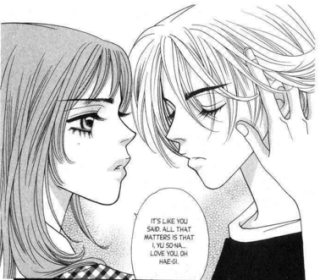

Watch out, this one’s a two-parter. Volume 7 is a tribute to bad decisions. Hae-Gi and So-Na return to her home, so Hae-Gi can ask her father for permission to date her. So much for that independence she was trying to achieve. Dear old Dad finally reveals why he’s so against their relationship: Hae-Gi’s brother, Gae-Ri, was the one who kidnapped So-Na years before. In retaliation, So-Na’s father had Gae-Ri and his accomplices killed.
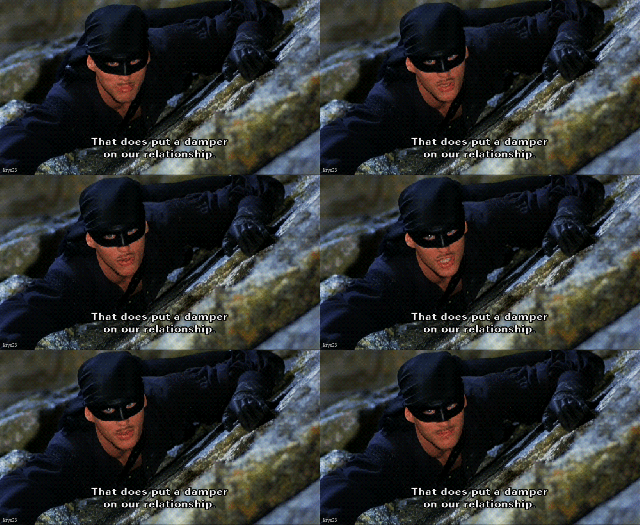
You’d think that would be enough to break up Hae-Gi and So-Na, or at the very least, make them re-think the relationship. While So-Na does show some hesitation about moving forward, about five minutes later Hae-Gi says that he doesn’t care what happened between their families, just that he loves So-Na. I love my boyfriend, too, but if his parents killed my sister, I don’t think we’d continue seeing each other.

It doesn’t matter, though, because So-Na and Hae-Gi run away together. I used to think that was romantic and brave, but now I think it’s really dumb. So-Na clearly has a death wish, as she keeps saying that as long as she and Hae-Gi can die together, she’ll be happy. What?

But even more than that, what bothers me is this “one true love” nonsense. Remember, Hae-Gi and So-Na are seventeen. They’re in high school. Think back to the people you dated in high school. I became enamored with the first guy I ever dated when I discovered that he was a Lord of the Rings fan, just like me. Or the second person I dated in high school, who I was first interested in because he was an anime fan. Because clearly liking the same thing means that you’ll be together forever. The idea that you’ll find the person you’re meant to be with forever in high school, to me, is a load of crap.The first person you date is most likely not going to be the person you’re going to marry, and they’re definitely not going to be worth dying over.

Volume 8: So-Na Dates Hwi-Rim
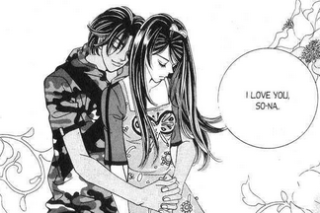
Or, put another way, So-Na willingly dates the man who tried to rape her

There are so many problems with this. I’m not even sure where to start.

Rape in fiction is a quandary, and we could argue all day about using it as a plot device, as a way to show character, and whether or not it’s okay to use. It may make me uncomfortable, and I may not like to see rape used in fiction, but does that mean it should never be used? I believe – and this is just my own opinion – that if rape (or in this case, attempted rape) is used in a story, it has to be necessary; it can’t just be for shits’n’giggles. That is, it should propel the story forward, reveal something new about the characters involved, and not trivialize the victim’s experience.

So-Na’s kidnapping traumatized her for years, and left her reclusive and depressed, and she admits to being suicidal before the series began. Sure, it’s not the happiest backstory, but her reaction to it, I think, is normal and expected of someone who’s been through that. However, Hwi-Rim’s attempted rape doesn’t have that same effect on her. Even if it So-Na didn’t suffer long term effects from it (which she didn’t), I don’t think she would want to be anywhere near Hwi-Rim, let alone dating him. This is what I mean about trivializing the victim. The attempted rape is all but forgotten, and the only hang-ups she has about dating Hwi-Rim is that he’s not Hae-Gi. And the reason Hwi-Rim tried to rape So-Na in the first place was because he loved her.

For some context, Hae-Gi and his family were exiled to America, and So-Na wants to date someone to forget about him. She chooses Hwi-Rim because…well, I don’t know. If she wanted to date someone, she could have gone out with, say the class president who asked her out, and by the way, hasn’t tried to fucking rape her. 

I think the lessons Snow Drop is telling us is that:

1. Rape is an expression of love.

2. Attempted rape has no lasting traumatic effects on the victim.

3. A romantic relationship with your would-be rapist is okay and probably healing.

I just…if I had a week, I couldn’t tell list all the reasons that explain how fucked up that all is.

Volume 9: So-Na Has No Identity Outside of Hae-Gi
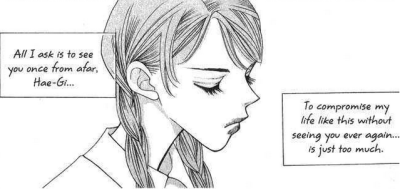
This book is much more mild than the last few, but there’s still one thing in it that really bothers me. So-Na is now going to a different school and has made friends with the “delinquent” girls. This is supposed to show us how depressed and self-destructive So-Na’s become since Hae-Gi was exiled, but I think it misses its mark. It doesn’t make me pity So-Na; in fact, I think it makes me dislike her a lot. I think this is just my own mentality, though. Maybe this hit harder for other readers, but I’ve always been the girl going, “I don’t need no man!” I hate when a girl loses her lover, and falls to pieces. Part of that is because I don’t think I’ve ever seen the reverse – a man losing his lover as well as the will to live – but I hate how tied in So-Na’s mental health is to Hae-Gi. When she’s strong, it’s because she has Hae-Gi’s support. When she’s weak, it’s because he’s gone. Her dependency on him for her own happiness and well-being is cringe-worthy at best, and falls into “Bella jumps off cliff to see her ex-boyfriend” territory at worst. This is exactly why I said I didn’t want this series falling into unsuspecting hands. It’s not romantic, it’s not tragic; it’s a teenage girl making bad choices because she’s going through a break up. So-Na, just get a dramatic haircut or something and move on with your life, like a normal eighteen-year-old.

Oh well. At least no one was sexually assaulted in this volume.

Moment of Redemption: Hae-Gi and So-Na’s Reunion
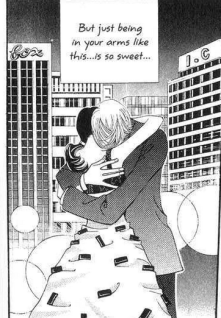
At this point, Hae-Gi and So-Na have not seen each other in at least a year. So-Na travels to America with Hwi-Rim just so she can see him. Literally, just to look at him. Because she swore that she would never see Hae-Gi again, So-Na has no plans to interact with him. When she does get a glimpse at him, though, she’s so overwhelmed she has to run away. Hae-Gi spots her and chases after her, and the couple finally meets again. It’s sad and romantic, and I love the artwork in this scene.

Volume 10: Ha-Da Rapes Ko-Mo

It’s not graphic, but I still don’t want to put a picture up. Please enjoy this royalty-free picture of inter-species friendship instead.

I’ll try to make this quick, because I’m not sure how much more I can stomach. Ha-Da accidentally gets Ko-Mo high as balls (it’s a long story), and has sex with him. That’s bad enough, especially considering that Ko-Mo has spent most of the series trying to get Ha-Da to leave him alone. But, because Ha-Da is a “hero” in the story and we’re supposed to be cheering for him, Ha-Da having sex with a drugged up Ko-Mo can’t be seen as a villainous thing. We’re supposed to like this guy, after all. Instead of Ko-Mo being horribly scarred or attempting to kill Ha-Da (which he’s done), he falls in love. Ko-Mo falls in love with his rapist.

You here that, fellas? If they keep saying “no”, what they need from you is a good dicking.

Fuck. That.

This is even more troubling to me that So-Na dating Hwi-Rim. Hwi-Rim’s attempted rape of So-Na was portrayed as monstrous and violent, but Ha-Da’s rape of Ko-Mo was portrayed as romantic. All Ko-Mo needed to finally say yes to Ha-Da was a shitton of drugs.

This might be the worst thing I’ve ever read. And I once read a graphic fanfiction about Princess Leia and Optimus Prime.

Volume 11: Snow Drop Just Keeps Going
At least Romeo and Juliet stayed dead.

Snow Drop‘s tagline advertises the manhwa as “a Romeo & Juliet style romance”. I’d say that’s accurate, as both works feature feuding families and teenagers making stupid decisions. It really looked So-Na and Hae-Gi were going to go the same way as the original star-crossed couple, when they are shot and stabbed by their own family members. As they lay dying in the hospital, So-Na sees her mother and Hae-Gi in the afterlife. They are amazingly happy, but decide that they want to live together. They don’t die, their families forgive each other, and even Ko-Mo returns his feelings for Ha-Da. It’s a happy ending for everyone!

Except it doesn’t end there. The second half of the book looks like it belongs in a completely different series. The big conflict is that Hae-Gi wants to marry So-Na, but she thinks they’re too young. Finally, she says something sensible. Had I been the creator, I would have either killed them off, and let the second half of this book be about their families, or I would have ended it with Hae-Gi’s and So-Na’s happy ending.

Volume 12: Choi Kyuang-ah Just Gives Up


Choi Kyuang-ah is the creator of Snow Drop, by the way.

I’ve got nothing against happy endings. I think real life needs more happy endings. Even after such a dramatic series where everything is doom and gloom, it’s nice to see So-Na and Hae-Gi succeed, and eventually get married, with their parents approval. In fact, one of my favorite moments comes at their wedding, with So-Na’s father and Hae-Gi’s mother respectfully bowing to one another. But it just drags on and on after that. In fact, most of the book doesn’t even focus on Hae-Gi and So-Na. A good portion of it is dedicated to Hwi-Rim finding love (with a high school student…), and glamour shots of Hae-Gi and So-Na kissing and declaring how much they love each other. The only thing resembling a plot towards the end is So-Na being upset that she likely won’t be able to have children. Flash forward, and we see her, Hae-Gi, and their new baby.

Everyone getting what they want and living happily ever after isn’t a bad ending, but there are two things that bother me about it. First of all, a lot of this really feels inflated and unnecessary. It makes me wonder if Kyuang-ah actually intended for the series to end this way, or if there was some sort of contract stipulation that said “you need to create X number of chapters”. In one of the bonus comics illustrating her life, she even says that the ending was originally going to be much darker. I have to wonder if she gave us the light and fluffy ending because she wanted to, or if it was a case of editorial meddling.

The other thing that bugs me about the ending is that it just doesn’t fit with the rest of the series. Snow Drop is convoluted, violent, and over-the-top dramatic. This ending is so happy, and comes to the characters so easily, makes it feel like it was ripped from a completely different manga. It’s just…too happy, and too neat.

Final Final Verdict:

If you haven’t lost your lunch yet, I’ll be back on soon with The Magician’s Nephew by C.S. Lewis.

Biggest Bullshit Moments in Snow Drop, Part 1

In my introductory post about Snow Drop, I described it as one of the most misguided comic series I’ve ever read. I already know I won’t be able to stomach re-reading the rest of the series, never mind blogging about each book. However, the fist volume only scratches the surface of all the melodrama to come. There’s so much crap in these books, I’ve decided to highlight some of the biggest instances of bullshit in the series.

Volume 2: Ha-Da Pursuing Ko-Mo

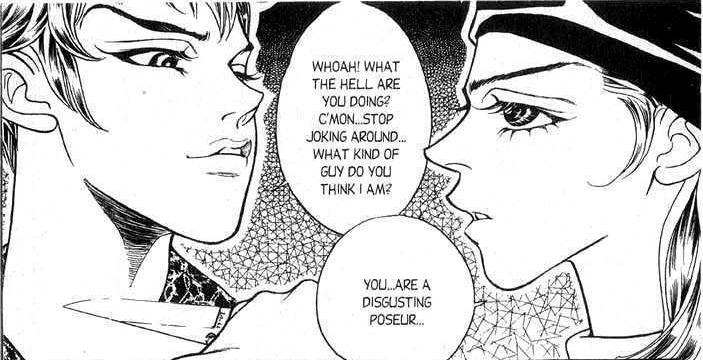
Ha-Da attempts to date Ko-Mo, and this doesn’t go very well for him. To begin with, no one – including So-Na, Hae-Gi, and Ko-Mo himself – tells Ha-Da that Ko-Mo’s male. Ko-Mo isn’t gay, either. Nor does he like being pursued by Ha-Da. Yet, Ko-Mo never tells Ha-Da that he’s a guy. As much as Ko-Mo tells Ha-Da to leave him alone, Ha-Da never takes the hint. Now, when someone tells you to stop doing something because they don’t like it, and you continue doing it, it’s called harassment. Ko-Mo finally puts a fucking KNIFE up to Ha-Da’s throat and mugs him to get him to back off.

He doesn’t.

Volume 3: So-Na Gets Roofied

At this point, So-Na has acquired a rival, Jin Sun-Mi. Sun-Mi is in love with Hae-Gi, but he’s dating So-Na. Sun-Mi decides to try to sabotage their relationship by drugging So-Na so she passes out in a storage shed at school. If that highly illegal and immoral behavior wasn’t bad enough, Sun-Mi has Ha-Da go to the storage shed as well, where he sees unconscious So-Na. He figures out that she’s been drugged, and that Sun-Mi was the culprit. Does he try to wake his best friend? Find help? Call the police? No. Instead, he kisses So-Na. This is meant to be romantic. Instead, the whole situation is disturbing as all hell, especially because Ha-Da knows that So-Na was kidnapped and molested when she was twelve.

What the fuck am I reading.

Moment of Redemption: Hae-Gi and So-Na’s date


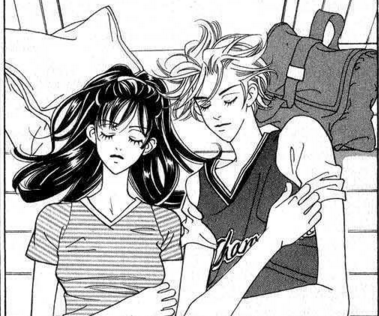
Nothing is completely awful, though, and Snow Drop did have times that I really did enjoy, things that made me want to keep reading, despite all the bullshit going on. Here, Hae-Gi takes So-Na out on an impromptu date. She’s nervous to be alone in the dark with him at first, but comes to realize that she does trust him. They go to a park and stargaze, and So-Na lies down next to him, which is a big deal for her, even if she does panic. This scene also gives us the couple’s first real kiss. It’s a very tender scene, especially considering all they’ve been through to get to this point.

Volume 4: So-Na is Attacked and No One Believes Her


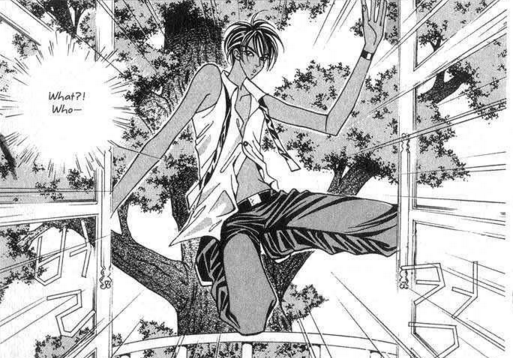
Trouble continues to brew when So-Na finds out that she finds out that she’s engaged to someone she’s never met, Hwi-Rim. Naturally, she objects to the prospect of arranged marriage, and especially to her fiance. It’s fair to say that she didn’t have the best first impression of him. Before So-Na and Hwi-Rim formally meet each other, he breaks into her room through her bedroom window, suggestion that they have a little “morning action”. So-Na throws a number of items to defend herself from him, including a stool, yet he never backs off. In fact, it looks like it’s a turn-on for him. By the time So-Na’s bodyguards arrive on the scene, he vanishes.

Later, So-Na’s father introduces her to Hwi-Rim, telling her that they are engaged now. So-Na tells everyone that he broke into her bedroom. Her bodyguards heard the commotion, and they even say there’s security tapes that could prove it was Hwi-Rim. Does her ever-loving father call off the engagement? Question Hwi-Rim’s character? Listen to his daughter? No. Instead he calls her a liar, and says she’s panicing because she doesn’t want to be married.

Also, how is Hwi-Rim staying in that tree? He has one leg supported by a branch, it looks like, but he’s not holding on to anything. He’s just sort of…hovering above it.

Volume 5:  A Failure to Communicate

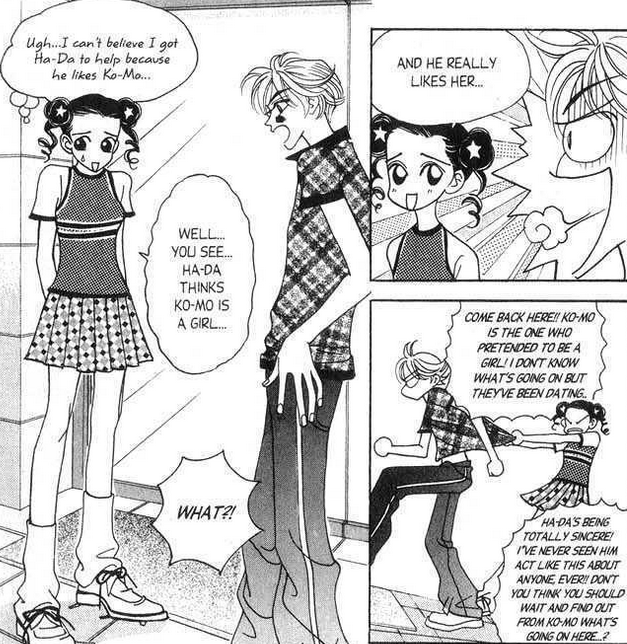
The biggest bullshit moment is actually a little hard to find in this volume. Drama happens, of course, but nothing to the degree of the previous books in the series. In fact, So-Na and Hae-Gi come out triumphant in the face of adversity, for a change. But this is also the book where Ha-Da finds out that Ko-Mo is a man, even though they’ve started dating. Ko-Mo, by the way, still doesn’t like Ha-Da, but is using him to get information. What bugs me about this is So-Na knew that her best friend really liked Ko-Mo, but also that Ko-Mo is a guy. How hard would it have been for So-Na to tell Ha-Da that Ko-Mo’s a guy? Maybe she thought it was funny at first, but really…you dropped the ball on that one, So-Na.

But that’s not so bad. After the questionable (and illegal) behavior of the characters so far, this volume was exciting and more light-hearted than the previous four. If the rest of the series were more like this, I would probably like it a lot more. But that hope spot is short-lived, however, and I remember why this series is so fucked up…

Volume 6: Hwi-Rim Attempts to Rape So-Na

I don’t want to put up a picture of this. Here’s a picture of my dog instead.

This scene freaked me out when I read the series, and still puts me on edge today. Maybe even moreso now. It’s fucked that she’s engaged to this guy, and that no one who can do anything about it will listen to So-Na. She already hated this guy, and the audience already knew that he wasn’t above attacking So-Na…so why put this in? Just to show how depraved Hwi-Rim is, when we’ve already seen it? Hae-Gi at least beat Hwi-Rim to a pulp, but other than that, our villain doesn’t suffer any consequences after that. What’s even more disturbing is how So-Na, a couple books down the road, just seems to forget what Hwi-Rim tried to do to her.

Moment of Redemption: So-Na Stands Up to Her Father

Throughout the series, So-Na’s father is a bully. He verbally abuses and blackmails her, and hits her more than once in the series. He refuses to listen to any of her objections about her engagement to Hwi-Rim, which was arranged to set-up more funds going to his political party. Many times, he tells So-Na that she’s unable to live independently. During a party to celebrate So-Na’s and Hwi-Rim’s engagement, she tells him – and everyone else there – that she and Hwi-Rim will never be married. Her father says that everything she owns, even the clothes on her back, are from him, and she will never survive on her own. So-Na says, “Watch me, I don’t need anything from you!” takes off her dress, and storms out of the dinner in just her underwear. Yes, it’s over the top, but after all her dad’s put her through, I love how she blatantly defies him.

That last book got a bit heavy. Let me end with just one embarrassing story to make things a bit more cheerful around her.

Manga Will Ruin Your Life: So-Na Gets a Job

Remember when I said I didn’t want these books to find young, impressionable minds? This is the reason why. Out on her own, So-Na tries to get a job, and she only gets hired once she admits to her employer that she’s only in it for the money. Her boss tells her that’s the only reason why anyone works, and she should have just said that from the start. It turns out that this is actually pretty terrible advice.

 Eventually, I turned sixteen, and went to a local grocery store for my first-ever job interview. When the woman interviewing me asked why I wanted to work there, I replied, “I want money.” I thought she would appreciate my honesty. She didn’t.

I didn’t get the job. Thanks, Snow Drop.

Snow Drop Chap. 4: The NPC

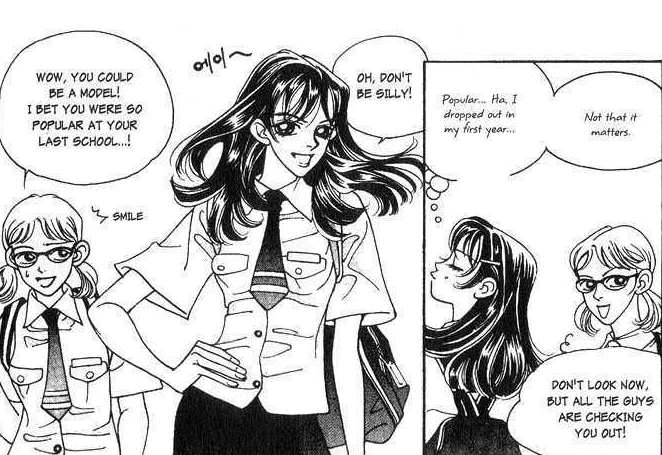
The chapters are divided pretty unevenly in the first volume of Snow Drop, and this is the shortest. It starts with So-Na solidifying her role as a Mary Sue by being admired by the boys from afar.

Ha-Da complains to So-Na that he didn’t get Ko-Mo’s number. So-Na, to her credit, tries to tell Ha-Da that Ko-Mo’s a guy, but doesn’t get the chance. Instead, he begs So-Na to get Ko-Mo’s number for him. Since he doesn’t know that Ko-Mo is Hae-Gi’s brother, I don’t know why he thought So-Na would be capable of getting Ko-Mo’s number. So-Na accepts the challenge anyway, and decides that she doesn’t need to talk to Hae-Gi. She goes back to her preferred MO of stalking.

Even her body guard comments that this is weird.

While she’s stalking Hae-Gi, it’s revealed that Hae-Gi is dropping out of school to work as a model full-time. His mother has suffered brain damage, and he needs to work to pay for the surgery that might heal her. I know enough about neurology (and have worked with people with traumatic brain injuries in the past) to say that while it might not be impossible, but it’s extremely unlikely that his mom would ever be 100% herself again, even if the surgery was successful. Of course, as Choi Kyang-ah never gives us specifics of the surgery, or what exactly is wrong with Hae-Gi’s mother, it’s hard to say. But there’s a reason that brain surgery is so difficult. Everyone’s brain is mapped out differently, and…

Okay, I could talk about neuropsychology for awhile, but that’s not why we’re here. Even if neuropsych is one of my favorite things ever.

The other thing that bugs me about this is that So-Na finds out all this from overhearing a conversation between Hae-Gi and another classmate. It’s not that it’s an overheard conversation – as convenient as it is – it’s the classmate that bothers me. We don’t know anything about her. She has no name, no background, and we know nothing about her. I would like to, though. She genuinely cares for Hae-Gi and doesn’t want him to drop out. She knows about his mother and how much trouble Ko-Mo gets into. It’s already been established that Hae-Gi doesn’t have any friends, but it sounds like he’s confided in this girl. She seems sweet and concerned, not manipulative and haughty, like So-Na. This is the girl I want to root for. I want So-Na to drop off a cliff, and for Hae-Gi to date a sweet, sensible girl that doesn’t bring any more drama into his already dramatic life.

That doesn’t happen. In fact, this is the last time we ever see this girl in the series. She’s not a character; she’s a sounding board. That’s really unfortunate, because in the few pages she’s in, I already like her a lot more than any of the main characters.

And that’s it. The final chapter of the first volume of Snow Drop.

It wasn’t that good.

Final Verdict: I don’t know.

Here’s one thing I know for sure: I don’t want to keep these books. I own every volume in the series, and most of them are in pretty good condition, so I’d be okay selling them. The problem with my copy in particular is that it has an ink stain that goes through several pages. I might consider giving this to someone who’s okay with that, but I don’t know anyone my age who would enjoy this series, and I wouldn’t want to give it to impressionable, adolescent minds. Like mine was, when I read it.

Anyone out there want a slightly used copy?

Snow Drop Chap. 3: Brotherly Love

At school later, it turns out Hae-Gi doesn’t remember anything from his drunkfest at Romeo. The next day at school, he tries to give So-Na her nursery key back. Here, So-Na makes a critical mistake: as she’s reaching for the key, she admits that she lost Hae-Gi’s marble.

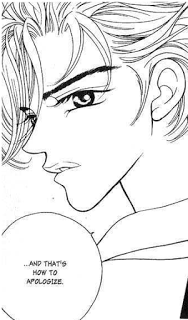
 I know that characters making bad decisions is important for fiction, but the key is literally in her hand. All she had to do is make a fist, and it would be hers again. So-Na couldn’t wait a whole ten seconds to tell him that she lost his marble. Hae-Gi snatches the key away and gets really, really mad at her. Reasonable, and  we get this one moment out of Hae-Gi, when he tells her that there’s something she still needs to learn.

THANK YOU.

So-Na is so haughty, she’s unlikable and unrelatable. I was pretty glad to see Hae-Gi cut her down to size here. Not that she learns her lesson.

What follows over the next few pages is some verbal barbs and taunting between the two. Because we all know that the foundation for a long, happy relationship is animosity.

Instead of just apologizing and trying not to be a giant dick. So-Na dresses up like she’s going clubbing and stalks Hae-Gi to the store where he works. Her plan appears to be to look good and demand her key back. As you might imagine, she fails.

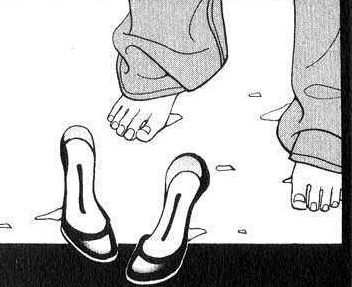
Hae-Gi is more interested in cutting So-Na down to size, and will let give her her key back, if she mops and helps clean up the store. When she complains that she can’t mop in her high-heeled shoes, Hae-Gi lends her his.

That would normally be a detail I wouldn’t mention here, but So-Na wears his shoes home. When I first read that, I thought it was kind of cute, but now I see a big problem with it.

I don’t think those will fit.

What the hell is Hae-Gi going to wear home?!

I also want to point out that it’s established that Hae-Gi is the “poor kid” who has two jobs to support his family. He shouldn’t have to worry about a girl stealing his shoes when he has money troubles enough. So-Na, you’re a jerk.

But there’s something way more at stake here than just Hae-Gi’s shoes.

Maybe an image like that isn’t out of place in a romance series. At first So-Na thinks that the person with Hae-Gi is a sexy girlfriend Hae-Gi’s been hiding. This is incorrect for two reasons, the first being that the long-haired person is actually a guy.

The second is that that guy is Hae-Gi’s brother.

I wish I could insert a sound effect of brakes squealing, as that image makes my brain come to a sudden stop. Also, that brotherly almost kiss is explained, by…well, like this:

Okay, I get it, it was used for comedy, just to create some confusion for So-Na. But then Ha-Da comes along, sees Ko-Mo, and immediately falls in love. Neither Hae-Gi or So-Na bother to tell him that Ko-Mo’s a boy.

Ha-Da doesn’t find out that Ko-Mo’s male until the fourth or fifth book in the series. Hae-Gi and So-Na let him think Ko-Mo’s a girl for…who knows how long?

What great friends.

Anyway, So-Na got her key back, if anyone actually cares.

God, why am I reading this?

Snow Drop Chap. 2: Alcohol Abuse

Welcome back to Snow Drop, and Ha-Da’s inadequately explored hatred of Hae-Gi. Seriously, there’s no reason for Ha-Da to hate Hae-Gi. Is it because Hae-Gi’s good-looking? As I mentioned in my previous post, Hae-Gi has no friends, so it can’t be that Ha-Da is envy of his so-called “popularity”. Granted, the main characters are in high school, a wretched hive of scum and jealousy, but it just seems so stupid and petty.

Much like a seventeen-year-old, come to think of it.

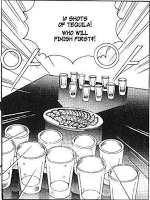
Ha-Da challenges Hae-Gi to a drinking contest with shots of tequila, which Hae-Gi accepts, for some reason. The only logic I can attribute to this decision is “high school”.

I used to read a lot of fanfiction, and participated in online play-by-post roleplays. Every so often, a writer will decide that their character needs to get drunk, either to show how edgy that character is, or give them a chance to make a fool out of themselves. Nine times out of ten, you can tell that the author’s never had a drink in her life. Characters get drunk after one drink, they puke immediately after getting drunk, they magically sober up when a bucket of cold water is dumped on them…

And, okay, some of those writers might have been me, thinking that I knew what heavy drinking was like from the occasional sip my mom let me have from her wine glass.

10 shots?! That’s enough to put me in a coma.

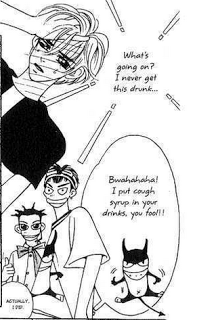
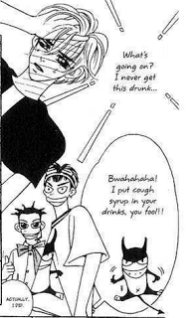
And I’m not saying that Choi Kyuang-ah has never had a drink, but that’s what this scene reminds me of. Not only because Ha-Da doesn’t get entirely blitzed after several shots of tequila (granted, he owns the club so it’s likely that he has a higher alcohol tolerance than Hae-Gi), but because Hae-Gi wasn’t feeling tipsy before the contest began. Which doesn’t seem like it makes sense, until it’s revealed that Ha-Da spiked all of Hae-Gi’s drinks before the contest actually began.

Wait.

That’s not okay.

Our heroes, ladies and gentlemen.

I’m not sure if I was okay with that when I read these books for the first time, but it definitely makes me uncomfortable now. If Hae-Gi was a girl, or Ha-Da was doing this to take sexual advantage of his rival, there’s no way Ha-Da would have gotten off scot-free. Ten shots of tequila are dangerous enough, especially when you only weigh 90 pounds like our pretty-boys here. Spiking Hae-Gi’s drinks beforehand could do some serious damage. You ever hear of alcohol poisoning?

Good, because I’m pretty sure Hae-Gi’s going to have it.

Fortunately, none of those terrible, terrible things that could easily happen after drinking all that happen to Hae-Gi, because he’s just too pretty to die. He just passes out for a bit, and then gets chatty. So-Na has the opportunity to search the unconscious Hae-Gi for her key, but opts not to. While normally I might complain about So-Na being stupid and missing her chance to get her key back, I’m actually okay with it. The poor guys taken enough abuse tonight, a girl who doesn’t like him going through his pockets would just be adding insult to injury.

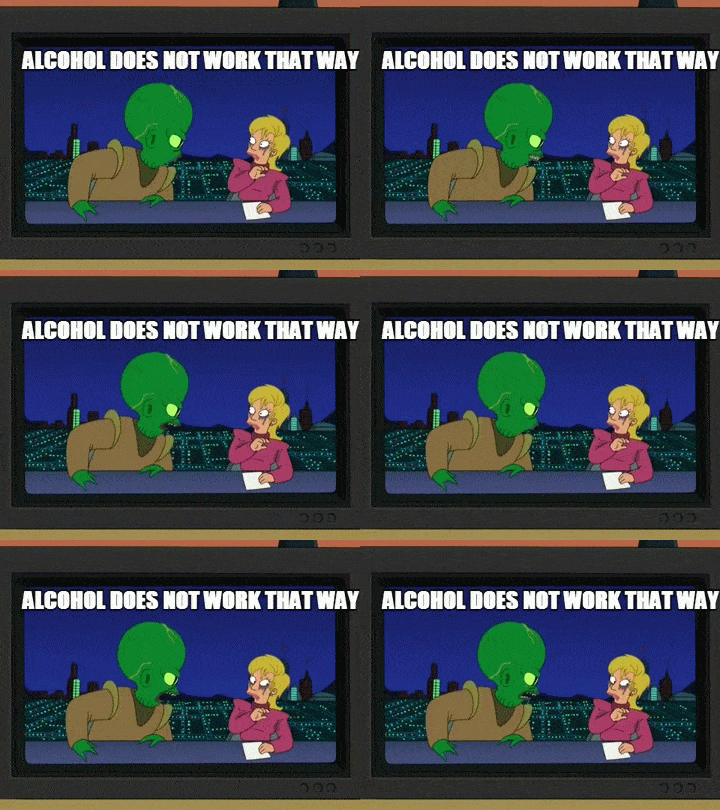
Though I will point out that So-Na’s nameless bodyguard, who’s taking Hae-Gi home, thinks that black coffee will help Hae-Gi sober up.

I didn’t want to have to do this again, but take it away, Morbo:

Drunk!Hae-Gi wakes up and starts talking about “touching the sky” for his brother. What he means by this is that he wants to become a pilot. I really like this, and not just because I’m a student pilot. In a lot of romance manga, the characters are singularly focused on one goal, and then their S.O. comes along and sweeps them off their feet. I wasn’t too crazy about the idea of Hae-Gi being a model, because leads being models/actresses/superstars is pretty common in romance manga. Dreaming of being a pilot is something different, so it stands out to me, and gives Hae-Gi more depth as a character.

If only I could start liking the other leads.